*Corresponding Author : Suk-Hyung Cho([email protected])
Received March 16, 2009 Revised April 15, 2009 Accepted April 22, 2009
Synthesis of P(PEGMA-co-PBMA) microgels by Precipitation Polymerization in Polymer Solution
Suk-Hyung Cho
1*and Yuong-Jun Kim
21Department of Medical Materials, Hyejeon College
2Department of Cosmetic Science, Chungwoon University
고분자 용액에서 침점중합에 의한 P(PEGMA-co-PBMA) 마이크로젤의 합성
조석형1*, 김영준2
1혜전대학 의료재료과, 2청운대학교 화장품과학과
Abstract Poly(ethyleneglycol methacrylate-co-benzyl methacrylate) (P(PEGMA-co-BMA)) microgel was prepared by precipitation copolymerization of PEGMA and benzyl methacrylate in poly(acrylic acid)/ethanol solution. The microgels with various sizes were obtained by changing the concentration of poly(acrylic acid), monomer and nature of solvents. The particle size of P(PEGMA-co-BMA) microgels was decreased with increasing the concentration of poly(acrylic acid) and increased with that of monomer. By increasing solubility parameter of solvents, the particle size was inecreased. The size of P(PEGMA-co-BMA) microgels was controlled by experimental conditions from 0.1 µm to 0.35 µm.
요 약 Poly(ethyleneglycol methacrylate-co-benzyl methacrylate) (P(PEGMA-co-BMA) 마이크로겔을 폴리아크릴산 용 액에서 PEGMA와 벤질 메타아크릴레이트를 침전중합법으로 합성하였다. 다양한 입자 크기를 갖는 마이크로겔은 폴 리아크릴산 및 모노머의 농도, 용매의 성질에 따라 합성하였다. P(PEGMA-co-BMA) 마이크로겔의 입자 크기는 폴리 아크릴산의 농도가 증가할수록 감소하였고 모노머의 농도가 증가할수록 증가하였다. 또한 용매의 용매 파라메타의 값이 증가할수록 입자의 크기는 증가하였다. 그리고 P(PEGMA-co-BMA) 마이크로겔의 크기는 실험 조건에 따라 0.1 µm에서 0.35 µm까지 조절할 수 있었다.
Key Words : microgel, precipitation polymerization, polymer solution
1. Introduction
The importance of utilizing microgels as high value added polymer materials using their characteristics of reactivity, macro surface area, viscosity, etc. has been recently increased. In other words, many researches have been conducted on development of performance of polymer latex in the film formation of model materials[1-3], coating, etc. as a study on physical properties of solutions such as molecular shape and
molecular weight[4], and on utilization as a carrier for paints or drugs using reactive microgel which introduced epoxy group, amide group, hydroxy group, or pendent vinyl on the particle surface[5,6].
For synthesis of microgel, emulsion polymerization, suspension polymerization, MR-type polymerization, etc.
are generally used[7-14]. In addition to these syntheses, preparation of polymer microgel by decomposition using high energy ultrasonic waves after synthesizing copolymer between monovinyl monomer, divinyl monomer and
microgel out of the copolymer is also used[15].
Polymer microgel has been used as a processing material for paints, adhesives, fibers, or papers because of the facts that it is relatively easy to prepare and functionalize, has wide surface area, is easy to quantify, and is easily reproduced due to its good dispersibility.
With recent progress of high functionalization, it has also been used in the fields of biochemistry, medicine, and pharmacy[16]. In particular, in the field of medicine, microgel is used for clinical tests detecting antigen-antibody reaction from reaction of surface agglutination between particles in the solution. M.
Yokoyama, et al. conducted research on prodrug of a new form containing enough amounts of drug as well as stability in the blood by producing poly (ethylene glycol)/poly (aspartic acid) block copolymer through separation of the part controlling appropriate physical and chemical characteristics and the part of medicinal bond of prodrug, combining it with an antitumor drug, adriamycin (ADR), and forming this into mono-disperse polymer micelle.[17,18] Also, Kim et al. conducted research on fine-particled prodrug containing many quantity of drug by synthesis of 5-FU combined monomer and precipitation polymerization, and examined anticancer activity about tumor-bearing mice.[19]
In this research, in order to prepare microgel that can be used for drug delivery system (DDS), methacrylic acid was combined with benzyl alcohol as model material and PEGMA and benzyl methacrylate was synthesized and precipitation polymerized in polyacrylic acid solution resulting in ultra-fine particled microgel. Additionally, the effects of concentration of polymer gel, concentration of monomer, nature of solvent, etc. on particle shape and size were examined.
2. Experiment
2.1 Samples and Reagents
Methacryloyl chloride (special reagent manufactured by TCI, Japan) and PEGMA and polyacrylic acid (PAA) (Aldrich Chemical Co., Mw: 450,000) were used as purchased, and distilled benzyl alcohol (manufactured by TCI, Japan) was used for a model material. Benzyl
methacrylate(BMA) was synthesized according to a previous method.19
Ethanol, methanol, propanol, and butanol used as solutions were dehydrated and dried using molecular sieve (4Å) before use, and used after low pressure distillation.
Benzoyl peroxide (PBO) (special reagent manufactured by TCI, Japan) used as starting reagent was used after recrystallization to ethanol. Acetone, diethyl ether, etc.
used as other solutions were used after refined by a general refinement method.
2.2 Preparation of P(PEGMA-co-BMA) microgels
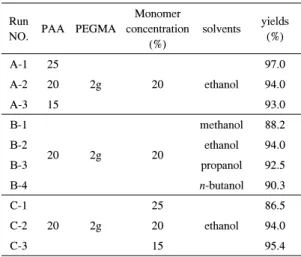
After BMA and PEGMA was dissolved in polyacrylic acid solution, P(PEGMA-co-BMA) microgel was prepared by precipitation polymerization based on the conditions of Table 1. After polyacrylic acid of fixed quantity with different concentrations was sufficiently swollen by ethanol at room temperature, PEGMA, BMA and BPO were combined at the ratio of weight to total weight based on the content and was left before reacted at 60ºC for 24 hours. To retrieve microgel produced, polyacrylic acid was centrifuged after dissolved by addition of excessive ethanol. P(PEGMA-co-BMA) microgel was obtained after the centrifuged supernatant liquid was subtracted, washed 5 times with ethanol, and dried at room temperature.
2.3 Electron microscopic Observation Microgels were dispersed evenly on the grid and vacuum metallized by gold to observe its particle size and shape through SEM (Hitachi S-2500C).
3. Results and Discussion
In order to obtain pure fine particles with a high yield, P(PEGMA-co-BMA) microgel was prepared by precipitation copolymerization of PEGMA and benzyl methacrylate as model material in polyacrylic acid solution resulting in preparation of ultra fine microgel.
Also, the effects of concentration of polymer solution, concentration of monomer, nature of solvents, concentration of crosslinking agent, etc. on particle shapes
: Monomer
: Polymer : Monomer Nucleation Microsphere
: Polymer : Monomer : Polymer
: Polymer Nucleation Microsphere
[Fig. 1] Mechanism for the formation of P(PEGMA-co-BMA) microgel by precipitation polymerization in poly(acrylic acid) solution
and sizes were examined.
Table 1 shows the synthesis conditions of P(PEGMA-co-BMA) microgels by precipitation polymerization in solutions of good solvent in monomer and poor solvent in polymer.
It is expected that preparation of polymer microgel by precipitation polymerization, as shown in Fig. 1 would restraint mutual flocculation between particles due to limitation of reaction space by steric inhibition of poly(acrylic acid) chain and thus produce ultra fine particled microgel.
[Table 1] Preparation of P(PEGMA-co- BMA) microgels in Poly(acrylic acid) Solution.
Run
NO. PAA PEGMA
Monomer concentration
(%)
solvents yields (%)
A-1 25
2g 20 ethanol
97.0
A-2 20 94.0
A-3 15 93.0
B-1
20 2g 20
methanol 88.2
B-2 ethanol 94.0
B-3 propanol 92.5
B-4 n-butanol 90.3
C-1
20 2g
25
ethanol 86.5
C-2 20 94.0
C-3 15 95.4
In other words, as shown in Fig. 1, PEGMA and BMA monomers form a nucleus by polymerization in poly(acrylic acid) solution and since the reaction space is restricted by poly(acrylic acid) chain, polymerized P(PEGMA-co-BMA) continue polymerization without
flocculation between particles forming microdomain eventually forming uniform microgel in small size.
Therefore, in synthesizing P(PEGMA-co-BMA) microgel, precipitation polymerization was conducted based on the change of concentration of poly(acrylic acid) solution and solubility parameter of solvents and the concentration ratio of poly(acrylic acid) and monomer.
The shapes of synthesized P(PEGMA-co-BMA) microgel were identified as particle shapes and the distribution of particles show polydispersability in the range of 0.3~0.5µm.
Precipitation polymerization is a method of preparing polymer that has homogeneous system before polymerization and heterogeneous system after polymerization by polymerizing in the system which is good solvent in monomer and poor solvent in polymer.
Therefore, this experiment used solvent which dissolves monomer of PEGMA and BMA but does not dissolve P(PEGMA-co-BMA).
In order to examine the effects of nature of solvents, P(PEGMA-co-BMA) microgel was synthesized with different solubility parameter values. As shown in Fig. 2 as solubility parameter values increase, particle size and distribution of sizes tend to increase, which is believed to be because as solubility parameters increase, polyacrylic acid is well swollen providing a relatively large space for PEGMA/BMA monomers to polymerize. The round shaped microgel with particle size of 0.1~0.6µm based on the reaction conditions showed a high yield of 88.2~94.0wt%.
[Fig. 3] Scanning electron micrographs of P(PEGMA-co-BMA) microgels prepared in various solvent with different weight percent of monomers. (A : 15%, B : 20%, C : 30%)
A B C
A
A BB CC
[Fig. 4] Scanning electron micrographs of P(PEGMA-co-BMA) microgels prepared in the concentration of poly(acrylic acid) solution(wt%) (A : 15%, B : 20%, C : 30%)
[Fig. 2] Scanning electron micrographs of P(PEGMA-co-BMA) microgels prepared in various solvent with different solubility parameter. (A : methanol, B : ethanol C : propanol, D : n-butanol)
Also, as shown in Fig. 3 when the weight percent of monomer were changed to 15 ~ 25wt% respectively, the particle size of microgel tended to increase within the range of 0.2~0.6µm as the weight percent of monomers increased. This is believed to be because as concentration of monomer increases, the size of microgel increases by
increasing concentration of monomers and the nucleus is produced during polymerization.
As shown in Fig. 4 as the concentration of polyacrylic acid solution is changed to 15~25wt%, the polymerization is resulted that the particle size of microgel decreases by increasing the concentration of polyacrylic acid. This is
believed that as the concentration of polyacrylic acid solution increases, steric inhibition of polymer chain is increased and it restricts the space for P(PEGMA-co-BMA) to polymerize.
4. Conclusion
The followings are the results of preparing ultra-fine particled microgel by precipitation polymerization of PEGMA and BMA in polyacrylic acid solution and examining the particle sizes and distribution based on concentrations of polymer solution, monomer and nature of solvents.
1. The microgel was prepared by changing solubility parameters of solvents. As the result, the particle sizes and distribution increased as solubility parameters decreased.
2. When polymerization was conducted at different ratios of polymer solution and monomer, the particle sizes and distribution increased as concentration of monomer increased.
3. The particle sizes of microgel with different concentration of polyacrylic acid solution were examined. The particle sizes decreased from 1µm to 0.2µm as concentration of polyacrylic acid increased.
Reference
[1] M. Hoffman, Makromol chem., 175, 613, 1974.
[2] K. Furusawa, Y. Kimmura and T. Tagawa, J. Colloid Interface Sci., 109, 69, 1986.
[3] J. Forget and C. Booth, J. Polym. Sci., Polym. Phys.
Ed., 17, 1403, 1979.
[4] J. Gram, J. Coating Technol., 51, 34, 1979.
[5] P. K. Guta, H. Johnson, and C. Allexon, J.
Controlled. Rel., 26, 229, 1993.
[6] C. M. Klech and X. Li, J. Pharm. Sci., 79, 999, 1990.
[7] C. Graillat, C. Pichot, A. Guyot and M. S.
El-Aasser, J. Polym. Sci., Chem. Ed., 24, 427, 1986.
[8] C. S. Cherm and G. W. Poehlein, J. Polym. Sci., Chem. Ed., 25, 617, 1987.
[9] M. Chainey, J. Hearn and M. C. Wilkinson, J.
Polym. Sci., Chem. Ed., 25, 505, 1987.
[10] C. M. Tseng, Y. Y. Lu, M. S. El-Aasser and J. W.
Vanderhoff, J. Polym. Sci., Chem. Ed., 24, 2995, 1986.
[11] J. W. Goodwin, L. Antl, R. D. Hill and R. H.
Ottewill, Colloids and Surface, 17, 67, 1986.
[12] O. Okey, J. Appl. Polym. Sci., 34, 307, 1987.
[13] C. K. Ober and M. L. Hair, J. Polym. Sci., Chem.
Ed., 25, 1395, 1987.
[14] S. K. Saha and A. K. Chaudhuri, J. Polym. Sci., Chem. Ed., 25, 519, 1987.
[15] Y. J. Kim, M. W. Park, K. S. Kim, and K. M,.
Kum., Polymer(Korea), 18(1), 14, 1994.
[16] L. Di Silvio, et al., Biomaterials, 15, 921, 1994.
[17] M, Yokoyama et al., J. Controlled Release, 11, 269, 1989.
[18] M, Yokoyama et al., Cancer Res., 50, 1695, 1990.
[19] S. H. Cho, Y. J. Kim, K. S. Kim, and T. K. Kim, Polymer(Korea), 23(4), 487, 1999.
Young-Jun Kim
[Regular member]• Aug. 1992 : Chungbuk University, Doctor of Engineering
• Mar. 1982 ~ Feb. 1993 : Professor of Hyejeon collige
• Mar. 1993 ~ current : Professor of Chungwoon University
<Research Interets>
Functional Polymer
Suk-Hyung Cho
[Regular member]• Aug. 1994 : Chungbuk University, Doctor of Engineering
• Aug. 1995 ~ current : Professor of Hyejeon collige
<Research Interests>
Functional Polymer