• 검색 결과가 없습니다.

Relationship between the Occurrence of Thromboembolism and INR Measurement Interval in Low Intensity Anticoagulation after Aortic Mechanical Valve Replacement

N/A
N/A
Protected

Academic year: 2021

Share "Relationship between the Occurrence of Thromboembolism and INR Measurement Interval in Low Intensity Anticoagulation after Aortic Mechanical Valve Replacement"

Copied!
5
0
0

로드 중.... (전체 텍스트 보기)

전체 글

(1)

DOI:10.5090/kjtcs.2011.44.3.220 ISSN: 2233-601X (Print) ISSN: 2093-6516 (Online)

*Department of Thoracic and Cardiovascular Surgery, College of Medicine and Institute of Health Sciences, Gyeongsang National University

†This paper was presented at the 19th Biennial Congress of the Association of Thoracic and Cardiovascular Surgeons of Asia in October 2009.

Received: September 28, 2010, Revised: January 8, 2011, Accepted: May 18, 2011

Corresponding author: Jun Young Choi, Department of Thoracic and Cardiovascular Surgery, College of Medicine and Institute of Health Sciences, Gyeongsang National University, 90, Chilam-dong, Jinju 660-702, Korea

(Tel) 82-55-750-8121 (Fax) 82-55-753-8138 (E-mail) [email protected]

C

The Korean Society for Thoracic and Cardiovascular Surgery. 2011. All right reserved.

CC
This is an open access article distributed under the terms of the Creative Commons Attribution Non-Commercial License (http://creative- commons.org/licenses/by-nc/3.0) which permits unrestricted non-commercial use, distribution, and reproduction in any medium, provided the original work is properly cited.

Relationship between the Occurrence of Thromboembolism and INR Measurement Interval in Low Intensity Anticoagulation

after Aortic Mechanical Valve Replacement

Sangho Rhie, M.D.*, Jun Young Choi, M.D.*, In Seok Jang, M.D.*, Jong Woo Kim, M.D.*, Chung Eun Lee, M.D.*, Hyun Oh Park, M.D.*

Background: We investigated changes in the International Normalized Ratio (INR) and its measurement interval in patients with thromboembolic events who were treated by low intensity anticoagulation therapy after isolated me- chanical aortic valve replacement. Materials and Methods: Seventy-seven patients who underwent surgery from June 1990 to September 2006 were enrolled in the study and observed until August 2008. The patients were fol- lowed up at 4∼8 week intervals and their warfarin (Coumadin)

dosage was adjusted aiming for a target range of INR 1.5∼2.5. The rate of thromboembolic events was obtained. Changes in the mean INR and INR measure- ment interval were comparatively analyzed between the normal group (event free group, N=52) who had no anti- coagulation-related complications and the thromboembolic group (N=10). Hospital records were reviewed retrospec- tively. Results: The observation period was 666.75 patient-years. Thromboembolic events occurred in 10 patients.

The linearized occurrence rate of thromboembolism was 1.50%/patient-years. Actuarial thromboembolism-free rates were 97.10±2.02% at 5 years, 84.30±5.22% at 10 years, and 67.44±12.14% at 15 years. The percentages of INR within the target range and mean INR were not statistically significantly different for the normal and thromboembolic groups. However, the mean INR during the segmented period just before the events showed a significantly lower level in the thromboembolic group (during a 4 month period: normal group, 1.86±0.14 vs. thromboembolic group, 1.50±0.28, p<0.001). The mean intervals of INR measurement during the whole observation period showed no significant differences between groups, but in the segmented period just before the events, the interval was sig- nificantly longer in thromboembolic group (during a 6 month period: normal group, 49.04±9.47 days vs. thromboem- bolic group, 65.89±44.88 days, p<0.01). Conclusion: To prevent the occurrence of thromboembolic events in pa- tients who receive isolated aortic valve replacement and low intensity anticoagulation therapy, we suggest that it would be safe to maintain an INR level above 1.8 and to measure the INR at least every 7∼8 weeks.

Key words: 1. Mechanical heart valve 2. Thromboembolism 3. Anticoagulation

4. INR measurement interval

(2)

INTRODUCTION

Although experience of anticoagulation treatment after me- chanical prosthetic valve replacement has accumulated, the proper level of anticoagulation remains controversial.

Over-dosage of Coumadin, which is an oral anticoagulant, can result in bleeding and under-dosage can bring on the complication of a thromboembolic event, so it is very im- portant for patients and doctors to try to maintain an ad- equate INR level (International Normalized Ratio), which is a value used for making dosage decisions. Determining an ad- equate anticoagulation level and maintaining the compliance of patients are important. A higher INR could reduce the ten- dency toward thromboembolic events but increase the ten- dency toward bleeding, so it is better to maintain the INR as low as possible, while staying within the range that lowers thromboembolic events.

The American College of Chest Physicians (ACCP) have suggested a standard level of INR to be 2.5 (2.0 to 3.0) for patients who have bi-leaflet mechanical prosthetic valves in normal sinus rhythm [1]. However, there have been a number of studies about the adequate level of INR, and also trials to determine the proper anticoagulation treatment (level of anti- coagulation) [2-5]. There are ethnic differences in response to anticoagulation therapy, so a lower INR has been suggested for Asian than for Westerners [6-9]. The authors have also reported an adequacy of INR ranging from 1.5 to 2.5 [10]. In order to prevent thromboembolic events, the good compliance of patients is essential [4]. In this study, the patients lived near the hospital, so we checked the patient’s INR at inter- vals of 4 to 8 weeks. We reviewed the relationship between thromboembolic events and the mean INR and INR measure- ment interval in patients who had undergone mechanical pros- thetic aortic valve replacements and maintained the level of INR from 1.5 to 2.5.

MATERIALS AND METHODS

We reviewed patient records up to August 2008 and ob- tained the rate of thromboembolic events of the 77 patients who had undergone surgeries from June 1990 until September 2006. We analyzed the mean INR and the INR measurement

interval between the normal group (N=52) which had no complications related to oral anticoagulation treatment and the group (N=10) with thromboembolic events.

We measured the INR whenever patients visited the hospi- tal with at intervals of 4 to 8 weeks. When the INR was out of the range of the target or varied widely, we shortened the INR measurement interval.

We titrated the dosage of oral warfarin sodium (Coumadin

) according to the INR, and did not use antiplatelet agents. We reviewed the medical records retrospectively.

We regarded a thromboembolic event as an end point. We judged symptoms and signs as a thromboembolic event if they were consistent with the ischemia or infarction of a ma- jor organ even without a definite diagnosis of thromboem- bolism. We analyzed the thromboembolism incidence and its long-term results. Furthermore, we compared and analyzed the mean INR and the INR measurement interval between the normal group (N=52) without complications related to anti- coagulation therapy and the thromboembolism event group (N=10).

We calculated the mean INR during the four months just before the thromboembolic events in order to determine the changes in the INR right before thromboembolic complica- tions. The reason we calculated the mean INR over the course of four months was to obtain the results of INR at least twice during that period. We calculated the mean INR measurement interval during the six months right before the thromboembolic events so as to determine the relationship of the complication and the INR measurement interval. We cal- culated the INR measurement interval during the six months in order to obtain the INR measurement interval at least twice.

We present the cumulative variables as mean and standard deviation, and the linearized occurrence rate as %/pa- tient-year. We used Kaplan-Meier analysis for the long-term results of thromboembolism and distinguished the differences between the groups with the Student’s t-test. We regarded the value of p<0.05 as significant.

RESULTS

The median age at surgery was 53 years old (16 to 72).

(3)

Fig. 1. Actuarial freedom rate from thromboembolism.

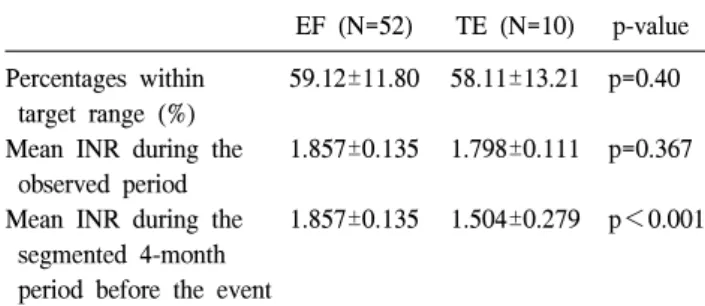
Table 1. Comparison of percentages within target range (INR 1.5∼2.5)

EF (N=52) TE (N=10) p-value Percentages within

target range (%) Mean INR during the observed period Mean INR during the segmented 4-month period before the event

59.12±11.80

1.857±0.135

1.857±0.135

58.11±13.21

1.798±0.111

1.504±0.279 p=0.40

p=0.367

p<0.001

N=Number of patients; INR=International normalized ratio;

EF=Event free (normal) group; TE=Thromboembolic group.

Table 2. Comparison of the interval of INR measurement be- tween groups

EF (N=52) TE (N=10) p-value Mean interval during

the observed period (day)

Interval during the segmented 6-month period before the event (day)

49.04±9.48

49.04±9.47

45.12±14.30

65.89±44.88 p=0.14

p<0.01

N=Number of patients; INR=International normalized ratio;

EF=Event free (normal) group; TE=Thromboembolic group.

We applied various valves to the patients according to re- gional characteristics. The valves were of 6 types: St. Jude, Carbomedics, ATS, SORIN, ON-X, and ATS-AP. We did not perform an analysis according to valve type because of the small sample size.

During the follow-up period of 666.75 pt-yr, there were 10 cases of thromboembolism, which means a 1.50%/pt-yr line- arized occurrence rate. According to Kaplan-Meier analysis, the actuarial freedom rates from thromboembolism were 97.10±2.02% at 5 years, 84.30±5.22% at 10 years, and 67.44±12.14% at 15 years (Fig. 1).

We compared the rate of target maintenance between the thromboembolism event group (N=10) and the normal group (N=52) without complications related to anticoagulation. The INR of all patients varied within the range of 0.9 to 11.97.

We targeted an INR range from 1.5 to 2.5. There was no significant difference in the mean maintenance rate between

the normal group (N=52) and the thromboembolic event group (N=10), which was 59.12±11.80%, 58.11±13.21% in each group, respectively (p=0.40) (Table 1).

The mean INR was 1.86±0.14 in the normal group and 1.80±0.11 in the event group, and the difference between these two was not significant (p=0.367) (Table 1). However, we analyzed the INR during the 4 months right before each event, and the mean INR of the normal group was 1.86±0.14 and that of the event group was 1.50±0.28. That means the event group had a significantly lower INR value (p≤0.001) (Table 1). The normal group did not have any complications, so we analyzed the value of the normal group for the whole period.

The INR measurement interval over the whole study period was 49.04±9.48 days in the normal group and 45.1±14.3 days in the event group. Therefore, there was no significant difference between the two groups (p=0.14) (Table 2). How- ever, when we observed the INR measurement interval during the 6 months right before events, the mean interval of the event group was 65.89±44.88 days. That was significantly longer than the mean interval of the normal group, which was 49.04±9.48 days (p<0.01) (Table 2).

DISCUSSION

INR, which is a standardized measurement of anti-

coagulation, has been used widely since the recommendation

by the WHO [11]. In addition, in order to prevent the pa-

tients who have mechanical valves from experiencing throm-

boembolism, the need for adequate warfarin anticoagulation

(4)

has been addressed [12]. For this, it is essential to maintain the proper INR. The present study’s results on the linearized occurrence rate of thromboembolism and actuarial event-free rates in the patients who maintained a low INR is similar to those of other reports [13-17].

There have been ongoing trials which use a low INR in the range of the lowest thromboembolism rate whenever possible. Furthermore, there have been reports that showed lower thromboembolic and bleeding rates with an INR be- tween 2.0 and 3.0 [2,3]. Although the ACCP suggests 2.5 (2.0∼3.0) as a target INR when the left atrium is not en- larged [1], the dosage of warfarin needed varies among ethnic groups. To maintain the same INR target, Asians require low- er dosages of warfarin than other ethnic groups [6-9]. You et al. [8] reported ethnic differences in bleeding and throm- boembolic rates in a study of Chinese patients in Hong Kong who had maintained an INR level from 1.8 to 2.4 and showed low rate of bleeding and thromboembolic compli- cations. The optimum low intensity anticoagulation therapy has been reported in Korea. Jeong et al. [5] reported that there was no statistically significant differences in throm- boembolism occurrence in the groups with an INR of 1.5 to 2.0, 2.0 to 2.5, and 2.5 to 3.0, and the bleeding rate was higher in the group with high intensity anticoagulation therapy. Kim and Kim [4] suggested that a lower INR from 1.5 to 2.5 would be optimal for patients who have mechan- ical prosthetic aortic valves. The authors have reported an op- timal level from 1.5 to 2.5 in a previous study [10]. In the present study, the target INR was set at 1.5 to 2.5 for the pa- tients who had undergone isolated mechanical aortic valve replacement. We used various types of valves, but we did not believe that the analysis of individual valves would be mean- ingful [18]. There were no differences in the rate of target INR maintenance or in the mean INR between the groups re- gardless of valve type. We assessed the INR during the four months before complications occurred, and this value was significantly different between the two groups. The INR of the event group was 1.50 and was significantly lower than that of the normal group, which was 1.86. This means that a certain period of very low INR, rather than the usual main- tenance of the mean INR level, can bring on thromboembolic events.

We analyzed the differences in INR measurement interval between the normal and the thromboembolic event groups.

We reviewed the 6 months just before the complications be- cause there were no differences in the INR measurement in- terval of the two groups over the whole observational period.

The INR measurement interval of the normal group was 49 days and that of the event group was 66 days. The event group showed lower patient compliance with taking anticoagulants.

To maintain INR in the target range for the patients who take warfarin, regular examinations are essential. Lidstone et al. [19] claimed that in some selected patients, they could elongate the INR measurement interval to 14 weeks or more safely; however, we believe this elongated interval is not op- timal because the INR measurement interval just before the complications was 66 days and longer than that of the normal group. In addition, the INR level was lower, despite the fact that exams were performed every 4 to 8 weeks in this study.

We conclude that a long INR measurement interval is poor for maintaining the target INR and a main cause of complications. We often observe a fluctuation in the INR even in the patients who have frequent INR measurements, so a long INR measurement interval is not optimal. However, when it comes to the INR measurement interval, further anal- ysis and studies about the factors which can lower the INR are needed. Just as Kim et al. [4] emphasized the importance of patient compliance, it is suggested that clinicians regularly educate patients about the importance of taking warfarin daily.

Torella et al. [18] suggested that in the bi-leaflet mechan- ical aortic valve group, it would be safe to maintain a low intensity INR level from 1.5 to 2.5. Their mean INR was 1.94. According to the INR results from this study, because of the higher risk of thromboembolism, the target INR should be over 1.8 despite an application of low intensity anti- coagulation therapy.

CONCLUSION

We suggest that to maintain an INR level over 1.8 and

INR measurement interval of 7 to 8 weeks would be safe for

preventing thromboembolic events when a low level of anti-

(5)

coagulation treatment is applied after isolated mechanical aortic valve replacement.

REFERENCES

1. Hirsh J, Guyatt G, Albers GW, Harrington R, Schünemann HJ, American College of Chest Physician. Antithrombotic and thrombolytic therapy: American College of Chest Physi- cians Evidence-Based Clinical Practice Guidelines (8th Edi- tion). Chest 2008;133(6 Suppl):110S-2S.

2. Butchart EG, Lewis PA, Grunkemeier GL, Kulatilake N, Breckenridge IM. Low risk of thrombosis and serious em- bolic events despite low-intensity anticoagulation. Experience with 1,004 Medtronic Hall valves. Circulation 1988;78(3 Pt 2):I66-77.

3. Horstkotte D, Schulte HD, Bircks W, Strauer BE. Lower in- tensity anticoagulation therapy results in lower complication rates with the St. Jude Medical prosthesis. J Thorac Cardiovasc Surg 1994;107:1136-45.

4. Kim CW, Kim YT. Anticoagulation Management after Mitral Valve Replacement with the St. Jude Medical Pros- thesis. Korean J Thorac Cardiovasc Surg 1998;31:1172-82.

5. Jeong SC, Kim MJ, Song CM, Kim WS, Shin YC, Kim BY. Low-intensity oral anticoagulation versus high-intensity oral anticoagulation in patients with mechanical bileaflet prosthetic heart valves. Korean J Thorac Cardiovasc Surg 2008;41:430-8.

6. Yu HC, Chan TY, Critchley JA, Woo KS. Factors determin- ing the maintenance dose of warfarin in Chinese patients.

QJM 1996;89:127-35.

7. Gan GG, Teh A, Goh KY, Chong HT, Pang KW. Racial background is a determinant factor in the maintenance dos- age of warfarin. Int J Hematol 2003;78:84-6.

8. You JH, Chan FW, Wong RS, Cheng G. Is INR between 2.0 and 3.0 the optimal level for Chinese patients on warfarin therapy for moderate-intensity anticoagulation? Br J Clin Pharmacol 2005;59:582-7.

9. Dang MT, Hambleton J, Kayser SR. The influence of eth-

nicity on warfarin dosage requirement. Ann Pharmacother 2005;39:1008-12. [Epub 2005 Apr 26]

10. Kim JW, Rhie SH, Kim YC, Yang JH, Jang IS, Choi, JY.

Acceptability of low intensity anticoagulation therapy after mechanical heart valve replacement. Korean J Thorac Cardiovasc Surg 2009;42:193-200.

11. Anonymous (1983). "33: Expert Committee on Biological Standardization. Requirements for thromboplastins and plas- ma used to control oral anticoagulant therapy". World Health Organ Tech Rep Ser. pp. 81-105.

12. Edmunds LH Jr. Thrombotic and bleeding complications of prosthetic heart valves. Ann Thorac Surg 1987;44:430-45.

13. Ikonomidis JS, Kratz JM, Crumbley AJ 3rd, et al.

Twenty-year experience with the St Jude Medical mechanical valve prosthesis. J Thorac Cardiovasc Surg 2003;126:2022- 31.

14. Aagaard J, Tingleff J. Fifteen years' clinical experience with the CarboMedics prosthetic heart valve. J Heart Valve Dis 2005;14:82-8.

15. Emery RW, Krogh CC, Arom KV, et al. The St. Jude Medical cardiac valve prosthesis: a 25-year experience with single valve replacement. Ann Thorac Surg 2005;79:776-82.

discussion 782-3.

16. Tominaga R, Kurisu K, Ochiai Y, et al. A 10-year experi- ence with the Carbomedics cardiac prosthesis. Ann Thorac Surg 2005;79:784-9.

17. Spiliopoulos K, Haschemi A, Parasiris P, Kemkes BM. Sorin BicarbonTM bileaflet valve: a 9.8-year experience. Clinical performance of the prosthesis after heart valve replacement in 587 patients. Interact Cardiovasc Thorac Surg 2009;8:

252-9.

18. Torella M, Torella D, Chiodini P, et al. LOWERing the INtensity of oral anticoaGulant Therapy in patients with bi- leaflet mechanical aortic valve replacement: results from the

"LOWERING-IT" Trial. Am Heart J 2010;160:171-8.

19. Lidstone V, Janes S, Stross P. INR: Intervals of measure-

ment can safely extend to 14 weeks. Clin Lab Haematol

2000;22:291-3.

수치

Table 2. Comparison of the interval of INR measurement be- be-tween groups

참조

관련 문서

 The Dutch physicist Pieter Zeeman showed the spectral lines emitted by atoms in a magnetic field split into multiple energy levels...  With no magnetic field to align them,

Modern Physics for Scientists and Engineers International Edition,

Secondly, M&A of non-chaebol and chaebol showed low improvement in profitability, output growth and productivity during the period before the

Five days later, on 15 January 1975, the Portuguese government signed an agreement with the MPLA, FNLA and UNITA providing for Angola to receive its independence on 11

Inclusion and Inclusiveness: Shared Vision of Youth for Local, National, and Global Village Inclusion at large stands for embracing populations with disabilities and

웹 표준을 지원하는 플랫폼에서 큰 수정없이 실행 가능함 패키징을 통해 다양한 기기를 위한 앱을 작성할 수 있음 네이티브 앱과

_____ culture appears to be attractive (도시의) to the

The index is calculated with the latest 5-year auction data of 400 selected Classic, Modern, and Contemporary Chinese painting artists from major auction houses..