| Abstract |
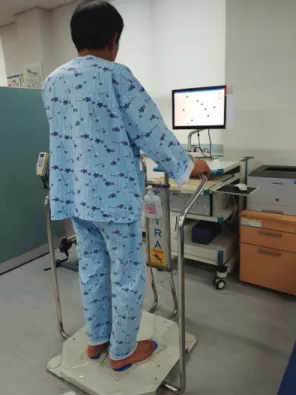
1)PURPOSE: This study is to investigate the therapeutic effect of Tetrax on balance dysfunction caused by ataxia in cerebellar stroke.
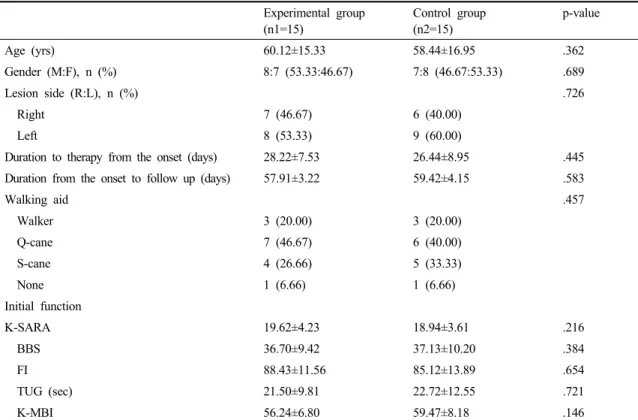
METHODS: A total of thirty subjects with cerebellar stroke were recruited. The participants was divided into two groups, the experimental (n=15) and the control group (n=15). Tetrax training and conventional physical therapy (CPT) were performed in experimental group, whereas the patients in the control group were treated with CPT twice a day. Each session of the Tetrax and CPT was carried out for 30 minutes, 5 times per week for 4 weeks. Korean version of the Scale for the Assessment and Rating of Ataxia (K-SARA) was the primary outcome measure, and the secondary outcomes covered Berg balance scale (BBS),
†Corresponding Author : [email protected]
This is an Open Access article distributed under the terms of the Creative Commons Attribution Non-Commercial License (http://creativecommons.org/licenses/by-nc/3.0) which permits unrestricted non-commercial use, distribution, and reproduction in any medium, provided the original work is properly cited.
falling index (FI), Timed up and go (TUG), and modified Barthel index of Korean version (K-MBI). All outcome measures were evaluated before and after 4 weeks.
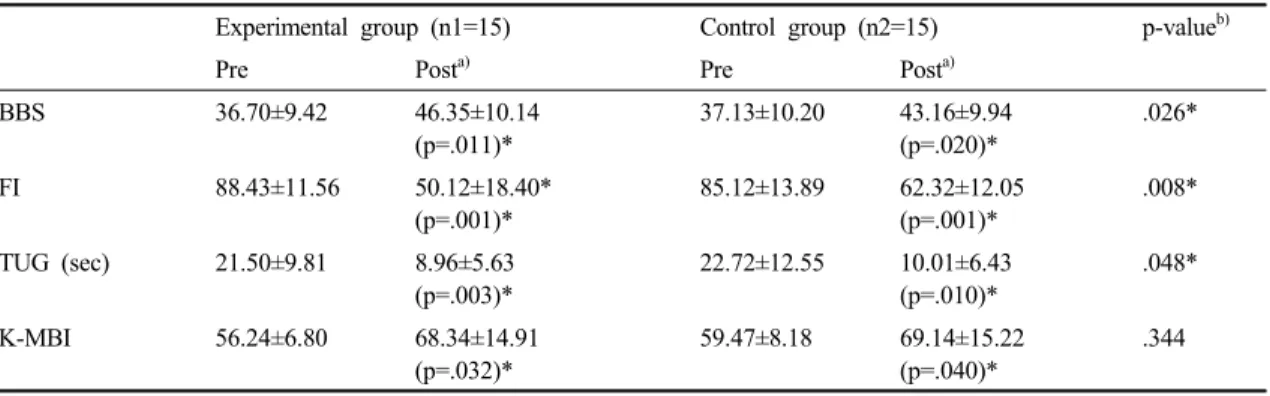
RESULTS: K-SARA was decreased significantly after 4 weeks intervention in both the experimental (p<.05) and the control group (p<.05). Furthermore, the experimental group produced significantly better outcomes in K-SARA, BBS, FI, and TUG compared with the control group (p=.012, p=.027, p=.008, and p=.048). There were significant correlations between K-SARA and BBS, FI, TUG, and K-MBI (p<.001, p<.001, p=.004, and p<.001).
CONCLUSION: The restoration of ataxia was related with the improvement of the balance, falling risk, mobility, and activity of daily living. Tetrax training was effectively aided recovery of ataxia after cerebellar stroke.
Key Words: Ataxia, Cerebellum, Postural balance, Stroke, Tetrax
Research Article Open Access
소뇌 뇌졸중 환자에서 실조로 인한 균형장애에 대한 시각적 피드백 훈련 기반 테트락스의 치료적 효과: 후향적 연구