Research Article Open Access
Effects of Balance Training on Different Support Surface on Balance and Gait in Patients with Chronic Stroke
Hae-na Kong, PT, BSc⋅Dae-hyouk Bang, PT, MSc1⋅Won-seob Shin, PT, PhD2†
Department of Physical Therapy, Graduate School of Health and Medical, Daejeon University
1Department of Physical Therapy, Graduate School of Daejeon University
2Department of Physical Therapy, Collage of Health and Medical Science, Daejeon University
Received: July 10, 2015 / Revised: July 15, 2015 / Accepted: August 6, 2015
ⓒ 2015 J Korean Soc Phys Med
| Abstract |1)
PURPOSE: The purpose of this study was to investigate the effect of balance training on different support surface (affected and non-affected sides) on the balance and gait function of chronic stroke patients.
METHODS: The patients were randomly assigned to 1 of 4 groups. Group 1 received balance training on the stable surface, group 2 received balance training on the unstable surface, group 3 received balance training on different support surface (affected side: stable surface, non-affected side: unstable surface), and group 4 received balance training on different support surface (affected side: unstable, non-affected side: stable). Twelve sessions (30 min/d, 3 times/wk for 4 wk) were applied. There were assessed before and after the intervention with Balancia, functional reach test (FRT), lateral reach test (LRT), timed up-and-go (TUG), and 10-meter walking test (10MWT).
RESULTS: After the training, all of the groups improved
†Corresponding Author: [email protected]
This is an Open Access article distributed under the terms of the Creative Commons Attribution Non-Commercial License (http://creativecommons.org/licenses/by-nc/3.0) which permits unrestricted non-commercial use, distribution, and reproduction in any medium, provided the original work is properly cited.
significantly than before training in Balancia, FRT, LRT, TUG, and 10MWT. There were significantly variable in sway distance, FRT, LRT, TUG, and 10MWT among the 4 groups.
Post hoc analysis revealed that the group 3 had significantly higher results than other 3 groups in sway distance, and FRT, LRT, TUG, and 10MWT.
CONCLUSION: Balance training on different support surface (affected side: stable surface, non-affected side:
unstable surface) could facilitate a stronger beneficial effect on balance and walking ability than other balance trainings on different support surface in patients with stroke.
Key Words: Stroke, Unstable surface, Support surface, Balance, Sensorimotor training
Ⅰ. Introduction
Stroke is a disease that impairs sensory and motor functions by causing irreversible damage to the brain due to cerebral vascular problems (Warlow et al, 2003). Thus, neurological deficits such as selective muscle activation, equilibrium reaction, balance control for postural maintenance, and movement control appear complex (Lundy-Ekman, 2013). Balance is continuously maintained by adjusting
central nervous system (Pollock et al, 2000). However, in stroke patients, these systems are affected depending on the location of the stroke lesion (Warlow et al, 2003), these results of have been demonstrated to decrease of balance control ability, limitation of ability to perform activities of daily living (ADL), loss of range of motion, imbalance of standing posture, and excessive weight bearing to the non-affected side (Dickstein et al, 1984;
Lundy-Ekman, 2013; Sackley, 1990; Shumway-Cook &
Woollacott, 2007).
Balance ability is an important factor for independent life and a requirement in other abilities to live a safe life (Pollock et al, 2000). For improving balance ability, symmetrical weight bearing ability is an essential factor (Bang et al, 2014). Symmetrical weight bearing is necessary for performing daily and various functional activities such as sitting, standing up, walking, and climbing stairs (Cameron et al, 2003). However, stroke patients supported 80% of the total weight bearing to the non-affected side while performing ADL (Bayouk et al, 2006). This problem could reduce weight bearing in the stance phase during walking, performance daily tasks, and walking ability by changing the alignment and decreasing postural control ability (Green et al, 2002; Kawanabe et al, 2007). In addition, asymmetrical weight bearing increases psychological anxiety and restricted ADL and gait ability. These problems may cause stroke patients to depend on others in their ADL and increase their risk of falling (Nyberg and Gustafson, 1995). Therefore, symmetrical weight distribution should be maintained so that patients can improve their performance in ADL and resolve other problems (Cheng et al, 2004).
Researchers have demonstrated that symmetric weight bearing training improved patients’ performance in ADL by using, for example, auditory feedback, task orientation
ankle and knee joint stability, lower extremity strength, muscle activation, proprioception, and balance control (Borreani et al, 2014; Carter et al, 2006; Verhagen et al, 2005). In addition, UST has been reported to be more effective than other methods for reducing postural sway while maintaining the standing position (Bayouk et al, 2006) and to increase the symmetry of weight distribution in stroke patients (Bang et al, 2014).
To our knowledge, no study has yet evaluated the effect of balance training on different support surface (affected and non-affected side). This different support surface method could represent a viable new training option for the lower limb. The aim of this study was to investigate the effect of balance training on balance and walking ability on different support surface in patients with chronic stroke.
Ⅱ. Methods
1. Participants
The subjects were 36 stroke patients admitted in the Department of Rehabilitation at B Hospital in Daejeon city.
Patients who were admitted or transferred to our department because of unilateral hemiparesis caused by stroke were evaluated. The inclusion criteria were as follows: (1) history and clinical presentation (hemiparesis) of stroke (first hemorrhage or infarction) of more than 6 months after the stroke event; (3) ability to remain standing for 30 seconds without any assistive tool; (4) no training in any interventions from other institutions; and (5) sufficient cognition to participate in the training, that is, a Mini-Mental State Examination (MMSE) score of 24 or higher. The exclusion criteria were (1) any comorbidity or disability other than stroke that precluded training and (2) any uncontrolled health conditions for which training
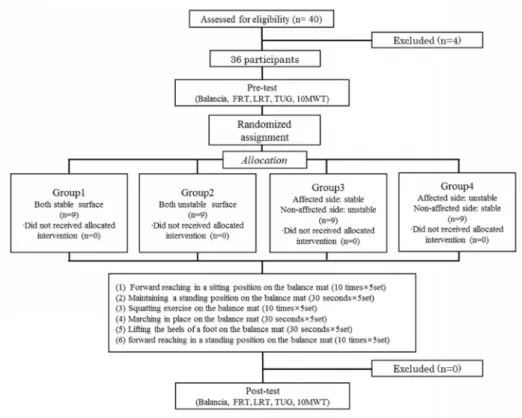
Fig. 1. Flow chart
Abbreviations: FRT, functional reach test; LRT, lateral reach test; TUG, timed up and go test; 10MWT, 10 meter walk test.
is contradicted. The study subjects voluntarily participated in the study after fully understanding the contents of this study. After explaining the study purpose and the experimental methods and processes, we obtained written informed consent from all of the patients. This study was approved by the Daejeon University institutional review board.
2. Experimental Design
This study was a double-blind, randomized controlled trial in which the therapist was blinded to the treatment.
The assessor was experienced and qualified for using measurement tools. The participants performed the tests after gaining sufficient familiarity with the measurement protocols shown in Fig. 1.
A 4-week training study was designed to evaluate the effect of different support surface types during balance
training on balance and walking ability. All of the enrolled patents were randomly assigned to 1 of 4 groups by using a table of random numbers. Group 1 received balance training on the stable surface, group 2 received balance training on the unstable surface, group 3 received balance training on different support surface (affected side: stable surface, non-affected side: unstable surface), and group 4 received balance training on different support surface (affected side: unstable, non-affected side: stable).
3. Training interventions
Each training protocol was applied in 12 sessions (30 min/d and 3 times/wk for 4 wk). For the duration of the study, all of the subjects received conventional rehabilitation, including physical, and occupational therapies, of the same intensity and time. Therapists were blinded to the study design.
Hampshire, USA) for balance training in clinical practice.
The balance training program consisted of the following:
(1) forward reaching in a sitting position on the balance mat (10 times), (2) maintaining a standing position on a balance mat (30 s), (3) squatting exercise on the balance mat (10 times), (4) marching in place on the balance mat (30 s), (5) lifting the heels of a foot on the balance mat (30 s), and (6) forward reaching in a standing position on the balance mat (10 times) (Bang et al, 2014; Verhagen et al, 2005).
4. Outcome measures
Balancia software ver. 2.0 (Mintosys, Korea) was used to measure the static balance ability of the stroke patients by assessing postural sway path length and speed at the center of pressure (COP). COP was collected continuously from the Wii balance board of the load cell located at the 4 corners and entered into the Balancia software system in a computer device that is connected to the Bluetooth.
During the measurement, the participants maintained a standing position and gazed forward to avoid postural sway of the eye. The COP was obtained during 30 s. The COP analysis results included sway distance, velocity, and weight distributions on the X and Y axes. Then, all data were extracted by sampling at 50 Hz using a 10-Hz low-pass filter (Clark et al, 2010; Park et al, 2013).
The functional reach test (FRT) can be easily and quickly used to measure dynamic balance in the clinic and forward direction center of gravity (COG) transfer. The participants were asked to reach forward as far as possible, while maintaining a standing position, with the shoulder joint at 90flexion, the elbow and hand at full extension without base of support transfer. The distance change was measured at the tip of the finger when the farthest forward reach was achieved from the starting position by using a tapeline
transfer. The participants were asked to reach lateral postural stability by maintaining the standing position, with the shoulder joint at 90abduction, the elbow and hand at extension without loss of balance. The distance change was measured at the tip of the finger when the lateral weight was heaviest during shifting from the standing position (Brauer et al, 1999).
The timed up-and-go test (TUG) was used as a dynamic balance test. This test records the time taken to rise from a chair (height: 50 cm), walk 3 m, turn around a marker, walk back to the chair, and sit down. The participants were asked to walk 3 times, and the average round-trip time was recorded (Podsiadlo and Richardson, 1991).
The 10-meter walking test (10MWT) is performed by walking 10 m to measure gait speed (Dean et al, 2000).
The walkway was 14 m long, including a 2-m section for acceleration and a 2-m section for deceleration; this setting has been used in other studies. The participants were asked to walk as fast and as safely as they could. Gait speed was measured with a stopwatch. The participants were asked to walk 3 times, and the average round-trip time was recorded (Hunt et al, 1981).
5. Statistical analysis
SPSS 18.0 for Windows (Chicago, IL, USA) was used for the statistical analysis. The chi-square test and one-way analysis of variance was used to analyze the homogeneity among the groups before the study. Because outcome measurement data showed parametric distributions, the paired t test was used to compare data obtained before and after treatment in each group. We calculated the treatment effects in each outcome measure as the change from pretreatment to post-treatment and compared this across the groups by using one-way analysis of variance.
Post-hoc analysis was performed by using the Scheffe test,
Table 1. Subject characteristics
Group 1 (n=9)
Group 2 (n=9)
Group 3 (n=9)
Group 4
(n=9) p-value
Gender (n)
Male 6 5 5 7
Female 3 4 4 2 0.51
Side of stroke (n)
Right 5 4 3 5
Left 4 5 6 4 0.75
Type of stroke (n)
Infarction 4 4 3 4
Hemorrhage 5 5 6 5 0.95
Duration since onset(month) 49.00(9.15)a 39.00(9.73) 47.44 (19.38) 37.33 (18.97) 0.49
Age (years) 57.56 (6.77) 59.44 (8.89) 57.33 (4.27) 55.22 (13.25) 0.80
MMSE (scores) 26.78 (2.11) 25.67 (16.6) 26.55 (2.01) 26.89 (2.85) 0.64 NOTE. a mean (SD), Baseline demographic data for participants include in the two variable groups and significance level at P <0.05 for difference between the groups.
Group 1 received balance training on the stable surface; Group 2 received balance training on the unstable surface; Group 3 received balance training on different support surface (affected side on unstable and less affected side; Group 4 received balance training on different support surface (affected side on unstable surface and less affected side on stable surface) Abbreviations: MMSE, mini-mental state examination.
if there was a significant effect on the groups. A p value
<.05 was considered statistically significant.
Ⅲ. Results
The mean age of the subjects was 57.3 ± 8.66 years, and the duration since onset was 43.17 weeks. No significant differences were observed in gender, side of stroke, type of stroke, duration since onset, age, weight, height, and MMSE among the groups at baseline (Table 1).
1. Characteristics within each group between pre and post
Table 2 shows the results of the 4 groups that were recorded before and after the training. The baseline evaluations revealed no significant differences between the 4 groups. A within-group analysis using a paired t test showed significant improvements in all 4 groups for the
Balancia (sway distance and velocity), FRT, LRT, TUG, and 10MWT after the training.
2. Results of the different support surface types among the groups
After treatment, there were significant differences the change in the sway distance (7.52 ± 2.78, vs. 14.99 ± 6.60 vs. 23.72 ± 11.91 vs. 8.65 ± 4.64, respectively, p
< .00), FRT (1.78 ± 2.36 vs. 6.49 ± 1.83 vs. 11.08 ± 2.80 vs. 1.11 ± 0.84, respectively, p < .00), LRT (1.32
± 0.81 vs. 3.58 ± 0.07 vs. 6.11 ± 2.07 vs. 1.26 ± 2.19, respectively, p < .00), TUG (2.34 ± 1.62 vs. 5.08 ± 3.56 vs. 16.79 ± 12.43 vs. 4.12 ± 8.38, respectively, p < .00, and 10MWT (3.23 ± 4.10 vs. 5.74 ± 3.95 vs. 11.64 ± 11.26 vs. 3.06 ± 2.93, respectively, p < .05). In the post hoc analysis, the improvements in group 3 were statistically significant compared with those in the other 3 groups at the sway distance, and FRT, LRT, TUG test, and 10MWT results (p < .01).
Sway distance 98.12 (17.62)
90.60 (14.50)*
90.78 (12.14)
75.80 (7.71)*,a
97.53 (15.69)
73.82 (5.14)*,a
63.02 (2.92)
84.37
(8.22)* 6.01 <.01 Sway velocity 4.10
(1.03)
3.53 (0.56)*
3.958 (0.61)
2.90 (0.34)*,a
4.12 (1.02)
2.65 (0.29)*,a
4.29 (0.87)
3.35
(0.33)*,c 9.33 <.01
FRT 10.01
(0.79)
11.78 (2.39)
9.78 (1.51)
16.28 (1.41)*,a
7.20 (2.58)
18.29 (1.45)*,a,b
8.85 (1.42)
9.96
(1.87)*,b,c 40.53 <.01
LRT 5.99
(1.35)
7.31 (1.08)*
7.02 (2.12)
10.61 (2.48)*
7.83 (2.51)
13.94 (4.03)*,a
8.28 (3.01)
9.54
(4.36)* 68.46 <.01
TUG 21.55
(1.59)
19.22 (2.44)*
18.32 (5.15)
13.24 (2.00)*,a
29.03 (12.20)
12.23 (0.91)*,a
20.56 (9.01)
16.44
(3.59)c 15.36 <.01
10MWT 21.54
(3.71)
18.31 (4.13)*
19.45 (4.10)
13.71 (3.11)*,a
24.42 (10.30)
12.78 (1.31)*,a
20.45 (3.79)
17.39
(1.50)c 8.62 <.01 Means (SD); *Significant difference within groups; aSignificant difference with group1; bSignificant difference with group2;
cSignificant difference with group3. Group 1 received balance training on the stable surface, group 2 received balance training on the unstable surface, group 3 received balance training on different support surface (affected side: stable surface, non-affected side: unstable surface), and group 4 received balance training on different support surface (affected side:
unstable, non-affected side: stable).
Abbreviations: FRT, functional reach test; LRT, lateral reach test; TUG, timed up and go test; 10MWT, 10 meter walk test.
Pre-test was performed before the intervention, and post-test was performed after 4 weeks.
In the pre-test between groups, there was no significant difference (p >.05).
The significance level were set at p <.05 for differences between the groups.
Ⅳ. Discussion
This study was conducted to examine the effects of balance training on balance and gait function by using different support surface types in chronic stroke patients.
We investigated the effects of the training when applied on unstable and stable surfaces, each other on the surface to either side. The major finding of our study is that balance training on different support surface (affected side: stable surface, non-affected side: unstable surface) led to greater improvement in balance and walking ability than each of the other methods in the patients with chronic stroke. All 4 groups showed improvement in Balancia (sway distance
& sway velocity), FRT, LRT, TUG test, and 10MWT results over time. However, between-group differences were noted in the Balancia (sway distance), FRT, LRT, TUG test, and 10MWT results according to the intervention.
In previous studies that conducted, for example, balance training by using UST, UST was reported as a method
for facilitating the ability of weight shifting to the affected side and symmetrical weight bearing on both the affected and non-affected sides (Dean et al, 2000; Taube et al, 2007;
Yavuzer et al, 2006). UST promotes posture control and dynamic balance control better than stable surface training (Irion, 1992). Bayouk et al (2006) found that postural sway was significantly decreased in the UST group of chronic stroke patients. Smania et al (2008) conducted 2 weeks of UST in chronic stroke patients. This study showed that UST is more effective in reducing sway velocity and increasing muscle activation of the lower extremities. A significant correlation was found between the decrease of sway velocity and the increase of gastrocnemius and rectus femoris muscle activation (Seo and Kim, 2013). Moreover, in another study, UST with treadmill training increased functional balance and walking abilities (Bang et al, 2013).
Our study shows that groups 2 (both on an unstable surface) and 3 (the affected side on a stable surface and the non-affected side on the unstable surface) showed
significantly increased balance and walking ability. These results are in agreement with the above-mentioned results.
Balance is controlled continuously by integration of the visual, vestibular, and somatosensory systems. Among these, somatosensory input information can improve leg function in chronic stroke patients and promote postural control during maintenance of the standing position and contribute the automatic balance control by promoting muscle contraction (Brunnström and Dickinson, 1972;
Conforto et al, 2007; Yoo et al, 2014). In addition, somatosensory information combines the necessary infor- mation to automatically adjust the contraction of tonic muscle to maintain balance and is affected by a condition of the support surface (Hughes et al, 1996). On a stable surface, input of surface normal somatosensory information is possible, but input from an unstable surface such as a ball and sponge confounds the somatosensory information (Chiang and Wu, 1997). In this unstable environment, somatosensory information strives hard to maintain the balance. Thus, balance ability is improved by improvement of postural control and muscle activity through such confusions of somatosensory information. Because unstable surface of the non-affected side confuse the proper proprioception input, facilitate the weight shifting stable surface of the affected side, in Yang and Roh (2012) study, symmetry of both lower extremity was increased by reducing difference of weight bearing ratio and muscle activity.
These results were similar to our results, as we found significant differences in sway distance, and FRT, LRT, and TUG test results.
The results of this study seemed to indicate improved balance and gait function. Furthermore, balance training using different support surface trainings (the affected side on a stable surface and the non-affected side on an unstable surface), patients strived hard to maintain the position of the foot of the non-affected side on an unstable surface.
This might affect their balance ability. Ju and Yoo (2014) showed a significant effect on sway distance and sway
velocity during cognitive-motor tasks with application of a stable surface on the affected side and an unstable surface on the non-affected side in stroke patients. We think that our study elicited a positive impact on balance and gait function because the different support surface types are focused on the control ability of the affected side.
This study has some limitations. First, a small number of patients and only patients in the hospital were recruited, so these data may not represent stroke patients in general.
Second, absence of a long-term effect did not allow for determination of the durability of the effects. Thus, the results should be considered with caution.
Ⅴ. Conclusion
The balance and walking ability of the chronic stroke participants after balance training using the different support surface were improved. This indicates that training using different support surface is as effective as conventional exercises dedicated especially to balance and walking ability in chronic stroke rehabilitation. Furthermore, applying a stable surface with the affected side and an unstable surface with the non-affected side during balance training will be most effective.
References
Bang DH, Shin WS, Kim SY, et al. The effects of action observational training on walking ability in chronic stroke patients: a double-blind randomized controlled trial. Clin Rehabil. 2013;27(12):1118-25.
Bang DH, Shin WS, Noh HJ, et al. Effect of Unstable Surface Training on Walking Ability in Stroke Patients. J Phys Ther Sci. 2014;26(11):1689.
Bayouk JF, Boucher J, PLeroux A. Balance training following stroke: effects of task-oriented exercises with and without altered sensory input. Int J Rehabil Res.
stable platforms based on ankle muscle activation.
Gait Posture. 2014;39(1):404-09.
Brauer S, Burns Y, Galley P. Lateral reach: a clinical measure of medio‐lateral postural stability. Physiother Res Int.
1999;4(2):81-8.
Brunnström S, Dickinson R. Clinical kinesiology. FA Davis Company. 1972.
Cameron DM, Bohannon RW, Garrett GE, et al. Physical impairments related to kinetic energy during sit-to-stand and curb-climbing following stroke. Clin Biomech (Bristol, Avon). 2003;18(4):332-40.
Carter JM, Beam WC, McMahan SG, et al. The effects of stability ball training on spinal stability in sedentary individuals. J Strength Cond Res. 2006;20(2):429-35.
Chaudhuri S, Aruin AS. The effect of shoe lifts on static and dynamic postural control in individuals with hemiparesis. Arch Phys Med Rehabil. 2000;81(11):
1498-503.
Cheng PT, Wang CM, Chung CY, et al. Effects of visual feedback rhythmic weight-shift training on hemiplegic stroke patients. Clin Rehabil. 2004;18(7):747-53.
Chiang JH, Wu G. The influence of foam surfaces on biomechanical variables contributing to postural control. Gait Posture. 1997;5(3):239-45.
Clark RA, Bryant AL, Pua Y, et al. Validity and reliability of the Nintendo Wii Balance Board for assessment of standing balance. Gait Posture. 2010;31(3):307-10.
Conforto AB, Cohen LG, dos Santos RL, et al. Effects of somatosensory stimulation on motor function in chronic cortico-subcortical strokes. J Neurol. 2007;
254(3):333-9.
Dean CM, Richards CL, Malouin F. Task-related circuit training improves performance of locomotor tasks in chronic stroke: a randomized, controlled pilot trial. Arch Phys Med Rehabil. 2000;81(4):409-17.
1984;64(1):19-23.
Duncan PW, Weiner DK, Chandler J, et al. Functional reach:
a new clinical measure of balance. J Gerontol.
1990;45(6):M192-M97.
Green J, Forster A, Bogle S, et al. Physiotherapy for patients with mobility problems more than 1 year after stroke:
a randomised controlled trial. Lancet. 2002;359 (9302):199-203.
Seo HG, Kim MC. Study on the Correlation between Muscle Activity of Lower Extremity and Sway Speed of Chronic Stroke Patients according to Unstable Surface Training. J Korean Soc Int Med. 2013;1(4):75-83.
Smania N, Piceli A, Gandolfi M, et al. Rehabilitation of sensorimotor integration deficit in balance impairment of patients with storke hemiparesis: a before/after pilot study. Neurol Sci. 2008;29(5):313-9.
Hughes MA, Duncan PW, Rose DK, et al. The relationship of postural sway to sensorimotor function, functional performance, and disability in the elderly. Arch Phys Med Rehabil. 1996;77(6):567-72.
Hunt SM, McKenna S, Williams J. Reliability of a population survey tool for measuring perceived health problems:
a study of patients with osteoarthrosis. J Epidemiol Community Health. 1981;35(4):297-300.
Irion J. Use of the gym ball in rehabilitation of spinal dysfunction.
Orthop Phys Ther Clin North Am. 1992;1(2):375-99.
Ju S-k, Yoo W-g. The Effect of Somatosensory and Cognitive- motor Tasks on the Paretic Leg of Chronic Stroke Patients in the Standing Posture. J Phys Ther Sci.2014;26(12):1869.
Kawanabe K, Kawashima A, Sashimoto I, et al. Effect of whole-body vibration exercise and muscle strengthening, balance, and walking exercises on walking ability in the elderly. Keio J Med. 2007;56(1):28-33.
Lundy-Ekman L. Neuroscience: fundamentals for rehabilitation.
Elsevier Health Sciences. 2013.
Nyberg L, Gustafson Y. Patient Falls in Stroke Rehabilitation A Challenge to Rehabilitation Strategies. Stroke.
1995;26(5):838-42.
Park DS, Lee DY, Choi, et al. Reliability and Validity of the Balancia using Wii Balance Board for Assessment of Balance with Stroke Patients. Kor Aca-Ind Coop Soc. 2013;14(6): 2767-72.
Podsiadlo D, Richardson S. The timed" Up & Go": a test of basic functional mobility for frail elderly persons.
J Am Geriatr Soc. 1991;39(2):142-8.
Pollock AS, Durward BR, Rowe PJ, et al. What is balance?
Clin Rehabil. 2000;14(4):402-06.
Sackley CM. The relationships between weight-bearing asymmetry after stroke, motor function and activities of daily living. Physiother Theory Pract. 1990;6(4):
179-85.
Shumway-Cook A, Woollacott MH. Motor control: translating research into clinical practice. Lippincott. Williams
& Wilkins. 2007.
Taube W, Gruber M, Beck S, et al. Cortical and spinal adapta-
tions induced by balance training: correlation between stance stability and corticospinal activation. Acta Physiol (Oxf). 2007;189(4):347-58.
Verhagen E, Bobbert M, Inklaar M, et al. The effect of a balance training programme on centre of pressure excursion in one-leg stance. Clin Biomech (Bristol, Avon). 2005;20(10):1094-100.
Warlow C, Sudlow C, Dennis M, et al. Stroke. Lancet.
2003;362(9391):1211-24.
Yang YP, Roh JS. The Effect of Types of Weight-Bearing Surfaces on Muscle Activities of Lower Limbs and Weight Distribution During Semi-Squat Movement of Patients With Hemiplegia. Phys Ther Korea.
2012;19(1):28-36.
Yavuzer G, Eser F, Karakus D, et al. The effects of balance training on gait late after stroke: a randomized controlled trial. Clin Rehabil. 2006;20(11):960-9.
Yoo J, Jeong J, Lee W. The Effect of Trunk Stabilization Exercise Using an Unstable Surface on the Abdominal Muscle Structure and Balance of Stroke Patients.
J Phys Ther Sci. 2014;26(6):857.