269 책임저자:황원덕
614-052, 부산시 진구 양정동 동의대학교 한의과대학 내과학교실 Tel: 051-850-8625, Fax: 051-853-4306 E-mail: [email protected]
최영현
614-052, 부산시 진구 양정동 동의대학교 한의과대학 생화학교실 Tel: 051-850-7413, Fax: 051-853-4036 E-mail: [email protected]
접수일:2011년 8월 1일, 1차 수정일:2011년 8월 4일, 2차 수정일:2011년 8월 9일, 게재승인일:2011년 8월 12일
Correspondence to:Won Deok Hwang
Department of Internal Medicine, Dongeui University College of Oriental Medicine, Yangjung-dong, Busanjin-gu, Busan 614-052, Korea Tel: +82-51-850-8625, Fax: +82-51-853-4306
E-mail: [email protected]
Co-corresponding author:Yung Hyun Choi
Department of Biochemistry, Dongeui University College of Oriental Medicine, Yangjung-dong, Busanjin-gu, Busan 614-052, Korea Tel: +82-51-850-7413, Fax: +82-51-853-4036
E-mail: [email protected]
유도화 줄기 에탄올 추출물의 JNK 활성을 통한 신세포암 Caki 세포의 Apoptosis 유도
동의대학교 한의과대학 1내과학교실 및 2생화학교실, 3대학원 바이오물질제어학과(BK21 Program) 및
블루바이오소재개발센터
송수진1ㆍ김성윤2ㆍ최영현2,3ㆍ황원덕1
Induction of Apoptosis by Ethanol Extract of Nerium indicum Stem Is Associated with Activation of JNK in Human Renal Carcinoma Caki-1 Cells
Su Jin Song1, Cheng Yun Jin2, Yung Hyun Choi2,3 and Won Deok Hwang1
Departments of 1Internal Medicine, 2Biochemistry, Dongeui University College of Oriental Medicine, Busan 614-052,
3Biomaterial Control (BK21 Program), Graduate School and Blue-Bio Industry Regional Innovation Center, Dongeui University, Busan 614-714, Korea
Nerium indicum Mill. is a medium-size evergreen flowering tree, widely distributed in Asia and used as traditional medicine. N. indicum is also one of the most poisonous plants, however it is reported that this plant extracts possess many pharmacological activities, including stimulating cardiac muscle, anti-diabetes, anti-angiogenesis and neuroprotection activities. In the present study, it was examined the biochemical mechanisms of apoptosis by ethanol extract of N. indicum stem (ENIS) in Caki-1 human renal carcinoma cells. Our data indicated that ENIS could inhibit the cell proliferation in a concentration- and time-dependent manners, which was connected with apoptosis induction as measured by DAPI staining and flow cytometry analysis. The induction of apoptosis by ENIS was associated with a loss of mitochondrial membrane potential (MMP), proteolytic activation of caspase-9 and caspase-3, and concomitant degradation of poly (ADP-ribose) polymerase (PARP) in Caki-1 cells. However, ENIS did not affect the activity of caspase-8. In addition, following exposure to ENIS, the activation of Jun N-terminal kinase (JNK) were concentration-dependently increased, and inhibition of JNK activation by pJNK inhibitor, SP600125, attenuated ENIS-induced apoptosis. Following exposure to ENIS, the generation of reactive oxygen species (ROS) were also increased, however inhibition of ROS generation by ROS scavenger, N-acetylcysteine (NAC), did not attenuat ENIS-induced apoptosis. Taken together, the results indicated that ENIS may be a potential chemotherapeutic agent for use in control of Caki-1 human renal carcinoma cell growth, and further studies will be needed for identification of active compounds that confer the anti-cancer activity of N. indicum extracts. (Cancer Prev Res 16, 269-279, 2011)
Key Words: Nerium indicum, Apoptosis, JNK, Caki-1
서 론
신세포암은 원발성 신종양의 약 85%를 차지하는 악성 종양으로 약 25~30%에서 진단 시 이미 전이가 일어나 는 것으로 알려져 있다. 신장에 국한된 신세포암의 경우 는 근치적 신적출술로 약 60~70%의 환자에서 5년 생존 율을 기대할 수 있으나 전이가 된 신세포암의 경우는 현 재까지 뚜렷한 치료법이 없는 실정이다.1) 현재까지 vin- blastine이 유용한 화학요법제로 알려져 있으나 반응율은 10% 내외가 고작이며 전이 신세포암은 대개 급속히 진 행하여 대부분이 2년 이내에 사망한다.2,3) 따라서 신세포 암의 경우에 화학치료가 왜 효과가 없는지에 대한 원인 분석과 함께 특별한 치료법이 없는 전이 신세포암의 생 존을 억제시키기 위해서는 이러한 세포들의 사멸을 촉 진할 수 있는 약물개발이 시급하다.
유도화(Nerium indicum, 夾竹桃)는 협죽도과에 속하는 넓은 잎 늘푸른 떨기나무의 일종으로, 인도가 원산지로 서 한국의 제주도와 남부 지방 등지에 자생하며,4) 제2형 당뇨병 치료를 위한 민간요법으로 사용되고 있다.5) 기존 의 연구에 따르면 유도화 추출물에는 여러 종류의 car- diac glycoside, alkaloid 및 carbohydrate가 함유되어 있어 신 생혈관형성 억제, 항암효과 및 신경세포 보호작용 등과 같은 약리학적인 효과를 가지는 것으로 보고되고 있다.6∼8) 또한 유도화의 잎에서 분리된 arabinogalactan은 mitogen에 의해 유도된 T 및 B 림프구의 증식을 자극하며 꽃에서 분리된 rhamnogalacturonan 및 xyloglucan은 PC12 신경세포 의 증식 및 분화를 유도하는 것으로 알려져 있다.5,8) 최근 의 연구결과에 의하면 낮은 농도의 유도화 추출물이 암 세포의 항전이 효과와 더불어 심장마비와 뇌졸중을 포 함한 심혈관계 질환에 탁월한 보호효과를 가지고 있다 고 알려져 있다.9∼11) 또한, 유방암 세포에서 세포사멸을 유도하여 암세포의 성장을 억제한 반면 마우스에서 유 래된 정상적인 유방세포에는 독성이 없는 것으로 보고 되었다.12) 따라서 유도화 추출물이 다양한 질병 예방과 치료에 효과적일 것으로 추정되지만 현재까지 세포사멸 유도와 관련된 생화학적 기전에 대한 연구는 미비한 실 정이다.
인체 내에서 세포의 사멸은 지속적으로 유발되는데, 이러한 세포의 사멸기전으로는 apoptosis와 necrosis가 있 으며, 후자는 면역반응을 활성화시키지만 전자는 그렇 지 않다.13,14) Necrosis는 감염이나 조직손상에 의하여 발 생하는 비정상적인 과정이므로 인체의 면역계는 apopto- sis에 대해서는 관용(tolerance)을 보이지만 necrosis에 대해
서는 반응을 나타낸다. Apoptosis는 programmed cell death 라고 불리는 생리학적 과정이며 최근 생물의학 연구자 들의 가장 활발한 연구 분야 중 하나이다. Apoptosis의 특 징으로는 mitochondria의 변화, 세포의 수축, 염색질 응축, 핵의 단편화 현상, 세포막의 수포화 현상, caspases 활성 화, 세포 표면에 phosphatidylserine의 발현 및 apoptotic body의 형성 등과 같은 형태적 또는 생화학적인 변화를 동반하며, 세포의 종류와 손상된 형태에 따라 여러 유전 자의 증가 또는 감소 등과 같은 상호작용에 의해 유발된
다.15,16) 또한 apoptosis는 대부분의 조직에서 손상을 입었
거나 감염된 세포들을 제거하는 중요한 과정으로서 이 러한 apoptosis 과정이 실패하게 되면 암과 같은 여러 가 지 질병의 원인이 된다.16) 따라서 apoptosis는 암화 과정 의 여러 단계에서 암을 치료하는 중요한 표적이 되고 있 다.
포유동물에서 apoptosis의 조절에 관여하는 유전자로 서 암유발유전자(proto-oncogene)인 B cell lymphoma-2 (Bcl- 2)가 발견된 이후 Bcl-2와 구조적으로 유사한 많은 단백 질들이 밝혀짐으로서 거대한 Bcl-2 family가 구성되었 다.17) 지금까지의 연구결과를 바탕으로 이들 Bcl-2 family 의 종류를 살펴보면, 세포의 사멸에 관여하는 것으로 알 려진 Bad, Bax, Bid, Bik 및 Bim 등과 같은 pro-apoptotic 유전자와 세포의 생존에 관여하는 것으로 알려진 Bcl-2, Bcl-xL 및 Bcl-wL 등과 같은 anti-apoptotic 유전자가 보고 되었다. Mitochondria에서 pro-apoptotic Bcl-2 family는 cyto- chrome c를 세포질로 방출시킴으로서 inhibitors of apopto- sis (IAPs) family에 속하는 X-linked IAP (XIAP), cIAP-1 및 cIAP-2 등과 같은 caspases 억제인자들을 분해하여 cas- pases를 활성화시키고 또한 reactive oxygen species (ROS)의 생산 의존 및 비의존적으로 관여함으로서 apoptosis를 유 도하는 것으로 알려져 있다.18,19) 일반적으로 ROS는 세포 의 생존에 해로운 것으로 알려져 있지만 apoptosis 유발의 경우에 면역계의 과잉반응에 의하여 정상 세포가 파괴 되는 것을 막아주는 역할을 한다.
본 연구에서는 유도화 추출물이 인체 신세포암인 Caki-1 세포에 미치는 항암 효과의 생화학적 기전 해석 을 위하여 암세포의 증식에 미치는 유도화 줄기 에탄올 추출물(ethanol extract of N. indicum stem, ENIS)의 영향을 조사하였고, ENIS에 의해 유발되는 apoptosis 과정 중 cas- pases 및 Jun N-terminal kinase (JNK)의 활성과 연관된 몇 가지 중요한 유전자들의 발현 변화를 조사하여 유의적 인 결과를 얻었기에 이를 보고하는 바이다.
재료 및 방법 1. 실험재료
본 실험에 사용된 유도화는 부산시 영도구에서 채집 된 것을 동정하여 사용하였다. 유도화 줄기의 에탄올 추 출물(ethanol extract of N. indicum stem, ENIS)을 얻기 위하 여 채집된 유도화의 줄기를 흐르는 물로 충분히 세척하 고 건조시킨 후 잘게 분쇄하였다. 건조된 유도화의 줄기 100 g에 ethanol 1 l를 첨가하여 60oC, 150 rpm으로 3일간 교반 후 상층액만 분리하여 Whatman 필터(No. 2)로 걸러 내고 감압 농축과정을 통하여 고형성분을 얻어내어 막 자사발로 잘게 마쇄하고 밀봉시켜 -70oC 초저온 냉동 고에 보관하였으며, 실험 시에는 dimethyl sulfoxide (DMSO)를 이용하여 10 mg/ml의 농도로 stock 용액을 만 든 다음 이를 적정 농도로 배지에 희석하여 처리하였다.
2. 세포의 배양
실험에 사용한 Caki-1 인체신세포암세포는 생명공학 연구소(KRIBB, Taejeon, Korea)에서 분양받았으며 90%의 RPMI-1640 배지(Gibco BRL, Grand Island, NY, USA), 10%
fetal bovine serum (FBS, Gibco BRL)에 1%의 penicillin 및 streptomycin (Gibco BRL)이 포함된 성장배지를 사용하여 5% CO2, 37oC의 조건하에서 배양하였다. 배지는 매 48시 간마다 교환해주었고, 세포의 증식에 따른 과밀도 현상 을 해소하기 위하여 0.05% trypsin-ethylenediamine tetra- acetic acid (EDTA, Gibco BRL)를 처리하여 세포를 부유시 킨 다음 적정 수의 세포를 분주하여 재배양하였다.
3. MTT assay에 의한 세포 성장억제 조사
세포 배양용 6 well plate에 Caki-1 세포를 3×10⁴개/ml로 분주하여 안정화시킨 다음 ENIS를 각각 배지에 희석하 여 각 well당 적정농도 혹은 시간별로 처리하였다. 일정 시간 경과 후 0.5 mg/ml 농도의 tetrazolium bromide salt (MTT, Amresco, Solon, OH, USA)를 2 ml씩 분주하고 2시 간 동안 CO2 incubator에서 배양시킨 다음 MTT 시약을 깨끗하게 제거하고 DMSO를 1 ml씩 분주하여 well에 생 성된 formazin을 모두 녹인 후 96 well plate에 200μl씩 옮 겨서 ELISA reader (Molecular Devices, Sunnyvale, CA, USA) 로 540 nm에서 흡광도를 측정하였다. 측정은 모두 세 번 을 하였으며, 그에 대한 평균값과 표준 오차를 Microsoft EXCEL program을 사용하여 분석하였다.
4. DAPI staining에 의한 세포 핵의 형태 관찰
ENIS 처리에 의한 암세포의 apoptosis 유발 여부 확인 을 위한 핵의 형태적 변화를 관찰하기 위하여 준비된 세 포를 모은 다음 37% formaldehyde 용액과 PBS를 1:9의 비율로 섞은 fixing solution을 모아진 세포에 500 μl 첨가 하여 충분히 섞은 후, 상온에서 10분 동안 고정하였다.
2,000 rpm으로 5분간 원심 분리한 후 상층액을 제거하고 PBS 200 μl를 넣어서 충분히 섞은 후, slide glass 위에 80 μl 정도 떨어뜨려 1,000 rpm에서 5분간 cytospin하였다.
PBS로 2~3회 washing하고 PBS가 다 마르기 전에 0.2%의 Triton X-100 (Amresco)을 첨가하여 상온에서 10분간 고정 하였다. 그 후 다시 PBS로 washing하고 4',6-dia- midino-2-phenylindole (DAPI, Sigma, St. Luis, MO, USA) 용 액을 세포가 고정된 slide glass 위에 적당량을 떨어뜨린 후 빛을 차단하고 상온에서 염색시켰다. 15분 정도 염색 시킨 후, PBS로 DAPI 용액을 충분하게 세척하고 증류수 로 재빨리 세척한 다음 absolute alcohol을 이용하여 탈수 과정을 거친 slide glass 위에 mounting solution을 처리한 후 형광 현미경(Carl Zeiss, Germany)을 이용하여 400배의 배율로 각 농도에 따른 암세포 핵의 형태 변화를 관찰하 였다.
5. Flow cytometry 분석
정상 및 ENIS가 함유된 배지에서 24시간 동안 배양시 킨 Caki-1 세포를 씻어 내고 0.05% trypsin-EDTA를 처리 하여 부유시킨 다음 2,000 rpm으로 5분간 원심 분리하여 상층액을 버리고 세포들만 모았다. 여기에 다시 PBS를 첨가하여 충분히 씻은 다음 2,000 rpm으로 5분간 원심분 리 한 후 상층액만 버리고 남은 세포에 CycleTEST PLUS DNA REAGENT Kit (Becton Dickinson, San Jose, CA, USA) 를 이용하여 고정 및 염색을 하여 4oC, 암실에서 30분 동 안 반응을 시킨 다음 DNA flow cytometry (Becton Dickin- son)에 적용시켜 형광반응에 따른 histogram을 ModiFit LT (Becton Dickinson) 프로그램으로 분석하였다.
6. Mitochondrial membrane potential (MMP, Δ Ψm)의 분석
ENIS가 처리된 Caki-1 세포의 MMP 변화 정도를 측정 하기 위하여 적정시간 동안 ENIS가 처리된 세포들을 모 은 다음 500 μl의 PBS를 첨가하여 충분히 섞은 후, 10 μM의 5,5', 6,6'-tetrachloro-1,1',3,3'-tetraethyl-imidacarbocyanine iodide (JC-1, Sigma) 용액을 처리하여 20분 동안 37oC에서 반응시켰다. 반응시킨 세포를 2,000 rpm으로 원심 분리
하여 상층액을 버리고 다시 500μl의 차가운 PBS를 첨가 하고 35 mm mesh를 이용하여 단일세포로 분리한 후 FACSCalibur에 적용시켜 ENIS 처리에 따른 MMP의 변화 정도를 분석하였다.
7. Western blotting에 의한 단백질 발현의 분석
정상 및 ENIS가 처리된 배지에서 자란 세포들을 PBS 로 씻어 내고 0.05% trypsin-EDTA를 처리하여 부유시킨 다음 원심분리를 하여 세포를 모았다. 이렇게 모아진 세 포에 적당량의 lysis buffer [25 mM Tris-Cl (pH 7.5), 250 mM NaCl, 5 mM EDTA, 1% NP-40, 1 mM phenyme- thylsulfonyl fluoride (PMSF), 5 mM dithiothreitol (DTT)]를 첨 가하여 4oC에서 1시간 동안 반응시킨 후, 14,000 rpm으로 30분간 원심분리하여 그 상층액을 취하였다. 상층액의 단백질 농도는 Bio-Rad 단백질 정량 시약(Bio-Rad, Hercules, CA, USA)과 그 사용방법에 따라 정량 한 다음 동량의 Laemmli sample buffer (Bio-Rad)를 섞어서 sample을 만들었다. 이렇게 만든 동량의 단백질을 sodium dodecyl sulphate (SDS)-polyacrylamide gel을 이용하여 전기영동으 로 분리하였다. 분리된 단백질을 함유한 acrylamide gel을 nitrocellulose membrane (Schleicher and Schuell, Keene, NH, USA)으로 electroblotting에 의해 전이시킨 후, 5% skim milk를 함유한 PBS-T (0.1% Tween 20 in PBS)에 담구어 상온에서 1시간 정도 incubation하여 비특이적인 단백질 들에 대한 blocking을 실시하고 PBS-T로 15분(5분간 3번) 정도 세척하였다. 준비된 membrane에 1차 항체를 처리하 여 상온에서 2시간 이상 또는 4oC에서 over night 시킨 다 음 PBS-T로 세척(15분간 1번, 5분간 5번)하고 처리된 1차 항체에 맞는 2차 항체(PBS-T로 1:1,500으로 희석하여 사용)를 사용하여 상온에서 1시간 정도 반응시켰다. 다 시 PBS-T로 세척(10분간 4번)하고 Enhanced Chemilumino- esence (ECL) 용액(Amersham Life Science Corp., Arlington Heights, IL, USA)을 적용시킨 다음 암실에서 X-ray film에 감광시켜 특정단백질의 양을 분석하였다.
8. In vitro caspase-3, -8 및 -9의 activity 측정
ENIS 처리에 의한 caspases의 활성화 정도를 알아보기 위하여 정상 및 ENIS가 처리된 배지에서 24시간 배양된 세포를 모은 뒤 단백질을 추출하고 정량하여 각각 150 μg의 단백질을 fluorogenic peptide 기질 100μM이 함유 된 extraction buffer [40 mM HEPES (pH 7.4), 20% glycerol (v/v), 1 mM EDTA, 0.2% NP-40 and 10 mM DL-DTT] 50 μl에 혼합하였으며, microtiter plate에 다시 extraction buf- fer에 희석하여 각 sample당 총 volume이 100μl가 되게
하였다. 실험에 사용된 기질은 caspase-3의 경우에는 Asp- Glu-Val-Asp (DEVD)-p-nitroaniline (pNA)이었고 caspase-8의 경우에는 Ile-Glu-Thr-Asp (IETD)-pNA이었으며, caspase-9 은 Leu-Glu-His-Asp (LEHD)-pNA였다. 준비된 plate를 37oC 에서 3시간 동안 incubation 시킨 후 ELISA reader를 이용 하여 405 nm의 흡광도를 이용하여 반응의 정도를 측정 하였다.
9. ROS 생성 변화의 측정
6 well plate에 Caki-1 세포를 3×10⁴개/ml로 분주하고, ENIS를 각각 제시된 시간 및 농도로 처리한 후, 배양액 에 5-(and 6)-carboxy-2'7'-dichloro-dihydrofluorescein diacetate (DCFDA, sigma)를 10μM 농도가 되게 분주하여 20분간 37oC, 5% CO2 조건에서 배양시켰다. 그 후 세포들을 모 아 3,000 rpm에서 원심분리하여 상층액을 제거한 후 PBS 로 세척하고 DNA flow cytometer를 이용하여 상대적인 ROS의 생성 변화를 관찰하였다.
10. 통계 처리
모든 실험결과는 평균±표준편차로 표시하였고 Sigma- Plot을 이용하여 Student t-test를 이용하여 통계적 유의성 을 얻었다.
결 과
1. 암세포의 성장에 미치는 ENIS의 영향
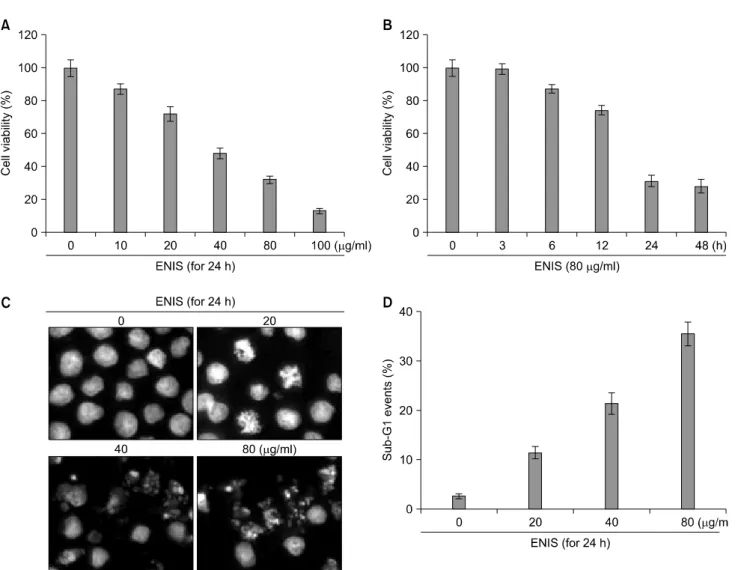
ENIS의 처리에 따른 Caki-1 세포의 성장억제 정도를 알아 보기 위하여 ENIS를 적정농도 및 시간별로 처리한 후, MTT assay를 이용하여 조사한 결과는 Fig. 1에 나타낸 바와 같다. 결과에서 알 수 있듯이 Caki-1 세포에 0~100 μg/ml의 ENIS를 24시간 처리 시 농도 의존적으로 세포 의 성장이 억제되는 것으로 나타났다(Fig. 1A). 또한 ENIS 의 농도를 80μg/ml로 고정하고 48시간까지 처리하였을 경우 12시간 처리군까지는 큰 변화가 나타나지 않았지 만 24시간 처리군에서부터 급격한 생존율의 감소가 관 찰되어 48시간 처리군에서는 60% 이상의 생존율 감소 현상이 나타났다(Fig. 1B). 이상의 결과에서 신세포암인 Caki-1 세포에 ENIS을 처리하였을 경우 처리시간에 따른 생존율 감소현상에 비교하여 처리농도에 따른 생존율 감소현상이 민감하게 나타나는 것으로 나타났으므로 이 후의 실험은 농도의존적으로 ENIS를 처리하여 진행하였 다.
Fig. 1. Inhibition of cell growth and induction of apoptosis by ethanol extract of N. indicum stem (ENIS) in Caki-1 human renal carcinoma cells. (A, B) Cells were seeded at 3×10⁴/ml in a 24-well plate and incubated for 24 h. The cells were treated with the indicated conditions of ENIS for 24 h (A) or 80μg/ml of ENIS for the indicated times (B). The cell viability was measured by the metabolic-dye-based MTT assay. The data shown are means±SD of three independent experiments. (C) The cells were treated with the indicated conditions of ENIS for 24 h, fixed and then stained with DAPI solution. After 10 min incubation at room temperature, stained nuclei were then observed under a fluorescent microscope (original magnification, ×400). (D) To quantify the degree of apoptosis induced by ENIS, cells grown under the same conditions as (C) were evaluated by flow cytometry for sub-G1 DNA content, which represents the cells undergoing apoptotic DNA degradation. Data are the mean±SD of two different experiments.
2. ENIS를 처리에 의한 apoptosis의 유발
다음은 ENIS 처리에 의한 Caki-1 세포의 증식억제가 apoptosis 유발과 연관성이 있는지 알아보기 위하여 정상 및 ENIS가 처리된 배지에서 배양된 세포를 고정시킨 후 DAPI 염색을 실시하여 핵의 형태변화를 형광현미경하 에서 관찰하였다. 정상배지에서 배양된 세포의 경우 핵 의 형태에 아무런 변화가 나타나지 않았지만 ENIS를 처 리한 경우, 처리 농도가 높아짐에 따라 apoptosis가 일어 난 세포에서 전형적으로 관찰되는 염색질 응축에 의한
apoptotic body의 출현이 증가되었다(Fig. 1C). 따라서 ENIS 처리에 따른 apoptosis 유발의 정도를 정량적으로 비교 평가하기 위하여 상기와 동일한 조건으로 배양된 세포들을 대상으로 DNA flow cytometry 분석을 통한 세 포주기의 sub-G1기에 해당되는 세포들의 빈도를 조사한 결과, ENIS 처리 농도의 증가에 따라 sub-G1기에 해당하 는 세포의 빈도가 증가함을 알 수 있었다(Fig. 1D). 특히 20μg/ml의 ENIS을 처리하였을 경우 sub-G1기에 해당하 는 세포의 빈도가 소폭 증가하였으나 40μg/ml 처리군에 서는 약 21% 정도로 증가하였으며, 80μg/ml 처리군에서
Fig. 2. Effects of ENIS treatment on the expression of Bcl-2 family proteins and loss of MMPs in Caki-1 cells. (A) After 24 h incubation with the indicated conditions of ENIS, the cells were lysed and then cellular proteins were separated by SDS-polyacrylamide gels and transferred onto nitrocellulose membranes. The membranes were probed with the indicated antibodies. Proteins were visualized using an ECL detection system. Actin was used as an internal control. (B) The cells grown under the same conditions as (A) were collected and incubated with JC-1 (10μM) for 20 min at 37oC in the dark.
The cells were the washed once with PBS and analyzed by a DNA flow cytometer. The results are expressed as the mean
±SD of three independent experiments.
Fig. 3. Effects of ENIS on the levels of anti-apoptotic IAP family members in Caki-1 cells. After 24 h incubation with the indicated conditions of ENIS, the cells were lysed and then cellular proteins were separated by SDS-polyacrylamide gels and transferred onto nitrocellulose membranes. The mem- branes were probed with the indicated antibodies. Proteins were visualized using an ECL detection system. Actin was used as an internal control.
는 약 35% 정도로 급격하게 증가하는 것으로 나타났다.
이상의 결과에서 ENIS 처리에 의한 Caki-1 인체신세포암 의 생존율 감소가 apoptosis 유발과 밀접한 관련이 있음을 알 수 있었다.
3. Bcl-2 family의 발현 및 MMP에 미치는 ENIS의 영향
다음은 Bcl-2 family에 속하는 단백질들이 ENIS에 의해 유발되는 apoptosis에 있어서 어떠한 영향을 미치는지를
확인하기 위하여 적정 농도의 ENIS에 24시간 배양된 세 포의 단백질을 분리하여 Western blot 분석을 실시하였 다. Fig. 2A에 나타낸 바와 같이 Caki-1 세포에 ENIS을 처 리하였을 경우 anti-apoptotic 유전자인 Bcl-2 및 Bcl-xL 유 전자의 단백질 발현이 처리 농도 의존적으로 감소되는 것으로 나타났으며, pro-apoptotic 유전자인 Bax의 경우에 는 큰 변화가 없는 것으로 나타났다. 하지만 또 다른 pro-apoptotic 유전자인 Bad의 경우에는 20μg/ml과 40μg/
ml에서 현저하게 증가하는 것으로 나타났다. 또한 mi- tochondrial 외막에 존재하는 Bcl-2 family의 발현 변화에 의하여 유발되는 것으로 알려진 MMP의 소실이 ENIS 처 리에 의하여 현저하게 증가되었다(Fig. 2B). 이상의 결과 를 살펴볼 때 ENIS 처리에 따른 apoptosis 유발에 있어서 Bcl-2 family가 중요한 역할을 한다는 것을 알 수 있었으 며, 이러한 Bcl-2 family의 변화에 따른 mitochondria mem- brane의 permeability의 변화가 관여한다는 것을 확인할 수 있었다.
4. IAP family의 발현에 미치는 ENIS의 영향
Caspase의 활성을 억제하는 것으로 알려진 IAP family 단백질의 발현에 미치는 ENIS의 영향을 동일 조건에서 조사한 결과는 Fig. 3에 나타난 바와 같다. 결과에서 알 수 있듯이 Caki-1 세포에서 ENIS 처리에 의한 IAP family 에 속하는 XIAP와 cIAP-1 단백질의 발현이 ENIS 처리 농 도 의존적으로 감소하는 것을 확인할 수 있었으나, cIAP- 2의 단백질 발현의 변화는 관찰되지 않았다. 이상의 결
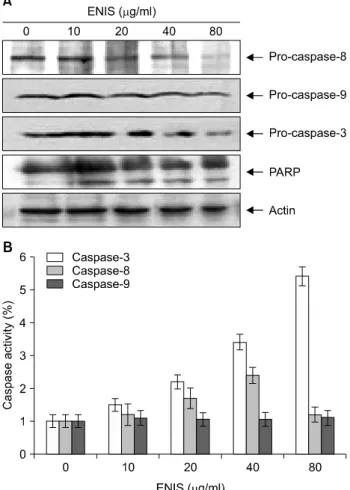
Fig. 4. Effects of ENIS on the activation of caspases in Caki-1 cells. (A) Cells were treated with the indicated conditions of ENIS for 24 h. The cells were lysed, cellular proteins were separated by SDS-polyacrylamide gels and then transferred onto nitrocellulose membranes. The membranes were probed with the indicated antibodies. Proteins were visualized using an ECL detection system. Actin was used as an internal control. (B) After 24 h incubation with the indicated con- centrations of ENIS, the cells were lysed and aliquots (50μg protein) were assayed for in vitro caspase-3, -8, and -9 activity using DEVD-pNA, IETD-pNA, and LEHD-pNA as substrates, respectively, at 37oC for 1 h. The released fluorescent pro- ducts were measured. Data are expressed as mean±SD of three independent experiments.
과에서 ENIS 처리에 의한 apoptosis의 유발에서 있어서 IAP family에 속하는 단백질들이 부분적으로 관여한다는 것을 알 수 있었다.
5. Caspase의 발현 및 활성에 미치는 ENIS의 영향
Apoptosis 유발에 있어서 중요한 역할을 하는 것으로 알려진 caspase-3, -8 및 -9의 발현 및 활성에 미치는 ENIS 의 영향을 조사하였다. Fig. 4A에 나타난 바와 같이 ENIS
의 처리에 의하여 initiator caspase로 알려진 caspase-8과 ef- fector caspase로 알려진 caspase-3의 활성형 단백질은 나타 나지 않았지만 비활성형 단백질의 발현이 처리농도 의 존적으로 현저히 감소되는 것으로 관찰되었으며, cas- pase-3의 기질단백질로서 DNA repair와 genomic stability에 관여하는 poly (ADP-ribose) polymerase (PARP) 단백질의 단 편화 현상이 관찰되었다. 하지만 또 다른 initiator caspase 인 caspase-9의 경우는 ENIS 처리에 따른 변화가 관찰되 지 않았다. 이상의 Western blot 분석에 의한 결과를 재확 인하기 위하여 caspase의 활성 정도를 직접 분석한 결과, ENIS 처리 농도 증가에 따라 caspase-3이 현저히 증가되 었고 caspase-8의 활성도 다소 증가된 반면, caspase-9의 경 우에는 ENIS 처리에 의해 큰 변화가 없었음을 알 수 있 었다(Fig. 4B). 이상의 결과를 살펴볼 때 ENIS 처리에 따 른 Caki-1 세포에서의 apoptosis 유발은 caspase-8 및 -3의 활성화가 중요한 역할을 한다는 것을 알 수 있었다.
6. JNK의 발현 및 ROS의 생성에 미치는 ENIS의 영향
다음은 ENIS의 처리에 따른 apoptosis의 유발과 스트레 스와 연관된 유전자인 JNK와의 연관성을 알아보았다.
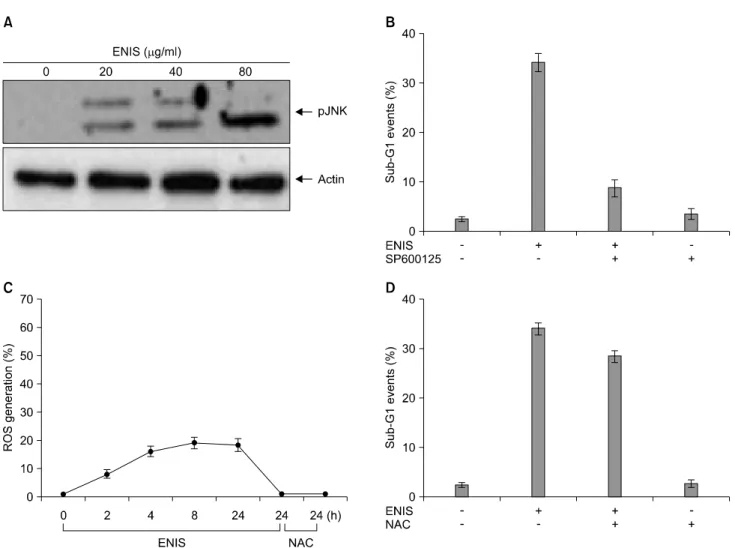
Fig. 5A에 나타난 바와 같이 Caki-1 세포에 ENIS를 처리 하였을 경우 인산화된 JNK의 발현(pJNK) 양이 현저히 증가하는 것으로 관찰되었으므로 ENIS에 의하여 유발되 는 apoptosis에 JNK가 관여하는 지를 확인하기 위하여 JNK inhibitor인 SP600125를 1시간 선처리 한 후 ENIS를 처리한 다음 DNA flow cytometry를 이용하여 apoptosis의 유발 정도를 정량적으로 분석하였다. Fig. 5B에 나타낸 결과에서 알 수 있듯이 ENIS 단독 처리군에 서는 sub-G1 기에 해당되는 세포의 빈도가 약 30% 정도임에 비하여 SP600125를 선처리한 조건에서 배양된 세포의 경우 apoptosis 유발 빈도가 현저하게 감소되었다. 이러한 결과 는 JNK의 활성 증가가 ENIS에 의한 apoptosis 유발에 직 접적으로 관여하고 있음을 의미한다. 다음으로 ENIS의 처리에 따른 ROS 생성 및 apoptosis와의 연관성을 확인해 본 결과, Fig. 5C에 나타난 바와 같이 Caki-1 세포에 80 μg/ml의 ENIS을 처리하였을 경우 2시간부터 8시간까지 ROS의 생성이 현저히 증가되었고 24시간까지 유지되는 것으로 나타났으며, 이러한 ROS의 생성은 ROS scavenger 인 N-acetylcysteine (NAC)에 의하여 완벽하게 억제된다는 것을 알 수 있었다. 따라서 이러한 ROS의 생성이 ENIS에 의하여 유발되는 apoptosis에 관여하는지를 확인하기 위 하여 NAC을 1시간 선처리한 후 ENIS을 처리한 다음 apoptosis의 유발 정도를 정량적으로 분석하였다. Fig. 5D 의 결과에서 알 수 있듯이 ENIS에 의하여 유발되었던
Fig. 5. Effects of activation of JNK and generation of ROS on ENIS-induced apoptosis in Caki-1 cells. (A) Cells were incubated with the indicated concentration of ENIS for 24 h. The cells were lysed, and cellular proteins were separated by SDS-polyacrylamide gel and transferred onto nitrocellulose membrane. The membrane was probed with anti-p-JNK antibody. Proteins were visualized using an ECL detection system. Actin was used as an internal control. (B) Cells were pretreated with SP600125 (40 mM) for 1 h and then treated with ENIS (80μg/ml) for 24 h. The percentage of sub-G1 cell population was evaluated by a flow cytometer.
(C) Cells were treated with or without NAC (10 mM) for 1 h before being challenged with 80μg/ml of ENIS for the indicated times. For the measurement of ROS generation, the cells were incubated with 10μM DCF-DA at 37oC for 30 min, and ROS generation was measured by a flow cytometer. (D) Following incubation of cells under the same conditions as (C), the degree of apoptosis were evaluated by a flow cytometer for sub-G1 DNA content, which represents the cells undergoing apoptotic DNA degradation. Data are the mean±SD of three independent experiments.
apoptosis가 ROS scavenger인 NAC 선처리에 의하여 큰 변 화가 없는 것으로 나타나, Caki-1 세포에서 ENIS 처리에 의한 apoptosis 유발은 ROS 생성과 무관하게 JNK의 활성 증가를 통하여 일어난다는 것을 알 수 있었다.
고 찰
본 연구에서는 인체신세포암인 Caki-1 세포의 생존율 에 미치는 ENIS의 영향과 이와 연관된 apoptosis 유발 여 부 및 생화학적 기전 해석을 시도하였다. 이를 위하여
Caki-1 세포에서 ENIS 처리농도 및 시간에 따른 생존율 의 정도를 먼저 비교한 결과, Fig. 1에 나타난 바와 같이 Caki-1 세포에서 ENIS의 처리농도 및 시간이 증가할수록 생존율이 감소하는 것을 확인할 수 있었다. ENIS에 의한 생존율의 감소 및 형태변화가 apoptosis 유발과 관련이 있 는지를 확인하기 위하여 핵의 형태 변화 및 세포주기 sub-G1의 정략적인 분석을 실시한 결과, ENIS 처리에 의 하여 apoptosis가 유발된 세포에서 특이적으로 나타나는 염색질 응축에 의한 apoptotic body가 관찰되었고 sub-G1 의 비율이 ENIS 처리 농도 의존적으로 현저하게 증가하
였다. 따라서 인체신세포암인 Caki-1 세포에서 ENIS의 처리에 의하여 유발되는 생존율의 감소는 apoptosis의 유 발과 밀접한 관계가 있음을 알 수 있다.
일반적으로 apoptosis 유발 과정은 Bcl-2 및 IAP family 단백질들과 caspases 등과 같은 여러 가지 유전자 산물들 이 관여하는 것으로 알려져 있다. 먼저 Bcl-2 family에 속 하는 단백질들은 네 가지의 Bcl homology (BH) domains (BH1-BH4) 중 최소한 한 개의 domain을 포함하고 있으 며, mitochondria 보존과 mitochondria에 의해 유도되는 apoptosis를 조절하는 중요한 조절자이다.20) 이 단백질들 은 Bcl-2, Bcl-xL, Bcl-w 및 Mcl-1과 같이 apoptosis를 억제하 는 anti-apoptotic member와 Bax, Bad, Bak, Bid 및 Bcl-xS와 같이 apoptosis를 유발하는 pro-apoptotic member로 구성되 어 있다.21) 이러한 anti-apoptotic 및 pro-apoptotic member들 사이의 비율에 의하여 생리적 및 병리적인 조건하에서 세포의 생존 및 죽음이 결정되는데,22) 이 member들 간의 균형이 깨어지게 되면 mitochondria로부터 cytosol로 cyto- chrome c가 방출되어 cysteine-related proteases인 caspases, 종 양억제 유전자인 p53, DNA의 단편화와 연관된 endonu- clease 등의 활성을 조절하여 apoptosis가 유발되는 것으로 알려져 있다.23) 따라서 본 실험에서 사용한 Caki-1 세포 에 ENIS을 처리하였을 경우 Bcl-2 family에 속하는 인자들 의 발현 변화가 유발되는지를 확인한 결과, ENIS에 의해 Caki-1 세포에서는 pro-apoptotic 인자인 Bax의 발현이 큰 변화가 없는 반면 Bad가 현저히 증가하였고, anti-apop- totic 인자인 Bcl-2 및 Bcl-xL의 단백질 발현감소가 관찰되 었으며 이로 인하여 MMP의 loss가 증가하는 것으로 확인 되었다(Fig. 2). 이상의 결과를 살펴볼 때 ENIS에 의한 apoptosis 유발은 Bcl-2 family에 속하는 유전자의 발현 차 이에 의한 mitochondria membrane의 permeability 변화에 의하여 cytochrome c가 mitochondria에서 cytosol로 방출되 면서 개시될 것으로 추정된다.
Caspases 의존적인 apoptosis는 여러 단계로 조절되는데 그 중 IAP family는 caspase의 활성을 직접 억제하는 것으 로 알려져 있는데,24,25) 현재까지 밝혀진 여덟 종류의 IAPs는 한 개 이상의 baculovirus IAP repeat (BIR) domain을 가진다. IAPs 중 일부는 caspases의 ubiquitination 및 degra- dation을 조절하는 RING finger domain을 가지며, 또 다른 일부는 protein–protein interaction 기능을 하는 caspase-re- cruitment domain (CARD)을 가지는 것으로 알려져 있다.26) IAPs의 중요한 기능은 BIR domain 의존적인 상호작용 및 caspase-3, -7 및 -9의 활성 차단을 통한 apoptosis의 억제이 다. 가장 강력한 IAP로 알려진 XIAP는 활성화된 caspases 와 높은 친화력을 가지며 apoptosis를 억제한다. XIAP의
BIR3 domain은 caspase-9와 결합하는 반면에 BIR1 및 BIR2 domain은 활성형 caspase-3 및 -7과 결합하여 apoptosis를 억제한다.27,28) XIAP 외에도 cIAP-1 및 cIAP-2도 각각 다 양한 caspases와의 결합을 통하여 apoptosis를 억제하는 것 으로 알려져 있다.29,30) 본 실험에서는 ENIS 처리에 따른 IAP family 인자들의 발현 변화를 조사해 본 결과, 단백질 수준에서 XIAP와 cIAP-1의 변화 감소가 관찰되었기에 ENIS에 의한 apoptosis에 IAP family 단백질들이 일정한 영 향을 미쳤을 것으로 생각된다(Fig. 3).
Caspase protease라는 효소 역시 apoptosis 유발에 중요한 조절인자로서 작용하는데, 이 단백질들은 세포에서 핵 과 mitochondria의 외막에 불활성 상태인 proenzyme 형태 로 존재한다.31) 많은 caspases 중 initiator caspase인 caspase-8 은 활성화된 death receptor에 의해 형성된 death-inducing signaling complex (DISC)에 의해 활성화되어 effector caspase 인 caspase-3을 활성화시킨다. 이렇게 활성화된 caspase-3 은 PARP 등과 같은 많은 표적 단백질들을 분해함으로서 apoptosis를 유발한다.32) 또 다른 caspase인 caspase-9의 활 성화는 mitochondria에서 유리된 cytochrome c에 의해서 형 성된 apoptosome에 의하여 유발되며, 이렇게 활성화된 caspase-9는 caspase-3을 활성화시켜 apoptosis를 일으키는 것으로 알려져 있다.33) 따라서 본 실험에서는 여러 종류 의 caspases 중 apoptosis 유발에 직접적으로 관여하는 것 으로 알려진 caspase-3, -8 및 -9의 발현 및 기질단백질에 미치는 ENIS의 영향에 대해서 조사하였다. Fig. 4A의 결 과에서와 같이 개시인자로 알려진 caspase-9의 경우 큰 변화가 없는 것으로 관찰되었지만, 또 다른 개시인자인 caspase-8와 effect caspase인 caspase-3의 경우는 ENIS의 농 도가 증가할수록 비활성형 단백질의 발현이 감소하였으 며, 기질단백질인 PARP의 단편화 현상이 유발되는 것으 로 나타났다. 다음으로 활성형 단백질의 증가를 확인하 기 위해서 in vitro assay를 이용하여 caspases의 활성 정도 를 직접적으로 측정해본 결과, ENIS 처리에 의해 cas- pase-3 및 -8의 활성 정도가 현저하게 증가하는 것을 알 수 있었다(Fig. 4B). 이상의 결과를 살펴보면 ENIS 처리에 의한 apoptosis 유발은 caspase-8 및 -3의 활성화와 직접 관 련이 있음을 알 수 있었다.
호흡과정에서 세포 내로 들어간 산소가 산화과정에 이용되면서 여러 대사과정에서 생성되는 ROS는 주위의 화합물과 아주 쉽게 반응하며 전자를 잃거나 얻으려 하 기 때문에 높은 반응성을 띠고 있다.34) 병원체나 이물질 을 제거하기 위한 생체방어과정에서 ROS가 많이 발생하 는데, 이들의 강한 살균작용으로 병원체로부터 인체를 보호하기도 하며, 다양한 암세포의 세포주기 조절작용
에 관여하고 mitochondria 의존적인 세포사멸을 유도하여 Bcl-2 member 단백질의 발현을 조절하기도 하는 것으로 알려져 있다.35,36) 또한 ROS는 다양한 인자에 의하여 유 발될 수 있는데 대표적인 것이 JNK와 같은 스트레스성 인자들의 조절작용에 의하여 생기는 것으로 알려져 있
다.37,38) 따라서 ENIS에 의한 pJNK 단백질의 발현 변화를
살펴 본 결과, ENIS 처리에 의하여 pJNK의 발현이 현저 하게 증가하였지만 JNK 활성의 억제자인 SP600125를 선 처리하였을 경우 apoptosis의 억제 현상이 뚜렷하게 관찰 되었다(Fig. 5A, B). 하지만 ENIS 처리에 의하여 ROS의 생 성은 증가하였지만 ROS scavenger인 NAC에 의하여 apop- tosis의 억제 현상이 관찰되지 않는 것으로 보아 ROS가 ENIS에 의한 apoptosis 유도에는 밀접한 연관성이 없음을 알 수 있었다(Fig. 5C, D). 즉 Caki-1 세포에 ENIS을 처리 했을 경우 JNK가 활성화됨으로서 Bcl-2 family의 발현 변 화에 따른 mitochondrial membrane의 permeability 변화와 그에 따른 caspases의 활성화와 연관된 기질 단백질들의 분해에 의하여 apoptosis가 유발된다는 것을 알 수 있었 다.
결 론
본 실험에서는 유도화 줄기 에탄올 추출물(ENIS)의 처 리에 의하여 인체신세포암 Caki-1 세포의 생존율이 감소 되었으며, 이러한 생존율의 감소는 apoptosis 유도와 밀접 한 관련이 있음을 보고하고자 한다. 또한 이러한 과정에 는 Bad의 발현 증가, Bcl-2 및 Bcl-xL의 발현 감소와 연관 된 MMP의 소실, JNK의 활성화 및 caspase의 활성화 및 기질 단백질들의 분해 등이 연계되어 있었다. 이러한 연 구 결과는 ENIS의 항암기전 해석을 이해하고 향후 지속 적인 연구를 위한 귀중한 자료로 사용될 것으로 생각된 다.
감사의 글
본 연구는 지식경제부ㆍ부산광역시 지원 지역혁신센 터사업 동의대학교 블루바이오 소재 개발 및 실용화 지 원 센터(RIC08-06-07) 지원에 의하여 이루어진 결과임.
참 고 문 헌
1) Motzer RJ, Bander NH, Nanus DM. Renal-cell carcinoma. N Engl J Med 335, 865-875, 1996.
2) Escudier B, Eisen T, Stadler WM. Sorafenib in advanced
clear-cell renal-cell carcinoma. N Engl J Med 356, 125-134, 2007.
3) Ratain MJ, Eisen T, Stadler WM. Phase II placebo-controlled randomized discontinuation trial of sorafenib in patients with metastatic renal cell carcinoma. J Clin Oncol 24, 2505-2512, 2006.
4) Ishikawa A, Yamashita H, Hiemori M, Inagaki E, Kimoto M, Okamoto M, Tsuji H, Memon AN, Mohammadio A, Natori Y. Characterization of inhibitors of postprandial hyperglycemia from the leaves of Nerium indicum. J Nutr Sci Vitaminol 53, 166-173, 2007.
5) Ding K, Fang JN, Dong T, Tsim KW, Wu, H.
Characterization of a rhamnogalacturonan and a xyloglucan from Nerium indicum and their activities on PC12 pheochro- mocytoma cells. J Nat Prod 66, 7-10, 2003.
6) Mae SH, Sofia M, Bolhuis RL, Nooter K, Oostrum RG, Subagus W, Ibnu GG. Selectivity of compounds isolated from the leaves of Nerium indicum Mill. on various human cancer cell lines. Med J Malaysia 63(Suppl A), 24-25, 2008.
7) Yu MS, Wong AY, So KF, Fang JN, Yuen WH, Chang RC.
New polysaccharide from Nerium indicum protects neurons via stress kinase signaling pathway. Brain Res 1153, 221-230, 2007.
8) Dong Q, Fang JN. Structural elucidation of a new arabinogalactan from the leaves of Nerium indicum. Carbohydr Res 332, 109-114, 2001.
9) Gayathri V, Ananthi S, Chandronitha C, Ramakrishnan G, Sundaram RL, Vasanthi HR. Cardioprotective effect of nerium oleander flower against isoproterenol-induced myocardial oxidative stress in experimental rats. J Cardiovasc Pharmacol Ther 16, 96-104, 2011.
10) Harrison JS, Mondor EB. Evidence for an invasive aphid
"Superclone": Extremely low genetic diversity in oleander aphid (Aphis nerii) populations in the Southern United States.
PLoS One 6, e17524, 2011.
11) Block KI, Gyllenhaal C, Newman RA. Response to 'Probable hepatotoxicity related to Nerium oleander extract in a patient with metastatic synovial sarcoma of the knee'. J Altern Complement Med 15, 1269, 2009.
12) Rashan LJ, Franke K, Khine MM, Kelter G, Fiebig HH, Neumann J, Wessjohann LA. Characterization of the anticancer properties of monoglycosidic cardenolides isolated from Nerium oleander and Streptocaulon tomentosum. J Ethnopharmacol 134, 781-788, 2011.
13) Leist M, Jäättelä M. Four deaths and a funeral: from caspases to alternative mechanisms. Nat Rev Mol Cell Biol 2, 589-598, 2001.
14) Vilches Troya J. Understanding cell death: a challenge for biomedicine. An R Acad Nac Med 122, 631-656, 2005.
15) Huerta S, Goulet E. Huerta-Yepez S, Livingston EH.
Screening and detection of apoptosis. J Surg Res 139, 143-156, 2007.
16) Huerta S, Goulet EJ, Livingston EH. Colon cancer and
apoptosis. Am J Surg 191, 517-526, 2006.
17) Nagata S. Apoptotic DNA fragmentation. Exp Cell Res 256, 12-18, 2000.
18) Lin S, Fujii M, Hou DX. Rhein induces apoptosis in HL-60 cells via reactive oxygen species-independent mitochondrial death pathway. Arch Biochem Biophys 418, 99-107, 2003.
19) Jacobson MD. Reactive oxygen species and programmed cell death. Trends Biochem Sci 21, 83-86, 1996.
20) Du J, Chen GG, Vlantis AC, Chan PK Tsang RK, van Hasselt CA. Resistance to apoptosis of HPV 16-infected laryngeal cancer cells is associated with decreased Bak and increased Bcl-2 expression. Cancer Lett 205, 1-88, 2004.
21) Reed JC. Bcl-2 family proteins. Oncogene 17, 3225-3236, 1998.
22) Kroemer G. The proto-oncogene Bcl-2 and its role in regulating apoptosis. Nat Med 3, 614-620, 1997.
23) Green DR, Reed JC. Mitochondra and apoptosis. Science 281, 1309-1312, 1998.
23) Rosse T, Olivier R, Monney L, Rager M, Conus S, Fellay I, Jansen B, Borner C. Bcl-2 prolongs cell survival after Bax-induced release of cytochrome c. Nature 391, 496-499, 1998.
24) Salvesen GS, Duckett CS. IAP proteins: blocking the road to death's door. Nat Rev Mol Cell Biol 3, 401-410, 2002.
25) Deveraux QL, Reed JC. IAP family proteins-suppressors of apoptosis. Genes Dev 13, 239-252, 1999.
26) Checinska A, Hoogeland BS, Rodriguez JA, Giaccone G, Kruyt FA. Role of XIAP in inhibiting cisplatin-induced caspase activation in non-small cell lung cancer cells: a small molecule Smac mimic sensitizes for chemotherapy-induced apoptosis by enhancing caspase-3 activation. Exp Cell Res 313, 1215-1224, 2007.
27) Chai J, Shiozaki E, Srinivasula SM, Wu Q, Datta P, Alnemri ES, Shi Y. Structural basis of caspase-7 inhibition by XIAP.
Cell 104, 769-780, 2001.
28) Huang Y, Park YC, Rich RL, Segal D, Myszka DG, Wu H.
Structural basis of caspase inhibition by XIAP: differential roles of the linker versus the BIR domain. Cell 104, 781-790,
2001.
29) Deveraux QL, Roy N, Stennicke HR, Van Arsdale T, Zhou Q, Srinivasula SM, Alnemri ES, Salvesen GS, Reed JC. IAPs block apoptotic events induced by caspase-8 and cytochrome c by direct inhibition of distinct caspases. EMBO J 17, 2215-2223, 1998.
30) Roy N, Deveraux QL, Takahashi R, Salvesen GS, Reed JC.
The c-IAP-1 and c-IAP-2 proteins are direct inhibitors of specific caspases. EMBO J 16, 6914-6925, 1997.
31) Nagata S. Apoptosis by death factor. Cell 88, 355-365, 1997.
32) Chai F, Truong-Tran AQ, Ho LH, Zalewski PD. Regulation of caspase activation and apoptosis by cellular zinc fluxes and zinc deprivation: a review. Immunol Cell Biol 77, 272-278, 1999.
34) Sauer H, Wartenberg M, Hescheler J. Reactive oxygen species as intracellular messengers during cell growth and differen- tiation. Cell Physiol Biochem 11, 173-186, 2001.
35) Ling YH, Liebes L, Zou Y, Perez-Soler R. Reactive oxygen species generation and mitochondrial dysfunction in the apoptotic response to Bortezomib, a novel proteasome inhi- bitor, in human H460 non-small cell lung cancer cells. J Biol Chem 278, 33714-33723, 2003.
36) Zhang Y, Chen F. Reactive oxygen species (ROS), troublemakers between nuclear factor-kappaB (NF-kappaB) and c-Jun NH(2)-terminal kinase (JNK). Cancer Res 64, 1902-1905, 2004.
37) Kim BC, Kim HG, Lee SA, Lim S, Park EH, Kim SJ, Lim CJ. Genipin-induced apoptosis in hepatoma cells is mediated by reactive oxygen species/c-Jun NH2-terminal kinase- dependent activation of mitochondrial pathway. Biochem Pharmacol 70, 1398-1407, 2005.
38) Moungjaroen J, Nimmannit U, Callery PS, Wang L, Azad N, Lipipun V, Chanvorachote P, Rojanasakul Y. Reactive oxygen species mediate caspase activation and apoptosis induced by lipoic acid in human lung epithelial cancer cells through Bcl-2 down-regulation. J Pharmacol Exp Ther 319, 1062-1069, 2006.