Review Article / 종설
아토피 피부염에서 프로바이오틱스 치료 유효성에 관한 문헌적 고찰
홍수정1· 정명수2· 안성훈3
원광대학교 일반대학원 한의학과 박사과정 (1연구생) 원광대학교 한의학전문대학원 예방의학과 (2교수)
안성훈한방병원 병원장 (3한의학박사)
A Review on Effects of Probiotics in Atopic Dermatitis
Soo-Jeong Hong1· Myong-Soo Chong2· Sung-Hun Ahn3
1Dep. of Korea medicine, Graduate School of Wonkwang University, Wonkwang University
2Dep. of Preventive medicine, College of Korean Medicine, WonKwang University
3Ahn Sung Hun Oriental Medical Clinic
Abstract
Objective : The purpose of this study is to investigate the use of probiotics for cure of atopic dermatitis and suggest for the better method of studies in order to seek more effective treatment.
Methods : We searched from Korean Traditional Knowledge Portal(KTKP), Reserach Information Sharing Service(RISS), National Discovery for Science Leader(NDSL) and PubMed. We selected among the papers published from 2005 to 2019 using terms related to ‘Atopic dermatitic & Allergy diseases & Probiotics’.
Results : 41 papers were selected from the database worldwidely. In these collected 41 related theses, there were 14 experimental studies(34.1%), 16 clinical studies( 39.0%), 11 review studies (26.9%). 23 papers(76.7%) insisted that the effects is but 9 papers(30%) said not effective.
Conclusion : The effects of probiotics in atopic dermatitis is investigated positively, however, we have to consider the methods to approach the result including the sort, amount of probiotics, how to culture, how to eat and so on.
Key words : Atopic Dermatitis, Allergic disease, Probiotics, Lactic acid bacteria.
ⓒ 2020 the Society of Korean Medicine Ophthalmology & Otolaryngology & Dermatology
This is an Open Access journal distributed under the terms of the Creative Commons Attribution Non-Commercial License (http://creativecommons.org/license/by-nc/3.0/) which permits unrestricted non-commercial use, distribution, and reproduction in any medium, provided the original work is properly cited.
Ⅰ. 서 론
아토피 피부염은 홍반, 부종, 삼출, 건조, 소양 등의 증상이 연령과 체질에 따라 특이적으로 전신에 분포되 어 나타나는 만성의 재발 염증성 피부질환이다. 현재 아토피 피부염에 관한 정확한 원인은 밝혀지지 않았지 만 유전적 요인, 환경적 요인1), 면역학적 요인2) 등과 관 련이 있을 것이란 보고가 제기되었고 최근에는 아토피 피부염의 발생 원인을 표피장벽의 이상3)이란 주장과 장 관내 미생물 불균형4)과의 상관성이란 주장이 새롭게 제 기되고 있다. 한의학계에서는 아토피 피부염을 風熱, 濕 熱, 血熱, 脾虛濕盛, 陰虛을 원인으로 보고 있으며 병증 으로 胎熱 등이 나타난다고 보고 있다5). 아토피 피부염 은 국가마다 차이는 있지만 15-25%의 유병률을 보이 며 세계적으로 증가추세에 있고6) 한국의 경우에는 소아 인구의 약 10%, 성인인구의 3%가 아토피 피부염을 갖 고 있으며 유병률 또한 꾸준히 증가하는 추세를 보인다
7)는 보고가 있다.
지금까지 알려진 아토피 피부염의 치료 방법으로는 부신피질호르몬제나 사이클로스포린 등의 면역억제제 혹은 면역조절제가 사용되고 있다8). 그러나 이런 약제 들의 장기간 사용 할 경우 피부 위축 등 부작용이 야기 되고 있다9). 따라서 최근 들어 이를 극복하기 위한 치 료법의 개발에 대한 노력이 활발히 이루어지고 있으며 그 중에서 프로바이오틱스를 이용하여 장내의 미생물을 조절하여 아토피피부염을 치료하려는 시도가 활발히 진 행 중이다.
프로바이오틱스(Probiotics)란 World Health Organization(WHO)에서는 ‘적절한 양으로 투여되었 을 때 숙주의 건강에 이로움을 주는 살아있는 미생물’
로 정의하고 있다(WHO 2002)10). Lactobacillus나 Bifidobacterium으로 대변되는 유산균은 프로바이오
틱스의 대부분을 차지하고 있으며11) 국내에서는 정장작 용을 하는 대표적인 건강기능식품으로 인식되어왔으나 2010년 이후부터는 ‘유산균 이용제품’을 표기할 때 ‘프 로바이오틱스’로 변경하도록 하였다10). 따라서 본 연구 에서는 프로바이오틱스와 유산균을 갖은 개념으로 이해 하고 혼용하기로 하였다. 프로바이오틱스는 섭취했을 때 체내에서 유익한 효과를 나타낼 뿐 아니라 부작용도 거의 없어 비교적 안전하다고 알려져 있다11). 특히 프 로바이오틱스와 아토피 피부염과 관련된 연구 중에는 과민면역반응을 억제해 아토피 피부염과 알레르기성 피 부염 등에 효과가 있다는 가능성이 꾸준하게 연구되어 오고 있으며12,13) 균주에 대한 안전성과 유효성에 관한 평가 기준이 확립되면서 많은 연구들이 지속되고 있다.
본 연구는 기존의 연구 보고된 문헌을 고찰해 봄으로써 아토피 피부염과 관련된 프로바이오틱스의 유효성에 대 한 상관관계를 알아보고 좀 더 효율적인 연구방법 등을 제안하고자 한다.
Ⅱ. 연구방법
연구 자료 수집은 국내전자데이터베이스 검색을 통해 서 수행하였다. 자료의 수집을 위해 ‘한국학술정보 (KISS)(DBpia)’, ‘한국전통지식포탈(KTKP)’, ‘학술연구 정보서비스(RISS)’, ‘한국의학정보포탈’, ‘Pubmed’ 중 심으로 on-line 검색을 실행하였다. 검색어로는 ‘아토 피 피부염과 프로바이오틱스’, ‘아토피 피부염과 유산 균’, ‘알레르기성 피부염과 프로바이오틱스’, ‘알레르기 성 피부염과 유산균’ 등을 순차적으로 조합하여 검색하 였고 원문보기가 가능한 논문을 열람하였다. 검색은 2005년부터 2019년도까지 출간된 논문들 중 학위논문 을 제외한 학회에 발표된 논문만으로 한정하였는데 국 내외 총 41편이 검색되었다.
Corresponding author : Myong-Soo Chong, Dep. of Preventive medicine College of Korean Medicine Wonkwang University, Iksandaero 460 Iksan city, Jeollabukdo, 54538, Korea.(Tel : 063-850-6912, E-mail : [email protected])
Ⅲ. 결 과
1. 연도 및 유형별 분류
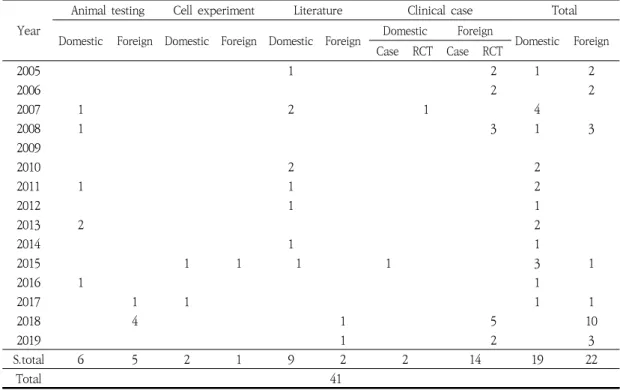
연구를 진행한 논문 총 41편 가운데 국내 19편의 논 문을 연도별로 살펴보면 2005년 1편(5.3%), 2007년 4 편(21.1%), 2008년 1편(5.3%), 2010년 2편(10.5%), 2011년 2편(10.5%), 2012년 1편(5.3%), 2013년 2편 (10.5%), 2014년 1편(5.3%), 2015년 3편(15.8%), 2016년 1편(5.3%), 2017년 1편(5.3%)으로 조사되었 다. 이 중 문헌고찰논문은 9편(47.4%)으로 가장 많았고 실험 논문이 8편(42.1%) 임상실험이 2편(10.5%) 순으 로 나타났다. 국외논문은 총 22편이 검색되었는데 연도 별로 분류해보면 2005년 2편(9.1%), 2006년 2편 (9.1%), 2008년 3편(13.7%), 2015년 1편(4.5%), 2017년 1편(4.5%,) 2018년 10편(45.4%), 2019년 3 편(13.7%) 등으로 나타났고 그 중 임상실험논문이 14 편(63.6%) 실험논문이 6편(27.2%) 문헌고찰이 2편
Year
Animal testing Cell experiment Literature Clinical case Total
Domestic Foreign Domestic Foreign Domestic Foreign Domestic Foreign
Domestic Foreign Case RCT Case RCT
2005 1 2 1 2
2006 2 2
2007 1 2 1 4
2008 1 3 1 3
2009
2010 2 2
2011 1 1 2
2012 1 1
2013 2 2
2014 1 1
2015 1 1 1 1 3 1
2016 1 1
2017 1 1 1 1
2018 4 1 5 10
2019 1 2 3
S.total 6 5 2 1 9 2 2 14 19 22
Total 41
Table 1. Classification of Article Associated with Atopic Dermatitis and Probiotics (9.1%)으로 조사되었다(Table 1).
2. 국내 논문 분석 결과 1) 동물실험 분석결과
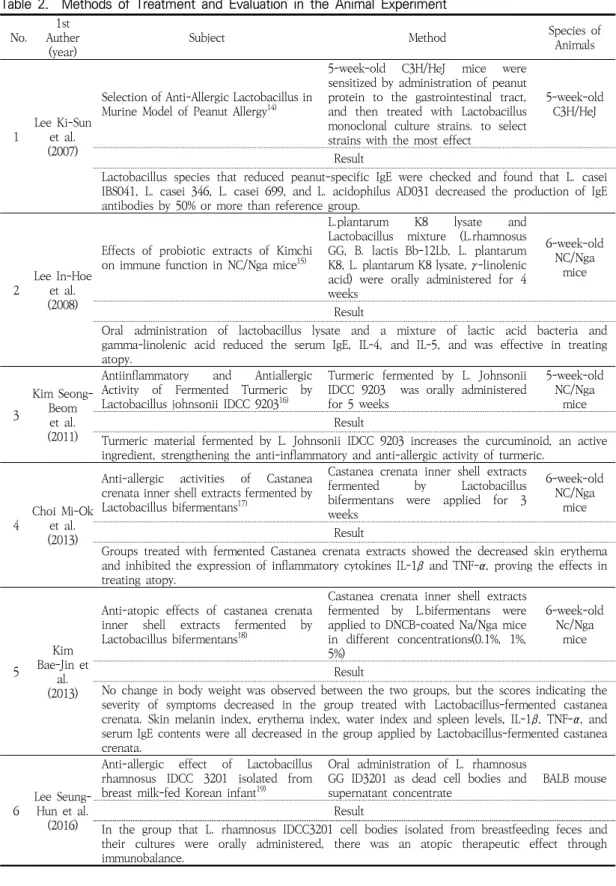
아토피 피부염 관련 동물실험 논문 총 6편 중 대상 동물로 2,4-dinitrochlorobenzene(DNCB)로 유도된 NC/Nga mouse를 사용한 논문이 4편(80%)이었고 BALB mouse를 사용한 논문이 1편(20%), C3H/HeJ mouse를 사용한 논문이 1편이었다. 그 중 4편의 논문 에서는 아토피 유발 생쥐에게 유산균을 직접 경구투여 시켰고 두 편에서는 병변부위에 도포하는 방법으로 변 화를 관찰하였다(Table 2).
2) 세포실험 및 시험관 분석 결과
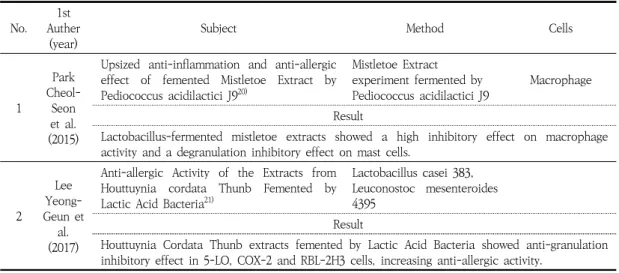
아토피 피부염 관련해 유산균 균주를 이용한 세포 실 험논문은 총 2편이었는데 이들 모두 유산균을 다른 식 물과 함께 발효시켜 실험하였다(Table 3).
No.
1st Auther
(year)
Subject Method Species of
Animals
1
Lee Ki-Sun et al.
(2007)
Selection of Anti-Allergic Lactobacillus in Murine Model of Peanut Allergy14)
5-week-old C3H/HeJ mice were sensitized by administration of peanut protein to the gastrointestinal tract, and then treated with Lactobacillus monoclonal culture strains. to select strains with the most effect
5-week-old C3H/HeJ
Result
Lactobacillus species that reduced peanut-specific IgE were checked and found that L. casei IBS041, L. casei 346, L. casei 699, and L. acidophilus AD031 decreased the production of IgE antibodies by 50% or more than reference group.
2
Lee In-Hoe et al.
(2008)
Effects of probiotic extracts of Kimchi on immune function in NC/Nga mice15)
L.plantarum K8 lysate and Lactobacillus mixture (L.rhamnosus GG, B. lactis Bb-12Lb, L. plantarum K8, L. plantarum K8 lysate, γ-linolenic acid) were orally administered for 4 weeks
6-week-old NC/Nga
mice
Result
Oral administration of lactobacillus lysate and a mixture of lactic acid bacteria and gamma-linolenic acid reduced the serum IgE, IL-4, and IL-5, and was effective in treating atopy.
3
Kim Seong- Beom et al.
(2011)
Antiinflammatory and Antiallergic Activity of Fermented Turmeric by Lactobacillus johnsonii IDCC 920316)
Turmeric fermented by L. Johnsonii IDCC 9203 was orally administered for 5 weeks
5-week-old NC/Nga
mice Result
Turmeric material fermented by L. Johnsonii IDCC 9203 increases the curcuminoid, an active ingredient, strengthening the anti-inflammatory and anti-allergic activity of turmeric.
4
Choi Mi-Ok et al.
(2013)
Anti-allergic activities of Castanea crenata inner shell extracts fermented by Lactobacillus bifermentans17)
Castanea crenata inner shell extracts fermented by Lactobacillus bifermentans were applied for 3 weeks
6-week-old NC/Nga
mice Result
Groups treated with fermented Castanea crenata extracts showed the decreased skin erythema and inhibited the expression of inflammatory cytokines IL-1β and TNF-α, proving the effects in treating atopy.
5
Kim Bae-Jin et
al.
(2013)
Anti-atopic effects of castanea crenata inner shell extracts fermented by Lactobacillus bifermentans18)
Castanea crenata inner shell extracts fermented by L.bifermentans were applied to DNCB-coated Na/Nga mice in different concentrations(0.1%, 1%, 5%)
6-week-old Nc/Nga
mice
Result
No change in body weight was observed between the two groups, but the scores indicating the severity of symptoms decreased in the group treated with Lactobacillus-fermented castanea crenata. Skin melanin index, erythema index, water index and spleen levels, IL-1β, TNF-α, and serum IgE contents were all decreased in the group applied by Lactobacillus-fermented castanea crenata.
6
Lee Seung- Hun et al.
(2016)
Anti-allergic effect of Lactobacillus rhamnosus IDCC 3201 isolated from breast milk-fed Korean infant19)
Oral administration of L. rhamnosus GG ID3201 as dead cell bodies and supernatant concentrate
BALB mouse
Result
In the group that L. rhamnosus IDCC3201 cell bodies isolated from breastfeeding feces and their cultures were orally administered, there was an atopic therapeutic effect through immunobalance.
Table 2. Methods of Treatment and Evaluation in the Animal Experiment
No.
1st Auther
(year)
Subject Method Cells
1
Park Cheol- Seon et al.
(2015)
Upsized anti-inflammation and anti-allergic effect of femented Mistletoe Extract by Pediococcus acidilactici J920)
Mistletoe Extract experiment fermented by Pediococcus acidilactici J9
Macrophage
Result
Lactobacillus-fermented mistletoe extracts showed a high inhibitory effect on macrophage activity and a degranulation inhibitory effect on mast cells.
2
Lee Yeong- Geun et
al.
(2017)
Anti-allergic Activity of the Extracts from Houttuynia cordata Thunb Femented by Lactic Acid Bacteria21)
Lactobacillus casei 383, Leuconostoc mesenteroides 4395
Result
Houttuynia Cordata Thunb extracts femented by Lactic Acid Bacteria showed anti-granulation inhibitory effect in 5-LO, COX-2 and RBL-2H3 cells, increasing anti-allergic activity.
Table 3. Methods of Treatment and Evaluation in the Cell Experiment
No.
1st Auther
(year)
Subject Method 1 Method 2
1
Ji Geun- Eok (2005)
Probiotics in Prevention Allergy
22) PR*
Presentation of the literary reviews on allergic and atopic developmental mechanisms and allergic reduction effect of probiotics and the animal test results
Result
In the Ovalbumin-induced allergic mouse model, allergy was reduced when probiotics were orally administered. The timing of Bifidobacterium affects the incidence of OVA allergy in mice, and it was most effective when it was administered before the occurrence of allergy. All the living cells, heat-treated dead cells and crushed cells of Bifidobacteria were effective, but living bacteria were most effective.
2
Jeong Seok- Geun et al.
(2007)
Anti-Allergy Effect of Lactic
Acid Bacteria23) PR* Survey of anti-Allergy Effect of Lactic Acid Bacteria
Result
The immune boosting effect of lactic acid bacteria has been scientifically recognized, and the immune boosting can be converted to allergic prevention effects. It has been reported that the probiotics such as lactic acid bacteria can act as a defense against early onset of allergies and thus for early atopy, but more verification is required.
3
Ji Geun- Eok et al.
(2007)
Understanding Allergies and Preventing Allergies with Probiotics Lactobacillus24)
Bifidus BGN4, Bifidus AD011, L a c t o b a c i l l u s AD031
Study of Probiotics Effects on Atopic Dermatitis through Animal and Clinical Experiments
Result
1. Oral administration of lactic acid bacteria, such as BGN4, to mice with peanut-induced allergy reduced allergic symptoms.
2. The results of experimental papers showing low incidence of atopic dermatitis after ingestion of lactic acid bacteria such as BGN4 before and after delivery to pregnant women with atopic family history were analyzed to check if probiotics were effective for atopic dermatitis.
Table 4. Subjects and Methods in the Review Studies
No.
1st Auther
(year)
Subject Method 1 Method 2
4
Seo Jae-Gu
et al.
(2010)
Development of Probiotic Products and Challenges25) PR*
Probiotics development trend, probiotic product stability and functionality research
Result
To date, the probiotic market is dominated by living bacteria-oriented products, but products made of dead bacteria and antimicrobial agents such as bacteriocins should also be studied, and the clinical studies on improvement effects for immune diseases such as atopy should be continued.
5
Baek Yeong-
Mi et al.
(2010)
Health Improvement and Treatment Effect of Probiotics
26)
Data were collected by searching related papers on Pubmed and RISS
Domestic and foreign papers and clinical reports demonstrating the efficacy of probiotics treatment, and reviews on applicable diseases Result
Probiotics are effective in the treatment of atopic dermatitis. And it is better to consume the probiotics in harmony with the interaction between probiotics and the human host.
6
SeppoSa lminen et al.
(2011)
LGG: Effects on Intestinal Immunity, Allergies and Obesity
27) PR* Efficacy Study of Lactobacillus GG
Result
Lactobacillus rhamnosus GG has its own peculiarities and is effective in allergic disease, obesity and intestinal immunity.
7
Hwang Ji-Seon et al.
(2012)
Probiotics as an Immune Modulator for Allergic Disorders28)
PR*
Efficacy, Mechanism of Probiotics, Current Status and Research for Atopic Dermatitis and Allergy Treatment
Result
In the prevention and treatment of atopic dermatitis and allergic diseases using probiotics, the results may vary depending on the type of probiotics, the dosage and the duration of ingestion.
8
Lim Gwang-
Se et al.
(2014)
Bioactive Molecules Produced by Probiotics to Control Enteric Pathogens29)
PR* Health functional research of
probiotics Result
The health functions of probiotics include the followings: reducing the incidence of colorectal cancer and other colon-related diseases such as Colorectal Cancer and IBS; relieving the atopic dermatitis by promoting the immune system; antihypertensive and anticholesterol effects;
reducing the effects of antibiotics on intestinal bacteria; preventing the gastrointestinal tract infections.
9 An Kang-
Mo (2015)
The preventive and Therapeutic Effect of Probiotics in Allergic Diseases30)
PR*
Study on preventive and therapeutic effect of orally administered probiotics in allergic diseases Result
When probiotics were given to pregnant women with atopic family history before delivery, the incidence of atopic dermatitis was lower in newborns after birth. And when probiotics were administered to patients with atopic dermatitis, the severity was reduced.
* PR; personal research of data.
Table 4. 계속
3) 문헌고찰 논문 분석 결과
문헌고찰은 아토피 피부염과 프로바이오틱스를 주제 로 관련된 선행논문 및 자료를 수집해 분석해 놓은 형 태로 아토피 피부염과 프로바이오틱스와의 상관관계 및 유효성을 고찰형태로 발표하였다(Table 4).
4) 임상사례 분석 결과
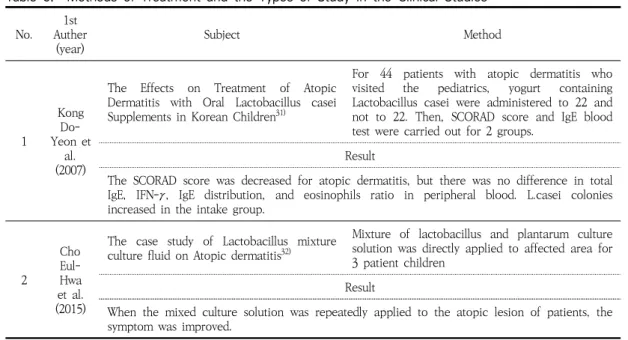
임상논문은 인체를 대상으로 일정한 처치를 시행하여 경과 및 효과를 관찰, 분석한 연구를 말한다. 본 논문에 서는 아토피 피부염 환자에게 직접 유산균이 들어있는 음료수를 복용시킨 실험이 1편이었고 Lactobacillus와 plantarum을 혼합 배양한 팩을 환부에 직접 발라 관찰 한 증례보고 1편만이 조사되었다(Table5).
3. 국외 논문 분석 결과
2005년부터 2019년까지 검색된 국외논문은 총 22 편이었다. 그 중 아토피 피부염 환자에게 직접 프로바 이오틱스를 경구투여한 임상실험 논문이 14편(63.6%), 아토피 유발 마우스를 대상으로 프로바이오틱스를 경구 투여한 실험논문이 5편(22.7%), 문헌고찰 연구가 2편
No.
1st Auther
(year)
Subject Method
1
Kong Do- Yeon et
al.
(2007)
The Effects on Treatment of Atopic Dermatitis with Oral Lactobacillus casei Supplements in Korean Children31)
For 44 patients with atopic dermatitis who visited the pediatrics, yogurt containing Lactobacillus casei were administered to 22 and not to 22. Then, SCORAD score and IgE blood test were carried out for 2 groups.
Result
The SCORAD score was decreased for atopic dermatitis, but there was no difference in total IgE, IFN-γ, IgE distribution, and eosinophils ratio in peripheral blood. L.casei colonies increased in the intake group.
2
Cho Eul- Hwa et al.
(2015)
The case study of Lactobacillus mixture culture fluid on Atopic dermatitis32)
Mixture of lactobacillus and plantarum culture solution was directly applied to affected area for 3 patient children
Result
When the mixed culture solution was repeatedly applied to the atopic lesion of patients, the symptom was improved.
Table 5. Methods of Treatment and the Types of Study in the Clinical Studies
(9.1%), 세포를 대상으로 프로바이오틱스의 유효성을 분석한 세포실험 논문이 1편(4.5%)으로 검색되었다.
1) 동물실험 분석결과
아토피 피부염 관련 동물실험논문은 총 5편이 검색되 었다. 모든 실험 대상동물은 아토피 유발생쥐인 BALB mouse를 사용하였고, 실험방법 또한 모두 경구투여를 실행하였다(Table 6).
2) 세포실험 분석결과
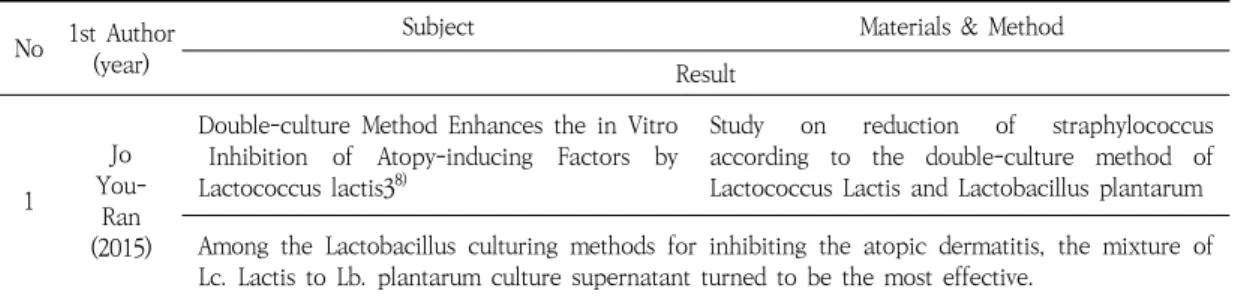
유산균과 아토피 피부염간의 유효성을 연구하는 과정 에서는 두 가지가 섞인 혼합균주를 이용해 배양방법에 따른 유효성의 차이를 실험한 논문 1편이 검색되었다 (Table 7).
3) 문헌고찰 분석결과
문헌고찰 논문은 아토피 피부염과 프로바이오틱스간 의 유효성을 검토한 논문 1편과 프로바이오틱스 서플리 먼트를 섭취했을 때 나타나는 효과를 고찰한 논문이 각 1편씩 검색되었다(Table 8).
No 1st Author (year)
Subject Materials & Method
Result
1
Park Mi-Sung
(2017)
Oral administration of lactobacilli isolated from Jeotgal, a salted fermented
seafood~~ 33)
Lactobacillus plantarum (JBcc105645 and JBCC105683) isolated from Jeotgal was orally administered to 5-week-old female BALB/c mice Lactobacilli Lactobacilli isolated from Jeotgal inhibited atopic cytokines such as IL-4 and
IFN-γ in skin lesions of mice with atopic dermatitis.
2
Kim Han-Wool
(2018)
A probiotic Mixture Regulates T cell Balance and Reduces Atopic Dermatitis Symptoms in Mice.34)
Duolac ATP(Mixture of L.casei CBTLC5, L.pantarum CBT LP3,L. rhamnosus CBTLR5,B.lactis CBT BL3) was orally administered to Balb/c mice and NC/Nga mice When Duolac ATP mixed with probiotics was administered to mice with atopic dermatitis, PD-L1 was promoted and anti-inflammatory cytokines IL-10 and TGF-β were increased.
3
Kwon Min-Sung
(2018)
Lactobacillus sakei WIKIM30 Ameliorates Atopic Dermatitis-Like Skin Lesions~~35)
L.sakei WIKIM30 was orally administered to Balb/c mice and BMDC/T cell experiment was carried out.
Oral administration of L. sakei WIKIM30 reduced the atopic dermatological lesions and IgE &
IL-4 levels in lymph nodes. It also lowered cytokine levels of Th2 and increased IL-10 in peripheral lymph nodes. WIKIM 30 modulated the intestinal microbiota in the mice with atopic dermatitis.
4
Yoshihiro Tokudome (2018)
Influence of Oral Administration of Lactic Acid Bacteria Metabolites~~~36)
Lactic acid bacteria metabolites was orally administered to mice with atopic dermatitis.
Oral administration of liquid Lactobacillus metabolites to the mice with atopic dermatitis improved the water content of the stratum corneum, the transdermal moisture loss, the AP of ceramide, and the epidermal thickness.
5
Kim Jong- Hwa (2018)
Cream Cheese-Derived Lactococcus chungangensis CAU 28 Modulates the Gut Microbiota and Alleviates Atopic Dermatitis in BALB/c Mice37)
Cream Cheese-Derived Lactococcus chungangensis CAU 28 was orally administered to BALB/c mice
When cream cheese-derived Lactococcus chungangensis CAU 28 was orally administered, it showed the atopic dermatitis improvements, such as the immune response related to single-chain fatty acids and the intestinal environment.
Table 6. Methods of Treatment and Evaluation in the Animal Experiment
No 1st Author (year)
Subject Materials & Method
Result
1
Jo You-
Ran (2015)
Double-culture Method Enhances the in Vitro Inhibition of Atopy-inducing Factors by Lactococcus lactis38)
Study on reduction of straphylococcus according to the double-culture method of Lactococcus Lactis and Lactobacillus plantarum Among the Lactobacillus culturing methods for inhibiting the atopic dermatitis, the mixture of Lc. Lactis to Lb. plantarum culture supernatant turned to be the most effective.
Table 7. Methods of Treatment and Evaluation in the Cell Experiment
No 1st Author (year)
Subject Materials & Method
Result
1
Garima Sharma
(2018)
Probiotics as a potential Immuno -modulating Pharmabiotics in Allergic Diseases: Current Status and Future Prospects39)
Study on probiotics including B. bifidum strain, L. plantarum CJLP133, B. lactis CECT8245 and improvement of atopic dermatitis
There have been many researches on probiotics effective to atopy and allergy, but the proven results are not sufficient. Therefore, demonstrable international standards for probiotics are needed and guidelines should be established.
2 Li L1 (2019)
Probiotic supplementation for Prevention of Atopic Dermatitis in Infants and Children40)
Probiotic supplement studies for Prevention of Atopic Dermatitis carried out till March 8, 2018 in PubMed, EBSCO, Embase and Web of Science databases
In a total of 28 studies including theses, probiotic supplements turned out to be effective for atopy. Ingestion of probiotics, especially when pregnant or newborn, can prevent the development of atopy in infancy and school age.
Table 8. Subjects and Methods in the Review Studies
No 1st Author (year)
Subject Materials & Method
Result
1
Vilianen M1 (2005)
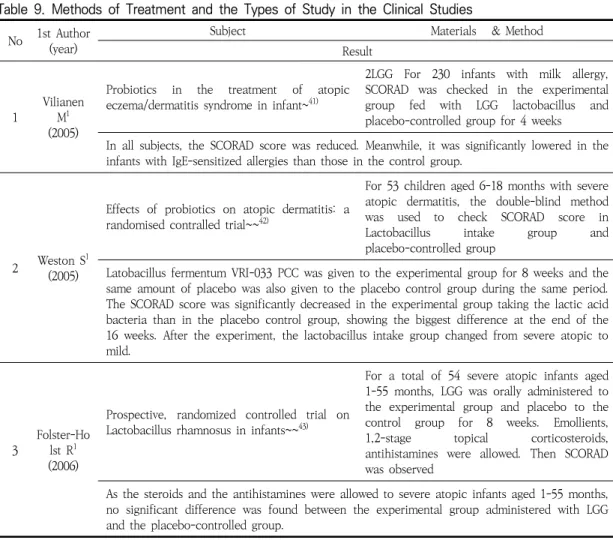
Probiotics in the treatment of atopic eczema/dermatitis syndrome in infant~41)
2LGG For 230 infants with milk allergy, SCORAD was checked in the experimental group fed with LGG lactobacillus and placebo-controlled group for 4 weeks
In all subjects, the SCORAD score was reduced. Meanwhile, it was significantly lowered in the infants with IgE-sensitized allergies than those in the control group.
2 Weston S1 (2005)
Effects of probiotics on atopic dermatitis: a randomised contralled trial~~42)
For 53 children aged 6-18 months with severe atopic dermatitis, the double-blind method was used to check SCORAD score in Lactobacillus intake group and placebo-controlled group
Latobacillus fermentum VRI-033 PCC was given to the experimental group for 8 weeks and the same amount of placebo was also given to the placebo control group during the same period.
The SCORAD score was significantly decreased in the experimental group taking the lactic acid bacteria than in the placebo control group, showing the biggest difference at the end of the 16 weeks. After the experiment, the lactobacillus intake group changed from severe atopic to mild.
3
Folster-Ho lst R1 (2006)
Prospective, randomized controlled trial on Lactobacillus rhamnosus in infants~~43)
For a total of 54 severe atopic infants aged 1-55 months, LGG was orally administered to the experimental group and placebo to the control group for 8 weeks. Emollients, 1,2-stage topical corticosteroids, antihistamines were allowed. Then SCORAD was observed
As the steroids and the antihistamines were allowed to severe atopic infants aged 1-55 months, no significant difference was found between the experimental group administered with LGG and the placebo-controlled group.
Table 9. Methods of Treatment and the Types of Study in the Clinical Studies
No 1st Author (year)
Subject Materials & Method
Result
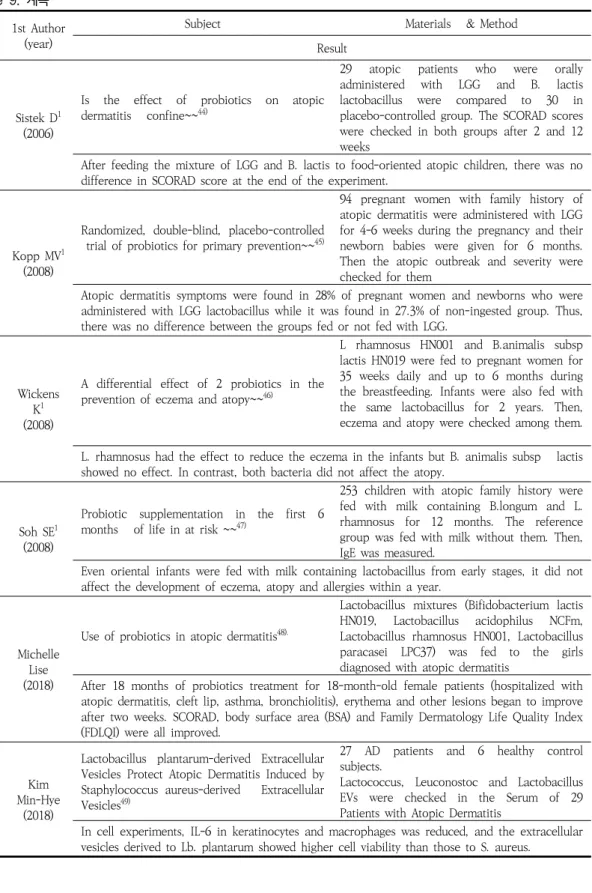
4 Sistek D1 (2006)
Is the effect of probiotics on atopic dermatitis confine~~44)
29 atopic patients who were orally administered with LGG and B. lactis lactobacillus were compared to 30 in placebo-controlled group. The SCORAD scores were checked in both groups after 2 and 12 weeks
After feeding the mixture of LGG and B. lactis to food-oriented atopic children, there was no difference in SCORAD score at the end of the experiment.
5 Kopp MV1 (2008)
Randomized, double-blind, placebo-controlled trial of probiotics for primary prevention~~45)
94 pregnant women with family history of atopic dermatitis were administered with LGG for 4-6 weeks during the pregnancy and their newborn babies were given for 6 months.
Then the atopic outbreak and severity were checked for them
Atopic dermatitis symptoms were found in 28% of pregnant women and newborns who were administered with LGG lactobacillus while it was found in 27.3% of non-ingested group. Thus, there was no difference between the groups fed or not fed with LGG.
6
Wickens K1 (2008)
A differential effect of 2 probiotics in the prevention of eczema and atopy~~46)
L rhamnosus HN001 and B.animalis subsp lactis HN019 were fed to pregnant women for 35 weeks daily and up to 6 months during the breastfeeding. Infants were also fed with the same lactobacillus for 2 years. Then, eczema and atopy were checked among them.
L. rhamnosus had the effect to reduce the eczema in the infants but B. animalis subsp lactis showed no effect. In contrast, both bacteria did not affect the atopy.
7 Soh SE1 (2008)
Probiotic supplementation in the first 6 months of life in at risk ~~47)
253 children with atopic family history were fed with milk containing B.longum and L.
rhamnosus for 12 months. The reference group was fed with milk without them. Then, IgE was measured.
Even oriental infants were fed with milk containing lactobacillus from early stages, it did not affect the development of eczema, atopy and allergies within a year.
8
Michelle Lise (2018)
Use of probiotics in atopic dermatitis48).
Lactobacillus mixtures (Bifidobacterium lactis HN019, Lactobacillus acidophilus NCFm, Lactobacillus rhamnosus HN001, Lactobacillus paracasei LPC37) was fed to the girls diagnosed with atopic dermatitis
After 18 months of probiotics treatment for 18-month-old female patients (hospitalized with atopic dermatitis, cleft lip, asthma, bronchiolitis), erythema and other lesions began to improve after two weeks. SCORAD, body surface area (BSA) and Family Dermatology Life Quality Index (FDLQI) were all improved.
9
Kim Min-Hye
(2018)
Lactobacillus plantarum-derived Extracellular Vesicles Protect Atopic Dermatitis Induced by Staphylococcus aureus-derived Extracellular Vesicles49)
27 AD patients and 6 healthy control subjects.
Lactococcus, Leuconostoc and Lactobacillus EVs were checked in the Serum of 29 Patients with Atopic Dermatitis
In cell experiments, IL-6 in keratinocytes and macrophages was reduced, and the extracellular vesicles derived to Lb. plantarum showed higher cell viability than those to S. aureus.
Table 9. 계속
No 1st Author (year)
Subject Materials & Method
Result
10
M.
Dolores Ibanes (2018)
Effect of synbiotic supplementation on children with atopic dermatitis: an observational prospective study50)
Synbiotic supplementation (Lb.casei, Bd. lactis,
Lb.rhamnosus, Lb. plantarum,
f r u c t o o l i g o s a c c h a r i d e s , galactooligosaccharides, biotin) were orally administered to patients with atopic dermatitis for 8 weeks
When synbiotic (a mixture of probiotics and prebiotics) was orally administered to children with atopic dermatitis, both SCORAD and VAS were reduced. The number of patients with moderate severity was also lowered.
11
Edyta Krzch Falta (2018)
Probiotics: Myths of facts about their role in allergy prevention51)
Lb. rhamnosus, Lb.helveticus, Trilac were orally administered to patients with food allergy, atopic dermatitis, asthma and rhinitis According to the questionnaire survey for Polish people, the ingestion of live lactic acid bacteria in childhood (6-7 years) was not closely associated with atopic dermatitis, while supplementing the live lactic acid bacteria through habitual diets in adolescence (13-14 years) was more effective for allergic diseases.
12
Vicente Navarro- Lopez (2018)
Effect of Oral Administration of a Mixture of Probiotic Strains on SCORAD Index and Use of Topical Steroids in Young Patients with Moderate Atopic Dermatitis52)
A mixture of Bifidobacterium lactis CECT 8145, B longum CECT 7347 and Lactobacillus casei CECT 9104 was orally administered to 50 patients aged 4-17 years with severe atopic dermatitis for 12 weeks.
Children with atopic dermatitis who ate oral probiotics mixtures had significantly lower levels of SCORAD than those who did not ingest. The amount of steroids used locally was also reduced.
13
Sofia Reddel (2019)
Gut microbiota profile in children affected by atopic dermatitis and evaluation of intestinal persistence of probiotic mixture.53)
B.breve BR03 and L. salivarius LS01 were orally administered to 19 atopic dermatitis patients aged 0-16 years
Consuming the probiotics alone does not improve the atopic dermatitis. These probiotics are effective when the time for their transformation into beneficial bacteria in the intestine, their duration, and their balance with harmful bacteria are all met.
14
Schmidt RM1 (2019)
Probiotics in late infancy reduce the incidence of eczema : A randomized controlled trial54)
290 preschool children were divided into a group fed with mixture of L. rhamnosus and B. animalis subsp lactis and a placebo-controlled group and tested for 6 months.
There was no significant difference in the incidence of eczema between the mixed Lactobacillus intake group and the placebo control group. The period of preschoolers seems to have little to do with lactic acid bacteria.
Table 9. 계속
4) 임상실험 분석결과
임상논문은 총 14편이 검색되었다. 실험대상을 아토 피 피부염을 가지고 있는 영. 유아에게 유산균을 복용 시킨 후 변화를 관찰한 논문이 14편이었고 아토피피부
염 가족력이 있는 임산부에게 출산전후 일정기간동안 유산균을 복용시키고 그녀들이 출산한 신생아들에게도 복용시키는 방법으로 연구한 논문이 2편이 검색되었다 (Table 9).
4. 연구 방법에 따른 분류
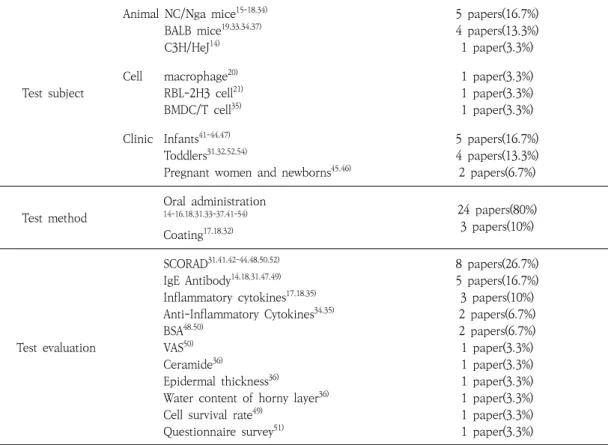
총 실험논문 30편을 각각 실험 진행 방법에 따라 분 류한 결과, 동물실험에서 가장 많이 사용된 동물은 아 토피 유발 생쥐인 NC/Nga mice가 5편(16.7%)으로 가장 많았고, 임상실험에 참여한 대상에는 유아가 가장 많았으며 5편(16.7%), 실험 진행방법은 유산균을 직접 경구 투여시키는 경우가 24편(80%)으로 도포하는 방법 3편(10%)보다 우세하게 많았다. 아토피피부염이 유산 균과의 유효성을 검증하는 척도로는 SCORAD 방법 8 편(26.7%), IgE 항체의 변화 5편(16.7%), 염증에 관여 하는 사이토카인 3편(10%) 순으로 나타났다.
5. 연구에 사용된 유산균 균주 종류별 순위 아토피 피부염과 프로바이오틱스 유효성을 검증하기 위해 사용된 균주의 종류를 분석해보았다. 실험논문 총
Test subject
Animal NC/Nga mice15-18,34)
BALB mice19,33,34,37)
C3H/HeJ14)
5 papers(16.7%) 4 papers(13.3%) 1 paper(3.3%) Cell macrophage20)
RBL-2H3 cell21) BMDC/T cell35)
1 paper(3.3%) 1 paper(3.3%) 1 paper(3.3%) Clinic Infants41-44,47)
Toddlers31,32,52,54)
Pregnant women and newborns45,46)
5 papers(16.7%) 4 papers(13.3%) 2 papers(6.7%)
Test method
Oral administration
14-16,18,31,33-37,41-54)
Coating17,18,32)
24 papers(80%) 3 papers(10%)
Test evaluation
SCORAD31,41,42-44,48,50,52)
IgE Antibody14,18,31,47,49)
Inflammatory cytokines17,18,35)
Anti-Inflammatory Cytokines34,35) BSA48,50)
VAS50) Ceramide36)
Epidermal thickness36) Water content of horny layer36) Cell survival rate49)
Questionnaire survey51)
8 papers(26.7%) 5 papers(16.7%) 3 papers(10%) 2 papers(6.7%) 2 papers(6.7%) 1 paper(3.3%) 1 paper(3.3%) 1 paper(3.3%) 1 paper(3.3%) 1 paper(3.3%) 1 paper(3.3%)
Table 10. Classification of subjects, method, and evaluation for experiment
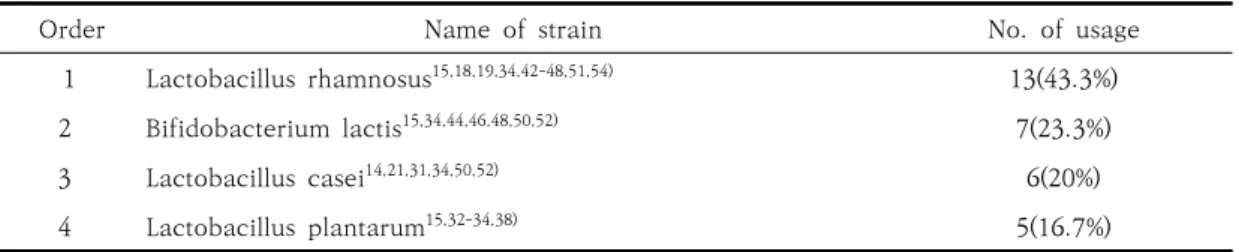
30편 중에 제일 많이 중복 사용된 균주는 Lacto- bacillus rhamnosus 13편(43.3%)였고 Bifido- bacterium lactis 7편(23.3%)Lactobacullus casei 6 편(20%), Lactobacillus plantarum 5편(16.7%)순으 로 나타났다(Table 11).
6. 아토피피부염과 유산균의 유효성 분석 아토피피부염과 프로바이오틱스의 유효성을 분석한 결과 총 실험논문 30편 가운데 23편(76.7%)이 유효하 다는 결과를 나타냈고 유효하지 않다는 내용이 9편 (30%)으로 나타났다. 유효하다는 논문들의 내용을 살펴 보면 염증을 유발시키는 사이토카인의 감소 7편 (30.4%), SCORAD 점수 감소 5편(21.7%), 염증을 억 제시키는 사이토카인 증가 4편(17.3%) 순으로 이용되 었고 유효내용으로는 다음과 같은 순서대로 나타났다 (Table 12).
Order Name of strain No. of usage
1 Lactobacillus rhamnosus15,18,19,34,42-48,51,54) 13(43.3%)
2 Bifidobacterium lactis15,34,44,46,48,50,52) 7(23.3%)
3 Lactobacillus casei14,21,31,34,50,52) 6(20%)
4 Lactobacillus plantarum15,32-34,38) 5(16.7%)
Table 11. The Sorts of Probiotics to Use in Experiment
Validity
checkup Validity content
Valid.
23 papers (76.7%)
1. Reduction of inflammatory cytokine19,31,41,42,49,50,52) 7 papers(30.4%) 2. Reduction of SCORAD score31,41,42,50,52) 5 papers(21.7%) 3. Increase of inflammatory inhibitory cytokines16,21,34,35) 4 papers(17.3%)
4. Reduction of serum IgE14,15,18) 3 papers(13.0%)
5. Inhibition of Mast Cell Degranulation20,21) 2 papers(8.7%)
6. Improvement of stratum corneum36) 1 paper (4.3%)
7. Increase of cell survival rate46) 1 paper (4.3%)
Not valid.
9 papers (30%)
1. No difference between control group and experimental group31,43-45,48,54). 6 papers(66.7%) 2. Effective for eczema but not for atopy46). 1 paper(11.1%) 3. Not effective within 1 year after ingestion53). 1 paper(11.1%) 4. Depends on the period, but little effective51). 1 paper(11.1%)
Table 12. The Efficacy in Atopic Dermatitis with Probiotics
Ⅳ. 고 찰
아토피 피부염(Atopic dermatitis)는 주로 영, 유아 부터 성인에 까지 광범위하게 유발되는 만성적 또는 재 발성 염증 피부질환이다. 한번 발병하면 과민 반응으로 인해 피부를 긁게 되고 이는 홍반, 짓무름, 부종과 혈 종, 가려움, 그리고 태선화 등으로 이어진다. 아토피 피 부염의 발병 원인은 아직까지 명확히 규명되지 않았으 나 서양의학 분야에서는 유전적인 요인, 환경적인 요인
1), 그리고 면역학적 이상2), 피부장벽의 손상3), 장관미 생물과의 상관관계4) 등 복합적인 요인들이 동시에 관여 하는 것으로 알려져 있다. 반면 한의학계에서는 아토피 피부염을 風熱, 濕熱, 血熱, 脾虛濕盛, 陰虛을 원인으로
보고 있으며 병증으로 胎熱 등이 나타난다고 보고 있다
5). 아토피 피부염의 발현과 중증 여부를 진단하는 기준 중에는 염증을 유발하는 사이토카인, 항염 작용을 하는 사이토카인의 수치와 혈청 내 immunoglobulin- E(IgE) 농도 등이 있는데 증상이 심할수록 염증유발 사 이토카인과 혈청 내 IgE 수치가 높게 나타난다. 또한 피부염이 나타나는 각 병변에 따라 점수를 매기는 SCORAD 점수도 아토피피부염의 진단 지표 중 하나로 흔하게 제시된다. 혈청 내 IgE 수치와 염증사이토카인 그리고 SCORAD 점수가 감소하였다는 것은 아토피 피 부염 증상이 완화되었다는 것을 말한다 할 수 있다. 현 재까지 널리 알려진 아토피 피부염의 치료 방법은 건조 된 피부에 보습을 주거나 염증 억제제인 스테로이드제
의 연고 등 외용제, 항히스타민제의 도포나 복용 그리 고 면역반응 억제제 등이 흔히 사용되고 있다8). 이러한 치료제는 매우 짧은 기간에는 효과적인 증상 완화 결과 를 나타내고 있으나, 만성적 증상에 장기간 사용할 때 에 피부가 위축되는 등 부작용이 따르며 약 복용을 중 단하며 병변의 재발 가능성이 높으므로9) 안전하고 효과 적인 새로운 보완 대체 치료법이 요구되고 있다. 가장 대표적인 것이 프로바이오틱스인데 ‘프로바이오틱스 (Probiotics)란 World Health Organization(WHO) 에서는 ‘적절한 양으로 투여 되었을 때 숙주의 건강에 이로움을 주는 살아있는 미생물’로 정의하고 있다 (WHO 2002)10). Lactobacillus나 Bifidobacterium 으로 대변되는 유산균은 프로바이오틱스의 대부분을 차 지하고 있으며11) 처음 국내에서는 정장작용을 하는 대 표적인 건강기능식품으로 인식되어왔으나 2010년 이후 프로바이오틱스를 표기할 때 ‘유산균 이용제품’에서 ‘프 로바이오틱스’로 변경되면서 보다 포괄적인 개념으로 전이되었다10). 따라서 본 연구에서는 프로바이오틱스와 유산균을 갖은 개념으로 이해하고 사용하기로 하였다.
프로바이오틱스는 섭취했을 때 체내에서 유익한 효과를 나타낼 뿐 아니라 부작용도 거의 없어 비교적 안전하다 고 알려져 있다. 프로바이오틱스중 Lactobacillus GG 균, Rhamnosus균, Bifidus균 등은 아토피 피부염과 관련해서 지나치게 항진된 Th2 사이토카인을 억제하고 저하된 Th1 사이토카인을 증진시켜 면역의 균형을 맞 춰줌으로 아토피 피부염을 치료하는데 매우 긍정적인 보고가 있다12). 실지로 아토피 피부염 질환을 가진 유 아에게 프로바이오틱스를 섭취시켰을 때 상당한 치료효 과가 나타난다는 보고가 발표되면서13) 균주에 대한 안 전성, 유효성에 관한 평가 기준이 제고되면서 많은 연 구들이 가속화 되고 있다. 2005년부터 2019년까지 프 로바이오틱스와 아토피 피부염, 프로바이오틱스와 알레 르기성 피부염의 상관관계 중 유효성에 관련된 논문을 검색해 분석해 보았을 때, 국내외 모두 41편이 검색되 었다. 검색어로는 아토피 피부염과 프로바이오틱스가 활용되었다. 알레르기성 피부염과 프로바이오틱스에 대
해 국내외 학회지에 발표된 논문들을 검색한 결과 국내 논문 19편 중 동물과 세포로 한 실험논문이 8편 (42.1%)으로 제일 많았고 임상논문이 2편(10.5%)으로 가장 적은 반면, 국외논문은 총 22편 가운데 임상논문 이 14편(63.6%)으로 가장 많았고 문헌을 고찰한 논문 이 2편(9.1%)으로 가장 적었다. 국내 동물대상 실험논 문 6편에서는 주로 아토피 유발 생쥐모델인 NC/Nga 마우스(4편)를 사용해 아토피 피부염을 유발시킨 후 유 산균등을 직접 경구투여 시키거나 병변에 도포하였다.
전후를 비교한 실험 결과는 6편 모두 유산균을 처치하 기 전 보다 처치하고 난 후 혈청 IgE가 감소하고 IL-4, TNF-α와 같은 염증을 일으키는 사이토카인이 감소되었 고 항알레르기와 면역균형에 유의한 효과가 있는 것으로 나타났다. 국내 세포실험 2편에서 실험대상으로 사용한 유산균 균주로는 Pediococcus acidilactici J9와 Lactobacillus casei 383, Leuconostoc mesen- teroides 4395의 혼합균주가 이용되었으며 2편에서도 염증 유발 사이토카인인 TNF-α등이 감소되었거나 항 알레르기에 유의한 효과를 나타내는 것으로 나타났다.
국외논문에서는 검색된 총 22편의 논문 가운데, 동물 을 대상으로 실험한 논문 5편 중 아토피 유발 생쥐모델 을 BALB/c 모델을 사용한 경우가 4편으로 가장 많았 고, 5편 모두 경구투여 시키는 방법을 진행하였다. 결과 로는 아토피 유발 생쥐 모두에게 유산균을 복용시켰더 니 표피 각질층의 경피 수분 손실과 세라마이드가 개선 되었고36), 항염 사이토카인(IL-10)은 증가하였고 염증 을 일으키는 사이토카인(IL-4 등)은 줄어드는 것35)으로 나타났다. 국외 논문들 중 세포실험에서는 유산균 단일 균주를 사용했을 때와 두 가지 균주를 혼합 배양했을 때를 비교해 혼합방법에 따라 효과의 차이가 있음을 보 여주었다. 최근에 발표된 국외논문 중 문헌고찰 2편에 서는 유산균과 아토피 피부염의 상관관계에서는 유의한 효과가 있는 것을 연구한 반면, 유산균 섭취시기에 따 라 다른 효과가 나타날 가능성을 제기하면서 빠른 시일 내에 광범위하게 아토피 피부염 등을 치료 가능한 유산 균의 종류와 국제적 기준 및 가이드라인 확립이 필요함