Journal of Bacteriology and Virology 2015. Vol. 45, No. 2 p.104 – 111 http://dx.doi.org/10.4167/jbv.2015.45.2.104
Molecular Characterization of Community-Associated
Methicillin-Resistant and Methicillin-Susceptible Staphylococcus aureus Isolates from Children with Skin Infections in Busan, Korea
So Hae Park1, Ki Ju Kim1, Byoung Kuk Kim2 and Soo Myung Hwang1*
1Department of Clinical Laboratory Science, Catholic University of Pusan, Busan; 2Department of Laboratory Medicine, Busan St. Mary's Hospital, Busan, Korea
The prevalence and molecular characteristics of community-associated methicillin-resistant Staphylococcus aureus (CA-MRSA) and methicillin-susceptible S. aureus (CA-MSSA) from children with skin infection were investigated by staphylocoagulase (SC) typing, multilocus sequence typing (MLST), SCCmec typing and virulent toxins, including Panton-Valentine leucocidin (PVL), and exfoliative toxins (ET). Among 69 cases of CA-S. aureus for a 3 month period from March to June, 2014 at hospital in Busan, 28 (40.6%) were MRSA and 41 (59.4%) were MSSA. Of the 28 CA-MRSA isolates, two major clones were identified as SC type Vb-ST72-SCCmec type IV (53.6%) and SC type l-ST89-SCCmec type II variant (42.8%), and the remaining one (3.6%) was SC type lll-ST8-SCCmec type IV. In CA-MSSA, the prevalent clone was SC type Vb-ST72 (29.3%), followed by SC type Vb-ST188 (21.9%), SC type Va-ST121 (19.5%) and SC type lV-ST30 (9.6%). None was positive for PVL gene, and all of the SC type l-ST89-SCCmec type II variant clones were ETB gene positive. The data suggest that there are significant clonal relatedness with specific SC types, and genetic diversities in both community strains isolated from children with skin infections.
Key Words: Community-associated MRSA, Staphylocoagulase type, Sequence type, SCCmec type, Skin infection
INTRODUCTION
Staphylococcus aureus is a major human pathogens and causative agent of skin and soft tissue infections and in- vasive disease with high rates of morbidity and mortality (1~3). Resistance of staphylococci to several antimicrobial agents contributes to their ability to survive in the hospital environment and to spread among patients and community.
Methicillin-resistant Staphylococcus aureus (MRSA) infec- tions were first detected in hospitals (healthcare associated,
HA-MRSA) (4). However, in recent year the emergence of community-associated methicillin-resistant S. aureus (CA- MRSA) infections involving children without health care- associated risk factors has been a serious public health problems (5, 6). Resistance to methicillin and other β-lactam antibiotics is caused by the mecA gene, which is situated on a mobile genetic element, staphylococcal cassette chromo- some mec (SCCmec) (1, 7, 8). CA-MRSA strains are characterized by the predominance of SCCmec type IV or V, the lack of multi-drug resistance, and often associated with Panton-Valentine leucocidin (PVL) toxin. In addition,
104
Original Article
Received: May 1, 2015/ Revised: May 11, 2015/ Accepted: May 13, 2015
*Corresponding author: Soo Myung Hwang. Department of Clinical Laboratory Science, Catholic University of Pusan, Busan 609-757, Korea.
Phone: +82-51-510-0563, Fax: +82-51-510-0568, e-mail: [email protected]
○CCThis is an Open Access article distributed under the terms of the Creative Commons riAttbution Non-Commercial License (http://creativecommons.org/license/by-nc/3.0/).
molecular characterizations, such as pulsed-field gel electro- phoresis (PFGE) and multilocus sequence types (STs), allow the genotypes of CA-MRSA to be distinguished from HA- MRSA (9~11). However, some CA-MRSA strains have now acquired multidrug resistance and have been shown diverse clones with virulence factors worldwide (1).
Various molecular typing methods have been developed to investigate the spread and evolution of pathogenic organisms.
Multilocus sequence typing (MLST) (2, 12, 13) and SCCmec typing (7, 8) are widely used to identify molecular epidemio- logical characteristics among S. aureus isolates. In addition, staphylocoagulase (SC) serotyping have been used as an epidemiological marker (14~16).
The production of coagulase causing the plasma coagu- lation is one of the important characteristics of S. aureus.
Staphylocoagulase has been classified into 10 serotypes based on the differences in antigenicity by inhibition assay using type-specific antibodies against each type of SC proteins (16). The SC genes (coa) were composed of six fundamental segments: signal sequence at N-terminal, D1 region, D2 region, central region, 27 amino acid repeat region and C-terminal sequence of 5 amino acids. Comparison of nucleotide sequences of coa of 10 serotypes showed D1 and D2 regions were more diverse than those of other regions (16). We reported the distribution and phenotypic changes of SC serotypes in S. aureus isolates from clinical sources and nasal cavities of healthy persons, 1994~2005 (17). On the data, serotype V was rapidly increased in both MRSA and MSSA strains, and phenotypic changes of SC in Korean strains were confirmed. Recently, SC genotypes based in the differences among the regions of SC gene, and the genetic diversity of SC and relatedness to chromosome types was reported (18, 19). However, there are few data on genotypic variation of SC, and relatedness to clonal complex defined by MLST in community associated S. aureus.
In this study, we investigated the SC types, MLST, SCCmec types and toxin genes, Panton-Valentine leucocidin (PVL) and exfoliative toxins (ETA or ETB) of CA-MRSA and CA-MSSA isolates, and compared the clonal relatedness with SC types as an epidemiological background of Korean strains.
MATERIALS AND METHODS
Bacterial strains, identification, and antimicrobial susceptibility testing
A total of 69 S. aureus strains isolated from pediatric patients (0 to 16 years old) with skin infections in St. Mary's Hospital in Busan, Korea, between March and June 2014, were used in this study. Community-associated (CA) isolates were identified according to the standard epidemiological definitions of the Centers for Disease Control and Pre- vention (CDC) (20). All strains were unique isolates from different patients. The Vitek 2 automated system (bioMérieux, Marcy l' Etoile, France) was used for microbiological identi- fication and antimicrobial susceptibility testing using a standard identification card and the modified broth micro- dilution method. The antibiotics tested included oxacillin, clindamycin, erythromycin, gentamycin, fusidic acid, cipro- floxacin, mupirocin, telithromycin, tetracycline and vanco- mycin. The S. aureus ATCC29213 strain was used for quality control.
DNA preparation
Genomic DNA was extracted from each isolate using the AccuPrep DNA Extraction kit (Bioneer, Daejeon, Korea) according to the manufacturer's protocol. MRSA isolates were initially identified using oxacillin resistance and confirmed for the presence of the mecA gene by PCR as described previously (21).
Staphylocoagulase (SC) typing
The SC genotypes were determined by the multiplex- PCRs (M-PCRs) assay consisting of specific primers identi- fying type l to X, and V subtypes, a and b, as described by Hirose et al. (18). Four sets of primer mixes were prepared according to a slightly modified Hirose's method. Multiplex primer set 1 and set 2 contained primers for identifying the SC gene of type l, ll, and lll, and primers for lV, Va and Vl, respectively. Multiplex primer set 3 and set 4 contained primers for identifying the SC gene of type Vll, Vlll and X, and primers for lX and Vb, respectively. The PCR was done
using premixed PCR reagent (Bioneer, Daejeon, Korea) with a total reaction volume of a 20 μl containing 25 ng of genomic DNA, 5 pmole of each primer. Amplification was performed with the MycyclerTM thermal cycler (Bio-Rad, Hercules, CA, USA), using 30 cycles of 94℃ for 30 sec, 55℃ for 30 sec, and 72℃ for 1 min. The final extension was allowed to continue for 5 min. PCR products were analyzed by electrophoresis on 1.5% agarose gel in Tris- acetate-EDTA buffer containing ethidium bromide. The reference strains of SC types used in this study were SHM48 (type l), SHD5 (type), USA300 (type lll), Cowan I (type lV), SHD25 (type V), SHM47 (type Vl), MW2 (type Vll), SHD19 (type Vlll) and SHB61 (type X).
Multilocus sequence typing (MLST)
MLST is based on sequence analysis of PCR products from seven S. aureus housekeeping genes, that is, arcC, aroE, glpF, gmk, pta, tpi, and yquiL. DNA from each isolate was amplified by PCR in a 20 μl reaction volume for the each of the seven MLST loci by using the primers and protocols as described previously (13). Each locus was subsequently sequenced using the Applied Biosystem 3730 sequencer with the BigDye Terminator cycle sequencing kit v3.1 (Applied Biosystems, Foster City, CA, USA). Allele numbers were assigned using the MLST website (http://
www.mlst.net) and sequence types (STs) were determined using a browsable database (http://saueus.mlst.net/).
SCCmec typing
SCCmec types of MRSA isolates were determined by using a multiplex PCR strategy as proposed by Olveira and de Lencastre (7). SCCmec elements were distinguished by the combination of ccr type and mecA complexes, which generates a specific amplification pattern for SCCmec types I to V.
Detection of toxin genes
All of the S. aureus isolates were screened for PVL genes (pvl) and exfoliative toxin genes (eta and etb) by PCR with primers as previously described (22, 23).
RESULTS Clinical characteristics of S. aureus
From March to June 2014, 69 non duplicated S. aureus isolates were collected from pediatric patients with skin infections in Busan, Korea. CA-S. aureus was defined as a positive culture from outpatients or inpatients who had no history of hospitalization or admission to a long term care facility within one year. Methicillin resistance was confirmed by PCR amplification of the mecA gene. Of the 69 CA-S.
aureus cases, 28 (40.6%) were MRSA and 41 (59.4%) were MSSA. The common lesions caused by CA-S. aureus were impetigo (92.9% in MRSA) and staphylococcal scalded skin syndrome (SSSS) (7.1% in MRSA), and atopic dermatitis, unspecified (100% in MSSA).
Molecular characteristics of CA-MRSA
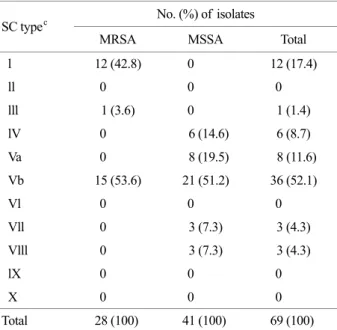
The molecular characteristics of the 28 MRSA strains from the patients with impetigo and SSSS were examined by SC typing, MLST, SCCmec typing and toxin genes. The most prevalent SC genotype was type Vb (53.6%), followed by type l (42.8%), and type lll (3.6%) (Table 1). In present study, we confirmed SC genotype Vb, which has known as SC serotype V, was predominant in community associated strains of S. aureus. In addition, the SC type l was not identified in any of the MRSA and MSSA isolated from clinical sources except for skin infection.
MLST sequence data were obtained for all strains of CA-MRSA and CA-MSSA based on seven unlinked genetic loci including conserved and variable regions of arcC, aroE, glpF, gmk, pta, tpi, and yquiL. The seven loci yielded 3 sequence types, ST72, ST89, and ST8 in CA-MRSA (Table 2). Of the 28 strains, 15 (53.6%) and 12 (42.8%) strains were ST72 and ST89, respectively, and the remaining one strain was ST8. The major occurrence of ST89 strains in CA-MRSA from skin infections represented the clonal differences in CA-MRSA or HA-MRSA isolates from several clinical sources except for skin.
The 28 CA-MRSA strains were classified into 2 SCCmec types, IV (57.1%) and II variant (42.9%). SCCmec type II
variant was defined as distinguished from SCCmec type II, carring ccr2, class A mec, PUB110, dcs and mecI but not kdp. SCCmec type IV were detected in ST72 and ST8 strains, and SCCmec type II variant was detected in all ST89 strains. All strains were PVL gene negative. ETB gene was detected mainly in all ST89 and two ST72 strains of MRSA, whereas ETA gene was not detected in MRSA strains. TSST-1 gene was detected in ST8 strain.
Overall, we detected 3 different genetic clones among the 28 CA-MRSA isolates. SC type Vb-ST72-SCCmec type
IV was the predominant clone (n=15, 53.6%), followed by SC type l-ST89-SCCmec type II variant (n=12, 42.8%) and SC type lll-ST8-SCCmec type IV (n=1, 3.6%). All the strains were negative for PVL gene. However ETB toxin, which was absent in MSSA, was variously found in up to 14 (7.1% to 100%) of these 28 strains (Table 2).
Molecular characteristics of CA-MSSA
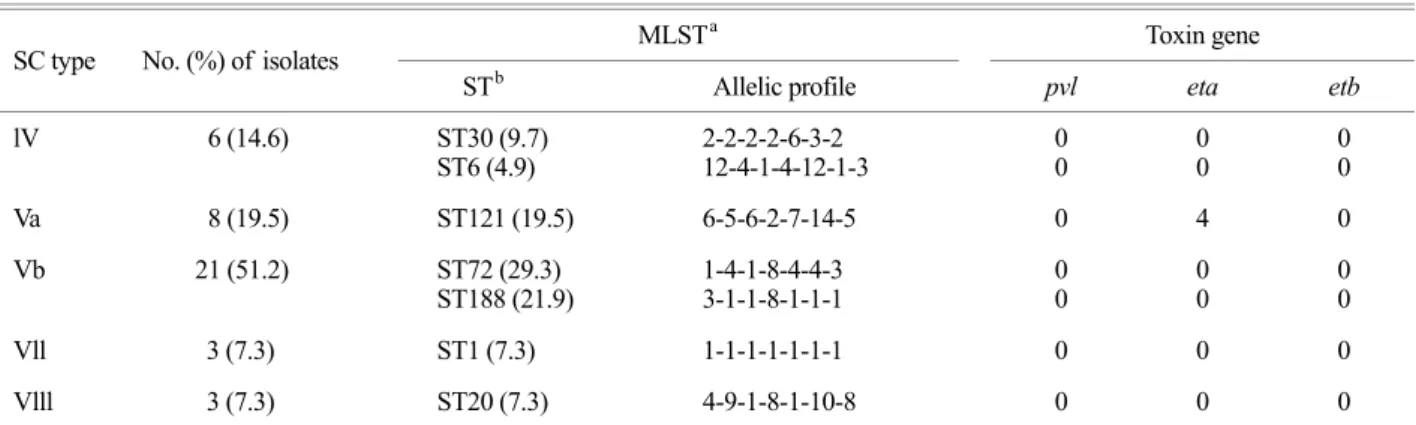
The 41 CA-MSSA isolates were classified into 5 SC types and 7 ST types. The most prevalent SC genotype was type Vb (51.2%) and Va (19.5%), followed by lV (14.6%), Vll (7.3%) and Vlll (7.3%), which were not identified in MRSA strains (Table 1). As for the MRSA strains, the MSSA strains showed high prevalent SC type Vb. The 7 ST types were identified as ST72 (29.3%), ST188 (21.9%), ST121 (19.5%), ST30 (9.6%), ST1 (7.3%), ST20 (7.3%), and ST6 (4.9%) (Table 3). No PVL, ETB and TSST-1 genes were detected in any of MSSA isolates, but ETA gene was detected in four ST121 strains. Overall, the most prevalent clone was SC type Vb-ST72 (29.3%), followed by SC type Vb-ST188 (21.9%), SC type Va-ST121 (19.5%). The re- maining clones were SC type lV with ST30 (9.6%) and ST6 (4.9%), SC type Vll-ST1 (7.3%), and SC type Vlll-ST20 (7.3%). In contrast to the CA-MRSA isolates, considerable molecular variability existed among the CA-MSSA isolates.
Antimicrobial susceptibilities
Antimicrobial resistance rates of the CA-MRSA and CA- MSSA isolates according to sequence types are summarized in Table 4. Among CA-MRSA isolates, ST89 clone showed high rates of resistance to clindamycin, erythromycin, genta- Table 1. Distribution of staphylocoagulase types in CA-MRSAa
and CA-MSSAb isolates
SC typec No. (%) of isolates
MRSA MSSA Total
l 12 (42.8) 0 12 (17.4)
ll 0 0 0
lll 1 (3.6) 0 1 (1.4)
lV 0 6 (14.6) 6 (8.7)
Va 0 8 (19.5) 8 (11.6)
Vb 15 (53.6) 21 (51.2) 36 (52.1)
Vl 0 0 0
Vll 0 3 (7.3) 3 (4.3)
Vlll 0 3 (7.3) 3 (4.3)
lX 0 0 0
X 0 0 0
Total 28 (100) 41 (100) 69 (100)
a CA-MRSA: community-associated methicillin-resistant Staphy- lococcus aureus, b MSSA: methicillin-susceptible Staphylococcus aureus, c Staphylocoagulase type
Table 2. Molecular characteristics of 28 CA-MRSA isolates
SC type No. (%) of isolate MLSTa
SCCmecc type Toxin gene
STb Allelic profile pvl eta etb
l 12 (42.8) ST89 (42.8) 1-26-28-18-18-33-50 II variant 0 0 12
lll 1 (3.6) ST8 (3.6) 3-3-1-1-4-4-3 IV 0 0 0
Vb 15 (53.6) ST72 (53.6) 1-4-1-8-4-4-3 IV 0 0 2
a MLST: multilocus sequence typing, b ST: sequence type, c SCCmec: staphylococcal cassette chromosome mec
mycin, and mupirocin than those of ST72 and ST8 clones, while all isolates exhibited susceptibility to fusidic acid and vancomycin. CA-MSSA isolates were more likely to be susceptible to clindamycin, erythromycin, gentamycin, and mupirocin, but were significantly resistant to fucidic acid except for ST30 and ST6, identifed as SC lV types. In comparison of antibiotics resistance patterns among clonal sequence types, considerable differences existed in both CA-MRSA and MSSA.
DISCUSSION
Incidence of infections caused by CA-MRSA, including infections in children with no risk factors, has increased worldwide as a community pathogen. This present study constitutes a comparison of the molecular epidemiology and the genetic characteristics in CA-MRSA and CA-MSSA strains isolated from children with skin infections. CA- MRSA, which accounts for 40.6% of CA-S. aureus, was isolated from children with impetigo (92.9%) and SSSS Table 3. Molecular characteristics of 41 CA-MSSA isolates
SC type No. (%) of isolates MLSTa Toxin gene
STb Allelic profile pvl eta etb
lV 6 (14.6) ST30 (9.7)
ST6 (4.9) 2-2-2-2-6-3-2
12-4-1-4-12-1-3 0
0 0
0 0
0
Va 8 (19.5) ST121 (19.5) 6-5-6-2-7-14-5 0 4 0
Vb 21 (51.2) ST72 (29.3)
ST188 (21.9) 1-4-1-8-4-4-3
3-1-1-8-1-1-1 0
0 0
0 0
0
Vll 3 (7.3) ST1 (7.3) 1-1-1-1-1-1-1 0 0 0
Vlll 3 (7.3) ST20 (7.3) 4-9-1-8-1-10-8 0 0 0
a MLST: multilocus sequence typing, b ST: sequence type
Table 4. Antimicrobial resistant rates of the CA-MRSA and MSSA isolates according to sequence types
Antimicrobial agent
CA-MRSA CA-MSSA
ST72
(n=15) ST89
(n=12) ST8
(n=1) Total
n (%) ST72
(n=12) ST188
(n=9) ST121
(n=8) ST30
(n=4) ST6
(n=2) ST1
(n=3) ST20 (n=3) Total
n (%) Oxacillin 15 (100) 12 (100) 1 (100) 28 (100) 0 (0) 0 (0) 0 (0) 0 (0) 0 (0) 0 (0) 0 (0) 0 (0) Clindamycin 4 (26) 10 (83) 0 (0) 14 (50) 0 (0) 0 (0) 2 (25) 0 (0) 2 (100) 0 (0) 0 (0) 4 (9) Erythromycin 4 (26) 10 (83) 0 (0) 14 (50) 0 (0) 2 (22) 3 (37) 0 (0) 2 (100) 0 (0) 0 (0) 7 (17) Gentamycin 4 (26) 9 (75) 1 (100) 14 (50) 4 (33) 4 (44) 2 (25) 0 (0) 0 (0) 0 (0) 2 (66) 12 (29) Fucidic acid 0 (0) 0 (0) 0 (0) 0 (0) 12 (100) 2 (22) 7 (87) 0 (0) 0 (0) 2 (66) 2 (66) 25 (60) Ciprofloxacin 1 (6) 0 (0) 0 (0) 1 (3) 0 (0) 0 (0) 0 (0) 0 (0) 0 (0) 0 (0) 0 (0) 0 (0) Mupirocin 5 (33) 6 (50) 0 (0) 11 (39) 3 (25) 3 (33) 3 (39) 0 (0) 0 (0) 0 (0) 0 (0) 9 (21) Telithromycin 0 (0) 5 (41) 0 (0) 5 (17) 0 (0) 0 (0) 0 (0) 0 (0) 0 (0) 0 (0) 0 (0) 0 (0) Tetracycline 3 (20) 1 (8) 0 (0) 4 (14) 1 (8) 3 (33) 1 (12) 0 (0) 0 (0) 0 (0) 0 (0) 5 (12) Vancomycin 0 (0) 0 (0) 0 (0) 0 (0) 0 (0) 0 (0) 0 (0) 0 (0) 0 (0) 0 (0) 0 (0) 0 (0)
(7.1%), and belonged to two major clones, SC type Vb- ST72-SCCmec IV (53.6%) and SC type l-ST89-SCCmec II variant (42.8%). In contrast to the CA-MRSA, CA-MSSA was isolated from children with atopic dermatitis, unspecified (100%), and showed considerable genetic diversity. In Korea, many studies have analyzed the molecular characteristics of MRSA isolates from clinical sources and healthy individuals, and CA-MRSA has already spread and become an important pathogen among Korean children (24, 25). CA-MRSA strains are genetically different from HA-MRSA and vary in different continents, and countries. The most prevalent clone of CA-MRSA in the USA was ST8 (USA300), SCCmec type IV, PVL+ strain (26). Compared with the USA, ST80- SCCmec type IV, PVL+ strains is the most commonly reported CA-MRSA in Europe (27). In East Asia, the most dominant strain was ST59-SCCmec type IV, but ST30, ST239 and ST5 clones were also prevalent (28). A recently published study showed that ST72-SCCmec IV clone was the most common genotype in Korean strains of CA-MRSA, and has increased in frequency in HA-MRSA bacteremia among Korean adults and children (25). In addition, ST5 and ST239 clones are common in HA-MRSA infections (29).
However, to our knowledge, there are no data for clonal relationship with genotypic variation of SC between CA- MRSA and MSSA strains isolated from type specific origins, skin infections (e.g., impetigo, staphylococcal scalded skin syndrome (SSSS), atopic dermatitis). SC serotyping has been applied to epidemiological study of S. aureus isolates in Japan and Korea. Our previous study showed that the predominant SC serotypes in MRSA were type ll and lV, which were consistent with ST5 and ST239, respectively, and SC serotype V which was mainly corresponding to ST72 clone, was rapidly increased in both MRSA and MSSA (17). Furthermore, the significant relationship among SCCmec types, prevalence of superantigenic toxin genes, and SC serotypes in MRSA and MSSA isolates was con- firmed (30, 31). Recently, Hirose et al. (18) and Sakai et al.
(32) developed the M-PCRs to classify SC genotypes simply and rapidly. As the results of SC typing using a M-PCRs, genotypic characteristics of SC in CA-S. aureus isolates could be analyzed precisely.
Among the SC types, SC type V, especially subtype Vb, belonging to ST72 clone was predominant in both CA- MRSA and MSSA, whereas subtype Va was only identified from CA-MSSA and belonged to ST121. In addition, SC type l belonging to ST89 clone was also predominant in CA-MRSA from skin infections. When compared with molecular characteristics of SC types and STs among the strains, there are significantly different between MRSA and MSSA strains, except for SC type Vb-ST72 clone, and MSSA strains have diverse genetic backgrounds. The data of Japanese CA-MRSA isolates from children with impetigo and nasal swabs showed the predominance of SC type l-ST89 clones, which have very similar genetic backgrounds in both countries. However, the dissemination of SC type Vb-ST72 clones in Korea showed the epidemiological signi- ficance of staphylococcal infections compared to Asian and Western countries. The SC gene is located on the chromo- some and known as core-variable gene (33). Watanabe et al.
reported that the diversity of SC caused by the recombination events between different coa allele and may be a key strategy for S. aureus to adapt to host immunity (19). In this study, we confirmed that most of all strains belonging to same SC type had the same ST clone defined by MLST, and the particular SC type and ST are associated with types of diseases, e.g., skin infection.
PVL is a virulence factor associated with community onset staphylococcal skin infections and necrotizing pneu- monia in the USA and Europe (26). The PVL genes were more strongly associated with furuncles and cellulitis (34).
In this study, PVL genes were not found in any of the isolates, which result was similar to those observed in other Korean studies. Exfoliative toxin (ET) causes blisters in bullous impetigo and SSSS, and three serotypes, ETA, ETB, and ETD, are linked to human skin infection (22). In Europe, USA, and Africa, ETA-positive strains are prevalent, whereas, in Japan, ETB-positive strains are prevalent and primarily in MRSA strains (33). Our data in this study showed the ETB gene was found primarily in MRSA, especially SC type l-ST89 strains which were associated with types of skin infection. Otherwise, ETA gene was found in MSSA, which data were coincident with Japanese data (35).
Molecular typing methods for discriminating different between isolates of the same species are essential epide- miological tools in infection prevention and control. In this study, combination of SC typing and MLST analysis was useful strain typing methods for understanding the molecular epidemiology of CA- MRSA and MSSA.
In summary, our study provides the information of the molecular characteristics of CA-S. aureus isolates from children with skin infections in Busan, Korea. The pre- dominant clones of CA-MRSA include SC type Vb-ST72, followed by SC type l-ST89. There are significant clonal relatedness with SC types and considerable amount of genetic variations between isolates.
REFERENCES
1) David MZ, Daum RS. Community-associated methicillin- resistant Staphylococcus aureus: epidemiology and clinical consequences of an emerging epidemic. Clin Microbiol Rev 2010;23:616-87.
2) Kim ES, Lee HJ, Chung GT, Lee YS, Shin DH, Jung SI, et al. Molecular characterization of methicillin-resistant Staphylococcus aureus isolates in Korea. J Clin Microbiol 2011;49:1979-82.
3) Kikuta H, Shibata M, Nakata S, Yamanaka T, Sakata H, Akizawa K, et al. Predominant Dissemination of PVL- Negative CC89 MRSA with SCCmec Type II in Chil- dren with Impetigo in Japan. Int J Pediatr 2011;2011:
143872.
4) Jevons MP. "Celbenin"-resistant Staphylococci. Br Med J 1961;14:124-5.
5) Hisata K, Kuwahara-Arai K, Yamanoto M, Ito T, Nakatomi Y, Cui L, et al. Dissemination of Methicillin- Resistant Staphylococci among HealthyJapanese Chil- dren. J Clin Microbiol 2005;43:3364-72.
6) Kim ES, Song JS, Lee HJ, Choe PG, Park KH, Cho JH, et al. A survey of community-associated methicillin- resistant Staphylococcus aureus in Korea. J Antimicrob Chemother 2007;60:1108-14.
7) Oliveira DC, de Lencastre H. Multiplex PCR strategy for rapid identification of structural types and variants of the mec element in methicillin-resistant Staphylococcus
aureus. Antimicrob Agents Chemother 2002;46:2155 -61.
8) Zhang K, McClure JA, Elsayed S, Louie T, Conly JM.
Novel Multiplex PCR Assay for Characterization and concomitant subtyping of Staphylococcal Cassette Chromosome mec types I to V in methicillin-resistant Staphylococcus aureus. J Clin Microbiol 2005;43:5026 -33.
9) Lulitanond A, Ito T, Li S, Han X, Ma XX, Engchanil C, et al. ST9 MRSA strains carrying a variant of type IX SCCmec identified in the Thai community. BMC Infect Dis 2013;13:214.
10) Berglund C, Ito T, Ma XX, Ikeda M, Watanabe S, Söderquist B, et al. Genetic diversity of methicillin- resistant Staphylococcus aureus carrying type IV SCCmec in Orebro County and the western region of Sweden. J Antimicrob Chemother 2009;63:32-41.
11) Zhao C, Liu Y, Zhao M, Liu Y, Yu Y, Chen H, et al.
Characterization of community acquired Staphylococcus aureus associated with skin and soft tissue infection in Beijing: high prevalence of PVL+ ST398. PLoS One 2012;7:e38577.
12) Lamers RP, Stinnett JW, Muthukrishnan G, Parkinson CL, Cole AM. Evolutionary Analyses of Staphylococcus aureus identify genetic relationships between nasal carriage and clinical isolates. PLoS One 2011;6:e16426.
13) Enright MC, Day NP, Davies CE, Peacock SJ, Spratt BG. Multilocus sequence typing for characterization of methicillin-resistant and methicillin-susceptible clones of Staphylococcus aureus. J Clin Microbiol 2000;38:
1008-15.
14) Hwang SM, Seki K, Sakurada J, Ogasawara M, Murai M, Ohmayu S, et al. Improved methods for detection and serotyping of coagulase from Staphylococcus aureus.
Microbiol Immunol 1989;33:175-82.
15) Kanemitsu K, Yamamoto H, Takemura H, Kaku M, Shimada J. Relatedness between the coagulase gene 3'-end region and coagulase serotypes among Staphy- lococcus aureus strains. Microbiol Immunol 2001;45:
23-7.
16) Watanabe S, Ito I, Takeuchi F, Endo M, Okuno E, Hiramatsu K. Structural comparison of ten serotypes of staphylocoagulases in Staphylococcus aureus. J Bacteriol 2005;187:3698-707.
17) Hwang SM, Kim TU. Changes in coagulase serotype of Staphylococcus aureus isolates in Busan, 1994-2005.
Kor J Microbiol 2007;43:346-50.
18) Hirose M, Kobayashi N, Ghosh S, Paul SK, Shen T, Urushibara N, et al. Identification of staphylocoagulase genotypes I-X and discrimination of type IV and V subtypes by multiplex PCR assay for clinical isolates of Staphylococcus aureus. Jpn J Infect Dis 2010;63:
257-63.
19) Watanabe S, Ito T, Sasaki T, Li S, Uchiyama I, Kishii K, et al. Genetic diversity of staphylocoagulase genes (coa): insight into the evolution of variable chromosomal virulence factors in Staphylococcus aureus. PLoS One 2009;4:e5714.
20) Centers for Disease Control and Prevention. 2005, posting date. Community associated MRSA information for clinicians. Infection control topics. Centers for Dis- ease Control and Prevention, Atlanta, GA. www.cdc.gov /ncidod/dhqp/ar_mrsa_ca_clinicians.html
21) Murakami K, Minamide W, Wada K, Nakamura E, Teraoka H, Watanabe S. Identification of methicillin- resistant strains of staphylococci by polymerase chain reaction. J Clin Microbiol 1991;29:2240-4.
22) Lina G, Piémont Y, Godail-Gamot F, Bes M, Peter MO, Gauduchon V, et al. Involvement of Panton-Valentine leukocidin producing Staphylococcus aureus in primary skin infections and pneumonia. Clin Infect Dis 1999;
29:1128-32.
23) Johnson WM, Tyler SD, Ewan EP, Ashton FE, Pollard DR, Rozee KR. Detection of genes for enterotoxins, exfoliative toxins, and toxic shock syndrome toxin 1 in Staphylococcus aureus by the polymerase chain reaction.
J Clin Microbiol 1991;29:426-30.
24) Lee J, Sung JY, Kim YM, Oh CE, Kim HB, Choi EH, et al. Molecular characterization of methicillin-resistant Staphylococcus aureus obtained from the anterior nares of healthy Korean children attending daycare centers.
Int J Infect Dis 2011;15:e558-63.
25) Bae IG, Kim JS, Kim S, Heo ST, Chang C, Lee EY.
Genetic correlation of community-associated methicillin- resistant Staphylococcus aureus strains from carriers and from patients with clinical infection in one region of Korea. J Korean Med Sci 2010;25:197-202.
26) Huang YC, Chen CJ. Community-associated methicillin-
resistant Staphylococcus aureus in children in Taiwan, 2000s. Int J Antimicrob Agents 2011;38:2-8.
27) Stam-Bolink EM, Mithoe D, Baas WH, Arends JP, Möller AV. Spread of a methicillin-resistant Staphy- lococcus aureus ST80 strain in the community of the northern Netherlands. Eur J Clin Microbiol Infect Dis 2007;26:723-7.
28) Song JH, Hsueh PR, Chung DR, Ko KS, Kang CI, Peck KR, et al. Spread of methicillin-resistant Staphylococcus aureus between the community and the hospitals in Asian countries: an ANSORP study. J Antimicrob Chemother 2011;66:1061-9.
29) Kim ES, Lee HJ, Chung GT, Lee YS, Shin DH, Jung SI, et al. Molecular characterization of methicillin-resistant Staphylococcus aureus isolates in Korea. J Clin Microbiol 2011;49:1979-82.
30) Cha EK, Chang KS, Hwang SM. Correlation between staphylococcal cassette chromosome mec type and coagulase serotype of methicillin-resistant Staphylo- coccus aureus. J Bacteriol Virol 2009;39:71-8.
31) Kim YG, Lee HS, Kang SK, Chang KS, Hwang SM.
Correlation Between the Prevalence of Superantigenic Toxin Genes and Coagulase Serotypes of Staphylococcus aureus Isolates. J Bacteriol Virol 2011;41:157-64.
32) Sakai F, Takemoto A, Watanabe S, Aoyama K, Ohkubo T, Yanahira S, et al. Multiplex PCRs for assignment of Staphylocoagulase types and subtypes of type VI Staphy- locoagulase. J Microbiol Methods 2008;75:312-7.
33) Lindsay JA, Moore CE, Day NP, Peacock SJ, Witney AA, Stabler RA, et al. Microarrays reveal that each of the ten dominant lineages of Staphylococcus aureus has a unique combination of surface-associated and regulatory genes. J Bacteriol 2006;188:669-76.
34) Daskalaki M, Rojo P, Marin-Ferrer M, Barrios M, Otero JR, Chaves F. Panton-Valentine leukocidin-positive Staphylococcus aureus skin and soft tissue infections among children in an emergency department in Madrid, Spain. Clin Microbiol Infect 2010;16:74-7.
35) Nakaminami H, Noguchi N, Ikeda M, Hasui M, Sato M, Yamamoto S, et al. Molecular epidemiology and anti- microbial susceptibilities of 273 exfoliative toxin- encoding-gene-positive Staphylococcus aureus isolates from patients with impetigo in Japan. J Med Microbiol 2008;57:1251-8.