광합성 녹색 미세조류 Haematococcus pluvialis를 이용한 이산화탄소 고정화 및 항산화성 카로티노이드 생산
강창덕*·박태현*·심상준† 성균관대학교화학공학과
440-746 경기도수원시장안구천천동 300
*서울대학교화학생물공학부
151-742 서울시관악구신림동산56-1 (2005년 11월 29일접수, 2005년 12월 28일채택)
Biological CO
2Fixation to Antioxidant Carotenoids by Photosynthesis Using the Green Microalga Haematococcus pluvialis
Chang Duk Kang*, Tai Hyun Park* and Sang Jun Sim
†Department of Chemical Engineering, Sungkyunkwan University, 300, Cheoncheon-dong, Jangan-gu, Suwon 440-746, Korea
*School of Chemical and Biological Engineering, Seoul National University, San 56-1, Shilim-dong, Gwanak-gu, Seoul 151-742, Korea (Received 29 November 2005; accepted 28 December 2005)
요 약
광합성미생물을이용하여 CO2를항산화성카로티노이드를다량함유하고있는바이오매스로전환하는새로운방 법의생물학적 CO2저감기술이제시되었다. 본연구에서담수녹색미세조류인Haematococcus pluvialis가광합성 미생물로사용되었으며, 이균주는녹색의성장세포에서적색의포낭세포로전환될때 2차카로티노이드인 astaxanthin
을세포내에다량축적하는것으로알려졌다. 균주의이러한특성을이용하여 CO2가연속적으로공급되는광반응기 에서자가영양배양방식으로 CO2고정화및그것을통한 astaxanthin 생산연구가수행되었다. 녹색성장세포의성 장은 5% CO2공급환경및기본 NIES-C 배지에서최대로이루어졌다. 적색포낭세포로효과적인전환을위해 5%
CO2주입과강한빛조사로이루어진자가영양유도법을적용하였으며, 이공정을통해 9.6 mg/L·day의 astaxanthin
생산성을획득하였다. 이때 astaxanthin으로전환되는 CO2의균주내고정화속도는 27.8 mg/L·day로나타났다. 본연 구를통해제시된H. pluvialis를이용한자가영양배양, 유도공정은 CO2고정화뿐만아니라고부가생리물질생산 기능을겸비하여새로운 CO2저감기술로적용될수있을것으로기대된다.
Abstract −As one of the CO2 reduction strategies, a biological method was proposed to convert CO2 to useful bio- mass with antioxidant carotenoids by photosynthetic microorganisms. One of the photoautotrophs, Haematococcus plu- vialis is a freshwater green microalga and accumulates the secondary carotenoid astaxanthin during induction of green vegetative cells to red cyst cells. In this study, CO2 fixation and astaxanthin production using H. pluvialis was con- ducted by photoautotrophic culture in the CO2 supplemented photo-incubator. Maximum growth rate of H. pluvialis was obtained at a 5% CO2 environment on basic N and P conditions of NIES-C medium. The photoautotrophic induction consisted of 5% CO2 supply and high light illumination promoted astaxanthin synthesis in H. pluvialis, yielding an astaxanthin productivity of 9.6 mg/L·day and a CO2 conversion rate of 27.8 mg/L·day to astaxanthin. From the results the sequential photoautotrophic culture and induction process using H. pluvialis is expecting an alternative CO2 reduc- tion technology with a function of valuable biosubstance production.
Key words: CO2 Fixation, Haematococcus pluvialis, Carotenoid, Astaxanthin, Antioxidant
1. 서 론
근래에들어급증하고있는대기중의이산화탄소(CO2) 농도는 지구온난화의주범으로지목되어 CO2처리및저감기술에대한사
회적관심이대두하고있으며, 그것과관련된연구가 CO2의분리,
회수, 저장, 재활용등의여러방면에서활발히진행되고있다[1]. 다 양한 CO2처리기술중에서광합성기작을지닌생물체를사용하는 생물학적인 CO2처리법은대기중의 CO2를섭취하여생물체내의 바이오매스로고정화시키는방법으로서, 동시에축적된바이오매스를
유용하게활용하는고부가가치적방법이라할수있다[2,3]. 또한,
†To whom correspondence should be addressed.
E-mail: [email protected]
고부가생리활성물질을다량축적하는광합성미생물을 CO2고정 화에적용함으로써단순히바이오매스활용뿐만아니라유용물질 생산을동시에실현할수있으므로 CO2처리공정의가치를보다 극대화할수있다.
광합성미생물중의하나인Haematococcus pluvialis는녹색단세포 조류(unicellular green algae)로최근에각광을받고있는 ketocarotenoid
계통의 astaxanthin(3,3’-dihydroxy-β,β-carotene-4,4’-dione)을 다량 축적할수있어서주목되고있는조류이다. 붉은 ketocarotenoid인
astaxanthin은엽황소(xanthophyll) 계열의카로티노이드물질중의 하나이지만구조적특이성으로인해같은계열의β-carotene 또는
lutein 등에비해수십배이상의높은항산화효과가있는것으로
알려졌다. 이러한고항산화성기능으로인해 astaxanthin은다양한생 물학적응용잠재성이증가하고있고, 특히의약품, 식품첨가제및
동물과치어의사료첨가제로이미사용되고있다[4-6].
H. pluvialis는외부성장환경에따라크게두가지형태, 즉두
개의 편모를 가지고 유영하는 녹색의 성장 세포 형태(green
vegetative cells)와이동성이없는적색의휴면포낭세포형태(red
cyst cells)로나눠진다. 우호적환경에서녹색의성장세포가안정
적으로성장하다가 여러가지외부환경조건변화에따라발생 하는비우호적환경에노출시 녹색의세포들은자기보호기작 에따라적색의포낭세포로전환하며, 이러한적색의휴면단계에 서 astaxanthin을다량축적한다[5, 7-9]. 효과적인 astaxanthin 축
적을위한녹색성장Haematococcus 세포의적색포낭세포로의
유도(induction) 방법에는질소원고갈, 고광도조사, 아세테이트
(CH3COO−) 첨가, 높은온도충격, 염의추가, 세포분열억제제 첨가등이있다[10-15].
이러한다양한유도방법들중에서특히Haematococcus 배양액
에아세테이트첨가를통한상대적질소원고갈법은그효과가매 우큰것으로보고되고있다. 이방법은인위적탄소원투입에의한
배양액내 C/N 비율의급증에따른질소원고갈효과를통해신속
한세포의형태변화를유도할뿐만아니라 astaxanthin 합성을포
함한적색포낭세포의대사에필요한탄소원까지동시에제공하는
장점이있어다른유도법에비해높은 astaxanthin 축적을보인다
[16-19]. 그러나장기적인적색포낭세포배양시아세테이트첨가
법은사용된유기탄소원으로인해고성장특성이있는타미생물 에의한배양액의오염위험성이잠재하여공정상적용, 특히옥외
개방형공정에는큰단점으로작용할수있다[15].
따라서본연구에서는아세테이트를대신하여무기탄소원인 CO2
를사용하여상대적질소원고갈법에의한H. pluvialis의 induction
을시도하였다. CO2를녹색의Haematococcus성장세포들의배양 공정뿐만아니라유도공정에서도탄소원으로사용함으로써유기 탄소원배제를통한공정의안정성을실현하였으며, 더나아가추
가적인 CO2고정화를통해축적된적색포낭세포들의 astaxanthin
함유거대바이오매스를확보하였다. 녹색Haematococcus세포의 효과적인성장을위해배양단계에서세포성장에대한주요기질,
즉 CO2, N, P의효과를각각살펴보았다. 또한, 안정적으로배양
된녹색성장세포의고농도 astaxanthin 함유적색포낭세포로의
유도를위해강한조사광과 CO2를이용한자가영양광유도법
(photoautotrophic induction)을적용하여그효과를살펴보았다. 이 때적색포낭Haematococcus세포에의한 astaxanthin으로의 CO2
고정화율도조사되었다.
2. 실 험
2-1. 균주및 배지
광합성을통한 CO2고정및카로티노이드물질축적을위한고 효율배양을위해광합성녹색미세조류인 H. pluvialis NIES-144
균주 (National institute for environmental studies, 일본)를확보하였
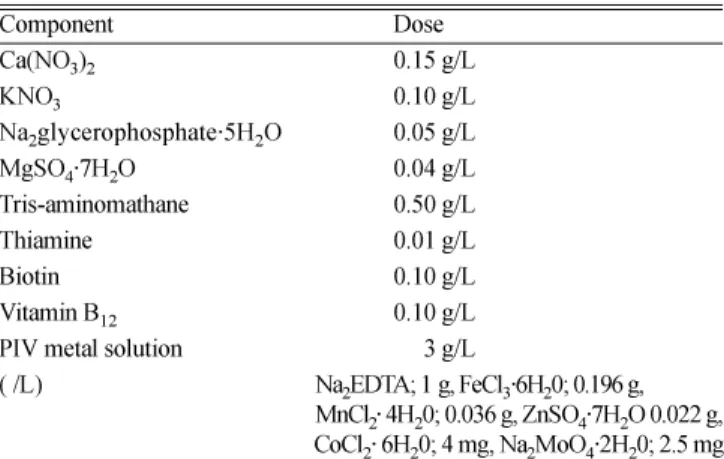
으며, 표준배양배지로 NIES-C 배지를선정하였다. 배지의조성은
Table 1과같으며, 배지의 pH를 7.5로적정한후고압증기멸균을 거쳐배양에사용하였다.
Astaxanthin 생산을위한 빛유도(light induction) 단계에서는
Haematococcus 세포들의효과적인유도를위해 NIES-C 배지로부
터질소원을제거한 NIES-N 배지를사용하였다. NIES-N 배지는
NIES-C 배지에서 Ca(NO3)2와 KNO3를 CaCl2·2H2O 0.13 g/L 및
KCl 0.07 g/L로각각대체하여제조하였으며, 배지의 pH는 NIES-C
배지와같은 pH 7.5로고정하였다.
2-2. H. pluvialis의성장
광배양시효율적인 CO2공급및용이한배양조건제어를위해자 체제작된 CO2혼합가스주입광배양기(CO2 fed photo-incubator, Fig. 1)에서H. pluvialis균주를 150 rpm의속도로 23oC에서진탕 배양하였다. 균주배양은 CO2혼합가스가연속적으로공급되는각각 의 250 mL Elernmeyer 플라스크에서 130 mL의배양부피로실시 하였으며, 이때공급되는혼합가스의유속은 65 mL/min로유지하였 다. 반응기내의광조사는형광등을이용하여 12시간명/암주기
(synchronizedillumination)로이루어졌으며, 광도는 50µmol photon/m2s
이었다. 본연구에서모든광도는 LI-250 quantum photometer(Lambda Instrument Corp., 미국)를이용하여플라스크표면에서측정하였다.
세포성장은 UV-Vis spectrophotometer(Hitachi, 일본)를이용하
여측정한 680 nm에서흡광도를통하여간접적으로관찰하였다. 이
때흡광도와세포의건조질량과는직선적인비례관계가성립하였 으며, 그 1차비례식은다음과같다.
Dry cell weight (g/L) = 0.668 × OD680
세포의건조질량은 GF/C 여과지(Whatman, 영국)를이용하여여 과된균체들을 80oC에서 24 시간동안건조후그질량을측정함 으로써얻을수있었다.
Table 1. Composition of NIES-C medium [15]
Component Dose
Ca(NO3)2 0.15 g/L
KNO3 0.10 g/L
Na2glycerophosphate·5H2O 0.05 g/L
MgSO4·7H2O 0.04 g/L
Tris-aminomathane 0.50 g/L
Thiamine 0.01 g/L
Biotin 0.10 g/L
Vitamin B12 0.10 g/L
PIV metal solution 0.13 g/L
( /L) Na2EDTA; 1 g, FeCl3·6H20; 0.196 g, MnCl2 ·4H20; 0.036 g, ZnSO4·7H2O 0.022g, CoCl2· 6H20; 4 mg, Na2MoO4·2H20; 2.5 mg
2-3. 빛 유도공정
카로티노이드생산을위한적색포낭세포단계로의빠른전환을 위해 10일배양된녹색Haematococcus세포들을원심분리를이용
하여수확한뒤질소원이배제된 NIES-N 배지에재현탁하였다. 원
심분리는 2,000 g의속도로 5분간실시하였으며, 질소원결핍배지 에현탁시세포의농도를 0.33 g/L (OD680= 0.5)로적정한뒤 CO2
혼합가스가연속적으로공급되는환경에서추가배양하였다. 이때
H. pluvialis의 induction을위한광배양조건은광조사조건을제 외하고모두균주의성장조건과같게하였다. 반응기내광조사 조건은연속조사방식(unsynchronized illumination)으로전환하였으 며, 광도는추가적인형광등을이용하여 200 µmol photon/m2s로증 가시켰다.
2-4. 카로티노이드 추출
세포내축적된카로티노이드를분리하기위해우선 8,000 g에서
10분간의원심분리를통하여세포들을수확하였다. 수확된세포들 은증류수로한번세척후 dichloromethane과 methanol의혼합용 매(1:3, v/v)에서초음파분쇄기(Sonic and Materials, Inc., 미국)를 이용하여파쇄하였다. 이때세포내부에축적된카로티노이드성분 들이용매상으로추출되며, 이과정은세포내에카로티노이드성 분이완전히추출될때까지, 즉세포의탈색이완전히이루어질때 까지반복시행하였다. 용매상의추출물은 10,000 g에서 10분간의 재원심분리를통하여고-액분리가완전히이루어진상태로획득 되었다[20, 21].
2-5. 카로티노이드 분석
유도된붉은색의H. pluvialis 세포들로부터추출된카로티노이드
성분들은카로티노이드물질중에서도특히 astaxanthin 성분을주 성분으로축적하는데, 세포내의 astaxanthin 축적특성상대부분
ester-형태의 astaxanthin을축적할뿐만아니라그 ester의종류도다 양하게발견되므로 HPLC 분석시수많은 peak이공존하게된다.
따라서 HPLC 분석전에 HPLC peak들의개수를줄여 peak 해석 및분석을쉽게하기위한추출물의전처리가필수적이다. 본연구 에서는 methanol에용해한 0.01 M NaOH를이용한 Yuan과 Chen의 가수분해법(saponification)을 통하여 astaxanthin-ester 형태들을
free-astaxanthin 형태로전환하였다[21].
가수분해반응이 완료된 free-astaxanthin 추출물들은 Simadzu
HPLC 시스템(Simadzu, 일본)을이용하여정성및정량화하였다. 본
HPLC 시스템은두개의 LC-10AD 펌프와 SPD-10A UV-Vis detector
로이루어졌으며, 분리용칼럼으로 250×4.6 mm HS-303 hydrosphere C18 column(YMC Inc., 일본)을사용하였다. 이동상은추출카로티 노이드성분들의더욱효과적인분리를위해이상구배시스템(two phase gradient system)을적용하였다. 이동상 A의성분은 dichloromethane:
methanol: acetonitrile: water, 5.0: 85.0: 5.5: 4.5(v/v)이며, 이동상 B
는 dichloromethane: methanol: acetonitrile: water, 22.0: 28.0: 45.5:
4.5(v/v)로이루어졌다. 두이동상은선형구배시스템(linear gradient system)에의해구동되었으며, 이동상 B 기준으로 0~8분동안 0%, 8~20분동안 0~100%선형적증가, 20~70분동안 100%의비율로 각각자동주입되었다. HPLC 시스템의전체유속은 1.0 mL/min으 로제어되었으며, 분리 peak들은 480 nm에서측정되었다[22].
3. 결과 및 고찰
3-1. H. pluvialis의성장에대한 CO2 농도의영향
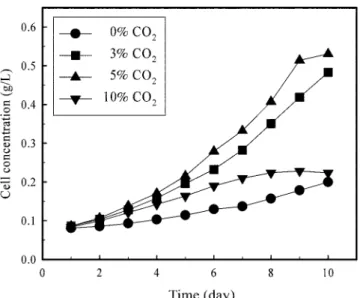
광합성균주배양을통한효율적인 CO2고정화를위해유기탄 소원이배제된성장배지에서기체형태의 CO2공급을통한자가 영양배양(autotrophic culture) 방식으로H. pluvialis균주를배양하 였다. CO2공급은순수 CO2 기체와공기의혼합으로만들어진다 양한농도의 CO2혼합기체를통하여이루어졌으며, 그혼합기체 의 CO2농도는각각 0, 3, 5, 10%로달리하였다. 광합성을위한광 조사는 50µmol photon/m2s의광도로 12시간명/암주기(synchronized illumination)로이루어졌다. 0% CO2공급(공기만주입)에서는균주 의성장이매우느리게나타났으며, CO2농도가증가함에따라균 주의성장속도가점점높아져 5% CO2주입환경에서가장높은 성장속도를보였다(Fig. 2). 반면에 10% CO2환경에서는높은 CO2
농도로인한세포에대한저해효과로균주의성장이둔화하였다
(Fig. 2). 따라서H. pluvialis NIES-144 균주의자가영양배양시
5% CO2환경이균주의효과적인성장을위한최적의탄소원공급
조건임을판단할수있다. 일반적으로녹색미세조류는 1~3%의낮
Fig. 1. Schematic diagram of CO2 fed photo-incubator for culture of Haematococcus pluvialis and astaxanthin production.
Fig. 2. Effect of CO2 concentrations on growth of green vegetative H. pluvialis on NIES-C medium. O% CO2 means supply of air only.
은농도의 CO2환경에서높은성장성을나타내고심지어순수대 기조건에서도안정된성장을보이기도한다. 이러한관점에서볼때, H. pluvailis NIES 144 균주는 CO2농도에매우민감한성장특성을 지닌녹색미세조류임을확인할수있고, 또한, 5% CO2환경에서 가장좋은성장을나타내는것으로볼때다른녹색미세조류에비 해 CO2에대한내성도우수한것으로판단된다.
3-2. H. pluvailis의 배양에서초기N, P 농도의최적화
본균주의최적성장을위해광합성미세조류의배양배지에서 가장기본적인영양원으로사용되는질소와인성분에대해균주의 성장속도에대한그효과를살펴보았다. 균주에따라황산염
(sulfate)이녹색미세조류성장에영향을주는경우도있지만본실
험에사용된균주의성장에는그효과가미미하여본실험에서제
외하였다. 기본배양배지로사용된 NIES-C 배지에질소원은질산
염(nitrate, NO3−) 형태로, 인원은인산염(phosphate, PO42−) 형태로
각각포함되어있다. 따라서 NIES-C 배지내에질산염및인산염
의 농도를 각각 변화시키면서 N과 P 조건의 최적화를 위한
H. pluvailis NIES-144 균주의배양실험을실행하였다. 질산염및 인산염은각각 Ca(NO3)2와 Na2glycerophosphate·5H2O를사용하여 기본배지성분의 2배, 5배, 10배의농도로첨가되었으며, 5% CO2
및 50 µmol photon/m2s의빛이공급되는자가영양환경에서배양 되었다. 각각의조건에서배양된균주와기본배지에서배양된균 주의평균비성장속도를조사하였으며, 그결과를 Table 2에서비
교하였다. 본연구에사용된 NIES-144 균주는기본배지의질산염
및인산염농도에서가장높은성장속도를보였으나, 질산염과인 산염모두 2배의농도로첨가된경우에서도기본배지와비슷한성 장속도를보였다. 그러나배지내의질산염및인산염농도가 5배 이상으로증가시세포성장에대한저해효과가나타나기본배지 에비해비성장속도가점차감소하였다. 특히 10배의질산염과인 산염이투입된고농도의 N과 P 환경에서세포의성장에대한그저 해효과가높게나타났다. 이러한결과로부터본Haematococcus 세 포의고농도배양은고농도배지를이용한유가식배양공정개발
을통해배양기내에균주성장의최적 N, P 환경을제공함으로써
실현할수있을것으로사료된다.
3-3. 빛유도법(light induction)에의한포낭세포로의고효율전환 및 CO2고정화를통한 고농도 astaxanthin생산
CO2고정화를통한고농도 astaxanthin 생산을위해 NIES-C 배
지에서성장한녹색Haematococcus세포를수확하여 NIES-N 배지 를이용하여질소원이배제된배지환경으로전환한뒤, 강한조사 광과 CO2를이용한자가영양광유도법(photoautotrophic induction)
을적용하여고농도 astaxanthin 함유적색포낭세포로의유도를시
도하였다. 자가영양광유도시광도조건은 200 µmol photon/m2s
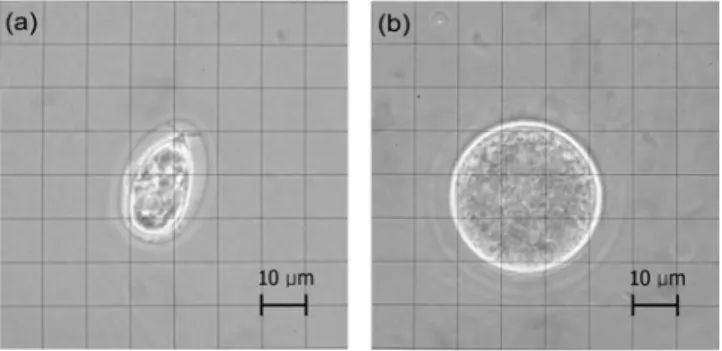
세기의빛을이용한연속조사(unsynchronized illumination)이었으 며, CO2는 5%의농도로연속적으로공급하였다. 현미경관찰을통 하여, 광유도시간이경과함에따라녹색성장세포들이비대해진 적색포낭세포들로효과적으로유도됨을확인하였다(Fig. 3). 또한,
astaxanthin 축적에대한자가영양광유도공정의효과를알아보
기위해강한조사환경이적용되지않고질소원결핍만을이용한
유도공정을통하여적색포낭세포로의유도및 astaxanthin 생산
을하였으며, 그결과를 Fig. 4에비교하여함께나타내었다. 질소
원결핍유도에서포낭세포에의한 astaxanthin 축적은매우느린
속도로진행되었으며, 평균 astaxanthin 생산속도는 1.14 mg/L·day
로나타났다. 이해비해자가영양광유도공정에서포낭세포에 의한 astaxanthin 축적은시간에따라급격히증가하였으며, 18일동
Table 2. Average specific growth rate of Haematococcus pluvialis NIES- 144 under various initial concentration of nitrate and phosphate;
1x concentration of nitrate and phosphate means each concentration in NIES-C medium
Nutrient Concentration (mg/L) µavg (/day)
Nitrate (NO3−) 1x 175 0.232
2x 350 0.222
5x 875 0.196
10x 1,750 0.184
Phosphate (PO42−) 1x 16 0.232
2x 32 0.218
5x 80 0.185
10x 160 0.168
Fig. 3. Microscope photographs of H. pluvialis NIES-144; (a) Green vegetative form, (b) Red cyst form.
Fig. 4. Comparison of astaxanthin production by H. pluvialis under different inductive conditions; Induction 1: Nitrate depriva- tion under 50 µmol photon/m2s of light, Induction 2: Nitrate deprivation and high light illumination with 200 µmol photon/m2s (photoautotrophic induction).
안의자가영양광유도를통하여 9.60 mg/L·day의생산속도로최 대 175 mg/L의astaxanthin을생산하였다(Fig. 4). 이것은질소원결 핍이녹색성장세포의포낭세포로의유도를위한기본조건임이
분명하나포낭세포에서 astaxanthin 축적에는그영향이없음을의미
한다. Wang과 Zarka[23]의연구에따르면 H. pluvialis는적색포낭 세포상태에서도광합성기작의활성을그대로유지하여 CO2를이 용한 탄소 동화 작용을 지속하는 것으로 알려졌다. 따라서
astaxanthin의합성도광합성을통한탄소동화작용을기반으로이루
어지므로, 자가영양광유도공정에서강한조사에의한광합성효 율촉진이빠른 CO2고정화및더나아가높은 astaxanthin 생산결 과를나타낸것으로사료된다.
18일동안의자가영양광유도공정에서H. pluvialis에의한 CO2
의 astaxanthin으로의전환정도가적색포낭세포의 astaxanthin 생 산 속도를 근거로 하여 평가되었다(Table 3). 이때 적색 포낭
Haematococcus세포에의해 27.8 mg/L·day의속도로 CO2가유용
항산화물질인 astaxanthin으로전환되는것으로나타났다. 따라서
본연구에서적용된자가영양광유도공정은 astaxanthin 생산성
향상과동시에추가적인 CO2고정화증대효과를얻을수있는공 정으로평가된다.
4. 결 론
광합성미세조류 H. pluvialis를이용하여생물학적 CO2고정화 및항산화성카로티노이드물질의동시생산을수행하였다. 먼저
H. pluvialis의성장에대한 CO2, 질산염, 인산염에대한효과가자 가영양배양환경에서각각조사되었다. CO2혼합기체가 5%농
도로주입될때녹색성장 Haematococcus 세포가가장좋은성장
을나타냈으며, 초기질산염과인염의농도는기본배지(NIES-C)
조건일때가장높은비성장속도를보였다. 항산화성카로티노이
드 astaxanthin 생산을위한녹색성장세포의적색포낭세포로의
유도는 200 µmol photon/m2s 빛의조사(unsynchronized illumination)
와동시에 5% CO2를연속공급하는 자가영양광 유도공정
(photoautotrophic induction)을통해이루어졌으며, 효과적인유도를 위해질소원결핍환경에있는녹색성장세포에이공정을적용하 였다. 이때적색포낭H. pluvialis에의한 astaxanthin 생산성은 9.6 mg/L·day이었으며, astaxanthin으로전환되는세포내 CO2고정화 속도는 27.8 mg/L·day로나타났다.
본연구에서광합성미세조류를이용한바이오매스로의 CO2고 정화및더나아가 CO2전환을통하여항산화기능의카로티노이 드물질을생산할수있는새로운생물학적 CO2고정화기술을제 시하였다. 이기술은단순히 CO2제거를위한기존의환경공정에 서탈피하여고부가생리활성물질생산의생물공정기능을부여 함으로써 CO2처리용현장기술로기존의화학공정보다적합할것 으로판단된다. 특히본연구에적용된H. pluvialis NIES-144 균주
는타미세조류에비해높은 CO2적응성또는내성이존재하므로 산업체배출 CO2의처리에직접적용될수있을것으로기대된다.
감 사
본연구는과학기술부의 21세기프론티어연구개발사업인이산
화탄소저감및처리기술개발사업단의연구비지원(DG2-201)으
로수행되었습니다.
참고문헌
1. http://www.cdrs.re.kr/research_develop/outline.htm
2. Kodama, M., Ikemoto, H. and Miyachi, S., “A New Species of Highly CO2 Tolerant Fast Growing Marine Microalga Suitable for High Density Culture,”J. Mar. Biotechnol., 1, 21-25(1993).
3. Zhang, K., Miyachi, S. and Kurano, N., “Photosynthetic Perfor- mance of a Cyanobacterium in a Vertical Flat-Plate Photobiore- actor for Outdoor Microalgal Production and Fixation of CO2,”
Biotechnol. Lett., 23, 21-26(2001).
4. Kobayashi, M. and Sakamoto, Y., “Singlet Oxygen Quenching Ability of Astaxanthin Esters from the Green Alga Haematococ- cus pluvialis,”Biotechnol. Lett., 21, 265-269(1999).
5. Margalith, P. Z., “Production of Ketocarotenoids by Microal- gae,”Appl. Microbiol. Biotechnol., 51, 431-438(1999).
6. Guerin, M., Huntley, M. E. and Olaizola, M., “Haematococcus Astaxanthin; Applications for Human Health and Nutrition,”
Trends Biotechnol., 21(5), 210-216(2003).
7. Kobayashi, M., Kakizono, T. and Nagai, S., “Astaxanthin Pro- duction by a Green Alga, Haematococcus pluvialis Accompa- nied with Morphological Changes in Acetate Media,”J. Ferment.
Bioeng., 71(5), 335-339(1991).
8. Boussiba, S., “Carotenogenesis in the Green Alga Haematococ- cus pluvialis: Cellular Physiology and Stress Response,”Physiol.
Plant, 108, 111-117(2000).
9. Fábregas, J., Domínguez, A., Maseda, A. and Otero, A., “Inter- actions Between Irradiance and Nutrient Availability During Astaxanthin Accumulation and Degradation in Haematococcus pluvialis,”Appl. Microbiol. Biotechnol., 61, 545-551(2003).
10. Kobayashi, M., Kakizono, T. and Nagai, S., “Enhanced Caro- tenoids Biosynthesis by Oxidative Stress in Acetate-induced Cyst Cells of a Green Unicellular Alga, Haematococcus pluvia- lis,”Appl. Environ. Microbiol., 59(3), 867-873(1993).
11. Kobayashi, M., Kurimura, Y. and Tsuji, Y., “Light Independent, Astaxanthin Production by the Green Microalga Haematococcus pluvialis Under Salt Stress,”Biotechnol. Lett., 19(6), 507-509(1997).
12. Sarada, R., Tripathi, U. and Ravishankar, G. A., “Influence of Stress on Astaxanthin Production in Haematococcus pluvialis Grown Under Different Culture Conditions,”Process Biochem.,
37, 623-627(2002).
Table 3. Astaxanthin productivity and CO2 fixation rate to astaxanthin by induced H. pluvialis cyst cells
Period *Conversion factor
(g CO2/g astaxanthin) Astaxanthin productivity
(mg/L·day) CO2 fixation rate to astaxanthin (mg/L·day)
Photoautotrophic induction 2.9 9.6 27.8
*In calculation for conversion factor, molecular weight of CO2 and astaxanthin (C40H52O4) was 44 and 597 g/mol, respectively.
13. Fábregas, J., Domínguez, A., Álvareza, D. C., Lamela, T. and Otero, A., “Induction of Astaxanthin Accumulation by Nitrogen and Magnesium Deficiencies in Haematococcus pluvialis,”Bio- technol. Lett., 20(6), 623-626(1998).
14. Fábregas, J., Otero, A., Maseda, A. and Domínguez, A., “Two Stage Cultures for the Production of Astaxanthin from Haema- tococcus pluvialis,”J. Biotechnol., 89, 65-71(2001).
15. Hata, N., Ogbonna, J. C., Hasegawa, Y., Taroda, H. and Tanaka, H., “Production of Astaxanthin by Haematococcus pluvialis in a Sequential Heterotrophic-Photoautotrophic Culture,”J. Appl. Phy- col., 13, 395-402(2001).
16. Kakizono, T., Kobayashi, M. and Nagai, S., “Effect of Carbon/
nitrogen Ratio on Encystment Accompanied with Astaxanthin Formation in a Green Alga, Haematococcus pluvialis,”J. Fer- ment. Bioeng., 74(6), 403-405(1992).
17. Orosa, M., Franqueira, D., Cid, A. and Abalde, J., “Carotenoid Accumulation in Haematococcus pluvialis in Mixotrophic Growth,”
Biotechnol. Lett., 23, 373-378(2001).
18. Orosa, M., Franqueira, D., Cid, A. and Abalde, J., “Analysis and
Enhancement of Astaxanthin Accumulation in Haematococcus pluvialis,”Bioresour. Technol., 96, 373-378(2005).
19. Domínguez-Bocanegra, A. R., Legarreta, I. G., Jeronimo, F. M.
and Campocosio, A. T., “Influence of Environmental and Nutri- tional Factors in the Production of Astaxanthin from Haemato- coccus pluvialis,”Bioresour. Technol., 92, 209-214(2004).
20. Wellburn, A. R., “The Spectral Determination of Chlorophylls a and b, as well as Total Carotenoids, Using Various Solvents with Spectrophotometers of Different Resolution,”J. Plant Physiol.,
144, 307-313(1994).
21. Yuan, J. P. and Chen, F., “Purification of Trans-Astaxanthin from a High-Yielding Astaxanthin Ester-Producing Strain of the Microalga Haematococcus pluvialis,”Food Chem., 68, 443-448(2000).
22. Yuan, J. P. and Chen, F., “Chromatographic Separation and Puri- fication of Trans-Astaxanthin from the Extracts of Haematococ- cus pluvialis,”J. Agric. Food Chem., 46, 3371-3375(1998).
23. Wang, B. and Zarka, A., “Astaxanthin Accumulation in Haema- tococcuspluvialis (Chlorophyceae) as an Active Protective Pro- cess Under High Irradiance,”J. Phycol., 39, 1116-1124(2003).