121
고추역병 길항미생물
Bacillus subtilis
AH18과Bacillus licheniformis
K11의 토양미생물 생태에 미치는 영향박기춘1·임종희2·김상달2*·이영근3
1농촌진흥청 인삼과, 2영남대학교 응용미생물학과, 3안동대학교 식물의학과
Effects of Phytophthora Blight-antagonistic Microorganisms Bacillus subtilis AH18 and Bacillus licheniformis K11
on the Soil Microbial Community
Kee-Choon Park
1, Jong-Hui Lim
2, Sang-Dal Kim
2*, and Young-Keun Yi
31Ginseng Research Division, Rural Development Administration, Eumseong 369-873, Korea
2Department of Applied Microbiology, College of Natural Resources, Yeungnam University, Gyeongsan 712-749, Korea
3School of Bioresource Science, Andong National University, Andong 760-749, Korea Received April 6, 2009; Accepted September 4, 2009
We measured the influence of antifungal antagonists
Bacillus subtilisAH18 and
Bacillus lichenifor- misK11 on soil microbial community in microcosms. Both antifungal antagonists were confirmed to suppress hot pepper phytophthora blight. Phospholipid fatty acids (PLFA) were analyzed to investigate the soil microbial community.
B. subtilisAH18 changed the total PLFA composition and bio-indicators of PLFA, compared with other treatments.
B. subtilisAH18 decreased the proportion of bacteria and gram negative/gram positive bacteria, and increased the fungi/bacteria and anaer- obic/aerobic microorganisms. In addition
cy19:0/18:1
ω7c, which means adaptation to unfavorable environmental conditions, was increased by the application of
B. subtilisAH18. On the other hand the inoculation of
B. licheniformisK11 or combined inoculation of both antifungal strains did not affect soil microbial community. The suppression of phytophthora blight and preservation of indig- enous soil microbial community may be achieved by the combined application of
B. subtilisAH18 and
B. licheniformisK11.
Key words: antifungal antagonist, microbial control agent, soil microbial community
서 론
길항미생물을이용하여 식물병을방제하는 것은친환경적인 방법으로서선호되고있고[Pusey 등, 1996], 많은길항미생물들
이선발되고있다[Boland 등, 1998]. 그리고토양식물병에대
한길항미생물은식물병을억제하는 효과가탁월하고, 병억제 효과가필요한기간만큼지속적으로토양에서살아남아야하지 만, 토양에접종된미생물은짧은시간 내에그수가줄어들고,
곧바로토양미생물군락도원래의상태대로복원된다[van Veen
등, 1997; Thirup 등, 2003]. 그러나접종한미생물이분비하는 물질등에의하여토양미생물생태에기대하지않는영향을줄 수도있다.
한편 토양미생물상을 분석하는 방법은 여러가지가 있으며,
각각장단점이 있다. 배지에배양하는미생물 분석초기의 방 법에서부터근래의 DNA 분석을통한 비배양분석까지다양하
게있지만, 특히토양인지질 지방산을분석하여미생물상을분 석하는 것은정량적 분석뿐만아니라미생물상의차이를확연 하게 보여주는면에서 다른 분석법보다큰 장점을 지니고 있 다. 인지질지방산을이용한토양미생물군락의분석법은 전체
지방산의수를이용한다양성지수뿐만아니라주요미생물그 룹의 존재유무를알려주기때문에미생물군락의구조를연구
하는데매우효과적인방법으로알려져있다[Bossio 등, 1998].
인지질지방산분석법은배양이나증폭 등의과정이없이 토양 에서바로인지질을추출하기때문에원래상태의토양미생물 군락을파악할수있는장점이있다. 물론이방법으로군락의 종구성을살펴볼수는없으나큰분류군으로는정량적으로접 근이가능하고, 비배양적방법이기 때문에미생물군락분석에 효과적이라고 할 수있다[Tunlid 등, 1992].그동안중금속이나
유기물에의한미생물군락의 변화를측정하는데이용되어왔
*Corresponding author
Phone: +82-53-810-3053; Fax: +82-53-810-4663 E-mail: [email protected]
doi:10.3839/jabc.2009.021
니라이들균들이기존의토양미생물상에미치는영향을살펴 보는데에도도움이될수있다. 이 연구의목표는고추역병에 대한길항미생물 B. subtilis AH18과 B. licheniformis K11의토
양미생물 군락에미치는영향을 단독또는복합으로처리하여 관찰하였다. 길항미생물에의한토양미생물군락의교란은인지
질지방산을분석하고전체지방산및각미생물군및생태의 지표지방산을 이용하여측정하였다.
재료 및 방법
미생물 토양 접종.고추역병에대한길항성이우수한것으로 선발된 미생물 B. subtilis AH18과 B. licheniformis K11의 단
독으로 또는 동시에 토양에 접종하였을 경우 토양미생물상에 미치는효과를구명하기위하여 30일간 육모한고추홍심이품
종을직경 10 cm, 높이 10 cm 정도크기의 포트에 토양을넣
은 후 두 미생물을 105/mL 농도로 5 mL씩 접종하였다. B.
subtilis AH18과 B. licheniformis K11를 동시에접종한 시험구 는 같은농도액을반으로줄인 량을접종하였다. 대조구는미
생물이자라지 않은 배지에물을넣은 후 미생물균 접종과 정에따라서수행하였다. 접종한폿트는 28oC 항온기에넣은 후 관찰하면서 표면이마르면 다시 물을 50 mL 관주하였다.
모든처리는 완전임의배치 4반복으로수행하였다. 미생물접 종 10일 후포트를회수하여토양을동결건조한다음분석할 때까지 −80oC에보관하였다.
미생물상 분석.냉동보관된토양시료를이용하여 인지질지 방산을 추출한 후 토양미생물 군락의 구성을 분석하였다
[Peacock 등, 2001]. 간단히 요약하면, 4 g의 토양 시료에 chloroform:methanol:buffer solution(1:2:0.8, v/v/v) 혼합물을넣 고 지질을 추출한 후 silicic acid column으로 neutral-, glyco-
및 phospho-lipid로분리하였다. 이중에서인지질을메틸화하
여만들어지는메틸화된지방산에 fatty acid methyl ester 19:0
를 내부 표준물질로 넣은 다음 MIDI Sherlock Microbial Identification System(MIDI Inc., Newark, DE)으로 지방산을 정성·정량하였다. 각인지질지방산의값은각시료에서총인 지질 지방산의 백분율로 표시하였다. fatty acid methyl ester 19:0 150 ng/µL 농도를내부표준물질로 이용하였다. 각지방
산의생물학적 지표 분류는 Li 등의 분류 기준을 이용하였다
[Li 등, 2006].
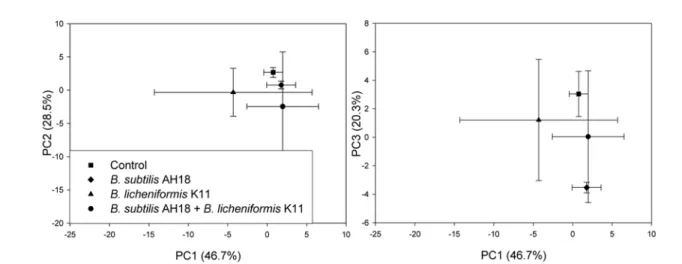
전체 토양미생물상의 변화. 지방산 구성을 다변량 통계분석 법의 하나인주요인분석법으로분석할경우미생물처리가토 양미생물생태에미친영향의정도를알수있다. 전체미생물
군락의 차이를 조사하기위하여 동정된 32개의각 인지질 지 방산을 주요인분석으로분석한결과처리간차이가 발견되었
다(Fig. 1). 주요요인 분석으로얻어지는그래프 상의새로운
축인 PC1이 전체변이의 46.7%를 설명하였고, PC2가 28.5%,
PC3가 20.3%를 각각 설명하였다. 가장 큰 변이를 설명하는
PC1에 대해서는 모든 처리간 차이를 보이지 않았고, PC2와
PC3에대하여 B. subtilis AH18 처리구가무처리대조구로부터 확연히 구분되었지만, B. licheniformis K11 단용처리구와 B.
subtilis AH18과 B. licheniformis K11의 혼용처리구는 PC1과
PC2에 대해서도차이를 보이지않았다. 따라서 전체토양미생
물상에 미치는 영향은 B. subtilis AH18을 단용처리 했을때
만 관찰되었고, B licheniformis K11의 단용처리나두 미생물 의 동시처리에서는 관찰되지않았다. 이러한 B. licheniformis K11의단독또는 B. subtilis AH18과의혼용구가무처리대조 구와 미생물상에서차이가없는것으로보이는것은이들 처리 구에서반복간차이로인한큰표준편차에기인한것으로사료 된다. B. licheniformis K11이 처리된시험구에서이러한큰표 준편차는 B. licheniformis K11이 토양미생물상에미치는영향 에 변이가 심함을 의미하고 또 그 변이가 심하다는 것은 B.
licheniformis K11이 미세한 토양 환경 변화에 B. subtilis
AH18보다민감하게반응할 수 있음을 보여준다. 토양에도입
되는 미생물에대한연구는대부분대상 병원균에초점을맞추 었고 일부연구만토양미생물군락에대한 영향을연구하였다.
토양에 접종한 길항미생물의 토양미생물 군락에 대한 영향은 대부분 단기간만 지속되었다[Girlanda 등, 2001; Bakker 등,
2002].토양에 접종된 길항균이토양미생물상에미치는 효과는
접종량에따라서 다를수 있지만, 접종량이많더라도그효과 가 9일 이상 오래 지속되지는 못한 결과가 보고된 바 있다
[Johnsen 등, 2005]. 따라서본 연구에서관찰된길항미생물 B.
subtilis AH18의 토양미생물상에 미치는 강한 영향도접종 10
일 이후까지지속가능성은낮아보인다. 한편접종한 길항미 생물에 의한 토양미생물상의 변화는 PLFA에 의한 관찰이 유
용한 방법이 될 수 있음을 다시 보여 주었다[Johnsen 등,
2005].
생물학적 지표 차이.동정된 여러인지질 지방산중에서 일
부 지방산은 생물적 지표로 이용될 수 있는데, 이들 지표를 이 용하여 고추역병 저항성균인 B. subtilis AH18과 B. licheniformis
K11의 단용 또는 혼용 처리에 따른 토양내의 세균, 곰팡이, 방 선균, 근균의 밀도 차이를 분석하였다. 또한 곰팡이/세균, 그램 음성세균/그램양성세균, 혐기성균/호기성균, cy19:0/18:1ω7c 지 방산, 단불포화지방산/ 포화지방산, cyclopropyl fatty acids의 비 율 등도 분석하여 토양미생물 군락의 생태를 조사하였다. 세균 의 비율은 30.7%인 B. subtilis AH18 처리구에서 34.4%인 대 조구와 36.1%인 B. licheniformis K11 처리구에서 보다 유의성 있게 적었고, 이들 길항균 혼합 처리구와는 유의성 있는 차이 가 없었다. B. licheniformis K11 처리구와 혼용 처리구에서는 무처리 대조구와 차이가 없었다. 곰팡이 비율은 7.7-9.5%로서 처리간 유의성 있는 차이가 없었지만 두 길항균의 동시 처리구 에서 가장 높았다. 방선균은 대조구에서 6.3%로서 7.1-7.5%인 다른 처리구 보다 유의성있게 적어서 이들 길항균들이 토양의 방성균 밀도를 증가시켰다(Fig. 2). 균근을 내생균근과 외생균
근으로 나누어 관찰한 결과 대조구에서 2.1%와 3.0%로서 가장 적었고, 두 미생물을 각각 나누어 처리한 경우에는 대조구 보 다 약간 증가했지만 유의성있는 차이는 없었다. 그리고 두 미생 물 동시 처리구에서는 가장 많은 4.9%와 4.6%이었지만 변이가 심해서 다른 처리구와 유의성있는 차이를 보여주지 못했다(Fig.
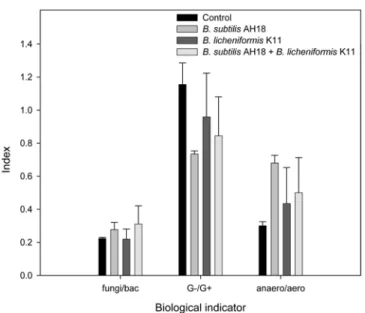
3). 한편 주요 생물학 지표 중에서 토양유기물 함량의 지표가 되는 곰팡이/세균의 비율은[Bardgett 등, 1996; Frostegard 등, 1996] B. subtilis AH18 처리구에서 0.28로서 0.22인 대조구 보 다 높았다. 탄소 영양원이 적은 조건에서 탄소 영양원이 풍부 한 조건 으로 이동의 지표가 될 수 있는 그램음성균/그램양성 균 비율은[Borga 등, 1994; Yao 등, 2000] 대조구에서 가장 높 은 1.16이었고, B. subtilis AH18 처리구에서 0.73으로서 유의 성 있게 낮아서 이 균의 밀도 증가는 토양 탄소원 이용을 증 가시킨 것으로 보였다. 혐기성균/호기성균의 비율은 B. subtilis
AH18 처리구가 0.68로서 0.30인 대조구 대조구보다 유의성 있 게 증가하였다. B. subtilis AH18 처리구에서 낮은 그램 음성균
Fig. 1. Ordinate plot from principal component analysis of phospholipid fatty acids extracted from soil inoculated with antifungal antagonists.
Fig. 2. Relative abundance of bacteria, fungi, and actinomycetes by the analysis of phospholipid fatty acids in the soils inoculated with antifungal bacteria Bacillus subtilis AH18, Bacillus licheniformis K11, and mixture of AH18 and K11.
Fig. 3. Relative abundance of arbuscular mycorrhirzae and ectomycorrhizae by the analysis of phospholipid fatty acids in the soils inoculated with antifungal bacteria Bacillus subtilis AH18, Bacillus licheniformis K11, and mixture of AH18 and K11.
/그램양성균 비율과 높은 혐기성균/호기성균 비율은 이 균의 처 리가 토양미생물 활성 증가에 효과적임을 보여주고 있다(Fig.
4). 또 다른 토양미생물 지표로서 불량환경 적응성을 의미하는
cy19:0/18:1ω7c 지방산 비율과 단불포화지방산/포화지방산 비율 도 0.38과 1.13인 대조구에 비하여 0.69와 1.90인 B. subtilis
AH18 처리구가 유의성 있게 증가하였다(Fig. 5). 따라서 전체 토양미생물상에 미치는 효과 뿐만 아니라 개별적인 미생물 구 성에 있어서도 B. subtilis AH18의 단용 처리가 토양미생물상 에 가장 큰 영향을 미쳤다. 지방산 분석을 토양미생물상 분석 에서 B. subtilis AH18의 단용 처리는 미생물을 처리하지 않은 대조구에 비하여 토양미생물상을 뚜렷이 바꾸었지만, B. subtilis
AH18가 B. licheniformis K11와 혼용되었을때는 토양미생물상
생태의 변화는 토양에서 인지질 지방산을 추출한 후 전체 지방 산과 지표 지방산의 상대적 비율로 분석하였다. 전체적 인지질 지방산 구성과 각 지표 지방산 분석에 의해서 B. subtilis
AH18 처리구는 무처리 대조구와 완전히 구분되었다. 전체 토 양미생물상을 B. subtilis AH18 처리가 바꾸었고 세균 비율을 감소시켰으며, 곰팡이/세균 비율을 높였으며, 그램음성균/그램양 성균의 비율을 낮추었으며, 혐기성균/호기성균의 비율은 증가시 켰다. 또한 불량환경 적응성을 의미하는 cy19:0/18:1ω7c 지방산 비율과 단불포화지방산/포화지방산 비율도 B. subtilis AH18 처 리구가 증가시켰다. 이에 반하여 B. licheniformis K11 처리나 두 미생물의 동시 처리는 전술한 토양미생물 지표에 큰 영향을 미치지 않았다. 따라서 지방산 분석을 토양미생물상 분석에서
B. subtilis AH18의 단용처리는 미생물을 처리하지 않은 대조구 에 비하여 토양미생물상을 뚜렷이 바꾸었지만, B. subtilis AH18 가 B. licheniformis K11와 혼용되었을 때는 토양미생물상 변화 에 미치는 영향이 적었다. 따라서 이들 두 미생물을 동시에 처 리할 경우 고추역병 방제와 토양미생물 생태 보존의 두 목적을 동시에 이룰 수 있을 것으로 기대된다.
Key words: antifungal antagonist, microbial control agent, soil microbial community
감사의 글
본 연구는 2007년 농림기술관리센터 과제(과제관리 번호:
107013-03)의 지원에 의해 이루어진 것으로 수행되었으며 이에 감사 드립니다.
참고문헌
Bakker PAHM, Glandorf DCM, Viebahn M, Ouwens TWM, Smit E, Leeflang P, Wernar K, Thomashow LS, Thomas-Oate JE, and van Loon LC (2002) Effects of Pseudomonas putida modified to produce phenazine-1-carboxylic acid and 2,4- diacetylphloroglucinol on the microflora of field grown wheat.
Antonie Van Leeuwenhoek81, 617-624.
Bardgett RD, Hobbs PJ, and Frostegard A (1996) Changes in soil fungal:bacterial biomass ratios following reductions in the intensity of management of an upland grassland. Biol Fert Soils Fig. 4. Indices of biological indicators by the analysis of
phospholipid fatty acidsin the soils inoculated with antifungal bacteria Bacillus subtilis AH18, Bacillus licheniformis K11, and mixture of AH18 and K11.
Fig. 5. Biological indicators by the analysis of phospholipid fatty acids in the soils inoculated with antifungal bacteria Bacillus subtilis AH18, Bacillus licheniformis K11, and mixture of AH18 and K11.
22, 261-264.
Boland GJ and Kuykendall LD (1998) In Plant-Microbe Interactions and Biological Control. Marcel Dekker, New York, NY, U.S.A.
Borga P, Nilsson M, and Tunlid A (1994) Bacterial communities in peat in relation to botanical composition as revealed by phospholipid fatty-acid analysis. Soil Biol Biochem 26, 841- Bossio DA, Scow KM, Gunapala N, and Graham KJ (1998)848.
Determinants of soil microbial communities: Effects of agricultural management, season, and soil type on phospholipid fatty acid profiles. Microb Ecol36, 1-12.
Ekelund F, Olsson S, and Johansen A (2003) Changes in the succession and diversity of protozoan and microbial populations in soil spiked with a range of copper concentrations. Soil Biol Biochem35, 1507-1516.
Frostegard A and E Baath (1996) The use of phospholipid fatty acid analysis to estimate bacterial and fungal biomass in soil.
Biol Fert Soils22, 59-65.
Frostegard A, Tunlid A, and Baath E (1993) Phospholipid fatty acid composition, biomass, and activity of microbial communities from two soil types experimentally exposed to different heavy metals. Appl Environ Microbiol59, 3605-3617.
Girlanda M, Perotto S, Mo°ßnne-Loccoz Y, Bergero R, Lazzari A, De¢•fago G, Bonfante P, and Luppi AM (2001) Impact of biocontrol Pseudomonas fluorescens CHA0 and a genetically modified derivative on the diversity of culturable fungi in the cucumber rhizosphere. Appl Environ Microbiol 67, 1851-1864.
Griffiths BS, Ritz K, Ebblewhite N, and Dobson G (1999) Soil microbial community structure: effects of substrate loading rates. Soil Biol Biochem31, 145-153.
Johansen A and Olsson S (2005) Using Phospholipid Fatty Acid Technique to Study Short-Term Effects of the Biological Control Agent Pseudomonas fluorescens DR54 on the Microbial Microbiota in Barley Rhizosphere. Microb Ecol 49, 271-281.
Li WH, Zhang CB, Jiang HB, Xin GR, and Yang ZY (2006) Changes in soil microbial community associated with invasion of the exotic weed, Mikania micrantha HBK. Plant Soil 281, 309-324.
Peacock A D, Mullen MD, Ringelberg, DB, Tyler DD, Hedrick DB, Gale PM, and White DC (2001) Soil microbial community responses to dairy manure or ammonium nitrate applications Soil Biol Biochem33, 1011-1019.
Pusey PL (1996) Micro-organisms as agents in plant disease control. Crop Protection Agents from Nature: Natural Products and Analogues. Crit Rep Appl Chem35, 426-436.
Thirup L, Johansen A, and Winding A (2003) Microbial succession in the rhizosphere of live and decomposing barley roots as affected by the antagonistic strain Pseudomonas fluorescens DR54-BN14 or the fungicide imazalil. FEMS Microb Ecol 43, 383-392.
Tunlid A and White DC (1992) Biochemical analysis of biomass, community structure, nutritional status, and metabolic activity of microbial communities in soil. Soil Biochemistry7, 229-262.
Van Veen JA, Van Overbeek LS, and Van Elsas JD (1997) Fate and activity of microorganisms introduced into soil. Microbiol Mol Rev61, 121-135.
Yao H, He Z, Wilson MJ, and Campbell CD (2000) Microbial biomass and community structure in a sequence of soils with increasing fertility and changing land use. Microb Ecol 40, 223-237.