Profiles of Compositional Components in Vegetable Soybeans ( Glycine max (L.) Merr.)
Jin Hwan Lee
1,*, In-Youl Baek
1, Jong-Min Ko
1, Nam Suk Kang
1, Hyun-Tae Kim
1, Won-Young Han
1, Sang-Ouk Shin
1, Keum-Yong Park
1, Ki-Won Oh
1,
Tae Joung Ha
1and Ki Hun Park
2,*
1Yeongnam Agricultural Research Institute, National Institute of Crop Science, Rural Development Administration, Miryang, 627-803, Korea
2Division of Applied Life Science (BK21 Program), EB-NCRC,
Institute of Agriculture & Life Science, Gyeongsang National University, Jinju 660-701, Korea
Received February 23, 2007; Accepted June 3, 2007
Compositional components such as isoflavone, protein, oil, fatty acid, and free sugar in Korean vegetable soybeans were examined with four cultivars including Hwaeomputkong, Keunolkong, Mirang, and Danmi 2. In the isoflavone, Mirang cultivar showed the highest content (967.1µg/g), whereas Keunolkong was the lowest content (535.9µg/g). The malonylglucosides were the predominant isoflavone type followed by the glucoside, aglycone, and acetyl glucoside forms, respectively. In the protein content, Hwaeomputkong was the lowest (41.7%) and Danmi 2 was the highest (45.9%). The oil contents were 11.5 to 21.2% and Mirang cultivar was the lowest. The fatty acid compositions of the oil extracts exhibited that linoleic acid was the highest (33.6-42.5%), followed by oleic, palmitic, linolenic, and stearic acids. Whereas, oleic acid (46.7 ± 2.0%) was more than linoleic acid (33.6 ± 1.3%) in Mirang cultivar. In the free sugar contents, Hwaeomputkong cultivar showed the highest level and sucrose (5.52 ± 0.49%) appeared to be most prevalent in vegetable soybeans.
Key words: fatty acid, free sugar, isoflavone, oil, protein, vegetable soybean
Soybeans (Glycine max (L.) Merr.) and soy products are recognized as excellent source of high-quality isoflaovone (Wu et al., 2004), protein, and oil (Charron et al., 2005). Their beneficial effects on the human diseases such as coronary heart disease, cancer, osteoporosis and menopausal discomfort have been reported (Anthony et al., 1996; Arjmandi et al., 1998; Wu et al., 1998).Although soybean value has been determined by protein and oil content (Wilson, 2001), isoflavone content may emerge as another determinant of soybean value. Because of estrogen-like effects, isoflavones are frequently referred to as phytoestrogens and to have a wide variety of health
benefits, including prevention of breast and prostate cancers, cardiovascular disease, and postmenopausal bone loss (Lamartiniere, 2000; Lee, et al., 2006). It is well established that isoflavones are responsible for the several biological activities of soybean, however the contents of them are affected by the cultivar grown as well as the environmental conditions of the seed filling stage (Wang and Murphy, 1994; Hoeck et al., 2000). Isoflavones in soybeans are widely founded as glucosides forms; the malognylated glucosides are the predominant, whereas the contents of aglycones, glucosides, and acetylated glucosides tend to increase during, cooking, processing, and extraction (Coward et al., 1998).
Protein, oil, and sugar are also important nutritional sources found in soybeans (Kim et al., 2005). Soybean protein used for foods with a variety of manufacturing process e.g. synthetic fiber, adhesives, textile-sizing, waterproofing, and many other uses. Soybean oil is becoming popular in the world due to its numerous edible applications such as cooking and baking as well as industrial applications such as paint, printing ink, soap,
*Corresponding authors
Phone: +82-55-350-1244; Fax: +82-55-352-3059 E-mail: [email protected] (Jin Hwan Lee) Phone: +82-55-751-5472; Fax: +82-55-757-0178 E-mail: [email protected] (Ki Hun Park)
Both corresponding authors contributed equally to the work.
Abbreviations: HPLC, high-performence liquid chromatogra- phy; GC, gas chromatography
antinutritional factors (Simonne et al., 2000). Although there are several benefits, few studies have been performed so far, on the compositional components of vegetable soybean cultivars. Therefore, the objective of current study was to determine the contents of isoflavones, proteins, oils, fatty acids, and free sugars in vegetable soybeans of major Korean cultivars to provide the basic information on their compositional components for the development of high quality soybean cultivars.
In this study, we isolated glycitein from Taekwangkong one of the G. max cultivars and analyzed individual isoflavone contents of four vegetable soybean cultivars in Korea using high-performance liquid chromatography (HPLC). We also investigated the primary constituents such as protein, oil, fatty acid, and free sugar concentrations in vegetable soybeans.
Materials and Methods
Plant materials. Four vegetable soybean cultivars (Hwaeomputkong, Keunolkong, Mirang, and Danmi 2) were selected and harvested from the experimental field of Yeongnam Agricultural Research Institute, National Institute of Crop Science, Rural Development Administration, Miryang, Korea, in 2006. Collected seeds were freeze- dried immediately after sampling and stored at 4oC until they were used.
Reagents. HPLC-grade water and acetonitrile were purchased from Merck (Darmstadt, Germany). The isoflavones, daidzein, genistein, daidzin, and genistin were obtained from our previous works (Lee et al., 2006a; Lee et al., 2006b). Glycitein was isolated from the 1N HCl extract of the pulverized seeds(cv. Taekawangkong) and the structure was confirmed by the spectroscopic data analysis. All other isoflavones and sugars (stachyose, raffinose, glucose, and sucrose) were obtained from Sigma Aldrich (St. Louis, MO).
Instruments. Separation of glycitein was conducted using thin layer chromatography (TLC) plates (E. Merck
Germany)] was used for HPLC. Protein and oil contents were determined using a B-339 Auto Kieldahl analyzer (Buchi, Schweiz) and a BÜCHI B-811 Extraction System (Büchi, Schweiz), respectively. For the analysis of fatty acid in crude oil, DS6200 (DONAM Instruments Inc., Korea) gas chromatography with a flame ionization detector (FID) and a capillary column (0.32 mm i.d. × 25 m HP-FFAP) were used. Free sugar content was analyzed using a Spectra system P-4000 HPLC system (Thermo Electron Inc., Somerset, NJ) with Waters Sugar Pak I (6.5
× 300 mm; Waters Co., Ltd.). The analytical HPLC system consisted of a G1311A Agilent 1100 quaternary pump (Agilent Technologies, Wilmington, DE), and the chromatographic data were processed using a Donam dsCHROM 2000 Software.
Extraction and isolation of glycitein. The pulverized seeds (5.0 kg) of Taekwangkong was extracted with 150 mL of 1 N HCl at 105oC for 3 h. The extract was filtered with Millipore 0.45 m membrane filter, and the filtrate was concentrated in vacuo at 50oC and to yield a brown gum (184 mg). The resulting residue was chromatographed on a silica gel column (1.5 × 6 cm, 230-340 mesh, 20 g) using CHCl3/acetone gradient (20 : 1→1 : 2) to yield 15 subfractions. The subfractions 6-9 were further purified by silica gel column chromatography with CHCl3/acetone (15 : 1→4 : 1) to yield glycitein (13 mg).The structure of glycitein was confirmed by spectroscopic analysis.
Glycitein: 1H-NMR (DMSO-d6, 500 MHz) δ 3.84 (3H, s, 6-OCH3), 6.81 (2H, d, J= 8.6 Hz, H-3 and 5), 6.94 (1H, s, H-8), 7.39 (2H, d, J= 8.6 Hz, H-2 and 6),7.43 (1H, s, H-5), and 8.28 (1H, s, H-2); 13C-NMR (DMSO-d6, 125 MHz) δ 57.9 (OCH3), 102.5 (C-8), 115.4 (C-3 and C-5), 115.6 (C-6), 116.9 (C-4a), 123.0 (C-1), 123.9 (C-3), 127.7 (C-5), 130.5 (C-2 and C-6), 141.1 (C-6), 153.3 (C- 2), 157.6 (C-4), 163.1 (C-7), and 175.1 (C-4).
Preparation of soybeans and quantitative analysis of isoflavones using HPLC. To extract isoflavones, 1.0 g of freeze-dried finely ground each soybean cultivars was mixed with 10 mL of 50% aqueous methanol in a 50 mL-
centrifuge bottle (Nalge Company, Rochester, NY). The sample bottles were vortexed for 1 min and shaken with shaker for 12 h at room temperature followed by centrifugation at 3000 rpm for 30 min (VS-6000CFN, VISION, Korea). The supernatant was filtered with a 0.45µm membrane filter prior to inject into the HPLC system. The analysis of isoflavones were carried out by reversed phase HPLC with a flow rate of 1.0 mL/min at 30oC using the solvent gradient of 0.1% (v/v) acetic acid in water (solvent A) and 100% acetonitrile (solvent B);
0~20 min, 20% solvent B; 20~30 min, 25% solvent B;
30~40 min, 35% solvent B. The HPLC chromatograms were recorded at 254 nm.
Calibration curves of the individual isoflavones. The calibration curves for isoflavones were made from the serial dilutions of the samples dissolved in 50% methanol.
The linear range and the equation of linear regression were obtained sequentially at 100, 80, 60, 40, 20, 10, 5, 2.5, and 1µg/mL. Mean areas (n = 3) generated from the standard solution was plotted against concentration to establish the calibration equation. A high linearity (r2>
0.998) was obtained for each calibration curve. The structures of the individual isoflavones using standard compounds are shown in Fig. 1.
Protein, oil, fatty acid, and free sugar analyses. Four vegetable soybean cultivars were finely ground using a coffee grinder (PHILIPS, HR2860, Netherlands). The protein content of soybeans was determined according to the Kjeldahl procedure (Kim et al., 2006). The soybean powder (0.2 g) was digested by Buchi B-435 digestion system and Buchi B-412 scrubber with 20 mL of H2SO4 and 3.0 g of catalyst (CuSO4 : K2SO4= 1 : 9). Nitrogen content was calculated by Buchi B-399 auto-Kjeldahl system and then converted to protein by multiplication on
6.25. Oil content was measured by Soxhlet method using Buchi B-811 extracted system (Kim et al., 2006). Two grams of soybean powder was added to 200 mL of n- hexane in extraction thimble and boiled for 2 h at 105oC.
After cooled to room temperature in a desiccator, the extracted oil was weighted. Total oil contents were represented on a dry matter basis of soybean. The fatty acid composition was determined using the extracted oil as follows (Kim et al., 2006):approximately, 100µL of oil was placed in a screw-capped vial, and then 5 mL of methylation solution (H2O : MeOH : toluene = 1 mL : 20 mL : 10 mL) was added followed by heating on a water bath (100oC) for 1 h, and cooling to room temperature, consecutively. The mixture was extracted with 10 mL of H2O : ether (1 : 1) solution. The 0.5µL of organic layer was injected on to the gas chromatography. The initial temperature of 140oC was raised to the final temperature of 200oC at a rate of 8oC min−1. Carrier gas was nitrogen at a flow of 0.5 min−1. During analysis the temperatures of the inlet and detector were maintained at 230-250oC. For analysis of free sugars, 1.0 g of soybean powder was extracted with 80% EtOH (10 mL) at room temperature for 12 h, and then centrifuged at 5000g for 5 min.28,30) The supernatant was filtered with a Sep-Pak C18 solid phase extraction cartridge (Waters, Milford, MA) and this residue was then dissolved in water. The 20 mL of diluted extract was injected into a HPLC system equipped with a Shodex RI-71 refractive index detector. The operating conditions were as follows: column temperature 35oC;
mobile phase acetonitrile : water (65 : 35, v/v); flow rate 0.5 mL/min. Contents of free sugar including glucose, sucrose, raffinose, and stachyose were calculated by comparing the HPLC peak areas with the external standard calibration curves.
Fig. 1. Chemical structures of isoflavones in soybean.
Results and Discussion
Individual isoflavone analysis of vegetable soybean cultivars. Through repeated silica gel chromatography of the hydrolyzed extract of Taekwangkong cultivar, glycitein was isolated and confirmed by spectroscopic analysis. Fig. 1 showed the structures of 12 isoflavones, which could be grouped according to the chemical moieties: aglycone, glucoside, malonylglucoside, and acetylglucoside. On the basis of individual isoflavone standard materials, a typical HPLC chromatogram of isoflavones in soybeans was obtained as shown in Fig. 2.
The result of the peak identification of the chromatogram is as follows: the isoflavone aglycones including daidzein (peak 9, 25.4 min), glycitein (peak 10, 27.9 min) and genistein (peak 12, 35.1 min); the isoflavone glucosides including daidzin (peak 1, 9.9 min), glycitin (peak 2, 11.2 min), genistin (peak 3, 15.8 min), malonyldaidzin (peak 4, 16.5 min), malonylglycitin (peak 5, 17.6 min), acetyldaidzin (peak 6, 21.4 min), malonylgenistin (peak 7, 22.1 min), acetylglycitin (peak 8, 25.4 min), and acetylgenistin (peak 11, 28.9 min).
There were significant differences between individual
isoflavone contents and total contents. Total isoflavone content was found as 967.1µg/g in Mirang, and 535.9 µg/
g in Keunolkong, while the average of total isoflavone in four cultivars was 796.8µg/g. The content of each isoflavone in four vegetable soybean cultivars grown in Milyang was shown in Table 1. In particular, malonyl glucosides were more than 75% of the total isoflavone content (Hwaeomputkong: 79%, Keunolkong: 74%, Mirang: 79%, and Danmi 2: 78%). Among isoflavones, malonyl genistin content was the highest (262.1-553.5
µg/g), followed by malonyl daidzin (123.8-241.8µg/g) and glycitin (65.2-90.6µg/g). Furthermore, acetyl glucosides including acetyl daidzin, acetyl genistin, and acetyl glycitin as well as glycitein were not detected.
Distributions of individual isoflavone among four vegetable soybean cultivars showed similar patterns.
However, the contents of glycitin (65.2-90.6µg/g) in vegetable soybeans were higher than those of daidzin (55.5-67.3µg/g) and genistin (19.6-46.4µg/g) in comparison with other Korean soybean cultivars (Wang et al., 1994;
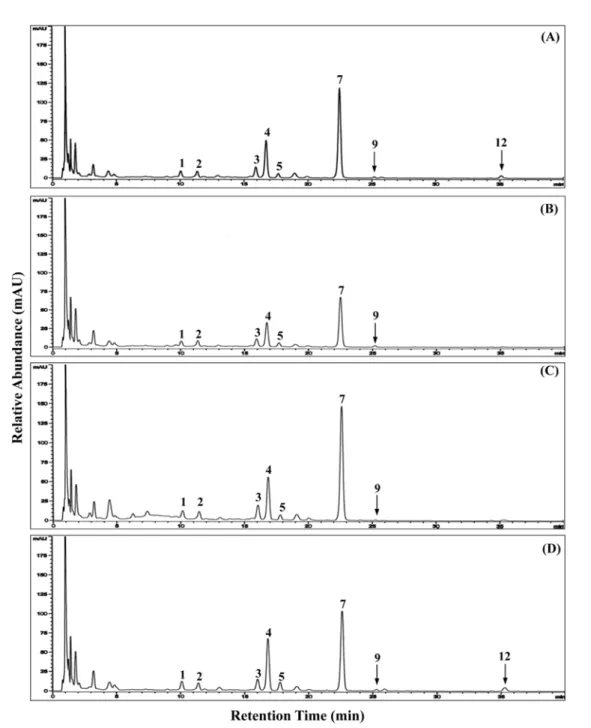
Yang and Chung, 2001). The HPLC chromatograms of isoflavones in four vegetable soybeans are shown in Fig. 3.
Daidzein was found as trace amounts in Hwaeomputkong daidzin, 5: Malonyl glycitin, 6: Acetyl daidzin, 7: Malonyl genistin, 8: Acetyl glycitin, 9: Daidzein, 10: Glycitein, 11:
Acetyl genistin, 12: Genistein. HPLC operating conditions: Column: Merck, Lichrophore 100RP-18e; Solvents: A, 0.1%
acetic acid in water, B, acetonitrile (gradient); Flow rate: 1.0 mL/min; Monitor: 254 nm; HPLC system: Agilent 1100.
Table 1. Individual isoflavone contents of vegetable soybeans
Cultivar Contents of isoflavone (µg/g)a
Di Gly Gi MDi MGly AcDi MGi AcGly De Gle AcGi Ge
Hwaeomputkong 62.8±1.5 71.2±1.4 31.0±0.7 182.5±4.9 9.4±0.6 ndb 458.8±28.4 nd trc nd nd 3.47±0.4 Keunolkong 55.5±0.9 65.2±0.8 19.6±0.6 123.8±2.6 8.1±0.3 nd 262.1±13.2 nd 1.57 ± 0.2 nd nd nd Mirang 63.8±1.9 90.6±1.9 46.4±1.1 200.1±6.9 12.7±0.8 nd 553.5±31.9 nd tr nd nd nd Danmi 2 67.3±1.3 82.1±1.7 35.1±0.7 241.8±4.2 29.7±0.6 nd 400.3±27.1 nd 1.30±0.1 nd nd 7.43±0.3
aValues indicate the mean’s of three replications. bnd: not detected. ctr: trace. Di: Daidzin, Gly: Glycitin, Gi: Genistin, MDi:
Malonyl daidzin, MGly: Malonyl glycitin, AcDi: Acetyl daidzin, MGi: Malonyl genistin, AcGly: Acetyl glycitin, De:
Daidzein, Gle: Glycitein, AcGi: Acetyl genistin, Ge: Genistein.
and Mirang cultivars (Fig. 3A and Fig. 3C), while it was found 1.57 ± 0.2 and 1.30 ± 0.1 µg/g in Keunolkong and Danmi 2 cultivars, respectively (Fig. 3B and Fig. 3D).
Total isoflavone contents of the vegetable soybeans were 2-3 times less than those of other Korean soybeans. These results suggested that vegetable soybeans were harvested early as immature state.
Analyses of protein, oils, fatty acid, and free sugar in the vegetable soybean cultivars. The protein content determined according to the Kjeldahl procedure resulted in the highest in Hwaeomputkong (45.9 ± 0.2%) and the
lowest in Danmi 2 cultivar (41.7 ± 1.4%) (Table 2). The oil content in the vegetable soybean cultivars measured by Soxhlet method showed that it was lower than that of other Korean soybean cultivars. Danmi 2 cultivar exhibited the highest content (21.2 ± 1.4%), whereas Mirang cultivar was the lowest (11.5 ± 0.4%) (Table 2).
The oil concentration of Mirang was much lower than that of other Korean soybean cultivar (15.78-20.30%) (Chung, 2006). The concentrations of protein and oil measured in the vegetable soybeans had moderate negative correlations.
Fig. 3. HPLC chromatogram of 50% methanolic extracts from the vegetable soybean cultivars. (A) Hwaeomputkong, (B) Keunolkong, (C) Mirang, (D) Danmi 2. 1: Daidzin, 2: Glycitin, 3: Genistin, 4: Malonyl daidzin, 5: Malonyl glycitin, 7:
Malonyl genistin, 9: Daidzein, 12: Genistein.
analyzed by using GC. Linoleic acid was the predominant (33.6-42.5%) followed by oleic (37.1-46.7%), palmitic (9.6-11.1%), and linolenic acids (5.4-6.5), respectively, whereas stearic acid was the lowest (3.3-3.7%) (Table 3).
In particular, Mirang cultivar showed higher content of oleic acid (46.7 ± 2.0%) than that of linoleic acid (33.6 ± 1.3%) (Table 3).
As the primary constituents of soybean, free sugars were considered to have potentials in the prevention and medical treatment of chronic adult diseases. The compositions of free sugars in the vegetable soybeans were analyzed as follows: 3.55-5.52% sucrose, 1.26- 1.62% raffinose, 0.46-0.53% stachyose, and 0.16-0.28%
glucose, respectively, and these sugars possessed greater than 90% of the free sugar in vegetable soybeans (Table 4). Hwaeomputkong showed the highest free sugar content, while Mirang cultivar was the lowest.
This study reports compositional components including isoflavones, protein, oil, fatty acids, and free sugars in
diseases. In the sugar of the vegetable soybean cultivars, the content of sucrose was the highest (3.55-5.52%), while that of stachyose (0.46-0.53%) was the lowest.
After further processing for food ingredients, these Korean vegetable soybean cultivars may contribute to enhance the health benefits as soy containing foods. The evaluation of vegetable soybean quality in breeding aspects is through to be important to enhance the value of functional materials as well as soybean as dietary supplement.
Acknowledgments. This study was supported by a Post Doctoral Course Program of Yeongnam Agricultural Research Institute, National Institute of Crop Science, Rural Development Administration, Republic of Korea.
References
Anthony MS, Clarkson TB, Hughes CL, Morgan TM, and
Table 3. Contents of protein and lipid in vegetable soybeans
Cultivar Composition of fatty acid (%)a
Oleic acid
(C18:1) Linoleic acid
(C18:2) Linolenic acid
(C18:3) Palmitic acid
(C16:0) Stearic acid (C18:0)
Hwaeomputkong 37.1 ± 2.4 42.5 ± 1.8 6.5 ± 0.6 10.4 ± 0.3 3.6 ± 0.3
Keunolkong 37.2 ± 1.8 42.3 ± 2.0 6.3 ± 0.6 11.1 ± 0.7 3.3 ± 0.1
Mirang 46.7 ± 2.0 33.6 ± 1.3 5.4 ± 0.3 10.8 ± 0.4 3.6 ± 0.1
Danmi 2 37.7 ± 1.5 42.1 ± 1.8 6.0 ± 0.5 9.6 ± 0.2 3.7 ± 0.3
aValues indicate the mean’s of three replications.
Table 4. Contents of free sugar in vegetable soybeans
Cultivar Contents of free sugar (%)a
Glucose Sucrose Raffinose Stachyose
Hwaeomputkong 0.16 ± 0.08 5.52 ± 0.49 1.62 ± 0.72 0.49 ± 0.09
Keunolkong 0.28 ± 0.11 4.47 ± 0.91 1.32 ± 0.66 0.46 ± 0.10
Mirang 0.23 ± 0.13 3.55 ± 0.84 1.26 ± 0.29 0.48 ± 0.11
Danmi 2 0.25 ± 0.04 3.98 ± 0.69 1.39 ± 0.87 0.53 ± 0.16
aValues indicate the mean’s of three replications.
Burke GL (1996) Soybean isoflavones improve cardio- vascular risk factors without affecting the reproductive system of peripubertal Rhesus monkeys. J Nutr126, 43- Arjmandi BH, Getlinger MJ, Goyal NV, Alekel L, Hasler50.
CM, Juma S, Drum ML, Hollis BW, and Kukreja SC (1998) Role of soy protein with normal or reduced isoflavone content in reversing bone loss induced by ovarian hormone deficiency in rats. Am J Clin Nutr 68, 1358S-1363S.
Charron CS, Allen FL, Johnson RD, Pantalone VR, and Sams CE (2005) Correlations of oil and protein with isoflavone concentration in soybean [Glycine max (L.) Merr.]. J Agric Food Chem53, 5735-5739.
Chung MG (2006) Variation of oil contents and fatty acid compositions in Korean soybean germplams. Korean J Crop Sci51, 139-145.
Coward L, Smith M, Kirk M, and Barnes S (1998) Chemi- cal modification of isoflavones in soyfoods during cook- ing and processing. Am J Clin Nutr69 (Suppl.), 1486S- 1491S.
Hoeck J, Fehr W, Murphy PA, and Welke G (2000) Influ- ence of genotype and environment on isoflavone con- tents of soybean. Crop Sci.40, 48-51.
Hu FB, Stampfer MJ, Manson JE, Rimm F, Colditz GA, Rosner BA, Hennekens CH, and Willett WC (1997) Dietary fat intake and risk of coronary heart disease in women. N Eng J Med337, 1491-1499.
Kim HK, Kang ST, Cho JH, Chung MG, and Suh DY (2005) Quantitative trait loci associated with oligosaccha- ride and sucrose contents in soybean (Glycine max L.). J Plant Biology 48, 106-112.
Kim SL, Berhow MA, Kim JT, Chi HY, Lee SJ, and Chung IM (2006) Evaluation of soyasaponin, isoflavone, pro- tein, lipid, and free sugar accumulation in developing soybean seeds. J Agric Food Chem54, 10003-10010.
Lamartiniere CA (2000) Protection against breast cancer
with genistein, a component of soy. Am J Clin Nutr 71, 1705S-1707S.
Lee JH, Baek IY, Kang NS, Ko JM, Han WY, Kim HT, Oh KW, Suh DY, Ha TJ, and Park KH (2006) Isolation and characterization of phytochemical constituents from soy- bean (Glycine max L. Merr.). Food Sci Biotechnol 15, 392-398.
Lee JH, Lee BW, Kim JH, Jeong TS, Kim MJ, Lee WS, and Park KH (2006) LDL-antioxidant pterocarpans from roots of Glycine max (L.) Merr. J Agric Food Chem 54, 2057-2063.
Miller JF, Zimmerman DC, and Vick BA (1987) Genetic control of high oleic acid content in sunflower oil. Crop Sci27, 923-926.
Simonne AH, Smith M, Weaver DB, Vail T, Barnes S, and Wei CI (2000) Retention and changes of soy isofla- vones and carotenoids in immature soybean seeds (Edamame) during processing. J Agric Food Chem 48, 6061-6069.
Tomomatsu H (1994) Health effects of oligosaccharides.
Food Technol 61-65.
Wang H and Murphy PA (1994) Isoflavone composition of American and Japanese soybeans in Iowa: effects of variety, crop year, and location. J Agric Food Chem 42, 1674-1677.
Wilson RF (2001) Developing agronomic high-protein soy- beans. Agro-Food-Industry Hi-Tech September/October.
Wu AH, Ziegler RG, Nomura AMY, West DW, Kolonel LN, Ross PLH, and Pike MC (1998) Soy intake and risk of breast cancer in Asians and Asian Americans. Am J Clin Nutr68, 1437S-1443S.
Wu Q, Wang M, Sciarappa WJ, and Simon JE (2004) LC/
UV/ESI-MS analysis of isoflavones in edamame and tofu soybeans. J Agric Food Chem52, 2763-2769.
Yang KJ and Chung IM (2001) Yearly and genotypic varia- tions in seed isoflavone content of local soybean culti- vars. Korean J Crop Sci46, 139-144.