I. Introduction
For the past few decades, various health information tech- nologies (HITs) have been developed for translation of paper-based health information into electronic health infor- mation, and many hospitals worldwide have adopted infor- mation systems, such as an electronic health record (EHR) system [1-3]. A recent major topic of HIT in the United States has been EHR systems, following the enactment of the American Recovery and Reinvestment Act (ARRA) [4]
in February 2009. The passage of the Health Information Technology for Economic and Clinical Health (HITECH)
Development of an Electronic Claim System Based on an Integrated Electronic Health Record Platform to Guarantee Interoperability
Hwa Sun Kim, RN, PhD1, Hune Cho, PhD2, In Keun Lee, PhD2
1Department of Medical Information Technology, Daegu Haany University; 2Department of Medical Informatics, Kyungpook National University College of Medicine, Daegu, Korea
Objectives: We design and develop an electronic claim system based on an integrated electronic health record (EHR) plat- form. This system is designed to be used for ambulatory care by office-based physicians in the United States. This is achieved by integrating various medical standard technologies for interoperability between heterogeneous information systems.
Methods: The developed system serves as a simple clinical data repository, it automatically fills out the Centers for Medicare and Medicaid Services (CMS)-1500 form based on information regarding the patients and physicians' clinical activities. It supports electronic insurance claims by creating reimbursement charges. It also contains an HL7 interface engine to exchange clinical messages between heterogeneous devices. Results: The system partially prevents physician malpractice by suggesting proper treatments according to patient diagnoses and supports physicians by easily preparing documents for reimbursement and submitting claim documents to insurance organizations electronically, without additional effort by the user. To show the usability of the developed system, we performed an experiment that compares the time spent filling out the CMS-1500 form directly and time required create electronic claim data using the developed system. From the experimental results, we con- clude that the system could save considerable time for physicians in making claim documents. Conclusions: The developed system might be particularly useful for those who need a reimbursement-specialized EHR system, even though the proposed system does not completely satisfy all criteria requested by the CMS and Office of the National Coordinator for Health Infor- mation Technology (ONC). This is because the criteria are not sufficient but necessary condition for the implementation of EHR systems. The system will be upgraded continuously to implement the criteria and to offer more stable and transparent transmission of electronic claim data.
Keywords: Electronic Health Records, Health Level Seven, Reimbursement, Relative Value Scales
Healthc Inform Res. 2011 June;17(2):101-110.
doi: 10.4258/hir.2011.17.2.101 pISSN 2093-3681 • eISSN 2093-369X
Received for review: May 27, 2011 Accepted for publication: June 27, 2011 Corresponding Author
In Keun Lee, PhD
Department of Medical Informatics, Kyungpook National University College of Medicine, Samdeok-dong 2-ga, Jung-gu, Daegu 700-721, Korea. Tel: +82-53-420-4896, Fax: +82-53-423-1242, E-mail: [email protected]
This is an Open Access article distributed under the terms of the Creative Com- mons Attribution Non-Commercial License (http://creativecommons.org/licenses/by- nc/3.0/) which permits unrestricted non-commercial use, distribution, and reproduc- tion in any medium, provided the original work is properly cited.
ⓒ 2011 The Korean Society of Medical Informatics
Act, part of the ARRA, aims to foster “meaningful use” of
“certified” EHR technology to improve healthcare quality, efficiency, and safety through electronic exchange of health information. The HITECH Act called for the establishment of an incentive payment program, with much money allo- cated to incentives for eligible professionals (e.g., physicians or physician assistants) and eligible hospitals that use a “cer- tified” EHR technology and demonstrate “meaningful use”
of HIT. In particular, the Centers for Medicare and Medicaid Services (CMS) defined “meaningful use” criteria [5] in for- mulating and implementing the incentive program, and the Office of the National Coordinator for Health Information Technology (ONC) issued EHR certification criteria [6] for the “meaningful use” requirement. Therefore, clinicians must contemplate how “meaningful use” plays a role in the overall integration of EHR technology, in order to avoid penalties in 2016 [7]. Thanks to healthcare reform in the United States, a great number of EHR systems have been developed as pro- viders have sought to keep pace with the rapid changes in the healthcare market. Further, the number of EHR modules or systems certified by the Certification Commission for Health Information Technology (CCHIT) is in the order of hundreds [8].
According to a report in [9], many organizations adopted an EHR system in 2010 (began to install a system in at least one facility: 34%, a fully functional EHR at one facil- ity: 26%, a fully operational EHR system across the entire organization: 27%). Nevertheless, just 1/4th of all office- based physicians are using a “basic” EHR system, while only 1 in 10 is using a “fully functional” EHR system [10]. One of the reasons for the low adoption ratio of EHR systems by office-based physicians may be the difficulty in finding a proper EHR system for each physician’s particular medical environment. That is, the EHR system providers aim to help physicians and hospitals through the incentive program by assisting them adopt an EHR system that meets the mini- mum criteria. At the same time, the physicians and hospitals may want to adopt an EHR system for reasons beyond the funds provided by the incentive program; they may also wish to have a powerful EHR system that improves patient care.
Even though the EHR systems developed to date in many enterprises may meet the criteria requested by the CMS and ONC, some systems cannot guarantee interoperability with other medical information systems. That is, the criteria aim to make an interoperable environment for the effective and safe exchange of medical information between hetero- geneous information systems. As such, the criteria are not sufficient conditions for EHR implementation; rather, they are necessary conditions. Therefore, the EHR systems should
provide various functions to offer good-quality medical ser- vice to patients.
Functions that office-based physicians require are the crea tion of reimbursement documents and the reliable transmission of electronic insurance claims, for a practice management system [11]. This is because the Health Insurance Portability and Accountability Act (HIPAA) [12] has ordered physi- cians to create CMS-1500 claim forms [13] incorporating the information required for reimbursement, such as basic information on a patient and physician, exact information on activities of the physician, conforming to written medical standards, and information on the patient’s insurance. More- over, HIPAA requires that physicians transmit the claim document electronically to the insurance organizations.
Various software tools such as InstaCode [14] and MPM Soft [15] supporting electronic completion of CMS-1500 form have been developed and sold. However, these tools does not fully satisfy the needs of physicians who want to operate them with an EHR system, because the functions of the tools are specialized in completing CMS-1500 form, i.e., physicians must enter information manually into the tools through keyboard interface.
Therefore, we designed and developed an electronic claim system based on an integrated EHR platform, called Seni- Care (MIPTH, Daegu, Korea) [2], which supports ambula- tory care by office-based physicians in the United States.
This was achieved by integrating various medical standard technologies to deliver interoperability between heteroge- neous information systems. The developed system serves as a simple clinical data repository, automatically fills out the CMS-1500 form based on patient and physician clini- cal activity information, and supports electronic insurance claims by creating a reimbursement charge. The system also contains an HL7 interface engine [16] to exchange clinical messages between heterogeneous devices. The developed system reduces physician malpractice by suggesting proper treatments related to patient diagnoses, and it also supports physicians in easily preparing documents for reimbursement and submitting claim documents electronically to insurance organizations, without manual intervention. We performed an experiment that compared records of time spent filling out the CMS-1500 claim form directly and time spent creat- ing electronic claim data using the developed system. This was done in order to show the usability of the developed sys- tem.
II. Methods
1. System Achitecture
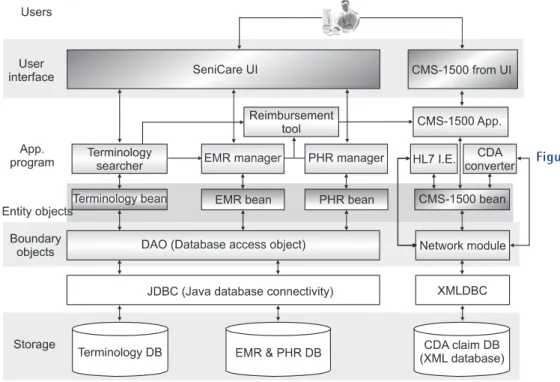
In terms of the roles of the components, as shown in Figure 1, SeniCare consists of four layers: 1) the storage layer; 2) boundary object layer; 3) application program layer; and 4) user interface layer. The components in each layer have in- dividual modules and each module performs its function by interconnecting with other modules. The roles and charac- teristics of each layer are outlined below.
1) Storage layer
Electronic medical information, such as medical standard terminologies, electronic medical records (EMRs), and per- sonal health records (PHRs), are stored and managed by operating databases. The terminology database stores the medical terminologies, referred to in creating the EMRs/
EHRs; the mapping data [17]; and the linkage information between concepts/words in the different terminologies to support a patient’s decision-making. Moreover, clinical doc- ument architecture (CDA) [18] messages, digitized from the contents of the CMS-1500 form, are stored in the CDA claim database.
2) Boundary object layer
The EHR platform is developed using the Java programming language, so Java database connectivity (JDBC) modules are used to connect the system and various databases. Even
though JDBC modules enable connection to databases, we developed an additional module, called a database access ob- ject (DAO), in order for the modules in the application pro- gram layer to easily manage the data stored in the database without considering its type. The DAO includes SQL queries for searching, removing, and inserting data directly into the database. In particular, the data are exchanged between modules as encapsulated entity objects such as Terminology bean, EMR bean, PHR bean, and CMS-1500 bean. The claim data related to the CMS-1500 form can be managed with SeniCare, in an independent database located in the local network, or with another information system in the global network. Therefore, we developed a network module that takes charge of the transmission of electronic medical infor- mation.
3) Application program layer
Various modules developed to satisfy patients’ needs are located in this layer. Here, concepts/words can be searched using the Terminology Searcher and medical information related to EMRs/PHRs can be easily managed using some manager modules. Moreover, the Reimbursement Tool is used to create claim documents based on the pre-stored medical information. Data in the claim documents must be transformed to a standardized format; therefore, the HL7 interface engine and CDA converter are located and used in this layer.
Figure 1. Architecture of SeniCare.
CDA: clinical document architecture, CMS: Centers for Medicare and Medicaid Services. UI: user interface, EMR: electronic medical re- cord, PHR: personal health record, HL7 I.E.: Health Level Seven interface en- gine, App.: application pro- gram, XMLDBC: eXtensible Markup Language database connectivity, DB: database.
4) User interface layer
Even though various modules are complexly interconnected with each other, the system should be easy to use for system users (physicians or nurses). One approach to designing a user-friendly interface is to ensure consistency of the frame structure and action process in the interface. Therefore, we offer a unified user interface module, based on Java swing, to maintain consistency. Moreover, even though the claim data of the CMS-1500 form is created and displayed electronical- ly, users may feel more comfortable creating the claim data in the program, entering through an interface that looks like the CMS-1500 form. Therefore, the CMS-1500 form user in- terface (UI) is developed for users to create claim data.
2. Usage of Medical Terminologies on the System
SeniCare supports various medical standard terminologies, such as Systematized Nomenclature of Medicine-Clinical Terms (SNOWMED-CT) [19], International Classification of Diseases (ICD) [20], Current Procedural Terminology (CPT) [21], alternative billing codes (ABC) [22], 3N (North Ameri- can Nursing Diagnosis Association, NANDA [23]; Nursing Outcomes Classification, NOC [24]; Nursing Interventions Classification, NIC [25]), and Logical Observation Identifi- ers Names and Codes (LOINC) [26], so that physicians may create standard medical information using one that is ap- propriate. Moreover, extra information, such as the linkage between terminologies, also helps physicians make decisions when they perform medical activities.
1) ICD, CPT and their linkages
Physicians’ medical activities, such as diagnosing patients and deciding treatments, greatly depend on their subjective judgments. However, physicians cannot help but consider the financial disadvantage caused by malpractice because these medical activities influence reimbursement decisions.
To prevent malpractice, some physicians refer to the recom- mendations of clinical decision-making support systems (CDSSs), developed to support physicians’ decision-making, before they perform medical activities. Malpractice could be reduced by suggesting a list of treatments related to a specific diagnosis, based on linkage information (e.g., linkages be- tween ICD and CPT codes), which the physicians can con- sider when they decide the proper treatments and request reimbursement.
2) NANDA, NIC, NOC, and their linkages
Nurses also can care for patients through the nursing pro- cess, which consists of a nursing diagnosis, nursing outcome, and nursing intervention. For a nurse to take proper care of
patients, the linkages from NANDA to NOC and NOC to NIC are suggested in [27], for consideration during the nurs- ing process. SeniCare also provides this linkage information to nurses, making medical information available on the nursing process, with 3N.
3) Management of mapping data
Some programs, such as cross coder [28], provide linkage information, but the information needs to be created or modified continuously, depending on the physicians’ subjec- tive opinion. Therefore, a mapping tool developed in [17] is included in SeniCare to manage linkage information.
3. Calculation of Reimbursement Charge
After a patient visit, physicians need to claim a reimburse- ment from the provincial government for the medical ser- vice rendered. As mentioned in section I, the government asks the physicians to complete standard claim documents, such as the CMS-1500 form. This form lists the physicians who performed the treatments, the patient, the treatments performed and related diagnoses, and the reimbursement charge related to the treatments. In particular, the charge is calculated using the fee indicated for each code in the Healthcare Common Procedure Coding System (HCPCS) [29], or its subset, the CPT. The fee is determined by consen- sus among many professionals, based on the following crite- ria: time, skill, risk to the patient and practitioner, severity of problems, geographic area, and annual budget neutrality. Us- ing these criteria, factors such as Relative Value Units (RVUs), the conversion factor (CF), and Geographic Practice Cost Indices (GPCIs) corresponding to a CPT code are suggested, to derive the reimbursement charge [30,31]. The following formula demonstrates how to compute the reimbursement charge of a specific medical service for non-facility office physicians.
Non - Facility Payment Amount = [(RVUwork + GPCIwork) + (RVUNon-Facility PE + GPCIPE) + (RVUMP + GPCIMP)] × CF ($) Where the subscripts denote the following. “Work” denotes the relative level of time, skill, training, and intensity to pro- vide a given service. “PE” denotes the portion of the reim- bursement associated with the practice expense, including reimbursement for supplies, equipment, and non-physician staff. “Non-Facility” denotes the service setting, which is generally a freestanding physician’s office. “MP” denotes the portion of the reimbursement associated with malpractice expenditures. Table 1 lists the GPCI factor and Table 2 lists the RVU and CF factors, issued in 2010 [30]. For example,
supposing that a patient visits a physician’s office, located in Orlando, Florida, and the patient receives medical service (CPT: 23405), the charge is calculated as follows:
Non - Facility Payment Amount = [(8.54 + 1.0) + (6.62 + 0.97) + (1.22 + 1.724)] × $36.8729 ≈ $629.22
Nurses also can claim reimbursement according to their clinical activities related to nursing intervention in the United States; however the intervention codes, such as NIC and clinical care classification, are not reimbursement codes.
Therefore, nurses should choose a relative code (ABC code) in HCPCS in order to create claim data. Different from the formula for physicians’ claims, the charge for ABC is calcu- lated by multiplying the given unit value, shown in Table 3, with the CF [30]. For example, if a nurse provided massage Table 1. Fragment of Geographic Practice Cost Indices (GPCIs) for
2010, by state and medicare locality
Locality name Work GPCI PE GPCI MP GPCI
Rest of Florida 1.000 0.970 1.724
Atlanta, GA 1.009 1.014 0.836
Rest of Georgia 1.000 0.942 0.829
PE: practice expense, MP: malpractice expenditure.
Table 2. Fragment of national physician fee schedule, relative value in 2010
CPT/HCPCS Description Work RVU Non-facility
PE RVU Facility PE RVU MP RVU Conversion factor
23405 Incision of tendon & muscle 8.54 6.62 6.62 1.22 36.8729
23406 Incise tendon(s) & muscle(s) 11.01 7.83 7.83 1.59 36.8729
23410 Repair rotator cuff, acute 11.39 8.53 8.53 1.63 36.8729
CPT: Current Procedural Terminology, HCPCS: Healthcare Common Procedure Coding System, RVU: Relative Value Units, PE:
practice expense, MP: malpractice expenditure.
Figure 2. (A) Calculation procedure for reimbursement charge, based on (CPT) code set. (B) Calculation procedure for reimbursement charge based on NIC and CCC code sets. ICD: International Classification of Diseases, CPT: Current Procedural Terminology, RVU: Relative Value Unit, CF: conversion factor, GPCI: Geographic Practice Cost Indices, NIC: Nursing Intervention Classi- fication, ABC: alternative billing codes, CCC: Clinical Care Classification, UV: unit value, NANDA: North American Nursing Diagnosis Association, NOC: Nursing Outcomes Classification, NIC: Nursing Interventions Classification.
Table 3. Fragment of relative values of ABC code set in 2010 ABC code Unit value Short description CBEAG 3 Infant massage, 15 minutes each CBEAJ 3.5 Lymphatic massage, 15 minutes each CBEAL 3.5 Myofascial release, 15 minutes each ABC: altermative billing codes.
therapy to an infant for 15 min (ABC: CBEAG) in 2010, the charge is calculated as follows:
Payment Amount = 3 × $36.8729 ≈ $110.61
Figure 2 shows the procedure used to derive the reim- bursement charges for physicians and nurses, respectively.
As shown in Figure 2A, if the physicians decide upon CPT codes by referring to mapping data between ICD and CPT codes, or based on the physicians’ individual opinion, the system gives the charge to the physicians by calculating it based on the related factors, after identifying the CPT code.
For the nursing process, as shown in Figure 2B, if the nurses decide upon interventions (NIC or Clinical Care classifica- tion [CCC]), the system finds reimbursable ABC codes by referring to mapping data between NIC/CCC and ABC, and gives the charge to nurses by calculating it using the related unit value, after identifying the ABC code.
4. Medical Claim Documents and Electronic Transmission Insurance claims due to physicians’ medical activities should be recorded using CMS-1500 forms. This form contains much information, such as the diagnosis based on the ICD code set, treatments related to the diagnosis based on the CPT or HCPCS (including ABC) code set, and personal in- formation about physicians and patients (e.g., name, address, phone, gender, insurance, affiliation). This information may be written repeatedly into the CMS-1500 form if physicians use paper documents. However, it may be very convenient if a program writes the information automatically, in the phy-
sicians’ stead, and the physicians then only confirm the writ- ten documents. We try to reduce confusion when physicians confirm the data in the documents by offering a UI structure that is similar to the CMS-1500 hardcopy form. Moreover, the reimbursement charge is calculated and filled into the form automatically, based on the treatments’ CPT or ABC code. Figure 3 shows a snapshot of the CMS-1500 form UI.
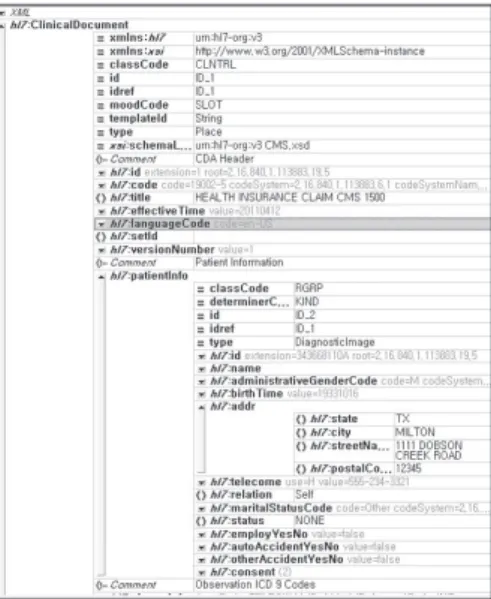
HIPAA, enacted by the United States Congress in 1996, is a set of rules and regulations that establishes standards for the transmission of electronic healthcare data. The standard ba- sically targets information exchange by representing the data using the CDA, which is part of the HL7 version 3 standards structure and semantics of clinical documents for exchange.
Therefore, the electronically created claim information needs to be transformed to a standard format, such as CDA. The system also does the transformation automatically. Figure 4 shows the HL7-based CDA schema that represents the CMS- 1500 form.
III. Results
Here, we show, at the beginning of the section, the whole system usage procedure—from “a patient visiting a physi- cian’s office” to “filing an electronic claim,” i.e., the activities of a physician servicing a patient using the developed EHR system (e.g., making a diagnosis, deciding upon a treatment according to the diagnosis, and creation of the electronic claim, based on the treatment). Moreover, we confirm, at the end of the section, the usability of the system, by compar- ing two experimental results: preparing claim documents by
Figure 3. Centers for Medicare and Medicaid Services (CMS)- 1500.
Figure 4. Fragment of HL7-based clinical document architecture (CDA) schema for Centers for Medicare and Medicaid Services (CMS)-1500 document.
filling out the CMS-1500 hardcopy forms and by using the electronic claim system.
1. System Usage Procedure
The whole procedure of physicians’ activities for patient care usually comprises the following: Patient visiting → insert basic information on patient → treating patient → calculat- ing reimbursement charge based on the treatments → writ- ing claim document → final confirmation by physician and patient → transmission of the claim document. Based on this procedure, we show an example of how an electronic claim is made through the system, using the following case: “a pa- tient, Hune Cho, who is a 58-year-old male, visits the physi- cian’s office located in Houston, Texas, for his condition of hypertension. Therefore, the physician, making the diagnosis of benign hypertension (ICD: 4011), performs a face-to-face treatment for 15 minutes with the patient (CPT: 995213).”
1) Inserting basic information on patient
The physician inserts all information on the patient into the system. Figure 5 shows a summary of the patient’s personal and health information offered by the system.
2) Making decision and decision of treatment
The physician makes a decision with the ICD code after ob- serving the patient’s symptoms. As shown in Figure 6A, the physician can search ICD codes with the keyword “hyper- tension.” Moreover, the physician can choose an ICD code from a list of diagnoses that the patient has received in the past. After making a diagnosis, the physician decides upon the proper treatments for the said diagnosis. To generate electronic information and a claim document, the physi- cian also chooses a supporting CPT code in the system. If there exists a list of CPT codes, as shown in Figure 6B (i.e.,
the “Current Diagnosis” panel associated with an ICD code selected previously), the system suggests proper CPT codes related to the indicated ICD in the “Linked CPT List” panel.
This method may prevent physician malpractice and may reduce the rejection ratio associated with performing treat- ments that are unrelated to the specific diagnosis.
If there is no CPT list related to an indicated ICD code, the physician cannot help but decide upon a CPT code by
Figure 5. Summary view of a patient’s personal and health infor- mation.
Figure 6. (A) Searching diagnoses with International Classifica- tion of Diseases (ICD) code. (B) Suggested Current Pro- cedural Terminology (CPT) list related to an indicated ICD code.
Figure 7. Mapping system adopted in SeniCare.
searching from the CPT code set. However, this activity (searching a CPT code directly) may be periodically re- peated. As such, it is very convenient to store and reuse the linkage data between ICD and CPT codes in the system.
Therefore, the physician creates new mapping data with a mapping tool [17] adopted in SeniCare, as shown in Figure 7.
3) Writing the CMS-1500 claim form
The system automatically generates the claim document by transferring basic personal information on the patient and physician to the CMS-1500 claim form. In particular, the system calculates the reimbursement charge based on the performed treatment, represented by a CPT or ABC code.
In the case above, the charge will be $67.29, calculated based on (CPT: 99213) associated with (ICD: 4011), in Texas, in 2011. Moreover, the physician can confirm the created data through the system’s CMS-1500 form UI, which aligns with the CMS-1500 form format, and the physician can then modify the claim data directly in the UI.
4) Submission of Claim Data
Finally, the confirmed claim information is transformed into a CDA message automatically, and this message will be transmitted to other heterogeneous information systems through a previously set up network.
2. Result of Experimental Study
In order to confirm the usability of the system, we compared records measuring the time spent completing CMS-1500 forms for five patient visits, using two methods: 1) manu- ally filling out the CMS-1500 form and 2) creating a claim form using the system. We compared the results recorded with respect to three features, including “inserting basic in- formation on the patient and physician,” “calculation of the reimbursement charge based on the performed treatment,”
and “creation and confirmation of the claim form.” Tables 4 and 5 present the time recorded when the CMS-1500 form is filled out by a physician directly and when the claim data is created by the system.
In the first test, the time required to insert basic informa- tion did not need to be recorded, because the system was not used in this test. However, much time was needed to calcu- late the reimbursement charge and to create claim data, be- cause the physician should fill out all required fields directly, even if the basic information on the patient and physician overlaps across all claim sheets.
In the second test, extra time was spent inserting basic information on the patient into the system, because the pa- tient was presumed to be visiting the office for the first time.
However, no extra time was needed to insert the information into the system after this initial effort. Moreover, it was un- necessary to measure the calculation time for the reimburse- ment charge because the system automatically calculates the charge based on the treatments already recorded by the phy- sician. It was also unnecessary to measure the creation time of the claim data because the system fills out the required fields of the CMS-1500 form (if it is measured meticulously, less than 1 sec may be taken). The values in the fourth field of Table 5 are the time spent by the physician confirming the claim data.
From these tests, we can conclude that the system greatly reduces the time and effort required in writing the claim documents. In this test, we did not consider the transforma- tion of the created claim data for transmission to other infor- mation systems, because comparison of this transformation process by post and by online network is basically meaning- less.
Table 4. Time recorded upon creation of the Centers for Medicare and Medicaid Services (CMS)-1500 paper form directly
Case Inserting basic information
Calculation of reimbursement
charge
Creation and confirmation of claim data
Total (sec)
1 - 154 323 477
2 - 75 315 390
3 - 94 305 309
4 - 65 285 290
5 - 89 342 431
Average - 95.4 314 379.4
Table 5. Time recorded upon creation of claim information with the system
Case Inserting basic information
Calculation of reimbursement
charge
Creation and confirmation of claim data
Total (sec)
1 234 - 55 289
2 0 - 25 25
3 0 - 22 22
4 0 - 28 28
5 0 - 35 35
Average 46.8 - 165 79.8
IV. Discussion
In this study, we designed and developed a system to support the creation of electronic claim data. This system automati- cally fills out CMS-1500 forms based on patient information and information on physicians' clinical activities. Further, the system automatically calculates the associated reimburse- ment charge. The system also contains an HL7 interface en- gine, to exchange clinical messages between heterogeneous devices. In order to demonstrate the usability of the devel- oped system, we performed an experiment that compared records of the time spent filling out the CMS-1500 form di- rectly and that spent creating electronic claim data using the developed system. From the test results, we concluded that the system could save much time for physicians in creating claim documents, and it may be useful to those who require a reimbursement-specialized EHR system.
The developed system does not completely satisfy all crite- ria requested by the CMS and ONC. That is, there is no in- teraction information on drug-drug and drug-allergy in the system, which must be implemented to meet the “meaningful use” requirements. Moreover, the security of data trans- mission also should be warranted in the system to achieve HIPAA Security Compliance. To overcome the limitations of the system, additional information guaranteed by medical experts and technologies related to secure data transmission should be included to the system. Therefore, further studies should be conducted on implementing all criteria and offer- ing a more stable, safe, and transparent transmission of the electronic claim data.
References
1. Walker JM, Bieber EJ, Richards F. Implementing an elec- tronic health record system. New York: Springer; 2004.
p3-43.
2. Medical Informatics Platform for Telehealth Develop- ment Center. SeniCare [Internet]. Daegue: Medical In- formatics Platform for Telehealth Development Center;
[cited at 2011 May 13]. Available from: http://medinfo.
knu.ac.kr/senicare.
3. Henricks WH. "Meaningful use" of electronic health re- cords and its relevance to laboratories and pathologists.
J Pathol Inform 2011; 2: 7.
4. American Medical Association. American Recovery and Reinvestment Act of 2009 [Internet]. [cited at 2011 May 20]. Available from: http://www.ama-assn.org/resourc- es/doc/washington/arra-hit-provisions.pdf.
5. Centers for Medicare & Medicaid Services. CMS EHR
meaningful use overview [Internet]. Baltimore, MD:
Centers for Medicare & Medicaid Services; [cited at 2011 May 20]. Available from: https://www.cms.
gov/EHRIncentivePrograms/30_Meaningful_Use.
asp#TopOfPage.
6. The Office of the National Coordinator for Health In- formation Technology. Establishment of the permanent certification program for health information technology [Internet]. Washington: The Office of the National Co- ordinator for Health Information Technology; 2011 [cit- ed at 2011 May 20]. Available from: http://origin.www.
gpo.gov/fdsys/pkg/FR-2011-01-07/pdf/2010-33174.pdf.
7. Centers for Medicare & Medicaid Services. Medicare and medicaid programs: electronic health record in- centive program [Internet]. Washington: Centers for Medicare & Medicaid Services; 2010 [cited at 2011 May 20]. Available from: http://edocket.access.gpo.gov/2010/
pdf/2010-17207.pdf.
8. The Office of the National Coordinator for Health Information Technology. Certified health IT product list [Internet]. Washington: The Office of the National Coordinator for Health Information Technology; 2010 [cited at 2011 May 20]. Available from: http://onc-chpl.
force.com/ehrcert/EHRProductSearch.
9. Health Information Management Systems Society. 22nd Annual HIMSS Leadership Survey [Internet]. Chicago:
Health Information Management Systems Society; 2011 [cited at 2011 May 9]. Available from: http://www.himss.
org/2011survey/healthcareCIO_final.asp.
10. Hsiao CJ, Hing E, Socey TC, Cai B. Electronic medical record/electronic health record use by office-based phy- sicians: United States, 2009 and preliminary 2010 state estimates. NCHS Health E-Stat [Internet]. Hyattsville:
National Center for Health Statistics; 2010 [cited at 2011 May 9]. Available from: http://www.cdc.gov/nchs/data/
hestat/emr_ehr_09/emr_ehr_09.htm.
11. Wikipedia. Practice management system [Internet].
Wikipedia; 2011 [cited at 2011 May 9]. Available from:
http://en.wikipedia.org/wiki/Practice_management_
software.
12. Centers for Medicare & Medicaid Services. The Health Insurance Portability and Accountability Act [Internet].
Baltimore: Centers for Medicare & Medicaid Services;
2011 [cited at 2011 May 9]. Available from: http://www.
cms.gov/HIPAAGenInfo.
13. Centers for Medicare & Medicaid Services. CMS- 1500 [Internet]. Baltimore: Centers for Medicare &
Medicaid Services; 2011 [cited at 2011 May 9]. Avail- able from: http://www.cms.gov/ElectronicBillingEDI-
Trans/16_1500.asp.
14. InstaCode. Coding tools for medical coding profession- als [Internet]. InstaCode Inc.; c2011 [cited at 2011 Jun 20]. Available from: http://www.instacode.com.
15. MPM Soft [Internet]. [cited at 2011 Jun 20]. Available from: http://www.mpmsoft.com.
16. Tran T, Kim HS, Cho H. A development of HL7 middle- ware for medical device communication. In: Proceed- ings of SERA'2007. Busan, KR; 2007. p485-492.
17. Lee IK, Kim HS, Cho H. Design and development of a system for mapping of medical standard terminologies.
J Korean Inst Intell Syst 2011; 21: 237-243.
18. Clinical Document Architecture [Internet]. [cited at 2011 May 13]. Available from: http://hl7book.net/index.
php?title=CDA.
19. International Health Terminology Standards Develop- ment Organization. Systematized Nomenclature of Medicine-Clinical Terms [Internet]. Copenhagen: Inter- national Health Terminology Standards Development Organization; [cited at 2011 May 13]. Available from:
http://www.ihtsdo.org.
20. World Health Organization. International Classification of Diseases [Internet]. Geneva: World Health Organi- zation; c2011 [cited at 2011 May 13]. Available from:
http://www.who.int/classifications/icd/en.
21. American Medical Association. Current Procedural Terminology [Internet]. Chicago: American Medical Association; c2011 [cited at 2011 May 13]. Available from: http://www.ama-assn.org/ama/pub/physician- resources/solutions-managing-your-practice/coding- billing-insurance/cpt.page.
22. ABC Coding Solutions Alternative Link. ABC [Internet].
Albuquerque, NM: ABC Coding Solutions Alternative Link: [cited at 2010 Nov 5]. Available from: http://www.
abccodes.com/ali/products_services/pro_description.
asp.
23. North American Nursing Diagnosis Association [Inter-
net]. Kaukauna, WI: NANDA International; [cited at 2010 Nov 5]. Available from: http://www.nanda.org.
24. The University of Iowa College of Nursing. Nursing Outcomes Classification [Internet]. Iowa City: The Uni- versity of Iowa College of Nursing; [cited at 2010 Nov 5]. Available from: http://www.nursing.uiowa.edu/excel- lence/nursing_knowledge/clinical_effectiveness/noc.
htm.
25. The University of Iowa College of Nursing. Nursing Interventions Classification [Internet]. Iowa City: The University of Iowa College of Nursing; [cited at 2010 Nov 5]. Available from: http://www.nursing.uiowa.edu/
excellence/nursing_knowledge/clinical_effectiveness/
nic.htm.
26. Logical Observation Identifiers Names and Codes [In- ternet]. [cited at 2010 Nov 5]. Available from: http://
loinc.org.
27. Johnson M, Bulechek G, Butcher H, Dochterman JM, Maas M, Moorhead S, Swanson E. NANDA, NOC, and NIC linkages. St. Louis: Mosby; 2006.
28. Wasserman Medical Publishers. Cross Coder [Internet].
Wasserman Medical Publishers; c2011 [cited at 2010 Dec 3]. Available from: http://www.crosscoder.com.
29. Centers for Medicare & Medicaid Services. The Health- care Common Procedure Coding System [Internet].
Baltimore, MD: Centers for Medicare & Medicaid Services; [cited at 2011 May 9]. Available from: https://
www.cms.gov/medhcpcsgeninfo.
30. Centers for Medicare & Medicaid Services. CY 2011 physician fee schedule final rule with comment pe- riod [Internet]. Baltimore, MD: Centers for Medicare
& Medicaid Services; [cited at 2011 May 9]. Available from: http://www.cms.gov/PhysicianFeeSched.
31. Introduction to relative value units and how medicare reimbursement in calculated [Internet]. [cited at 2011 May 11]. Available from: http://www.acro.org/washing- ton/RVU.pdf.