서 론
한국에서
65
세 이상 노인인구는 꾸준히 증가하고 있다.1)2000
년 도65
세 이상 인구가 전체의7
%를 넘어서 고령사회로 진입하였으며2018
년도에는14
.3
%로 증가하여, 현 추세로는2025
년도에65
세 이상 인구 비중이20
%를 넘어 초고령사회로 진입할 것이 예측되고 있 다.2) 이러한 노인인구 증가와 맞물려 의료비 역시 증가하고 있는 추 세이다.3)2017
년 기준65
세 이상 고령자에서 건강보험상 진료비는27
조
1
,357
억원으로 전체 진료비의39
.0
%를 차지하여 전년대비10
.5
% 증가, 개인당 진료비는398
만7
천원으로 전년(381
만1
천원)대비4
.6
% 증가하였다.2) 이러한 노인인구에서 기능 저하의 유무는 삶의 질의 저하 및 건강 상태의 악화와 관련되어 의료비를 증가시키는 중요한 노인 건강 문제이다.4) 노인에서 이러한 기능저하를 미리 예측하여 개입하는 것은 안전한 삶과 독립성을 유지하고5) 의료자원 사용을 감소시켜서 궁극적으로 의료비와 사회적 비용을 절감할 수 있다.6)기능저하와 관련된 임상요소들의 관계를 밝힌 기존 연구들을 통
Received July 22, 2020 Accepted September 17, 2020 Corresponding author Jeong Ho Shin
Tel: +82-31-379-8594, Fax: +82-31-379-8563 E-mail: [email protected]
ORCID: https://orcid.org/0000-0002-3354-8107
Copyright © 2020 The Korean Academy of Family Medicine
This is an open-access article distributed under the terms of the Creative Commons At- tribution Non-Commercial License (http://creativecommons.org/licenses/by-nc/4.0) which permits unrestricted noncommercial use, distribution, and reproduction in any medium, provided the original work is properly cited.
Original Article
https://doi.org/10.21215/kjfp.2020.10.6.436 eISSN 2233-9116
Korean J Fam Pract. 2020;10(6):436-442
Korean Journal of Family Practice
KJFP
체중변화가 노인 기능 저하에 미치는 영향
이영준, 신정호*
오산한국병원 가정의학과
Association between Functional Decline and Weight Change in Elderly Population
Young Joon Lee, Jeong Ho Shin*
Department of Family Medicine, Osan Hankook Hospital, Osan, Korea
Background: Functional decline in the elderly is a major problem contributing toward a low quality of life and increasing economic and social costs.
Several risk factors such as weight loss are associated with functional decline. This study aimed to investigate how weight changes in aged people affect functional decline.
Methods: Using the 5th–6th panel data sets from the Korean Longitudinal Study of Aging (KLoSA), we selected the consecutive respondents who showed no decline in activities of daily living (ADL) in the 5th panel data. We defined functional decline as the presence of one or more deficits in the ADL items. Data were analyzed by the t-test, Chi-square test, and multivariate logistic regression analysis. In addition, we also examined the relationship between weight changes and instrumental activities of daily living (I-ADL).
Results: A total of 4,256 respondents (mean age, 75.35 years) were included in the study, of whom were 1,738 (42.87%) male and 2,316 (57.13%) female. A total of 202 (4.75%) respondents showed a decline in ADL. Multivariate logistic regression analysis showed that weight gain was irrelevant to functional decline (all P-values >0.05). However, in cases of weight loss, there were significantly increased risks of ADL and I-ADL impairment (all P-values <0.001).
Conclusion: The results indicate that weight loss in the elderly is related to an increased risk of functional decline. Thus, when we see elderly patients who complain of weight loss, we should determine its cause and administer an appropriate treatment before it leads to actual functional impairment.
Keywords: Weight loss; Aged; Activities of Daily Living; Korean Longitudinal Study of Aging
이영준, 신정호. 노인의 체중 저하와 기능 저하 Korean Journal of Family Practice
KJFP
하여 노인에서의 기능저하는 복합적이며 다양한 요소들이 영향을 주는 것이 알려져 있다.7,8) 인지기능 장애, 우울, 동반질환, 체질량지 수의 변동, 하지의 기능장애, 사회적 고립, 활동량의 감소, 사회적 음주보다 낮은 수준의 음주 및 낮은 건강인지력, 흡연 및 시력장애 등이 제시되고 있다.9,10) 또한 체중 저하도 노인 기능 저하와 관계가 있으며, 이를 밝힌 많은 연구들이 보고되었다.11-16) 국내연구로
65
세 이상103
명을 대상으로 한K-FRAIL scale
의 전향적 코호트 연구에서 도 일상생활 수행능력 및 도구적 일상생활 수행능력과 체중 저하 사이에 관계가 있음을 밝힌 바가 있다.17) 하지만, 연구대상자가103
명으로 비교적 적은 수를 대상으로 한 점과 이미 기능저하가 있었던 노인들이 포함되어 있어, 새로 발생한 기능저하와 체중 감소 간의 관계를 평가하기에는 제한적이다.본 연구는 이전에 기능 저하가 없었던
65
세 이상 국내 노인을 대 상으로 최근1
년간 체중 변화가 새로 발생한 기능 저하에 미치는 영 향을 확인하고자 한다.방 법
1. 연구자료
본 연구는
Korean Longitudinal study of Aging
(KLoSA
) 고령화연구 패널5
차 및6
차 자료를 이용하여 분석하였다. 고령화연구패널조사 는2006
년 당시 제주도를 제외한 지역에 거주하는45
세 이상 인구 중 일반 가구 거주지를 대상으로 표본수 약10
,000
명을 목표로 표집 하여10
,254
명이 패널로 구축되었다.2006
년부터 짝수 연도에는 동 일한 조사 항목을 중심으로 기본조사를 실시하고 있다.2014
년에는1962–1963
년생을 중심으로 한920
명이 추가되었다.18) 이 연구에서는2014
년5
차 조사결과와2016
년6
차 조사결과를 이용하였다.2. 연구대상
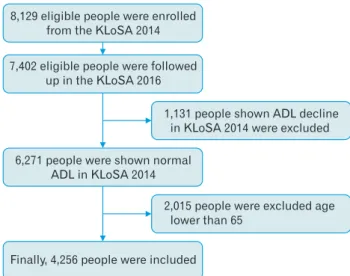
연구 대상자 선정은
2014
년도 응답자8
,129
명 가운데2016
년도에 도 연속 응답한7
,402
명을 대상으로 하였다. 이들 중2014
년도 조사 에서 일상생활 수행능력 설문에 부분적인 도움이 필요하거나, 도움 이 필요하다고 응답한1
,131
명을 제외하였다. 남은6
,271
명 가운데65
세 이상만을 선별하여4
,256
명을 대상으로 분석을 진행하였다 (Figure 1
).3. 변수정의
일상생활 수행능력을 평가하는 옷 갈아입기, 세수/양치/머리감 기, 목욕/샤워하기, 식사하기, 방 밖으로 나가기, 화장실 이용하기, 대소변 조절하기의
7
가지 설문 항목에서 한 가지 이상의 항목에 대하여 “부분적인 도움이 필요함” 또는 “전적으로 도움이 필요함”으로 응답한 경우에 기능저하가 있는 것으로 정의하였다.
도구적 일상생활 수행능력 평가에서 몸단장하기, 집안일 하기, 식 사준비하기, 빨래하기, 근거리 외출하기, 교통수단 이용하기, 물건사 기, 금전관리하기, 전화 걸고 받기, 약 챙겨 먹기의
10
가지 항목 중1
가지 이상의 항목에서 “부분적인 도움이 필요함” 또는 “전적으로 도 움이 필요함”으로 응답한 경우 도구적 일상생활에서의 기능저하가 있는 것으로 정의하였다.KLoSA
의 체중변동 조사 설문인 “현재를 기준으로 지난1
년 중체중은
5
킬로그램 이상 늘거나 줄었습니까?”에 대한1
) 증가,2
) 감 소,3
) 증가 후 감소,4
) 감소 후 증가,5
) 변화 없음에 대한 응답을 측 정하였다.현재 배우자가 생존하여 함께 거주하는 경우 배우자와 거주 중으 로 정의하였고, 미혼이거나 사별/이혼/별거의 사유가 있는 경우 그 외로 정의하였다. 교육수준의 경우
4
가지로 나누어 초등학교 졸업 이하, 중학교 졸업 이하, 고등학교 졸업 이하, 대학교 졸업 이상으로 분류하였다. 거주지역은 대도시에 거주하는 경우 대도시로 정의하 였고 그 외 중/소도시 및 읍, 면, 군 거주자는 그 외로 정의하였다.현재 근로 중인 경우 근로자로 정의하였다.
흡연자의 분류는 과거 흡연자 및 비흡연자는 비흡연으로 정의하 였으며 현재 흡연자만을 흡연자로 정의하였다. 음주자는 과거 음주 자 및 비음주자는 비음주로 정의하였고, 현재 주
2
회 이상 음주하 는 경우만 음주자로 정의하였다. 주1
회 이상 규칙적인 운동을 한다 고 응답한 경우 규칙적으로 운동을 하는 것으로 정의하였다.Original Article
Korean Journal of Family Practice
8,129 eligible people were enrolled from the KLoSA 2014
7,402 eligible people were followed up in the KLoSA 2016
6,271 people were shown normal ADL in KLoSA 2014
Finally, 4,256 people were included
1,131 people shown ADL decline in KLoSA 2014 were excluded
2,015 people were excluded age lower than 65
Figure 1. Flow diagram of the inclusion criteria for study participants.
KLoSA, Korean Longitudinal Study of Aging; ADL, Activities of Daily Living.
Young Joon Lee, Jeong Ho Shin. Functional Decline and Weight Loss in Elderly
Korean Journal of Family Practice
KJFP
과거력에서 고혈압, 당뇨 및 고혈당, 악성신생물, 만성폐질환, 심 장질환의 경우 직접적으로 의사에게서 진단을 받은 경우 과거력이 있는 것으로 정의하였으며, 뇌혈관질환의 경우 진단을 받거나, 뇌졸 중 의증 혹은 일시적 허혈성 발작으로 판정 받은 경우 과거력이 있
는 것으로 정의하였다.
4. 연구 구조 및 분석 방법
일상생활 수행능력과 도구적 일상생활 수행능력 및 변수들 간의 Table 1. Baseline characteristics of the study population
Variable Functional decline (n, %)
P-valuesa
No (n=4,054) Yes (n=202) Total (n=4,256)
Age (y) 75.02±6.82 81.89±7.44 75.35±7.01 <0.001
Sex
Female 2,316 (57.13) 125 (61.88) 2,441 (57.35) 0.183
Male 1,738 (42.87) 77 (38.12) 1,815 (42.65)
Marital status
Married 1,228 (30.29) 92 (45.54) 1,320 (31.02) <0.001
Others 2,826 (69.71) 110 (54.46) 2,936 (68.98)
Educational status
Elemetary school 2,243 (55.33) 141 (69.8) 2,384 (56.20) <0.001
Middle school 685 (16.90) 26 (12.87) 711 (16.71)
High school 837 (20.65) 27 (13.37) 864 (20.30)
College or more 289 (7.13) 8 (3.96) 297 (6.98)
Working status
Yes 1,066 (26.3) 3 (1.49) 1,069 (25.12) <0.001
No 2,988 (79.7) 199 (98.51) 3,187 (74.88)
Residence
Major city 1,619 (39.94) 66 (32.67) 1,685 (39.59) 0.039
Other 2,435 (60.06) 136 (67.33) 2571 (60.41)
Current smoker
Yes 352 (8.68) 6 (2.97) 358 (8.41) 0.004
No 3,702 (91.32) 196 (97.03) 3,898 (91.59)
Current drinking
Yes 1,142 (28.17) 11 (5.45) 1,153 (27.09) <0.001
No 2,912 (71.83) 191 (94.55) 3,103 (72.91)
Exercise
Yes 1,400 (34.53) 15 (7.43) 1,415 (33.25) <0.001
No 2,654 (65.47) 187 (92.57) 2,841 (66.75)
Hypertension
Yes 2,136 (52.69) 130 (64.36) 2,266 (53.24) 0.001
No 1,918 (47.31) 72 (35.64) 1,990 (46.76)
Diabetes/hyperglycemia
Yes 958 (23.63) 58 (28.71) 1,016 (23.87) 0.098
No 3,096 (76.37) 144 (71.29) 3,240 (76.13)
Cardiovascular disease
Yes 484 (11.94) 42 (20.79) 526 (12.36) <0.001
No 3,570 (88.06) 160 (79.21) 3,730 (87.64)
Cerebrovascular diseaseb
Yes 282 (6.96) 43 (21.29) 325 (7.64) <0.001
No 3,770 (93.04) 159 (78.71) 3,930 (92.36)
Chronic lung disease
Yes 164 (4.05) 13 (6.44) 177 (4.16) 0.097
No 3,890 (95.95) 189 (93.56) 4,079 (95.84)
Malignant neoplasm
Yes 288 (7.1) 19 (9.41) 307 (7.21) 0.217
No 3,766 (92.9) 183 (90.59) 3,949 (92.79)
Values are presented as mean±standard deviation or number (%).
at-test for continuous variables and chi-square test for categorical variables. b1 missing value in Cerebrovascular Disease.
이영준, 신정호. 노인의 체중 저하와 기능 저하 Korean Journal of Family Practice
KJFP
관계 분석을 위해 나이에 대해
T-test
를 시행하였으며 성별, 배우자 와 거주 유무, 교육, 근로, 주거, 흡연, 음주, 운동, 고혈압, 당뇨 및 고혈당, 심혈관질환, 뇌혈관질환, 만성폐질환, 악성신생물, 체중변화 와 일상생활 수행능력저하에 대해 카이제곱검정을 시행하였다.다변량 로지스틱 회귀분석을 통해
2014
년도와2016
년 연속 응답 자 가운데, 일상생활 수행능력 저하가 없었던 응답자에 새로 발생한 일상생활 수행능력 저하와 최근1
년간 체중 변화의 상관 관계를 분 석하였다. 체중 변화는2016
년도6
차 자료 중 최근1
년간의 체중 변 동 조사항목을 이용하였다.KLoSA
의 체중변동 조사 설문 응답을 기반으로Model I
은 체중변화를 묻는 설문에 대하여, “변화 없음”으 로 응답한 경우와 “체중 증가 후 체중 감소”, “체중 감소 후 체중 증 가” 응답을 대조군으로 취하여 “체중 증가”를 응답한 경우 체중 증 가군으로 두었고, “체중 감소”로 응답한 경우를 체중 감소군으로 분 류하였다.Model II
는 체중변동 조사 설문 응답에서 “체중 감소”로 응답한 경우를 실험군으로 그 외 응답들을 대조군으로 취하였다.Model III
는 “체중 증가”로 응답한 경우를 실험군으로 나머지 응답들을 대조군으로 두었다. 단변량 분석에서
P
값이0
.1
미만으로 확인 된 변수를 보정변수로 활용하기로 하였다.추가적으로 연구대상자 중 도구적 일상생활 수행능력에 이상이 없었던 인원
3
,861
명을 대상으로 동일한 분석을 수행하였다.통계 분석은
STATA ver
.15
.0
(Stata Corp
.,College Station
,TX
,USA
)를 이용하였다.P-value <0
.05
인 경우 유의한 것으로 판정하였 다.결 과
1. 연구대상자의 일반적 특성
총
4
,256
명의 응답자의 평균 연령은75
.35
(±7
.01
)세였으며, 여자가2
,441
명 (57
.35
%)으로 약간 우세했다. 응답자 중4
.75
% (202
명)에서2
년 뒤 기능저하가 관찰되었다. 일상생활 수행능력의 저하와 나이, 배우자 유무, 교육수준, 근로유무, 주거지역, 흡연, 음주, 운동, 심혈 관질환, 뇌혈관질환과 체중변동은 유의한 상관관계가 있었다. 기능 저하가 관찰된 군의 평균 연령은81
.89
세(±7
.44
)로 그렇지 않은 군 (75
.2
세±6
.82
)에 비하여 유의하게 연령이 높게 확인되었다 (P-value<0
.001
). 성별에 따라서 기능저하 발생에 유의한 차이는 관찰 되지 않았다(P-value=0
.183
). 배우자와 동거하는 경우보다 배우자가 없는 미혼과 사별, 별거로 응답한 군에서 일상생활 수행능력 저하 의 발생이 두드러졌다(3
.7
%vs 7
.0
%,P-value<0
.001
). 또한 낮은 교육 수준과 기능저하와의 관계가 유의함이 확인되었다(P-value<0
.001
).대학교 졸업 이상의 학력을 응답한
297
명 중8
명(2
.7
%)이 기능 저하를 보였으나, 초등학교 졸업 이하의 학력을 가진 경우
2
,384
명 중141
명(5
.91
%)에서 기능 저하를 보였다.65
세 이상 근로자의 경우 기능저 하의 발생이 유의하게 낮았다(0
.3
%vs 6
.2
%,P-value<0
.001
). 거주지가 대도시보다 중, 소도시나 읍, 면 등지에 거주할 경우 기능저하의 발 생율이 높았다(3
.9
%vs 5
.3
%,P-value=0
.039
).흡연의 경우 과거 흡연자 및 비흡연자에서 기능저하 발생이 증가 하였다(
1
.7
%vs 5
.0
%,P-value=0
.004
). 음주자가 비음주자에 비해 기 능저하의 발생율이 낮았고(1
%vs 6
.2
%,P-value<0
.001
), 주1
회 이상 운동을 하는 노인의 기능저하 발생이 더 낮았다(1
.01
%vs 6
.6
%,P-value<0
.001
). 과거력에서 고혈압 및 당뇨 혹은 고혈당, 만성폐질환 과 악성신생물의 진단 여부는 기능저하의 발생과 유의한 차이가 없 었다(All P-values>0
.05
). 심혈관 질환으로 진단된 노인과 뇌혈관질환 으로 진단받거나 의심되는 노인에서 기능저하의 발생율이 높았다 (All P-values<0
.001
) (Table 1
).2. 체중 변화와 일상생활 수행능력의 연관성
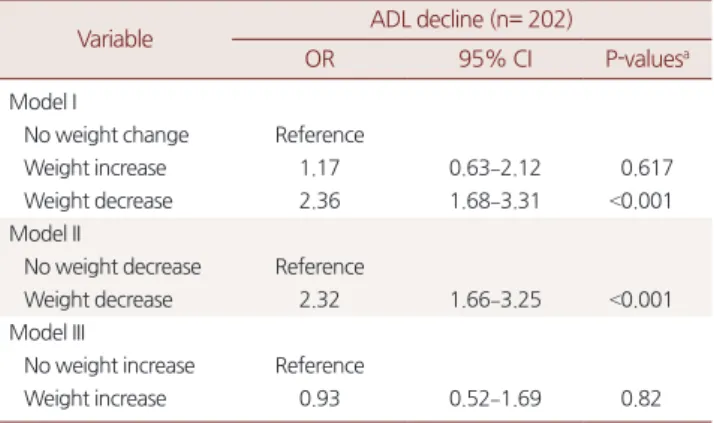
체중 변화와 기능저하에 대한 다변량 분석결과,
Model I
,II
에서 체중이 감소한 경우 체중 감소가 없는 군에 비해 유의하게 기능저하 발생이 증가하는 것으로 확인되었다(Model I
:odds ratio [OR]
,2
.36
;95
%confidence interval [CI]
,1
.68–3
.31
;Model II
:OR
,2
.32
;95
%CI
,1
.66–3
.25
). 체중이 증가한 경우는 체중 증가가 없다고 응답한 군과 비교하였을 때 기능저하 발생에 유의한 차이는 없는 것으로 확인되 었다(Model I
:OR
,1
.17
;95
%CI
,0
.63–2
.12
;Model III
:OR
,0
.93
;95
%CI
,0
.52–1
.69
) (Table 2
).Table 2. Association between functional decline and weight change (total n=4,256)
Variable ADL decline (n= 202)
OR 95% CI P-valuesa
Model I
No weight change Reference
Weight increase 1.17 0.63–2.12 0.617
Weight decrease 2.36 1.68–3.31 <0.001
Model II
No weight decrease Reference
Weight decrease 2.32 1.66–3.25 <0.001
Model III
No weight increase Reference
Weight increase 0.93 0.52–1.69 0.82
ADL, Activities of Daily Living; OR, odds ratio; CI, confidence interval.
aP-values were calculated by multivariate logistic regression analysis adjusted for age, level of education, marital state, smoking, alcohol consumption, residence, working state, hypertension, hyperglycemia & diabetes mellitus, chronic lung disease, cardiovascular disease, cerebrovascular disease.
Young Joon Lee, Jeong Ho Shin. Functional Decline and Weight Loss in Elderly
Korean Journal of Family Practice
KJFP
3. 체중 변화와 도구적 일상생활 수행능력의 연관성
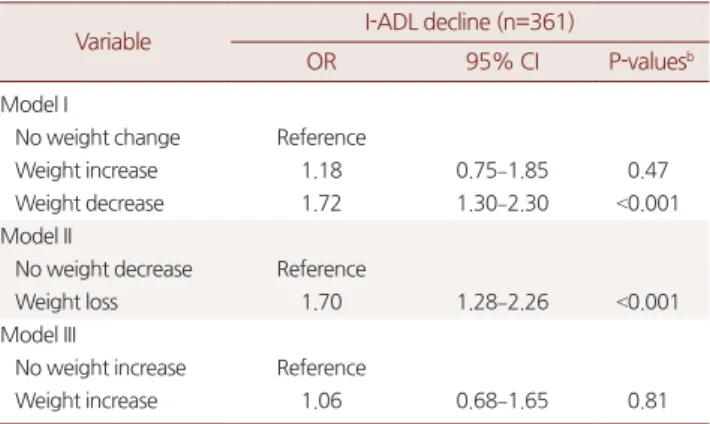
같은 모델을 이용하여 도구적 일상생활 수행능력과의 연관성을 분석한 결과 체중의 감소를 보고한 군에서 일관된 도구적 일상생활 수행능력의 감소를 보였다(
Model I
:OR
,1
.72
;95
%CI
,1
.30–2
.30
;Model II
:OR
,1
.7
;95
%CI
,1
.28–2
.26
). 체중 증가를 응답한 군에서 도구적 일상생활 수행능력의 저하와 유의한 연관성은 보이지 않았 다(Model I
:OR
,1
.20
;95
%CI
,0
.75–1
.85
;Model III
:OR
,1
.06
;95
%CI
,0
.68–1
.65
) (Table 3
).고 찰
본 연구를 통해
65
세 이상 노인인구에서 체중감소를 보고한 경 우, 일상생활 수행능력 및 도구적 일상생활 수행능력으로 평가한 기 능저하 발생 위험이 증가함을 확인할 수 있었다.Ritchie
등13)은 노인의BMI
와 관계없이 비의도적 체중손실이 일상 생활 수행능력의 저하와 연관 있음을 확인했다. 체중감소가 노인의 나쁜 예후를 시사하고 수 년 전부터 선행함을 관찰한 연구가 있으 며,19) 체중감소를 정상적인 노화의 과정 중 하나가 아닌 임상적 개입 이 필요한 상태로 보았다. 국내연구에서도 체중감소와 기능저하 사 이에 연관성을 밝히고 있다.본 연구에서도 기존 연구들과 마찬가지로 노인에서 체중 손실이 기능저하에 영향을 미칠 수 있음을 확인할 수 있었다.
노인에서는 여러 가지 원인 및 기전으로 체중감소가 일어날 수 있
다.20-22) 체중감소를 호소하는 많은 노인들이 총체적 영양실조를 겪
으며 이는 악액질과도 관련이 있다.23) 악액질은 영양불량과 운동 부
족으로 인해 근육감소의 속도가 빠르게 일어나는 만성 소모성 복합 증후군이며, 지방의 손실의 여부에 상관없이 골격근량의 지속적인 감소가 나타나며 이는 결국 근감소를 일으킨다.24) 또한, 악액질이 아 니어도 노화와 관계된 체중손실이나 어떠한 경우의 체중감소도 체 지방만이 아닌 제지방체중이 함께 손실되어 근감소로 이어진다.25,26) 이러한 근감소증은 노쇠의 핵심요소 중 하나이기도 하며,27) 근감소 의 결과 기능저하로 나타난다.
따라서 노인에서 체중 감소가 관찰되었을 때, 골격근량 및 근 감 소로 인한 향후 기능저하의 발생 가능성을 염두에 두고 체중을 유 지시키고, 동반질환, 영양결핍, 신체활동 등 교정 가능한 기능저하의 위험인자들을 확인하고 개선시키기 위한 노력이 필요할 것이다.28-30)
본 연구는 전국적으로 시행된 대규모 코호트를 이용한 분석으 로, 체중 감소와 기능저하 발생 사이의 시간적 선후관계를 확인할 수 있었으며, 자료의 대표성을 고려하였을 때, 국내 노인인구 전체로 결과를 일반화할 수 있을 것이다. 또한 다양한 보정변수를 이용하 여 분석하였으며, 일상생활 수행능력 및 도구적 일상생활 수행능력 을 활용한 분석 모두에서 일관된 결과를 확인할 수 있었다.
본 연구의 제한점으로는 우선 체중 변화를 비롯하여, 실측정이 아닌 설문을 통해 얻은 자료이기에 설문 당시 응답자에 의한 회상 바이어스가 발생할 가능성이 있다. 그러나
KLoSA
는 면접 방식으로 컴퓨터를 이용한 대인면접(computer-assisted personal interviewing
)을 채택하였으며, 이는 면접 상황을 모니터링하여 설문을 개선하거나 면접원을 감독하는 데에 도움을 주어 바이어스를 줄이는 효과가 있 을 것이다.두번째 제한점으로
KLoSA
설문에 있어서 체중 변화에 대한 응답 지의 모호성을 들 수 있다. 이를 보완하기 위해 “감소” 및 “증가 후 감소”로 응답한 대상들을 비교군(체중감소군)으로 설정하고 나머지 를 대조군으로 포함시켜 민감도 분석을 시행하였다. 민감도 분석에 서도 본 분석 결과와 일관되게, 일상생활 수행능력 저하(OR
,2
.18
;95
%CI
,1
.56–3
.06
) 및 도구적 일상생활 수행능력 저하(OR
,1
.59
;95
%CI
,1
.20–2
.09
)의 발생이 증가하였다. 민감도 분석을 통해 일부 제한점을 보완할 수는 있지만, 체중 변화에 따른 기능저하 발생 증 감을 확인하기 위해, 실제 체중 측정을 이용한 종단 연구가 필요할 것이다.결론적으로
65
세 이상 노인인구에서 체중 감소가 있는 경우, 추 후 기능저하 발생 위험이 증가하는 것으로 확인되었다. 노인에서 체 중 감소가 관찰된 경우, 그 원인을 파악하기 위한 노력이 필요하며, 향후 기능저하가 발생하지 않도록 보다 적극적인 중재가 필요하다.Table 3. Association between I-ADL and weight change (total n=
3,861a)
Variable I-ADL decline (n=361)
OR 95% CI P-valuesb
Model I
No weight change Reference
Weight increase 1.18 0.75–1.85 0.47
Weight decrease 1.72 1.30–2.30 <0.001
Model II
No weight decrease Reference
Weight loss 1.70 1.28–2.26 <0.001
Model III
No weight increase Reference
Weight increase 1.06 0.68–1.65 0.81
I-ADL, Instrumental Activities of Daily Living; OR, odds ratio; CI, confidence interval.
aAdditional 393 observation dropped for baseline I-ADL decline.
bP-values were calculated by multivariate logistic regression analysis adjusted for age, level of education, marital state, smoking, alcohol consumption, residence, working state, hypertension, hyperglycemia & diabetes mellitus, chronic lung disease, cardiovascular disease, cerebrovascular disease.
이영준, 신정호. 노인의 체중 저하와 기능 저하 Korean Journal of Family Practice
KJFP
요 약
연구배경: 고령인구에서 기능 저하는 삶의 질을 낮추고 사회
-
경제 적 비용을 높이는 원인이다. 본 연구는 한국 고령인구에서 체중 변 화가 기능저하에 미치는 영향을 알아보고자 하였다.방법:
2014
년도 및2016
년도 고령화연구패널조사(KLoSA
) 데이터를 이용하여65
세 이상 인구 중2014
년도에 기능저하가 없었던 응답자 에서2016
년 기준 최근1
년간 체중 변화가 기능저하 발생에 미치는 영향을 분석하였다. 기능저하는 일상생활 수행능력을 평가하는7
가 지 설문 항목 중 한 항목 이상에서 부분적 도움이 필요하다고 응답 한 경우와 전적인 도움이 필요함을 응답한 경우로 정의하여 다변량 로지스틱 회귀분석을 사용하여 분석하였다. 추가적으로 체중 저하 와 도구적 일상생활 수행능력의 저하와의 상관관계도 분석하였다.결과:
2014
년과2016
년 연속응답자4
,256
명이 최종 분석에 포함되었 다. 연구 대상자의 평균 연령은73
.35
세였으며. 남자는1
,738
명 (42
.87
%) 여성은2
,316
명(57
.13
%)이었다. 이들 중202
명(4
.75
%)에서 기 능저하가 관찰되었다. 다변량 로지스틱 회귀분석 결과 체중 증가는 일관되게 기능저하와 상관관계가 없었다(all P>0
.05
). 하지만 체중이 감소한 경우, 일상생활 수행능력 및 도구적 일상생활 수행능력으로 평가한 기능저하의 발생을 유의하게 증가시키는 것으로 확인되었다 (all P<0
.001
).결론: 본 연구를 통해 노인에서 체중이 감소한 경우 기능저하 발생 을 증가시킬 수 있음을 확인할 수 있었다. 체중 감소가 있는 경우 그 원인을 파악하는 노력이 필요하며, 향후 기능저하가 발생하지 않도 록 보다 적극적인 중재가 필요하다.
중심단어: 체중감소; 노인; 일상생활 수행능력; 고령화연구패널조사 CONFLICT OF INTEREST
No potential conflict of interest relevant to this article was reported
. ORCIDYoung Joon Lee
,https
://orcid
.org
/0000-0002-7602-379X Jeong Ho Shin
,https
://orcid
.org
/0000-0002-3354-8107
REFERENCES
1. Jeong HS, Song YM, Lee KS. Aging and health care expenditure. Korean J Health Econ Policy 2007; 13: 95-116.
2. Lee YS. 2018 Statistics of the Aged [Internet]. Daejeon: Statistics Korea; 2018.
[cited 2018 Nov 20]. Available from: http://kostat.go.kr/portal/korea/kor_
nw/1/1/index.board?bmode=read&aSeq=370779.
3. Cheong CL, Lee TJ. Population ageing and increasing health care expendi- tures- counting on death related costs by age group. Korean J Health Econ Policy 2017; 23: 127-48.
4. Lee HZ, Yom YH. Age difference in the trajectory of medical service utiliza- tion, medical expenses and health outcome among the elderly: a latent growth model analysis. Health Soc Welf Rev 2017; 37: 287-324.
5. Beswick AD, Rees K, Dieppe P, Ayis S, Gooberman-Hill R, Horwood J, et al.
Complex interventions to improve physical function and maintain inde- pendent living in elderly people: a systematic review and meta-analysis.
Lancet 2008; 371: 725-35.
6. Eklund K, Wilhelmson K. Outcomes of coordinated and integrated inter- ventions targeting frail elderly people: a systematic review of randomised controlled trials. Health Soc Care Community 2009; 17: 447-58.
7. Colón-Emeric CS, Whitson HE, Pavon J, Hoenig H. Functional decline in older adults. Am Fam Physician 2013; 88: 388-94.
8. Stuck AE, Walthert JM, Nikolaus T, Büla CJ, Hohmann C, Beck JC. Risk fac- tors for functional status decline in community-living elderly people: a sys- tematic literature review. Soc Sci Med 1999; 48: 445-69.
9. Mehta KM, Yaffe K, Covinsky KE. Cognitive impairment, depressive symp- toms, and functional decline in older people. J Am Geriatr Soc 2002; 50:
1045-50.
10. Kim SH, Cho B, Won CW, Hong YH, Son KY. Self-reported health status as a predictor of functional decline in a community-dwelling elderly popula- tion: nationwide longitudinal survey in Korea. Geriatr Gerontol Int 2017;
17: 885-92.
11. Volpato S, Bianchi L, Cherubini A, Landi F, Maggio M, Savino E, et al. Preva- lence and clinical correlates of sarcopenia in community-dwelling older people: application of the EWGSOP definition and diagnostic algorithm. J Gerontol A Biol Sci Med Sci 2014; 69: 438-46.
12. Bowen ME. The relationship between body weight, frailty, and the disable- ment process. J Gerontol B Psychol Sci Soc Sci 2012; 67: 618-26.
13. Ritchie CS, Locher JL, Roth DL, McVie T, Sawyer P, Allman R. Unintentional weight loss predicts decline in activities of daily living function and life- space mobility over 4 years among community-dwelling older adults. J Gerontol A Biol Sci Med Sci 2008; 63: 67-75.
14. Payette H, Coulombe C, Boutier V, Gray-Donald K. Nutrition risk factors for institutionalization in a free-living functionally dependent elderly popu- lation. J Clin Epidemiol 2000; 53: 579-87.
15. Sahyoun NR, Serdula MK, Galuska DA, Zhang XL, Pamuk ER. The epide- miology of recent involuntary weight loss in the United States population. J Nutr Health Aging 2004; 8: 510-7.
16. Bales CW, Ritchie CS. Sarcopenia, weight loss, and nutritional frailty in the elderly. Annu Rev Nutr 2002; 22: 309-23.
17. Jung HW, Yoo HJ, Park SY, Kim SW, Choi JY, Yoon SJ, et al. The Korean ver- sion of the FRAIL scale: clinical feasibility and validity of assessing the frailty status of Korean elderly. Korean J Intern Med 2016; 31: 594-600.
18. Korean Longitudinal Study of Aging (KLoSA) [Internet]. Eumseong: Korea Employment Information Service; c2015. [cited 2018 Nov 10]. Available from: https://survey.keis.or.kr/klosa/klosa01.jsp.
19. Alley DE, Metter EJ, Griswold ME, Harris TB, Simonsick EM, Longo DL, et
Young Joon Lee, Jeong Ho Shin. Functional Decline and Weight Loss in Elderly
Korean Journal of Family Practice
KJFP
al. Changes in weight at the end of life: characterizing weight loss by time to death in a cohort study of older men. Am J Epidemiol 2010; 172: 558-65.
20. Thompson Martin C, Kayser-Jones J, Stotts N, Porter C, Froelicher ES. Nu- tritional risk and low weight in community-living older adults: a review of the literature (1995-2005). J Gerontol A Biol Sci Med Sci 2006; 61: 927-34.
21. Morley JE. Weight loss in older persons: new therapeutic approaches. Curr Pharm Des 2007; 13: 3637-47.
22. Alibhai SM, Greenwood C, Payette H. An approach to the management of unintentional weight loss in elderly people. CMAJ 2005; 172: 773-80.
23. Evans WJ, Morley JE, Argilés J, Bales C, Baracos V, Guttridge D, et al. Cachex- ia: a new definition. Clin Nutr 2008; 27: 793-9.
24. Ali S, Garcia JM. Sarcopenia, cachexia and aging: diagnosis, mechanisms and therapeutic options- a mini-review. Gerontology 2014; 60: 294-305.
25. Kyle UG, Zhang FF, Morabia A, Pichard C. Longitudinal study of body composition changes associated with weight change and physical activity.
Nutrition 2006; 22: 1103-11.
26. Melton LJ 3rd, Khosla S, Crowson CS, O'Connor MK, O'Fallon WM, Riggs BL. Epidemiology of sarcopenia. J Am Geriatr Soc 2000; 48: 625-30.
27. Cruz-Jentoft AJ, Baeyens JP, Bauer JM, Boirie Y, Cederholm T, Landi F, et al.
Sarcopenia: European consensus on definition and diagnosis: report of the European Working Group on Sarcopenia in Older People. Age Ageing 2010;
39: 412-23.
28. Arnold AM, Newman AB, Cushman M, Ding J, Kritchevsky S. Body weight dynamics and their association with physical function and mortality in old- er adults: the Cardiovascular Health Study. J Gerontol A Biol Sci Med Sci 2010; 65: 63-70.
29. Jindai K, Nielson CM, Vorderstrasse BA, Quiñones AR. Multimorbidity and functional limitations among adults 65 or older, NHANES 2005-2012. Prev Chronic Dis 2016; 13: E151.
30. Barrett TM, Liebert MA, Schrock JM, Cepon-Robins TJ, Mathur A, Agarwal H, et al. Physical function and activity among older adults in Jodhpur, India.
Ann Hum Biol 2016; 43: 488-91.