Original Article
pISSN 2233-9019 · eISSN 2233-9116
Korean J Fam Pract. 2015;5(3, suppl. 2):228-234
KJFP
Korean Journal of Family Practice서 론
커피는 전세계적으로 흔히 섭취하는 식품으로 최근 한국에서의 커피 섭취량은 증가하고 있다. ‘
2013
년 국민건강영양조사’ 결과에 따 르면 한국의19
세 이상 성인3
,805
명을 대상으로 음식 항목별 주당 섭취 빈도를 조사한 결과, 커피의 주당 섭취횟수가12
.3
회로 단일 음 식 가운데 가장 높았다. 이와 같은 추세로 커피 음용이 건강에 미치 는 영향에도 관심이 늘어나고 있다.커피 섭취와 심혈관 질환과의 관련성은 아직까지 논란의 대상이 다. 어떤 연구에서는 커피 섭취가 심혈관 질환의 위험도를 증가시킨 다는 결과를 보여주기도 하지만1, 2) 이와는 대조적으로 심혈관 질환 위험 및 사망률을 줄여준다는 연구 결과들도 있다.3-6) 이와 같은 관 심은 커피 섭취와 심혈관 질환의 위험요소로 알려져 있는 혈중 지질
과의 상관관계에도 연결된다. 습관적인 커피 섭취는 혈중 지질 수치 상승과 관련이 되며, 특히 끓인 커피와 같은 비여과커피는 여과커피 보다 혈중 지질 상승에 더 밀접한 연관이 있다는 연구들이 보고된 바
있다.2, 6-11)
심혈관 질환의 위험인자 중 하나인 이상지질혈증은 식습관으로부 터 영향을 많이 받기 때문에 요즘 흔히 접할 수 있는 커피가 혈중 지 질과 관련성이 있는지 알아보는 것은 큰 의미가 있다. 전세계적으로 커피 섭취가 혈중 지질에 미치는 영향에 대한 많은 연구들이 있었지 만 국내 연구는 아직 부족하다.12) 따라서 본 연구에서는 일개 대학병 원 건강증진센터에 방문한 수검자를 대상으로 하루 커피 섭취량이 혈중 지질에 미치는 영향에 대해 연구하고자 한다.
습관적인 커피 섭취와 혈중 지질 농도
석경진
1, 윤창호
1,*, 김아솔
1, 고혜진
1, 김효민
1, 이혜림
1, 정승필
21경북대학교 의학전문대학원 가정의학교실, 2영남대학교 의과대학 가정의학교실
Habitual Coffee Consumption and Serum Lipid Concentrations
Kyung-Jin Seok
1, Chang-Ho Youn
1,*, A-Sol Kim
1, Hae-Jin Ko
1, Hyo-Min Kim
1, Hye-Rim Lee
1, Seung-Pil Jung
21Department of Family Medicine, Kyungpook National University School of Medicine; 2Department of Family Medicine, Yeungnam University College of Medicine
Background: Drinking coffee is very common in the world and the amount of coffee intake is increasing in Korea nowadays. The relationship between coffee consumption and serum lipid concentrations is not clear. Our aim in this study was to evaluate the association of the amount of coffee intake and serum lipid level.
Methods: A cross-sectional study including 530 adults who visited a university hospital for health check-up from 2013 January to 2013 December was conducted. Participants were divided into four groups by the amount of daily coffee consumption and assessed the serum lipid level.
Results: Higher coffee intake was associated with significantly increase in the mean of total cholesterol (P=0.009) and low-density lipoprotein cholesterol (P<0.001). After adjusting for sex, age, body mass index, smoking, alcohol, and regular exercise, the level of total cholesterol and low-density lipoprotein cholesterol were increased according to coffee consumptions significantly (P for trend <0.001, <0.001, respectively). The consumption of instant coffee significantly increased serum total cholesterol (P for trend=0.003) and low- density lipoprotein cholesterol (P for trend=0.002). And the consumption of filtered coffee was associated with higher low-density lipoprotein cholesterol (P for trend=0.007).
Conclusion: Higher coffee consumption was significantly associated with increased level of serum total cholesterol and low-density lipoprotein cholesterol.
Keywords: coffee; cholesterol; lipid
Received February 26, 2015 Revised August 12, 2015 Accepted September 3, 2015 Corresponding Author Chang-Ho Youn
Tel: +82-53-200-5791, Fax: +82-53-200-5480 E-mail: [email protected]
Copyright © 2015 The Korean Academy of Family Medicine
This is an open-access article distributed under the terms of the Creative Commons Attribution Non-Commercial License (http://creativecommons.org/licenses/by-nc/3.0) which permits unrestricted noncommercial use, distribution, and reproduction in any medium, provided the original work is properly cited.
방 법
1. 연구대상자
2013
년1
월부터2013
년12
월까지 일개 대학병원 건강증진센터 를 방문한19
세부터80
세까지의 성인 중 설문지의 미응답 문항이 있거나 혈중지질검사수치가 누락된 수검자를 제외한530
명을 대상 으로 하였다.2. 연구방법
1) 인구 통계학적 특성연구대상자들이 건강증진센터를 방문하여 작성한 자기기입식 설 문지를 통하여 연령, 성별, 음주력, 흡연력, 규칙적인 운동여부를 조사하였다. 설문 답안을 바탕으로 음주자는 주
3
회, 회당2
병 이상 알코올을 섭취하는 자, 흡연자는 현재 하루1
개비 이상으로 흡연하 는 자, 규칙적인 운동은 주3
회 이상,30
분 이상의 중등도 강도 운동 을 하는 경우로 정의하였다.2) 신체 계측
생체 계측기를 이용하여 신장 및 체중을 측정하였고, 체질량지수 (
body mass index
,BMI
)는 체중(kg
)을 키의 제곱(m
2)으로 나눈 수 치(Quetelet index
,kg
/m
2)로 산정하였다.3) 커피 종류 및 섭취량
설문 문항을 통해 커피 음용여부, 섭취량을 조사하고, 커피를 마시지 않는다고 응답한 대상자를 제외한 모든 대상자에게 마시 는 커피의 종류를 여과커피(
filtered coffee
), 인스턴트 커피(instant coffee
)로 나누어 기입하도록 하였다. 여기에서 여과커피는 어떤 첨 가물도 추가되지 않은 여과커피, 인스턴트 커피는 믹스커피와 설 탕, 시럽 등이 첨가된 커피로 구분하였다. 위 설문문항의 답안을 바 탕으로 총 연구대상자를 커피를 마시지 않는 군, 하루1
~2
잔 마시 는 군, 하루3
~4
잔 마시는 군, 하루4
잔 이상 마시는 군 등 총4
군 으로 분류하였고, 커피를 마시는 대상자를 커피 종류에 따라 다시 구분하여 분석에 이용하였다.4) 혈중 지질 농도
8
시간 이상 공복 상태에서 채혈하여 검사한 혈중 총 콜레스테롤 (total cholesterol
), 저밀도 지단백 콜레스테롤(low
-density lipo
-protein cholesterol
,LDL
-C
), 고밀도 지단백 콜레스테롤(high density lipoprotein cholesterol
,HDL
-C
), 중성지방(Triglyceride
) 농도를 조사하였다.3. 통계분석
각 군 사이의 인구통계학적 특성, 흡연, 음주, 운동 등 일반적 특 성의 차이를 분석하기 위해 일원배치분산분석(
one
-way analysis of variance
,ANOVA
) 및 카이제곱(Chi
-square
)검정을 시행하였 다. 커피 섭취량에 따른 혈중 지질 농도의 차이를 보기 위해 일원배 치분산분석과scheffe
방법을 통한 다중비교(multiple comparisons
) 를 시행하였다. 혈중 지질 농도에 영향을 줄 수 있는 인자를 보정 하기 위해 각 군간 유의한 차이를 보이는 변수 및 이전 연구들에서 혈중 지질 농도에 영향을 준다고 밝혀진 성별, 연령,BMI
, 흡연여 부, 음주여부, 규칙적 운동여부를 보정하여 공분산분석(Analysis of covariance
,ANCOVA
)을 시행하였고, 선형대비(linear contrast
) 검정을 통해 경향성 분석을 시행하였다. 모든 통계분석은SPSS for windows ver
.22
.0
(SPSS Inc
.Chicago
,IL
,USA
)를 사용하였으며, 유의수준은P
값0
.05
미만을 기준으로 하였다.결 과
1. 연구대상자의 일반적 특징
연구 대상자 중 남자는
330
명(62
.3
%), 여자는200
명(37
.7
%) 였 고, 평균 나이는48
세로 커피를 마시지 않는 군, 하루1
~2
잔, 하루3
~4
잔, 하루4
잔 이상 마시는 군으로 나누었을 때 평균 나이는 각 각48
.3
,45
.8
,45
.6
세였다. 총 대상자의 평균BMI
는24
.0kg
/m
2였 으며 각 군별로는 각각24
.2
,23
.7
,24
.9
,23
.9kg
/m
2였다. 커피 섭 취량이 많을수록 흡연자의 비율이 높고 규칙적 운동을 하는 사람 의 비율은 낮았다. 섭취하는 커피의 종류는 여과커피가 각 군에서34
.6
%,32
.0
%,30
.8
%로 인스턴트 커피 섭취 비율이 여과커피 섭취 비율보다 높았다(Table 1
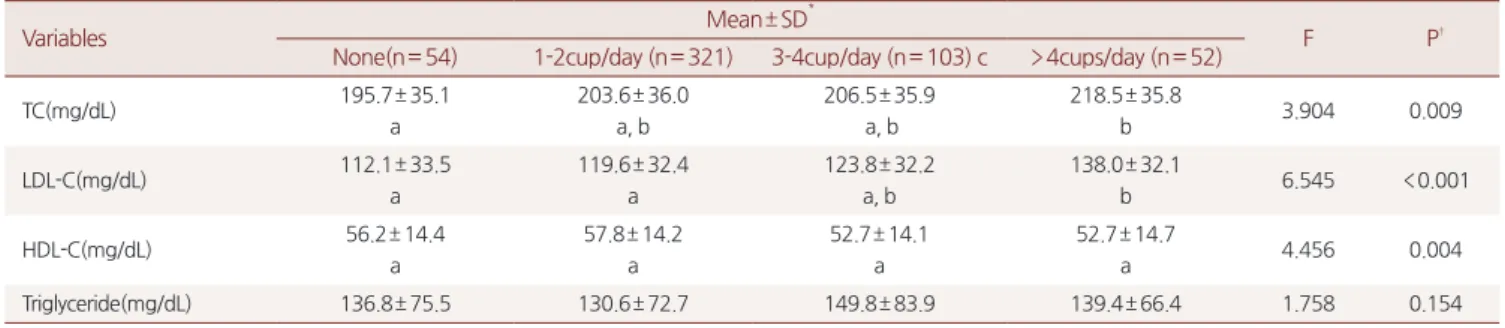
).2. 하루 커피 섭취량과 혈중 지질
혈중 총 콜레스테롤 농도의 평균값은 커피를 마시지 않는 군, 하 루
1
~2
잔 마시는 군, 하루3
~4
잔 마시는 군, 하루4
잔 이상 마시는 군에서 각각195
.7
,203
.6
,206
.5
,218
.5mg
/dL
(P
=0
.009
)로 하루 커피 섭취량이 증가할수록 총 콜레스테롤 수치가 증가하는 경향을 보였다. 또한LDL
-C
은 각 군에서112
.1
,119
.6
,123
.8
,138
.0mg
/dL
(P
<0
.001
)으로 커피 섭취량 증가에 따라서LDL
-C
수치는 통 계학적으로 유의하게 증가하였다. 각 군간HDL
-C
평균값은 통계 학적으로 유의한 차이를 보이나(P
=0
.004
), 커피 섭취량 증가에 따 른 선형관계를 보이지는 않았으며, 각 군간 중성지방 농도의 평균 값은 통계학적으로 유의한 차이를 보이지 않았다(P
=0
.154
)(Table
2
). 혈중 지질 농도에 영향을 줄 수 있는 성별, 연령,BMI
, 흡연여 부, 음주여부, 규칙적인 운동 여부를 보정하여 분석한 결과, 총 콜 레스테롤의 추정 평균값은 각 군에서 각각194
.6
,203
.6
,206
.2
,Kyung-Jin Seok, et al. A Survey of the Changes in the Awareness and Accessibility of and Satisfaction with Family Medicine Targeting the Busan Residents
Korean Journal of Family Practice
KJFP
219
.7mg
/dL
(P
=0
.005
)로 통계학적으로 유의한 차이를 보였으며, 커피 섭취량이 증가함에 따라 총 콜레스테롤이 상승하는 양상을 보 였다(P for trend
<0
.001
).LDL
-C
농도의 평균값 역시 각 군에서111
.0
,119
.8
,123
.8
,138
.4mg
/dL
(P
<0
.001
)로 통계학적으로 유의 한 차이를 보였으며, 커피 섭취량이 증가할수록LDL
-C
농도가 높 게 나타났다(P for trend
<0
.001
).HDL
-C
과 중성지방은 그 결과가 통계학적으로 유의하지 않았다(Table 3
,Figure 1a
).3. 커피 종류에 따른 커피 섭취량과 혈중 지질
음용하는 커피의 종류가 달라지게 되면 커피가 혈중 지질농도에 미치는 영향이 달라질 수 있기 때문에 마시는 커피의 종류에 따라
군을 나눈 후 각 군별로 섭취량에 따라 하루
1
~2
회, 하루3
~4
회, 하 루4
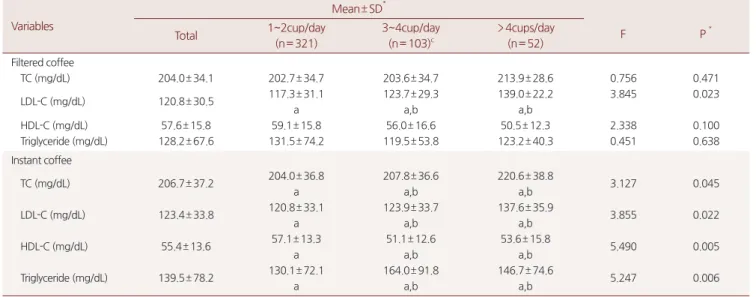
회 이상의 군을 나누어 혈중 지질 농도의 차이를 분석하였다.여과커피의 경우 커피 섭취량이 증가할수록 혈중 총 콜레스테롤이 상승하는 경향성은 보였으나 그 결과가 통계학적으로 유의하지 않 았고(
P
=0
.471
),LDL
-C
의 경우 평균값이 각 군에서117
.3
,123
.7
,139
.0mg
/dL
(P
=0
.0
.023
)으로 통계학적으로 유의한 차이를 보였 다(Table 4
).HDL
-C
, 중성지방은 통계학적으로 유의한 차이를 보 이지 않았다(각각,P
=0
.100
,0
.638
). 성별, 연령,BMI
, 흡연여부, 음주여부, 규칙적인 운동 여부로 보정을 하였을 경우 여과커피는 커피섭취량 증가에 따른LDL
-C
추정 평균값이 각 군별로117
.9
,121
.0
,140
.1mg
/dL
(P
=0
.025
)이며P for trend
가0
.007
로 통계학Table 1. General characteristics of study population
Variables Total
(n= 530)
None (n= 54)
1~2cup/day (n= 321)
3~4cup/day (n= 103)
>4cups/day
(n= 52) P*
Age(y) 48.0± 11.8 52.4± 12.9 48.3± 12.1 45.8± 10.5 45.6± 9.0 0.004
Gender Male(%) Female(%)
330 (62.3) 200 (37.7)
34 (63.0) 20 (37.0)
171 (53.3) 150 (46.7)
79 (76.7) 24 (23.3)
46 (88.5)
6 (11.5) <0.001†
Height(cm) 166.5± 8.3 165.4± 9.1 165.4± 8.3 168.9± 7.7 169.4± 6.7 <0.001
Weight(kg) 66.8± 12.0 66.6± 13.2 65.1± 11.9 71.3± 10.6 68.9± 11.2 <0.001
BMI(kg/(m2) 24.0± 3.3 24.2± 3.6 23.7± 3.4 24.9± 2.6 23.9± 3.3 0.013
Exercise‡ None Regular
254 (47.9) 276 (52.1)
22 (40.7) 32 (59.3)
145 (45.2) 176 (54.8)
52 (50.5) 51 (49.5)
35 (67.3)
17 (32.7) 0.017† Smoking
Non or ex-smoker Current smoker
401 (75.7) 129 (24.3)
45 (83.3) 9 (16.7)
259 (80.7) 62 (19.3)
67 (65.0) 36 (35.0)
30 (57.7)
22 (42.3) <0.001† Alcohol consumption
Non-drinker Drinker
162 (30.6) 368 (69.4)
20 (37.0) 34 (63.0)
100 (31.2) 221 (68.8)
26 (25.2) 77 (74.8)
16 (30.8)
36 (69.2) 0.476† Type of coffee
Filtered Instant
160 (30.2) 316 (59.6)
NA NA
111 (34.6) 210 (65.4)
33 (32.0) 70 (68.0)
16 (30.8)
36 (69.2) 0.804† Values are presented as mean±SD or number(%).
BMI: body mass index, NA: Not available
* P-values were calculated by analysis of variance (ANOVA) except values marked by †, † by the chi-square test
‡ Regular exercise means that exercise moderately more than 3 times weekly for over 30 minutes.
Table 2. Mean concentrations of the serum lipids according to daily coffee consumption
Variables Mean± SD*
F P†
None(n= 54) 1-2cup/day (n= 321) 3-4cup/day (n= 103) c >4cups/day (n= 52)
TC(mg/dL) 195.7± 35.1
a
203.6± 36.0 a, b
206.5± 35.9 a, b
218.5± 35.8
b 3.904 0.009
LDL-C(mg/dL) 112.1± 33.5
a
119.6± 32.4 a
123.8± 32.2 a, b
138.0± 32.1
b 6.545 <0.001
HDL-C(mg/dL) 56.2± 14.4
a
57.8± 14.2 a
52.7± 14.1 a
52.7± 14.7
a 4.456 0.004
Triglyceride(mg/dL) 136.8± 75.5 130.6± 72.7 149.8± 83.9 139.4± 66.4 1.758 0.154
TC: total cholesterol, HDL-C: high density lipoprotein cholesterol, LDL-C: low density lipoprotein cholesterol
* Means within a column followed by the same letter are not significantly different (P = 0.05, Scheffe’s test)
† P-values were calculated by analysis of variance (ANOVA).
적으로 유의하게 하루 커피섭취량이 많을수록
LDL
-C
수치가 증가 하는 경향을 나타내었다(Table 5
,Figure 1b
). 그 외에 커피 섭취량 에 따른 총 콜레스테롤,HDL
-C
, 중성지방의 상관성 분석은 통계 학적으로 유의하지 않았다.인스턴트 커피의 경우 총 콜레스테롤과
LDL
-C
농도의 평균 값이 각 군에서 유의한 차이를 보였으며(각각,P
=0
.045
,0
.022
),HDL
-C
, 중성지방과의 상관분석은 그 결과가 통계학적으로는 유 의하지만 커피섭취량 증가에 따른 농도 상승의 경향성을 보이지 않 았다(Table 4
). 위와 마찬가지로 혈중 지질 농도에 영향을 미칠 수 있는 인자들로 보정하여 시행한 분석에서 인스턴트 커피는 커피 섭 취량이 증가할수록 혈중 총 콜레스테롤 농도의 추정 평균값(각 군 별,203
.2
,208
.4
,223
.7
,P for trend
=0
.003
),LDL
-C
농도의 추 정 평균값(각 군별,120
.2
,124
.7
,139
.9
,P for trend
=0
.002
)이 상 승하는 경향을 보였고 이는 통계학적으로 유의했다 (Table 5
,Figure 1c
).HDL
-C
, 중성지방과는 통계학적으로 유의하지 않은 결과를 나타냈다.고 찰
본 연구는 일개 대학병원의 건강증진센터를 방문한 성인 수검자 를 대상으로 커피 섭취량과 혈중 지질 수치와의 상관관계를 보기 위 해 시행한 연구로 하루 커피 섭취량이 증가할수록 총 콜레스테롤과
LDL
-C
의 수치가 유의하게 상승하는 관련성을 보였으나HDL
-C
과 중성지방 수치와는 유의한 관계를 보이지 않았다. 혈중 지질에 영향을 미칠 수 있는 인자들로 보정한 뒤에도 커피 섭취량이 증가 함에 따라 총 콜레스테롤과LDL
-C
은 통계학적으로 유의한 상승 을 보였으나HDL
-C
과 중성지방은 유의하지 않은 결과를 보였다.커피 종류에 따라 분석을 시행한 결과, 여과커피는
LDL
-C
상승과 유의한 선형의 관련성을 보였고 인스턴트 커피는 총 콜레스테롤,LDL
-C
상승과 유의한 선형관계를 보여주었다.커피는 수천 가지의 물질로 이루어진 복합물로, 이 중
cafestol
,kahweol
을 대표로 하는deterpene alcohol
은 혈중 콜레스테롤을 상Table 3. Adjusted mean concentrations of the serum lipids according to daily coffee consumption
Variables
Adjusted mean± SE
P * P for trend † None
(n= 54)
1-2cup/day (n= 321)
3-4cup/day (n= 103)
>4cups/day (n= 52)
TC(mg/dL) 194.6± 4.9 203.6± 2.0 206.2± 3.6 219.7± 5.1 0.005 <0.001
LDL-C(mg/dL) 111.0± 4.4 119.8± 1.8 123.8± 3.2 138.4± 4.6 <0.001 <0.001
HDL-C(mg/dL) 56.7± 1.8 56.7± 0.8 54.7± 1.3 54.8± 1.9 0.53 0.349
Triglyceride(mg/dL) 134.7± 9.4 135.6± 3.9 139.0± 6.8 132.4± 9.7 0.95 0.932
TC: total cholesterol, HDL-C: high density lipoprotein cholesterol, LDL-C: low density lipoprotein cholesterol
* P-values were calculated by the analysis of covariance test adjusted by sex, age, BMI, cigarette smoking, alcohol drinking, and regular exercise.
† P for trend were calculated by trend test using linear contrast in ANCOVA.
Figure 1. Coffee consumption and serum lipid concentrations
Adjusted mean concentrations of the serum lipids according to daily coffee consumption as the group of (a) total (filtered plus instant coffee), (b) filtered coffee and (c) instant coffee consumption. Error bars indicate the standard error.
Kyung-Jin Seok, et al. A Survey of the Changes in the Awareness and Accessibility of and Satisfaction with Family Medicine Targeting the Busan Residents
Korean Journal of Family Practice
KJFP
승시키는 역할을 하는 주된 물질로 알려져 있다.2, 5, 7, 9-11, 13) 이 성분 들은 커피 원두가 볶아지고 분쇄된 후 뜨거운 물에 의해 배출되며 원두 종류와 분쇄된 입자 크기, 커피 준비 방법에 따라 이들 농도가 결정된다. 이런 성분과는 상반되는 역할을 하는
chlorogenic acid
또한 커피에 다량 함유되어 있는데, 커피에 함유된 주된polyphenol
인chlorogenic acid
는 동맥경화의 원인이 되는 지방 산화를 억제하 여 심혈관계를 보호하는 역할을 하며 커피가HDL
-C
을 상승시키 는 원인으로 추측되고 있다.7, 14-15)기존 연구들에서는 커피가 혈중 총 콜레스테롤,
LDL
-C
의 상승 과 관련이 된다고 보고하고 있다.2, 6-13,16)Naidoo
등11)은 단면연구를 통해 커피 섭취가 총 콜레스테롤,LDL
-C
, 중성지방 상승과 관련을 보인다고 보고하였고,Correa
등13)은 커피 섭취는 혈중 총 콜레스테 롤과LDL
-C
상승을 야기시킨다고 보고하였다. 이는 하루 커피 섭취량이 늘어날수록 총 콜레스테롤,
LDL
-C
이 상승하는 관련성을 보여 준 이번 연구 결과와도 일치하는 내용이다.커피섭취와
HDL
-C
, 중성지방에 대한 결과는 일관되지 않다.Jee
등11)은 메타분석을 통해 하루6
잔 이상의 커피를 마시는 경우 총 콜레스테롤,LDL
-C
, 중성지방이 유의하게 상승하였지만,HDL
-C
은 유의한 차이를 보이지 않는다고 보고하였다. 하지만 이와 대조 적으로 한 무작위 교차 임상연구에서는 중등도로 볶은 원두를 사용 한 여과커피 음용 시HDL
-C
이 상승하였으며13),Grosso
등17)의 연 구에서는 커피 섭취가 남녀에서 모두 중성지방 감소와 관련이 있었 고 여성에서는HDL
상승과 관련되었다.Kempf
등18)의 연구는 여 과커피의 습관적인 섭취 시 총 콜레스테롤,HDL
-C
의 증가와 함께LDL
-C
/HDL
-C ratio
는 감소하는 결과를 보여주기도 하였다. 이 처럼 커피 섭취가HDL
-C
, 중성지방 수치와 상관성이 발견되지 않 Table 4. Mean concentrations of the serum lipids according to filtered and instant coffee consumptionVariables
Mean± SD*
F P *
Total 1~2cup/day
(n= 321)
3~4cup/day (n= 103)c
>4cups/day (n= 52) Filtered coffee
TC (mg/dL) LDL-C (mg/dL) HDL-C (mg/dL) Triglyceride (mg/dL)
204.0± 34.1 120.8± 30.5 57.6± 15.8 128.2± 67.6
202.7± 34.7 117.3± 31.1
a 59.1± 15.8 131.5± 74.2
203.6± 34.7 123.7± 29.3
a,b 56.0± 16.6 119.5± 53.8
213.9± 28.6 139.0± 22.2
a,b 50.5± 12.3 123.2± 40.3
0.756 3.845
2.338 0.451
0.471 0.023
0.100 0.638 Instant coffee
TC (mg/dL)
LDL-C (mg/dL)
HDL-C (mg/dL)
Triglyceride (mg/dL)
206.7± 37.2
123.4± 33.8
55.4± 13.6
139.5± 78.2
204.0± 36.8 a 120.8± 33.1
a 57.1± 13.3
a 130.1± 72.1
a
207.8± 36.6 a,b 123.9± 33.7
a,b 51.1± 12.6
a,b 164.0± 91.8
a,b
220.6± 38.8 a,b 137.6± 35.9
a,b 53.6± 15.8
a,b 146.7± 74.6
a,b
3.127
3.855
5.490
5.247
0.045
0.022
0.005
0.006
TC: total cholesterol, HDL-C: high density lipoprotein cholesterol, LDL-C: low density lipoprotein cholesterol
* Means within a column followed by the same letter are not significantly different (P = 0.05, Scheffe's test)
† P-values were calculated by analysis of variance (ANOVA).
Table 5. Adjusted mean concentrations of the serum lipids according to filtered and instant coffee consumption
Variables
Adjusted mean± SE
P* P for trend† 1~2cup/day (n= 321) 3~4cup/day (n= 103) c >4cups/day
(n= 52) Filtered coffee
TC(mg/dL) LDL-C(mg/dL) HDL-C(mg/dL) Triglyceride(mg/dL)
202.9± 3.2 117.9± 2.8 57.8± 1.34 135.6± 10.0
201.9± 5.9 121.0± 5.2 59.2± 2.5 108.4± 10.7
216.4± 8.5 140.1± 7.4 53.0± 3.6 117.5± 15.5
0.309 0.025 0.341 0.078
0.146 0.007 0.214 0.281 Instant coffee
TC(mg/dL) LDL-C(mg/dL) HDL-C(mg/dL) Triglyceride(mg/dL)
203.2± 2.6 120.2± 2.3 56.1± 0.9 135.1± 5.0
208.4± 4.4 124.7± 4.0 53.1± 1.5 153.1± 8.6
223.7± 6.3 139.9± 5.7 56.0± 2.1 139.1± 12.2
0.012 0.007 0.236 0.200
0.003 0.002 0.219 0.762 TC: total cholesterol, HDL-C: high density lipoprotein cholesterol, LDL-C: low density lipoprotein cholesterol
* P-values were calculated by the analysis of covariance test adjusted by sex, age, BMI, cigarette smoking, alcohol drinking, and regular exercise.
† P for trend were calculated by trend test using linear contrast in ANCOVA
은 것은 본 연구 결과와도 일치하는 것이다. 이는 커피 준비 과정과 커피 원두 종류에 따라 커피에 함유된 성분들 간 비율 차이를 일으 키게 되고, 이로 인해 일관되지 않은 결과가 나타났을 것이라 생각 된다.
이전의 연구들에서는 커피섭취로 인한 혈중 지질 상승효과는 여 과커피보다는 비여과커피에서 더 뚜렷하게 나타났으며 이에 대해 여과커피의 경우 뜨거운 물이 여과지를 통과하는 동안
deterpene alcohol
이 부분적으로 걸러져 이러한 농도차이를 나타낸다고 설명한다.2, 6-11) 본 연구에서는 여과커피는
LDL
-C
과 상관성을, 인스턴트 커피는 총 콜레스테롤,
LDL
-C
상승과 선형관계를 보였고 이는 인스턴트 커피에 포함된 설탕, 시럽, 크림을 비롯한 첨가물질들의 혈중 지질에 대한 영향이 더 크기 때문인 것으로 추측된다.이번 연구의 제한점으로 첫째, 단면조사연구이기 때문에 커피 섭 취와 혈중 지질 농도와의 인과적 관계를 평가하지 못한 한계점이 있 을 수 있다. 둘째, 일개 대학병원 건강증진센터에서 이루어진 연구 이기 때문에 일반화하기 어렵다는 점을 들 수 있다. 셋째, 음주, 운 동, 흡연 등의 생활습관에 대해 설문지를 작성하고 보정을 하였으 나 혈중 지질에 가장 영향을 많이 미칠 수 있는 식습관이나 고지혈 증의 기왕력이 제대로 반영되지 않았기 때문에 이로 인한 혈중 지질 수치의 차이가 연구 결과에 미친 영향을 배제할 수 없다.
하지만 국내에서 커피섭취가 건강에 미치는 영향에 대해 연구한 논문이 많지 않은 시점에서 그 상관관계에 대해 알아보았다는 점에 서 의미가 있으며, 한국에서 많이 섭취하는 인스턴트 커피의 영향 에 대해 살펴본 점이 이전 연구들과 차이가 있다.
결론적으로 이번 연구에서는 커피 섭취량이 증가함에 따라 총 콜 레스테롤,
LDL
-C
수치가 상승하는 선형관계가 있음을 보여주었 으며 커피 섭취는HDL
-C
, 중성지방과는 유의한 관련성이 없었다.커피 종류에 있어서는 인스턴트 커피는 총 콜레스테롤,
LDL
-C
상 승과, 여과커피는LDL
-C
상승과 유의한 관련성을 가지는 결과를 나타냈다. 본 연구를 통해 실제 임상에서 환자들에게 커피 섭취 권 고에 대한 근거를 제시하는데 도움이 될 수 있을 것이라 생각한다.하지만 커피 섭취량 또는 커피 종류가 혈중 지질에 미치는 영향에 대한 선후관계를 분명히 밝히기 위해서는 향후 대규모의 전향적 연 구들이 필요할 것으로 사료된다.
요 약
연구배경: 커피는 전세계적으로 흔히 섭취하는 음료로 최근 한국에 서의 커피 섭취량은 증가하고 있다. 커피 섭취와 혈중 지질의 관련 성은 아직 분명히 밝혀지지 않았다. 본 연구는 커피 섭취가 혈중 지 질에 미치는 영향에 대해 알아보고자 하였다.
방법:
2013
년1
월부터12
월까지 일개 대학병원 건강증진센터를 방 문한530
명의 수검자들을 대상으로 커피 섭취를 하지 않는 군, 하루1
~2
잔 마시는 군,3
~4
잔 마시는 군,4
잔 이상 마시는 군으로 나누 어 혈중 지질 농도를 비교하였다.결과: 하루 커피 섭취량에 따라 나눈 각 군별의 혈중 총 콜레스테롤 의 농도의 평균값은
195
.7
,203
.6
,206
.5
,218
.5mg
/dL
(P
=0
.009
), 저밀도 지단백 콜레스테롤의 농도의 평균값은112
.1
,119
.6
,123
.8
,138
.0mg
/dL
(P
<0
.001
)로 커피 섭취량이 증가함에 따라 총 콜레스 테롤이 상승하는 경향을 보였으며, 성별, 나이, 체질량지수, 흡연여 부, 음주여부 및 규칙적 운동여부 등의 관련인자를 보정한 후에도 통계학적으로 유의한 경향성을 보였다(각각,P for trend
<0
.001
,<
0
.001
). 인스턴트 커피의 경우 하루 섭취량이 증가할수록 총 콜 레스테롤과 저밀도 지단백 콜레스테롤 농도의 유의한 상승을 보 였으며(각각,P for trend
=0
.003
,0
.002
), 여과커피는 저밀도 지 단백 콜레스테롤 농도의 상승과 유의한 관련성을 보였다 (P for trend
=0
.007
).결론: 커피 섭취량이 증가함에 따라 혈중 총 콜레스테롤과 저밀도 지단백 콜레스테롤 농도가 상승하는 상관관계를 보인다.
중심단어: 커피;콜레스테롤;지질
REFERENCES
1. Hammar N, Andersson T, Alfredsson L, Reuterwall C, Nilsson T, Hallqvist J, et al. Association of boiled and filtered coffee with incidence of first nonfatal myocardial infarction: the SHEEP and the VHEEP study. J Intern Med. 2003;253:653–9.
2. Cornelis MC, El-Sohemy A. Coffee, caffeine and coronary heart disease. Curr Opin Clin Nutr Metab Care. 2007;10:745-51.
3. Andersen LF, Jacobs DR, Carlsen MH, Blomhoff R. Consumption of coffee is associated with reduced risk of death attributed to inflammatory and cardiovascular diseases in the Iowa Women’s Health Study. Am J Clin Nutr. 2006;83:1039–46.
4. Mineharu Y, Koizumi A, Wada Y, Iso H, Watanabe Y, Date C, et al.
Coffee, green tea, black tea and oolong tea consumption and risk of mortality from cardiovascular disease in Japanese men and women.
J Epidemiol Community Health. 2011;65:230–40.
5. de Koning Gans JM, Uiterwaal CSPM, van der Schouw YT, Boer J, Grobbee DE, Verschuren WM, et al. Tea and coffee consumption and cardiovascular morbidity and mortality. Arterioscler Thromb Vasc Biol 2010;30:1665–71.
6. O'Keefe JH, Bhatti SK, Patil HR, DiNicolantonio JJ, Lucan SC, Lavie CJ. Effects of Habitual Coffee Consumption on Cardiometabolic Disease, Cardiovascular Health, and All-Cause Mortality. J Am Coll Cardiol. 2013;62:1043–51.
Kyung-Jin Seok, et al. A Survey of the Changes in the Awareness and Accessibility of and Satisfaction with Family Medicine Targeting the Busan Residents
Korean Journal of Family Practice
KJFP
7. Cano-Marquina A1, Tarín JJ, Cano A. The Impact of Coffee on Health. Maturitas. 2013;75:7–21.
8. Nystad T, Melhus M, Brustad M, Lund E. The effect of coffee consumption on serum total cholesterol in the Sami and Norwegian populations. Public Health Nutr. 2009;13:1818–25.
9. Urgert R, Katan MB. The cholesterol-raising factor from coffee beans. Annu Rev Nutr. 1997;17:305-24.
10. Naidoo N, Chen C, Rebello SA, Speer K, Tai ES, Lee J, et al.
Cholesterol-raising diterpenes in types of coffee commonly consumed in Singapore, Indonesia and India and associations with blood lipids: A survey and cross sectional study. Nutrition J.
2011;10:48. Published online 2011 May
11. Jee SH, He J, Appel LJ, Whelton PK, Suh I, Klag MJ. Coffee Consumption and Serum Lipids: A Meta-Analysis of Randomized Controlled Clinical Trials. Am J Epidemiol. 2001;153:353–62.
12. Shin MH, Kim DH, Bae JM, Lee HK, Lee MS, Noh JY, et al. The effect of Coffee Consumption on Serum Total Cholesterol Level in Healthy Middle-Aged Men. Korean J Prev Med. 1994;27:200-16.
13. Correa TA, Rogero MM, Mioto BM, Tarasoutchi D, Tuda VL, Cesar LA, et al. Paper-filtered coffee increases cholesterol and inflammation biomarkers independent of roasting degree: A clinical trial. Nutrition. 2013;29:977–81.
14. Uto-Kondo H, Ayaori M, Ogura M, Nakaya K, Ito M, Suzuki A, et al. Coffee Consumption Enhances High-Density Lipoprotein- Mediated Cholesterol Efflux in Macrophages. Circ Res.
2010;106:779-87.
15. Meng SX, Cao JM, Feng Q, Peng JH, Hu YY. Roles of Chlorogenic Acid on Regulating Glucose and Lipids Metabolism: A Review.
Evid Based Complement Alternat Med. 2013;8:1457–61.
16. Kokaze A, Ishikawa M, Matsunaga N, Karita K, Yoshida M, Shimada N, et al. Combined effect of longevity-associated mitochondrial DNA 5178 C/A polymorphism and coffee consumption on the risk of hyper-LDL cholesterolemia in middle-aged Japanese men. J Hum Genet. 2010;55:577–81.
17. Grosso G, Stepaniak U, Micek A, Topor-Mądry R, Pikhart H, Szafraniec K, et al. Association of daily coffee and tea consumption and metabolic syndrome: results from the Polish arm of the HAPIEE study. Eur J Nutr. 2014;8:1457-67. Epub 2014 Nov 4.
18. Kempf K, Herder C, Erlund I, Kolb H, Martin S, Carstensen M, et al. Effects of coffee consumption on subclinical inflammation and other risk factors for type 2 diabetes: a clinical trial. Am J Clin Nutr 2010;91:950–7.