• 검색 결과가 없습니다.

Correlation between Serum Lipid Level and Neurophysiological Findings in Patients with Carpal Tunnel Syndrome

N/A
N/A
Protected

Academic year: 2021

Share "Correlation between Serum Lipid Level and Neurophysiological Findings in Patients with Carpal Tunnel Syndrome"

Copied!
8
0
0

로드 중.... (전체 텍스트 보기)

전체 글

(1)

Original Article

손목굴증후군 환자의 신경생리학적 소견과 혈청 지질 수치와의 상관관계

아주대학교 의과대학 신경과학교실1, 산업의학과학교실2

여승현

1

․김동훈

1

․손성연

1

․홍윤희

1

․박재범

2

․주인수

1

Correlation between Serum Lipid Level and Neurophysiological Findings in Patients with Carpal Tunnel Syndrome

Seung Hyeon Yeo, M.D.

1

, Dong Hoon Kim, M.D.

1

, Sung Yeon Sohn, M.D.

1

, Yoon Hee Hong, M.D.

1

, Jae Bum Park, M.D.

2

, In Soo Joo, M.D.

1

Departments of

1

Neurology and

2

Occupational and Environmental Medicine, Ajou University School of Medicine, Suwon, Korea

Received 8 March 2010; received in revised form 8 June 2010; accepted 30 August 2010.

Background: Carpal tunnel syndrome (CTS) is the most common entrapment neuropathy caused by compression of the median nerve beneath the transverse carpal ligament. CTS can be correctly diagnosed by the patients' description of symp- toms and electrophysiological tests that measure nerve conduction through the wrist. Many previous studies reported various risk factors of CTS, such as obesity, diabetes mellitus, thyroid disease and trauma. Obesity is associated with both hyper- lipidemia and CTS. This study focused on the relationship between severity of CTS and serum lipid level. Methods: One hundred fourteen patients with CTS and 74 controls were divided into four groups according to the severity; normal, mild, moderate and severe. And then serum total cholesterol (TC), triglyceride (TG), low-density lipoprotein (LDL-C) and high-density lipoprotein (HDL-C) were measured in each group. Results: There was a positive correlation between TG and CTS severity (p<0.001). But TC, LDL-C and HDL-C were not correlated with CTS severity. Conclusions: These results sug- gest that high serum TG may act as an aggravating factor of CTS.

Key Words: Carpal tunnel syndrome, Neurophysiology, Lipid, Triglyceride

Address for correspondence;

In Soo Joo, M.D.

Department of Neurology, Ajou University School of Medicine, San 5, Woncheon-dong, Yeongtong-gu, Suwon 443-721, Korea Tel: +82-31-219-5175 Fax: +82-31-219-5178

E-mail: [email protected]

서 론

손목굴증후군(carpal tunnel syndrome)은 횡수근인대 (transverse carpal ligament)에서 정중신경(median nerve)이

압박을 받음으로써 관절막이 자극을 받아 건에 염증이 발

생하는 죄임신경병증이며, 보고자 마다 차이가 있지만 전

체 인구의 약 0.1%에서 이환될 정도로 흔한 말초신경병증

이다.

1

이 증후군의 진단은 주로 임상증상과 함께 전기생리

학적인 검사를 통해 이루어지는데 , Simpson에 의해 신경전

도검사가 도입된 후에 민감도가 70~80%인 진단율을 높이

려는 연구들이 많이 이루어져 현재까지 진단 감수성이 높

은 검사법으로 여겨지고 있으며 , 이러한 전기생리학적 척

도는 손목굴증후군의 임상정도와 상관관계가 있어 손목굴

증후군의 치료에 유용하게 이용되고 있다.

2,3

손목굴증후군

은 손목관절 주위 골절, 골관절증, 손목관절 및 굴근건의

(2)

활액막 종창, 횡수근인대 비대, 직업적인 손목의 과도한 사 용, 종양 등의 외부적인 요소들과 비만, 당뇨, 갑상선질환, 호르몬 대체요법, 류마티스 관절염 등의 전신적인 위험요 소들이 보고되고 있다.

4-7

Becker는 비만이 여러 위험요소 중에 강력한 위험요소임을(비만은 2.9배, 41세에서 60세의 나이는 1.91배, 당뇨는 1.82배의 비교 위험도) 보고하였다.

6

Johnson은 손목굴증후군 환자에서 손목의 체적과 정중신 경의 신경전도검사간에 상관관계가 있으며 손목비(wrist ratio)가 0.7을 넘을 때 손목굴증후군의 위험요소가 된다고 하였다.

8

이후 Moghtaderi은 손목굴증후군에 대해 손목비가 1.12, 체질량 지수(body mass index, 이하 BMI)가 1.75의 비 교위험도를 보인다고 하였다.

9

이처럼 비만은 손목굴증후 군의 주요한 위험요인이며, 비만에서는 중성지방 (triglyceride, 이하 TG) 증가, 고밀도지단백콜레스테롤(high- density lipoprotein cholesterol, 이하 HDL-C) 감소, 이상저밀도 지단백콜레스테롤(low-density lipoprotein cholesterol, 이하 LDL-C) 혈증이 동반된다.

10

Fessel은 혈청 지질이 높은 말 초신경병증 환자 6명을 처음 보고하였으며, Sandbank는 말 초신경병증 환자의 장딴지 신경(sural nerve) 조직 검사에서 수초의 심한 변화를 관찰하였다.

11,12

LDL-C는 섬유생성 사 이토카인(fibrogenic cytokine)을 증가시키고 그 결과 횡수근 인대 내부의 말초신경에 섬유조직의 성장(fibrogenesis)을 일으켜 손목굴증후군을 유발한다.

10,13

또한, TG는 지방세포 로부터 IL-6 등의 염증성 사이토카인 분비를 증가시켜 염 증반응을 일으킨다.

14

따라서 이상지질혈증은 손목굴증후 군의 위험요인이 될 수 있고, 본 연구는 손목굴증후군 환자 와 정상인에서 혈청지질과 신경생리검사결과를 비교하여 손목굴증후군의 임상증상 정도와 이상지질혈증과의 연관 성을 보고자 하였다.

대상과 방법

1. 연구대상

2005년 6월부터 2009년 6월까지 본원 신경과 근전도실로 상지의 감각장애 또는 운동장애로 의뢰된 환자들과 2009년 10월 한 달 동안 본원 산업의학과에 건강검진을 받으러 온 성인들 중 손목굴증후군의 증상이 있고 신경생리검사상 손목굴증후군으로 확진된 114명(남성 23명, 여성 91명)을 대상으로 하였고, 손목의 외상 등 외과적인 문제를 동반한 환자들과 손목굴증후군의 위험요소가 될 수 있는 당뇨, 갑 상선 질환, 류마티스 관절염의 전신질환을 가진 환자들은 제외하였다. 정상군은 2009년 10월 한 달 동안 본원 산업 의학과에 건강검진을 받으러 온 성인들로 손저림, 손의 위

약 등의 손목굴증후군의 증상이 없으며 신경생리검사상 이상 소견이 없는 74명(남성 18명, 여성 56명)을 그 대상 으로 하였다 .

2. 연구방법

환자 및 정상군은 8시간 이상의 공복 상태에서 혈액을 채취하여 혈청 총 콜레스테롤 (total cholesterol, 이하TC), TG, HDL-C, LDL-C를 자동분석방법으로 측정하였다. 일부 LDL-C 를 측정하지 않은 환자의 경우 Friedewald 공식[LDL-C=TC- (HDL-C-TG/5)] (mg/dL)에 따라 LDL-C를 구하였다.

15

신경 생리검사는 검사실 실온을 26℃ 이상으로 유지하고 표피 온도가 34℃ 이상의 상태에서 Medelec Synergy EMG 기계 를 이용하여 신경전도검사를 양측 상지의 정중신경에 시 행하였다. 자극전극, 기록전극, 접지전극 등은 모두 상품화 된 피부전극을 이용하였다. 감각신경전도검사는 둘째나 셋째 손가락-손목(finger-wrist, 이하 F-W) 구간 또는 손바닥- 손목(palm-wrist, 이하 P-W) 구간, 손목-팔꿈치(wrist-elbow, 이하 W-E) 구간에서 검사하였다. 운동신경전도검사는 기 록전극을 단무지외전근(abductor pollicis brevis)에 부착하 고 손목과 전완에서 자극하여 운동신경전도속도(motor nerve conduction velocity, 이하 MNCV)와 진폭을 측정하였다. 자 극의 강도는 운동신경전도검사를 위하여 최대위자극 (supramaximal stimulation)으로, 감각신경전도검사를 위하여 최대복합신경전위의 진폭을 나타내는 최소한의 자극 강 도로 자극하여 복합운동전위(compound muscle action potential, 이하 CMAP)와 감각신경전위(sensory nerve action potential, 이하 SNAP)를 유발하였다. 검사 시 손목굴증후군 의 진단은 정중신경의 W-E 구간이 정상이면서 Oh가 제시 한 F-W 구간 또는 P-W 구간의 감각신경전도속도(sensory nerve conduction velocity, 이하 SNCV)의 감소 및 정중운동 신경의 말단잠복기 지연 등을 진단 기준으로 삼았다.

16

이 를 다시 Stevens이 제시한 기준을 따라 세 군으로 나누었 다.

17

1) 경도: 감각신경의 말단잠복기의 지연(상대적 또는 절대적인)±정상범위 아래의 SNAP 진폭; 2) 중등도: 감각 신경의 말단잠복기의 지연과 운동신경의 말단잠복기의 지연 (상대적 또는 절대적인); 3) 중증: SNAP의 소실 또는 무지 의 CMAP소실 및 감소가 동반된 감각신경의 말단잠복기의 지연과 운동신경의 말단잠복기의 지연. 근전도 검사에서 잔떨림 (fibrillation), 감소된 동원(reduced recruitment)과 운 동단위전위의 변화가 관찰될 경우 .

3. 분석방법

SPSS version 13을 이용하여 자료를 정리하였으며 정상

(3)

Table 1. Demographic findings and comparison of patients with carpal tunnel syndrome and controls

CTS Control

Number 114 78

Male: female ratio (female %) 23:91 (79.8%) 18:56 (71.8%)

Age (years) 56.04±9.61 51.72±10.88

TC (mg/dL) 187.21±37.89 187.55±34.04

TG (mg/dL) 132.87±64.20

*

99.42±52.35

*

HDL-C (mg/dL) 51.88±11.98 53.62±11.74

LDL-C (mg/dL) 108.80±33.87 114.05±29.42

Values are expressed as mean±standard deviation.

*

t-test, p-value<0.05.

CTS, carpal tunnel syndrome; TC, total cholesterol; TG, triglyceride; HDL-C, high-density lipoprotein cholesterol; LDL-C, low-density lipoprotein cholesterol.

Table 2. Demographic findings of patients with carpal tunnel syndrome according to the electrophysiological severity

Female (n) Male (n) Number (%)

Severity

Mild 37 5 42 (36.84)

Moderate 36 9 45 (39.47)

Severe 18 9 27 (23.68)

Age (yr)

30~39 6 0 6 (5.26)

40~49 16 6 22 (19.30)

50~59 34 7 41 (35.96)

60~69 32 4 36 (31.58)

70~79 3 6 9 (7.89)

Mean age (yr)±standard deviation 55.48±9.25 58.26±10.89 56.04±9.61

군과 손목굴증후군 두 군 간의 TC, TG, HDL-C, LDL-C수 치의 비교는 t-test분석법을 이용하였으며, 손목굴증후군의 정도에 따라 정상(A 군), 경도(B 군), 중등도(C 군), 중증 (D 군) 네 군간의 TC, TG, HDL-C, LDL-C 수치의 비교 및 신경생리검사 소견은 일원배치분석(one-way ANOVA)을 이용하였고 Tukey로 사후 검정하였다. 또한 신경생리검사 소견의 정도와 각 지질 수치의 상관관계는 Pearson 상관분 석으로 분석하였다.

결 과

1. 인구통계학적 특성

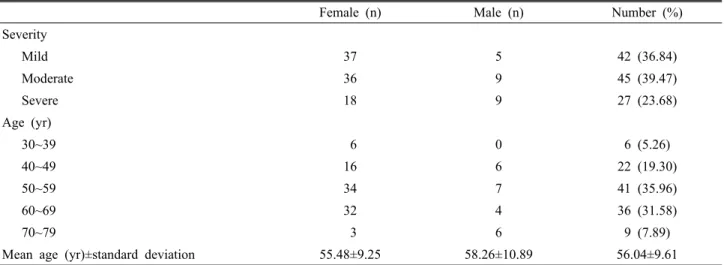
손목굴증후군 환자는 114명 중 여성이 79.8%이었으며 정상군은 74명 중 71.8%가 여성으로 손목굴증후군의 환자 군에서 여성의 비율이 높았다. 나이는 30세부터 85세까지 분포하였으며 환자군과 정상군에서 평균 나이의 유의한

차이는 없었다(Table 1, 2). 신경생리검사 결과에 따라 네 군으로 나누었을 때, 여성의 비율이 경도군에서는 88.1%

로, 정상군, 중등도군, 중증군(각각 71.8, 80.0, 66.7%)에 비 해 높았다(Table 2).

2. 신경생리검사 결과

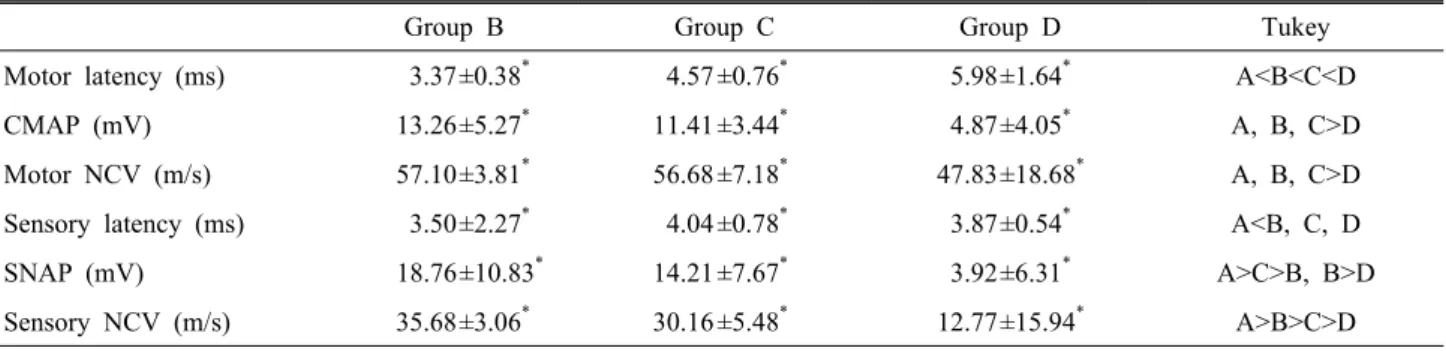
신경생리검사 결과에 따라 나눈 경도군에서는 운동신경

말단 잠복기, CMAP, MNCV, SNAP는 정상 소견을 보였고

SNCV는 35.68±3.06 m/s로 감소되어 있었다. 중등도군에서

는 CMAP, MNCV, SNAP는 정상 소견을 보였고 운동신경

말단잠복기는 4.57±0.76 ms로 지연되어 있었고 SNCV는

30.16±5.48 m/s로 감소되어 있었다. 중증군에서는 운동

신경 말단 잠복기가 5.98±1.64 ms로 지연되어 있었고, CMAP

(4.87±4.05 mV), MNCV (47.83±18.68 m/s), SNAP (3.92±6.31

mV), SNCV (12.77±15.94 m/s)는 감소 소견을 보였다(Table 3).

(4)

Table 3. Comparison of electrophysiological severity and correlation with serum tiriglyceride level

Group B Group C Group D Tukey

Motor latency (ms) 3.37±0.38

*

4.57 ±0.76

*

5.98±1.64

*

A<B<C<D

CMAP (mV) 13.26±5.27

*

11.41 ±3.44

*

4.87±4.05

*

A, B, C>D

Motor NCV (m/s) 57.10±3.81

*

56.68 ±7.18

*

47.83±18.68

*

A, B, C>D

Sensory latency (ms) 3.50±2.27

*

4.04 ±0.78

*

3.87±0.54

*

A<B, C, D

SNAP (mV) 18.76±10.83

*

14.21 ±7.67

*

3.92±6.31

*

A>C>B, B>D

Sensory NCV (m/s) 35.68±3.06

*

30.16 ±5.48

*

12.77±15.94

*

A>B>C>D Values are expressed as mean±standard deviation.

Group B: mildly affected, group C: moderately affected, group D: severely affected.

*

One-way ANOVA, p-value<0.0001.

CMAP, compound muscle action potential; NCV, nerve conduction velocity; SNAP, sensory nerve action potential.

Table 4. Comparison of serum total cholesterol, triglyceride, high-density lipoprotein cholesterol and low-density lipoprotein cholesterol according to the electrophysiological severities

Group A Group B Group C Group D Tukey

TC (mg/dL) 187.55±34.04 184.43±39.74 189.33±37.90 188.00±36.03

TG (mg/dL) 99.42±52.35

*

108.98±49.59

*

146.00±69.56

*

148.15±66.23

*

A, B<C, D

HDL-C (mg/dL) 53.62±11.74 51.48±11.31 52.40±13.01 51.63±11.59

LDL-C (mg/dL) 114.05±29.42 111.21±32.44 107.68±34.68 106.91±35.70 Values are expressed as mean±standard deviation.

Group A: normal, group B: mildly affected, group C: moderately affected, group D: severely affected.

*

One-way ANOVA, p-value<0.001.

TC, total cholesterol; TG, triglyceride; HDL-C, high-density lipoprotein cholesterol; LDL-C, low-density lipoprotein cholesterol.

3. 혈청 지질 소견과 신경생리검사 소견 간의 분석

혈청 TC, HDL-C, LDL-C는 환자군에서 평균이 각각 187.21±

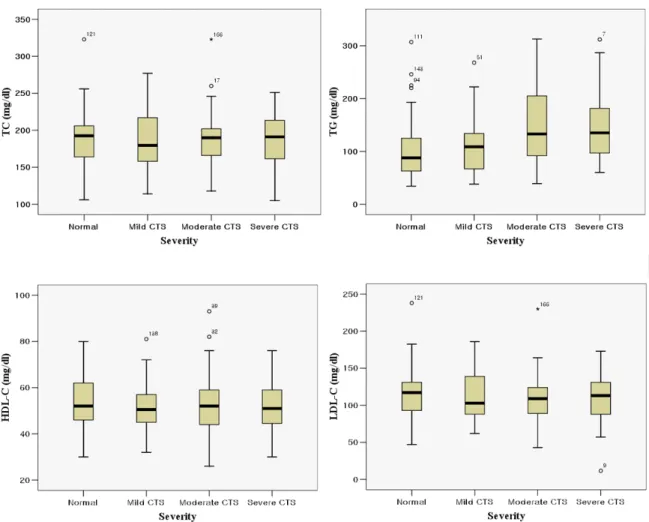
37.89 mg/dL, 51.88±11.98 mg/dL, 108.80±33.87 mg/dL이었고, 정상군에서는 187.55±34.04 mg/dL, 53.62±11.74 mg/dL, 114.05±29.42 mg/dL으로 두 군간의 차이를 보이지 않았다 (Table 1). TG는 환자군과 정상군에서 각각 132.87±64.20 mg/dL, 99.42±52.35 mg/dL으로 환자군에서 높았으며 유의한 차이를 보였다(p<0.05) (Table 1). 혈청 TC, HDL-C, LDL-C는 경도군에서 평균이 각각 184.43±39.74 mg/dL, 51.48±11.31 mg/dL, 111.21±32.44 mg/dL이었고, 중등도군에서는 각각 189.33±37.90 mg/dL, 52.40±13.01 mg/dL, 107.98±34.68 mg/dL 이며, 중증군에서는 각각 188.00±36.03 mg/dL, 51.63±11.59 mg/dL, 106.91±35.70 mg/dL으로 정상을 포함한 네 군간의 차이를 보이지 않았다. TG는 정상군, 경도군, 중등도 및 중 증군에서 각각 99.42±52.35 mg/dL, 108.98±49.59 mg/dL, 146.00±69.56 mg/dL, 148.15±66.23 mg/dL으로 네 군에서 유 의한 차이를 보였다(p<0.001) (Table 4) (Figure 1). 또한 사 후 검증에서 정상군과 중등도 이상에서 유의함을 검증할

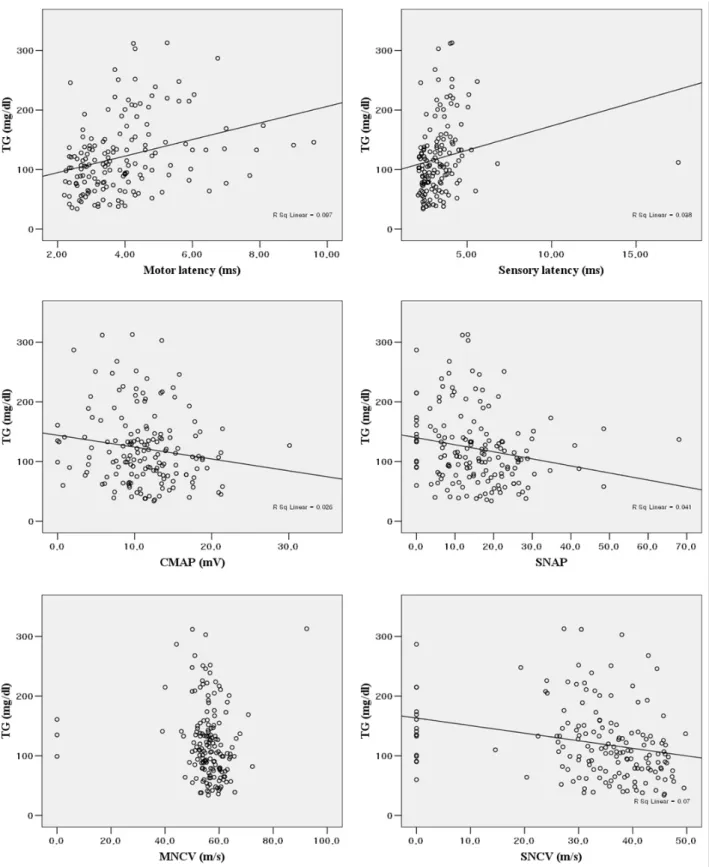
수 있었고 중증도가 심할수록 TG수치가 증가하는 양의 상 관관계를 보였다 (p<0.001). 신경전도검사 각 요소 별로 TG 수치와 상관관계를 비교했을 때 운동신경의 말단잠복기 (p<0.001), 감각신경의 말단잠복기(p<0.05)는 양의 상관관 계를 보이면서 유의하였으며 , SNAP (p<0.05), SNCV (p<0.005), CMAP (p<0.05)는 음의 상관관계를 보이면서 유의하였으나 MNCV는 유의하지 않았다(Figure 2).

고 찰
1863년 James Paget에 의하여 처음 기술된 손목굴증후군

은 치료 가능한 신경병증의 하나라는 점에서 조기진단이

강조되어 왔다. 손목굴증후군의 진단은 임상증상과 이학

적 검사를 통하여 어느 정도 가능하고 대개 전기진단학적

검사를 통하여 확진한다. 전기진단학적 검사는 신경의 탈

수초화와 허혈의 정도를 알 수 있고, 미만성 말초신경병증,

경수신경근병증, 그리고 단일신경병증과 같은 다른 신경

질환들과 감별할 수 있으므로 손목굴증후군을 진단하는

(5)

Figure 1. Comparison of serum total cholesterol (TC), triglyceride (TG), high-density lipoprotein cholesterol (HDL-C), and low-density lipoprotein cholesterol (LDL-C) according to the electrophysiological findings in patients with carpal tunnel syndrome (CTS). Serum TG is correlated with CTS severity, but TC, LDL-C and HDL-C are not correlated with CTS severity.

데 매우 유용한 검사이며, 최근 연구에서는 손목굴증후 군의 임상증상 정도와 전기진단학적 척도 사이에 연관 됨이 보고되고 있다.

3

손목굴증후군의 치료가 늦어지면 신경에 비가역적인 손 상이 생겨 영구적인 후유증이 남기 때문에 조기진단을 위 하여 손목굴증후군의 위험요인을 밝히는 연구들이 많이 진행되었고 비만이 주된 위험요인으로 보고되고 있다. 비 만에 의한 손목굴의 내용물 체적의 증가가 손목굴증후군 을 야기한다고 알려져 있고, 또한 손목굴증후군의 위험요 소로 높은 수치의 LDL-C를 제시한 Nakamichi와 Tachibana 의 연구는 지질대사 이상이 손목굴증후군의 위험요소임을 시사한다.

18

그리고 이상지질은 말초신경병증을 유발하는 데, 1971년 처음 Fessel이 혈청 지질이 높은 말초신경병증 환자 6명을 보고하면서 혈청 지질과 말초신경병증의 연관 성에 관심을 갖기 시작하였으며, 이후 Sandbank 등은 고지

혈증이 있는 말초신경병증 환자의 장딴지 신경 조직 검사

에서 수초의 심한 변화를 관찰하였다.

11,12

또한 McManis는

혈청 TG가 800 mg/dL 이상 증가된 환자 6명에서 감각운동

축돌기신경병증(axonal sensorimotor neuropathy) 소견을 얻

었고 이중 1명은 TG를 교정하는 치료 후 신경병증의 증상

이 소실되었으며 , Kaufman은 혈청 TG가 400 mg/dL 이상

되는 두 명의 통증성 말초신경병증 (painful peripheral neuro-

pathy) 환자를 보고하였고 신경조직검사에서 축돌기의 손

상을 보였다 .

19,20

그리고 Drory는 말초신경병증의 증상이

없으면서 혈청 TG가 400 mg/dL 이상인 16명에게서 신경

전도검사, 교감피부반응(sympathetic skin responses), 안정

시와 과호흡 시 R-R간격의 변화를 조사하여 6명에게서 이

상소견을 발견하고 높은 혈청 TG수치는 말초신경병증을

일으키며 , 이상소견이 나온 이들은 무증상(subclinical) 말

초신경병증 상태라고 설명하였다.

21

실험적으로 Sandbank와

(6)

Figure 2. Correlation between serum triglyceride (TG) level and electrophysiological findings. Serum TG has a positive

correlation with motor (p<0.001) and sensory latency (p<0.05). Serum TG has a negative correlation with amplitude of

CMAP (p<0.05), and sensory nerve action potential (SNAP) (p<0.05), and sensory nerve conduction velocity (SNCV)

(p<0.005). However, motor nerve conduction velocity (MNCV) is not correlated with serum TG.

(7)

Bubis는 쥐들에게 고지혈식사를 시키고 그들의 궁둥신경 (sciatic nerve)을 확인했을 때 대조군에 비해 수초와 축돌 기의 손상을 발견하였는데, 수초 손상은 과수초화(hyper- myelination), 탈수초화(demyelination) 손상이 둘 다 관찰되 었으며, 축돌기는 축돌기 자체 손상보다는 신경미세섬유 (neurofilament)가 뭉쳐진 것이 일부 관찰되었고 미토콘드 리아가 일부 축돌기안에서 축적되어 있는 것을 발견하였 다 .

22

최근 연구에서는 고중성지방혈증이 지방세포로부터 IL-6, IL-8, GRO (growth regulated oncogene), MCP-1 (monocyte chemotatic protein-1) 등의 분비를 증가시키고 HDL에 의 한 항염증작용을 저하시킨다고 한다.

14,23

결론적으로, 이 상지질은 손목굴의 염증을 증가시켜 손목굴증후군을 악화 시킬 수 있을 것이다.

손목굴증후군은 주로 중년 여성에서 호발하고 연령별로 는 40~60세 사이가 전체 발생의 58%를 차지하며, 남녀비 는 1:3 정도로 여자에게 흔하다.

24

인천지역을 대상으로 한 연구에서는 40~60세 사이가 전체 발생의 80%를 차지하고 50세의 평균나이를 보이며, 남녀비가 1:4 정도로 여자가 많다고 보고하였다.

25

본 연구에서 수근관 증후군의 남녀 비는 1:4로 기존의 연구와 비슷한 결과를 보였으나, 연령 별로는 40~60세 사이가 전체 발생의 87%를 차지하였고 평 균나이가 56세로 기존의 연구보다 높게 나타났는데, 이는 주로 40대 이상을 대상으로 하는 건강검진 대상자를 대상 군으로 선정하였기 때문이다.

최근의 연구에서 손목굴증후군 환자의 LDL-C와 SNCV 는 역의 연관성이 있고, 여성 환자의 TG와 SNCV도 역의 연관성이 있으며, LDL-C의 혈중농도에 따라 수근관 증후 군의 발생이 증가한다고 보고하였다.

18

또 다른 연구에서 는 복부비만, 높은 TG 수치, 고혈압 및 과공복혈당을 가진 대사증후군이 SNAP 및 CMAP의 감소와 연관이 있다고 보 고하고 있다.

26

이는 혈청내 TG와 LDL-C의 수준이 손목굴 증후군의 위험요인이 될 수 있음을 의미한다. 본 연구에서 는 MNCV를 제외한 모든 신경전도 소견이 TG의 혈중농도 와 양의 상관관계가 있었다. MNCV는 중증군에서 활동전 위를 보이지 않는 경우(no action potential)들이 포함되어 있어 유의한 결과가 나오지 않은 것으로 판단된다. 혈청 TG 수치는 신경생리소견의 중증도에 따른 네 군간에 유의 한 차이가 있었고, 특히 경도보다 중등도 이상에서 TG 혈 중농도 증가가 뚜렷하였다. 이러한 결과는 혈청 TG가 손 목굴증후군의 유발요인이라기보다 악화요인으로 작용하 였을 가능성이 높음을 시사한다.

본 연구는 우리나라에서 손목굴증후군 환자와 정상인의 혈청 지질을 비교 분석하고 신경생리학적 결과에 따라 환

자군을 나누어 혈청 지질과 신경생리학적 결과간의 연관 성을 분석한 첫 연구이다. 다만, 비만이 손목굴증후군의 위험요소이고, TG는 비만과 연관이 있는 것으로 비만에 대한 고려가 되지 못한 제한점이 있다. 향후 TG와 연관성 있는 비만과 고지혈증, 비만 및 당뇨를 포함하는 대사증후 군에 대한 연관성 연구가 더 필요하다 .

REFERENCES

1. Stevens JC, Sun S, Beard CM, O’Fallon WM, Kurland LT.

Carpal tunnel syndrome in Rochester, Minnesota, 1961 to 1980.

Neurology 1988;38:134-138.

2. Simpson JA. Electrical signs in the diagnosis of carpal tunnel and related syndromes. J Neuro Neurosurg Psychiatry 1956;19:

275-280.

3. Do HC, Lee J, Lee SJ, Park MY, Ha JS. The relationship be- tween clinical grading and electrophysiological parameter in carpal tunnel syndrome. Yeungnam Univ J Med 2007;24:407-415.

4. Nathan PA, Keniston RC, Myers LD, Meadows KD. Longitu- dinal study of median nerve sensory conduction in industry:

relationship to age, gender, hand dominance, occupational hand use, and clinical diagnosis. J Hand Surg Am 1992;17:850-857.

5. Stallings SP, Kasdan ML, Soergel TM, Corwin HM. A case-control study of obesity as a risk factor for carpal tunnel syndrome in a population of 600 patients presenting for inde- pendent medical examination. J Hand Surg Am 1997;22:211-215.

6. Becker J, Nora DB, Gomes I, Stringari FF, Seitensus r, Panosso JS, et al. An evaluation of gender, obesity, age and diabetes mellitus as risk factors for carpal tunnel syndrome. Clin Neurophysiol 2002;113:1429-1434.

7. Geoghegan JM, Clark DI, Bainbridge LC, Smith C, Hubbard R. Risk factors in carpal tunnel syndrome. J Hand Surg 2004;

29:315-320.

8. Johnson EW, Gatens T, Poindexter D, Bowers D. Wrist dimensions: correlation with median sensory latencies. Arch Phys Med Rehabil 1983;64:556-557.

9. Moghtaderi A, Isadi S, Sharafadinzadeh N. An evaluation of gender, body mass, wrist circumference and wrist ratio as in- dependent risk factor for carpal tunnel syndrome. Acta Neurol Scand 2005;112:375-379.

10. Howard BV, Ruotolo G, Robbins DC. Obesity and dyslipidemia.

Endocrinol Metab Clin North Am 2003;32:855-867.

11. Fessel WJ. Fat disorders and peripheral neuropathy. Brain 1971;94:531-540.

12. Sandbank U, Bechar M, Bornstein B. Hyperlipidemic poluneu- ropathy. Case report: histological and electron-microscopical study.

Acta Neuropath 1971;19:290-300.

13. Leonarduzzi G, Sevanian A, Poli G. Cholesterol oxidation pro- ducts and fibrogenesis. Biofactors 2001;15:117-119.

14. Bassols J, Moreno-Navarrete JM, Ortega F, Ricart W, Fermadez-

Real JM. LIGHT is associated with hypertriglyceridemia in

obese subjects and increased cytokine secretion from cultured

(8)

human adipocytes. Int J Obes 201034:146-156.

15. Friedewald WT, Levy RI, Fredrickson DS. Estimation of the concentration of low-density lipoprotein cholesterol in plasma, without use of the preparative ultracentrifuge. Clin Chem 1972;

18:499-502.

16. Oh SJ. Clinical electromyography: nerve conduction studies.

3rd ed. Philadelphia: Williams & Wilkins. 2003;628-633.

17. Stevens JC. AAEM minimonograph 26: the electrodiagnosis of carpal tunnel syndrome. American Association of Electrodiagnostic Medicine. Muscle Nerve 1997;20:1477-1486.

18. Nakamichi K, Tachibana S. Hypercholesterolemia as a risk factor for idiopathic carpal tunnel syndrome. Muscle Nerve 2005;32:

364-367.

19. McManis PG, Windebank AJ, Kiziltan M. Neuropathy asso- ciated with hyperlipidemia. Neurology 1994;44:2185-2186.

20. Kaufman M. Triglycerides and neuropathy. Neurology 1995;45:

2119-2120.

21. Drory VE, Groozman GB, Rubinstein A, Korezyn AD. Hyper- triglyceridemia may cause a subclinical peripheral neuropathy.

Electromyogr Clin Neurophysiol 1999;39:39-41.

22. Sandbank U, Bubis JJ. Hyperlipidemic poluneuropathy. Experi- mental study. Brain 1973;96:355-358.

23. Patel S, Puranik R, Nakhla S, Lundman P, Stocker R, Wang XS, et al. Acute hypertriglyceridaemia in humans increases the tri- glyceride content and decreases the anti-inflammatory capacity of high density lipoproteins. Atherosclerosis 2009;204:424-428.

24. Phalen GS. Reflections on 21 years’ experience with the carpal tunnel syndrome. JAMA 1970;212:1365-1367.

25. Choi YH, Leem JH, Chae CH, Park JI, Kang SK. An evalua- tion for occupational distribution of carpal tunnel syndrome di- agnosed at a university hospital. Korean J Occup Environ Med 1999;11:313-322.

26. Balci K, Utku U. Carpal tunnel syndrome and metabolic syndrome.

Acta Neurol Scand 2007;116:113-117.

수치

Table 2. Demographic findings of patients with carpal tunnel syndrome according to the electrophysiological severity
Table 3. Comparison of electrophysiological severity and correlation with serum tiriglyceride level
Figure 1. Comparison of serum total cholesterol (TC), triglyceride (TG), high-density lipoprotein cholesterol (HDL-C), and low-density lipoprotein cholesterol (LDL-C) according to the electrophysiological findings in patients with  carpal tunnel syndrome (
Figure 2. Correlation between serum triglyceride (TG) level and electrophysiological findings

참조

관련 문서

Mean density of intertidal invertebrate communities in Yongjeong (H1) according to the tidal levels at each investigation stations (H, High tide level; M, middle tide level; L,

Values of Glucose, T-protein, T-cholesterol and Triglyceride of Blistered fluid caused by Buhang blistering --- 19..

FBG: fasting blood glucose, TC: total cholesterol, TG: triglyceride, HDL-C: high density lipoprotein-cholesterol, LDL-C: low density lipoprotein-cholesterol,

Serum uric acid levels and risk for vascular disease in patients with metabolic syndrome... Prevalence if the metabolic syndrome in a Turkish

Second, the total cholesterol, low density lipoprotein cholesterol, and triglyceride of the exercise group significantly decreased after 8 weeks of Ju-do

Key words : Alzheimer's disease, mild cognitive impairment, apo E genotype, homocysteine, hs-CRP, plasma antioxidants, albumin, uric acid, bilirubin, lipid profile,

Corrosion resistance increased with corrosion potential shifting to noble direction and there is a good correlation each other between passivaity current

E and prickly pear cactus in Sprague Dawley rats fed fish oil by examining erythrocyte Na-leak, platelet aggregation, TBARS production and plasma