• 검색 결과가 없습니다.

미추 경막외 차단술 시 주사침 길이에 따른 효과

N/A
N/A
Protected

Academic year: 2021

Share "미추 경막외 차단술 시 주사침 길이에 따른 효과"

Copied!
7
0
0

로드 중.... (전체 텍스트 보기)

전체 글

(1)

접수일 : 2013 년 8 월 8 일 , 게재승인일 : 2013 년 9 월 10 일 책임저자 : 강진규 , 서울시 강동구 동남로 892

󰂕 134-727, 강동경희대병원 재활의학과

Tel: 02-440-7246, Fax: 02-440-7260 E-mail: [email protected]

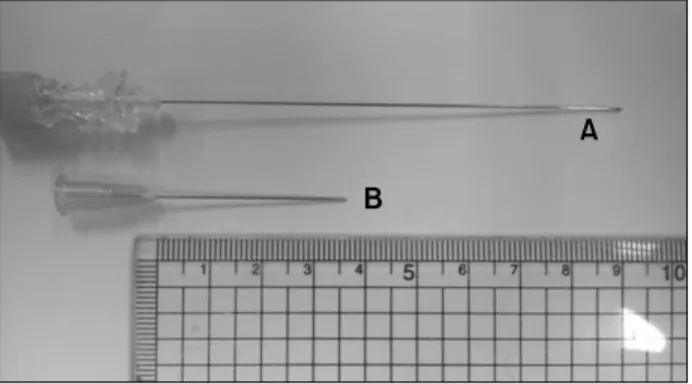
Fig. 1. The length of two needles used in this study. (A) a 22-gauge long needle (9 cm) (B) a 25-gauge short needle (3.5 cm).

미추 경막외 차단술 시 주사침 길이에 따른 효과

경희대학교 의과대학 재활의학교실

김동환ㆍ김희상ㆍ유승돈ㆍ윤동환ㆍ전진만ㆍ이승아ㆍ강진규

Effect of Caudal Epidural Injection ac- cording to Needle Length

Dong Hwan Kim, M.D., Hee-Sang Kim, M.D., Seung Don Yoo, M.D., Dong Hwan Yun, M.D., Jinmann Chon, M.D., Seung Ah Lee, M.D. and Jin Kyu Kang, M.D.

Department of Physical Medicine & Rehabilitation, College of Medicine, Kyung Hee University, Seoul, Korea

Objective: To analyze the effect and adverse effect of cau- dal epidural injection according to needle length difference.

Method: Patients were randomly allocated into 2 groups.

Group A was injected by 22-gauge long spinal needle (9 cm), and Group B was injected by 25-gauge short needle (3.5 cm). Pain or disability experienced during daily life were assessed before injection using the Visual Analogue Score (VAS), the Oswestry Disability Index (ODI) and the Roland-Morris Disability Questionnaire (RDQ). Also, imme- diately after injection, the pain experienced during needle insertion was assessed by VAS. After 2 weeks, patients were reassessed using the same outcome measures.

Results: Fifty-eight patients underwent caudal epidural in- jection, and group A was 30 patients, group B was 28 patients. Both groups demonstrated significant improvement after injection in all outcome measures. The degree of im- provement in the VAS, ODI, RDQ were not significantly dif- ferent between two groups (p>0.05). This result suggest that the needle length difference does not affect the pain relief effect of caudal epidural injection, and in Group B, the degree of pain during needle insertion was significantly low (p=0.031) and any adverse effect related with dural irri- tation, which were found in 5 patients of Group A, was not reported. Conclusion: Caudal epidural injection by 25-gauge 3.5 cm short needle are as effective as 22-gauge 9 cm long needle for pain relief in patients with low back pain or radicular leg pain. Caudal epidural injection by 25-gauge 3.5 cm short needle is less painful and safe methods of ensuring that injections are administered into epidural space. (Clinical Pain 2013;12:80-86)

Key Words: Low back pain, Caudal epidural injection, Needle length, Adverse effect

INTRODUCTION

Epidural injections, via the inter-laminar, trans-foraminal or caudal routes, of local anesthetic and corticosteroid are accepted treatments in the management of low back pain and radicular leg pain.

1

They offer the patient therapeutic benefit and offer the physician diagnostic information that can help guide future management.

Access to the epidural space through sacral hiatus is one of the most commonly used techniques in managing chron- ic low back pain, because caudal epidural injections are simple procedure that is easier to administer in the out- patient department than lumbar epidurals. Previous reports reveal that caudal epidural injection is a relatively safe pro- cedure which is used in a wide range of clinical settings.

2-6

It has become one of the most commonly performed inter- ventions in pain practice for those with low back pain.

Also, caudal epidural injection can be effectively used to

treat low back pain or radicular leg pain caused by nerve

root lesion lower than the height of the L4 nerve,

7

and a

(2)

22-gauge long spinal needle (Fig. 1A) is used commonly.

However, when using a 22-gauge long spinal needle, pa- tients often complain of severe pain or dizziness. There- fore, patients often reject for followed same procedure lat- er, even though it is indicated. As a result, patient’s com- pliance was decreased. Studies by Markakis

8

revealed the rate of serious complications from caudal epidural injec- tions was 1/40,000 and total complications were 1.5/1,000.

One complication of caudal epidural injections, dural punc- ture, occurred in 1 of 1,100 (0.09%) and in 1 of 750 (0.13%) in previous studies by Dalens et al.

9

and Veyckemans et al.

10

For this reason, many physician prefer to use shorter and thinner needle than 22-gauge long spinal needle. And 25-gauge short needle (3.5 cm) (Fig. 1B) was frequently used instead of 22-gauge long needle in many clinical settings.

This study is aim to comparatively analyze the effect and adverse effect of caudal epidural injection according to needle length difference between 22-gauge long needle (9 cm) and 25-gauge short needle (3.5 cm).

MATERIALS AND METHODS

1. Materials

Patients with radicular leg pain due to disc prolapse treated with caudal epidural injection who visited depart- ment of physical medicine and rehabilitation of Kyung Hee University hospital at Gangdong and Kyung Hee medical center were included in this study. Inclusion criteria in- cludes symptomatic disc prolapse diagnosed with magnetic resonance imaging scan, disc prolapse of 1 level only either L4-5 or L5-S1, lumbar radiculopathy confirmed with elec- tromyography, leg pain for more than 4 weeks and age be- tween 20 and 60. Exclusion criteria includes multiple disc herniation, spondylolisthesis, history of lumbar surgery or symptoms requiring emergency surgery, epidural injection within the last month, blood clotting disorders, unexplained evidence of infection or inflammation, pregnancy and pro- gressive neurologic deficits.

From April 2011 to August 2012, total 58 patients who undergo caudal epidural injection by blind method except 6 who did not want to participate in this study were recruited. All patients were randomly allocated into 2 groups. Group A was injected by 22-gauge long spinal nee- dle (9 cm), and Group B was injected by 25-gauge short

needle (3.5 cm).

2. Methods

1) Caudal epidural injection: A single technique by a single operator was used in all cases. Patients were placed in the prone position. The skin of the buttocks and natal cleft were cleaned with anti-septic chlorhexidine and the anatomical landmarks of the two sacral cornua and the soft spot of the sacral hiatus were identified. Using strict aseptic technique, a 22-gauge 9 cm spinal needle or 25-gauge 3.5 cm needle was introduced through the sacral hiatus. The needle was blindly directed into the sacral hiatus at an ap- proximately 45

o

angle with the bevel facing posteriorly.

The needle was advanced, and directed to cannulate the sa- cral canal. Placement of the needle involved consideration of the anatomical landmarks and sensory feedback to the operator’s hand. The give of passing through the membrane of the sacral hiatus and the slight resistance to advancement of the spinal needle is usually characteristic of entering the epidural space. If the physician was not satisfied with the position of the needle, then it was removed and reinserted.

When needle placement was believed to be correct, aspira- tion was performed to exclude venous or dural puncture.

And then 10 ml of 0.5% lidocaine, 1 ml (40 mg) of tri- amcinolone were injected through inserted needle. All in- jected material consisted of 10 ml of 0.5% lidocaine, 1 ml (40 mg) of triamcinolone.

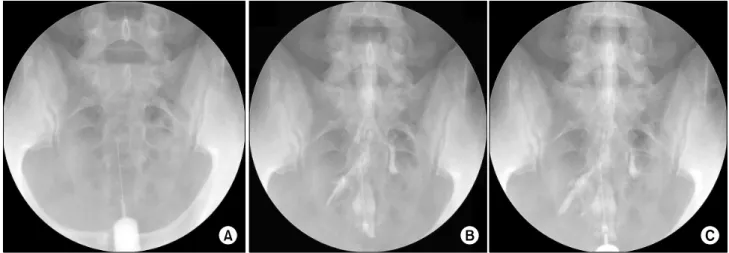
In addition to the two groups (group A and B) that in- jected blindly, as an example to injected material can reach above L5 level, 5 patients under age of 40 underwent fluo- roscopy guided caudal epidural injection. In this group, on- ly 25-gauge 3.5 cm needle was used and the injected mate- rial consisted of 10 ml of 0.5% lidocaine, 1 ml (40 mg) of triamcinolone and 1 ml of contrast medium (Iohexol 20%, Omnipaque). The needle was blindly directed into the sacral hiatus as the same method described above, and after the needle placement was believed to be correct, physician start to caudal epidural injection. The needle position and dispersion of contrast into the epidural space and nerve root filling was confirmed by fluoroscopy in posteroanterior views (Fig. 2).

2) Assessment of treatment effects: Before caudal epi-

dural injection, their pain or disability experienced during

daily life were assessed by a questionnaire including Visual

Analogue Score (VAS), the Korean Version of Oswestry

(3)

Fig. 2. (A) Fluoroscopy guided caudal epidural injection using a 25-gauge short needle (PA view). Injected material consisted of 10 ml of 0.5% lidocaine, 40 mg (1 ml) of triamcinolone and 1 ml of contrast medium (Iohexol 20%, Omnipaque). A 25-gauge short (3.5 cm) needle was correctly inserted through sacral hiatus just before start injection. (B) After 6 ml of injectate was injected. The dispersion of injected material into the epidural space and nerve root filling was observed. (C) After injection was done with a total of 12 ml, the injected material reach above L5 level.

Disability Index (ODI)

11

and the Korean Version of Roland-Morris Disability Questionnaire (RDQ).

12

Patients usually feel pain when the needle enters the epidural space by passing through the sacrococcygeal membrane. So, im- mediately after injection, the pain experienced during nee- dle insertion was assessed by VAS and if any immediate adverse effect occur, patients were asked to report.

Two weeks after injection, their pain or disability during daily life were reassessed using the same outcome meas- ures, as described above, by questionnaire or telephone survey. In addition, any adverse effect about caudal epi- dural injection experienced during last 2 weeks were asked to report.

3) Statistical analysis: The statistical analysis obtained average and standard deviation of each item for VAS, ODI and RDQ using SPSS 13.0. The Wilcoxon signed-rank test was used to compare the clinical values before, and 2 weeks after the injection for all patients and for each group.

And, the change of VAS, ODI and RDQ between the day of injection and 2 weeks after injection was compared in Group A and Group B, respectively. The Mann-Whitney U test was used for group comparisons on the mean degree of improvement in VAS, ODI and RDQ. A p-value of

<0.05 was considered to be statistically significant.

RESULTS

1. Subjects

Group A (22-gauge 9 cm long spinal needle) has 30 pa- tients and there were 13 males (43.3%) and 17 females (56.7%). The age range was 29∼59 with a mean age of 49.2 years. The initial VAS range was 4∼9 with a mean VAS of 6.4, ODI range was 14∼52 with a mean ODI of 30 and RDQ range was 4∼18 with a mean RDQ of 7.93.

Group B (25-gauge 3.5 cm short needle) has 28 patients and there were 15 males (53.5%) and 13 females (46.5%).

The age range was 23∼59 with a mean age of 43.4 years.

The initial VAS range was 2∼9 with a mean VAS of 6.4, ODI range was 8∼52 with a mean ODI of 30.4 and RDQ range was 3∼14 with a mean RDQ of 7.13. There were no significant differences between two groups about age and initial VAS, ODI, RDQ (Table 1).

2. Comparison of pre- and post-injections out- come measure within groups and between groups The degree of pain experienced during needle insertion assessed with VAS was significantly low in the group B (p=0.031) (Table 2). The degree of pain experienced during needle insertion with mean VAS was 5.13 in group A and 3.87 in group B.

Two weeks after caudal epidural injection, both groups

(4)

Fig. 3. (A) Comparison of Pre- and Post-injection Outcome Measure within Group A. In group A, all outcome measures about pain or disability experienced during last 2 weeks showed significant improvement (p<0.05). (B) Comparison of Pre- and Post-injection Outcome Measure within Group B. In group B, all outcome measures about pain or disability experienced during last 2 weeks showed significant improvement (p<0.05).

Table 2. Comparison of Pre- and Post-Injections Outcome Measure between Two Groups

Group A Group B p value

Pain during procedure (VAS) 5.13±1.99 3.87±1.64 0.031*

ΔVAS 2.06±2.21 2.13±1.55 0.806

ΔODI 9.06±8.44 12.13±8.33 0.412

ΔRDQ 2.46±3.77 3.86±2.61 0.187

Values are mean±standard deviation. Group A: Caudal epidural injected by 22-gauge long spinal needle (9 cm), Group B: Caudal epidural injected by 25-gauge short needle (3.5 cm), VAS: Visual Analogue Score, ODI: Oswestry Disability Index, RDQ:

Roland-Morris Disability Questionnaire. *Bold characters represent statistically significant values (p<0.05).

Table 1. Clinical Characteristics of Two Groups

Group A (n=30) Group B (n=28) p value

Age (mean±SD) 49.2±10.3 43.4±12.7 0.475

Sex (male/female) 13/17 15/13

Initial VAS (mean±SD) 6.40±1.55 6.40±2.06 0.438

Initial ODI (mean±SD) 30.00±11.23 30.40±14.73 0.143

Initial RDQ (mean±SD) 7.93±4.57 7.13±4.26 0.843

Level of disc prolapse

L4-5 16 11

L5-S1 14 17

Group A: Caudal epidural injected by 22-gauge long spinal needle (9 cm), Group B: Caudal epidural injected by 25-gauge short needle (3.5 cm), SD: standard deviation, VAS: Visual Analogue Score, ODI: Oswestry Disability Index, RDQ: Roland-Morris Disability Questionnaire.

demonstrated significant improvement in all outcome measures about pain or disability experienced during last 2 weeks (p<0.05) (Fig. 3). But, there were no significant

difference between Group A and Group B regarding the de-

gree of improvement in the VAS, ODI, RDQ (p>0.05)

(Table 2).

(5)

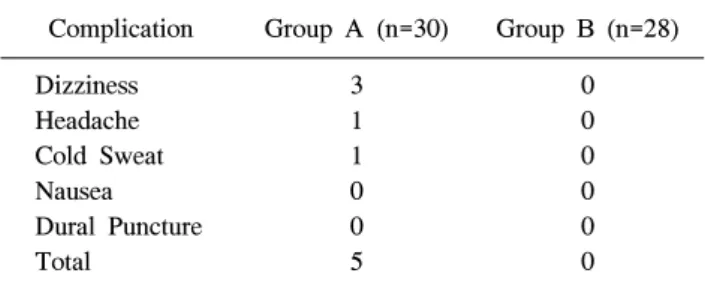
Table 3. The Adverse Effects that Reported after Caudal Epidural Injection (Numbers of Patients)

Complication Group A (n=30) Group B (n=28)

Dizziness 3 0

Headache 1 0

Cold Sweat 1 0

Nausea 0 0

Dural Puncture 0 0

Total 5 0

Group A: Caudal epidural injected by 22-gauge 9 cm spinal nee- dle, Group B: Caudal epidural injected by 25-gauge 3.5 cm needle.

3. The adverse effects of the caudal epidural injection

In group B, there was no adverse effect immediately af- ter caudal epidural injection and until two weeks after injection.

In contrast to the group B that any adverse effects were not reported, in Group A, the adverse effects might be re- lated with dural irritation were found in 5 patients. The diz- ziness were in 3 patients, headache was in 1 patient, and cold sweat was in 1 patient, although no dural puncture was reported (Table 3).

DISCUSSION

The caudal epidural injection is one of the most widely used intervention in the management of low back pain as- sociated with radicular leg pain. The rationale for admin- istration of epidural steroid injection is based on the as- sumption that inflammation of the spinal nerve root causes radicular pain and the epidural corticosteroids relieve this pain, allow time for healing and physical therapy. It is be- lieved that epidural steroid injection are mainly effective in treating acute radiculopathy at intermediate term follow-up, even though it was found to have no long-term benefit.

13

Absolute contraindications to epidural steroid injection in- clude systemic infection, local infection at the site of the planned injection, bleeding disorder or anticoagulant ther- apy, allergy to glucocorticoids, and patient refusal.

14

Although epidural steroid injection is a common tool of conservative therapy in patients with radicular pain,

15

it is not inherently benign.

16

Several rare complications have been reported in the literature. They include local dis-

comfort, infection, side effects of steroid, dural puncture, post dural puncture headache, epidural hematoma, and nerve injury.

17

Other rare complications include aggravated back pain, facial flushing, vasovagal reactions, episodes of nausea, increased leg pain

18

and even transient blindness.

19

Most complications are more related to the invasiveness of the procedure than to the injection itself.

20

The most com- mon technical complication of epidural injection is in- advertent dural puncture, which has an incidence as high as 7%.

21

Post dural puncture headache occurs in 20% to 50% of all dural punctures.

22

In this study, no dural punc- ture was definitely reported. However, dural irritation might have been a main cause of other side effects such as dizzi- ness, cold sweat, and headache, which were reported in 5 patients in Group A.

One of the important key factors of successful caudal epidural injection by blind method to avoid dural puncture may be a clear understanding of the normal anatomy of the sacral hiatus and the surrounding structures. The sacral hia- tus is located at the caudal end of the sacrum and bordered laterally by two sacral cornua. Only skin, subcutaneous fat tissue, and the sacrococcygeal ligament cover the hiatus.

When the needle has passed through the sacrococcygeal ligament, the hiatus communicates with the epidural space directly, it can reach to dural end.

The prevalence of the dural puncture is relatively low, but the dural puncture is a serious complication from cau- dal epidural injection. It has been reported after caudal epi- dural injection in several case reports by Desparmet

23

and Lumb and Carli

24

in the pediatric literature. Two conditions can lead to dural puncture during caudal epidural injection:

(1) dural cystic structures, such as a posterior sacral me- ningocele, or a Tarlov cyst that contains cerebrospinal fluid and extends inferiorly, and (2) an anatomic variation of ex- tension of the dura to a lower than average lower sacral level. Joo et al.

25

reported that in all of these situations, the inferior end of the dural sac is located at the lower level of the sacral vertebra, and the spinal cavity itself reaches the lower sacral segments earlier reports by Senoglu et al., Joo et al.

25,26

revealed that for these reasons, determining the anatomical location of the sacral hiatus, the sacrococcy- geal ligament, and the level of termination of the dural sac are essential before performing caudal epidural injection, to prevent dural puncture.

Therefore, during caudal epidural injection, it is important

(6)

Fig. 4. Diagram of the sacrum and caudal epidural space. In most anatomic study, the maximum of linear distance from the dural end to apex of hiatus (a) does not exceed the 6 cm. So, long spinal needle (9 cm) can be enough to cause dural puncture.

to know the distance between the apex of the hiatus and the end of the dural sac for determining the length of the needle to be introduced into the canal. Crighton et al.

27

found the mean shortest distance from the dura to the upper edge of the sacrococcygeal membrane to be 60 mm (range 34∼80 mm) in their MRI study of 14 patients. In another study in male adult cadavers, Aggarwal et al.

28

found the mean short- est distance between the apex of the hiatus and the end of the dural sac to be 32±12 mm (range 5.8∼60.0 mm), and Senoglu et al.

29

found the mean distance to be 44.6 mm with a similarly large range of distances 10∼80 mm. The anat- omy of such a short distance carry a higher risk of dural puncture when using a 22-gauge long spinal needle (9 cm) (Fig. 4). Based on these studies, we suggest to use a 25-gauge 3.5 cm short needle to avoid harmful dural punc- ture and to reduce any complication related to the invasive- ness of the procedure using a 22-gauge long spinal needle.

In addition, when using fluoroscopy guided caudal epi- dural injection by 25-gauge short needle, injected material can reach above L5 level in all 5 cases in our study. The position of needle that successfully inserted into epidural space and dispersion of contrast into the epidural space were confirmed by fluoroscopy as shown in Fig. 2. These findings suggested that when caudal epidural injection was done by blind method, using a 25-gauge 3.5cm needle was

enough to make injected material reach above L5 level.

This study has some limitations in making our conclusion clear. First, in previous study, in the event of unaided or blind needle insertion, incorrect needle placement has been reported to occur in 25% to 38% of cases, even in the hands of experienced physicians.

30

So, many studies were per- formed to reveal that fluoroscopy or ultrasound guided cau- dal epidural injection were higher successful rate of needle placement to epidural space and greater effect to pain relief than blind method. But, we considered that the needle was correctly positioned at epidural space by blind methods.

Second, in previous anatomic study with 92 cadaveric human sacra,

31

there are closed sacral canals in 3% of the cases. In 7% of the cases, there are some anatomic abnor- malities of sacral hiatus such as absent hiatus (4%), bony septum (2%), and complete agenesis (1%) which means that sacrum has no posterior wall. But, in this study, we precluded the possibility of such anatomic variations.

Third, two types of needles used in this study had differ- ences in terms of not only length, but also thickness. The outer diameter of 22-gauge needle is 0.717 in millimeter and that of 25-gauge needle is 0.514 in millimeter. Thus, 22-gauge long spinal needle was thicker than 25-gauge short needle about 0.2 millimeter. However, the difference of the thickness was not considered as an independent variable.

Last, we evaluated small size cases, so additional studies of more cases or other populations could be conducted in future.

CONCLUSION

The effect of caudal epidural injection on the degree of pain relief was not significantly different between Group A and B. This result suggested that the needle length dif- ference does not affect the pain relief effect of caudal epi- dural injection, if only the needle was correctly inserted in- to epidural space.

In Group B, the degree of pain during needle insertion was significantly low than Group A. In addition, any ad- verse effect related with dural irritation, which were found in 5 patients of Group A, was not reported.

So, when using caudal epidural injection, the use of

25-gauge 3.5 cm short needle are as effective as 22-gauge

9 cm long needle for pain relief and improvement of ADL

(activities of daily life) in patients with low back pain or

(7)

radicular leg pain. Caudal epidural injection by 25-gauge 3.5 cm short needle is less painful and safe methods of ensuring that injected materials are administered into epidural space.

REFERENCES

1. Ahn KH, Kim HS, Lee JH, Kim DH, Cho DI, Shin JC, et al. Effects of L4-5 Transforaminal Epidural Steroid Injection in L5 Radiculopathy. J Korean Acad Rehab Med 2005; 29: 281-285

2. Friedly J, Chan L, Deyo R. Increases in lumbosacral in- jections in the medicare population: 1994 to 2001. Spine 2007; 32: 1754-1760

3. Macario A, Pergolizzi JV. Systematic literature review of spinal decompression via motorized traction for chronic discogenic low back pain. Pain Pract 2006; 6: 171-178 4. Manchikanti L. Medicare in interventional pain manage-

ment: a critical analysis. Pain Physician 2006; 9: 171-197 5. Mulleman D, Mammou S, Griffoul I, Watier H, Goupille

P. Pathophysiology of disc-related sciatica. I.- Evidence supporting a chemical component. Jt Bone Spine 2006; 73:

151-158

6. Slipman CW, Shin CH, Patel RK, Braverman DL, Lenrow DA, Ellen MI, et al. Etiologies of failed back surgery syndrome. Pain Med 2002; 3: 200-207

7. Kang SH, Seo KM, Kim DK, Shin JY. Confirming of Needle Position and Spreading of Solution according to Injection Volume in Caudal Epidural Injection. J Korean Acad Rehab Med 2005; 29: 483-488

8. Markakis DA. Regional anesthesia in pediatrics. Anesthe- siol Clin N Am 2000; 18: 355-381

9. Dalens B, Hasnaoui A. Caudal anesthesia in pediatric sur- gery: success rate and adverse effects in 750 consecutive patients. Anesth Analg 1989; 68: 83-89

10. Veyckemans F, Van Obbergh LJ, Gouverneur JM. Lessons from 1,100 pediatric caudal blocks in a teaching hospital.

Reg Anesth 1992; 17: 119-125

11. Jeon CH, Kim DJ, Kim DJ, Lee HM, Park HJ. Cross-cul- tural Adaptation of the Korean Version of the Oswestry Disability Index (ODI). Journal of Korean Spine Surg.

2005; 12: 146-152

12. Lee JS, Lee DH, Suh KT, Kim JI, Lim JM, Goh TS.

Validation of the Korean Version of the Roland-Morris Disability Questionnaire. Eur Spine J 2011; 20: 2115-2119 13. Wilson-MacDonald J, Burt G, Griffin D, Glynn C. Epidural

steroid injection for nerve root compression. A randomized, controlled trial. J Bone Joint Surg 2005; 87-B: 352-355 14. Bosscher HA, Glitin MG. Epidural steroid injections. In :

Raj PP, ed. Textbook of Regional Anesthesia. New York,

NY : Churchill Livingstone ; 2002: 687-702

15. Tripathi M, Nath SS, Gupta RK. Paraplegia after intracord injection during attempted epidural steroid injection in an awake patient. Anesth Analg 2005; 101: 1209-1211 16. McLain RF, Fry M, Hecht ST. Transient paralysis asso-

ciated with epidural steroid injection. J Spinal Disord 1997;

10: 441-444

17. Abram SE. Treatment of lumbosacral radiculopathy with epidural steroids. Anesthesiology 1999; 91: 1937-1941 18. Botwin KP, Gruber RD, Bouchlas CG et al. Complications

of fluoroscopically guided caudal epidural injections. Am J Phys Med Rehabil 2001; 80: 416-414

19. Young WF. Transient blindness after lumbar epidural ste- roid injection : a case report and literature review. Spine 2002; 27: E476-E477

20. Snarr J. Risk, benefits and complications of epidural steroid injections : a case report. AANA J 2007; 75: 183-188 21. Abram SE, O’Connor TC. Complications associated with

epidural steroid injections. Reg Anesth 1996; 21: 149-162 22. Jankowski CJ. Complications of regional anesthesia. In :

Raj PP. Textbook of Regional Anesthesia. New York, NY : Churchill Livingstone ; 2002: 829-852

23. Desparmet JF. Total spinal anaesthesia after caudal anaes- thesia in an infant. Anesth Analg 1990; 70: 665-667 24. Lumb AB, Carli F. Respiratory arrest after an caudal in-

jection of bupivacaine. Anaesthesia 1989; 44: 324-325 25. Joo J, Kim J, Lee J. The prevalence of anatomical varia-

tions that can cause inadvertent dural puncture when per- forming caudal block in Koreans: a study using magnetic resonance imaging. Anaesthesia 2010; 65: 23-26

26. Senoglu N, Senoglu M, Oksuz H, Gumusalan Y, Yuksel KZ, Zencirci B, et al. Landmarks of the sacral hiatus for caudal epidural block: an anatomical study. Br J Anaesth 2005; 95: 692-695

27. Crighton IM, Barry BP, Hobbs GJ. A study of the anatomy of the caudal space using magnetic resonance imaging. Br J Anaesth 1997; 78: 391-395

28. Aggarwal A, Kaur H, Batra YK, Aggarwal AK, Rajeev S, Sahni D. Anatomic consideration of caudal epidural space:

a cadaver study. Clin Anat 2009; 22: 730-737

29. Senoglu N, Senoglu M, Ozkan F, Kesilmez C, Kızıldag B, Celik M. The level of termination of the dural sac by MRI and its clinical relevance in caudal epidural block in adults.

Surg Radiol Anat 2013 Mar 21

30. Price CM, Rogers PD, Prosser AS, Arden NK. Comparison of the caudal and lumbar approaches to the epidural space.

Ann Rheum Dis 2000; 59: 879-882

31. Sekiguchi M, Yabuki S, Satoh K, Kikuchi S. An anatomic

study of the sacral hiatus: a basis for successful caudal epi-

dural block. Clin J Pain. 2004; 20(1): 51-54

수치

Fig.  1.  The  length  of  two  needles  used  in  this  study.  (A)  a  22-gauge  long  needle  (9  cm)  (B)  a  25-gauge  short  needle  (3.5  cm).
Fig.  2.  (A)  Fluoroscopy  guided  caudal  epidural  injection  using  a  25-gauge  short  needle  (PA  view)
Table  2.  Comparison  of  Pre-  and  Post-Injections  Outcome  Measure  between  Two  Groups
Table  3.  The  Adverse  Effects  that  Reported  after  Caudal  Epidural  Injection  (Numbers  of  Patients)
+2

참조

관련 문서

Depending on Tennis Forehand Stroke with elbow pain and without elbow pain Kinematic Analysis of

웹 표준을 지원하는 플랫폼에서 큰 수정없이 실행 가능함 패키징을 통해 다양한 기기를 위한 앱을 작성할 수 있음 네이티브 앱과

_____ culture appears to be attractive (도시의) to the

【판결요지】[1] [다수의견] 동일인의 소유에 속하는 토지 및 그 지상 건물에 관하여 공동저 당권이 설정된 후 그 지상 건물이 철거되고 새로 건물이 신축된 경우에는

The index is calculated with the latest 5-year auction data of 400 selected Classic, Modern, and Contemporary Chinese painting artists from major auction houses..

(1.1 points) According to the passage, which of the following is NOT mentioned as the nature of pain.. ① Pain is not tied to any referent in

1 John Owen, Justification by Faith Alone, in The Works of John Owen, ed. John Bolt, trans. Scott Clark, "Do This and Live: Christ's Active Obedience as the

As a results, the SDF showed the greatest remineralization effect among.. The fluoride varnish and tape showed similar remineralizing effect. Only in the SDF group, a difference