Models for Spiritual Care in Hospice and Palliative Care
Kyung-Ah Kang, R.N., Ph.D.
Department of Nursing, Sahmyook University, Seoul, Korea
Spirituality is an essential part of human beings. Spiritual care, designed to meet the spiri- tual needs of terminally ill patients and their families, is one of the most important aspects of hospice and palliative care (HPC). This study reviewed and analyzed literature utiliz- ing the most commonly used Korean and international healthcare databases to identify care models that adequately address the spiritual needs of terminally ill patients and their families in practice. The results of this study show that spirituality is an intrinsic part of humans, meaning that people are holistic beings. The literature has provided ten evidence- based theories that can be used as models in HPC. Three of the models focus on how the spiritual care outcomes of viewing spiritual health, quality of life, and coping, are impor- tant outcomes. The remaining seven models focus on implementation of spiritual care. The
“whole-person care model” addresses the multidisciplinary collaboration within HPC. The
“existential functioning model” emphasizes the existential needs of human beings. The “open pluralism view” considers the cultural diversity and other types of diversity of care recipi- ents. The “spiritual-relational view” and “framework of systemic organization” models focus on the relationship between hospital palliative care teams and terminally ill patients.
The “principal components model” and “actioning spirituality and spiritual care in educa- tion and training model” explain the overall dynamics of the spiritual care process. Based on these models, continuous clinical research efforts are needed to establish an optimal spiritual care model for HPC.
Key Words: Spirituality, Hospice care, Evidence-based practice
Received March 26, 2018 Revised April 10, 2018 Accepted May 1, 2018
Correspondence to Kyung-Ah Kang
Department of Nursing, Sahmyook University, 815 Hwarang-ro, Nowon-gu, Seoul 01795, Korea Tel: +82-2-3399-1585 Fax: +82-2-3399-1594 E-mail: [email protected] pISSN 1229-1285•eISSN 2287-6189
This is an Open Access article distributed under the terms of the Creative Commons Attribution Non-Commercial License (http://creativecommons.org/licenses/by-nc/4.0/) which permits unrestricted non-commercial use, distribution, and reproduction in any medium, provided the original work is properly cited.
Copyright © 2018 by Korean Society for Hospice and Palliative Care
INTRODUCTION
Life-threatening diseases are a great challenge to the lives of terminally ill patients and their families. When approaching death, patients tend to become more interested in the funda- mental values of life. It is clear that HPCTs are the healthcare providers who must accompany terminally ill patients on this journey. HPCTs provide end-of-life care; they help patients adjust to pain, despair, and the inevitable changes that they and their families should experience, and provide professional and systematic spiritual care services that enable patients to
live a good-quality life during their final days (1). A systematic protocol for evidence-based practice grounded on evidence- based theories must be established for HPCTs to provide more effective spiritual care.
To provide a foundation for establishing a practical spiritual care model based on evidence-based theories, this paper pro- vides a literature review about spiritual care models suitable for use in HPC. Studies were identified using both interna- tional databases (MEDLINE® via PubMed, Cochrane Library CENTRAL, EMBASE, and CINAHL®) and Korean elec- tronic databases (KMBASE, KOREAMED, RISS, KISS, and
NANET). The authors have included published studies written in English and Korean from the earliest available publication date until May 2017.
This study examined the common characteristics of spiritual care models identified through the process described above, dividing the models into two groups that reflect two differ- ent perspectives. The first set of spiritual care models includes three models focusing on caring outcomes, whilst the second group consists of seven models highlighting the implementa- tion of spiritual care.
THE COMMON CHARACTERISTICS OF SPIRITUAL CARE MODELS
Although various theoretical models for the spiritual care of terminally ill patients have been proposed, they all share com- mon views about the concepts of spirituality and holistic hu- manity.
Spirituality is a key concept in the care of terminally ill pa- tients, representing a vital sign for the need of spiritual care.
When people experience pain, relating to disease, extreme life stress, or loss, they begin to ask existential questions regard- ing who they are and why they exist in the world. Spirituality reflects the fundamental nature of human beings; it is both the way individuals seek and express the meaning and purpose of life, and the way individuals experience the connection be- tween themselves and other people, nature, or a divine being (2–4). Spirituality is related to patients’ pain relief, which is the primary goal of HPC. It is also strongly associated with the cultural beliefs and religion of patients (3,5,6). The U.S.
national palliative care guidelines suggest that “spirituality is a broader concept than religion and not limited to it,” and that HPCTs must have the ability to recognize and understand the spirituality of the care recipient to improve the quality of spiritual care in HPC (7,8). Many studies have shown that ex- pressing spirituality has a significant positive correlation with improved immune functions, positive coping, quality of life (QOL), and mental health in terminally ill patients (8,9). They have also argued for the need to develop spiritually-based in- terventions that respect individuals’ meanings, as opposed to uniform interventions (10).
The holistic view of human beings is a common concept ad-
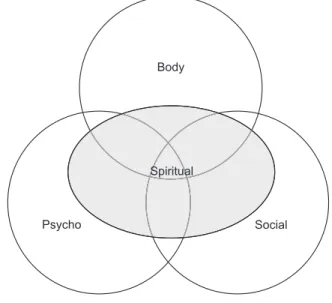
dressed in spiritual care models for terminally ill patients. From a holistic perspective, a human being is an integrated organ- ism with physical, psychosocial, and spiritual aspects. He or she has an integrated holistic existence, which is not merely the sum of various parts, but something more (Figure 1) (11).
Patients’ psychological well-being is closely related to their physical symptoms, psychological states such as anxiety and depression, and social factors such as social roles or important relationships. Therefore, when the spiritual state of terminally ill patients is assessed, factors that affect other personality as- pects should also be considered (12).
THE THEORIES OF SPIRTUAL CARE
HPC perceives human beings from a holistic viewpoint. The concept and practice of holistic care incorporate the physical, psychological, and spiritual aspects of the care recipient si- multaneously, suggesting that spiritual aspects should be given more attention in end-of-life care. Such careful consideration of patients’ spirituality is necessary because spiritual and ex- istential suffering may occur in association with problems in many areas, including physical pain and symptoms, psycho- logical anxiety, depression, or despair, religious faith and loss of faith, and social experiences, for example the breakdown or dissolution of a relationship.
Theoretical models for spiritual care rooted in various per-
Psycho Social
Body
Spiritual
Figure 1. Holistic human concept.
Source: Korean Hospice and Palliative Nursing Association. Hospice Palliative Nursing. Seoul:Hyunmoon Press;2015.
spectives are presented in this paper to promote the spiritual well-being of the terminally ill patient as a whole person and produce more effective spiritual care outcomes. In this study, the theoretical models of spiritual care are grouped into two categories that prioritize outcome variables and the implemen- tation of spiritual care.
MODELS BASED ON CARING OUTCOMES
1. The spiritual health model
For patients suffering from a terminal illness, spiritual prob-
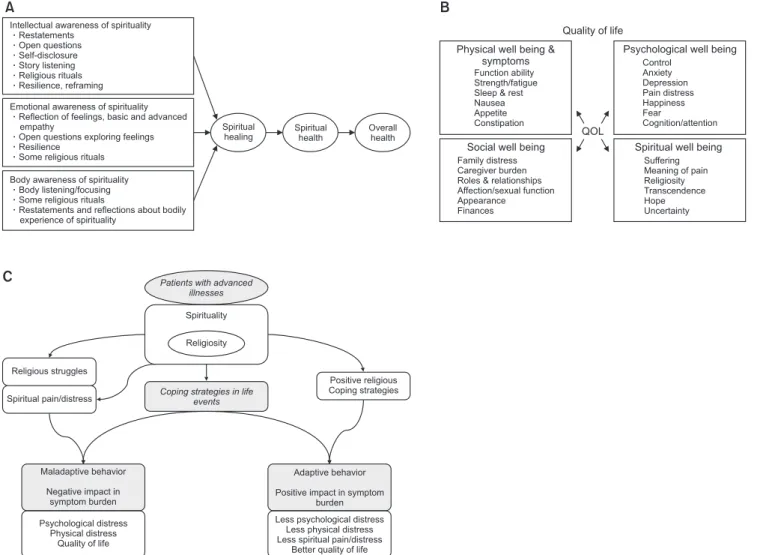
lems are very significant in HPC practice. Spiritual health is a buffer that reduces depression, helplessness, and hopelessness among terminally ill patients. The attributes of spiritual well- being, transcendence, hope, meaning, and dignity in termi- nally ill patients are closely related to pain control, QOL, and adaptation to and acceptance of loss. Therefore, HPCTs need to understand that patients’ physical and psychosocial issues have a strong relationship with their spiritual health. They should approach and respect patients’ autonomy, values, and beliefs from different perspectives, including religion, culture, and personal beliefs, as well as adopting an open point of view (2,11,13). Figure 2A shows the spiritual health model based on the holistic view of human beings proposed by Taylor (2). This
Quality of life Physical well being &
symptoms Function ability Strength/fatigue Sleep & rest Nausea Appetite Constipation Social well being
QOL
Family distress Caregiver burden Roles & relationships Affection/sexual function Appearance Finances
Spiritual well being Suffering Meaning of pain Religiosity Transcendence Hope Uncertainty Psychological well being
Control Anxiety Depression Pain distress Happiness Fear
Cognition/attention Spiritual
healing
A B
Spiritual health
Overall health Intellectual awareness of spirituality
Restatements Open questions Self-disclosure Story listening Religious rituals Resilience, reframing Emotional awareness of spirituality
Reflection of feelings, basic and advanced empathy
Open questions exploring feelings Resilience
Some religious rituals Body awareness of spirituality
Body listening/focusing Some religious rituals
Restatements and reflections about bodily experience of spirituality
C Patients with advanced
illnesses Spirituality
Religiosity
Coping strategies in life events
Positive religious Coping strategies Religious struggles
Spiritual pain/distress
Adaptive behavior Positive impact in symptom
burden Less psychological distress
Less physical distress Less spiritual pain/distress
Better quality of life Maladaptive behavior
Negative impact in symptom burden Psychological distress
Physical distress Quality of life
Figure 2. Models based on caring outcomes. (A) Model for supporting patient spiritual health. (B) The City of Hope Quality of life model. (C) Spirituality and religi- osity model.
Source 1: Taylor EJ. What do I say? Talking with patients about spirituality. Philadelphia:Templeton Foundation Press;2007. p. 8.
Source 2: prc.coh.org [Internet]. Duarte, CA: Pain and Palliative Care Center; 2017 [cited 2016 Oct 28]. Available from: http://prc.coh.org.
Source 3: Delgado-Guay MO. Spiritual care. In: Bruera E, Higginson I, von Gunten CF, Morita T, eds. Textbook of palliative medicine and supportive care. 2nd ed.
Boca Raton:CRC Press;2016.
model postulates that HPCTs’ understanding and perception regarding intellectual (mental), emotional, and bodily (physical) aspects of terminally ill patients’ affect the spiritual healing and spiritual health of care recipients, and that spiritual health has a positive effect on human beings’ overall health.
2. The quality of life model
The QOL model has been adopted for the provision of high quality HPC in the End-of-Life Nursing Education Con- sortium (ELNEC) Project implemented by the City of Hope and the American Association of Colleges of Nursing (Figure 2B) (14). The ELNEC Module I Palliative Care Faculty Guide provides the following advice to HPC professionals:
QOL dimensions encompass the physical, psychologi- cal, social and spiritual dimensions of a person. The dying experience impacts all dimensions. The meaning of QOL:
Differs from person to person, Can only be defined by the patient based on their own life experience, Important to examine aspects of each dimension from the patient’s and family’s perspective, Do not assume what “quality” means to them. Focus on both negative and positive attributes.
Only assessing and focusing on fears, for example, misses the opportunity to help patients and families realize their hopes. QOL is considered throughout the illness/dying tra- jectory (including the time of death and the bereavement period) (15).
In addition, recent studies have emphasized the importance of assessing physical symptoms, spiritual needs, the control of physical symptoms, and spiritual care, and present QOL as an indicator for assessing care outcomes. In a study of 403 elderly patients with terminal cancer which used QOL as an outcome variable, the results showed that physical (frequency and in- tensity of symptoms), psychological (depression and despair), and spiritual (spiritual needs) variables accounted for 67 per- cent of the subjects’ QOL. The worse a patient’s physical and psychological state became, the lower his or her QOL became.
By contrast, the higher the degree of spiritual experience, the higher the QOL (16).
3. The coping model
The present study introduces two models that view coping as an outcome of terminally ill patients’ care. The first model
is the spirituality and religiosity model (17). This model fo- cuses on patients’ spirituality, religiosity (antecedents), coping strategies (intervening factor), and coping (outcome variable).
It argues that spirituality consists of lived experiences that oc- cur among terminally ill patients and their families near the end of life. Spirituality influences the religious coping strate- gies of patients and their families, resulting in either adaptive or maladaptive behavior. This theory defines spirituality as an imperative factor in the adaptive strategies of terminally ill pa- tients. However, although it is a practical theory that presents indicators for measuring adaptation as an outcome variable (physical, psychological, and spiritual pain, and QOL) and thus enables the assessment of specific effects of spiritual care, it does not propose specific methods regarding adaptation strategies (Figure 2C).
The second model also applies the coping concept proposed by Folkman et al. (18,19) to terminally ill patients’ treatment (20). It argues that HPC can supplement the lack of specific adaptation strategies in the spirituality and religiosity model.
Additionally, Daaleman (21) has found that, among spiritual care recipients, spiritual care helped in coping with illness. This coping model considers internal mechanisms (hope, dignity, meaning, reminiscence, courage, fighting spirit, and resilience) and external resources such as supportive and complementary therapies, magic and alternative therapies, psychopharmacol- ogy, psychotherapy, caregivers, volunteers, palliative care, and religion. The therapies that have been used at HPC include meaning-based therapies, dignity therapy, cognitive behavioral therapy, psychopharmacology, and supportive and comple- mentary therapies (art, relaxation, and music) (22).
MODELS FOCUSING ON CARING IMPLEMENTATION
1. The spiritual care implementation model
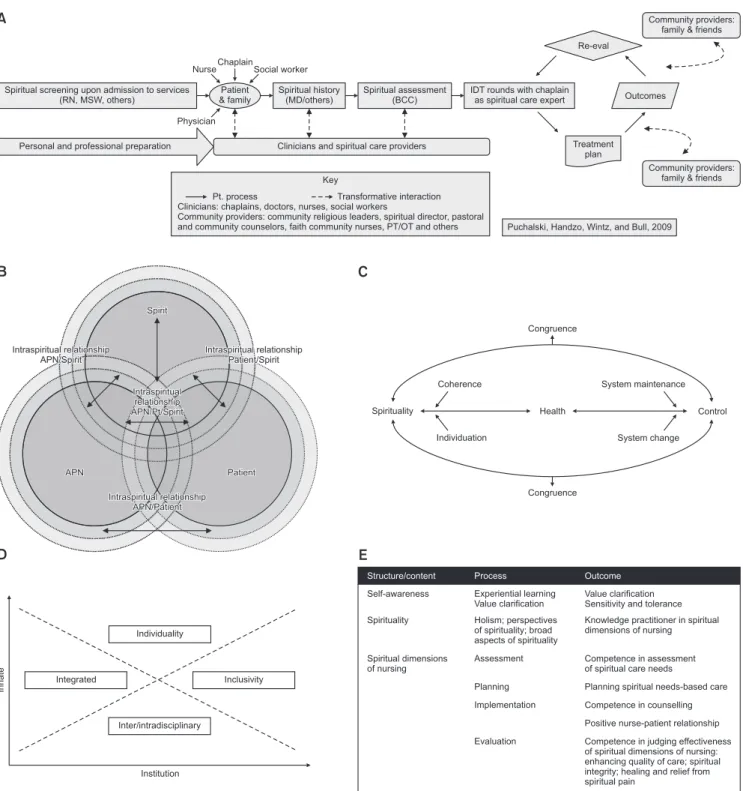
This model requires varying degrees of expertise, and the chaplain, as the spiritual care specialist, must be fully involved in patients’ medical care. The role of HPCTs in providing gen- eralized spiritual care is to: 1) provide compassionate care by careful listening; 2) make a formal spiritual screening or his- tory; 3) assess for spiritual distress or spiritual resources; 4)
integrate spirituality into the biopsychosocial assessment and treatment plan; 5) integrate patients’ resources for strength, including their spiritual resources, into the care of patients; 6) work with specialists such as the Board Certified Chaplains; 7) recognize that the clinician-patient relationship is key to pa- tients’ healing; and 8) reflect on HPCTs’ personal values and beliefs as essential to their calling of service to the patient as a whole person (Figure 3A) (23-25).
2. The existential functioning model
In the United States, national palliative care guidelines include spiritual care, particularly as they relate to existential concerns, life review, and the meaning of life. In the existential function- ing perspective, HPCTs’ role is to: 1) recognize the dynamic relationship among emotionally-related, existentially-related, and spiritually-related distress; 2) address processes causing distress and functional impairment; and 3) treat patients as in- tegrated wholes, appreciating how they may need to draw on existential, spiritual, and emotional resources in to acknowl- edge, bear, and put into perspective the issues that matter most to them (13).
Puchalski et al. (25) and Koenig et al. (26) stress the rela- tionship between spirituality and experiencing transcendent meaning in life. Spirituality consists of the concepts of religious issues (faith) and existential problem (meaning). The faith part of spirituality is frequently associated with religion and reli- gious beliefs, whereas the meaning aspect of spirituality seems to be a more universal concept that can be found in religious or nonreligious individuals. Breitbart et al. (27), Chochinov et al. (28,29), and others have tested what has become known as meaning-centered psychotherapy and an intervention that supports patients’ dignity. This literature documents that all the team members can participate in these therapies.
1) Meaning-centered psychotherapy (MCP)
According to Frankl (30), meaning of life involves a belief that one is accomplishing a unique role and purpose in one’s life;
a life associated with a responsibility to live according to one’
s full potential as a human being, thereby achieving a sense of peace, contentment, or even transcendence through connect- edness with something greater than oneself. The goal of MCP is to enhance psychological and spiritual well-being and QOL
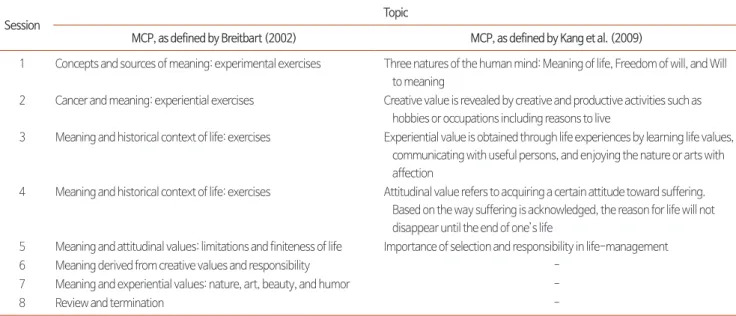
(1). An important part of spirituality can be guiding patients to reflect on meaning and purpose in their lives, along with their contributions and experiences. Two types of MCPs are pre- sented in Table 1 (31,32).
2) Dignity psychotherapy (DP)
Dignity refers to the sense of self-esteem and self-worth (33).
Patients whose personal psychological, spiritual, and physical needs are successfully met by the end of life may be perceived as having achieved a sense of dignity (34,35). Patients enrolled in DP are asked to record their life from the numerous angles they would want to remember most. They respond to a series of questions (Table 2) which focus on things they feel are most important and would want their loved one(s) to remember most. The recorded tape is transcribed, edited, and given back to the patients. This intervention can bring about a sense of legacy, coherence, enhanced identity, and emotional reconcili- ation (35).
3. The open pluralism view
The open pluralism view stresses the importance of differing spiritual and cultural traditions in forming relationships (22).
Open pluralism refers to a “commitment to explore, under- stand, and hear the voices of the particular moral communi- ties that constitute our culture” (36). Its goal is to have greater ownership of the role that the visions and commitments of communities including religious, cultural as well as secular humanist perspectives, have for institutional structures and social processes. People’s own spiritual beliefs and practices are a source of comfort, coping, and support and are the most effective way to influence healing (37). Given the developing ethnic diversity within HPC settings, it has become essential that healthcare providers have some understanding of the complexities of culture and spirituality (24).
4. The spiritual-relational view
This conceptual nursing model explains spiritual care by nurse practitioners (NPs) and reflects the importance of the initial NP–patient relationship and spiritual assessment rather than NPs immediately implementing specific religious practices (Figure 3B) (38). This model consists of three interconnected circles (Figure 3B). Each circle represents an NP, patient, and
APN Patient Spirit
Intraspiritual relationship APN/Spirit
Intraspiritual relationship APN/Pt/Spirit
Intraspiritual relationship Patient/Spirit
Intraspiritual relationship APN/Patient
Puchalski, Handzo, Wintz, and Bull, 2009 Personal and professional preparation
Re-eval
Outcomes
Treatment plan Clinicians and spiritual care providers
Spiritual screening upon admission to services (RN, MSW, others)
Spiritual history (MD/others)
Spiritual assessment (BCC)
IDT rounds with chaplain as spiritual care expert
Congruence
Coherence
Spirituality Health
Individuation
System maintenance
Control
System change
Congruence
Community providers:
family & friends
Community providers:
family & friends Pt. process Transformative interaction
Clinicians: chaplains, doctors, nurses, social workers
Community providers: community religious leaders, spiritual director, pastoral and community counselors, faith community nurses, PT/OT and others
Key NurseChaplain
Physician
Social worker Patient
& family
A
B C
Structure/content Process Outcome
Self-awareness
Spirituality
Spiritual dimensions of nursing
Experiential learning Value clarification Holism; perspectives of spirituality; broad aspects of spirituality Assessment
Planning Implementation
Evaluation
Value clarification Sensitivity and tolerance Knowledge practitioner in spiritual dimensions of nursing
Competence in assessment of spiritual care needs
Planning spiritual needs-based care Competence in counselling Positive nurse-patient relationship Competence in judging effectiveness of spiritual dimensions of nursing:
enhancing quality of care; spiritual integrity; healing and relief from spiritual pain
Innate
Institution Individuality
Inter/intradisciplinary
Integrated Inclusivity
D E
Figure 3. Models focusing on caring implementation. (A) Spiritual care implementation model. (B) Nursing model for the implementation of spiritual care by nurse practitioners. (C) The framework of systemic organization. (D) Principal components model. (E) The ASSET model.
Source 1: Puchalski C, Ferrell B, Virani R, Otis-Green S, Baird P, Bull J, et al. Improving the quality of spiritual care as a dimension of palliative care: the report of the Consensus Conference. J Palliat Med 2009;12:885-904.
Source 2: Carron R, Cumbie SA. Development of a conceptual nursing model for the implementation of spiritual care in adult primary healthcare settings by nurse practitioners. J Am Acad Nurse Pract 2011;23:552-60.
Source 3: Friedemann ML, Mouch J, Racey T. Nursing the spirit: the framework of systemic organization. J Adv Nurs 2002;39:325-32.
Source 4: McSherry W. The principal components model: a model for advancing spirituality and spiritual care within nursing and health care practice. J Clin Nurs 2006;15:905-17.
Source 5: Narayanasamy A. The puzzle of spirituality for nursing: a guide to practical assessment. Br J Nurs 2004;13:1140-4.
spirit. The first stage of spiritual care is to develop an inter- personal relationship between the NP and patient. During this phase of development, the NP can conduct either a written or an oral spiritual assessment to decide the patients. For an ad- ept assessment, the NP must recognize and acknowledge the role of his or her own spirituality. The dotted circles represent the growth and evolving dynamic that can occur between the NP and patient. Simultaneously, the NP and the patient each have their own unique spirituality that is developed as an intra-spiritual relationship. As the NP and patient each de-
velop within their interpersonal spiritual relationship, the NP- patient relationship can enter the spirit dynamic. The NP can use the spirit dynamic as a support system for both the patient and themselves. In this way, the model becomes an evolving dynamic relationship between the NP, patient, and spirit (38).
5. The Framework of Systemic Organization
The Framework of Systemic Organization (FSO) (39) is in- troduced as an organizing structure by which nurses can en- gage in nurse–patient relationships to find out their patients’
Table 2. Dignity Psychotherapy Questions.
• Can you tell me a little about your life history, particularly those parts that you either remember most or think are the most important?
• When did you feel most alive?
• Are there specific things that you would want your family to know about you, and are there particular things you would want them to remember?
• What are the most important roles (e.g., family, vocational, community service) you have played in life?
• Why are they so important to you, and what do you think you accomplished in those roles?
• What are your most important accomplishments, and what do you feel most proud of?
• Are there particular things that you feel still need to be said to your loved ones, or things that you would want to take the time to say once again?
• What are your hopes and dreams for your loved ones?
• What have you learned about life that you would want to pass along to others?
• What advice or words of guidance would you wish to pass along to your (son, daughter, husband, wife, parent, other[s])?
• Are there words or perhaps even instructions you would like to offer your family, to provide them with comfort or solace?
• In creating this permanent record, are there other things that you would like included?
Source: Chochinov HM. Dignity-conserving care—a new model for palliative care: helping the patient feel valued. JAMA 2002;287:2253-60.
Table 1. Meaning-Centered Psychotherapy Intervention.
Session Topic
MCP, as defined by Breitbart (2002) MCP, as defined by Kang et al. (2009)
1 Concepts and sources of meaning: experimental exercises Three natures of the human mind: Meaning of life, Freedom of will, and Will to meaning
2 Cancer and meaning: experiential exercises Creative value is revealed by creative and productive activities such as hobbies or occupations including reasons to live
3 Meaning and historical context of life: exercises Experiential value is obtained through life experiences by learning life values, communicating with useful persons, and enjoying the nature or arts with affection
4 Meaning and historical context of life: exercises Attitudinal value refers to acquiring a certain attitude toward suffering.
Based on the way suffering is acknowledged, the reason for life will not disappear until the end of one’s life
5 Meaning and attitudinal values: limitations and finiteness of life Importance of selection and responsibility in life-management
6 Meaning derived from creative values and responsibility -
7 Meaning and experiential values: nature, art, beauty, and humor -
8 Review and termination -
MCP: Meaning-centered Psychotherapy.
Source 1: Breitbart W. Spirituality and meaning in supportive care: spirituality- and meaning-centered group psychotherapy interventions in advanced cancer.
Support Care Cancer 2002;10:272-80.
Source 2: Kang KA, Shim JS, Jeon DG, Koh MS. The effects of logotherapy on meaning in life and quality of life of late adolescents with terminal cancer. J Korean Acad Nurs 2009:39:759-68.
spiritual needs (Figure 3C).
The right side of Figure 3C shows the two processes in- volved in gaining control; system maintenance and system change. The goal is to maintain individuals’ physical function through measured planning and acting (system maintenance) while channeling energy, integrating knowledge, and chang- ing behavior patterns to minimize unwanted changes (system change). The struggle to gain control takes place at the level of individuals, families, social groups, and the society at large.
The left side of Figure 3C shows system processes of coherence and individuation used when individuals strive for spirituality.
Coherence allows for a sense of unity within and is achieved through activities that nurture mind and spirit; religious prac- tices, meaningful relationships with others, music and the arts, or experiencing the beauty of nature. Individuation, the second process inherent in spirituality, includes human effort to con- nect with and become a part of something outside of oneself through integration of knowledge, adjustment of values and opinions, and subsequent alteration of behavior patterns (39).
6. The principal components model
The principal components model (PCM) advances spirituality and spiritual care within HPC and contains six components;
individuality, inclusivity, integration, inter/intra-disciplinary collaboration, innate, and institution (40). Individuality means individual perceptions of spirituality. Inclusivity refers to the need to capture and reflect the perceptions and concerns of all stakeholders involved in HPC delivery. Integrated spiritual care refers the idea of integrated care. The terms “inter” and
“intra” in the context of inter/intra-disciplinary collaboration are defined as “inter” working with other HPCTs and “intra”
working within the same HPCT. Thus, spiritual care com- prises “team working.” The reference to innate and institution includes the view that spirituality is innate within all individu- als. It is critical in the advancement of spiritual care, namely the innate nature of spirituality and the institution. The PCM may assist HPCTs to participate in and overcome some of the structural, organizational, political, and social variables that impact spiritual care (Figure 3D).
7. The actioning spirituality and spiritual care in education and training (ASSET) model
The ASSET (5) offers a foundational structure promoting to have spirituality and spiritual care education and training in action within HPC (Figure 3E). This model offers work- able definitions and theoretical perspectives rooted in theology, sociobiology, and philosophy. ASSET can be used as a foun- dational structure for the assessment of spiritual needs, and planning, implementing and evaluating spiritual care.
CONCLUSION
Spiritual care is one of the core components of HPC. The aim of this study was to identify care models that meet the ac- tual spiritual needs of terminally ill patients and their families, by conducting a literature review using the Korean and inter- national databases most commonly used in healthcare. After having analyzed the content of many spiritual care models, this study suggests that the holistic view of human beings is a common characteristic of HPC models. In addition, the mod- els tend to agree that spirituality is an intrinsic aspect of hu- man beings and an ontological characteristic that needs to be fulfilled, especially during life-crisis situations. HPCTs should all be equipped with the ability to assess terminally ill patients’
spirituality. Moreover, this study has also analyzed and clas- sified ten models of spiritual care through a literature review.
Three of these models focused on spiritual care outcomes, and seven focused on the implementation of spiritual care. Based on these models, this study concludes that continuous clinical research is needed to build an optimal spiritual care model for HPC.
요약
영성은 인간의 본질적인 부분으로 말기 환자와 가족의 실제적인 영 적요구 충족을 위한 영적돌봄은 HPC에서 가장 중요한 영역이다. 말 기환자와 가족의 실제적인 영적요구에 부응하는 돌봄모형을 확인하 기 위해 최근 보건의료계에서 가장 많이 사용하는 국·내외 database 를 검색하여 분석한 결과, 영성은 전인적 존재인 인간의 본질적인 부 분으로, 삶의 위기상황에 더욱 충족되어야 할 존재론적 특성으로서, 말기 환자의 영성평가는 HPCT이 기본적으로 갖추어야 할 역량임
이 확인되었다. HPC에 evidence based theory로 활용 가능한 총 10 개의 모델이 제시되었다. 세 개의 모델들은 영적돌봄 결과에 초점을 둔 모델로서, spiritual health, QOL, and coping을 중요한 outcome 으로 보는 모델들이었다. 영적돌봄수행에 초점을 둔 모델은 7개였 으며, HPCT의 다학제간 협력을 통한 돌봄과정을 나타낸 ‘Whole- person Care Model’, 인간의 보편적인 실존적 요구충족이 보완된
‘An Existential Functioning Model’, 대상자의 문화적, 그 외 다양성 을 고려하는 ‘An Open Pluralism View’, HPCT와 말기환자와의 관
계중심모델인 ‘A spiritual-relational view’ and ‘The Framework of Systemic Organization’, 영적돌봄과정의 전체적 역동을 설명하는
‘The principal components model’ and ‘The Actioning Spirituality and Spiritual care in Education and Training model’이 있다. 이러 한 모델을 토대로 HPC에서 가장 최선의 영적돌봄 모델 구축을 위한 지속적인 임상연구 노력이 계속될 필요가 있겠다.
중심단어: 영성, 호스피스돌봄, 근거중심실무
REFERENCES
1. Okon TR. Spiritual, religious, and existential aspects of palliative care. J Palliat Med 2005;8:392-414.
2. Taylor EJ. What do I say? Talking with patients about spirituality. Philadelphia:Templeton Foundation Press;2007.
3. Ferrell BR. Spiritual care in hospice and palliative care. Korean J Hosp Palliat Care 2017;20:215-20.
4. McSherry W, Cash K, Ross L. Meaning of spirituality: implications for nursing practice. J Clin Nurs 2004;13:934-41.
5. Narayanasamy A. The puzzle of spirituality for nursing: a guide to practical assessment. Br J Nurs 2004;13:1140-4.
6. Richardson P. Assessment and implementation of spirituality and religiosity in cancer care: effects on patient outcomes. Clin J Oncol Nurs 2012;16:E150-5.
7. Sheldon JE. Spirituality as a part of nursing. J Hosp Palliat Nurs 2000;2:101-8.
8. Elliott R. Spirituality, mental health nursing and assessment. J Community Health Nurs 2011;25:4-10.
9. Sephton SE, Koopman C, Schaal M, Thoresen C, Spiegel D. Spiritual expression and immune status in women with metastatic brease cancer:
An exploretory study. Breast J 2001;7:345-53.
10. Stein EM, Kolidas E, Moadel A. Do spiritual patients want spiritual interventions?: A qualitative exploration of underserved cancer paitents’
perspectives on religion and spirituality. Palliat Support Care 2015;13:19-25.
11. Korean Hospice and Palliative Nursing Association. Hospice Palliative Nursing. Seoul:Hyunmoon Press;2015.
12. Giske T, Cone PH. Opening up to learning spiritual care of patients: a grounded theory study of nursing students. J Clin Nurs 2012;21:2006-15.
13. Chochinov HM, Cann BJ. Interventions to enhance the spiritual aspects of dying. J Palliat Med 2005;1:S103-15.
14. prc.coh.org [Internet]. Duarte, CA: Pain and Palliative Care Center; 2017 [cited 2016 Oct 28]. Available from: http://prc.coh.org.
15. AACN. ELNEC [Internet]. Washington, DC; American Association of Colleges of Nursing: c2017 [cited by 2016 Oct 28]. Available from:http://
www.aacn.nche.edu/elnec.
16. Buck HG, Overcash J, McMillan SC. The geriatric cancer experience at the end of life: Testing an adapted model. Oncol Nurs Forum 2009;36:
664-73.
17. Bruera E, Higginson I, von Gunten CF, Morita T, eds. Textbook of palliative medicine and supportive care. 2nd ed. Boca Raton:CRC Press;2016.
18. Folkman S, Lazarus RS, Dunkel-Schetter C, DeLongis A, Gruen RJ. Dynamics of a stressful encounter: cognitive appraisal, coping, and en- counter outcomes. J Pers Soc Psychol 1986;50:992-1003.
19. Folkman S, Greer S. Promoting psychological well-being in the face of serious illness: when theory, research and practice inform each other.
Psychooncology 2009;9:11-9.
20. Delgado-Guay MO. Spiritual care. In: Bruera E, Higginson I, von Gunten CF, Morita T, eds. Textbook of palliative medicine and supportive care. 2nd ed. Boca Raton:CRC Press;2016.
21. Daaleman TP. A health services framework of spiritual care. J Nurs Manag 2012;20:1021-8.
22. Wein S, Baider L. Coping in palliative medicine. In: Cherny NI, Fallon M, Kaasa S, Portenoy RK, Currow DC, eds. Oxford textbook of palliative medicine 5th ed. Oxford:Oxford University Press;2015.
23. Puchalski C, Ferrell B, Virani R, Otis-Green S, Baird P, Bull J, et al. Improving the quality of spiritual care as a dimension of palliative care: the report of the Consensus Conference. J Palliat Med 2009;12:885-904.
24. Balboni MJ, Puchalski CM, Peteet JR. The relationship between medicine, spirituality and religion: Three models for integration. J Relig Health 2014;53:1586-98.
25. Puchalski CM, Ferrell B, O’Donnell E. Spiritual issues in palliative care. In: Bruera E, Yennurajalingam S. Oxford American handbook of hos- pice and palliative medicine. Oxford:Oxford University Press;2011.
26. Koenig HG, Idler E, Kasl S, Hays JC, George LK, Musick M, et al. Religion, spirituality, and medicine: a rebuttal to skeptics. Int J Psychiatry Med 1999;29:123-31.
27. Breitbart W, Poppito S, Rosenfeld B, Vickers AJ, Li Y, Abbey J, et al. Pilot randomized controlled trial of individual meaning-centered psycho- therapy for patients with advanced cancer. J Clin Oncol 2012;30:1304-9.
28. Chochinov HM, Hack T, Hassard T, Kristjanson LJ, McClement S, Harlos M. Dignity therapy: a novel psychotherapeutic intervention for pa- tients near the end of life. J Clin Oncol 2005;23:5520-5.
29. Chochinov HM, Kristjanson LJ, Breitbart W, McClement S, Hack TF, Hassard T, et al. Effect of dignity therapy on distress and end-of life ex- perience in terminally ill patients: a randomised controlled trial. Lancet Oncol 2011;12:753-62.
30. Frankl VF. Man’s search for meaning. 4th ed. Boston:Beacon Press;1992.
31. Breitbart W. Spirituality and meaning in supportive care: spirituality- and meaning-centered group psychotherapy interventions in ad- vanced cancer. Support Care Cancer 2002;10:272-80.
32. Kang KA, Shim JS, Jeon DG, Koh MS. The effects of logotherapy on meaning in life and quality of life of late adolescents with terminal cancer.
J Korean Acad Nurs 2009:39:759-68.
33. Pullman D. Human dignity and the ethics and aesthetics of pain and suffering. Theor Med Bioeth 2002;23:75-94.
34. Madan TN. Dying with dignity. Soc Sci Med 1992;35:425-32.
35. Chochinov HM. Dignity-conserving care—a new model for palliative care: helping the patient feel valued. JAMA 2002;287:2253-60.
36. Kinghorn WA, McEvoy MD, Michel A, Balboni M. Professionalism in modern medicine: does the emperor have any clothes? Acad Med 2007;
82:40-5.
37. Johnson KS, Elbert-Avila KI, Tulsky JA. The influence of spiritual beliefs and practices on the treatment preferences of African Americans: a review of the literature. J Am Geriatr Soc 2005;53:711-9.
38. Carron R, Cumbie SA. Development of a conceptual nursing model for the implementation of spiritual care in adult primary healthcare set- tings by nurse practitioners. J Am Acad Nurse Pract 2011;23:552-60.
39. Friedemann ML, Mouch J, Racey T. Nursing the spirit: the Framework of Systemic Organization. J Adv Nurs 2002;39:325-32.
40. McSherry W. The principal components model: a model for advancing spirituality and spiritual care within nursing and health care practice. J Clin Nurs 2006;15:905-17.