Biomedical Science Letters 2014, 20(3): 156~161 http://dx.doi.org/10.15616/BSL.2014.20.3.156 eISSN : 2288-7415
Effects of Dietary from Safflower Bud on the Osteoporosis in Ovariectomized Rats
Seul Ki Lim
2, Dong Il Kim
1, Min Jung Park
1, Joo Hee Choi
1, Young Kuk Kim
3, An Chul Lee
3, Mi Young Choi
3and Soo Hyun Park
1,†1
Department of Veterinary Physiology, College of Veterinary Medicine, Chonnam National University, Gwangju 500-757, Korea
2
Metabolism and Functionality Research Group, R & D division, World Institute of Kimchi, Gwangju 503-360, Korea
3
R&D Team, Dasan Institute of Life & Science Co., Ltd. 1064-3 Usan-Dong, Gwangsangu, Gwangju 506-812, Korea
It has been reported that safflower seeds have preventive effects against osteoporosis. Recently, safflower buds (SB) were found to have more useful functional ingredients than safflower seeds. In the current study, we evaluated the anti-osteoporosis effects of SB diet in ovariectomized (OVX) rats. The rats were divided into five groups; sham operated group, OVX alone group, OVX plus 17β-estradiol (E
210 μg/kg, i.p.) and OVX plus SB diet feeding group (0.3% or 1%). Feeding of SB diet (0.3% or 1%) to OVX rats markedly increased bone mineral density (BMD) of femurs, compared to the OVX group. The OVX rats exhibited a marked increase in trabecular separation (Tb.Sp) and this change was inhibited by the feeding of SB diet, similar to that seen with OVX+E2 group. Moreover, feeding of SB diet to OVX rats decreased the markers of bone turnover, including osteocalcin and alkaline phosphatase (ALP). These results suggest that SB extract has a bone sparing effect in OVX-induced trabecular bone loss and prevents deterioration of bone microarchitecture by suppressing the rate of bone turnover. Therefore, SB may be useful for preserving bone mass and structure in estrogen deficient women with a potential role in reducing postmenopausal osteoporosis
Key Words: Ovariectomized rats, Safflower bud, Bone biomechanics, Bone turnover
INTRODUCTION
Osteoporosis is a bone disease which is characterized by the decrease of mineral density in bone (Cauley et al., 2000;
Cummings and Melton, 2002). In particular, in the case of women, when women reach menopause, due to the rapid decrease of the estrogen hormone in calcium homeostasis,
holes in bone occurs (Raisz et al., 2005). Ovariectomized (OVX)-estrogen hormone deficiency is a major risk factor for osteoporosis (Brennan et al., 2012). OVX rats were used as a model of postmenopausal model (Lelovas et al., 2008).
The Safflower (Carthamus tinctorius L.) seed has been used as a traditional herbal medicine in Korea and other Asian countries (Bae et al., 2002). In addition, fracture healing was repaired more rapidly in rats supplemented with safflower seed powder and its fractions than in control rats (Seo et al., 2000). Safflower seeds have been reported to have bone protecting effect in OVX rats (Kim et al., 2002;
Alam et al, 2006). On the other hand, the safflower bud (SB) has increased contents of useful functional ingredients such as flavonoids and polyphenol contents, compared to
Original Article
*Received: August 25, 2014 / Revised: September 29, 2014 Accepted: September 29, 2014
†Corresponding author: Soo Hyun Park. Department of Veterinary Physiology, College of Veterinary Medicine, Chonnam National University, Gwangju 500-757, Korea.
Tel: +82-62-530-2832, Fax: +82-62-530-2809 e-mail: [email protected]
○CThe Korean Society for Biomedical Laboratory Sciences. All rights reserved.
safflower leaf, stem and root (Hiramatsu et al., 2009). Thus, in this study, we investigated the preventive effects of SB in osteoporosis in OVX rat models.
MATERIALS AND METHODS Animals and treatments
The 8-week-old female Sprague-Dawley strain rats were purchased from Sam tacos (Oh San, Korea) and were housed for a week to obtain the adaptation period. The rats underwent either a sham-operation or were OVX (n = 8~10 for each group). Sham rats were fed a AIN-76 diet, whereas OVX rats were divided into 4 groups that were fed a AIN-76 diet and AIN-76 diet containing SB (0.3% and 1%) for 16 weeks. Rats were housed in clean environmental conditions with a temperature 23 ± 2℃, with a relative humidity of 55 ± 5%, and with a 12-h light/dark cycle during the 16-week intervention period. All rats had free access to distilled water and diet throughout the study. The food intake and body weight were measured at intervals of a week. Safflower buds (SB) used in this experiment is produced in Jangheung and was purchased from a market in Jangheung. SB was washed with water and air-dried SB was used. Safflower germinated sprouts are pulverized using a grinder to prepare powder of safflower germination. The diet for Ovx+ SB rats contained 0.3% or 1% SB mixed with the standard rat chow. The diet was prepared by mixing 0.3 or 1% SB into 100 g standard rat chow. 17β-estradiol (E
2) was purchased from Sigma-Aldrich Chemical Company (MO, USA). Rats were subcutaneously injected 5 times per week with 100 μL of vehicle in the sham and OVX groups, and with 17β-estradiol (10 μg/kg/day). For the experiments, rats were fed with 0.3% and 1% SB diets, as described above. The experimental protocol was approved by the Animal Care and Use Committee of Chonnam National University.
Body weights and uterus tissue weights
Body weights were measured on a weekly basis to monitor health and measure weight gain. Uterus tissue weights were measured immediately after necropsy. At necropsy, uteri were removed from fat tissue. Uterus tissue
weights were measured to confirm the ovariectomy pro- cedure.
Bone mineral density (BMD)
The femur was dissected from the femoral region and fixed with 4% paraformaldehyde fixed storage system and a high-resolution micro-computerized tomography (Three- dimensional micro focus computed tomography; micro-CT, Sky-Scan 1172TM, Skyscan, Kontich, Belgium) using a micro video image was obtained. Fine image was obtained from Nercon Ver 1.3 (Skyscan) and was as the gray scale level and a two-dimensional image reconstruction of the CTAn (SkyScan) software was used to reconstruct a three- dimensional model.
Serum analysis
After 16 weeks of experiment time, the experimental rats were fasted for 24 h and anesthetized. Blood samples were collected from the heart by cardiac puncture. Blood were centrifuged at 6,000 ×g for 10 min; then, serum samples were stored at -80℃ prior to biochemical analysis.
The analysis of osteogenesis markers osteocalcin, estrogen, and ALP was measured using ELISA kits.
Statistical methods
Statistical analyses were performed using GraphPad Prism software version 4.0 (GraghPad Software, San Diego, CA, USA). The data for all of the measurements were analyzed using a one-way analysis of variance (ANOVA) with subsequent post hoc multiple comparison by Dunnett's test. Statistically significant values were defined as P<0.05.
RESULTS AND DISCUSSION
Effects of SB on food intakes and body weight in OVX rats
During the experimental period, food intakes and body
weight were measured. Average daily dietary intake levels
were similar in all groups. As a result, all groups including
the sham group exhibited no differences in food intakes
among OVX rats (Fig. 1A). On the other hand, body
weights in OVX rats were increased compared with sham
group and those in E
2-treated OVX rats were not increased compared to OVX rats. This weight gain is due to reduced secretion of ovarian hormones, which induce the obesity characterized by the accumulation of body fat in OVX animal models (Yoon and Lee, 1988). However, the feeding of SB diets in OVX rats did not prevent the increase of body weights (Fig. 1B). These results indicate that SB did not suppress body weight gain in OVX rats. Sarmiento et al. (1977) and Geinox et al. (1993) reported that fracture healing in rat femora was affected by functional weight
bearing and nutritional differences. Our results indicate indirectly that food intake and weight gain induced by OVX were affected by feeding SB diets.
Effects of SB diets on uterine weights and serum estrogen level in OVX rats
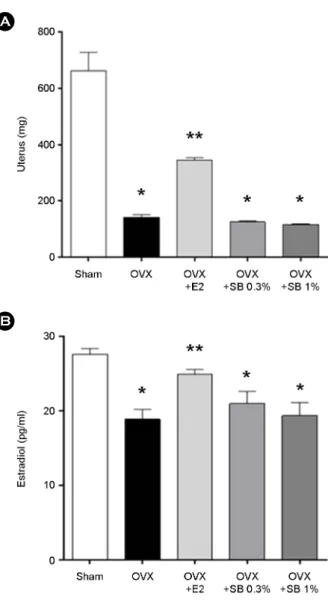
Because estrogen is limited in clinical applications due to its tumor-promoting effects (Davis et al., 2006), we checked whether SB has estrogenicity by assessing the wet weights of the uterus. The uterine weights were also decreased in
Fig. 1. Effects of safflower buds (SB) on food intake (A) and bodyweight (B) in ovariectomized (OVX) rats. OVX rats were treated with 17β-estradiol (E2, 10 μg/kg, i.p.) or fed with SB diet (0.3%
or 1%). Each value is expressed as mean ± S.E., n = 8~10.
*P<0.05 compared with the sham group and **P<0.05 compared with the OVX group.
A
B
Fig. 2. Effects of safflower buds (SB) on uterine weight (A) and serum estradiol (B) in ovariectomized (OVX) rats. OVX rats were treated with 17β-estradiol (E2, 10 μg/kg, i.p.) or fed with SB diet (0.3% or 1%). Each value is expressed as mean ± S.E., n = 8~10.
*P<0.05 compared with the sham group and **P<0.05 compared with the OVX group.
A
B
OVX (4w~16w*) OVX+E2 (4w~16w**)
OVX-induced rats compared to sham group. Uterine weights in OVX rats fed with SB diets (0.3% and 1%) were not different from OVX group (Fig. 2A). Also, serum estrogen levels were measured using ELISA Kit, and the results showed similar results to uterine weights. Serum estrogen levels in OVX rats alone and OVX rats fed with SB diets (0.3% or 1%) were not different (Fig. 2B). Our results are consistent with that safflower seed treatment in OVX rats did not affect serum estrogen levels (Kim et al., 2003).
Since phytoestrogens are plant-derived compounds that
have affinity to the estrogen receptor and are able to act as either estrogen agonists or antagonists (Lagari and Levis, 2012), our results suggest the possibility that SB may not be phytoestrogen and SB also do not affect estrogen levels.
Effects of SB diets on bone mineral density (BMD) in OVX rats
OVX rats are classically used as an animal model for
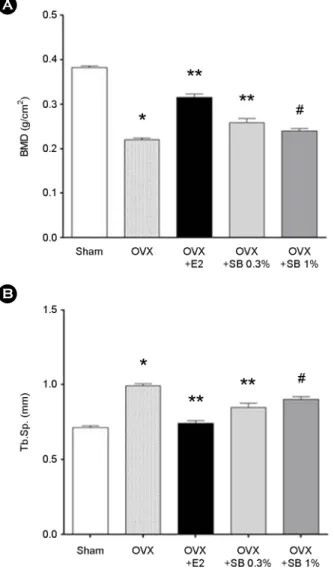
Fig. 3. Effects of safflower buds (SB) on bone mineral density (BMD) (A) and morphological characteristic Tb.Sp (B) in ovariec- tomized (OVX) rats. OVX rats were treated with 17β-estradiol (E2, 10 μg/kg, i.p.) or fed with SB diet (0.3% or 1%). Each value is expressed as mean ± S.E., n = 8~10. *P<0.05 compared with the sham group and **P<0.05 compared with the OVX group.
A
B
Fig. 4. Effects of safflower buds (SB) on serum osteocalcin con- centrations (A) and serum alkaline phosphatase (ALP) concen- trations (B) in ovariectomized (OVX) rats. OVX rats were treated with 17β-estradiol (E2, 10 μg/kg, i.p.) or fed with SB diet (0.3%
or 1%). Each value is expressed as mean ± S.E., n = 8~10. *P<
0.05 compared with the sham group and **P<0.001 compared with the OVX group.
A
B
postmenopausal bone loss (Kalu, 1991). Currently, bone mineral density (BMD) measurements are commonly used to diagnose osteoporosis and to predict the risk of fractures (Cummings, 1995). So, we evaluated the effect of SB diets on BMD levels in OVX rats. According to several reports, the levels of osteoporosis in rats were shown to rise 2~6 weeks after removing the ovaries (O and Lee, 1993). In the present study, feeding of SB diets in OVX rats showed a significant protection effect on BMD analysis. However, dose dependent statistical significance between 0.3% and 1% SB diets feeding groups was not observed (Fig. 3A).
Trabecular separation (Tb.Sp) is the average distance between the trabecular and is used as good micro-CT imaging biomarker to evaluate the protection effect in the ovariectomy mediated osteoporotic mouse model (Kang et al., 2014). The levels of Tb.Sp in OVX rats fed with SB diets were also significantly reduced compared with OVX alone group (Fig. 3B). These results suggest that feeding of SB diets improved the connectivity of trabecular bone in the OVX rats though to a lesser degree than treatment with E2.
Effects of SB treatment on serum bone turnover markers in OVX rats
Plasma osteocalcin levels in OVX group were higher than those in sham group. And the ovariectomy-induced osteocalcin levels were prevented by the feeding of SB diets (Fig. 4A). In the present study, we assessed the activity of serum bone-specific alkaline phosphatase (ALP) as biochemical marker of bone formation, which is synthesized in osteoblast and liver (Meller et al., 1984). Gomez et al.
(1995) suggested that bone ALP (BAP) activity in serum can provide an index for the rate of bone formation. The changes of serum ALP activity are more dramatic than others in this study. As shown in Fig. 4B, the activities of serum ALP in OVX group significantly increased compared to sham group (i.e., 113 ± 12.3 U/L vs. 66 ± 21.3 U/L, P<0.001). And the OVX-induced ALP activity was pre- vented by the feeding of SB diets (0.3% or 1%). These results suggest that the feeding of SB diets improved bone mass by the decrease of OVX-induced APL activity. The most significant finding of this study is that SB diets can
effectively prevent OVX-induced osteoporosis in rats.
Feeding of SB diets can not only maintain bone mineral density but also prevent trabecular bone loss after OVX.
Taken together, our results suggest that SB is a potential lead compound for the development of novel anti- osteoporosis agents, and may be an important source of new anti-osteoporosis components.
Acknowledgements
This research was financially supported by the Ministry of Trade, Industry and Energy (MOTIE), Korea Institute for Advancement of Technology (KIAT) and Honam Institute for Regional Program Evaluation through the Leading Industry Development for Economic Region. The animal experiment in this study was supported by the Animal Medical Institute of Chonnam National University.
REFERENCES
Alam MR, Kim SM, Lee JI, Chon SK, Choi SJ, Choi IH, Kim NS.
Effects of Safflower seed oil in osteoporosis induced- ovariectomized rats. Am J Chin Med. 2006. 34: 601-612.
Bae SJ, Shim SM, Park YJ, Lee JY, Chang EJ, Choi SW.
Cytotoxicity of phenolic compounds isolated from seeds of safflower (Carthamus tiractorious L.) on cancer cell lines.
Food Sci Biothchnol. 2002. 11: 140-146.
Brennan O, Kuliwaba JS, Lee TC, Parkinson IH, Fazzalari NL, McNamara LM, O'Brien FJ. Temporal changes in bone composition, architecture, and strength following estrogen deficiency in osteoporosis. Calcif Tissue Int. 2012. 91: 440 -449.
Cauley JA, Thompson DE, Ensrud KC, Scott JC, Black D. Risk of mortality following clinical fractures. Osteoporos Int. 2000.
11: 556-561.
Cummings SR, Nevitt MC, Browner WS, Stone K, Fox KM, Ensrud KE, Cauley J, Black D, Vogt TM. Risk factors for hip fracture in white women. N Engl J Med. 1995. 332: 767-773.
Cummings SR, Melton LJ. Epidemiology and outcomes of osteo- porotic fractures. Lancet. 2002. 359: 1761-1767.
Davis JR, McNeilly JR, Norris AJ, Pope C, Wilding M, McDowell G, Holland JP, McNeilly AS. Fetal gonadotrope cell origin of FSH-secreting pituitary adenoma - insight into human pituitary tumour pathogenesis. Clin Endocrinol (Oxf). 2006. 65: 648
-654.
Geinoz G, Rapin CH, Rizzoli R, Kraemer R, Buchs B, Slosman D, Michel JP, Bonjour JP. Relationship between bone mineral density and dietary intakes in the elderly. Osteoporos Int. 1993.
3: 242-248.
Gomez BJr, Ardakani S, Ju J, Jenkins D, Cerelli MJ, Daniloff GY, Kung VT. Monoclonal antibody assay for measuring bone- specific alkaline phosphatase activity in serum. Clin Chem.
1995. 41: 1560-1566.
Hiramatsu M, Takahashi T, Komatsu M, Kido T, Kasahara Y.
Antioxidant and neuroprotective activities of Mogami-benibana (safflower, Carthamus tinctorius Linne). Neurochem Res. 2009.
34: 795-805.
Kalu DN. The ovariectomized rat model of postmenopausal bone loss. Bone Miner. 1991. 15: 1751-1791.
Kang DM, Yoon KH, Kim JY, Oh JM, Lee M, Jung ST, Jung SK, Lee YH. CT Imaging Biomarker for Evaluation of Emodin as a Potential Drug on LPS-mediated Osteoporosis Mice.
Acad Radiol. 2014. 21: 457-462.
Kim EO, Lee KT, Choi SW. Chemical compariwon of germinated- and ungerminated safflower (Carthamus tinctorius) seeds. J Korean Soc Food Sci Nutr. 2008. 37: 1162-1167.
Kim HY, Kim CS, Jhon GJ, Moon IS, Choi SH, Cho KS, Chai JK, Kim CK. The effect of safflower seed extract on periodontal healing of 1-wall intrabony defects in beagle dogs. J Periodontol. 2002. 73: 1457-1466.
Kim MR, Yang CH, Seo BI. Effects of safflower seeds on bone
mineral density in ovariectomy-induced postmenopausal osteoporotic rats. Kor J Herbology. 1998. 13: 37-43.
Kim SM, Choi IH, Kim NS. Effects of Safflower Seeds on the Serum Levels of Insulin-like Growth Factors, Insulin-like Growth Factor Binding Protein-3 and BALP in Osteoporosis Induced-ovariectomized Rats. J Vet Clin. 2003. 20: 263-273.
Lagari VS, Levis S. Phytoestrogens for menopausal bone loss and climacteric symptoms. J Steroid Biochem Mol Biol. 2012.
139: 294-301.
Lelovas PP, Xanthos TT, Thoma SE, Lyritis GP, Dontas IA. The laboratory rat as an animal model for osteoporosis research.
Comp Med. 2008. 58: 424-430.
O JH, Lee YS. Effects of Dietary Calcium Levels on the Reduction of Calcium Availability in Ovariectomized Osteoporosis Model Rats. Korean J Nutr. 1993. 26: 277-285.
Raisz LG. Pathogenesis of osteoporosis: concepts, conflicts, and prospects. J Clin Invest. 2005. 115: 3318-3325.
Sarmiento A, Schaeffer JF, Beckerman L, Latta LL, Enis JE.
Fracture healing in rat femora as affected by functional weigtbearing. J Bone Joint Surg. 1997. 59: 369-375.
Seo HJ, Kim JH, Kwak DY, Jeon SM, Ku SK, Lee JH, Moon KD, Choi MS. The effects of safflower seed powder and its fraction on bone tissue in rib-fractured rats during the recovery. Korean J Nutr. 2000. 33: 441-420.
Yoon JH, Lee SS. Effect of Ovariectomy Induced Hyperphagia on the Intestinal Adaptation. Korean J Nutr. 1988. 21: 182-187.