| Abstract |
1)PURPOSE: This study examined the effects of Robot Tilt-table Training (RTT) on the lower extremity strength, balance, gait, and satisfaction with rehabilitation, in patients with subacute stroke (less than six months after stroke onset), and requiring intensive rehabilitation.
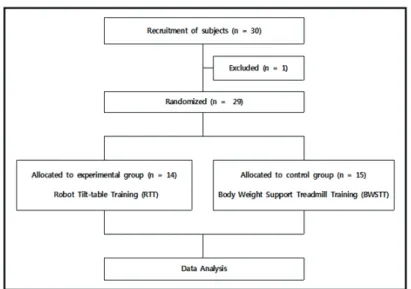
METHODS: A total of 29 subacute stroke patients were divided into an RTT group (n = 14) and a Body Weight Support Treadmill Training (BWSTT) group (n = 15). The mean age of patients was 62 years. RTT and BWSTT were performed for four weeks, three times a week, for 30 minutes.
Isometric strength of the lower extremities before and after intervention was compared by measuring the maximal voluntary isometric contraction of the lower extremity
†Corresponding Author : Won-Seob Shin
[email protected], https://orcid.org/0000-0002-6515-7020 This is an Open Access article distributed under the terms of the Creative Commons Attribution Non-Commercial License (http://creativecommons.org/licenses/by-nc/3.0) which permits unrestricted non-commercial use, distribution, and reproduction in any medium, provided the original work is properly cited.
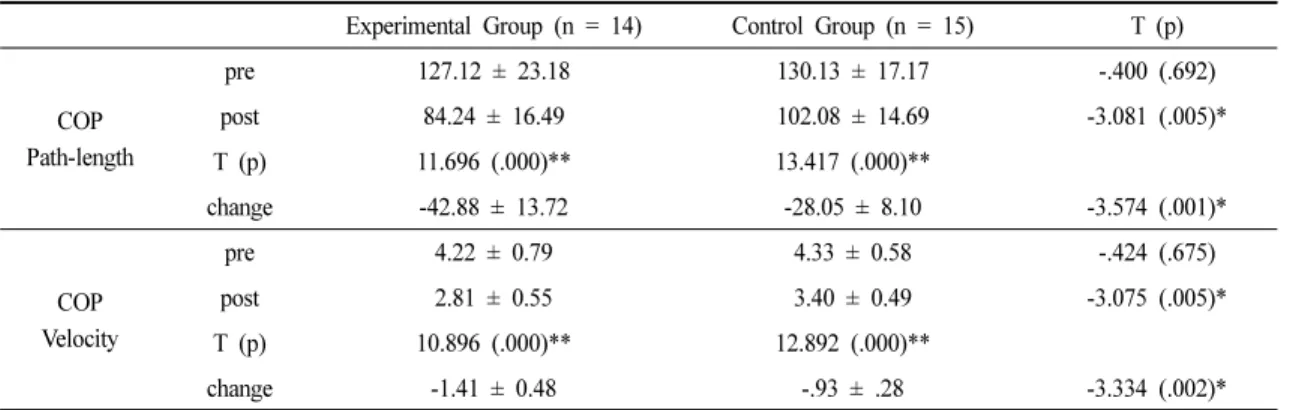
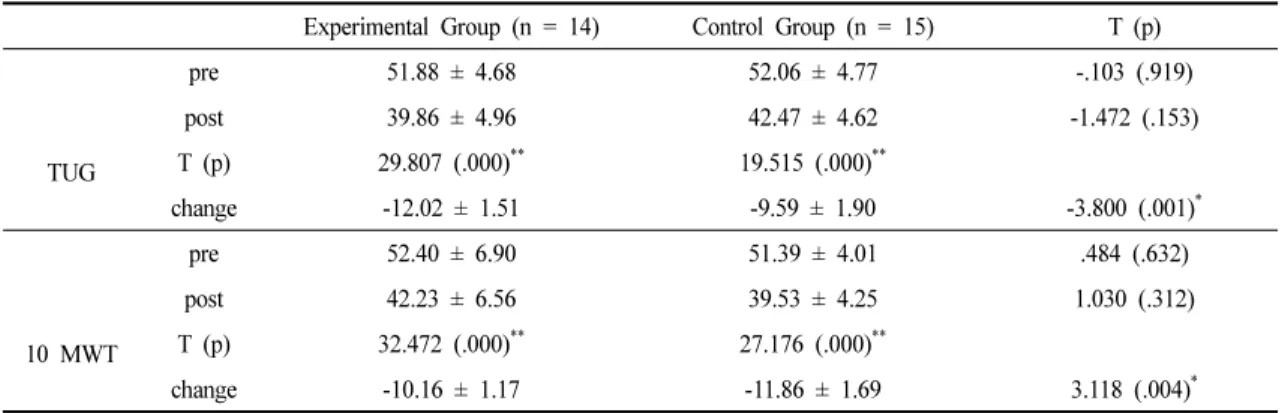
muscles. To compare the balance function, the center of pressure (COP) path-length and COP velocity were measured. Timed Up & Go test (TUG) and 10 Meter Walking Test (10 MWT) were evaluated to compare the gait function.
A satisfaction with rehabilitation survey was conducted for subjective evaluation of the subject's satisfaction with the rehabilitation training imparted.
RESULTS: In the intra-group comparison, both groups showed significant improvement in lower extremity strength, balance, gait, and satisfaction with rehabilitation, by comparing the parameters before and after the intervention (p < .05).
Comparison of the amount of change between groups revealed significant improvement for all parameters in the RTT group, except for the 10 MWT (p < .05).
CONCLUSION: Both groups are effective for all variables, but the RTT group showed enhanced efficacy for variables such as lower extremity strength, balance, gait, and satisfaction with rehabilitation, as compared to the BWSTT group.
Key Words: Stroke, Subacute, Robotic, Strength, Balance, gait
Research Article Open Access
아급성기 뇌졸중 환자의 다리근력, 균형, 보행, 재활만족도에 대한 로봇 보조 기립경사대 훈련과 체중지지 트레드밀 훈련의 효과 비교