서 론
1. 연구의 필요성
아로마테라피는 식물의 꽃, 줄기, 잎, 열매, 뿌리, 레진 등에서 추출 한 에센셜 오일을 이용하며, 호흡기나 피부를 통해 체내로 흡수되 어 신체와 정신의 치유를 도모한다(Roh & Park, 2009). 아로마테라 피는 에센셜 오일에 함유된 화학성분의 분자량과 생화학적 특성에
따라 향과 치료효과가 달라지며, 우울, 불안, 스트레스, 피로, 통증 완화, 수면, 면역력 강화에 영향을 미치는 것으로 알려져 있다(Sal- vatore, 2003).
아로마테라피를 적용한 국내 연구는 1990년대 후반을 시작으로 점차 증가하여 2000년 이후 약 3,000천여 편의 연구가 진행되었다 (KERIS, 2012). 그러나 초창기에 진행된 대부분의 아로마테라피 연 구는 피부관리사들에 의해 피부나 전신에 적용되어 신체적 및 정 신적인 이완을 목적으로 많이 진행되어 왔으며, 점차 아로마 에센 셜 오일(essential oil)의 효과를 규명하는 임상 연구와 아로마테라피 를 치료 목적으로 사용하는 의료인들의 효과검증(Mo & Song, 2007) 등으로 확대되어 현재 여러 분야에서 다양한 연구가 이루어 지고 있다. 연구대상자 역시 초창기에는 주로 일반인을 대상으로 진 행되었다가 점차 건강문제를 가진 대상자로 확대되었다(Song, Park, Jo, & Cha, 2009). 아로마테라피를 적용한 간호학 연구로는 주로 중년
Corresponding author:
Su Jin Won, Graduate School, Department of Nursing, Kangwon National University, 1 Kangwondeahak-gil, Chuncheon 200-701, Korea
Tel: +82-33-731-8079 Fax: +82-33-250-8840 E-mail: [email protected] 투고일: 2013년 4월 19일 심사의뢰일: 2013년 4월 22일 게재확정일: 2013년 5월 9일 This is an Open Access article distributed under the terms of the Creative Commons Attri- bution Non-Commercial License (http://creativecommons.org/licenses/by-nc/3.0) which permits unrestricted non-commercial use, distribution, and reproduction in any medium, provided the original work is properly cited.
아로마테라피 중재를 적용한 간호학 논문 분석
채영란1·원수진2
1강원대학교 간호학과, 2강원대학교 간호학과 박사과정
An Analysis of Aromatherapy Intervention Studies in Nursing
Young Ran Chae¹, Su Jin Won²
¹Department of Nursing, Kangwon National University, Chuncheon; ²Graduate School, Department of Nursing, Kangwon National University, Chuncheon, Korea
Purpose: This study aimed to analyze the effects and intervention methods of aromatherapy studies in nursing. Methods: A sys- tematic literature review was conducted. Nursing literature databases were searched to identify intervention studies published in Ko- rea between 2000 and 2011. Finally, 53 articles were included in the review. Results: The most preferred application method of aro- matherapy was massage. The major dependent variables were anxiety, depression, pain, and sleep disturbance. 76.5% of the studies reported positive effects on anxiety. 93.8% of the studies reported positive effects on depression. 86.7% of the studies reported posi- tive effects on pain. 92.3% of the studies reported positive effects on sleep disturbance. Psychometric measurements were mainly used in the studies. Only 33.9% of the studies adopted physical or physiological measurements. The most prevalent physical or physi- ological instrument was vital signs. Conclusion: Aromatherapy had positive effects on anxiety, depression, pain, and sleep distur- bance measuring when using psychometric instruments. However, there was no sufficient evidence measuring when using physical or physiological instruments. These need to be studied using well-designed, randomized, controlled trials, and should encourage the use of both psychometric and physiological measures for aromatherapy intervention in nursing studies.
Key Words: Aromatherapy; Nursing studies; Analysis 국문주요어: 아로마테라피, 간호연구, 분석
여성이나 갱년기 여성의 스트레스 우울, 불안, 자아 존중감에 대한 연구(Cha et al., 2010; Lee, 2002), 여대생의 생리불순, 금연, 불안에 관 한 연구(Choi, 2004; Lee, Shin, & Jung, 2005)부터 치매환자(Choi, 2008), 관절염 환자(Roh, 2004; Won & Chae, 2011), 편마비나 뇌졸중 환자(Jung & Jeon, 2004; Shin, Cho, & Jung, 2004), 혈액투석환자(Lee et al., 2004), 암 환자(Lee & Kim, 2011) 및 호스피스 환자(Kim, 2005) 에 이르기까지 매우 다양한 대상자에서 연구가 진행되었으며, 처치 의 효과도 매우 다양하였다.
아로마테라피를 적용한 연구들이 지속적으로 증가됨에 따라 이 러한 연구를 종합하여 아로마테라피 연구의 경향을 제시해주고 반 복연구로 인한 소모적인 연구를 지양하며, 후속 연구의 방향과 전 략을 제시 할 필요성이 대두되면서(Kim, 2004), 이를 종합하는 연구 로 통증에 대한 효과분석(Park, Park, Jang, Kwak, & Han, 2011), 스트 레스에 대한 효과분석(Kim & Suh, 2008), 정신 심리적 효과분석 (Roh & Park, 2009) 등이 이루어졌으며, 아로마테라피 중재 전반에 관한 분석(Song, Park, Jo, & Cha, 2009)도 진행되었다. 그러나 이러한 연구들은 특정 증상만을 다루거나 외국 문헌과 간호학 외 연구들 을 포함하여 분석하고 있으며, 연구결과도 주로 심리사회적 분석에 초점을 두고 있어 객관적인 지표를 통해 아로마테라피의 효과를 확 인하는 간호학 연구들의 경향을 파악하는 데는 어려움이 있었다.
아로마테라피가 간호중재로서 적극적으로 활용되기 위해서는 간 호학 분야에 적용된 아로마테라피 중재의 특성을 파악하고 중재 결과를 확인할 필요가 있다. 더불어 아로마테라피를 적용한 간호학 연구들에서 이용되고 있는 신체적 및 생리적 지표와 중재 결과를 분석하는 것도 필요하다.
이에 본 연구는 국내 간호학 분야에서 아로마테라피를 적용한 중 재연구를 분석하고자 한다. 이러한 연구결과는 추후 아로마테라피 를 적용한 간호중재 연구의 방향을 제시하고 아로마테라피를 이용 한 중재 프로그램 개발에 지침을 제공하며, 근거기반 실무의 지침 을 제공할 수 있을 것이다.
2. 연구목적
본 연구의 목적은 국내 간호학 분야에서 아로마테라피를 간호중 재로 적용한 연구의 특성을 분석하고, 중재 효과를 분석하기 위한 것으로, 구체적인 목적은 다음과 같다.
1) 아로마테라피의 적용대상, 적용방법 및 측정변수를 파악한다.
2) 아로마테라피 중재 결과를 파악한다.
3) 중재효과를 파악하기 위해 사용된 신체적 및 생리적 지표와 중재 결과를 파악한다.
연구 방법
1. 연구 설계
본 연구는 국내 간호학 분야에서 발표된 아로마테라피 중재 연구 를 분석한 문헌고찰 연구이다.
2. 분석대상 논문
2000년부터 2012년까지 국내 간호학분야에서 시행된 아로마테라 피 요법이 대상자의 생리학적 변수에 미치는 효과에 관한 연구를 찾기 위하여 간호학 관련 학술지 논문을 검색하였다. 학위논문은 학술지 논문과 중복되는 경우가 많아 국내학술지에 게재된 간호학 관련 논문으로 검색을 제한하였으며, 간호학 학회지는 대한간호학 회지, 기본간호학회지, 기초간호자연과학회지, 여성건강간호학회 지, 노인간호학회지, 대한산부회지, 지역사회간호학회지, 아동간호 학회지, 정신간호학회지, 간호행정학회지, 한국모자보건학회지, 한 국간호교육학회지, 근관절건강학회지, 성인간호학회지. 재활간호학 회와 검색사이트 http://www.riss4u.net (한국교육학술정보원), http://
nanet.go.kr (국회도서관)에서 키워드를 ‘아로마테라피’, ‘아로마’, ‘향 기요법’, ‘향요법’, ‘향기흡입’으로 검색하였다. 대상논문의 선정기준 은 다음과 같다; 1) 간호학 관련 학술지에 게재된 아로마테라피 중 재 논문을 선정하였다. 2) 실험군과 대조군이 있는 중재 연구를 선 정하였다.
아로마를 키워드로 검색된 연구가 228편, 향기요법으로 검색된 연구가 69편, 향기흡입이 18편, 아로마테라피가 103편, 향요법이 105 편으로 전체 523편의 논문이 검색되었고, 간호학 외 논문 438편이 제외되어 85편의 논문이 선정되었으며, 이 중에 중복되는 논문 32편 이 제외되어 최종 53편의 논문을 분석하였다(Figure 1).
3. 분석방법
2012년 4월 20일부터 6월 4일까지 연구자 1인이 논문 선정기준에
Articles included Articles excluded
References except nursing researches
(n= 438) Articles retrieved in literature
search (n= 523)
Articles in nursing (n= 85)
Intervention researches in nursing (n= 53)
Articles duplicated (n= 32)
Figure 1. Identification of the Included Studies.
↖
↖ ↖
↖
적합한 논문을 검색하여 분석 자료를 수집하였으며, 수집된 자료 는 연구목적에 의한 분석기준과 자료 분석 양식을 만들어 정리하 였다.
1) 발표 연도 및 연구대상
논문의 발표년도는 1년 단위로 구분하였으며, 대상자는 질환(관 절염환자, 투석환자, 편마비환자, 수술 전 환자, 알레르기비염 환자, 치핵절제술 환자, 고혈압 환자, 뇌성마비 아동, 치매)이나 건강인의 경우 특성별(임상검사 대상자, 산모, 대학생, 노인, 중년여성, 여고생, 돌봄 제공자)로 구분하였다.
2) 아로마테라피 적용방법과 적용 오일
적용방법은 마사지, 흡입법, 도포법, 흡입법과 도포법을 병행, 마 사지와 흡입법을 병행으로 분류하였으며, 아로마테라피에 사용된 오일을 제시하였다.
3) 종속변수 및 중재 효과
중재의 효과를 측정한 변수를 분석하였으며, 중재 효과는 각 논 문에서 제시한 통계량을 제시하였다.
4. 자료 분석 방법
SPSS/PC 12.0 통계프로그램을 이용하여 실수와 백분율을 구하 였다.
연구 결과
1. 연구논문의 특성
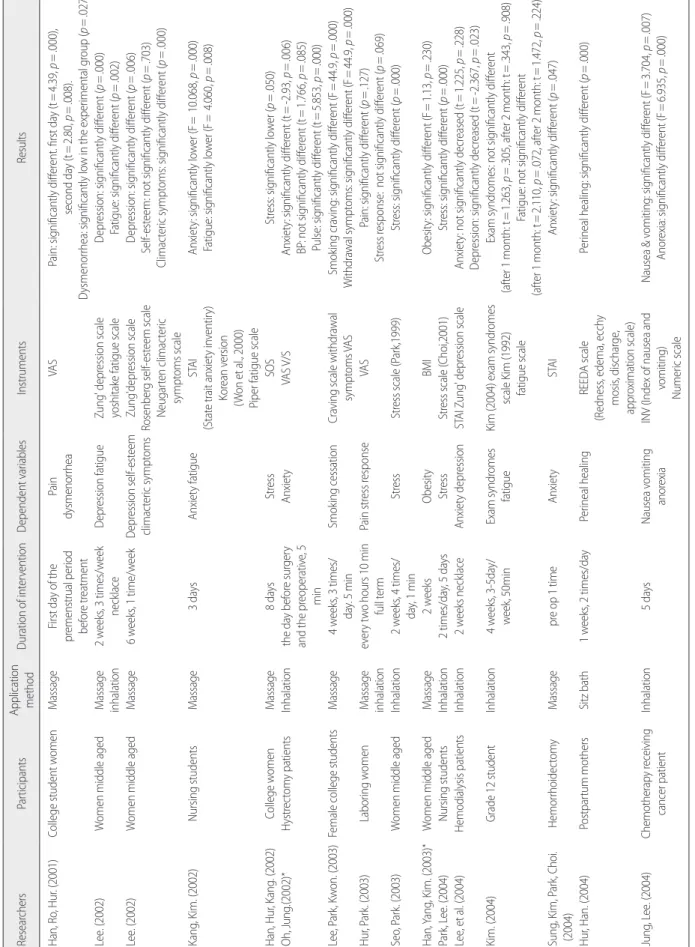
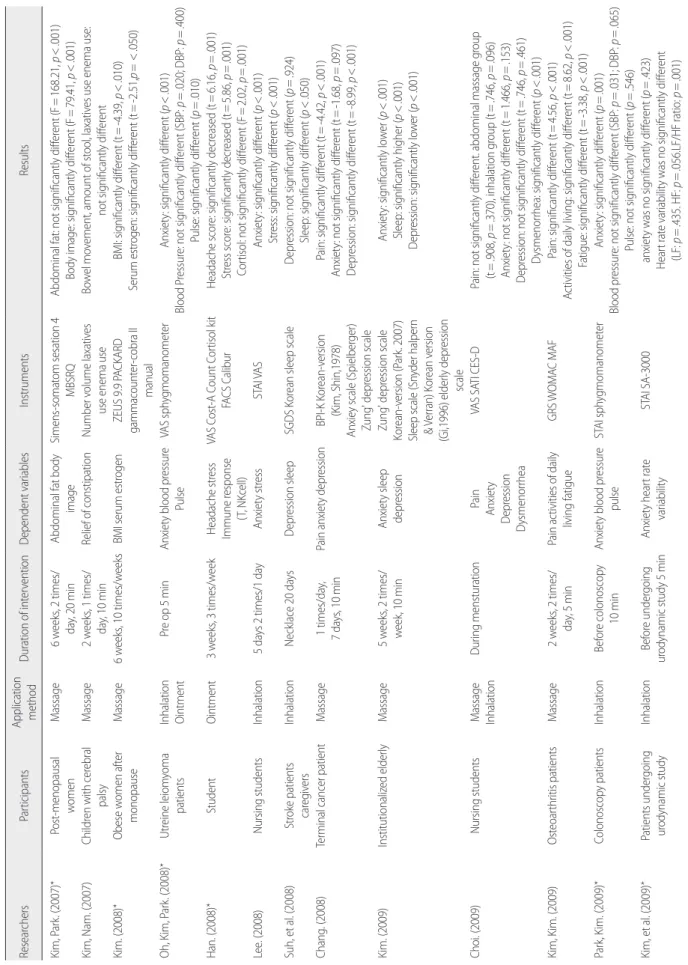
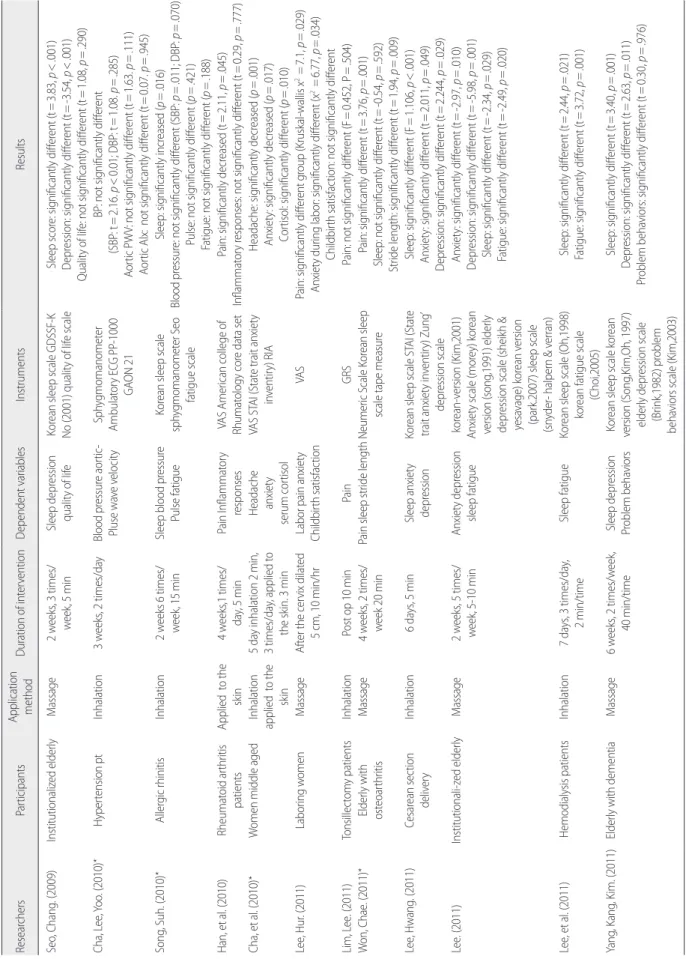
본 연구에서 분석한 53편의 논문의 특성은 Tables 1, 2에 제시되어 있다.
1) 발표연도 및 연구대상
연도별 발표논문의 분포는 2001년 1편, ’02년 5편, ’03년 4편, ’04년 10편, ’05년 3편, ’06년 4편, ’07년 3편, ’08년 6편, ’09년 6편, ’10년 4편, ’11 년 7편으로 증가추세이었다.
연구대상은 질환은 수술 전 환자 5편(9.4%)으로 가장 많고, 관절 염 환자와 임상검사 대상자 각각 4편(각7.5%), 투석환자 2편(3.8%), 편 마비환자 2편(3.8%), 암환자 2편(3.8%), 알레르기비염 환자 1편(1.9%), 치매환자 1편(1.9%), 고혈압 환자 1편(1.9%), 뇌성마비 아동1편(1.9%)이 었으며 건강인을 대상으로 한 경우는 대학생이 9편(16.9%)으로 가 장 많았고, 중년여성 8편(15.0%), 노인 5편(9.4%), 산모 5편(9.4%), 고등
학생 2편(3.8%) 및 돌봄 제공자 1편(1.9%)이었다.
2) 중재 적용방법
아로마테라피를 적용한 중재방법으로는 마사지가 27편(50.9%), Table 1. Summary of the Selected Studies (N= 53)
Year of publication Participants with a disease n
Healthy participants n
2001 1
2002 1 4
2003 4
2004 5 5
2005 3
2006 1 3
2007 1 2
2008 2 4
2009 1 5
2010 3 1
2011 5 2
Total 19 34
Application method n (%)
Massage 27 (50.9)
Inhalation 16 (30.2)
Massage + inhalation 3 (5.7)
Ointment (?) 3 (5.7)
Sitz bath 2 (3.8)
Ointment + inhalation 1 (1.9)
Aroma essential oil genus n (%)
Lavender 38 (24.8)
Chamomile 16 (10.5)
Bergamot 12 (7.8)
Peppermint 10 (6.5)
Clarysages 10 (6.5)
Rosemary 8 (5.2)
Rose 7 (4.6)
Neroli 5 (3.3)
Grapefruit 5 (3.3)
Orange 5 (3.3)
Geranium 5 (3.3)
Ylang yalng 4 (2.6)
Euchalyptus 3 (2.0)
lemon 3 (2.0)
Cypress 3 (2.0)
Jasmine 3 (2.0)
Myrre 2 (1.3)
Mandarin 2 (1.3)
Ginger 2 (1.3)
Majoram 2 (1.3)
Juniperberry 2 (1.3)
Frankincense 2 (1.3)
Basil 1 (0.7)
Sandalwood 1 (0.7)
Pine 1 (0.7)
Pennel 1 (0.7)
Table 2. Intervention Characteristics and Results of the Selected Studies ResearchersParticipantsApplication methodDuration of interventionDependent variablesInstrumentsResults Han, Ro, Hur. (2001)College student womenMassageFirst day of the premenstrual period before treatment
Pain dysmenorrheaVASPain: significantly different. first day (t=4.39, p=.000), second day (t=2.80, p=.008). Dysmenorrhea: significantly low in the experimental group (p=.027) Lee. (2002)Women middle agedMassage inhalation2 weeks, 3 times/week necklaceDepression fatigueZung' depression scale yoshitake fatigue scaleDepression: significantly different (p=.000) Fatigue: significantly different (p=.002) Lee. (2002)Women middle agedMassage6 weeks, 1 time/weekDepression self-esteem climacteric symptomsZung'depression scale Rosenberg self-esteem scale Neugarten climacteric symptoms scale
Depression: significantly different (p=.006) Self-esteem: not significantly different (p=.703) Climacteric symptoms: significantly different (p=.000) Kang, Kim. (2002)Nursing studentsMassage3 daysAnxiety fatigueSTAI (State trait anxiety inventiry) Korean version (Won et al., 2000) Piper fatigue scale
Anxiety: significantly lower (F= 10.068, p=.000) Fatigue: significantly lower (F= 4.060, p=.008) Han, Hur, Kang. (2002)College womenMassage8 daysStressSOSStress: significantly lower (p=.050) Oh, Jung.(2002)*Hystrectomy patientsInhalationthe day before surgery and the preoperative, 5 min
AnxietyVAS V/SAnxiety: significantly different (t=-2.93, p=.006) BP: not significantly different (t=1.766, p=.085) Pulse: significantly different (t=5.853, p=.000) Lee, Park, Kwon. (2003)Female college studentsMassage4 weeks, 3 times/ day. 5 minSmoking cessationCraving scale withdrawal symptoms VASSmoking craving: significantly different (F=44.9, p=.000) Withdrawal symptoms: significantly different (F=44.9, p=.000) Hur, Park. (2003)Laboring womenMassage inhalationevery two hours 10 min full termPain stress responseVASPain: significantly different (p=.127) Stress response: not significantly different (p=.069) Seo, Park. (2003)Women middle agedInhalation2 weeks, 4 times/ day, 1 minStressStress scale (Park,1999)Stress: significantly different (p=.000) Han, Yang, Kim. (2003)*Women middle agedMassage2 weeksObesityBMIObesity: significantly different (F=1.13, p=.230) Park, Lee. (2004)Nursing studentsInhalation2 times/day, 5 daysStressStress scale (Choi,2001)Stress: significantly different (p=.000) Lee, et al. (2004)Hemodialysis patientsInhalation2 weeks necklaceAnxiety depressionSTAI Zung' depression scaleAnxiety: not significantly decreased (t=1.225, p=.228) Depression: significantly decreased (t=-2.367, p=.023) Kim. (2004)Grade 12 studentInhalation4 weeks, 3-5day/ week, 50minExam syndromes fatigueKim (2004) exam syndromes scale Kim (1992) fatigue scale
Exam syndromes: not significantly different (after 1 month: t=1.263, p=.305, after 2 month: t=.343, p=.908) Fatigue: not significantly different (after 1 month: t=2.110, p=.072, after 2 month: t=1.472, p=.224) Sung, Kim, Park, Choi. (2004)HemorrhoidectomyMassagepre op 1 timeAnxietySTAIAnxiety: significantly different (p=.047) Hur, Han. (2004)Postpartum mothersSitz bath1 weeks, 2 times/dayPerineal healingREEDA scale (Redness, edema, ecchy mosis, discharge, approximation scale) Perineal healing: significantly different (p=.000) Jung, Lee. (2004)Chemotherapy receiving cancer patientInhalation5 daysNausea vomiting anorexiaINV (Index of nausea and vomiting) Numeric scale
Nausea & vomiting: significantly different (F=3.704, p=.007) Anorexia: significantly different (F=6.935, p=.000) (Continued to the page)
Table 2. (Continued from the previous page) Intervention Characteristics and Results of the Selected Studies ResearchersParticipantsApplication methodDuration of interventionDependent variablesInstrumentsResults Hur. (2004)*Postpartum mothersSitz bath2 times/dayPerineal discomfort breast milk IgAVAS Immunoturbidimetric assayEpisiotomy discomfort: significantly low in the experimental group (p=.005) Breast milk IgA: significant time effects were found Jung, Jeon. (2004)Hemiparesis patientsMassage10 days, 1 times/ day, 20 minShoulder pain Depression sleepVAS Zung' depression scaleShoulder pain: significantly different (F=8.31, P=.010) Depression: significantly different (p=.000) Sleep: significantly lowe (p=.030) Shin, Cho, Jung. (2004)*Stroke patientsInhalation1 timesAutonomic nerve system stressQECG-3 systemAutonomic nerve system: significantly different (F=4.80, p=.011) Stress: not significantly different (F=0.15, p=.861) Roh. (2004)*ElderlyMassage3 weeks, 3 times/ week, 20 min/ 1 time , twice in 3 weeksDepression hope stride lengthSDS Herth hope scale tape measureDepression: significantly different (t=2.79, p=.030) Hope: not significantly different (t=-1.01, p=.320) Stride length: significantly different (t=1.94, p=.050) Hur, Oh, Park. (2005)Laboring womenMassage1 timePain perception of childbirthLabor pain expression scalePain: significant time effects (F=329.77, p=.000) Perception of childbirth experience: not significantly different (t=-0.241. p=.810) Lee, Shin, Jung. (2005)*Nursing studentsInhalation1 timesAutonomic nerve systemQECG-3 SDNN (Standard deviation of all normal-normal intervals)
LF/HF ratio: not significantly different (t=1.952, p=.051) NN(normal-normal)intervals: significantly different (t=3.087, p=.003) Lee, Hong. (2005)Institutiona-lized elderlyMassage5 weeks, 2 times/ week, 40 min/timeStress depression sleepKorean version (song,1991) Elderly depression scale (Sheikh & Yesavage) Korean version (Park.2007) Sleep scale (Snyder-Halpern & Verran) Stress: significantly different (p=.000) Depression: significantly lower (p=.000) Sleep: significantly different (p=.026) Lee. (2006)Grade 12 studentMassage4 weeks 3 times/ 1 day 2 min 30 secCigarette use smoking craving depressionCES-D (Center for epidermiologic studies depression)
Cigarette use: significantly different (F=12.1, p<.001) Smoking craving: not significantly different (F=1.12, p=.275) Depression: significantly different (F=5.29, p<.05) Kim, Sung. (2006)Colonoscopy patientsMassageBoth foots each 5 minAnxiety pain sleepVAS VAS GRSAnxiety score: significantly decreased (p=.000) Pain score significantly decreased (F=21.269, p=.000) Sleep score significantly increased (p=.004) Lee. (2006)*GastroscopyMassageEach hand 4-5 minAnxiety blood pressure pulseSTAI sphygmomanom-eterAnxiety: not significantly different (p=.058) Blood pressure: not significantly different SBP (p=.292), DBP (p=.571) Pulse: significantly different (p=.010) Choi. (2006)Osteoarthritis with elderly womenMassage3 weeks, 3 times/weekPain physical function sleep depressionWOMCA KWOMAC Korean sleep scale CES-DPain: significantly different (F=65.7, p=.001) Physical function: significantly different (F=135.9, p=.001) Sleep: significantly different (F=43.8, p=.001) Depression: significantly different (F=19.7, p=.001) Kim. (2007)*Obese women after monopauseMassage6 weeks 5 times/ week, 20 minBody composition serum lipidWeight BMI ZEUS9.9 Hitachi 7600 auto-analyzerWeight &, BMI: significantly different (body weight: F=38.33, p<.001; BMI: F=10.59, p=.033) HDL,& LDL: not significantly different (HDL: F=2.29, p=.140; LDL: F=0.12. p=.731)
(Continued to the page)