CASE REPORT
크론병 환자에서 인플릭시맵과 메살라진 치료 후 발생한 지연발생 급성 세뇨관간질 신염 증례
유양재, 정상윤, 구대회, 고강지, 표희정, 권영주, 박영태, 원남희1
고려대학교 의과대학 내과학교실, 병리학교실1
A Case of Late Onset-Acute Tubulointerstitial Nephritis with Infliximab and Mesalazine Treatment in a Patient with Crohn’s Disease
Yang Jae Yoo, Sang Yoon Chung, Dae Hoe Gu, Gang Jee Ko, Heui Jung Pyo, Young Joo Kwon, Young-Tae Bak and Nam Hee Won1 Departments of Internal Medicine and Pathology1, Korea University College of Medicine, Seoul, Korea
Infliximab is a chimeric anti-tumor necrosis factor-alpha monoclonal antibody. Infusion related reactions and infection are well known side effects of infliximab; however, renal complications have not been well recognized. We report on a patient with late onset-acute tubulointerstitial nephritis (ATIN) after treatment with infliximab and mesalazine for Crohn’s disease. A 25-year-old woman was admitted with a purpuric rash on both lower extremities and arthralgia. She had been diagnosed with Crohn’s disease 5.6 years previously and had been treated with mesalazine and infliximab. Serum creatinine level, last measured one year ago, was elevated from 0.6 mg/dL to 1.9 mg/dL. Results of urinalysis, ultrasound, and serologic examinations were normal. With a tentative diagnosis of Henoch-Schönlein purpura, oral prednisolone was given, and serum creatinine decreased to 1.46 mg/dL, but was elevated to 2.6 mg/dL again at two months after discontinuation of prednisolone. Renal biopsy indicated that ATIN was probably induced by drug, considering significant infiltration of eosinophils. Concomitant use of infliximab with mesalazine was supposed to trigger ATIN. Oral prednisolone was administered, and serum creatinine level showed partial recovery. Thus, ATIN should be suspected as a cause of renal impairment in Crohn’s disease even after a long period of maintenance treatment with infliximab and mesalazine. (Korean J Gastroenterol 2014;63:308-312)
Key Words: Acute tubulointerstitial nephritis; Acute kidney injury; Crohn disease; Infliximab
Received August 28, 2013. Revised September 16, 2013. Accepted October 2, 2013.
CC This is an open access article distributed under the terms of the Creative Commons Attribution Non-Commercial License (http://creativecommons.org/licenses/
by-nc/3.0) which permits unrestricted non-commercial use, distribution, and reproduction in any medium, provided the original work is properly cited.
교신저자: 고강지, 152-703, 서울시 구로구 구로동로 148, 고려대학교구로병원 신장내과
Correspondence to: Gang Jee Ko, Division of Nephrology, Department of Internal Medicine, Korea University Guro Hospital, 148 Gurodong-ro, Guro-gu, Seoul 152-703, Korea. Tel: +82-2-2626-3039, Fax: +82-2-2626-1798, E-mail: [email protected]
Financial support: None. Conflict of interest: None.
INTRODUCTION
Acute tubulointerstitial nephritis (ATIN) is a disorder that manifests as acute kidney injury (AKI) with interstitial in- flammation, edema, and tubulitis, which is usually related to drug or infection.1 Renal dysfunction of ATIN is assumed to be reversible in most cases, and drug related ATIN should re- solve with discontinuation of the responsible drug. However, one recent study showed that despite appropriate treatment,
a significant proportion of ATIN cases progress to chronic kid- ney injury.2
Although ATIN can be idiopathic, drug-induced ATIN is more prevalent. In an analysis of pooled data from three large studies reported in 2004, drug-induced ATIN accounted for 91 of the 128 cases (71.1%). Almost every drug is capable of inducing ATIN, and the clinical presentation and laboratory findings vary according to the class of drug involved (i.e., NSAIDs-related ATIN versus other types of drug-induced
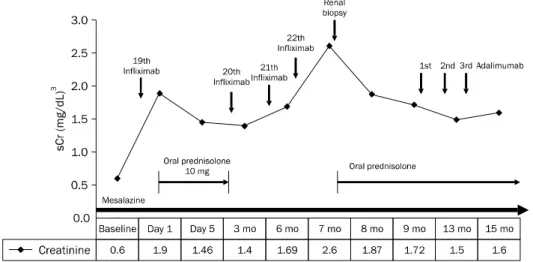
Fig. 1. Changes of serum creatinine levels. Creatinine level showed a slight decrease after initial admini- stration of oral prednisolone. How- ever, it increased again when the steroid was discontinued according to infliximab treatment. Oral predni- solone (0.5 mg/kg) was reintroduced, and the serum creatinine level re- mained nearly stable after adalimu- mab treatment.
ATIN).3,4 Induction of ATIN is characterized by infiltration of various inflammatory cells into the interstitium, such as lym- phocytes and monocytes, eosinophils, plasma cells, neu- trophils, and histiocytes. A higher proportion of eosinophil in- filtrates can also indicate drug-induced ATIN, except NSAIDs-related ATIN, which often does not cause eosinophil infiltration.4
Infliximab, a chimeric tumor necrosis factor-alpha (TNF-α) monoclonal antibody, has been used in treatment of patients with inflammatory bowel disease and rheumatoid arthritis.
TNF-α monoclonal antibody treatment along with mesala- zine has been established for remission of Crohn’s disease, and is considered the most potent treatment available at present.5,6 Infusion related reaction and infection are well known side effects of infliximab treatment7; however, renal complications, particularly in cases of prolonged con- comitant use with mesalazine have not been well recognized.
Here, we report on a patient who presented with delayed onset ATIN after a prolonged period of maintenance treat- ment with infliximab and mesalazine for Crohn’s disease.
CASE REPORT
A 25-year-old woman was admitted with a purpuric rash on both upper and lower extremities and arthralgia of both ankle joints. She had been diagnosed with Crohn’s disease 5.6 years previously and was treated with 3.0 g/day of mesa- lazine. Infliximab was added to her treatment protocol after 3.5 years of mesalazine treatment because she had experi- enced multiple relapses and a fistula was identified at the distal ileum. She had been stable since the start of infliximab
administration. The 19th infliximab infusion had been ad- ministered one month prior to admission.
On admission, BUN and creatinine were elevated to 26 and 1.9 mg/dL from her baseline level of 11.0 and 0.6 mg/dL from one year previously. Urinalysis showed no abnormal findings, such as hematuria, pyuria, or proteinuria. Protei- nuria of 209 mg was detected in 24-hour urine collection.
Kidney size and echogenicity was preserved within the nor- mal range on ultrasonography, and serologic examinations showed no significant abnormalities. Ten milligram of oral prednisolone was given for control of purpura and arthralgia with the impression of Henoch-Schönlein purpura, although vasculitis was not confirmed with skin biopsy because the skin lesion lasted for a relatively short period of time. After ad- ministration of prednisolone and hydration, the purpura and arthralgia resolved, and her creatinine decreased to 1.46 mg/dL, although it did not reach the baseline level in the seri- al follow-up.
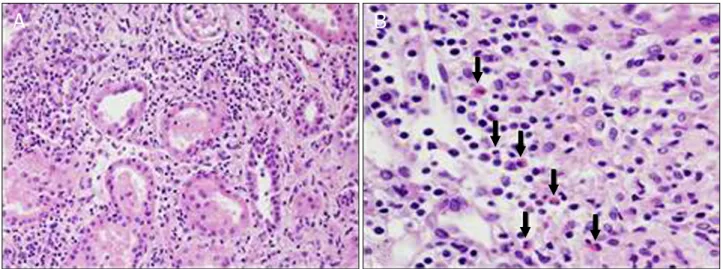
Prednisolone was discontinued after two months of treat- ment, and regular infliximab infusion had been continued ev- ery other month. Creatinine increased again, up to 2.6 mg/dL, five months after discontinuation of prednisolone (Fig. 1). Renal biopsy revealed ATIN with interstitial inflam- mation. Drug induced interstitial nephritis was suspected due to infiltration of various inflammatory cells in the tubules, especially eosinophils. Included glomeruli had a normal ap- pearance, and immunofluorescence study for all immuno- globulins and complements showed negative results.
Chronic exposure to causative drugs was also suspected be- cause acute inflammatory cell infiltration and edema was al- so seen along with signs of chronic tubulointerstitial nephritis
Fig. 2. Histologic examination with light microscopy of kidney. (A) There was diffuse tubular damage and infiltration of interstitial inflammation into the tubular epithelial cells (H&E, ×100). (B) Inflammatory cell infiltration was superimposed on chronic tubulointerstitial nephritis, which manifested as tubular atrophy with attendant interstitial fibrosis. Infiltration of various inflammatory cells, including lymphocytes, plasma cells, eosinophils, and a few neutrophils, was observed, and a higher proportion of eosinophil infiltration (arrows) was noted (H&E, ×400).
(Fig. 2).
Concomitant use of infliximab with mesalazine was sup- posed to induce ATIN because the patient denied taking any medications other than mesalazine and infliximab. Consider- ing that mesalazine had been maintained for 5.6 years with- out complication and renal biopsy showed active in- flammatory response with a significant number of eosino- phils, although there was superimposed chronic interstitial nephritis, infliximab was considered to trigger ATIN in con- comitant use of mesalazine. Serum creatinine had also in- creased according to the schedule of infliximab infusion, which was administered every two months.
Oral prednisolone was started for control of the ATIN.
Because TNF-α antibody treatment should be sustained for control of Crohn’s disease, adalimumab, a fully humanized TNF-α antibody, was administered subcutaneously with me- salazine instead of infliximab, possibly to minimize immuno- logic reaction. The serum creatinine level showed partial re- covery to 1.6 mg/dL after two weeks of steroid therapy, and stabilized.
DISCUSSION
ATIN is observed in 2-3% of all renal biopsy samples; how- ever, the number increases to 6.5-27% when the analysis is restricted to AKI patients.8,9 The causes of ATIN are variable.
Idiopathic cases such as tubulointerstitial nephritis and uvei- tis syndrome and anti-tubular basement membrane disease
have been reported. Systemic diseases such as sarcoidosis, systemic lupus erythematosus, and Sjögren’s syndrome are also known to be associated with ATIN. Among various under- lying causes, drug-induced ATIN is the most prevalent, con- sisting of more than 75% cases of ATIN, followed by infection (15%).1,4 Theoretically, any drug is capable of triggering ATIN.
Antibiotics, antiviral medications, anticonvulsants, an- algesics, and anti-ulcer medications have frequently been associated with ATIN.4
In the current case, the patient had been treated with in- fliximab and mesalazine exclusively. Several cases of de- layed onset of mesalazine-induced ATIN have been reported previously.10,11 However, the median duration of mesalazine treatment was less than two years, and chronic interstitial nephritis with interstitial fibrosis and lymphocytic infiltration was mainly manifested in patients who experienced renal dysfunction after taking mesalazine more than 1.5 years.
ATIN in Crohn’s disease with a prolonged period of main- tenance treatment more than five years has rarely been reported.11,12 Given that the patient had been taking mesala- zine for more than five years without any noticeable effects on renal function, the possibility of infliximab as a triggering agent for ATIN was suspected. Temporal association be- tween aggravation of renal function and the interval of in- fliximab administration and the immunogenicity of in- fliximab, possibly due to its chimeric nature,13 supported our suspicion that infliximab triggered development of ATIN in the current case.
Renal complication related to infliximab has rarely been reported. In fact, infliximab has been used for therapeutic treatment of granulomatous tubulointerstitial nephritis and amyloidosis secondary to Crohn’s disease. However, recent studies have reported renal involvement during anti-TNF-α treatment, including infliximab, adalimumab, and etanercept, a soluble TNF-α receptor approved for management of rheu- matoid arthritis. Lupus nephritis, vasculitis, and glomer- ulonephritis, such as Henoch-Schönlein purpura and mem- branous nephropathy, have been reported after anti-TNF-α treatment.14,15 One case of ATIN after etanercept treatment has been reported.16 However, the case is the first report of ATIN in a patient with Crohn’s disease treated with infliximab and mesalazine.
The problems of ATIN related to anti-TNF-α treatment are the difficulty of diagnosis and treatment. Low suspicion of ATIN as the cause of renal dysfunction in patients treated with anti-TNF-α treatment for Crohn’s disease or rheumatoid ar- thritis could complicate early diagnosis. Absence of typical symptoms or signs of ATIN may also delay diagnosis. Fever, rash, and eosinophilia are classic clinical features of ATIN;
however, less than 10% of patients show all three findings.
Although proteinuria, hematuria, and leukocyturia may be present on urinalysis, these findings are not diagnostic for ATIN.4 Eosinophiluria was once thought to be a typical finding;
however, its role in diagnosis of drug-induced ATIN is limited due to low sensitivity and specificity.17-19 Renal biopsy is es- sential for diagnosis of ATIN and the presence of interstitial inflammation and tubulitis are the main pathologic findings.4
In our case, purpuric rash, which may have been an extra- renal manifestation of ATIN during the first episode of renal dysfunction, was accompanied by arthralgia, which led us to misrecognize the condition as Henoch-Schönlein purpura.
The absence of abnormal findings on urinalysis initially, and the substantially long duration of exposure to infliximab, also reduced our suspicion of ATIN, preventing early diagnosis and treatment.
The difficulty of ATIN treatment related to anti-TNF-α treat- ment in Crohn’s disease is that there are few therapeutic op- tions for Crohn’s disease besides anti-TNF-α treatment. Early detection of causative agents and removal of the offending drug are the mainstays of therapy for drug-induced ATIN, and are crucial to avoidance of serious and progressive injury.
However, anti-TNF-α antibody treatment cannot be dis-
continued even after diagnosis of ATIN possibly related to in- fliximab, as in our case, because it is the most powerful method for control of Crohn’s disease. In the current case, anti-TNF-α antibody treatment was sustained, and steroid treatment was initiated in order to reduce the inflammation of ATIN. The use of steroids for treatment of drug-induced ATIN has remained controversial1; however, recent studies have suggested that steroids should be started as soon as drug-induced ATIN is diagnosed in order to prevent interstitial fibrosis and to help in recovery of renal function.20 It is not cer- tain whether adalimumab, a fully humanized anti-TNF-α anti- body, is the best possible choice to minimize the immuno- logic reaction in the kidney. The role of adalimumab as a re- placement for infliximab should be examined in further studies.
ATIN could develop even after a prolonged period of main- tenance treatment with infliximab and mesalazine in Crohn’s disease. Early diagnosis via renal biopsy should be made promptly whenever renal dysfunction manifests in patients with Crohn’s disease on anti-TNF-α antibody treatment with mesalazine.
REFERENCES
1. Praga M, González E. Acute interstitial nephritis. Kidney Int 2010;77:956-961.
2. Baker RJ, Pusey CD. The changing profile of acute tubulointer- stitial nephritis. Nephrol Dial Transplant 2004;19:8-11.
3. Markowitz GS, Perazella MA. Drug-induced renal failure: a focus on tubulointerstitial disease. Clin Chim Acta 2005;351:31-47.
4. Perazella MA, Markowitz GS. Drug-induced acute interstitial nephritis. Nat Rev Nephrol 2010;6:461-470.
5. Danese S, Colombel JF, Reinisch W, Rutgeerts PJ. Review article:
infliximab for Crohn's disease treatment--shifting therapeutic strategies after 10 years of clinical experience. Aliment Pharmacol Ther 2011;33:857-869.
6. Sandborn WJ, Hanauer SB, Rutgeerts P, et al. Adalimumab for maintenance treatment of Crohn’s disease: results of the CLASSIC II trial. Gut 2007;56:1232-1239.
7. Gottlieb AB. Infliximab for psoriasis. J Am Acad Dermatol 2003;49(2 Suppl):S112-S117.
8. Farrington K, Levison DA, Greenwood RN, Cattell WR, Baker LR.
Renal biopsy in patients with unexplained renal impairment and normal kidney size. Q J Med 1989;70:221-233.
9. Haas M, Spargo BH, Wit EJ, Meehan SM. Etiologies and outcome of acute renal insufficiency in older adults: a renal biopsy study of 259 cases. Am J Kidney Dis 2000;35:433-447.
10. Corrigan G, Stevens PE. Review article: interstitial nephritis as- sociated with the use of mesalazine in inflammatory bowel
disease. Aliment Pharmacol Ther 2000;14:1-6.
11. Gisbert JP, González-Lama Y, Maté J. 5-Aminosalicylates and re- nal function in inflammatory bowel disease: a systematic review.
Inflamm Bowel Dis 2007;13:629-638.
12. World MJ, Stevens PE, Ashton MA, Rainford DJ. Mesalazine-as- sociated interstitial nephritis. Nephrol Dial Transplant 1996;11:
614-621.
13. Garcês S, Demengeot J, Benito-Garcia E. The immunogenicity of anti-TNF therapy in immune-mediated inflammatory diseases:
a systematic review of the literature with a meta-analysis. Ann Rheum Dis 2013;72:1947-1955.
14. Stokes MB, Foster K, Markowitz GS, et al. Development of glo- merulonephritis during anti-TNF-alpha therapy for rheumatoid arthritis. Nephrol Dial Transplant 2005;20:1400-1406.
15. Chin G, Luxton G, Harvey JM. Infliximab and nephrotic syndrome.
Nephrol Dial Transplant 2005;20:2824-2826.
16. Sugimoto T, Yasuda M, Sakaguchi M, et al. Acute interstitial nephritis associated with etanercept. Rheumatol Int 2008;28:
1283-1284.
17. Nolan CR 3rd, Anger MS, Kelleher SP. Eosinophiluria--a new method of detection and definition of the clinical spectrum. N Engl J Med 1986;315:1516-1519.
18. Corwin HL, Bray RA, Haber MH. The detection and interpretation of urinary eosinophils. Arch Pathol Lab Med 1989;113:1256- 1258.
19. Fletcher A. Eosinophiluria and acute interstitial nephritis. N Engl J Med 2008;358:1760-1761.
20. González E, Gutiérrez E, Galeano C, et al; Grupo Madrileño De Nefritis Intersticiales. Early steroid treatment improves the re- covery of renal function in patients with drug-induced acute in- terstitial nephritis. Kidney Int 2008;73:940-946.