© 2017 Korean Breast Cancer Society. All rights reserved. http://ejbc.kr | pISSN 1738-6756
INTRODUCTION
Breast cancer is the most common cancer of women in the world. In Korea, 17,792 patients were diagnosed as having breast cancer during 2012; 46.6% of these patients were pre- menopausal [1-3].
One of the major concerns for young female breast cancer patients is whether the ability for menstruation and pregnancy will be terminated due to the disease. The results of a survey
“Helping Ourselves, Helping Others: The Young Women’s
Breast Cancer Study” revealed that over 50% of women younger than 40 years of age, upon diagnosis, are concerned about future fertility, and a significant proportion wish to con- sider pregnancy after breast cancer treatment [4,5].
Gonadotropin-releasing hormone (GnRH) agonists have been used with adjuvant chemotherapy to protect ovarian function [6]. Trials of the GnRH agonist functionality have shown mixed results. In the GBG 37 ZORO study, premeno- pausal patients with breast cancer who received goserelin si- multaneously with modern neoadjuvant chemotherapy did not experience statistically significant lower rates of amenor- rhea after the end of chemotherapy compared with those re- ceiving chemotherapy alone [7]. In contrast, in the POEMS/
S0230 trial, the administration of goserelin along with chemo- therapy reduced the risk of early menopause and improved the prospects of fertility [8].
Moreover, there are no data about the actual pregnancy rates among young breast cancer patients receiving GnRH ag- onists and concurrent chemotherapy in Korea. Therefore, we retrospectively evaluated the rates of pregnancy and resump- tion of menstruation in young Korean breast cancer patients.
Fertility Rates in Young Korean Breast Cancer Patients Treated with Gonadotropin-Releasing Hormone and Chemotherapy
Isaac Kim, Jai Min Ryu, Hyun-June Paik, Sungmin Park, Soo Youn Bae, Se Kyung Lee, Jonghan Yu, Seok Won Kim, Seok Jin Nam, Jeong Eon Lee
Division of Breast and Endocrine Surgery, Department of Surgery, Samsung Medical Center, Sungkyunkwan University School of Medicine, Seoul, Korea ORIGINAL ARTICLE
Purpose: Gonadotropin-releasing hormone (GnRH) agonists have been used with adjuvant chemotherapy to protect ovarian func- tion. However, there are no data on the actual pregnancy rates among young breast cancer patients receiving GnRH agonists and concurrent chemotherapy in Korea. Methods: Among pa- tients who underwent surgery from January 2002 to April 2012, premenopausal patients aged between 20 and 40 years were in- cluded in the analysis. We retrospectively reviewed clinicopathol- ogic features (e.g., age, obstetric and menstruation history), re- currence, and survival status. The rate of resumption of men- struation was calculated in all patients. In the married group, pregnancy and delivery rates were also recorded. Results:
Among 101 patients, 19 were lost to follow-up and 82 were eligi- ble for the analysis. Among them, 31 were married, 10 of 51 got married, and 41 remained unmarried through the follow-up peri-
od. Among the married patients, 15 became pregnant and gave birth to 19 babies, whereas 26 did not become pregnant. The pregnancy rate in the married group was 50.0% (15/30). Three of 15 pregnancies (20.0%) were multiparous. Most of the delivered babies were healthy and 80.0% of patients had no problems breastfeeding (12/15). More than half the patients in all groups recovered menstrual status within 12 months. Conclusion: Fifty percent of young breast cancer patients who attempted preg- nancy succeeded in pregnancy after adjuvant chemotherapy and GnRH agonists. Further studies that include control groups are required to confirm whether the use of GnRH agonists im- proves pregnancy.
Key Words: Breast neoplasms, Drug therapy, Gonadotropin-releasing hormone, Pregnancy rate
Correspondence to: Jeong Eon Lee
Division of Breast and Endocrine Surgery, Department of Surgery, Samsung Medical Center, Sungkyunkwan University School of Medicine, 81 Irwon-ro, Gangnam-gu, Seoul 06351, Korea
Tel: +82-10-9933-3478, Fax: +82-2-3410-6982 E-mail: [email protected]
This research was supported by a grant of the Korea Healthcare Technology R&D Project through the Korea Health Industry Development Institute (KHIDI), funded by the Ministry for Health & Welfare Affairs, Republic of Korea (HI14C3418).
Received: July 5, 2016 Accepted: January 9, 2017
Cancer
METHODS
Study population
We retrospectively reviewed the medical records of patients with invasive breast cancer who underwent surgery at the Breast Cancer Center of Samsung Medical Center, Seoul, Korea and conducted telephone surveys to obtain additional data. Patients who underwent surgery from January 2002 to April 2012 were eligible for this study because GnRH agonists for ovarian protection were used in extensively after 2002 at this institution. All patients decided to use GnRH agonists themselves after getting information about GnRH agonists in the outpatient department. Among them, premenopausal pa- tients aged between 20 and 40 years were included in the analysis. All patients were treated with adjuvant chemother- apy, although the chemotherapy regimens were not all the same. Women with estrogen receptor (ER)-positive tumors were offered tamoxifen for 5 years, and those treated with breast conserving surgeries were offered adjuvant radiother- apy after the end of chemotherapy. Patients were excluded if they had distant metastasis at diagnosis or a history of ipsilateral or contralateral breast cancer, received neoadjuvant chemotherapy, or previously undergone bilateral salpingo-oophorectomy for any reason, or if they had lost contact with clinicians immedi- ately after surgery. Patients were also excluded if they used GnRH agonists sequentially after chemotherapy for adjuvant therapy, as alternative endocrine treatment after recurrence, or for the treatment of conditions other than breast cancer, such as endometriosis.
During this period, GnRH agonists were administered to
101 patients via subcutaneous injection 2 weeks before the initiation of chemotherapy and administered every 28 days until the completion of chemotherapy. Two kinds of GnRH agonists were used in the study: leuprorelin 3.75 mg (Leuplin®; Takeda Chemical Industries Ltd., Osaka, Japan) for 60 women and goserelin 3.6 mg (ZOLADEX®; AstraZeneca Pharma In- ternational, Cambridge, UK) for 41 women.
We retrospectively reviewed clinicopathologic features, in- cluding pathological stage, nuclear grade, histological grade, immunohistochemical findings (e.g., ER, progesterone recep- tor, and human epidermal growth factor receptor 2 status), treatment modalities, and recurrence or survival status. In add- ition, age and obstetric and menstruation history were includ- ed. In the married group, pregnancy and delivery rate were calculated. In the unmarried group, the rate of resumption of menstruation was calculated. Median follow-up duration was 7.48 years (range, 4–14 years). This study was approved by the Institutional Review Board of Samsung Medical Center (IRB number: 2016-03-123-0001).
Statistical analysis
All data were analyzed using IBM SPSS Statistics version 23.0 software (IBM Corp., Armonk, USA). Chi-square tests or linear by linear associations were used to compare baseline clinicopathologic details between the pregnancy and non- pregnancy groups. One way analysis of variance, was used to check differences in menstruation recovery in each group and Spearman rank correlation analysis was used to reveal the in- terrelationship between resumption of menstruation and age at diagnosis or menarche. A p-value <0.05 was considered
101 Patients
21 Pregnancy (–)
10 Pregnancy (+) 10 Become to married
26 Nonpregnancy
41 Still unmarried 19 Follow-up loss
51 Unmarried 31 Married
15 Pregnancy (19 babies were born)
5 Pregnancy (+) 5 Pregnancy (–)
Figure 1. Fertility follow-up for 101 concurrent Gonadotropin-releasing hormone agonist users.
statistically significant.
RESULTS
Categorization of patients
Out of 101 patients, 19 were lost to follow-up and 82 were eligible for inclusion in the study. Among these patients, 31 patients were in the married group, 10 of 51 patients initially in the unmarried group got married during follow-up, and 41 patients remained unmarried throughout the follow-up peri- od. Among the married group, a total of 15 patients became pregnant and gave birth to 19 babies, whereas 26 patients did not become pregnant (Figure 1).
Pregnancy outcomes
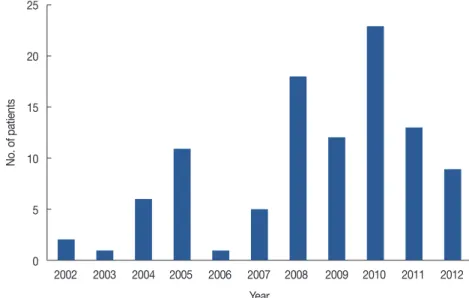
In the initial period, only 1 to 2 cases were treated with GnRH agonists annually. After 2008, the use of GnRH ago- nists increased, but the increase was not linear over time. The greatest annual use of GnRH agonists was 23 cases in 2010 (Figure 2). The first delivery in the married group was more than 5 years after the initial use of GnRH agonists. After 2012, the number of delivered babies was consistently greater than two per year (Figure 3). Table 1 shows the number of patients in the married group who achieved pregnancy and breast- feeding. Among the 41 patients in the ever-married group, 15 became pregnant and gave birth to one or more babies.
Among the 26 patients who did not become pregnant, 11 did not attempt pregnancy and 15 did not become pregnant de- spite attempts. There was one case of a delayed pregnancy at- tempt for additional chemotherapy; this patient was 21 years old at diagnosis and had stage IIA disease. At 1 year after par-
tial mastectomy, she underwent (video-assisted thoracoscopic surgery) metastasectomy for lung metastasis and gave up try- ing for pregnancy to receive additional chemotherapy. Two of the 15 patients who unsuccessfully attempted pregnancy tried in vitro fertilization. All patients who achieved pregnancy did so through a sexual relationship. The pregnancy rate among women who attempted pregnancy was 50.0% (15/30). Three of 15 pregnancies were multiparous (20.0%). In most cases, the delivered babies were healthy and no adverse events occurred during pregnancy and delivery. There was one case of a pre- term infant who needed neonatal intensive care unit care.
Most patients who delivered babies had no problems breast- feeding (12/15, 80.0%). Among the 12 patients who success- fully breastfed, seven received breast conserving surgery and five underwent total mastectomy. All patients used the contra- lateral breast for breastfeeding. The breastfeeding duration
Figure 2. Annual cases of concurrent Gonadotropin-releasing hormone agonist use (total 101 cases).
25
20
15
10
5
0
2002 2003 2004 2005 2006 2007 2008 2009 2010 2011 2012 Year
No. of patients
Figure 3. Annual distribution of delivery.
4
3
2
1
0 2007 2008 2009 2010 2011 2012 2013 2014 2015
Year
No. of delivered babies
was 1 to 12 months. Table 2 shows the duration from each treatment to pregnancy in 15 pregnant patients. Achieving pregnancy took more than 40 months from the last chemo- therapy session and surgery. The mean duration from last tamoxifen dosage to pregnancy was 18 months, which oc- curred in only six ER-positive patients.
Comparison of patient characteristics
The clinicopathologic characteristics of patients in the preg- nancy and nonpregnancy groups are listed in Table 3. Median age was similar in the pregnancy group (range, 22–39 years) and nonpregnancy group (range, 21–40 years). Most of the patients in both groups were stage II. The rate of ER-negative cancer tended to be higher in the pregnancy group than in the nonpregnancy group, and the rate of ER positivity tended to be higher in the nonpregnancy group, but there was no statis- tically significant difference. Among the six patients in the pregnancy group who were treated with tamoxifen, five pa- tients received tamoxifen for 5 years and one patient for 1
year. Among the 15 patients treated with tamoxifen in the nonpregnancy group, 14 took tamoxifen for 5 years and one patient took it for 1 year. FAC (fluorouracil+doxorubicin+cycl ophosphamide) was the most frequently used regimen in the pregnancy group, but all regimens were evenly used in the nonpregnancy group. There was no correlation between the chemotherapy regimen and pregnancy. Disease-free survival time was similar in both groups.
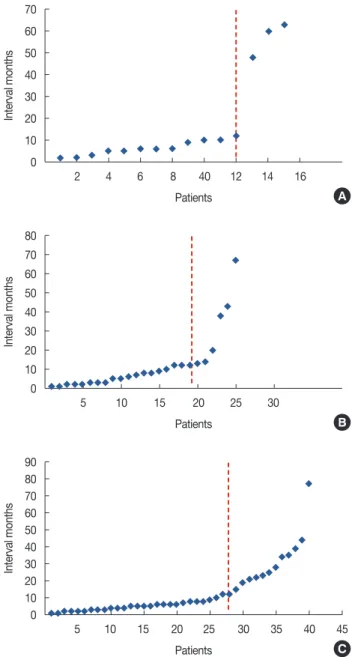
Menstruation resumption from end of chemotherapy More than half of patients restarted menstruation within 1year in all groups (Figure 4). In the nonpregnancy and still unmarried groups, only one patient in each group did not re- sume menstruation. The duration from end of chemotherapy to menstruation in each group did not differ statistically (Table 4). Most of 40 patients in the still unmarried group restarted menstruation within 12 months regardless of age and men- arche (Table 5).
Table 1. Pregnancy outcomes
Variable No. of patients (%)
Among married group (n=41)
Not attempted pregnancy 11 (26.8)
Do not want babies 6
Already have babies 4
Delayed pregnancy for continuous treatment 1
Attempted pregnancy 30 (73.2)
Not achieved 15
Achieved pregnancy 15
Patients who achieved pregnancy & delivery (n=15) No. of babies born
1 12
2 2
3 1
Adverse pregnancy event
None 14
Miscarriage 0
Preterm baby 1
Breast feeding (mo)
≤6 7
>6 5
None 3
Table 2. Duration from each treatment to pregnancy in 15 pregnant pa- tients
Treatment modalities Duration (mo),
mean±SD (range) From last CTx. to pregnancy 41.4±13.5 (10–73)
From OP to pregnancy 47.4±12.5 (15–75)
From last TMX to pregnancy (only 6 patients ) 18.0±2.82 (10–24) CTx=chemotherapy; OP=operation; TMX=tamoxifen.
Table 3. Characteristics of 41 patients in married status Characteristic Pregnancy
(n=15)
Nonpregnancy
(n=26) p-value
Age* 30.4±2.15 32.7±1.65 0.078
Age distribution (yr) 0.053
≤30 7 5
>30 8 21
Stage
I 6 9 0.666
II 8 16 0.710
III 1 1 0.669
Estrogen receptor status 0.133
Positive 6 15
Negative 9 11
HER2 0.430
Positive 3 3
Negative 12 23
Tamoxifen treatment 0.133
Yes 6 15
No 9 11
Chemotherapy regimens
AC 2 6 0.482
AC+taxol 3 5 0.907
AC+docetaxel 2 8 0.286
FAC 8 7 0.076
GnRH agonist 0.103
Goserelin 2 10
Leuprorelin 13 16
Disease-free survival years* 8.3±1.3 7.4±1.1 0.262 HER2=human epidermal growth factor receptor 2; AC=doxorubicin+cyclo- phosphamide; FAC=fluorouracil+doxorubicin+cyclophosphamide; GnRH=
gonadotropin-releasing hormone.
*Mean±SD.
DISCUSSION
In our survey, the pregnancy rate in young Korean breast cancer patients treated with concurrent chemotherapy and GnRH agonists was 50.0% (15/30), and 20.0% of the pregnancies were multiparous (3/15). Most of the delivered babies were healthy and 80.0% had no problems breastfeeding (12/15).
More than half of the patients in all groups recovered men- struation within 12 months.
Several previous studies report the pregnancy rate in similar conditions. Shen et al. [9] showed comparable spontaneous pregnancy rates in patients who received chemotherapy with and without GnRH agonist use (odds ratio [OR], 0.177; 95%
confidence interval [CI], 0.92–1.40; p=0.09). In contrast, in the POEMS/S0230 trial, the pregnancy rate was 11% in the chemotherapy alone group and 21% in the goserelin group (OR, 2.45; 95% CI, 1.09–5.51; p=0.03) [8]. A meta-analysis by Munhoz et al. [10] also revealed a higher number of preg- nancies in the GnRH group than in the chemotherapy alone group (OR, 1.85; 95% CI, 1.02–3.36; p=0.04). The fertility rate in our study was higher than that in other studies. This is probably due to the small number of patients and the analysis of only married patients who attempted pregnancy. Another study of pregnancy rates in patients who attempted pregnancy showed a 71% pregnancy rate [11]. In our study population, the pregnancy rate in all married patients regardless of at- tempt was 36.5%. Meanwhile, our study retrospectively select- ed patients who used GnRH agonists, and these patients not only decided to use of GnRH agonists themselves, but also purchased it. GnRH agonists are quite expensive, and some patients who may have desired pregnancy could not use it due to financial constraints. Thus, it is possible that the pregnancy rate observed in our study was influenced by selection bias.
Several studies have reported similar numbers of reported miscarriages, elective terminations, and pregnancy complica- tions, irrespective of GnRH agonist use [8,10]. Wong et al.
[11] reported that, among 30 patients who achieved pregnan- cy under GnRH agonist use with chemotherapy, there were five spontaneous miscarriages, three voluntary terminations Figure 4. Menstruation resumption. (A) In pregnancy group, (B) in non-
pregnancy group, and (C) in still unmarried group. X-axis means each patient in due order from with the shortest recovery months to the lon- gest recovery months. Y-axis means interval months to menstruation resumption in each patient. The dotted line indicates range of menstrual recovery within 1 year.
70 60 50 40 30 20 10 0
90 80 70 60 50 40 30 20 10 0 80 70 60 50 40 30 20 10 0
2 4 6 8 40 12 14 16
5 10 15 20 25 30 35 40 45
5 10 15 20 25 30
Patients
Patients Patients
Interval monthsInterval monthsInterval months
A
C B
Table 4. Duration from end of chemotherapy to menstruation
Group Duration (mo),
mean±SD (range) p-value
Pregnancy 16.47±10.7 (2–63)
Nonpregnancy 11.77±7.66 (1–67) 0.720
Still unmarried 13.25±7.71 (1–77)
Table 5. Interval months to resumption of menstruation in unmarried patients
Variable Interval months, No. (%) Total
No. p-value
≤12 >12, ≤24 >24
Age (yr) 0.510
≤30 10 (67.0) 2 (13.0) 3 (20.0) 15 >30 18 (72.0) 4 (16.0) 3 (12.0) 25
Menarche (yr) 0.089
≤12 9 (69.0) 1 (8.0) 3 (23.0) 13 >12 19 (70.0) 5 (19.0) 3 (11.0) 27 Total 28 (70.0) 6 (15.0) 6 (15.0) 40
for social reasons, and one case of ectopic pregnancy. In previ- ous reports, the rate of congenital abnormalities of infants born to women with a history of breast cancer ranges was 0%
to 7.2%. Considering that the percentage of congenital abnor- malities in the general population is nearly 4%, the rate ob- served in these women is similar to that of the general popula- tion [12]. Therefore, patients do not need to abandon preg- nancy after breast cancer for fear of adverse events.
There were no differences in clinicopathologic characteris- tics between the pregnancy and nonpregnancy groups in our study. ER-negative status was more common in the pregnancy group than the nonpregnancy group, but the difference was not significant (p=0.133). In a multicenter retrospective study including 333 pregnancies after breast cancer and 874 matched nonpregnant controls, ER status did not influence pregnancy [13]. The main adjuvant endocrine therapy for premenopausal patients with receptor-positive breast cancer is a 5-year course of tamoxifen. During pregnancy, tamoxifen and its metabolites interact with rapidly growing and developing embryonic or fetal tissues. The relatively high frequency of severe congenital abnormalities indicates that reliable birth control is mandatory during tamoxifen treatment. After tamoxifen use, a 2-month washout period is advisable based on the known half-life of tamoxifen [14]. In our study, patients in the pregnancy group had a greater chance of becoming pregnant because the rate of tamoxifen use was lower than in the nonpregnancy group.
Moreover, the “healthy mom effect” noted in previous studies proposes that only women who feel healthy give birth and those who are affected by their disease do not. Thus, the women who become pregnant after breast cancer treatment may represent a group of women who are free of relapse and/
or generally healthier than women in the nonpregnant group [15,16]. If this notion could be applied to our results, disease- free survival is higher in the pregnancy group than in the nonpregnancy group. However, we could not find a statistical intergroup difference. We found that disease-free survival tended to be higher in the pregnancy group than in the non- pregnancy group. This could be due to our small study popul- ation.
In previous reports, menstruation recovery was faster and more common in the GnRH agonist group than in the che- motherapy alone group [7,9]. Another study described the re- lationship between menstruation resumption and age, show- ing that the incidence of anticancer treatment related ovarian failure increased with increasing age in 22% to 61% and 61%
to 97% of women aged <40 years and >40 years, respectively [17]. The high resumption rate of menstruation in our study could not be explained by the effect of GnRH agonist because our study had no control group without GnRH agonist use.
However, it could be explained by young age because only premenopausal patients aged 20 to 40 years were included in our study.
We note that our study had several limitations. First, the small sample size and loss of 19 patients in follow-up limited our power to calculate the fertility rate. Second, the absence of a control group prevented an analysis of clinicopathologic fac- tors. Third, there were no data on hormones such as follicle- stimulating hormone, anti-Mullerian hormone, luteinizing hormone, estradiol (E2), and inhibin A or B, which help de- tect chemotherapy-induced ovarian damage prior to men- struation status. Despite these limitations, this study is valu- able in that it revealed the real pregnancy rate of Korean young breast cancer patients using GnRH agonists with che- motherapy. Moreover, the use of additional telephone surveys improved the reliability of our results.
Although GnRH agonists have potential side effects includ- ing hot flashes, headaches, mood changes, sweating, and dry skin [18], it is used by young breast cancer patients in many countries who wish to retain the option of pregnancy. Several studies recently reported other advantages of GnRH agonists.
The concurrent administration of GnRH agonists during neo- adjuvant chemotherapy improved pathologic complete re- sponse rates and suppressed Ki-67 expression, especially in hormone receptor negative tumors [19], and showed better recurrence-free survival than treatment with chemotherapy alone (adjusted hazard ratio, 0.21; p=0.009; unadjusted haz- ard ratio, 0.33; p=0.034) [20].
We surveyed the real pregnancy rate in Korean young breast cancer patients treated with concurrent chemotherapy and GnRH agonists. A further study with a control group is required to confirm whether the use of GnRH agonists im- proves pregnancy rates.
CONFLICT OF INTEREST
The authors declare that they have no competing interests.
REFERENCES
1. Jung KW, Won YJ, Kong HJ, Oh CM, Cho H, Lee DH, et al. Cancer sta- tistics in Korea: incidence, mortality, survival, and prevalence in 2012.
Cancer Res Treat 2015;47:127-41.
2. Breast cancer facts & figures 2015-2016. American Cancer Society.
http://www.cancer.org/acs/groups/content/@research/documents/
document/acspc-046381.pdf. Accessed March 1st, 2016.
3. Assi HA, Khoury KE, Dbouk H, Khalil LE, Mouhieddine TH, El Saghir NS. Epidemiology and prognosis of breast cancer in young women. J Thorac Dis 2013;5 Suppl 1:S2-8.
4. Pagani O, Partridge A, Korde L, Badve S, Bartlett J, Albain K, et al. Preg-
nancy after breast cancer: if you wish, ma’am. Breast Cancer Res Treat 2011;129:309-17.
5. Anders CK, Johnson R, Litton J, Phillips M, Bleyer A. Breast cancer be- fore age 40 years. Semin Oncol 2009;36:237-49.
6. Bedoschi G, Turan V, Oktay K. Utility of GnRH-agonists for fertility preservation in women with operable breast cancer: is it protective?
Curr Breast Cancer Rep 2013;5:302-8.
7. Gerber B, von Minckwitz G, Stehle H, Reimer T, Felberbaum R, Maass N, et al. Effect of luteinizing hormone-releasing hormone agonist on ovarian function after modern adjuvant breast cancer chemotherapy:
the GBG 37 ZORO study. J Clin Oncol 2011;29:2334-41.
8. Moore HC, Unger JM, Phillips KA, Boyle F, Hitre E, Porter D, et al.
Goserelin for ovarian protection during breast-cancer adjuvant chemo- therapy. N Engl J Med 2015;372:923-32.
9. Shen YW, Zhang XM, Lv M, Chen L, Qin TJ, Wang F, et al. Utility of go- nadotropin-releasing hormone agonists for prevention of chemothera- py-induced ovarian damage in premenopausal women with breast cancer: a systematic review and meta-analysis. Onco Targets Ther 2015;8:3349-59.
10. Munhoz RR, Pereira AA, Sasse AD, Hoff PM, Traina TA, Hudis CA, et al. Gonadotropin-releasing hormone agonists for ovarian function preservation in premenopausal women undergoing chemotherapy for early-stage breast cancer: a systematic review and meta-analysis. JAMA Oncol 2016;2:65-73.
11. Wong M, O’Neill S, Walsh G, Smith IE. Goserelin with chemotherapy to preserve ovarian function in pre-menopausal women with early breast cancer: menstruation and pregnancy outcomes. Ann Oncol 2013;24:133-8.
12. Langagergaard V, Gislum M, Skriver MV, Nørgård B, Lash TL, Rothman
KJ, et al. Birth outcome in women with breast cancer. Br J Cancer 2006;94:142-6.
13. Azim HA Jr, Kroman N, Paesmans M, Gelber S, Rotmensz N, Ameye L, et al. Prognostic impact of pregnancy after breast cancer according to estrogen receptor status: a multicenter retrospective study. J Clin Oncol 2013;31:73-9.
14. Braems G, Denys H, De Wever O, Cocquyt V, Van den Broecke R. Use of tamoxifen before and during pregnancy. Oncologist 2011;16:1547- 51.
15. Sankila R, Heinävaara S, Hakulinen T. Survival of breast cancer patients after subsequent term pregnancy: “healthy mother effect”. Am J Obstet Gynecol 1994;170:818-23.
16. Gelber S, Coates AS, Goldhirsch A, Castiglione-Gertsch M, Marini G, Lindtner J, et al. Effect of pregnancy on overall survival after the diagno- sis of early-stage breast cancer. J Clin Oncol 2001;19:1671-5.
17. Lambertini M, Anserini P, Levaggi A, Poggio F, Del Mastro L. Fertility counseling of young breast cancer patients. J Thorac Dis 2013;5 Suppl 1:S68-80.
18. Yang B, Shi W, Yang J, Liu H, Zhao H, Li X, et al. Concurrent treatment with gonadotropin-releasing hormone agonists for chemotherapy-in- duced ovarian damage in premenopausal women with breast cancer: a meta-analysis of randomized controlled trials. Breast 2013;22:150-7.
19. Kim HJ, Yoon TI, Chae HD, Kim JE, Chae EY, Yu JH, et al. Concurrent gonadotropin-releasing hormone agonist administration with chemo- therapy improves neoadjuvant chemotherapy responses in young pre- menopausal breast cancer patients. J Breast Cancer 2015;18:365-70.
20. Kim J, Kim M, Lee JH, Lee H, Lee SK, Bae SY, et al. Ovarian function preservation with GnRH agonist in young breast cancer patients: does it impede the effect of adjuvant chemotherapy? Breast 2014;23:670-5.