ABSTRACT
Objectives: Since 2007, human papillomavirus (HPV) vaccines have been administered for the prevention of cervical cancer in Korea. We investigated the status of HPV vaccination among HPV-infected adult women with abnormal cervical cytology before the introduction of National Immunization Program.
Methods: From 2010 to 2016, HPV-positive women (age, 20–60 years) with atypical squamous cells of undetermined significance or low-grade squamous intraepithelial lesion (LSIL) were enrolled from five hospitals across Korea. Their HPV genotype, epidemiologic, and clinical data, including HPV vaccination history, were obtained. We compared the epidemiological characteristics and prevalence of HPV-16/18 genotypes between vaccinated and unvaccinated women.
Results: Among the 1,300 women, approximately 26% had a history of vaccination.
Vaccinated patients were significantly younger, unmarried, and had a higher education level than unvaccinated women. For HPV-vaccinated individuals by vaccine dose, there was a significant younger age at vaccination initiation (p=0.025), longer duration from HPV vaccination to Pap test date (p=0.001), and lower proportion of HPV-16/18 (p=0.028) in the women with three doses. There was a significantly lower prevalence of HPV-16/18 genotypes in women who were vaccinated at least 12 months prior than in unvaccinated women
Original Article
Jaehyun Seong ,1 Sangmi Ryou ,1 Myeongsu Yoo ,1 JeongGyu Lee ,1 Kisoon Kim ,1 Youngmee Jee ,2 Chi Heum Cho ,3 Seok Mo Kim ,4 Sung Ran Hong ,5 Dae Hoon Jeong ,6 Won-Chul Lee ,7 Jong Sup Park ,8 Tae Jin Kim ,9 Mee-Kyung Kee 1
1 Division of Viral Diseases Research, Center for Infectious Diseases Research, Korea National Institute of Health, Cheongju, Korea
2Center for Infectious Diseases Research, Korea National Institute of Health, Cheongju, Korea
3Department of Obstetrics and Gynecology, Keimyung University Dongsan Medical Center, Daegu, Korea
4Department of Obstetrics and Gynecology, Chonnam National University Medical School, Gwangju, Korea
5 Department of Pathology, Cheil General Hospital and Women's Healthcare Center, Dankook University College of Medicine, Seoul, Korea
6 Department of Obstetrics and Gynecology, Inje University Busan Paik Hospital, University College of Medicine, Busan, Korea
7Department of Preventive Medicine, The Catholic University of Korea College of Medicine, Seoul, Korea
8 Department of Obstetrics and Gynecology, Seoul St. Mary's Hospital, The Catholic University of Korea College of Medicine, Seoul, Korea
9 Department of Obstetrics and Gynecology, Cheil General Hospital and Women's Healthcare Center, Dankook University, Seoul, Korea
Status of HPV vaccination among HPV-infected women aged 20–60
years with abnormal cervical cytology in South Korea: a multicenter,
retrospective study
Received: Feb 1, 2019 Revised: Jun 12, 2019 Accepted: Jun 19, 2019 Correspondence to Mee-Kyung Kee
Division of Viral Disease Research, Center for Infectious Diseases Research, Korea National Institute of Health, 187 Osongsaengmyeong 2-ro, Osong-eup, Heungdeok-gu, Cheongju 28159, Korea.
E-mail: [email protected] Copyright © 2020. Asian Society of Gynecologic Oncology, Korean Society of Gynecologic Oncology
This is an Open Access article distributed under the terms of the Creative Commons Attribution Non-Commercial License (https://
creativecommons.org/licenses/by-nc/4.0/) which permits unrestricted non-commercial use, distribution, and reproduction in any medium, provided the original work is properly cited.
ORCID iDs Jaehyun Seong
https://orcid.org/0000-0003-2345-3937 Sangmi Ryou
https://orcid.org/0000-0001-9997-9420 Myeongsu Yoo
https://orcid.org/0000-0001-8542-8898 JeongGyu Lee
https://orcid.org/0000-0002-7213-6797 Kisoon Kim
https://orcid.org/0000-0002-5387-8074 Youngmee Jee
https://orcid.org/0000-0001-5369-6628
Chi Heum Cho
https://orcid.org/0000-0002-0437-4099 Seok Mo Kim
https://orcid.org/0000-0003-2318-0334 Sung Ran Hong
https://orcid.org/0000-0002-6828-2345 Dae Hoon Jeong
https://orcid.org/0000-0001-9354-5496 Won-Chul Lee
https://orcid.org/0000-0002-5483-1614 Jong Sup Park
https://orcid.org/0000-0003-4086-4885 Tae Jin Kim
https://orcid.org/0000-0002-5322-2745 Mee-Kyung Kee
https://orcid.org/0000-0001-7361-8811 Funding
This study was supported by a fund from the Chronic Infectious Disease Cohort Study (4800-4859-304) from the Korea Centers for Disease Control and Prevention.
Conflict of Interest
No potential conflict of interest relevant to this article was reported.
Author Contributions
Data curation: S.J., L.W.C.; Formal analysis:
S.J., Y.M.; Funding acquisition: K.K., J.Y.;
Investigation: P.J.S., K.T.J.; Methodology: R.S., K.M.K.; Project administration: K.K., P.J.S., K.T.J., K.M.K.; Resources: C.C.H., K.S.M., H.S.R., J.D.H.; Software: L.J.; Supervision: J.Y.;
Writing - original draft: S.J.; Writing - review &
editing: R.S., K.M.K.
(adjusted prevalence ratio [aPR]=0.51; 95% confidence interval [CI]=0.29–0.88). For women with LSIL, the prevalence of the HPV-16/18 genotypes was significantly lower in women who were vaccinated more than 12 months prior than in unvaccinated women (aPR=0.35; 95%
CI=0.13–0.96).
Conclusion: This study highlighted the status of HPV vaccination and the prevalence of HPV- 16/18 genotypes among HPV-infected women with abnormal cervical cytology according to HPV vaccination. It provides preliminary information regarding the status of HPV vaccination among Korean adult women.
Keywords: HPV; Vaccination; Adult; Korea; Genotype
INTRODUCTION
Human papillomavirus (HPV) infection is the main cause of cervical cancer, with an estimated 530,000 cases worldwide in 2012. There were 266,000 deaths due to cervical cancer, accounting for 8% of all cancer-attributed deaths in women that year [1]. In Korea in 2015, 3,582 new cervical cancer cases were reported with 967 cervical cancer deaths. Cervical cancer is a disease associated with significant patient burden, and in 2015, it was the third most common cancer in Korean women aged 15–34 years [2,3]. Between 2004 and 2015, the prevalence of cervical cancer in Korean women declined; however, the number of patients diagnosed with carcinoma in situ, cervical intraepithelial neoplasia 1, 2, not designated as cervical cancer, increased 2-fold during the same period [4]. Additionally, the overall prevalence of HPV infection in Korean women was 34.2%, with 49.9% of women aged 18–29 years infected [5]. By March 2017, 2 vaccines, Gardasil and Cervarix, had been introduced to prevent cervical cancer as part of a National Immunization Program (NIP) in 71 countries worldwide [6]. In Korea, these vaccines have been available since 2007 after obtaining approval from the Ministry of Food and Drug Safety, and have been included as part of a NIP to vaccinate girls aged 12 years in 2016 [7]. Both vaccines were known to have a preventive effect on the HPV-16/18 genotypes that cause 70% of the cervical cancers [8]. Because insurance providers do not cover the cost of HPV vaccinations and some women prefer to be vaccinated privately (i.e., outside of the NIP) according to the recommendations of their gynecologist, there is a paucity of information regarding HPV vaccination status in Korea.
Because HPV genotype distribution varies according to geographic region and race [9], it is necessary to determine the impact of vaccination. There is limited research on the extent and the status of HPV vaccination in Korea. In light of this, it is necessary to investigate the status of HPV vaccinations among Korean women. Therefore, we analyzed HPV vaccination status among HPV-infected Korean women aged ≥20 years, and the prevalence of vaccine-targeted HPV genotypes according to HPV vaccination before the introduction of NIP.
MATERIALS AND METHODS
1. Materials
We used data collected from the Korea HPV cohort study, which is a multicenter study, undertaken within the obstetrics department at five general hospitals across Korea in 2009 to identify high risk factors of cervical disease progression (until the stage of high-grade squamous intraepithelial lesions [HSILs]) among HPV-infected adult Korean women. The
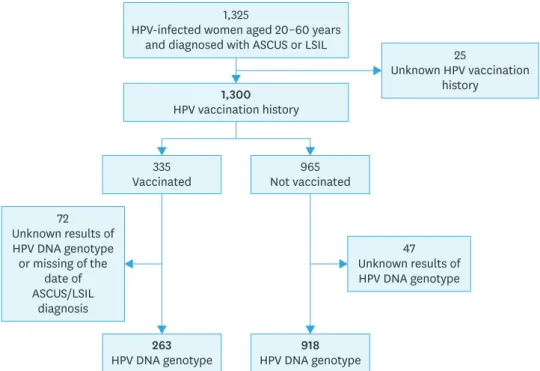
HPV cohort study registered subjects who satisfied the following inclusion criteria. First, the participants were Korean women aged 20–60 years with a DNA test positive for HPV regardless of HPV genotype, and second, HPV-infected women were diagnosed with atypical squamous cells of undetermined significance (ASCUS) or low-grade squamous intraepithelial lesion (LSIL) via a Papanicolaou (Pap) test [10]. From 2010 to 2016, out of 1,325 registered adult women in the cohort study, 1,300 women who responded to questions about their HPV vaccination history were selected as individuals for this study. To compare the prevalence of HPV genotypes by HPV vaccination, we collected data from 1,181 women by carrying out HPV genotyping after HPV vaccination (Fig. 1). Each of the 5 hospitals obtained approval from their Institutional Review Board (IRB) to participate in the HPV cohort study. In addition, we obtained approval from the IRB of the Korea Centers for Disease Control and Prevention for this study (No. 2015-05-EXP-05-P-A).
2. Laboratory methods
For cervical cytology, laboratories at each of the five participating hospitals screened liquid- based Pap smears using Cervex-Brush (Rovers Medical Devices, Oss, The Netherlands) of all subjects enrolled in this cohort study. HPV genotyping was conducted using the DNA microarray technique (DNA chip), which is based on the polymerase chain reaction (PCR) method. Briefly, after amplification, PCR products were analyzed by electrophoresis and hybridized with radiolabeled generic probes specific to HPV [10].
3. Analysis
The study individuals were divided into vaccination and non-vaccination groups. This was based on baseline data from standardized case report forms at the time of cohort registration in each of the 5 hospitals. The cohort study staff interviewed subjects or reviewed their
Not vaccinated965 Vaccinated335
HPV DNA genotype918 HPV DNA genotype263
1,300 HPV vaccination history
1,325
HPV-infected women aged 20–60 years and diagnosed with ASCUS or LSIL
Unknown HPV vaccination25 history
Unknown results of47 HPV DNA genotype Unknown results of72
HPV DNA genotype or missing of the
date of ASCUS/LSIL
diagnosis
Fig. 1. Flow chart of study design of the status of HPV vaccination among HPV-infected adults women in Korea.
ASCUS, atypical squamous cells of undetermined significance; HPV, human papillomavirus; LSIL, low-grade squamous intraepithelial lesion.
medical chart for vaccination history (vaccine type, vaccine doses, and vaccine date). Women who received at least one dose of HPV vaccine (Gardasil or Cervarix) were classified as being in the vaccination group. Subject characteristics were analyzed by age (20–29, 30–39, 40–49, 50–60 years) at ASCUS or LSIL diagnosis by Pap test, marriage status (married or unmarried), education level (middle school or lower, high school, university, graduate school or higher), monthly income level (<$3,000, $3,000–4,999, $5,000–6,999, ≥$7,000), occupation (housewives, administrator or expert, service or salesman, others), smoking status (non- smoker, ex-smoker, current smoker), alcohol drinking status (non-drinker, ex-drinker, current drinker), the number of sexual partners in the last year (none, 1 person, 2–3 persons,
≥4 persons), family history of cervical cancer (no, yes), and Pap test results (ASCUS, LSIL).
HPV genotype at baseline was classified as HPV-16/18 (vaccine-targeted HPV genotypes).
Logistic regression analysis was used to analyze the association between the status of vaccination by epidemiological variables with the odds ratio (OR) and 95% confidence interval (CI). For vaccination groups, we analyzed vaccine type, age at vaccine initiation (recommended age; ≤25 years old for Cervarix, ≤26 years old for Gardasil), the period from vaccination to ASCUS or LSIL diagnosis by Pap test (1–12 months, >12 months), Pap result (ASCUS, LSIL), and HPV genotype (HPV-16/18, other genotypes) by HPV vaccine doses (1–3) using the Cochran-Armitage test for trends.
We analyzed the prevalence of the HPV-16/18 genotype, which was the common HPV
genotype targeted by both vaccines: Gardasil, a quadrivalent vaccine, and Cervarix, a bivalent vaccine. HPV-16/18 genotype prevalence was defined as the proportion of cases with at least one genotype (HPV 16 or HPV 18) among individuals. To estimate the prevalence of HPV-16/18 according to the period post HPV vaccination prior to ASCUS or LSIL diagnosis, we performed multiple logistic regression analysis by employing a model adjusted for demographic variables. The p-values of <0.05 were regarded as statistically significant. All statistical analyses were conducted using SAS 9.4 (SAS Institute Inc., Cary, NC, USA).
RESULTS
1. Characteristics of HPV vaccination in Korean adult women with HPV Among 1,300 Korean adult women with HPV diagnosed ASCUS or LSIL, 25.8% were vaccinated against HPV. The proportion of subjects with HPV vaccination according to demographic variables was significantly different depending on age at ASCUS or LSIL diagnosis, marital status, and education level. The proportion of women who were vaccinated against HPV was higher among younger participants; 53.8%, 36.0%, 14.1%, and 3.6% were vaccinated among women in their 20's, 30's, 40's, and 50's, respectively.
Compared to the proportion of HPV vaccinated individuals among women aged 50–60 years, women in their 20's were 11.01 times more likely to be vaccinated (95% CI=5.05–
23.98), 7.69 times more likely in their 30's (95% CI=3.70–15.97), and 3.14 times more likely in their 40's (95% CI=1.50–6.57). For marital status, 45% of the unmarried women were more likely to be vaccinated than the vaccinated proportion of the married women (adjusted odds ratio [aOR]=2.08; 95% CI=1.51–2.88). There was a higher likelihood of vaccination among those who had a higher education level; compared with those with a middle school education (2.3%; Table 1), individuals with a high school education (vaccinated proportion 15.0%, aOR=3.50; 95% CI=1.04–11.79), university (35.2%, aOR=5.65; 95% CI=1.69–18.86), and graduated school or higher (34.3%, aOR=7.14; 95% CI=2.01–25.42) were more likely to be vaccinated.
Among the 335 vaccinated women, 68% and 32% were vaccinated using Gardasil and Cervarix, respectively. Of these, 20.3% were vaccinated with one dose, 16.4% with 2 doses, and 63.3% with three doses.
There were no significant differences according to vaccine dose in the vaccination group when comparing vaccine types and clinical diagnosis results (PAP result; ASCUS, LSIL).
Table 1. Epidemiological characteristics of HPV-infected adult women according to HPV vaccination in Korea
Category Overall Vaccinated OR (95% CI) aOR (95% CI)
Total 1,300 335 (25.8)
Age (Pap)*
20–29 236 (18.2) 127 (53.8) 31.56 (15.49–64.43) 11.01 (5.05–23.98)
30–39 386 (29.7) 139 (36.0) 15.26 (7.60–30.63) 7.69 (3.70–15.97)
40–49 425 (32.7) 60 (14.1) 4.46 (2.17–9.15) 3.14 (1.50–6.57)
50–60 253 (19.5) 9 (3.6) Ref Ref
Marital status*
Married 863 (66.4) 139 (16.1) Ref Ref
Unmarried 436 (33.6) 196 (45.0) 4.25 (3.27–5.53) 2.08 (1.51–2.88)
Education
≤Middle school 129 (9.9) 3 (2.3) Ref Ref
High school 393 (30.2) 59 (15.0) 7.46 (2.28–24.09) 3.50 (1.04–11.79) University 679 (52.2) 239 (35.2) 22.81 (7.18–72.46) 5.65 (1.69–18.86)
≥Graduate school 99 (7.6) 34 (34.3) 21.97 (6.50–74.25) 7.14 (2.01–25.42) Income per month, KRW*,†
<3,000,000 385 (31.6) 99 (25.7) Ref Ref
3,000,000–4,999,999 378 (31.0) 86 (22.8) 0.85 (0.61–1.19) 0.96 (0.66–1.41) 5,000,000–6,999,999 222 (18.2) 61 (27.5) 1.10 (0.75–1.59) 1.12 (0.72–1.72)
≥7,000,000 234 (19.2) 59 (25.2) 0.97 (0.67–1.42) 1.16 (0.75–1.82)
Job
Housewives 417 (32.1) 66 (15.8) Ref Ref
Administrator, expert 534 (41.1) 187 (35.0) 2.87 (2.09–3.94) 0.90 (0.60–1.28) Service, salesman 226 (17.4) 47 (20.8) 1.40 (0.92–2.12) 0.66 (0.40–1.08)
Others 123 (9.5) 35 (28.5) 2.12 (1.32–3.39) 0.99 (0.55–1.77)
Smoking
Non-smoker 1,111 (85.5) 266 (23.9) Ref Ref
Ex-smoker 75 (5.8) 27 (36.0) 1.85 (1.24–2.78) 0.93 (0.60–1.45)
Current smoker 114 (8.8) 42 (36.8) 1.79 (1.09–2.92) 1.12 (0.66–1.92) Alcohol*
Non-drinker 313 (24.1) 48 (15.3) Ref Ref
Ex-drinker 84 (6.5) 23 (27.4) 2.27 (1.62–3.19) 1.16 (0.79–1.69)
Current drinker 902 (69.4) 263 (29.2) 2.08 (1.18–3.68) 1.13 (0.61–2.12) No. sexual partners (recent 1 yr)*
0 137 (10.6) 39 (28.5) Ref Ref
1 1,043 (81.0) 250 (24.0) 0.79 (0.53–1.18) 1.05 (0.67–1.67)
2–3 104 (8.1) 39 (37.5) 1.51 (0.88–2.60) 1.34 (0.73–2.48)
≥4 4 (0.3) 3 (75.0) 7.53 (0.76–74.60) 5.04 (0.37–69.13)
Family history of cervical cancer
No 1,226 (94.3) 312 (25.4) Ref Ref
Yes 74 (5.7) 23 (31.1) 1.32 (0.79–2.20) 1.22 (0.92–1.61)
Papanicolaou test
ASCUS 730 (56.2) 162 (22.2) Ref Ref
LSIL 570 (43.8) 173 (30.4) 1.53 (1.19–1.96) 1.21 (0.92–1.60)
HPV genotype*
HPV-16/18 216 (17.4) 53 (24.5) 0.89 (0.64–1.26) 0.81 (0.55–1.17)
Other type 1,028 (82.6) 273 (26.6) Ref Ref
Data shown are number (%) not otherwise specified. Age (Pap): age at ASCUS or LSIL diagnosis by a Papanicolaou test.
aOR, adjusted odds ratio; ASCUS, atypical squamous cells of undetermined significance; CI, confidence interval;
HPV, human papillomavirus; KRW, Korean Won; LSIL, low-grade squamous intraepithelial lesion; OR, odds ratio.
*Missing value were excluded in the analysis; †The currency exchange rate of 1 KRW to U.S. Dollar (USD) was approximately 0.0008 (1,000,000 KRW=845.3 USD).
For HPV-vaccinated individuals by vaccine dose, there was a significant younger age at vaccination initiation (p=0.025). For the duration of vaccination, 72% of 156 individuals with more than 12 months from vaccine initiation were vaccinated with three doses; they were more likely to be vaccinated within 12 months less or equal duration from vaccination (p=0.001). The proportion of HPV-16/18 among individuals with three doses was lower than that of other HPV genotypes (p=0.028; Table 2).
2. The prevalence of HPV-16/18 genotypes by HPV vaccination
Of the 1,300 study subjects, both the results and date of HPV genotyping were acquired for 263 vaccinated and 918 unvaccinated women. For vaccinated women, the median time from HPV vaccination to ASCUS or LSIL diagnosis was 11.45 months (1.30–26.55; interquartile Q1–Q3 range).
The overall prevalence of HPV-16/18 among 1,181 individuals was 17.0% (19.2% with ASCUS; 13.9%
with LSIL). Using unvaccinated women as the control group, after adjusting for age at the time Pap test and HPV vaccine doses, we performed a comparison to analyze the prevalence of HPV-16/18 by post vaccination period. For at least 12 months after HPV vaccination, the prevalence of the HPV-16/18 genotypes in the vaccinated group was 11.0%, which was significantly lower than the prevalence for the unvaccinated group (adjusted prevalence ratio [aPR]=0.51; 95% CI=0.29–0.88).
Particularly, for LSIL patients, the prevalence of HPV-16/18 genotypes at least 12 months post vaccination was 7.3%, which was significantly lower than the prevalence for unvaccinated patients (aPR=0.35; 95% CI=0.13–0.96). Vaccinated women with ASCUS did not show a significantly lower prevalence for HPV-16/18 genotypes than unvaccinated women (Table 3).
DISCUSSION
Our findings revealed the status of HPV vaccination among Korean adult women with HPV (aged 20–60 years) before the introduction of NIP in 2016. This is the first study to analyze the overall vaccination status among HPV-infected Korean adult women with ASCUS or LSIL.
In this study, the proportion of HPV-infected adult women who received a HPV vaccination was approximately 26%. In a previous study on Korea's National Immunization Survey in Table 2. Status of HPV vaccination among HPV-infected adult women by vaccine dose in Korea
Category Overall HPV vaccine dose p-value
1 dose 2 doses 3 doses
Total 335 68 (20.3) 55 (16.4) 212 (63.3)
Vaccine type* 0.184
Cervarix 99 (32.0) 23 (23.2) 17 (17.2) 59 (59.6)
Gardasil 210 (68.0) 40 (19.0) 35 (16.7) 135 (64.3)
Age at vaccination initiation*,† 0.025
≤Recommended age 75 (25.2) 15 (20.0) 5 (6.7) 55 (73.3)
>Recommend age 223 (74.8) 45 (20.2) 44 (19.7) 134 (60.1)
Duration of vaccination*,‡ 0.001
1–12 months 111 (41.6) 20 (18.0) 35 (31.5) 56 (50.5)
>12 months 156 (58.4) 7 (4.5) 5 (12.5) 144 (72.0)
Papanicolaou test 0.466
ASCUS 162 (48.4) 34 (21.0) 25 (15.4) 103 (63.6)
LSIL 173 (51.6) 34 (19.7) 30 (17.3) 109 (63.0)
HPV genotype* 0.028
HPV-16/18 53 (26.3) 15 (28.3) 10 (18.9) 28 (52.8)
Other type 273 (83.7) 51 (18.7) 41 (15.0) 181 (66.3)
ASCUS, atypical squamous cells of undetermined significance; HPV, human papillomavirus; LSIL, low-grade squamous intraepithelial lesion.
*Missing value were excluded in the analysis; †Recommended age: ≤25 years old for Cervarix, ≤26 years old for Gardasil; ‡The length of the period from date of HPV vaccination to date of PAP test.
2013, it was revealed that overall, 12.6% of individuals aged 19–59 years were vaccinated.
The HPV vaccination status varied with age; 28.7%, 15.9%, and 4.6% individuals were found to be vaccinated in the age groups of 19–26 years, 27–39 years, and 40–59 years, respectively [11]. Compared with the results of this study, we noted that HPV-infected women were more likely to be vaccinated compared to the general population. In this study, the proportion of women aged 20–29 years who received HPV vaccination was 55%. Younger women with higher education levels were more likely to be vaccinated. HPV vaccination was related to higher education in adult Korean women. This could explain by the fact that higher educated women could be better informed regarding HPV vaccination [12]. The HPV vaccination proportion did not differ according to other epidemiological factors, except for age, marital status, and education level. In addition, we found that less than 30% of women who had none to one sexual partner in the last year were vaccinated, whereas 37.5%
of women who had 2–3 sexual partners and 75% of the women with ≥4 sexual partners in the last year were vaccinated. This could predict its use as a preventive measure against exposure to HPV infection. However, there was no statistically significant difference in the proportion of vaccinations as few subjects had >1 sexual partners in the last year. The price of 3 vaccine doses for Cervarix or Gardasil was about 500 dollars in Korea. Although both vaccines investigated in this study are expensive and their costs were not covered by Korean health insurance, we did not find any significant difference between the monthly income of vaccinated and non-vaccinated participants.
In Korea, although Gardasil and Cervarix have been in circulation in the market since 2007 and 2008, respectively, NIP has been conducted since mid-2016. In some countries that had initiated NIP earlier than Korea, including Australia, the UK, and the USA, the beneficial effects of these vaccines, such as reduction in HPV infections, genital warts, and cervical cancer lesions, have already been reported. Over 70% of the targeted individuals have been vaccinated, and consequently, the prevalence of vaccine-type HPV and genital warts (HPV-6 and -11) has been reduced by 86% and 93%, respectively [13]. Hence, HPV vaccine is generally administered before the age of sexual initiation, but HPV vaccination has also been recommended for adult women [14,15]. HPV vaccine is also known to be effective in preventing HPV persistence and cervical intraepithelial neoplasia (CIN) progression among adult women who were exposed to sexual activities [16,17]. In this study, the proportion of women vaccinated according to age recommendations (Cervarix: aged 9–25; Gardasil: aged Table 3. The prevalence of HPV-16/18 among HPV-infected adult women with abnormal cervical cytology by the vaccination period
Vaccination period Overall N HPV-16/18
No. (%)* PR (95% CI) aPR (95% CI)
ASCUS+LSIL 1,181 201 (17.0)
Not vaccinated 918 163 (17.8) Ref Ref
1–12 months 109 21 (19.3) 1.09 (0.72–1.63) 1.07 (0.55–2.08)
>12 months 154 17 (11.0) 0.62 (0.39–0.99) 0.51 (0.29–0.88)
ASCUS 686 132 (19.2)
Not vaccinated 552 109 (19.8) Ref Ref
1–12 months 55 11 (20.0) 1.01 (0.58–1.76) 1.14 (0.47–2.77)
>12 months 79 12 (15.2) 0.77 (0.45–1.33) 0.64 (0.32–1.26)
LSIL 495 69 (13.9)
Not vaccinated 366 54 (14.8) Ref Ref
1–12 months 54 10 (18.5) 1.26 (0.68–2.31) 0.98 (0.35–2.78)
>12 months 75 5 (7.3) 0.45 (0.19–1.09) 0.35 (0.13–0.96)
aPR, adjusted prevalence ratio ASCUS, atypical squamous cells of undetermined significance; CI, confidence interval; HPV, human papillomavirus; LSIL, low-grade squamous intraepithelial lesion; PR, prevalence ratio.
*Prevalence of HPV-16/18 genotypes.
9–26) was 25.2%, and their prevalence of HPV-16/18 was 18.5%, which was not significantly different in the prevalence of HPV-16/18 both among vaccinated women over age 26 (16.1%) and non-vaccinated women (17.8%).
The duration of HPV antibody response is critical for prevention of HPV infection.
Immunogenicity is highly dependent on the number and timing of vaccine doses. According to several reports, antibody responses to each type were heterogeneous: seroconversion for HPV-16 occurred most frequently between 6 and 12 months and HPV-18 occurred at 12.6 months [18]. Based on these reports, to investigate the prevalence of vaccine targeted HPV genotypes based on vaccination history at the time of ASCUS or LSIL diagnosis, we analyzed the prevalence of HPV-16/18 genotypes according to the common HPV genotypes targeted by HPV vaccines. Consequently, we found that for at least 12 months after HPV vaccination, the prevalence of HPV-16/18 in adult women diagnosed with LSIL was significantly lower. ASCUS or LSIL stage before CIN1 is less associated with cervical cancer than CIN, and the prevalence of HPV-16/18 on ASCUS or LSIL stage is reduced compared with CIN 2+ [9,19]. According to previous study, vaccine-related genetic patterns (HPV-16/18) are reduced after 24 months in CIN 2+ adult female patients in the USA [20]. Similarly, we found that women diagnosed with LSIL at the stage of progression before CIN 2+ were downed in the prevalence of HPV-16/18 after 12 months from HPV vaccination.
This study has some limitations. Researchers enquired about vaccination history (the type of vaccine; number of vaccinations; and timing of the vaccination), which may have been subject to recall bias. We did not obtain the results of HPV genotypes or Pap test at the time of HPV vaccination; therefore, we do not know the change of vaccine-targeted HPV genotype after vaccination. Another limitation is that our study lacks a sufficient sample size; if a larger sample had been available, then our study could have potentially revealed more significant characteristic of HPV vaccination. However, since our data were analyzed at the start of NIP in mid-2016, we believe it is meaningful to identify the status and characteristics of HPV vaccination of Korean adult women with HPV.
Korea has strengthened its policy for preventing cervical cancer by conducting NIP for girls aged 12 years and providing cervical cancer testing for women aged ≥20 years. The results of our study will be important for confirming vaccination status before the introduction of NIP and can subsequently be used for making future policies related to HPV vaccination in Korea. To evaluate the effectiveness of these preventive projects, HPV infection status and the cervical cancer development rate among NIP recipients should be frequently monitored in this population. Studies involving the examination of populations who were not subjected to NIP, and patients with HSILs, CIN 2+, or other conditions, are warranted.
ACKNOWLEDGMENTS
The authors are grateful to the researchers from the following institutions who participated in the Korea HPV cohort study: The Catholic University of Korea (Soo Young Huh, Yoon Kyung Lee, Yoon Jin Choi and Hyun O Han); Dankook University College of Medicine (Chang Sun Hwang, Ki Hun Lee, Kyung Taek Im, In-Ho Lee, Kyeong A So, Mi Kyung Kim, Yoo Kyung Lee); Keimyung University Dongsan Medical Center (Sang Hun Kwon and So Jin Shin); Inje University College of Medicine (Jung Mi Byun and Dae Hoon Jung); Korea University Guro Hospital (Jae Gwan Lee and Jin Hwa Hong).
REFERENCES
1. de Martel C, Plummer M, Vignat J, Franceschi S. Worldwide burden of cancer attributable to HPV by site, country and HPV type. Int J Cancer 2017;141:664-70.
PUBMED | CROSSREF
2. Korea Central Cancer Registry; National Cancer Center. Annual report of cancer statistics in Korea in 2015, Ministry of Health and Welfare. Goyang: National Cancer Center; 2017.
3. Statistics Korea. Statistics of reasons for death, Statistics Korea [Internet]. Daejeon: Statistics Korea; c2018 [cited 2018 May 29]. Available from: http://kosis.kr/statHtml/statHtml.
do?orgId=101&tblId=DT_1B34E02&conn_path=I2.
4. Statistics Korea. National Health Insurance Corporation [Internet]. Daejeon: Statistics Korea; c2017 [cited 2018 Jun 1]. Available from: http://kosis.kr/statHtml/statHtml.do?orgId=350&tblId=TX_35001_
A061&conn_path=I2.
5. Lee EH, Um TH, Chi HS, Hong YJ, Cha YJ. Prevalence and distribution of human papillomavirus infection in Korean women as determined by restriction fragment mass polymorphism assay. J Korean Med Sci 2012;27:1091-7.
PUBMED | CROSSREF
6. World Health Organization. Human papillomavirus vaccines: WHO position paper, May 2017-Recommendations. Vaccine 2017;35:5753-5.
PUBMED | CROSSREF
7. Korea Centers for Disease Control and Prevention. Guidelines for the National Immunization Program [Internet]. Cheongju: Korea Centers for Disease Control and Prevention; c2009 [cited 2018 Aug 2].
Available from: http://nip.cdc.go.kr.
8. Schiller JT, Castellsagué X, Villa LL, Hildesheim A. An update of prophylactic human papillomavirus L1 virus-like particle vaccine clinical trial results. Vaccine 2008;26 Suppl 10:K53-61.
PUBMED | CROSSREF
9. Crow JM. HPV: The global burden. Nature 2012;488:S2-3.
PUBMED | CROSSREF
10. Lee WC, Lee SY, Koo YJ, Kim TJ, Hur SY, Hong SR, et al. Establishment of a Korea HPV cohort study. J Gynecol Oncol 2013;24:59-65.
PUBMED | CROSSREF
11. Korea Centers for Disease Control and Prevention. 2013 Korea National Immunization Survey. Cheongju:
Korea Centers for Disease Control and Prevention; 2013.
12. Leval A, Herweijer E, Ploner A, Eloranta S, Fridman Simard J, Dillner J, et al. Quadrivalent human papillomavirus vaccine effectiveness: a Swedish national cohort study. J Natl Cancer Inst 2013;105:469-74.
PUBMED | CROSSREF
13. Lee LY, Garland SM. Human papillomavirus vaccination: the population impact. F1000 Res 2017;6:866.
PUBMED | CROSSREF
14. Min KJ, Kwon SH, Kim S, Kim HJ, Seong SJ, Song YJ, et al. Preventive vaccination against cervical cancer:
Korean Society of Gynecologic Oncology Guideline. J Gynecol Oncol 2016;27:e30.
PUBMED | CROSSREF
15. Schwarz TF, Galaj A, Spaczynski M, Wysocki J, Kaufmann AM, Poncelet S, et al. Ten-year immune persistence and safety of the HPV-16/18 AS04-adjuvanted vaccine in females vaccinated at 15–55 years of age. Cancer Med 2017;6:2723-31.
PUBMED | CROSSREF
16. Muñoz N, Manalastas R Jr, Pitisuttithum P, Tresukosol D, Monsonego J, Ault K, et al. Safety, immunogenicity, and efficacy of quadrivalent human papillomavirus (types 6, 11, 16, 18) recombinant vaccine in women aged 24–45 years: a randomised, double-blind trial. Lancet 2009;373:1949-57.
PUBMED | CROSSREF
17. Castellsagué X, Muñoz N, Pitisuttithum P, Ferris D, Monsonego J, Ault K, et al. End-of-study safety, immunogenicity, and efficacy of quadrivalent HPV (types 6, 11, 16, 18) recombinant vaccine in adult women 24–45 years of age. Br J Cancer 2011;105:28-37.
PUBMED | CROSSREF
18. Carter JJ, Koutsky LA, Hughes JP, Lee SK, Kuypers J, Kiviat N, et al. Comparison of human papillomavirus types 16, 18, and 6 capsid antibody responses following incident infection. J Infect Dis 2000;181:1911-9.
PUBMED | CROSSREF
19. Lau S, Franco EL. Management of low-grade cervical lesions in young women. CMAJ 2005;173:771-4.
PUBMED | CROSSREF
20. Powell SE, Hariri S, Steinau M, Bauer HM, Bennett NM, Bloch KC, et al. Impact of human papillomavirus (HPV) vaccination on HPV 16/18-related prevalence in precancerous cervical lesions. Vaccine 2012;31:109-13.
PUBMED | CROSSREF