INTRODUCTION
Epithelial ovarian cancer (EOC) is still the leading cause of death among gynecologic malignancies because it is usually diagnosed in advanced-stage of the disease. Although EOCs are highly responsive to initial combination chemotherapy with taxane-carboplatin, successful management of advanced or recurrent gynecological malignancies is often difficult
because of resistance of cancer cells to cytotoxic drugs [1,2].
Therefore, new strategies that may be effective in improving survival and enhancing the response rate to chemotherapy are needed for these patients.
Accumulating epidemiological and translational studies sug- gest that selenium protects against the development of vari- ous cancers including prostate, colon, esophagus, lung, and stomach [3-6]. Especially, numerous case-control studies have demonstrated an inverse relationship between selenium sta- tus and prostate cancer risk [7-11]. A randomized controlled study of selenium as a chemopreventive agent demonstrated that supplementation of people with selenized yeast is capa- ble of reducing the overall cancer morbidity by nearly 50% [3].
Generally, selenium compounds fall into two categories, organic and inorganic forms. Organic selenium exists in the form of selenoproteins such as glutathione peroxidases and
The effects of selenium on tumor growth in epithelial ovarian carcinoma
Jin Sun Park*, Ji Yoon Ryu*, Hye-Kyung Jeon, Young Jae Cho, Young Ae Park, Jung-Joo Choi, Jeong-Won Lee, Byoung-Gie Kim, Duk-Soo Bae
Department of Obstetrics and Gynecology, Samsung Medical Center, Sungkyunkwan University School of Medicine, Seoul, Korea
Received Feb 7, 2012, Revised Apr 9, 2012, Accepted Apr 9, 2012
*Both authors contributed equally.
Correspondence to Jeong-Won Lee
Department of Obstetrics and Gynecology, Samsung Medical Center, Sungkyunkwan University School of Medicine, 81 Irwon-ro, Gangnam- gu, Seoul 135-710, Korea. Tel: 82-2-3410-1382, Fax: 82-2-3410-0630, E-mail:
Objective: Epidemiological studies suggest that selenium protects against the development of several cancers. Selenium (sodium selenite) has been reported to interfere with cell growth and proliferation, and to induce cell death. In this study, we tested whether selenium could have growth-inhibiting effect in ovarian cancer cells and an orthotopic animal model.
Methods: Cell growth in selenium-treated cells was determined in human ovarian cancer cells, A2780, HeyA8, and SKOV3ip1 using 3-(4,5-dimethylthiazol-2-yl)-2,5-diphenyltetrazoliumbromide (MTT) assay. Animal experiment of selenium with paclitaxel was performed using SKOV3ip1 cells in nude mice to evaluate their inhibiting effect for tumor growth. In addition, another animal experiment of paclitaxel with or without selenium was performed to assess the effect of survival and food intake in mice.
Results: The in vitro growth of selenium-treated cells was significantly decreased dose-dependently in A2780, HeyA8, and SKOV3ip1 cells. Therapy experiment in mice was started 1 week after injection of the SKOV3ip1 cells. Treatment with selenium (1.5 mg/kg, 3 times/week) and paclitaxel injection showed no addictive effect of the inhibition of tumor growth. However, combination of selenium and paclitaxel showed the slightly increased food intake compared with paclitaxel alone.
Conclusion: Although selenium has growth-inhibiting effect in ovarian carcinoma cells in vitro, there is no additive effect on tumor growth in mice treated with combination of paclitaxel and selenium. However, food intake is slightly higher in selenium- treated mice during chemotherapy.
Keywords: Cell survival, Ovarian carcinoma, Sodium selenite, Tumor growth
thioredoxin reductases [12] which regulate cellular redox balance, and together with several low-molecular weight se- lenium compounds have been shown to play an important role in protection of mammalian cells against various forms of environmental stress as well as against tumor development [13]. Sodium selenite is a major inorganic form of selenium which is often used in chemopreventive studies [14]. Several studies have shown that sodium selenite inhibits growth of cancer cell lines including prostate and liver cancer, malignant melanoma or various hematologic malignancies via induc- ing apoptosis via different mechanisms involving oxidative stress, mitogen-activated protein kinases, p53-dependent signaling and mitochondria [15-18]. Although there is some evidence for selective selenium toxicity to cancer cells, there is relatively few data on specific effects cytotoxic of selenium and as a supportive element during chemotherapy in EOC. In this study, we tried to evaluate the in vitro and in vivo effect of inorganic selenium (sodium selenite) on tumor growth and food intake in EOC using an animal model.
MATERIALS AND METHODS 1. Chemical and cell culture
Sodium selenite was obtained from Sigma-Aldrich Inc. (St.
Louis, MO, USA). Human EOC cell lines (HeyA8, A2780, and SKOV3ip1) were obtained from the American Type Culture Collection (ATCC, Manassas, VA, USA). All of ovarian cancer cells were maintained in RPMI 1640 supplemented with 10%
fetal bovine serum (FBS) and 0.1% gentamicin sulfate (Gemini Bioproducts, Calabasas, CA, USA) in 5% CO2 at 37oC.
2. Cell proliferation assay
Cells were plated in culture medium in a 96-well plate at 3×10³ cells/well. After 24 hours, cells were treated to the sodium selenite and the assay was performed at 48 hours and 72 hours. For proliferation assays, cells were stained with 3-(4,5-Dimethylthiazol-2-yl)-2,5-diphenyltetrazolium bromide MTT (Amresco, Solon, OH, USA), after 4 hours of additional incubation, the medium was discarded, 100 µL of acidic iso- propanol (0.1 N HCL in absolute sopropanol) was added, and the plate was shaken gently. Absorbance was measured on an enzyme linked immunosorbent assay (ELISA) reader at a test wavelength of 540 nm.
3. Apoptosis assay
The relative percentage of apoptotic cells was assessed at 24 hours using the Annexin V-FITC apoptosis Detection Kit- 1 (BD Pharmingen, San Diego, CA, USA) according to the
manufacturer's protocol. Briefly, SKOV3ip1 cells were washed twice in phosphate buffered saline (PBS), and the pellet was resuspended in annexin V binding buffer at a concentration of 106 cells/mL. Annexin V FITC and propidium iodide (PI) were added (5 µL to each per 105 cells). Samples were mixed gen- tly and incubated for 15 minutes at room temperature in the dark before fluorescence activated cell sorter (FACS) analysis.
4. Animals and in vivo treatment
Female BALB/c nude mice were purchased from Orient Bio (Seongnam, Korea). This study was reviewed and approved by the Institutional Animal Care and Use Committee (IACUC) of the Samsung Biomedical Research Institute (SBRI). SBRI is an Association for Assessment and Accreditation of Laboratory Animal Care International (AAALAC International, protocol No. H-A9-003) accredited facility and abides by the Institute of Laboratory Animal Resources (ILAR) guide. To generate tumors, SKOV3ip1 (1.0×10⁶ cells/0.2 mL HBSS) were injected into the peritoneal cavity of BALB/c nude mice [19,20], that were 8 to 12 weeks old. Paclitaxel (100 µg) or PBS was injected i.p. once weekly; sodium selenite (1.5 mg/kg) was injected 3 times weekly i.p. in 200 µL volume [21]. Mice (n=10 per group) were monitored for adverse effects, and tumors were harvest- ed after 4 weeks of therapy or when any of the mice began to appear moribund. Mice (n=10 per group) were monitored daily for tumor development and postoperative complica- tions and were sacrificed on days 35 to 40, or if mice seemed moribund. Total body weight, tumor weight, tumor incidence, and the number of tumor nodules were recorded. To assess the effect of survival and food intake in mice, we performed separate animal experiments and measured the oral intake for every week until death.
5. Statistical analysis
Continuous variables were compared with the Student’s t-test or ANOVA if normally distributed and the Mann-Whit- ney rank sum test if distributions were nonparametric using GraphPad Prism 4 for Windows ver. 4.0 (GraphPad Software Inc., La Jolla, CA, USA). A p<0.05 was considered statistically significant.
RESULTS
1. Selenium inhibits cell survival of ovarian cancer cells in vitro
Ovarian cancer cells were treated with sodium selenite for 48 hours and 72 hours. Selenium significantly inhibited cell survival in A2780, HeyA8, and SKOV3ip1 ovarian cancer cells
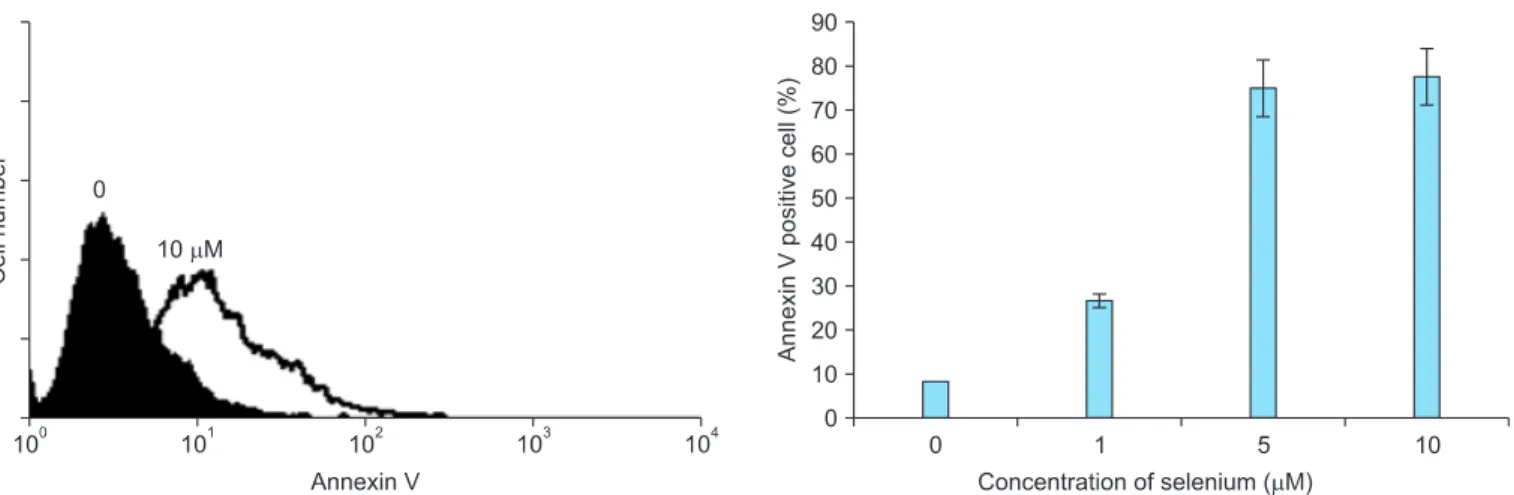
with a dose-dependent manner (Fig. 1). All cells types showed inhibited cell survival over 50% when treated with more than 5 µM of selenium. Moreover, we assessed the effect on apop- tosis of selenium using the SKOV3ip1 cell. Apoptosis was sig- nificantly increased in these cells dose-dependently by adding selenium (Fig. 2).
2. Selenium does not have addictive effect with paclitaxel in inhibiting tumor growth of SKOV3ip1 animal model The SKOV3ip1 ovarian cancer cells were implanted into the peritoneal cavity of nude mice for experiments designed to test the therapeutic potential of selenium administration.
From seven days after cell injection, therapy was started ac-
Fig. 1. Effect of sodium selenite on cell growth in ovarian cancers. Several ovarian cancer cells were treated with sodium selenite for 48 hours and 72 hours, cell proliferation analysis was performed by MTT assay. *p<0.01, compared with un-treated control; †p<0.01, compared with 1 µM of selenium.
cording to the four treatment groups; control, paclitaxel, selenium and co-treatment of paclitaxel and selenium. The animals were sacrificed after 4 weeks of therapy and a nec- ropsy was done. The data for the effects of these therapies are summarized in Fig. 3. Selenium alone was not effective in inhibiting tumor growth compared with controls treated with PBS. Treatment with paclitaxel alone or paclitaxel plus selenium was effective in inhibiting tumor growth compared with controls. However, there was no significant difference between paclitaxel alone and paclitaxel plus selenium groups.
This result suggests that adding selenium into tumor bearing mice did not seem to have an addictive effect in inhibiting tu-
mor growth. Daily monitoring of the animals throughout the course of therapy showed acceptable tolerability with no un- toward side effects, such as changes in body weight, mobility, posture, and feeding habits between all groups.
3. Selenium supplementation exhibited slightly increased food oral intake during paclitaxel chemotherapy To evaluate the effect of selenium as a supportive element during the chemotherapy in EOC, we checked the survival, food and water intake of mice receiving paclitaxel with or without selenium supplementation. Survival and water intake of both groups did not show significant difference accord- Fig. 2. Effect of sodium selenite on apoptosis in SKOV3ip1 cells. The relative percentage of apoptotic cells was assessed at 24 hours after adding sodium selenite using the Annexin V-FITC apoptosis kit.
Fig. 3. Selenium does not have addictive effect with paclitaxel in inhibiting tumor growth and nodules of SKOV3ip1 animal model. To generate tumors, SKOV3ip1 cells were injected into the peritoneal cavity of BALB/c nude mice. Paclitaxel (PTX, 100 µg) or phosphate buffered saline (PBS) was injected i.p. once weekly; sodium selenite (Selenium, 1.5 mg/kg) was injected 3 times weekly i.p. in 200 µL volume. Mice (n=10 per group) were monitored for adverse effects, and tumors were harvested after 4 weeks of therapy or when any of the mice began to appear moribund.
*p<0.01.
ing to selenium supplementation. However, we found that the mean food intake was slightly increased in the selenium- treated group, especially 5 to 7weeks after cell injection (Fig. 4).
DISCUSSION
In this study, we found that selenium treatment significantly decreased cell survival in a dose-dependent manner in A2780, HeyA8, and SKOV3ip1 ovarian cancer cells. However, adding selenium into tumor bearing mice did not seem to have an addictive effect in inhibiting tumor growth in the SKOV3ip1 ovarian cancer model. In addition, the combination of sele- nium and paclitaxel showed slightly increased food intake compared with paclitaxel alone.
The anti-cancer mechanisms of selenium are still not fully understood. Several mechanisms have been proposed, which include maintenance of glutathione peroxidase activity to protect against oxidative damage, detoxification of intermedi- ate metabolites of chemical carcinogens, stimulation of the immune system, induction of cell cycle arrest and apoptosis, and inhibition of angiogenesis [13,22-24]. Selenium has been shown to have potent anti-proliferative and cytotoxic prop- erties and several in vitro studies carried on different cancer cell lines further demonstrated its ability to induce apoptosis in target cells, mostly via increased oxidative stress and DNA damaging [25,26]. In colon cancer cells, selenium inhibits the growth and proliferation in a time- and dose-dependent man- ner, and selenite-induced toxicity may be related to p53 and
dependent signaling [27]. Studies have shown that selenium induced prostate cancer cell apoptosis and cell cycle arrest, processes that have been postulated to be critical for cancer chemoprevention by selenium [28-30].
Several studies have showed the in vivo effects of selenium as therapy to treat mice bearing human cancers. Cao et al. [31]
reported that selenium is a highly effective modulator of the therapeutic efficacy and selectivity of anticancer drugs in nude mice bearing human tumor xenografts of colon carcinoma and squamous cell carcinoma of the head and neck. Corcoran et al. [32] reported that high dose dietary supplementation of inorganic selenium inhibits the progression of hormone refractory prostate cancer, which is due at least in part to a de- crease in angiogenesis. In addition, selenite treatment inhibits tumor volume by 58% after 42 days of treatment [33] in a xenograft model of human prostate cancer. Moreover, Cafrey and Frenkel [21] reported that when either selenite or seleno- methionine were administered close to the time of the initial cisplatin treatment, the induction of resistance was prevented in human ovarian tumors in vivo. They suggested that sele- nium compounds can prevent the induction by cisplatin of drug resistance [21]. However, this study did not show any ad- dictive in vivo effects of selenium for inhibiting tumor growth.
We could not suggest exactly the possible explanation for the disparity of this study between the in vitro and in vivo results, but our results that used a partially immunodeficient model suggest other mechanisms by which selenium can modulate the tumor microenvironment. Further experiments with other chemotherapeutic agent rather than paclitaxel or use of or- ganic selenium should be required to confirm this result.
There have been several few clinical trials investigating the effect of selenium supplementation during cancer chemo- therapy. Forty-one patients with solid tumors undergoing cis- platin chemotherapy were randomized into two groups, and the group that received selenium showed significantly higher WBC counts on day 14 after initiation of chemotherapy [34].
Furthermore, consumption of granulocyte colony-stimulating factor and volumes of blood transfusion were significantly less in the selenium-supplemented group. An ovarian cancer study was done with 62 women undergoing cisplatin and cy- clophosphamide combination chemotherapy and half of the patients received selenium supplementation [35]. The group that received selenium showed significantly reduced neutro- penia as well as increased WBCs from the second to third che- motherapy cycle. The authors also report that with selenium supplementation, there seemed to be a significant decrease in all cited side effects: nausea, vomiting, hair loss, etc. In this study, we found slightly increased food intake in selenium- treated mice during the chemotherapy. Further evaluation Fig. 4. Selenium supplementation exhibited slightly increased food
intake during chemotherapy. Food intake was measured for every week until to death during chemotherapy. Paclitaxel (100 µg) was injected i.p. once weekly; sodium selenite (1.5 mg/kg) was injected 3 times weekly i.p. in 200 µL volume using SKOV3ip1 models.
could be needed to identify these effects in human trial.
In conclusion, we found that selenium treatment significant- ly decreased cell survival in a dose-dependent manner in sev- eral ovarian cancer cells. However, adding selenium into tu- mor bearing mice did not seem to have any addictive effect in inhibiting tumor growth in SKOV3ip1 ovarian cancer model. In addition, the combination of selenium and paclitaxel showed slightly increased food intake compared with paclitaxel alone.
CONFLICT OF INTEREST
No potential conflict of interest relevant to this article was reported.
ACKNOWLEDGMENTS
This study was supported by a grant from the Korea Health- care Technology R&D Project, Ministry for Health & Welfare Affairs, Republic of Korea (A092255).
REFERENCES
1. Landen CN Jr, Birrer MJ, Sood AK. Early events in the pathogenesis of epithelial ovarian cancer. J Clin Oncol 2008;26:995-1005.
2. Ozols RF, Bookman MA, Connolly DC, Daly MB, Godwin AK, Schilder RJ, et al. Focus on epithelial ovarian cancer.
Cancer Cell 2004;5:19-24.
3. Clark LC, Combs GF Jr, Turnbull BW, Slate EH, Chalker DK, Chow J, et al. Effects of selenium supplementation for cancer prevention in patients with carcinoma of the skin:
a randomized controlled trial. Nutritional Prevention of Cancer Study Group. JAMA 1996;276:1957-63.
4. Mannisto S, Alfthan G, Virtanen M, Kataja V, Uusitupa M, Pietinen P. Toenail selenium and breast cancer-a case- control study in Finland. Eur J Clin Nutr 2000;54:98-103.
5. Garland M, Morris JS, Stampfer MJ, Colditz GA, Spate VL, Baskett CK, et al. Prospective study of toenail selenium levels and cancer among women. J Natl Cancer Inst 1995;87:497-505.
6. Wei WQ, Abnet CC, Qiao YL, Dawsey SM, Dong ZW, Sun XD, et al. Prospective study of serum selenium concentrations and esophageal and gastric cardia cancer, heart disease, stroke, and total death. Am J Clin Nutr 2004;79:80-5.
7. Brooks JD, Metter EJ, Chan DW, Sokoll LJ, Landis P,
Nelson WG, et al. Plasma selenium level before diagnosis and the risk of prostate cancer development. J Urol 2001;166:2034-8.
8. Helzlsouer KJ, Huang HY, Alberg AJ, Hoffman S, Burke A, Norkus EP, et al. Association between alpha-tocopherol, gamma-tocopherol, selenium, and subsequent prostate cancer. J Natl Cancer Inst 2000;92:2018-23.
9. Li H, Stampfer MJ, Giovannucci EL, Morris JS, Willett WC, Gaziano JM, et al. A prospective study of plasma selenium levels and prostate cancer risk. J Natl Cancer Inst 2004;96:696-703.
10. Nomura AM, Lee J, Stemmermann GN, Combs GF Jr.
Serum selenium and subsequent risk of prostate cancer.
Cancer Epidemiol Biomarkers Prev 2000;9:883-7.
11. Yoshizawa K, Willett WC, Morris SJ, Stampfer MJ, Spiegelman D, Rimm EB, et al. Study of prediagnostic selenium level in toenails and the risk of advanced prostate cancer. J Natl Cancer Inst 1998;90:1219-24.
12. Papp LV, Lu J, Holmgren A, Khanna KK. From selenium to selenoproteins: synthesis, identity, and their role in human health. Antioxid Redox Signal 2007;9:775-806.
13. Ganther HE. Selenium metabolism, selenoproteins and mechanisms of cancer prevention: complexities with thioredoxin reductase. Carcinogenesis 1999;20:1657-66.
14. Drake EN. Cancer chemoprevention: selenium as a pro- oxidant, not an antioxidant. Med Hypotheses 2006;67:
318-22.
15. Chen T, Wong YS, Zheng W, Bai Y, Huang L. Selenium nanoparticles fabricated in Undaria pinnatifida poly- saccharide solutions induce mitochondria-mediated apoptosis in A375 human melanoma cells. Colloids Surf B Biointerfaces 2008;67:26-31.
16. Dong H, Ying T, Li T, Cao T, Wang J, Yuan J, et al. Com para- tive proteomic analysis of apoptosis induced by sodium selenite in human acute promyelocytic leukemia NB4 cells. J Cell Biochem 2006;98:1495-506.
17. Jiang C, Hu H, Malewicz B, Wang Z, Lu J. Selenite-induced p53 Ser-15 phosphorylation and caspase-mediated apoptosis in LNCaP human prostate cancer cells. Mol Cancer Ther 2004;3:877-84.
18. Kim YS, Jhon DY, Lee KY. Involvement of ROS and JNK1 in selenite-induced apoptosis in Chang liver cells. Exp Mol Med 2004;36:157-64.
19. Lee JW, Shahzad MM, Lin YG, Armaiz-Pena G, Mangala LS, Han HD, et al. Surgical stress promotes tumor growth in ovarian carcinoma. Clin Cancer Res 2009;15:2695-702.
20. Lee JW, Han HD, Shahzad MM, Kim SW, Mangala LS, Nick AM, et al. EphA2 immunoconjugate as molecularly targeted chemotherapy for ovarian carcinoma. J Natl
Cancer Inst 2009;101:1193-205.
21. Caffrey PB, Frenkel GD. Selenium compounds prevent the induction of drug resistance by cisplatin in human ovarian tumor xenografts in vivo. Cancer Chemother Pharmacol 2000;46:74-8.
22. Combs GF Jr, Gray WP. Chemopreventive agents:
selenium. Pharmacol Ther 1998;79:179-92.
23. Combs GF Jr. Status of selenium in prostate cancer prevention. Br J Cancer 2004;91:195-9.
24. Whanger PD. Selenium and its relationship to cancer: an update. Br J Nutr 2004;91:11-28.
25. Han B, Wei W, Hua F, Cao T, Dong H, Yang T, et al.
Requirement for ERK activity in sodium selenite-induced apoptosis of acute promyelocytic leukemia-derived NB4 cells. J Biochem Mol Biol 2007;40:196-204.
26. Jonsson-Videsater K, Bjorkhem-Bergman L, Hossain A, Soderberg A, Eriksson LC, Paul C, et al. Selenite-induced apoptosis in doxorubicin-resistant cells and effects on the thioredoxin system. Biochem Pharmacol 2004;67:513-22.
27. Kralova V, Brigulova K, Cervinka M, Rudolf E. Anti pro- liferative and cytotoxic effects of sodium selenite in human colon cancer cells. Toxicol In Vitro 2009;23:1497- 503.
28. Zhong W, Oberley TD. Redox-mediated effects of selenium on apoptosis and cell cycle in the LNCaP human prostate cancer cell line. Cancer Res 2001;61:7071-8.
29. Zhao R, Xiang N, Domann FE, Zhong W. Expression of
p53 enhances selenite-induced superoxide production and apoptosis in human prostate cancer cells. Cancer Res 2006;66:2296-304.
30. Zhao R, Domann FE, Zhong W. Apoptosis induced by seleno methionine and methioninase is superoxide mediated and p53 dependent in human prostate cancer cells. Mol Cancer Ther 2006;5:3275-84.
31. Cao S, Durrani FA, Rustum YM. Selective modulation of the therapeutic efficacy of anticancer drugs by selenium containing compounds against human tumor xenografts.
Clin Cancer Res 2004;10:2561-9.
32. Corcoran NM, Najdovska M, Costello AJ. Inorganic selenium retards progression of experimental hormone refractory prostate cancer. J Urol 2004;171:907-10.
33. Bhattacharyya RS, Husbeck B, Feldman D, Knox SJ.
Selenite treatment inhibits LAPC-4 tumor growth and prostate-specific antigen secretion in a xenograft model of human prostate cancer. Int J Radiat Oncol Biol Phys 2008;72:935-40.
34. Hu YJ, Chen Y, Zhang YQ, Zhou MZ, Song XM, Zhang BZ, et al. The protective role of selenium on the toxicity of cisplatin-contained chemotherapy regimen in cancer patients. Biol Trace Elem Res 1997;56:331-41.
35. Sieja K, Talerczyk M. Selenium as an element in the treat- ment of ovarian cancer in women receiving chemotherapy.
Gynecol Oncol 2004;93:320-7.