• 검색 결과가 없습니다.

A Case of Malignant Glomus Tumor on Shoulder with Pulmonary Metastasis Treated with Doxorubicin and Ifosfamide in a 10-year Old Girl 

N/A
N/A
Protected

Academic year: 2021

Share "A Case of Malignant Glomus Tumor on Shoulder with Pulmonary Metastasis Treated with Doxorubicin and Ifosfamide in a 10-year Old Girl "

Copied!
5
0
0

로드 중.... (전체 텍스트 보기)

전체 글

(1)

독소루비신과 아이포스파마이드로 치료한 폐전이 된 악성사구종양 1예

진원석ㆍ전인상

가천대학교 의학전문대학원 소아과학교실

A Case of Malignant Glomus Tumor on Shoulder with Pulmonary Metastasis Treated with Doxorubicin and Ifosfamide in a 10-year Old Girl

Won-Seok Jin, M.D. and In-Sang Jeon, M.D., Ph.D.

Department of Pediatrics, Graduate School of Medicine, Gachon University, Incheon, Korea

Malignant glomus tumor is an exceedingly rare neoplasm occurring in the soft tissues.

Controversy exists over whether malignant glomus tumor is a true malignancy due to the rarity of metastasis, however, this neoplasm has been known to show relatively fre- quent metastasis and poor outcome. To improve the outcome of systemic therapy for malignant glomus tumor might be necessary, but the appropriate chemotherapy or radio- therapy has yet to be elucidated. We report a case of malignant glomus tumor with multiple pulmonary metastases treated with total surgical resection and adjuvant chemo- therapy including doxorubicin and ifosfamide; however 7 months after completion of chemotherapy primary lung nodules increased. This case suggests that these chemo- therapeutic agents are not effective for the management of malignant glomus tumor with metastasis.

pISSN 2233-5250 / eISSN 2233-4580 http://dx.doi.org/10.15264/cpho.2016.23.1.65 Clin Pediatr Hematol Oncol 2016;23:65∼69

Received on January 30, 2016 Revised on March 1, 2016 Accepted on March 26, 2016

Corresponding Author: In-Sang Jeon Department of Pediatrics, Graduate School of Medicine, Gachon University, 24, Namdong-daero, 774 beon-gil, Namdong-gu, Incheon 21565, Korea Tel: +82-32-460-8382 Fax: +82-32-460-2362 E-mail: [email protected]

Key Words: Malignant glomus tumor, Chemotherapy

Introduction

The majority of glomus tumors are small benign neo- plasms assumed to stem from modified smooth muscle cells of a glomus body, an anatomic structure thought to play an important role in temperature regulation [1]. The in- cidence of glomus tumor is very low with an estimated rate of approximately 1% among soft tissue tumors [2]. Glomus

tumors rarely show aggressive features suggesting malig- nancy; an unresectable large mass and histological finding such as nuclear atypia, necrosis, and mitotic activity.

Despite exhibiting these features of malignancy, most ma-

lignant glomus tumors including glomangiosarcomas are

rarely known to metastasize [3]. As such, there has been

controversy regarding whether malignant glomus tumor has

a true malignant nature. However, a review of atypical and

malignant glomus tumors showed that 38% show malignant

(2)

Fig. 1. Thoracic spine MRI and lung CT. (A) T1 weighted sagittal image of the thoracic spine MRI showing a multi-lobulated and

irregularly branching mass from the upper margin at C3 to the lower margin at T6. (B) Lung view of chest CT showing small nodules on the left lung field. (C) Lung view of chest CT showing the metastatic nodule size in left and right lower lobes increased.

features of being located within the dermis, show a size of greater than 2 cm, or exhibit malignant histology accom- panied by metastasis. Moreover, 75% of patients with meta- stasis died within 3 years after diagnosis [4]. Therefore, it seems that systemic therapy is required to improve the out- come of malignant glomus tumor. Surgical resection, how- ever, has been the mainstay of treatment and only a few cases have reported of chemotherapy use [5-8]. For its rarity it is not yet known whether adequate chemotherapy or/and radiotherapy is necessary.

We report a case of a malignant glomus tumor with lung metastasis in a 9-year-old girl who was treated with doxor- ubicin and ifosmamide. An increase in primary lung nodules was observed 7 months after completion of chemotherapy.

This case suggests that a systemic therapy should be applied to improve patient outcome of this rare neoplasm.

Case Report

A 10-year-old Russian Caucasian female visited a hospital in Russia for a mass on her right shoulder incidentally found during a checkup after a fall. She had no significant medical history except for some food allergies. Her grand- mother died from gastric cancer, and none of her other rel- atives had any significant medical history. Initial radiograph showed that she had no fractures, but a mass was found near her right scapula. She denied having any pain, tender-

ness, or sensory change on her shoulder area. Physical ex- amination showed a diffuse soft mass along the right bor- der of the scapula but cervical or axillary lymph node en- largement was not observed. Sonography showed that the mass measured approximately 5.6 cm in longest diameter and had a heterogeneous echogenicity. Given the history of trauma, the mass was initially thought to be a hematoma.

But after a few months’ observation, the size of the mass increased rather than decreasing, prompting additional imaging studies. Magnetic resonance imaging (MRI) showed that the mass was located on her back near the right scapula. The mass measured 11 cm (longitudinal length)×

4.5 cm (transverse length)×3 cm (depth) in size. There was no evidence of metastatic nodules in the lungs.

Incisional biopsy was performed to obtain a pathologic

diagnosis. The pathologic finding was suggestive of

sarcoma. At this point, she was transferred to our hospital

for further evaluation and treatment. Upon her visit to our

hospital, a thoracic MRI was performed, which showed a

large mass located between her scapulas and posterior to

the cervical and thoracic spines. The maximum length of

the mass was 14 cm, which extended from the upper mar-

gin of C3 spine to the lower margin of T6 spine. The trans-

verse diameter of the mass was 4.4 cm, and the thickness

was approximately 2 cm (Fig. 1A). Chest CT showed multi-

ple small nodules on both lungs (Fig. 1B). Additional imag-

ing studies, including bone scan, abdominopelvic CT, and

(3)

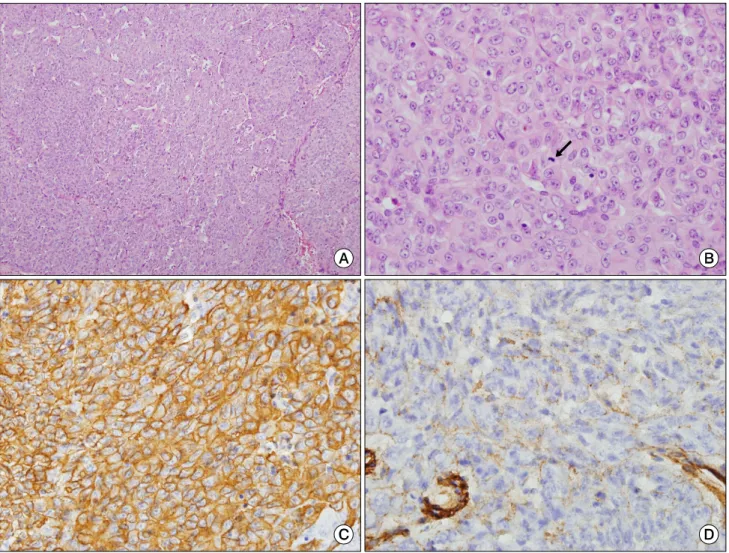
Fig. 2. Photomicrography of a malignant glomus tumor. (A) Solid sheets or trabeculae of tumor cells along with a prominent thin-walled

vascular network (H&E ×100). (B) Tumor cells have ovoid vesicular nuclei with prominent nucleoli. Mitosis (arrow) is seen (H&E

×400). (C) Tumor cells are positive for smooth muscle actin (immunostain ×400). (D) Collagen type IV is positive in pericellular areas (immunostain ×400).

brain MRI, were performed for detection of other meta- stases, but none was found.

The tissue sample from her incision biopsy performed in Russia was examined by a pathologist in our hospital.

Grossly, the tumor was ill-defined, un-encapsulated, and infiltrative. The cut surface was grayish white and smooth with a soft consistency and geographic necrosis was noted.

Microscopically, the tumor consisted of solid sheets or tra- beculae of ovoid to spindle cells along with a prominent thin-walled vascular network (Fig. 2A). Cytoplasm was seen relatively plump and eosinophilic and nuclei were uni- formly ovoid and markedly vesicular with a thin nuclear membrane with prominent nucleoli. Frequent mitotic fig-

ures (15/10 HPFs) were seen (Fig. 2B). Lymphovascular in-

vasion was frequently observed. Immunohistochemistry

staining revealed that the tumor cells were positive for

smooth muscle actin (Fig. 2C), vimentin, and CD99, and

focally positive for pancytokeratin, EMA, and collagen type

IV (Fig. 2D), while staining negative for S-100 protein,

CD34, desmin, HMB-45, bcl-2, and c-kit. These findings

were compatible with the diagnosis of malignant glomus

tumor. After informed consent was obtained, four cycles

(12 weeks) of chemotherapy containing doxorubicin (20

mg/m

2

/day as a continuous infusion on days 0, 1, 2) and

ifosfamide (1.7 g/m

2

/day on days 0, 1, 2, 3) every 3 weeks

were completed without any significant complications with

(4)

the exception of myelosuppression. After 4 cycles of che- motherapy, surgical resection was performed and the histo- logic findings showed no necrosis, but lymphovascular in- vasion was not observed and resection margin was free of tumor involvement. An additional 2 cycles of chemotherapy was performed during 2 months and follow up MRI imag- ing studies showed postoperative inflammatory change with significant decrease in size of pulmonary metastatic nodules and disappearance of some small nodules. However, chest CT taken 7 months after completion of chemotherapy showed an increase in size of the primary metastatic lung nodules in the left and right lower lobe (Fig. 1C). Nodules were excised and the pathologic finding was compatible with metastatic malignant glomus tumor.

Discussion

Malignant glomus tumor is an exceedingly rare neoplasm which customarily originates from glomus bodies in the dermis or subcutis of the extremities. Some cases of malig- nant glomus tumor with metastasis have been reported [9-11]. In addition, retrospective review of 52 cases of atyp- ical and malignant glomus tumors was performed. Among them, 8 cases were malignant glomus tumor with metastasis [4]. Folpe et al. classified 52 cases according to the size and location of tumor and histologic features. They classified 21 cases which fulfilled at least one of the following criteria:

deep location, size measuring more than 2 cm, presence of atypical mitotic figures, or combination of moderate to high nuclear grade and mitotic activity similar to malignant glomus tumor [4]. Metastasis was observed in 8 cases (38%) and the most common metastatic site was the lung (n=4).

These findings contrast previous reports that metastasis in malignant glomus tumor is a rare event. Moreover, 6 of these cases (75%) died of disease within 3 years after com- pletion of chemotherapy. This review suggests that malig- nant glomus tumor possessing malignant features requires systemic therapy (chemotherapy or radiotherapy) to im- prove the outcome of this neoplasm.

However, optimal systemic therapy for malignant glomus tumor has not yet been established for the rarity of this neoplasm. Complete resection of specimen margins free of

tumor for malignant glomus tumor might be the mainstay of therapy similar to other soft tissue sarcomas [12]. In addi- tion to surgical resection of advanced or metastatic malig- nant glomus tumors, systemic therapy may be required to achieve a more satisfactory outcome.

In our case, the size of the mass and histologic findings with lung metastasis correspond to a high risk group of ma- lignant glomus tumor. Initially, combination chemotherapy consisting of doxorubicin and ifosfamide was performed.

Then surgical resection was performed only on the primary scapular mass. Metastatic pulmonary nodules were not re- sected as the nodules were multiple and small. Complete resection without residual mass with clear resection margin was performed. The pathologic finding of the specimen ob- tained after the operation was not compatible with the complete response but lymphovascular invasion was not observed. In addition, the primary mass size showed a slight decrease and metastatic nodule size also decreased and some small ones disappeared. The primary mass was relatively localized without surrounding tissue invasion, therefore, an operation could be performed without tumor involvement in the resection margin. However, the pulmo- nary metastatic primary nodule size increased 7 months af- ter completion of chemotherapy. As a result, combination chemotherapy consisting of doxorubicin and ifosfamide seemed to prevent the progression of primary tumor. For the metastatic nodules, the therapy seemed effective ini- tially but was not effective as time progressed.

References

1. Venkatachalam MA, Greally JG. Fine structure of glomus tu- mor: similarity of glomus cells to smooth muscle. Cancer 1969;23:1176-84.

2. De Chiara A, Apice G, Mori S, et al. Malignant glomus tu- mour: a case report and review of the literature. Sarcoma 2003;7:87-91.

3. Brathwaite CD, Poppiti RJ Jr. Malignant glomus tumor. A case report of widespread metastases in a patient with multiple glo- mus body hamartomas. Am J Surg Pathol 1996;20:233-8.

4. Folpe AL, Fanburg-Smith JC, Miettinen M, Weiss SW. Atypical

and malignant glomus tumors: analysis of 52 cases, with a

proposal for the reclassification of glomus tumors. Am J Surg

Pathol 2001;25:1-12.

(5)

5. Gaertner EM, Steinberg DM, Huber M, et al. Pulmonary and mediastinal glomus tumors-report of five cases including a pulmonary glomangiosarcoma: a clinicopathologic study with literature review. Am J Surg Pathol 2000;24:1105-14.

6. Kayal JD, Hampton RW, Sheehan DJ, Washington CV.

Malignant glomus tumor: a case report and review of the literature. Dermatol Surg 2001;27:837-40.

7. Zhang Q, Wang S, Divakaran J, et al. Malignant glomus tu- mour of the lung. Pathology 2010;42:594-6.

8. Chung DH, Kim NR, Kim T, et al. Malignant glomus tumor of the thyroid gland where is heretofore an unreported organ:

a case report and literature review. Endocr Pathol 2015;26:

37-44.

9. Watanabe K, Sugino T, Saito A, Kusakabe T, Suzuki T.

Glomangiosarcoma of the hip: report of a highly aggressive tumour with widespread distant metastases. Br J Dermatol 1998;139:1097-101.

10. Song SE, Lee CH, Kim KA, Lee HJ, Park CM. Malignant glo- mus tumor of the stomach with multiorgan metastases: report of a case. Surg Today 2010;40:662-7.

11. Zhang Y, Li H, Zhang WQ. Malignant glomus tumor of the esophagus with mediastinal lymph node metastases. Ann Thorac Surg 2013;96:1464-6.

12. Pretell-Mazzini J, Barton MD Jr, Conway SA, Temple HT.

Unplanned excision of soft-tissue sarcomas: current concepts

for management and prognosis. J Bone Joint Surg Am

2015;97:597-603.

수치

Fig. 1. Thoracic spine MRI and lung CT. (A) T1 weighted sagittal image of the thoracic spine MRI showing a multi-lobulated and  irregularly branching mass from the upper margin at C3 to the lower margin at T6
Fig. 2. Photomicrography of a malignant glomus tumor. (A) Solid sheets or trabeculae of tumor cells along with a prominent thin-walled vascular network (H&E ×100)

참조

관련 문서

The Volume structure of the STA308A consists of individual volume registers for each channel and a master volume register that provides an offset to each channels volume

Median overall survival of 28 multiple myeloma patients treated with Cyclophosphamide-Prednisone combination regimens as a primary therapy was 115 weeks.. Median

Methods: I conducted a retrospective analysis of clinical records of children aged between 4 and 19 years who were treated with flunarizine for headache at

§  Problems encountered during project management are fundamentally dynamic.. However, they have been treated statically with a partial view on

A retrospective analysis of invasive tumor percentages of GSS tumor samples showed that samples with high tumor content correlated well with FNAB samples

Just as we achieved good control with a joint-based controller that was based on a linearizing and decoupling model of the arm, we can do the same for the Cartesian case.

The feed is commonly a solution in a solvent like ethanol or t-butanol, and the nonsolvent is water..

 Although van der Waals equation is still less accurate at high