전해수 수세, 열풍건조 및 자외선 조사에 의한 미역의 미생물 감소 효과
박시우1, 김꽃봉우리2, 김민지2, 강보경1, 박원민1, 김보람1, 안나경1, 최연욱1, 조영제3, 안동현1*
1부경대학교식품공학과/식품연구소
2부경대학교수산과학연구소
3경북대학교식품공학부
Received: November 7, 2014 / Revised: February 26, 2015 / Accepted: February 27, 2015
서 론
미역(Undaria pinnatifida)은갈조류의다시마목미역과 에속하는해조류로서칼슘, 칼륨, 철분, 요오드등의무기질 성분및각종비타민등이풍부하며, 우리나라전연안에분 포하며, 연해주, 중국, 일본등지에분포하는극동지방특산 의해조류이다[5]. 미역에는생리활성물질이많이함유되어 있는것으로알려져있으며, 그중점질다당류인알긴산은 중금속및방사능물질의체외배출, 콜레스테롤저하[20],
비만및변비방지효능[32], 혈압및당뇨예방효과[35]가
있다는보고가있으며, 또한미역이함유하고있는 fucoidan
은항암, 항콜레스테롤, 혈액응고저해, 혈압조절등의혈 류개선작용[3, 28] 및지질대사개선효과[30]가있는것 으로알려져있다.
국내의미역생산량은연도별차이는있으나연간약 45
만톤이상이생산되고있는데, 2013년생산량은약 47만톤
으로그중식용미역생산량이약 32만톤, 전복먹이용이약 15만톤생산되었으며, 이중수출량이약 11만 8천톤으로 금액으로는 259만달러에달하는것으로나타났다[22]. 국내 에서시판되고있는미역의경우제조형태에따라건미역과 염장미역으로나뉜다. 그중건미역의경우미역을일광건 조하여장기간보관이용이하도록처리한제품으로아무런 Effect of Electrolyzed Water and Hot-Air-Drying with UV for the Reduction of Microbial Populations of Undaria pinnatifida Si-Woo Bark1, Koth-Bong-Woo-Ri Kim2, Min-Ji Kim2, Bo-Kyeong Kang1, Won-Min Pak1, Bo-Ram Kim1, Na-Kyung Ahn1, Yeon-Uk Choi1, Young-Je Cho3, and Dong-Hyun Ahn1*
1Department of Food Science & Technology/Institute of Food Science, Pukyong National University, Busan 608-737, Republic of Korea
2Institute of Fisheries Sciences, Pukyong National University, Busan 619-911, Republic of Korea
3School of Food Science of Biotechnology, Kyungpook National University, Daegu 702-701, Republic of Korea
This study was conducted to investigate the effects of electrolyzed water (EW) and hot-air-drying with ultraviolet light (UV) to reduce coliform bacteria of Undaria pinnatifida (UP). The UP was washed in the order of 15% EW, tap water (TW), and distilled water (DW) under following conditions: 15% EW for 10 min (washing: 1 time), TW for 1 min, and DW for 10 min (washing:
5 times). Viable cells, coliform, and mold counts were at 102-103 CFU/g in untreated samples. After EW treatment, viable cells, coliform, and molds were not detected in whole samples or on the surface of UP. But, after hot-air-drying at 48oC for 48 h, the number of viable cells, coliform, and molds were 101-105 CFU/g. After hot-air-drying at 48oC for 48 h with UV (12-48 h), viable cells, coliform, and molds were not detected in whole samples or on the surface of UP. In respect of color value, there were no significant changes. In sensory evaluation, the UP with hot-air-drying with UV (12 h) had the highest score in overall preference among UV treatment groups. These results suggest that the treatments at 15% EW for 10 min and hot-air-drying at 48oC for 48 h with UV (12 h) were effective to reduce coliform bacteria of the dried Undaria pinnatifida.
Keywords:Undaria pinnatifida, quality, ultraviolet, electrolyzed water, coliform bacteria
*Corresponding author
Tel: +82-51-629-5831, Fax: +82-51-629-5824 E-mail: [email protected]
© 2015, The Korean Society for Microbiology and Biotechnology
가공공정없이자연상태에서건조하는경우가대부분이다
[5]. 이러한미역을건조하기위해서는채취후 1-2일내에
부패가되지않게처리해주어야한다. 그러나미역표면의 점액물질에의해건조속도가매우느리고이로인하여미생 물에오염될가능성이매우높다. 이러한미역을건조처리 하기위해미생물오염및부패를억제할수있는방법이절 실히요구되고있는실정이다[1].
미역의수세과정중에서부터미생물을제어할수있는방 법으로살균수로세척하는방법이있는데이산화염소수, 전 해수등다양한살균세척수가사용되고있다. 그중전해수
는수도수에일정량의 NaCl를첨가한후전기분해하여얻
어지는것으로[34], 평행평판전극간에이온분리막을설치
하고 이 전극간에 전압을 인가하면 이온들이 Coulomb's
force에의해반대극성을갖는전극으로분리접속되게하는
작용과식 (1), (2)와같이전기분해작용에의해만들어진다.
양극에서는수소이온을방출하여산성수가되며, 음극에서 는수소와수산화이온이발생되어알칼리수가된다.
양극측 : 4H2O → 8H+ + 2(O) + O2 + 8e− (1) 음극측 : 4H2O + 4e−→ 4OH−+ 2H2 (2) 특히양극측에서는식 (3)과 (4)와같은반응이일어나서 활성산소류가발생한다.
O2 + H2O−e → O3 + 2H+ (3)
H2O + O → H2O2 (4)
또한물중에염분이나염소가존재하게되면양극측에는 식 (5)와 (6)과같은반응이일어나서염소가스가발생되며 활성염소가생성되어수중에용존하게된다.
2Cl−→ Cl2 + 2e− (5)
Cl2 + H2O→HClO + H++Cl− (6)
전해수의경우높은환원력, 차아염소산(HClO), 활성산소 (O3, H2O2)를가지고있어강력한살균력을가지고있는것 으로알려져있으며[4, 18, 21, 25, 26, 37], 전해수는처리대 상이넓고다양하며, 반응후에는휘발성기체와물로되어 유해한잔류물이없으며, 인체에도안전한것으로알려져있 다[14].
수세를완료한미역의경우일반적으로천일건조를실시 하거나, 산업적으로대량의미역을건조할경우에는송풍건 조, 냉풍건조, 열풍건조등의방법이이용되고있는실정이 다. 천일건조의경우장기간의건조과정중에열화현상, 제 품의갈변및영양소파괴, 미생물의증식등으로인하여품 질저하를초래하는경우가많다. 산업적으로이용하는열풍 건조의경우신속하고균일하게건조가이루어져경제적이 며, 일반천일건조에비하여미생물의증식을최대한배제할
수있다는장점이있다[13].
이에본연구에서는생미역뿐만아니라건미역에서의위 생적인안전성을확보하기위하여, 생미역에전해수수세처 리를하여세척단계에서의미생물제어효과및열풍건조 를통한건미역의미생물제어효과를확인하였으며, 또한전
해수처리, 열풍건조, UV 조사의병행처리를통한미역의미
생물안전성, 색도및관능적인품질에미치는영향에대해 서도알아보았다.
재료 및 방법
실험재료
본실험에사용한생미역은㈜석하(Busan, Korea)에서제
공받은기장산의것을사용하였다. 전해수 제조 및 미역 수세
전해수는 NaCl 0.8% 용액을제조한뒤전해수생성장치
(전극의최대전력 100 V, 5 A, 전극표면 36 mm × 285 mm × 6개, 탱크용량 0.5 L, TMD Co., Busan, Korea)로전기분해 하여제조하였다. 6개의전극을 setting한전해수처리장치
에서 0.8% NaCl 용액을이용하여제조하였으며, 이때전압
30 V, 전류 600 A, 처리시간 6분으로전해수를제조하였다. 제조후 pH 9.0-9.5, 차아염소산(HClO) 함량 300-330 ppm 범위의전해수를사용하였다. 차아염소산의함량측정은전 해수 50 ml에 KI 2 g을넣고 35% acetic acid를 10 ml 첨가 한뒤 1% 전분지시약을 2-3 방울가하고 0.1 N Na2S2O3로 적정하여다음식에의하여함량을계산하였다.
HClO 함량(ppm) = 0.1 N Na2S2O3 소비량(ml) × 7.092 따라서미역의세척과정은제조된전기분해수를원액으로
하여 15% 농도로조절한후미역무게의 10배량을가하여
10분간세척하고수돗물로 1분간세척한후물기를제거하
여증류수로 10분동안다시세척하여물기를빼준후증류 수세척을 4회더반복하여실험에사용하였다.
미역 열풍건조 및 UV조사
수세 완료한 미역을 열풍건조기(WFO-600SD, EYELA Co., Tokyo, Japan)에서 48oC, 48시간동안처리하여건조된 미역을제조하였다. 이때열풍건조기안에 UV 등(G8T5 8W UV-C, Sankyo Denki Co., Kanagawa, Japan) 2개를시료
로부터 15 cm 거리에 설치하여열풍건조 동안 0, 12, 24,
48시간 간격으로 UV를조사하였다. 미생물학적 검사
미역 2 g을 무균적으로 취하여 10배량의 멸균 PBS
(phosphate buffered saline, pH 7.4)를 첨가한 후, 1,000 rpm에서 1분간 호모게나이저(AM-7, Ace homogenizer, Nihonseiki, Tokyo, Japan)로균질화한다음 10배희석법으 로희석하였다. 생균수의측정은 PCA(plate count agar, BD Difco, Detroit, USA), 대장균군의측정은 DLA(desoxycholate lactose agar, BD Difco, Detroit, USA)에희석액을분주·도 말하여 35oC에서 24시간배양한후생성된집락의수를측 정하였다. 곰팡이 측정은 PDA(potato dextrose agar, BD Difco, Detroit, USA)에희석액을분주·도말하여 25oC에서 3- 5일간배양하며생성된집락의수를측정하였다. 미역표면 의미생물검사는멸균 PBS 200 μl를멸균된면봉에흡수시
켜미역표면을(10 × 10 cm) 닦아준후면봉끝부분을잘라
멸균 PBS 9 ml이담긴 cap tube에넣었다. 이를 4회더반 복한후에, 면봉이담긴 cap tube를 180 rpm에서 3시간진
탕하였다. 진탕후 PBS 용액만취하여 10배희석법으로희
석하여미생물검사를실시하였다. 색도
전자선조사한미역을 분쇄하여 3.5 g을취하여색차계
(JC801, Color Technosystem Co., Tokyo, Japan)로 L*, a*, b*값으로색도를측정하였다. 이때사용된표준백판의값은 L*= 93.39, a*= 0.28, b*= 1.68이었다.
관능평가
14명의 panel(식품공학전공학생, 남 3명, 여 11명, 21-27세) 을선정하여미역의색, 맛향및전체적인기호도의 4가지 항목을 7점점수법(7점, 매우좋다; 6점, 좋다; 5점, 조금좋 다; 4점, 보통이다; 3점, 조금나쁘다; 2점, 나쁘다; 1점, 아주 나쁘다)으로평가하였다.
통계처리
실험결과의통계처리는 SAS program(Statistical analytical system V8.2, SAS Institute Inc., Cary, NC, USA)을이용 하여분산분석한후 Duncan의다중검정법으로 p < 0.05 수 준에서항목들간의유의적차이를검정하였다.
결과 및 고찰
전해수 수세 및 건조에 따른 미생물학적 품질
예비실험을통하여세척수로서전해수의농도는고농도의
전해수(90%, 70%, 50%)를사용하였을경우미역의색이변
하여적합하지않았으나, 저농도전해수(15%)를 10분동안
1회침지후증류수로 10분씩 5회세척하였을때대장균군 감소효과와함께품질유지에좋은결과를확인하였다. 열풍 건조의온도는중온성세균의성장을억제하면서, 품질의변
화를최소화할수있는 48oC로실시하였으며, 열풍건조시 간은 48시간일때시판건미역의수분함량(약 6-12%)과[8]
유사함을확인하였다. 따라서이러한조건을토대로전해수 로수세처리한미역에열풍건조를실시하여건미역을제조 하였으나, 열풍건조한미역에서미생물의오염이확인되었 으며, 이는열풍건조기내의미생물오염여부가의심되어
이를 해결하기 위해 살균 효과가 뛰어난 UV-C를[7, 10,
17, 31, 36] 열풍건조기내에설치후열풍건조하는동안에
UV-C를동시에조사하여건조한미역을제조하였으며, 이 를토대로미역의세척및건조최적조건을확립한후다음 의실험을진행하였다.
15% 전해수 1회, 증류수 5회수세후 48시간열풍건조및 0-48시간간격의 UV 조사를통한건조미역의생균수를측
정한결과(Table 1), 무처리구의미역전체부위와표면부
위에서각각 3.20, 2.11 log CFU/g의균이검출되었으며, 전 해수수세후에는균이검출되지않았다. 수세후열풍건조 기를이용하여 48oC, 48시간열풍건조를진행하면서 0, 12,
24, 48시간간격으로 UV를병행하여건조하였다. 건조된미
역의 UV 시간별생균수결과, UV 0시간에서미역전체와
Table 1. Viable cell counts of U. pinnatifida treated with elec-
trolyzed water. (Unit : Log CFU/g)
Whole Surface
Untreated 3.20 2.11
15% EW1) + DW2) -4) -
15% EW + DW + HAD3)
UV 0 h 5.00 4.26
UV 12 h - -
UV 24 h - -
UV 48 h - -
1)Electrolyzed water for 10 min (washing : 1 time).
2)Distilled water for 10 min (washing : 5 times).
3)Hot air drying at 48oC for 48 h.
4)Not detected.
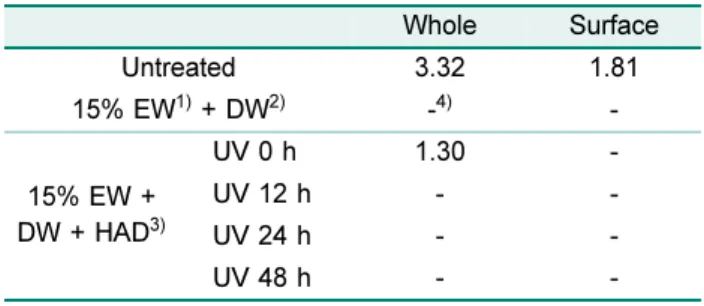
Table 2. Coliform counts of U. pinnatifida treated with electro-
lyzed water. (Unit : Log CFU/g)
Whole Surface
Untreated 3.32 1.81
15% EW1) + DW2) -4) -
15% EW + DW + HAD3)
UV 0 h 1.30 -
UV 12 h - -
UV 24 h - -
UV 48 h - -
1)Electrolyzed water for 10 min (washing : 1 time).
2)Distilled water for 10 min (washing : 5 times).
3)Hot air drying at 48oC for 48 h.
4)Not detected.
표면부위에서각각 5.00 및 4.26 log CFU/g의균이검출되었으 며, UV 12, 24, 48시간조사에서는균이검출되지않았다.
대장균군측정결과(Table 2), 무처리구미역전체와표면
부위에서각각 3.32 및 1.81 log CFU/g의대장균군이검출 되었으며, 전해수수세후에는대장균군이검출되지않았다.
수세후열풍건조동안 UV 0, 12, 24, 48시간으로병행하여
건조시킨미역의대장균군의결과, UV 0시간의미역전체 부위에서만 1.30 CFU/g의대장균군이검출되었으며, 나머 지 UV 처리구에서는대장균군이검출되지않았다.
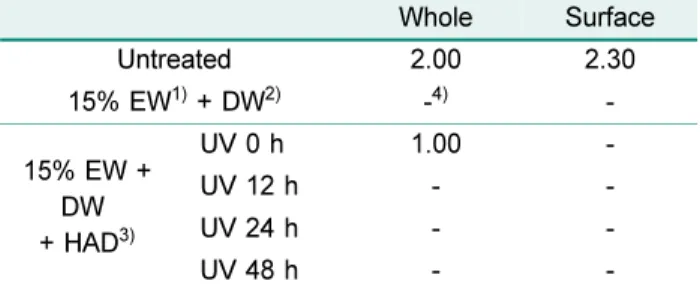
곰팡이측정결과(Table 3), 무처리구의미역전체부위와
표면부위에서각각 2.00 및 2.30 log CFU/g이검출되었으나 전해수수세후곰팡이가검출되지않았다. 수세후 48oC, 48시간열풍건조동안 UV 0, 12, 24, 48시간으로병행하여
건조시킨미역의곰팡이수측정결과, UV 0시간의미역전
체부위에서 1.00 log CFU/g의곰팡이가검출되었으며, 나머 지 UV 처리구에서는검출되지않았다. 생균수, 대장균군, 곰 팡이의결과에서전해수수세후에는균이검출되지않았으 나, 열풍건조기를통한건조에의하여균이검출되는것으로 보아열풍건조기내에서의균오염가능성을확인할수있었 다. 따라서이러한열풍건조기내에서의미생물오염을억제 하기위한 UV 처리시간별미생물의억제효과를살펴보았
을때 UV 12, 24, 48시간모두에서미생물이검출되지않음
을확인하였다.
Lee 등[27]의연구에의하면전해수처리에의하여깻잎,
상추, 미니배추에서 Escherichia coli 및 Bacillus cereus 균
이검출되지않았거나약 5 log cycle의감소를보였다고보
고하였다. 또한, Jeong 등[12]의전기분해수세정에따른깻 잎의미생물의변화를보면총균수및대장균군이무처리구
에비하여전해수처리후약 3 log cycle 감소한다고보고하
였으며, Koseki 등[24]의연구에서오이에전해수 5분처리 시호기성세균, 대장균군, 곰팡이가약 2-4 log cycle 감소한 다고보고하여본실험의생균수, 대장균군, 곰팡이수가감
소하는결과와유사한결과를확인하였다. John [14]에의하 면전해수의살균기작은전기분해시생성되는 HClO가세 포내에서 HCl과활성산소로분해되어 HCl은세포내에서 pH 를낮추고, 활성산소는세포물질의불활성화를유도하여균 을사멸시킨다고하였다. UV-C에의한미생물억제효과는 Kang 등[16]의연구에서치콘에 UV-C 조사시총호기성세 균과곰팡이수가약 1-1.5 log cycle 감소하였으며, 이산화탄 소수와 UV-C 병행처리시에는약 2-3 log cycle 감소하여병 행처리에의하여더좋은효과를보이는것을확인할수있 었다. Manzocco 등[29]의연구에서절단사과에 UV-C 처리 시중온세균과효모가약 1-1.5 log cycle 감소한다고보고 하였다. 또한 Selma 등[33]의양파와꽃상추에 UV-C 처리 시총중온세균, 총대장균군및곰팡이가약 1-2.5 log cycle 감소한다고보고하고있어본실험의결과와유사한결과를 확인하였다.
이상의결과, 생미역의경우전해수수세처리만으로미생 물억제효과가우수함을확인하였고, 건미역의경우, 전해 수수세후에열풍건조와 UV 병행처리시에미생물제어 효과가뛰어남을확인하였다. UV 조사조건은 24시간이상 조사시탄냄새및탄맛이느껴진다는의견이있어관능적 품질을생각하였을때, UV 12시간병행조사가미생물제어 최적조건으로사료된다.
색도
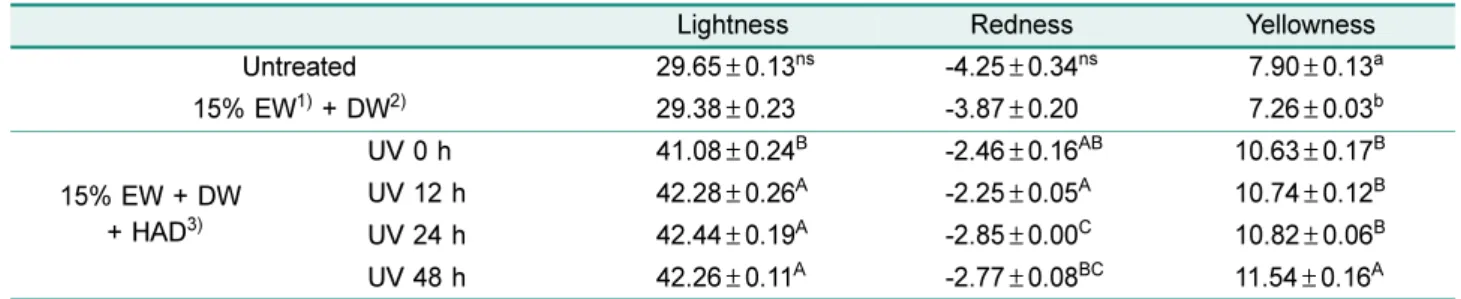
15% 전해수로 10분세척후증류수로 10분씩 5회수세하 여 48oC의열풍건조기에 UV 등을설치하여 48시간동안 UV 조사시간간격을달리하여건조미역의색도를측정하
였다(Table 4). 건조처리전전해수로세척한미역의색도
결과는, 무처리구와비교시명도와적색도는유의적인차이 가나타나지않았으며, 황색도의경우전해수처리구에서유 의적인감소를보였다. 미역에함유되어있는주요색소로는 carotene류의 β-carotene, chlorophyll류의 chlorophyll a, xanthophyll류의 fucoxantine의함량이높다고알려져있는 데[38], Han 등[9]의조리에따른미역중의색도변화연구 에서미역에산이가해지면 chlorophyll 및 fucoxantine계색 소의손실이일어나적색도의증가및황색도가감소하는결 과를보였다고보고하였다. 따라서본연구에서황색도가감
소한것은전해수중의 HClO가 HCl로분해되면서미역의
색소에영향을주어황색도가감소한것으로사료된다. 수세 후 48oC, 48시간열풍건조과정중 UV를 0, 12, 24, 48시간 간격으로병행처리하여건조시킨미역의색도결과, 명도는 건조후에증가하였으며, UV 조사처리후에는약간의증가
를보였고, UV 시간에따른유의적인차이는보이지않았다.
적색도의경우, 수세후건조에의해적색도가증가하였으며,
UV 조사를 24 및 48시간처리시적색도는약간감소하였
Table 3. Molds counts of of U. pinnatifida treated with electro-
lyzed water. (Unit : Log CFU/g)
Whole Surface
Untreated 2.00 2.30
15% EW1) + DW2) -4) -
15% EW + DW + HAD3)
UV 0 h 1.00 -
UV 12 h - -
UV 24 h - -
UV 48 h - -
1)Electrolyzed water for 10 min (washing : 1 time).
2)Distilled water for 10 min (washing : 5 times).
3)Hot air drying at 48oC for 48 h.
4)Not detected.
다. 황색도의경우건조후, 수세만하였을때보다유의적인
증가를보였으며, UV 48시간처리구가 UV 0-24시간처리
구보다유의적으로증가함을보였다.
Yoo와 Jang [39]의전기분해수처리에따른콩나물의색도 변화를살펴보면, 무처리구와미산성전해수및차아염소산수 처리에의하여명도는유의적인차이를보이지않았으며, 황 색도는유의적으로감소한다고보고하여, 본실험의결과와 유사한결과를확인하였다. Koide 등[23]의절단당근의전해 수처리에의한물성변화논문에서전해수처리시당근의명 도및적색도는유의적인차이를보이지않았으나, 황색도는 유의적으로증가하였다고보고하였다. Kim 등[19]의 UV-C 조사에의한수입건어포의품질에미치는영향에관한논문
에서 UV-C 조사선량이증가할수록명도와적색도는유의적
인차이를보이지않으며, 황색도는유의적으로증가한다고 보고하고있어본실험의결과와는상반된결과를확인하였 으며이는시료의종류에따른차이로사료된다.
관능평가
15% 전해수로 10분세척후증류수로 10분씩 5회수세하 여 48oC의열풍건조기에 UV 등을설치하여 48시간동안 UV 조사시간간격을달리하여제조한건조미역의관능평
가결과(Table 5), 무처리구와전해수수세구간향및맛항
목에서유의적인차이를보이지않았다. 하지만전해수수세 구에서무처리구에비하여높은점수를얻었다. 전해수수세 시미역에서전해수취와맛이약간난다는의견을보였으 며, 전해수처리에의해미역자체의비린맛및향이감소
했다고하였다(no data). 전해수수세한미역을열풍건조기
를이용하여 48oC, 48시간열풍건조하면서 UV를병행조사 한건조미역의관능평가결과는 UV 조사시간에따른향및 맛항목에서유의적인차이를보이지않았다. 그러나 UV
24시간이상조사시건미역자체의맛이나향이감소했다
고하였으며, 일부는탄맛및탄냄새가난다고평가하였 다(no data). Jeong 등[11]의전기분해수세정처리에의한딸 Table 4. Color value of U. pinnatifida treated with electrolyzed water.
Lightness Redness Yellowness
Untreated 29.65± 0.13ns -4.25± 0.34ns 07.90± 0.13a
15% EW1) + DW2) 29.38± 0.23 -3.87± 0.20 07.26± 0.03b
15% EW + DW + HAD3)
UV 0 h 41.08± 0.24B -2.46± 0.16AB 10.63± 0.17B
UV 12 h 42.28± 0.26A -2.25± 0.05A 10.74± 0.12B
UV 24 h 42.44± 0.19A -2.85± 0.00C 10.82± 0.06B
UV 48 h 42.26± 0.11A -2.77± 0.08BC 11.54± 0.16A
1)Electrolyzed water for 10 min (washing : 1 time).
2)Distilled water for 10 min (washing : 5 times).
3)Hot air drying at 48oC for 48 h.
Means in the same column (small letter between non-drying treatments, big letter between drying treatments) bearing different superscripts in samples are significantly different (p < 0.05).
ns : not significantly different.
Table 5. Sensory evaluation of U. pinnatifida treated with electrolyzed water.
Color Aroma Taste Overall preference
Untreated 4.00± 0.85ns 3.58± 1.08ns 3.42± 0.90b 3.50± 0.80b
15% EW1) + DW2) 4.58± 0.79 4.08± 0.51 4.25± 1.06a 4.25± 0.87a
15% EW + DW + HAD3)
UV 0 h 4.25± 0.62NS 4.08± 0.29NS 4.17± 0.83NS 4.33± 0.89NS
UV 12 h 3.92± 0.67 4.00± 0.00 4.17± 1.27 4.33± 1.0
UV 24 h 3.83± 0.72 4.08± 0.51 3.50± 0.90 3.83± 0.83
UV 48 h 3.83± 0.83 4.00± 0.43 3.42± 0.79 3.42± 0.79
1)Electrolyzed water for 10 min (washing : 1 time).
2)Distilled water for 10 min (washing : 5 times).
3)Hot air drying at 48oC for 48 h.
Means in the same column (small letter between non-drying treatments) bearing different superscripts in samples are signifi- cantly different (p < 0.05).
NS : not significantly different.
기의품질특성의관능평과결과, 무처리구와전해수처리구 간형태, 색, 향및종합적기호도에서유의적인차이를보 이지않았다고보고하고있어본실험의결과와유사한결 과를확인하였다. 또한 Chun 등[6]의 UV-C 조사가고춧가 루의품질에미치는영향의관능평과결과, 신선도, 부패도, 향, 종합적기호도항목에서무처리구와 UV-C 조사선량별 처리구간유의적인차이를보이지않았다고보고하였으며, Allende 등[2]의 red oak leaf lettuce의 UV-C 처리에의한 관능적으로무처리구와 UV-C 처리구간유의적인차이를보 이지않는다고보고하고있어, 본실험의관능평가결과와 유사한결과를확인하였다. 따라서, 본실험의 15% 전해수
및증류수수세와열풍건조및 UV 12시간병행건조를통
하여미생물을효과적으로제어하면서관능적인품질변화 없는건조미역을제조할수있는방법으로사료된다.
요 약
15% 전해수로 10분간세척후증류수로 10분씩 5회수세 하여 48oC의열풍건조기에 UV 등을설치하여미생물의변 화를확인하였다. 전해수수세후생균수, 대장균군, 곰팡이 수에서모두균이검출되지않았다. 하지만, 수세후열풍건 조기를이용하여 48oC에서 48시간동안열풍건조시미생물 이다시검출됨을확인하였고, 이에열풍건조기내에 UV 등
을설치하여, UV 조사최적시간을확인하였다. 그결과 UV
조사를 12시간이상처리시미생물이검출되지않는것으
로나타났다. 15% 전해수수세및열풍건조미역의색도결
과, 전해수수세구는무처리구와비교시황색도에서만유의 적인감소를보였으며, 수세후열풍건조시명도, 적색도및 황색도가유의적으로크게증가하였다. 관능평가결과, 색, 향, 맛및전체적호감도항목에서무처리구와전해수수세 구간유의적인차이는없었으나전해수처리시미역의비린 맛및비린향이감소한다고하였다. 또한 48oC, 48시간열 풍건조동안 UV 0-48시간조사구간에서도색, 향, 맛및전 체적호감도에서유의적인차이를보이지않았다. 결론적으
로, 15% 전해수수세시생미역의미생물증식을효과적으
로제어할수있을뿐만아니라미역의비린맛및비린냄 새를줄여관능적으로나은제품을제조할수있었다. 전해 수수세후열풍건조하는동안 UV 조사를 12시간실시할 경우열풍건조기를통한미생물오염을억제할수있어전 해수-열풍건조-UV 병행처리시미생물제어효과가우수한 건미역을생산할수있을것으로사료된다.
Acknowledgments
Following are results of a study on the “Leaders in Industry-uni- versity Cooperation (LINC)” Project (Grant 2012-0741), supported
by the Ministry of Education (MOE) and the National Research Foundation of Korea (NRF).
References
1. Ahn SJ, Kim YS, Park KP. 2004. Storage of waste-brown sea- weed and degradation of alginate using microorganism. J.
Environ. Sci. 13: 313-318.
2. Allende A, McEvoy JL, Luo Y, Artes F, Wang CY. 2006. Effec- tiveness of two-sided UV-C treatments in inhibiting natural microflora and extending the shelf-life of minimally processed
‘Red Oak Leaf’ lettuce. Food Microbiol. 23: 241-249.
3. Bojakowski K, Abramczyk P, Bojakowska M, Zwolinska A, Przybylski J, Gaciong Z. 2001. Fucoidan improves the renal blood flow in the early stage of renal ischemia/reperfusion injury in the rat. J. Physiol. Pharmacol. 52: 137-143.
4. Buck JW, Van Iersel MW, Oetting RD, Hung YC. 2002. In vitro fungicidal activity of acidic electrolyzed oxidizing water. Plant Dis. 86: 278-281.
5. Choi JS, Bae HJ, Kim YC, Park NH, Kim TB, Choi YJ, et al.
2008. Nutritional composition and biological activities of the methanol extracts of sea mustard (Undaria pinnatifida) in mar- ket. J. Life Sci. 18: 387-394.
6. Chun HH, Kim JY, Kim HJ, Song KB. 2009. Effect of UV-C irradiation on the quality of red pepper powder during storage.
Korean J. Food Preserv. 16: 454-458.
7. Devine DA, Keech AP, Wood DJ, Killington RA, Boyes H, Doubleday B, et al. 2001. Ultraviolet disinfection with a novel microwave-powered device. J. Appl. Microbiol. 91: 786-794.
8. Foodnara.2014. http://www.foodnara.go.kr/kisna/index.do?
nMenuCode=18.
9. Han JS, Lee YJ, Lee SJ, Kim JA, Minamide T. 2002. Changes in chromaticity and 6 mineral contents of sea mustards according to several cooking methods. Korean J. Soc. Food Cookery Sci. 18: 101-108.
10. Holdworth SD. 1971. Dehydration of food products. J. Food Technol. 6: 331-334.
11. Jeong JW, Kim JH, Kwon KH, Park KJ. 2006. Disinfection effects of electrolyzed water on strawberry and quality changes during storage. Korean J. Food Preserv. 13: 316- 321.
12. Jeong JW, Kim JH, Kwon KH. 2005. Comparison of quality characteristics of sesame leaf cleaned with various electro- lyzed water during storage. Korean J. Food Preserv. 12: 558- 564.
13. Jin TY, Oh DH, Eun JB. 2006. Change of physicochemical characteristics and functional components in the raw materi- als of Saengsik, uncooked food by drying methods. Korean J.
Food Sci. Technol. 38:188-196.
14. John G. 1997. Essentials of Food Microbiology. pp.97-98. 1st ed. Arnold Publishers, London.
15. Jung SW, Park KJ, Park BI, Kim YH. 1996. Surface steriliza- tion effect of electrolyzed acid water on vegetable. Korean J.
Food Sci. Technol. 28: 1045-1051.
16. Kang JH, Park JY, Oh DH, Song KB. 2012. Effect of combined treatment of aqueous chlorine dioxide and UV-C or electron beam irradiation on microbial growth and quality in Chicon during storage. J. Korean Soc. Food Sci. Nutr. 41: 1632-1638.
17. Keyser M, Muller IA, Cilliers FP, Nel W, Gouws PA. 2008.
Ultraviolet radiation as a non-thermal treatment for the inacti- vation of microorganisms in fruit juice. Innov. Food Sci.
Emerg. Technol. 9: 348-354.
18. Kim C, Hung C, Brackett RE. 2000. Efficacy of electrolyzed oxidizing (EO) and chemically modified water on different types of foodborne pathogens. Int. J. Food Microbiol. 61: 199- 207.
19. Kim JY, Chun HH, Song KB. 2008. Effect of UV-C irradiation on the quality of imported dried fish during storage. Korean J.
Food Preserv. 15: 922-926.
20. Kim KH, Cheong JJ. 1984. Optimum conditions for extracting alginic acid from and amino acid composition of its extraction residue. Korean J. Food Sci. Technol. 16: 336-340.
21. Kiura H, Sano K, Morimatsu S, Nakano T, Morita C, Yamagu- chi M, et al. 2002. Bactericidal activity of electrolyzed acid water from solution containing sodium chloride at low concen- tration in comparison with that at high concentration. J. Micro- bial. Methods 49: 285-293.
22. KMI. 2013. Korea Maritime Institute homepage, http://www.
foc.re.kr.
23. Koide S, Shitanda D, Note M, Cao W. 2011. Effects of mildly heated, slightly acidic electrolyzed water on the disinfection and physicochemical properties of sliced carrot. Food Control 22: 452-456.
24. Koseki S, Yoshida K, Isobe S, Itoh K. 2004. Efficacy of acidic electrolyzed water for microbial decontamination of cucum- bers and strawberries. J. Food Prot. 67: 1247-1251.
25. Koseki S, Yoshida K, Isobe S, Itoh K. 2011. Decontamination of lettuce using acidic electrolyzed water. J. Food Prot. 64:
652-658.
26. Lee JH, Kwon TR, Moon JD, Lee JT. 1998. Effect of acidic electrolyte water on growth and infection of Phytophthora cap- sici. Korean J. Plant. Pathol. 14: 440-444.
27. Lee WJ, Lee CH, Yoo JY, Kim KY, Jang KI. 2011. Sterilization efficacy of washing method using based on microbubbles and electrolyzed water on various vegetables. J. Korean Soc.
Food Sci. Nutr. 40: 912-917.
28. Maeda H, Hosokawa M, Sashima T, Funayama K, Miyashita K. 2005. Fucoxanthin from edible seaweed shows antiobesity effect through UCP1 expression in white adipose tissues. Bio- chem. Biophys. Res. Commun. 332: 392-397.
29. Manzocco L, Pieve SD, Bertolini A, Bartolomeoli I, Maifreni M, Vianello A, et al. 2011. Surface decontamination of fresh-cut apple by UV-C light exposure : effects on structure, colour and sensory properties. Postharvest Biol. Technol. 61: 165-171.
30. Murata M, Ishihara K, Saito H. 1999. Hepatic fatty acid oxida- tion enzyme activities are stimulated in rats fed the brown sea- weed, Undaria pinnatifida wakame. J. Nutr. 129: 146-151.
31. Perkins-Veazie P, Collins JK, Howard L. 2008. Blueberry fruit response to postharvest application of ultraviolet radiation.
Postharvest Biol. Technol. 47: 280-285.
32. Sato M, Hosokawa T, Yamaguchi T, Nakano T, Muramoto K, Kahara T. 2002. Angiotensin I-converting enzyme inhibitory peptides derived from wakame (Undaria pinnatifida) and their antihypertensive effect in spontaneously hypersensitive rats.
J. Agric. Food Chem. 50: 6245-6252.
33. Selma MV, Allende A, Lopez-Galvez F, Conesa MA, Gill MI.
2008. Disinfection potential of ozone, ultraviolet-C and their combination in wash water for the fresh-cut vegetable industry.
Food Microbiol. 25: 809-814.
34. Shigenobu K, Seiichiro I. 2007. Microbial control of fresh pro- duce using electrolyzed water. Jpn. Agric. Res. Q. 41: 273- 282.
35. Suetsuna K, Kaekawa K, Chen JR. 2004. Antihypertensive effects of Undaria pinnatifida wakame peptide on blood pres- sure in spontaneously hypersensitive rats. J. Nutr. Biochem.
5: 267-272.
36. US Food and Drug Administration. 2007. Irradiation in the pro- duction, processing and handling of food. 21CFR. part 179.39. Code of Federal Regulations 3, pp 439-440.
37. Venkitanarayanan KS, Ezeike GO, Hung YC, Doyle MP. 1999.
Efficacy of electrolyzed oxidizing water for inactivation Esche- richia coli O157:H7, Salmonella enteritidis, and Listeria mono- cytogenes. Appl. Environ. Microbiol. 65: 4276-4279.
38. White RC, Jones IO, Gibbs E, Butler LS. 1972. Flurometric estimation of chlorophyllides, pheophytins and pheophorbides in mixtures. J. Agric. Food Chem. 20: 773-778.
39. Yoo JY, Jang KI. 2011. Change in quality of soybean sprouts washed with electrolyzed water during storage. J. Korean Soc. Food Sci. Nutr. 40: 586-592.