• 검색 결과가 없습니다.

Primary Synovial Sarcoma of the Parietal Pleura: A Case ReportMin-Kyun Kang, M.D.

N/A
N/A
Protected

Academic year: 2021

Share "Primary Synovial Sarcoma of the Parietal Pleura: A Case ReportMin-Kyun Kang, M.D."

Copied!
3
0
0

로드 중.... (전체 텍스트 보기)

전체 글

(1)

Korean J Thorac Cardiovasc Surg 2013;46:159-161 □ Case Report □ http://dx.doi.org/10.5090/kjtcs.2013.46.2.159 ISSN: 2233-601X (Print) ISSN: 2093-6516 (Online)

− 159 −

Department of Thoracic and Cardiovascular Surgery,

1

Inje University Busan Paik Hospital, Inje University College of Medicine,

2

Inje University Haeundae Paik Hospital, Inje University College of Medicine,

3

Department of Pathology, Inje University Busan Paik Hospital, Inje University College of Medicine

Received: July 18, 2012, Revised: August 17, 2012, Accepted: August 21, 2012

Corresponding author: Kwang-Hyun Cho, Department of Thoracic and Cardiovascular Surgery, Inje University Busan Paik Hospital, Inje University College of Medicine, 75 Bokji-ro, Busanjin-gu, Busan 614-735, Korea

(Tel) 82-51-890-6834 (Fax) 82-51-891-1297 (E-mail) [email protected]

C

The Korean Society for Thoracic and Cardiovascular Surgery. 2013. All right reserved.

CC
This is an open access article distributed under the terms of the Creative Commons Attribution Non-Commercial License (http://creative- commons.org/licenses/by-nc/3.0) which permits unrestricted non-commercial use, distribution, and reproduction in any medium, provided the original work is properly cited.

Primary Synovial Sarcoma of the Parietal Pleura: A Case Report

Min-Kyun Kang, M.D.

1

, Kwang-Hyun Cho, M.D.

1

, Yang-Haeng Lee, M.D.

1

, Il-Yong Han, M.D.

1

, Young Chul Yoon, M.D.

1

, Kyung-Taek Park, M.D.

1

, Do Kyun Kang, M.D.

2

, Bo-Mi Kim, M.D.

3

Synovial sarcoma is a malignant soft tissue tumor that most commonly occurs in the extremities of young and middle-aged adults, in the vicinity of large joints. Although synovial sarcoma is frequently associated with joints, it may arise in unexpected sites, such as the mediastinum, heart, lung, pleura, or chest wall. Primary synovial sarco- ma of the pleura is rare. To date, nearly 36 cases of primary synovial sarcoma of the pleura have been reported since Gaertner et al. published the first case in 1996. The oncologic characteristics, treatment, and prognosis for pleural synovial sarcomas are not well defined because of a paucity of data. However, a multimodal approach, in- cluding surgical resection, chemotherapy, and radiotherapy, has generally been suggested. We report the outcome of one patient with primary pleural synovial sarcoma treated with radical resection and adjuvant treatment.

Key words: 1. Primary synovial sarcoma 2. Pleura

3. Synovial sarcoma

CASE REPORT

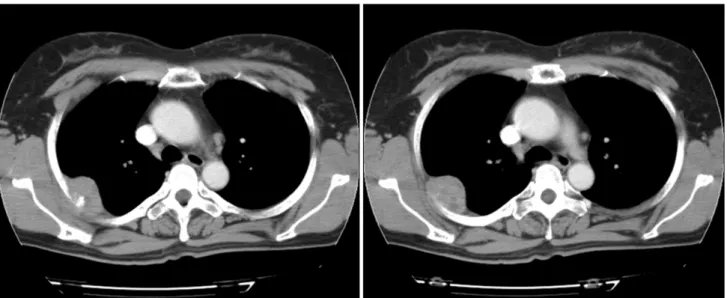
A 53-year-old woman was admitted to the Department of Cardiothoracic Surgery because of upper right back pain for 2 weeks. Her vital signs were within normal limits, and phys- ical examination revealed no abnormal findings. Her labo- ratory findings were also within normal limits. Computed to- mography of the chest demonstrated a heterogeneous mass (4.0×3.0×3.0 cm) attached to the right parietal pleura with di- rect invasion of the posterior arch of the right 4th rib (Fig.

1). Positron emission tomography demonstrated a hyper- metabolic mass attached to the right parietal pleura. The max- imum standardized uptake value of the mass was 8.0. There was no evidence of definite metastasis. The patient underwent

surgical resection through a right posterolateral thoracotomy.

Intraoperatively, there was an encapsulated soft mass in the posterior portion of the right 3rd intercostal space. There was direct invasion of the right 3rd and 4th ribs; however, there was no invasion of the right lung. A radical resection of the tumor including the right 3rd and 4th ribs was performed.

The chest wall defect was repaired with a Gore-Tex

Dual-Mesh patch (2 mm). On histopathological examination

(Fig. 2), the tumor was confirmed to be a poorly differ-

entiated monophasic synovial sarcoma. The histopathological

specimen showed synovial sarcoma composed of spindle cells

with a hemangiopericytoma-like vascular pattern. The tumor

cells showed immunohistochemical positivity for vimentin, a

sarcoma tumor marker for identifying mesenchyme; focal

(2)

Min-Kyun Kang, et al

− 160 −

Fig. 1. Computed tomography of the chest shows a heterogeneous mass attached to the right parietal pleura with direct invasion of the posterior arch of the right 4th rib.

Fig. 2. Histopathological examination. (A) The specimen shows synovial sarcoma composed of spindle cells with a hemangiopericytoma-like vascular pattern (H&E, ×200). (B) The tumor cells showed immunohistochemical positivity for vimentin (vimentin stain, ×200).

weak positivity for epithelial membrane antigen; but im- munohistochemical negativity for S-100 protein, CD34 and actin, the other fibrous tumor markers. The patient was dis- charged in stable condition 5 weeks after the operation and she received adjuvant radiotherapy at another hospital.

DISCUSSION

Synovial sarcoma most commonly occurs in the extremities

of young and middle-aged adults, typically in the vicinity of

large joints. It may arise in unusual locations. Primary syno-

vial sarcoma of the pleura is rare [1]. To date, nearly 36 cas-

es of primary synovial sarcoma of the pleura have been re-

ported since Gaertner et al. [2] published the first case in

1996. Only one case of primary synovial sarcoma of the

pleura was reported in Korea in 2005 by Lee et al. [3]. On

computed tomography of the chest, a synovial sarcoma of the

pleura is characterized commonly as a heterogeneously en-

(3)

Primary Synovial Sarcoma of the Parietal Pleura

− 161 − hanced mass with well-defined margins, cortical bone destruc- tion, tumor calcifications, and tumor infiltration of the chest wall musculature. The histogenesis of synovial sarcomas is not well known, but the tumors may be derived from pluri- potent mesenchymal cells capable of epithelial differentiation.

The specific chromosomal translocation (X:18) is found in more than 90% of synovial sarcomas and can be detected by the fluorescence in-situ hybridization method [4]. Synovial sarcoma encompasses two histologic subtypes: monophasic and biphasic. The presence of poorly differentiated tumor cells within lesions of either subtype is considered to be a poor prognostic factor [5]. In this report, the tumor was a poorly differentiated monophasic synovial sarcoma. In gen- eral, treatment for soft tissue sarcoma comprises a combina- tion of surgical resection, radiotherapy, and chemotherapy [6].

Although there is no gold standard of treatment for primary pleural synovial sarcoma, a multidisciplinary approach, in- cluding surgical resection, chemotherapy, and radiotherapy has been suggested. Radical resection is the mainstay of treatment. Adjuvant radiotherapy is usually recommended in cases of incomplete resection or extensive resection of a large tumor [7]. The benefits of chemotherapy are unclear. Howev- er, neoadjuvant chemotherapy can be beneficial prior to radi- cal resection since it can cause reduction in tumor volume and potentially treat micrometastasis [8]. The 5-year survival rate for synovial sarcoma is 50% to 80%, depending on the patient’s age, the tumor size, and its resectability [9]. The primary synovial sarcoma of the chest has a high recurrence rate. Duran-Mendicuti et al. [10] reported that the disease-free interval was 2 to 14 months after surgical resection of pri- mary pleural synovial sarcoma. Because a synovial sarcoma of the pleura is rare, data regarding its natural history and published cases are limited. In our medical center, radical re- section was performed for synovial sarcoma arising in the pa- rietal pleura. After radical resection, adjuvant radiotherapy was performed. In conclusion, further investigation and data

collection are required to optimize treatment for primary synovial sarcoma of the pleura.

CONFLICT OF INTEREST

No potential conflict of interest relevant to this article was reported.

REFERENCES

1. Hung JJ, Chou TY, Sun CH, Liu JS, Hsu WH. Primary synovial sarcoma of the posterior chest wall. Ann Thorac Surg 2008;85:2120-2.

2. Gaertner E, Zeren EH, Fleming MV, Colby TV, Travis WD.

Biphasic synovial sarcomas arising in the pleural cavity: a clinicopathologic study of five cases. Am J Surg Pathol 1996;20:36-45.

3. Lee SY, Song IH, Lee SJ, Park HJ, Lee CS, Lee KR.

Synovial sarcoma of the parietal pleura: one case report.

Korean J Thorac Cardiovasc Surg 2005;38:454-6.

4. Aubry MC, Bridge JA, Wickert R, Tazelaar HD. Primary monophasic synovial sarcoma of the pleura: five cases con- firmed by the presence of SYT-SSX fusion transcript. Am J Surg Pathol 2001;25:776-81.

5. Miettinen MM. Soft tissue tumors with epithelial differen- tiation. In: Miettinen MM. Diagnostic soft tissue pathology.

New York: Churchill Livingstone; 2003. p. 463-8.

6. Eilber FC, Dry SM. Diagnosis and management of synovial sarcoma. J Surg Oncol 2008;97:314-20.

7. National Comprehensive Cancer Network. NCCN guidelines [Internet]. Fort Washington: National Comprehensive Cancer Network [cited 2012 May 20]. Available from: http://www.

nccn.org/professionals/physician_gls/f_guidelines.asp.

8. Silva RG, Gross JL, Silava RA, et al. Primary monophasic synovial sarcoma of the pleura: neoadjuvant chemotherapy followed by complete resection. Thoracic Cancer 2010;1:95- 101.

9. Albritton KH, Randall RL. Prospects for targeted therapy of synovial sarcoma. J Pediatr Hematol Oncol 2005;27:219-22.

10. Duran-Mendicuti A, Costello P, Vargas SO. Primary syno-

vial sarcoma of the chest: radiographic and clinicopatho-

logic correlation. J Thorac Imaging 2003;18:87-93.

수치

Fig. 1. Computed tomography of the chest shows a heterogeneous mass attached to the right parietal pleura with direct invasion of the  posterior arch of the right 4th rib.

참조

관련 문서

Median overall survival of 28 multiple myeloma patients treated with Cyclophosphamide-Prednisone combination regimens as a primary therapy was 115 weeks.. Median

When conceptual words of space represent the meaning of time, the scope of space forms the primary meaning, expanding into the scope of time.. Such a change

For the study of inhibitory synapse development, we analyzed the intensity, area, and density of Gephyrin or VGAT clusters in primary hippocamapal

19) Yu Y, Kang J., Clinical studies on treatment of chronic prostatitis with acupuncture

The purpose of this study was to provide primary material in discussing methods to activate the treatment effects of diabetes and reduce the rate of

à For each subentity, create a table that includes the attributes of that entity set plus the primary key of the higher level

In chlorination, the transition state resembles the reactant (small radical character), therefore the tertiary radical is slightly more stable than the primary one. In

• Flow in the reservoir and central core of the tube: primary forces are pressure and gravity forces.. • Selective withdrawal: Colder water is withdrawn into the intake channel