• 검색 결과가 없습니다.

The Effects of High-heeled Shoes on Static Balance and EMG activity of Lower Extremity Muscles for Young Women

N/A
N/A
Protected

Academic year: 2021

Share "The Effects of High-heeled Shoes on Static Balance and EMG activity of Lower Extremity Muscles for Young Women"

Copied!
6
0
0

로드 중.... (전체 텍스트 보기)

전체 글

(1)

, E-mail: [email protected]

2008 11 15 / 2008 11 26 / 2008 12 2

1)

젊은 여성에서 높은 굽 신발의 착용기간에 따른 정적균형과 다리 근활성도 분석

,

1

The Effects of High-heeled Shoes on Static Balance and EMG Activity of Lower Extremity Muscles for Young Women

Myoung-hee Lee, PT, MS, Jong-sung Chang, PT, MS, Sang-yeol Lee, PT, MS, Joung-youl Ju, PT, MS, Sung-soo Bae, PT, PhD

1

Major in Physical Therapy, Graduate School of Daegu University

1

Department of Physical Therapy, College of Rehabilitation Science, Daegu University

<Abstract>

Purpose The purpose of this study is to determine the effects of high heeled shoes on the static balance and EMG activity of lower extremity muscles.

Methods Twenty subjects were composed of control group(wearing low-heeled shoes) and experimental group(wearing high-heeled shoes). Two groups participated in bearfoot standing and measured static balance and EMG activity of lower extremity muscles. Balance Performance Monitor(BPM) was used to measure the static balance and FlexComp Infiniti

TM

was used to measure the EMG activity of lower extremity muscles.

Results In static balance, sway area and path of experimental group was significantly larger than control group(p<0.05). And sway velocity of experimental group was significantly faster than control group(p<0.05).

They means static balance of experimental group was significantly lower than control group(p<0.05). In EMG activity, L5 paraspinalis and biceps femoris of experimental group was significantly more increased than that of control group(p<0.05).

Conclusion The long-time experience in wearing high heeled shoes may have caused change in static balance and EMG activity of lower extremity muscles.

Key Words High-heeled shoes, Static balance, EMG activity

(2)

.

( , 2000). (2003)

65%

.

,

(Lee , 1990). Lee (2001)

,

, ,

. 2

(Gefen , 2002),

(Barton , 2008).

, (1999)

.

.

.

, (

, 1998). (hallus valgus)

(Piqué-Vidal , 2007),

, ,

(Lee , 2001) .

.

( , 2004).

( , 2005).

4

4

( , 2007).

. 1

.

. 1.

20 20

. (7 )

,

(3)

(7 ) 3 4

.

2.

3 .

1) Balance Performance Monitor(BPM)

Balance Performance Monitor(BPM, Dataprint software 5.3, SMS Healthcare Inc., UK) . BPM

,

(Sackley , 2005).

BPM

, 4 15°

30 (Kerr Eng, 2002).

, (sway area), (sway path),

(sway velocity) .

, ,

.

2) (Electromyography, EMG) BPM

FlexComp InfinitiTM(Thought Technology Ltd., Canada) .

.

,

, ,

.

(sampling rate)

1024 , (full-wave rectification)

, (root mean square) .

Biogragh Infiniti 20~500

(band pass filtering) .

(Fig. 1).

3.

SPSS 12.0 for windows ,

,

t- . α

0.05 .

.

1.

10 , 10

Fig 1. Adhesive position of superficial electrode

L5 : L5 paraspinalis, RF: rectus femoris, BF: biceps femoris,

TA: tibialis anterior, GCM: gastrocnemious

(4)

Table 1 .

2.

BPM

(Table 2).

(sway area), (sway path), (sway velocity)

(p<0.05).

(p<0.05), (p<0.05).

3.

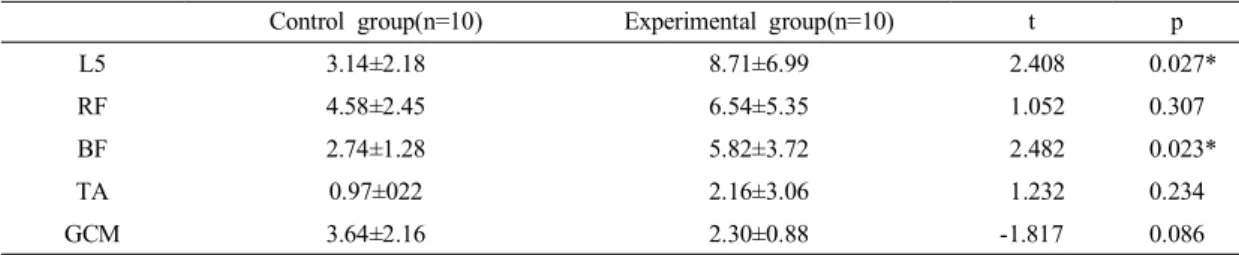
. Table 3

.

(p<0.05). ,

(p>0.05).

.

, ,

, , ,

(Shumway-Cook Woollacott, 2000).

(Lee , 2001).

Control group(n=10) Experimental group(n=10) t p

Area 97.00±3.32 170.50±27.71 2.634 0.017

Path 192.80±12.01 225.70±9.34 2.163 0.044

Velocity 27.20±1.31 38.60±3.31 3.203 0.005

p<0.05

Table 2. Comparison of BPM with different group (%MVC)

Control group(n=10) Experimental group(n=10) t p

L5 3.14±2.18 8.71±6.99 2.408 0.027*

RF 4.58±2.45 6.54±5.35 1.052 0.307

BF 2.74±1.28 5.82±3.72 2.482 0.023*

TA 0.97±022 2.16±3.06 1.232 0.234

GCM 3.64±2.16 2.30±0.88 -1.817 0.086

*p<0.05

L5 : L5 paraspinalis, RF: rectus femoris, BF: biceps femoris, TA: tibialis anterior, GCM: gastrocnemious

Table 3. Comparison of IEMG with different group (%MVC)

Age(years) Height( ) Weight( )

Control group(n=10) 22.20±0.42 164.00±1.81 55.70±0.65

Experimental group(n=10) 23.80±0.90 161.50±4.22 51.70±0.88

(Mean±SE)

(5)

(1997) 20

,

.

, ,

.

(2007)

.

.

. (1999)

.

. ,

.

- α

(Smith , 1996).

.

.

20

.

.

.

, .

. . 2007;18(2):311-330.

, , . 20

. . 2004;14(3):83-98.

, , .

. . 1999;6(2):32-42.

, .

. . 2003;12(1):75-84.

. ( )

. . . 2005.

, , .

Roll-Over . . 2007;

(6)

. . , , . 1998:73-80.

Barton CJ, Coyle JA, Tinley P. The effect of heel lifts on trunk muscle activation during gait: A study of young healthy females. J Electromyogr Kinesiol. 2008 May 8 [Epub ahead of print]

Gefen A, Megido-Ravid M, Itzchak Y et al.

Analysis of muscular fatigue and foot stability during high-heeled gait. Gait Posture 2002;15:

56-63.

Kerr HM, Eng JJ. Multidirectional measures of seated postural stability. Clin Biomech (Bristol, Avon).2002;17(7):555-7.

Lee KH, Shieh JC, Matteliano A et al. Electromyo- graphic changes of leg muscles with heel lifts in women: therapeutic implications. Arch Phys Med Rehabil 1990;71:31-3.

Lee CH, Jeong EH, Freivalds A. Biomechanical effects of wearing high-heeled shoes. Int J Ind Ergon 2001;28:321-6.

Li JX, Hong Y. Kinematic and electromyographic analysis of the trunk and lower limbs during

Assoc. 2007;97:447 .56.

Piqué-Vidal C, Solé MT, Antich J. Hallux valgus inheritance: pedigree research in 350 patients with bunion deformity. J Foot Ankle Surg. 2007 May-Jun;46(3):149-54.

Sackley CM, Hill HJ, Pound K et al. The intra- rater reliability of the balance performance monitor when measuring sitting symmetry and weight-shift activity after stroke in a community setting. Clin Rehabil. 2005 Oct;19(7):746-50.

Shumway-Cook A, Woollacott MH. Motor control:

Theory and practical applications(2nd ed). Baltimore:

Willims & Wilkins. 2000.

Smith LK, Weiss EL, Lehmkuhl LD. Brunnstrom's Clinical Kinesiology. 5th ed. Philadelphia. F.A.

Davis Co., 1996.

Snow RE, Williams KR. High heeled shoes: their effect on center of mass position, posture, three- dimensional kinematics, rearfoot motion, and ground reaction forces. Arch Phys Med Rehabil. 1994;

75(5):568-76.

수치

Fig 1. Adhesive position of superficial electrode L5 : L5 paraspinalis, RF: rectus femoris, BF: biceps femoris, TA: tibialis anterior, GCM: gastrocnemious
Table 3. Comparison of IEMG with different group (%MVC)

참조

관련 문서

Sixth, there was no significant correlation between lower extremity muscle thickness, static stability, and dynamic stability of excellent athletes in college

High complication rate in locking plate fixation of lower periprosthetic distal femur fractures in patients with total knee arthroplasties.. Management and

In conclusion, Pilates chair exercise is a positive factor in improving skeletal muscle mass among menopausal women's body composition and lower muscles EMG

The purpose of this study was to investigate the lower extremity muscle strength and student health of male middle school students. Twenty middle school

Organized participation in soccer club activity of middle and high school students had positive effects on their learning attitudes, school life and

In the lower extremity balance, the change in left unilateral clerk showed a statistically significant difference as the exercise group increased post-test

§ briefs, pants, wallet, keys, belt, socks, shoes, shirt, tie, jacket, iPod, watch. □ A more reasonable

 Some special high angle boundaries have significantly lower energy than ordinary high angle