J Korean Soc Transplant | www.ksot.org 6 March 2012 | Volume 26 | Issue 1 J Korean Soc Transplant | 2012;26:6-9 | http://dx.doi.org/10.4285/jkstn.2012.26.1.6
Review Article
The Diagnosis of Acute Antibody-Mediated Rejection in ABO-Incompatible Liver Transplants
Department of Pathology, Samsung Medical Center, Sungkyunkwan University School of Medicine, Seoul, Korea
Ghee Young Kwon, M.D.
Liver transplantation (LT) across the ABO-blood type barrier is prone to antibody-mediated rejection (AMR), which often leads to a deleterious clinical outcome. While it is of paramount importance to make an early diagnosis of AMR, the morphologic features of AMR in the liver are not specific, and the differential diagnosis is often difficult or even impossible on a morphologic basis alone. The clinical utility of C4d immunostaining is limited in the liver, unlike other organs, further complicating the situation. Therefore, the diagnosis of AMR in the liver requires integration of clinical, morphologic, immunopathologic, and serological evidence.
Key Words: ABO-incompatible transplantation, Liver, Acute antibody-mediated rejection, C4d 중심 단어: ABO 부적합, 이식, 간, 급성 항체매개형 이식거부반응, C4d
Correspondence:Ghee Young Kwon, Department of Path- ology, Samsung Medical Center, 50 Ilwon-dong, Gangnam-gu, Seoul 135-710, Korea
Tel: +82-2-3410-2770, Fax: +82-2-3410-0025 E-mail: [email protected]
Received : February 29, 2012, Accepted : March 5, 2012
Introduction
Liver transplantation (LT) across the ABO-blood type barrier (ABO-incompatible; ABOi) poses a significant risk of graft failure due to antibody-mediated rejection (AMR) caused by anti-donor blood group A/B anti- bodies(1). Therefore, it is important to make a correct and timely diagnosis followed by prompt initiation of the appropriate management. However, the diagnosis of AMR in liver is not straightforward and too often difficult. In this review, the pathologic features and the diagnosis of AMR in ABOi LT are briefly discussed.
General Considerations in Liver Transplantation
Liver is considered a relatively tolerogenic organ less susceptible to AMR and the resistance is attributed to a variety of characteristic features of liver which contribute to the clearing and dilution of antibodies or
antigen-antibody complexes, such as Kupffer cell pha- gocytosis, large sinusoidal surface area, dual afferent hepatic blood supply, and secretion of soluble MHC class I antigens(2). Therefore, it was expected that liv- er would be a more plausible target for ABOi trans- plantation but it turned out that the hurdle for ABOi transplantation is higher in liver and kidney was the first organ to be successfully transplanted across ABO blood group barrier(3).
General Pathologic Features of Acute Allograft Rejection
Allograft rejection is a form of immunologic reaction initiated by a host (i.e. recipient) after exposure to a foreign (i.e. donor) antigens. In common with other forms of immune reactions, allograft rejection is gen- erally classified according to a major immunopatho- genic mechanism. Thus, cellular rejection is mediated by immune cells infiltrating into grafted organs, a ma- jority of which are T lymphocytes and anti-donor anti- bodies play an axial role in AMR.
In morphological aspects, cellular rejection is easier
to demonstrate because the offender cells are readily
recognized under light microscope as small dark
round cells infiltrating into interstitium and tubules (as
Ghee Young Kwon: The Diagnosis of Acute Antibody-Mediated Rejection of Liver Transplants
J Korean Soc Transplant | www.ksot.org 7 March 2012 | Volume 26 | Issue 1
in renal allograft) or portal tract and bile ducts often involving venules (as in hepatic allograft)(4). In con- trast, the instigating antibodies of AMR are not visible under light microscope and the intragraft plasma cells are not indicators of AMR since the antibodies are produced in other organs and the roles of intragraft plasma cells are mainly in maintaining cytokine milieu.
Thus, reliable histologic diagnosis of AMR had to wait for the advent of C4d immunostaining(5).
The Role of C4d in the Diagnosis of AMR
C4d is a degradation product of C4 produced in the process of complement cascade after antigen antibody interaction. It is covalently bound to the vascular sur- face and thus can be detected by immunostaining while other components of complement system are washed away into the blood stream(5). Positive re- action to C4d on immunostaining is a diagnostic in- dicator of acute AMR after renal(6,7) or cardiac(8) al- lograft strongly decorating interstitial capillary struc- tures. However, the significance of C4d staining is not the same in different organs and in liver it is not clearly established(9,10).
Morphology of Hyperacute Rejection in Liver
Hyperacute rejection is caused by preformed anti- donor antibodies in the recipient and is the prototype of AMR. In liver, it presents in slightly different tem- poral context and the manifestation is not as “hypera- cute” as in kidney, in which the characterstic findings are already encountered in the operation room. There- fore, some authors prefer the term, “primary AMR”
but the basic morphologic features are equivalent to those of hyperacute rejection in other organs(11).
Pathologic features of “hyperacute rejection” can be found in failed ABOi LT and grossly, the liver is en- larged and hemorrhagic with random areas of necrosis and thrombosis in large vessels. Microscopically, in- flammatory vasculitis can be found and blood vessels show reactive endothelial cells with aggregate/sludge of platelets/neutrophils(11).
Histologic Features of AMR in Liver
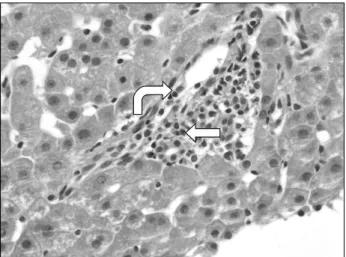
In liver, histologic features of AMR are not specific and constellation of microscopic findings are found depending on the timing of the biopsy and the char- acteristics of the antibodies(11,12). Commonly present microscopic findings include clustering of neutrophils, neutrophilic portal infiltrates, red blood cell (RBC) sludging and neutrophil margination, portal edema, fo- cal hemorrhage in space of Disse, fibrinoid degener- ation of arteries, single cell or clusters of hepatocyte necrosis, patchy geographic infarction and bile ductu- lar proliferation. Most of the above-mentioned features reflect non-specific inflammatory reaction, endothe- lial/vascular damage and the subsequent consequen- ces. These findings are not specific and can be found in a variety of other conditions such as preservation injury, hypoxic injury, septic injury and biliary ob- struction all of which share common pathophysiology of endothelial damage(11-13). Particularly problematic is preservation injury, which, when severe, can pres- ent in almost identical morphologic context. Helpful features in differential diagnosis are margination of neutrophils and macrophages, endothelial activation and blastic lymphocytes and eosinophils, however, it is not always possible to make a clear distinction (Fig.
1)(12). Often present late sequelae include loss of small bile ducts, obliterative arteriopathy and ob- structive cholangiopathy(14,15).
The Significance of C4d Immunostaining in Liver
The clinical implication of C4d reactivity is not
straightforward in liver and there are controversial re-
ports regarding the frequency, pattern and clinical cor-
relation(9,16). Focal deposition of C4d in liver is
found in a variety of conditions and is generally re-
garded as of little clinical impact. There are reports
that show extensive C4d deposition is associated with
AMR and correlated with graft survival(10). However,
C4d deposition in liver has been reported in several
other conditions, such as acute cellular rejection,
chronic rejection, recurrent diseases including auto-
Ghee Young Kwon: The Diagnosis of Acute Antibody-Mediated Rejection of Liver Transplants
J Korean Soc Transplant | www.ksot.org 8 March 2012 | Volume 26 | Issue 1
Fig. 1. Histologic features of morphologically severe preserva- tion injury simulating AMR. Above findings are from protocol biopsy of 1 week post-transplant after ABOi LT. Portal tract shows activated endothelial cells (curved arrow) and gran- ulocytic infiltrates (straight arrow). These findings are sugges- tive of AMR, however, in this patient, the level of serum trans- aminase was withing normal limits and C4d-immunostaining was negative. Final diagnosis of preservation injury was ren- dered (H&E, ×400).
immune hepatitis and even preservation injury(16-18).
And it should be kept in mind that C4d is often pos- itive in well-functioning ABOi kidney transplant(19).
Regarding the pattern of staining, it is worthwhile to cover the significance of staining in portal stroma. In view of its mechanism, it is to be expected that C4d staining is present on vascular structures and in ordi- nary situation of immunostaining in the practice of pathology, the decoration of stroma by markers other than mesenchymal ones, is regarded as nonspecific reaction. However, there have been reports that asso- ciate clinical outcome with C4d positivity defined as portal stromal staining(20) though the findings have not been confirmed in other studies(16). In my per- sonal opinion, to confer significance on stromal stain- ing is counterintuitive to most pathologists and re- quires thorough validation through extensive studies.
Relative consensus to date concerning C4d staining in liver can thus be summarized that the staining is sparse in native liver and that diffuse strong staining in portal microvasculature is indicative of AMR but can be found in other conditions and thus not completely specific or sensitive(16,17).
Grading of AMR
It is not surprising that there is no consensus grad- ing system for AMR considering that the histologic di- agnosi itself is not straightforward. However, it is one of second natures for pathologists to grade, and there are a few proposals for grading. One is to apply Banff rejection activity index with minor modification(20) and another is to devise a similar version(21).
Summary
AMR after ABOi LT has no highly specific histologic features and C4d immunostaining has limited utility.
Therefore, the diagnosis of AMR should be defined by combined clinical, morphologic, immunopathologic and serological evidence.
REFERENCES
1) Egawa H, Teramukai S, Haga H, Tanabe M, Fukushima M, Shimazu M. Present status of ABO-incompatible liv- ing donor liver transplantation in Japan. Hepatology 2008;47:143-52.
2) Demetris AJ, Murase N, Nakamura K, Iwaki Y, Yagihashi A, Valdivia L, et al. Immunopathology of antibodies as effectors of orthotopic liver allograft rejection. Semin Liver Dis 1992;12:51-9.
3) Tanabe M, Kawachi S, Obara H, Shinoda M, Hibi T, Kitagawa Y, et al. Current progress in ABO-incompatible liver transplantation. Eur J Clin Invest 2010;40:943-9.
4) Mathew JM, Ruiz P. Immunopathology of organ trans- plantation. In: Ruiz P, ed. Transplantation pathology. 1st ed. Cambridge: Cambridge University Press; 2009:1-16.
5) Gierej B, Górnicka B, Wasiutyński A. Role of C3d and C4d complement fragments in the diagnostics of acute allograft rejection after transplantations. Ann Transplant 2009;14:61-70.
6) Takemoto SK, Zeevi A, Feng S, Colvin RB, Jordan S, Kobashigawa J, et al. National conference to assess anti- body-mediated rejection in solid organ transplantation.
Am J Transplant 2004;4:1033-41.
7) Collins AB, Schneeberger EE, Pascual MA, Saidman SL, Williams WW, Tolkoff-Rubin N, et al. Complement acti- vation in acute humoral renal allograft rejection: diag- nostic significance of C4d deposits in peritubular capilla- ries. J Am Soc Nephrol 1999;10:2208-14.
8) Behr TM, Feucht HE, Richter K, Reiter C, Spes CH, Pongratz D, et al. Detection of humoral rejection in hu- man cardiac allografts by assessing the capillary deposition
Ghee Young Kwon: The Diagnosis of Acute Antibody-Mediated Rejection of Liver Transplants
J Korean Soc Transplant | www.ksot.org 9 March 2012 | Volume 26 | Issue 1
of complement fragment C4d in endomyocardial biop- sies. J Heart Lung Transplant 1999;18:904-12.
9) Troxell ML, Higgins JP, Kambham N. Evaluation of C4d staining in liver and small intestine allografts. Arch Pathol Lab Med 2006;130:1489-96.
10) Sakashita H, Haga H, Ashihara E, Wen MC, Tsuji H, Miyagawa-Hayashino A, et al. Significance of C4d stain- ing in ABO-identical/compatible liver transplantation.
Mod Pathol 2007;20:676-84.
11) Demetris AJ, Jaffe R, Tzakis A, Ramsey G, Todo S, Belle S, et al. Antibody-mediated rejection of human ortho- topic liver allografts. A study of liver transplantation across ABO blood group barriers. Am J Pathol 1988;
132:489-502.
12) Demetris AJ, Minervini M, Nalesnik M, Ochoa E, Randhawa P, Sasatomi E, et al. Histopathology of liver transplantation. In: Ruiz P, ed. Transplantation patho- logy. 1st ed. Cambridge: Cambridge University Press;
2009:111-84.
13) Haga H, Egawa H, Shirase T, Miyagawa A, Sakurai T, Minamiguchi S, et al. Periportal edema and necrosis as diagnostic histological features of early humoral rejection in ABO-incompatible liver transplantation. Liver Transpl 2004;10:16-27.
14) Sanchez-Urdazpal L, Batts KP, Gores GJ, Moore SB, Sterioff S, Wiesner RH, et al. Increased bile duct compli- cations in liver transplantation across the ABO barrier.
Ann Surg 1993;218:152-8.
15) Sebagh M, Farges O, Kalil A, Samuel D, Bismuth H, Reynes M. Sclerosing cholangitis following human or- thotopic liver transplantation. Am J Surg Pathol 1995;19:
81-90.
16) Bellamy CO. Complement C4d immunohistochemistry in the assessment of liver allograft biopsy samples: appli- cations and pitfalls. Liver Transpl 2011;17:747-50.
17) Ali S, Ormsby A, Shah V, Segovia MC, Kantz KL, Skorupski S, et al. Significance of complement split prod- uct C4d in ABO-compatible liver allograft: diagnosing utility in acute antibody mediated rejection. Transpl Immunol 2012;26:62-9.
18) Neuman UP, Neuhaus P. C4d immunostaining in acute humoral rejection after ABO blood group-incompatible liver transplantation. Liver Transpl 2006;12:356-7.
19) Haas M. The significance of C4d staining with minimal histologic abnormalities. Curr Opin Organ Transplant 2010;15:21-7.
20) Haga H, Egawa H, Fujimoto Y, Ueda M, Miyagawa- Hayashino A, Sakurai T, et al. Acute humoral rejection and C4d immunostaining in ABO blood type-incompat- ible liver transplantation. Liver Transpl 2006;12:457-64.
21) Morioka D, Togo S, Kumamoto T, Takeda K, Matsuo K, Inayama Y, et al. Six consecutive cases of successful adult ABO-incompatible living donor liver transplanta- tion: a proposal for grading the severity of antibody-me- diated rejection. Transplantation 2008;85:171-8.