• 검색 결과가 없습니다.

Comparing 18F-Fluorodeoxyglucose Positron Emission Tomography and Video-assisted Thoracoscopic Surgery in the Evaluation of Small Pulmonary Nodules in Patients with a History of Malignancy

N/A
N/A
Protected

Academic year: 2021

Share "Comparing 18F-Fluorodeoxyglucose Positron Emission Tomography and Video-assisted Thoracoscopic Surgery in the Evaluation of Small Pulmonary Nodules in Patients with a History of Malignancy"

Copied!
5
0
0

로드 중.... (전체 텍스트 보기)

전체 글

(1)

http://dx.doi.org/10.5090/kjtcs.2012.45.1.35 ISSN: 2233-601X (Print) ISSN: 2093-6516 (Online)

Department of Thoracic and Cardiovascular Surgery,

1

Sacred Heart Hospital, Hallym University College of Medicine,

2

Kangdong Sacred Heart Hospital, Hallym University College of Medicine,

3

Kangwon National University Hospital, Kangwon National University School of Medicine,

4

Kangnam Sacred Heart Hospital, Hallym University College of Medicine,

5

Chuncheon Sacred Heart Hospital, Hallym University College of Medicine

Received: July 11, 2011, Revised: October 13, 2011, Accepted: November 11, 2011

Corresponding author: Sung Woo Cho, Department of Thoracic and Cardiovascular Surgery, Kangdong Sacred Heart Hospital, Hallym University College of Medicine, 150 Seongnaegil, Gandgong-gu, Seoul 134-701, Korea

(Tel) 82-2-2224-2241 (Fax) 82-2-488-0114 (E-mail) [email protected]

C

The Korean Society for Thoracic and Cardiovascular Surgery. 2012. All right reserved.

CC

This is an open access article distributed under the terms of the Creative Commons Attribution Non-Commercial License (http://creative- commons.org/licenses/by-nc/3.0) which permits unrestricted non-commercial use, distribution, and reproduction in any medium, provided the original work is properly cited.

Comparing 18F-Fluorodeoxyglucose Positron Emission Tomography and Video-assisted Thoracoscopic Surgery

in the Evaluation of Small Pulmonary Nodules in Patients with a History of Malignancy

Hong Kyu Lee, M.D.

1

, Sung Woo Cho, M.D.

2,3

, Hee Sung Lee, M.D.

4

, Kun Il Kim, M.D.

1

, Hyoung Soo Kim, M.D.

5

, Seong Joon Cho, M.D.

3

Background: The aims of the study were to determine the accuracy of fluorodeoxyglucose positron emission to- mography (FDG-PET) in detecting pulmonary metastasis through video-assisted thoracoscopic surgery (VATS), a technique that allows the excisional biopsy of small pulmonary nodules in patients with known malignancies.

Materials and Methods: Between October 2007 and April 2010, 28 patients with known malignancies and small pulmonary nodules underwent VATS excisional biopsies. All patients were in follow-up for a previously treated malignancy. The malignancies included the following: colorectum (9), breast (6), head and neck (5), stomach (3), lymph (1), ovary (1), uterus (1), bladder (1), and liver (1). Results: There were 16 men and 12 women whose mean age was 56.7 years old (range, 38 to 77 years). The sizes of the mean nodules removed were 11.3 mm (range, 7 to 21 mm). Diagnoses included metastatic (11), bronchioloalveolar carcinoma (1), primary adenocarcinoma (1), pulmonary tuberculosis (6), fibrosis (5), organizing pneumonia (3), lymphoid hyperplasia (1). Among these le- sions, 46.4% were malignant. Conclusion: True positive FDG-PET was 39.2%. FDG-PET is not a sensitive test in the evaluation of patients with a history of an extrathoracic malignancy and newly diagnosed small pulmonary nodules. VATS excision allows the early diagnosis of small pulmonary nodules, with low morbidity, in patients with known malignancies.

Key words: 1. Video-assisted thoracic surgery 2. Biopsy

3. Positive emission tomography

INTRODUCTION

During follow-up, patients with known malignancies com- monly undergo screening studies to detect recurrence or metastasis. 18F-fluorodeoxyglucose positron emission tomog-

raphy (FDG-PET) is increasingly being used for screening, often in conjunction with computed tomography (CT).

Overall, in the setting of an indeterminate nodule greater

than 1 cm, FDG-PET has a sensitivity of 96.8% and specific-

ity of 77.8% in the detection of malignancy [1]. However, lit-

(2)

Table 1. Patient characteristics

Characteristics Number

Sex Male Female

Known malignancies Colorectum Breast Head and neck Stomach Lymph Ovary Uterus Bladder Liver

16 12

9 6 5 3 1 1 1 1 1

tle is known about the accuracy of FDG-PET in detecting ex- trathoracic malignancies that have spread to the lungs.

Recently, video assisted thoracoscopic surgery (VATS) has been performed for the resection of small pulmonary lesions.

This technique is less painful and invasive, and is thus more acceptable to patients than thoracotomy.

In this study, we performed VATS in cases of suspected pulmonary metastasis from known malignancy. The aims of the study were to determine the accuracy of FDG-PET in de- tecting pulmonary metastasis through the VATS technique, which allows the excisional biopsy of small pulmonary nod- ules in patients with known malignancies.

MATERIALS AND METHODS

Between July 2007 and April 2010, we prospectively stud- ied 28 patients who were in follow-up care for a previously treated malignancy. The malignancies included the colorectum (9), breast (6), head and neck (5), stomach (3), lymph (1), ovary, uterus, liver, bladder (Table 1). Small pulmonary nod- ules had been found on chest CT and FDG-PET during rou- tine follow-up care. Diagnostic VATS was then performed as part of a metastatic evaluation within a mean 20 days (range, 2 to 90 days).

Medical records were reviewed for age, gender, primary tu- mor type, chest CT, and FDG-PET results, as well as histo- pathology of the removed nodules. Chest CT results were transcribed based on the clinical report, as well as review of

the images, with nodule measurement. FDG-PET imaging re- sults with the maximum standardized uptake values (SUVmax) were abstracted from the radiology reading at our institution.

In operating room, the patient was positioned for VATS.

The operative lung was isolated. After prepping and draping, three working ports were created and the lung was visualized.

An autosuture stapling device that was 45 or 60 mm long and used 4.8 mm staples was placed on an area of the lung with palpation and was fired. The excised wedge of lung was removed from the chest. Palpation confirmed the resection of the correct pulmonary nodule. Frozen section histopathologic evaluation identified the nature of the lesion. The independent sample t-test was used for statistical analysis. All statistical analyses were performed using SPSS ver. 18.0 (SPSS Inc., Chicago, IL, USA).

RESULTS

There were 16 men and 12 women whose median age was 56.7 years old (range, 38 to 77 years). All lesions were re- sected on the first attempt using standard VATS wedge ex- cision techniques. Postoperative median length of chest tube drainage was 3.9 days (range, 2 to 8 days). No intraoperative or postoperative complications were detected.

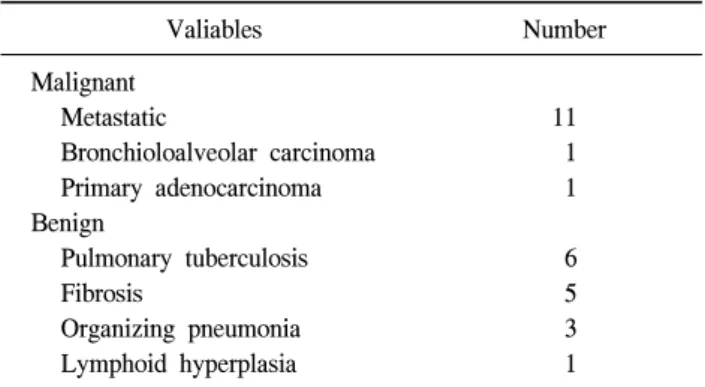
Thirteen of 28 (46.4%) small pulmonary nodules were malignant. The histopathology of the nodules was metastatic adenocarcinoma in 6 (5 in the colorectum, 1 in the breast), primary adenocarcinoma in 1 (breast), squamous cell in 4 (3 in the head and neck, 1 in the uterus), urothelial carcinoma in 1, and bronchioloalveolar carcinoma in 1. Benign diag- noses included pulmonary tulberculosis in 6, fibrosis in 5, or- ganizing pneumonia in 3, and lymphoid hyperplasia in 1 (Table 2).

Overall sensitivity of 18F-FDG-PET in the 28 patients who

underwent resection was 39.2%. No association was found

between malignant and benign tissue in the SUVmax and tu-

mor sizes (Table 3). A receiver operating characteristics curve

was constructed and a cut-off value was determined for the

diagnosis of metastatic small pulmonary nodules. Using the

cut-off of 2.5 for the SUVmax, the sensitivity and specificity

for predicting metastatic small pulmonary nodules were

(3)

Table 2. Results of video-assisted thoracoscopic surgery

Valiables Number

Malignant Metastatic

Bronchioloalveolar carcinoma Primary adenocarcinoma Benign

Pulmonary tuberculosis Fibrosis

Organizing pneumonia Lymphoid hyperplasia

11 1 1

6 5 3 1

Table 3. Tumor size and maximal SUV (mean)

Valiables Benign Malignant p-value Tumor size (mm)

Maximal SUV

11.88 3.75

10.81 4.18

0.565 0.649 SUV=standard uptake value.

Fig. 1. Receiver operating characteristics (ROC) curve for maximal standard uptake value (95% confidence interval).

Fig. 2. Receiver operating characteristics (ROC) curve for tumor size (95% confidence interval).

60.0% and 43.7%, respectively. Using the cut-off of 1 mm for tumor size, the sensitivity and specificity for predicting metastatic small pulmonary nodules were 45.0% and 50.0%, respectively (Figs. 1, 2).

DISCUSSION

The presumed diagnosis of small pulmonary nodules is based on several factors: the age of the patient, associated symptoms, appearance of the lesion on a radiograph, and the length of time the lesion has been present. A single pulmo- nary nodule is more likely to be malignant in patients with known cancer [2].

The idea of whole body cancer surveillance is very appeal- ing and has, for some, compelled the use of FDG-PET as a screening tool for recurrence of various malignancies.

Integrated FDG-PET/CT can evaluate nodules as small as 7 or 8 mm in size. A high SUVmax, especially in a small pul- monary nodule, provides important information and helps guide therapy. Moreover, an integrated FDG-PET/CT may provide other targets (lymph nodes or M1 sites) that harbor metastatic disease that require biopsy prior to resection. The optimal value of the SUVmax for mediastinal and hilar lymph nodes has recently been evaluated [3].

The usefulness of 18F-FDG-PET for differentiation of be- nign and malignant pulmonary lesions has been investigated in various studies [4-6]. The reported sensitivity and specific- ity of the 18F-FDG-PET ranges between 0.75 and 1.0.

SUVmax were significantly increased in malignant lesions compared to benign lesions [7], and the value of 2.5 is ac- cepted as the cut-off point for malignancy [8].

SUV expresses FDG uptake by the lesion normalized ac-

cording to the dose administered and the subject’s body

weight. In fact, having defined the many factors that can af-

fect the uptake of labeled glucose and, therefore, the SUV, it

is not easy to establish fixed values that serve to distinguish

(4)

between the benign and malignant nature of a small pulmo- nary nodule [9]. A number of formulas designed to correct the underestimation of the SUV caused by hyperglycemia, such as adjusting the value of this parameter according to the patient’s serum glucose level, have also been studied. Using this method, some authors have achieved a slight increase in the reproducibility of the technique [10]. While much has been published about the sensitivity of FDG-PET for pulmo- nary nodules in primary lung cancer, little information has been available on the sensitivity of PET for metastatic pul- monary lesions from extrathoracic malignancies.

Modern CT scanners have a far higher detection rate than CT scanners of 15 years ago. Even in the case of small nod- ules, we could use CT localization to identify the metastasis.

The accurate and timely diagnosis of pulmonary nodules is essential for the proper management of patients with known malignancies. The implications of metastatic lung lesions, no matter what size, on treatment selection for patients who have received a diagnosis of a malignancy are enormous. However, the small size of these lesions makes diagnosis difficult.

Definitive diagnosis of lung lesions can sometimes not be made because of the inaccessibility of the true lesion or the inadequacy of the sample size [11,12]. Bronchoscopic biopsy and percutaneous needle biopsy under CT are useful methods;

however, they are not always able to yield a definite diag- nosis, since results depend on the technique and tumor size.

Moreover, specimens may be too small to be diagnosed, and negative biopsy results might require further examination.

Surgical lung biopsy is considered the final diagnostic modal- ity to be used in patients with undiagnosed small pulmonary nodules.

VATS has replaced thoracotomy as the preferred surgical modality for diagnostic excisional biopsy of indeterminate pulmonary nodules because of decreased morbidity. We do use finger palpation through the port if we have difficulty identifying the lesion or the margins. We also use long Roberts haemostatic clamps to feel the surface of the lung when we search for the lesion. It is generally accepted that VATS biopsy reduces postoperative pain and disability, caus- es fewer operative scars, and is equally effective in obtaining histologic diagnosis [13,14].

CONCLUSION

In patients with a history of an extrathoracic malignancy and newly diagnosed small pulmonary nodules, FDG-PET is not sensitive enough to dictate treatment. The results of this study in patients with known malignant disease reinforce the need for timely VATS wedge excision of small pulmonary nodules.

REFERENCES

1. Gould MK, Maclean CC, Kuschner WG, Rydzak CE, Owens DK. Accuracy of positron emission tomography for diagnosis of pulmonary nodules and mass lesions: a meta-analysis. JAMA 2001;285:914-24.

2. Sortini A, Carcoforo P, Ascanelli S, Sortini D, Pozza E.

Significance of a single pulmonary nodule in patients with previous history of malignancy. Eur J Cardiothorac Surg 2001;20:1101-5.

3. Bryant AS, Cerfolio RJ, Klemm KM, Ojha B. Maximum standard uptake value of mediastinal lymph nodes on in- tegrated FDG-PET-CT predicts pathology in patients with non-small cell lung cancer. Ann Thorac Surg 2006;82:

417-22.

4. Halter G, Storck M, Guhlmann A, Frank J, Grosse S, Liewald F. FDG positron emission tomography in the diag- nosis of peripheral pulmonary focal lesions. Thorac Cardio- vasc Surg 2000;48:97-101.

5. Erasmus JJ, McAdams HP, Connolly JE. Solitary pulmonary nodules: Part II. Evaluation of the indeterminate nodule.

Radiographics 2000;20:59-66.

6. Pieterman RM, van Putten JW, Meuzelaar JJ, et al. Preoper- ative staging of non-small-cell lung cancer with posi- tron-emission tomography. N Engl J Med 2000;343:254-61.

7. Duhaylongsod FG, Lowe VJ, Patz EF Jr, Vaughn AL, Coleman RE, Wolfe WG. Lung tumor growth correlates with glucose metabolism measured by fluoride-18 fluo- rodeoxyglucose positron emission tomography. Ann Thorac Surg 1995;60:1348-52.

8. Prauer HW, Weber WA, Romer W, Treumann T, Ziegler SI, Schwaiger M. Controlled prospective study of positron emis- sion tomography using the glucose analogue [18f]fluo- rodeoxyglucose in the evaluation of pulmonary nodules. Br J Surg 1998;85:1506-11.

9. Hickeson M, Yun M, Matthies A, et al. Use of a corrected

standardized uptake value based on the lesion size on CT

permits accurate characterization of lung nodules on FDG-

PET. Eur J Nucl Med Mol Imaging 2002;29:1639-47.

(5)

10. Nakamoto Y, Zasadny KR, Minn H, Wahl RL. Reproducibi- lity of common semi-quantitative parameters for evaluating lung cancer glucose metabolism with positron emission to- mography using 2-deoxy-2-[18F]fluoro-D-glucose. Mol Imag- ing Biol 2002;4:171-8.

11. Burt ME, Flye MW, Webber BL, Wesley RA. Prospective evaluation of aspiration needle, cutting needle, transbron- chial, and open lung biopsy in patients with pulmonary infil- trates. Ann Thorac Surg 1981;32:146-53.

12. Curley FJ, Johal JS, Burke ME, Fraire AE. Transbronchial lung biopsy: can specimen quality be predicted at the time of biopsy? Chest 1998;113:1037-41.

13. Ferguson MK. Thoracoscopy for diagnosis of diffuse lung disease. Ann Thorac Surg 1993;56:694-6.

14. Carnochan FM, Walker WS, Cameron EW. Efficacy of video

assisted thoracoscopic lung biopsy: an historical comparison

with open lung biopsy. Thorax 1994;49:361-3.

수치

Table 1. Patient characteristics Characteristics Number Sex Male Female Known  malignancies Colorectum Breast Head  and  neck Stomach Lymph Ovary Uterus Bladder Liver 1612  9  6  5  3  1  1  1  1  1
Table 3. Tumor size and maximal SUV (mean)

참조

관련 문서

The index is calculated with the latest 5-year auction data of 400 selected Classic, Modern, and Contemporary Chinese painting artists from major auction houses..

It considers the energy use of the different components that are involved in the distribution and viewing of video content: data centres and content delivery networks

a prospective analysis of 50 cases. Preoperative staging of non-small-cell lung cancer with positron-emission tomography. Staging of non- small-cell lung cancer

Randomised, double blind, placebo controlled study of fluticasone propionate in patients with moderate to severe chronic obstructive pulmonary disease: the

The “Asset Allocation” portfolio assumes the following weights: 25% in the S&P 500, 10% in the Russell 2000, 15% in the MSCI EAFE, 5% in the MSCI EME, 25% in the

1 John Owen, Justification by Faith Alone, in The Works of John Owen, ed. John Bolt, trans. Scott Clark, "Do This and Live: Christ's Active Obedience as the

This study aims to assess the impacts of the foundation and management of the Innopolis start-ups in terms of expansion of entrepreneurship

In this study, two experiments were conducted to understand the effects of additional charge on the detailed growth mechanism of Alq 3 and to determine the effect of