A Prospective Korean Multicenter Study for Infectious Complications in Patients Undergoing Prostate Surgery:
Risk Factors and Efficacy of Antibiotic Prophylaxis
This multicenter study was undertaken to determine the efficacy of antibiotic prophylaxis and identify the risk factors for infectious complications after prostate surgery in Korean patients. A total of 424 patients who underwent surgery of the prostate were reviewed. All patients underwent urinalysis and urine culture preoperatively and postoperatively. Efficacy of antibiotic prophylaxis and risk factors for infectious complications were investigated.
Infectious complications were observed in 34.9% of all patients. Factors independently associated with infectious complications were diabetes mellitus (adjusted OR, 1.99; 95%
CI, 1.09-3.65, P = 0.025) and operation time (adjusted OR, 1.08; 95% CI, 1.03-1.13, P = 0.004). Clinicians should be aware of the high risk of infectious complications in patients with diabetes and those who undergo a prolonged operation time. Neither the type nor duration of prophylactic antibiotics resulted in differences in infectious complications.
Keywords: Urinary Tract Infections; Transurethral Resection of Prostate; Risk Factors Eu Chang Hwang,1 Seung Il Jung,1
Dong Deuk Kwon,1 Gilho Lee,2 Jae Hyun Bae,3 Yong Gil Na,4 Seung Ki Min,5 Hwancheol Son,6 Sun Ju Lee,7 Jae Min Chung,8 Hong Chung,9 In Rae Cho,10 Young Ho Kim,11 Tae-Hyoung Kim,12 and In Ho Chang12
1Department of Urology, Chonnam National University, Hwasun; 2Department of Urology, Dankook University, College of Medicine, Cheonan;
3Department of Urology, Korea University, College of Medicine, Seoul; 4Department of Urology, Chungnam National University, College of Medicine, Daejeon; 5Department of Urology, National Police Hospital, Seoul; 6Department of Urology, Seoul National University, College of Medicine, Seoul;
7Department of Urology, Kyung Hee University, School of Medicine, Seoul; 8Department of Urology, Kosin University, College of Medicine, Busan;
9Department of Urology, Konkuk University, School of Medicine, Chungju; 10Department of Urology, Inje University, College of Medicine, Busan; 11Department of Urology, Soon Chun Hyang University, College of Medicine, Bucheon; 12Department of Urology, Chung-Ang University, College of Medicine, Seoul;
The Korean Association of Urogenital Tract Infection and Inflammation (KAUTII), Seoul, Korea
Received: 6 February 2014 Accepted: 27 May 2014 Address for Correspondence:
Seung Il Jung, MD
Department of Urology, Chonnam National University Hwasun Hospital, 322 Seoyang-ro, Hwasun 519-763, Korea Tel: +82.61-379-7749, Fax: +82.61-379-7750 E-mail: [email protected]
Funding: This study was supported by the Research Foundation Grant funded by the Korean Urological Association (KUA-2012- 002).
http://dx.doi.org/10.3346/jkms.2014.29.9.1271 • J Korean Med Sci 2014; 29: 1271-1277
INTRODUCTION
The purpose of prophylactic antibiotic use is to prevent local or systemic postproce- dural infection. Two types of infection dominate urologic surgery: 1, urinary tract in- fection (UTI), which is either a space or organ infection associated with both endoscop- ic and endoluminal interventions and with both open or laparoscopic surgery, mostly coinciding with catheter and stent placement or an undetected harbored bacterial load; and 2, wound infection after open and laparoscopic surgery. A third form of in- fection is observed in the male genital system (prostatitis, epididymitis, and orchitis). A fourth form of infection, bloodstream-borne sepsis secondary to urologic instrumen- tation, accounts for 10% to 12% of healthcare-associated infections in urology wards (1). However, the use of antibiotics in urologic surgery has been controversial for de- cades (2, 3). During the previous decade, much progress in prostate surgery has been made (e.g., transurethral surgery, open and laparoscopic prostatectomy); however, controversy over antibiotic prophylaxis for prostatic surgery remains.
In the context of surgical field classification, transurethral resection of the prostate (TURP) can be categorized into a clean-contaminated or contaminated operation de- pending on the patient’s history of UTI/urogenital infection, catheterization, and ster- ile/nonsterile urine (4). This classification may extend to total or laparoscopic radical prostatectomy because during surgery, opening of the urogenital tract is inevitable and Foley catheterization is mandatory after the procedure (5). In this regard, the adminis- tration of prophylactic antibiotics is suitable for prevention of postoperative infectious complications. Unfortunately, however, studies of the prophylactic effect of antimicro- bial therapy and risk factors associated with TURP and other prostate interventions (e.g., adenoma enucleation, laser ablation) have been limited (6-9). In addition, there are few retrospective or prospective cohort studies of the prophylactic antibiotic effec- Urology
tiveness in total or radical prostatectomy (10-12). These studies focused only on surgical site infection, not UTI, and did not in- clude risk factor assessment. As mentioned previously, in cases of prostatectomy, the urinary tract is opened during the proce- dure; thus, postoperative bacteriuria is probably the main source of postoperative infectious complications (13). There- fore, it is reasonable to identify the risk factors for postoperative bacteriuria or infectious complications and the effectiveness of prophylactic antimicrobial therapy for prostate surgery.
There is currently a lack of information on the risk factors for infectious complications associated with prostate surgery in Korea. In addition, the Health Insurance Review & Assessment Service of Korea recently recommended the use of first- or sec- ond-generation instead of third-generation cephalosporins for prophylactic antibiotics in patients undergoing prostate surgery without any Korean evidence. Therefore, we evaluated the risk factors for infectious complications after transurethral surgery of the prostate and after open or laparoscopic prostate surgery as well as the efficacy of antibiotic prophylaxis.
MATERIALS AND METHODS Study population
From January 2012 to June 2013, we evaluated a total of 424 pa- tients with symptomatic benign prostatic hyperplasia or pros- tate cancer who underwent TURP, holmium laser enucleation of the prostate, photovaporization of the prostate (GreenLight laser; American Medical Systems, Minnetonka, MN, USA), or prostatectomy at multiple institutions in Korea. Inclusion crite- ria were as follows: patients who received initial intravenous antibiotics 30 to 60 min before prostate related surgery, patients who underwent urinalysis and urine culture by collection of a midstream urine sample on 3 to 5 days preoperatively, at 4 to 8 hr after postoperative removal of the catheter, and 1 to 2 weeks postoperatively. Patients were ineligible if they had no follow up urinalysis and urine culture.
All data were recorded prospectively. The clinical parameters subjected to analysis were age, preoperative maximal flow rate, residual urine volume, prostate volume, prostate-specific anti- gen level, resected prostate volume (fresh tissue weight in the operating room), operation time (minutes), duration of postop- erative catheterization, presence of bladder stones, recent (with- in 2 weeks) or preoperative UTI, presence of preoperative Foley catheterization, duration of antibiotic therapy (intravenous and oral), presence of diabetes mellitus (DM), operation method, type of antibiotics, and infectious complication rate. Postopera- tive infectious complications were defined as febrile UTI and bacteriuria.
Defintion of postoperative infectious complications Because “postoperative bacteriuria” is the best-assessed out-
come parameter, we chose this as the primary outcome param- eter for our purposes. Because we were aware of the possible lack of clinical significance of bacteriuria, our secondary out- come parameters were symptomatic UTI, fever, sepsis, and bac- teremia. Therefore, postoperative infectious complications were defined as febrile UTI and bacteriuria. Febrile UTI and bacteri- uria were described according to the clinical guideline for the diagnosis and treatment of urinary tract infections in Korea (14)
Use of antibiotics
All patients received an initial intravenous antibiotics 30 to 60 min before surgery. The oral antibiotics were the same type as the intravenous antibiotics used previously. The selection of in- travenous antibiotics was chosen according to physician prefer- ence.
Statistics
Statistical analysis was performed using the SPSS software, ver- sion 17.0 (SPSS Inc., Chicago, IL, USA). Descriptive analysis was performed to assess patient demographics. Univariate and mul- tivariate logistic regression analyses (stepwise backward proce- dure) were performed to assess the associations of clinical pa- rameters with infectious complications. Statistical significance was set at P < 0.05 for all analyses.
Ethics statement
The study protocol was reviewed and approved by the institu- tional review board of the Chonnam National University Hwa- sun Hospital (IRB approved protocol: No. 2012-177). All of sub- jects submitted informed consent.
RESULTS
Baseline demographics
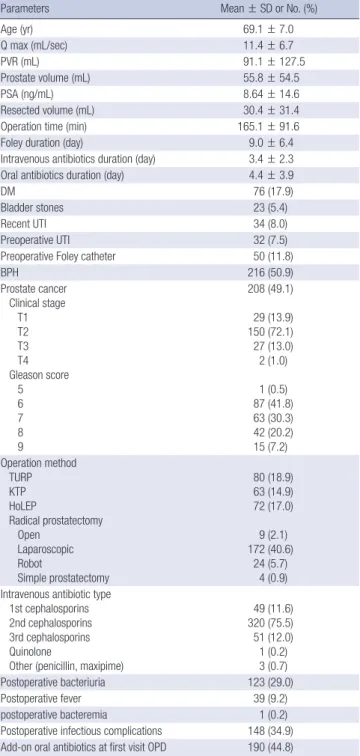
The mean age of the enrolled patients was 69.1 ± 7.0 yr. The mean prostate volume was 55.8 ± 54.5 mL. Of all 424 patients, 215 underwent transurethral prostate surgery and 209 patients underwent open or laparoscopic prostate surgery. The mean durations of the operative, intravenous antibiotic administra- tion, and postoperative Foley catheter placement were 165.1 ± 91.6 min, 3.4 ± 2.3 days, and 9.0 ± 6.4 days, respectively. The frequency of DM, recent UTI, preoperative UTI, and preopera- tive Foley catheter placement were 17.9%, 8.0%, 7.5%, and 11.8%, respectively. A first- or second-generation cephalosporin was given to 369 (87.0%) patients, and a third-generation cephalo- sporin to 51 (12.0%) patients (Table 1). Postoperative infectious complications developed in 149 (34.9%) paients, including post- operative bacteriuria (29.0%), fever (9.2%), and bacteremia (0.2%) (Table 1).
Clinical parameters associated with postoperative infectious complications
Univariate analysis indicated that long-term ( > 5 days) Foley catheterization (OR, 2.44; 95% CI, 1.59-3.73, P = 0.001), opera- tion time (OR, 1.02; 95% CI, 1.01-1.05, P = 0.006), transurethral prostate surgery (OR, 0.42; 95% CI, 0.28-0.64, P = 0.001), DM (OR, 1.66; 95% CI, 1.03-2.75, P = 0.049), and third-generation
cephalosporins (OR, 0.46; 95% CI, 0.23-0.93, P = 0.032) were risk factors for postoperative infectious complications. Howev- er, the prostate volume (OR, 0.99; 95% CI, 0.99-1.01, P = 0.052) and a duration of intravenous antibiotic administration > 72 hr (OR, 1.52; 95% CI, 0.99-2.33, P = 0.055) showed borderline sig- nificance (Table 2).
Multivariate analysis revealed that DM (adjusted OR, 1.99;
95% CI, 1.09-3.65, P = 0.025) and operation time (adjusted OR, 1.08; 95% CI, 1.03-1.13, P = 0.004) were independently associat- ed with postoperative infectious complications (Table 3).
Culture results
Among the patients who had postoperative bacteriuria and bac- teremia (n = 124), 4 patients had 2 organisms in culture. The quinolone resistance microorganisms were identified as Esche- richia coli (n = 4), Klebsiella pneumoniae (n = 2), Pseudomonas aeruginosa (n = 1), Enterobacter spp. (n = 1), Enterococcus spp.
(n = 14), Acinetobacter baumannii (n = 1), and others (n = 2).
Thus, overall quinolone resistance rate were 19.5% (25/128). In Table 1. Demographic and clinical characteristics of patients (n = 424)
Parameters Mean ± SD or No. (%)
Age (yr) 69.1 ± 7.0
Q max (mL/sec) 11.4 ± 6.7
PVR (mL) 91.1 ± 127.5
Prostate volume (mL) 55.8 ± 54.5
PSA (ng/mL) 8.64 ± 14.6
Resected volume (mL) 30.4 ± 31.4
Operation time (min) 165.1 ± 91.6
Foley duration (day) 9.0 ± 6.4
Intravenous antibiotics duration (day) 3.4 ± 2.3 Oral antibiotics duration (day) 4.4 ± 3.9
DM 76 (17.9)
Bladder stones 23 (5.4)
Recent UTI 34 (8.0)
Preoperative UTI 32 (7.5)
Preoperative Foley catheter 50 (11.8)
BPH 216 (50.9)
Prostate cancer Clinical stage
T1 T2 T3 T4 Gleason score
5 6 7 8 9
208 (49.1) 29 (13.9) 150 (72.1) 27 (13.0) 2 (1.0) 1 (0.5) 87 (41.8) 63 (30.3) 42 (20.2) 15 (7.2) Operation method
TURP KTP HoLEP
Radical prostatectomy Open
Laparoscopic Robot
Simple prostatectomy
80 (18.9) 63 (14.9) 72 (17.0) 9 (2.1) 172 (40.6)
24 (5.7) 4 (0.9) Intravenous antibiotic type
1st cephalosporins 2nd cephalosporins 3rd cephalosporins Quinolone
Other (penicillin, maxipime)
49 (11.6) 320 (75.5) 51 (12.0) 1 (0.2) 3 (0.7)
Postoperative bacteriuria 123 (29.0)
Postoperative fever 39 (9.2)
postoperative bacteremia 1 (0.2)
Postoperative infectious complications 148 (34.9) Add-on oral antibiotics at first visit OPD 190 (44.8)
Q max, maximal flow rate; PVR, post void residuals; PSA, prostate specific antigen;
DM, diabetes mellitus; UTI, urinary tract infection; TURP, transurethral resection of the prostate; KTP, photovaporization of the prostate using potassium-titanyl-phosphate laser; HoLEP, holmium laser enucleation of the prostate; OPD, outpatient department.
Table 2. Univariate analysis of predictive factors for infectious complications
Variables Odds ratio (95% CI) P value
Age < 70 yr ≥ 70 yr
Reference
1.30 (0.873-1.94) 0.196
DM 1.66 (1.03-2.75) 0.049
Bladder stones 0.99 (0.41-2.40) 0.975
Recent UTI 1.16 (0.56-2.40) 0.671
Preoperative UTI 1.30 (0.62-2.71) 0.481
Preoperative Foley 1.40 (0.77-2.56) 0.264
Qmax (continuous, mL/sec) 0.98 (0.95-1.02) 0.543
PVR (continuous, mL) 1.01 (0.99-1.03) 0.153
Prostate volume (continuous, mL) 0.99 (0.99-1.01) 0.052 Operation method (endoscopic)
Open, laparoscopy, robot Endoscopic
Reference 0.42 (0.28-0.64)
0.001 0.001 Foley catheter duration
≤ 5 days > 5 days
Reference
2.44 (1.59-3.73) 0.001 Intravenous antibiotics type
1st, 2nd cephalosporins 3rd cephalosporins Quinolone Other
Reference 0.46 (0.23-0.93)
0 (0) 0 (0)
0.205 0.032 1 0.999 Intravenous antibiotic duration
≤ 72 hr > 72 hr
Reference
1.52 (0.99-2.33) 0.055 Oral antibiotic treatment 0.77 (0.51-1.17) 0.230 Operation time (continuous, min) 1.02 (1.01-1.05) 0.006 DM, diabetes mellitus; PVR, post void residuals; Qmax, maximal flow rate.
Table 3. Multivariate analysis of predictive factors for infectious complications
Variables Adjusted odds ratio (95% CI) P value
DM 1.99 (1.09-3.65) 0.025
PVR (continuous, mL) 1.03 (1.00-1.05) 0.054
Operation time (continuous, min) 1.08 (1.03-1.13) 0.004 DM, diabetes mellitus; PVR, post void residuals.
addition, the results of extended spectrum β-lactamase (ESBL) positivity were similar to those of quinolone resistance rate (21.1%, Table 4).
DISCUSSION
The incidence of postoperative infectious complications after prostate-related surgery in this study was 34.9%. DM and a long operation time were independently predictive of postoperative infectious complications after prostate-related surgery. In uro- logic surgical practice, the prevention of postoperative infec- tious complications is important; however, few studies have evaluated the risk factors for postoperative infectious complica- tions in such settings.
The current classes of surgery/surgical field contamination were developed and updated for open surgery and to deter- mine the relative risk of surgical wound infection (15). Urologi- cal interventions have not been classified, and the current defi- nitions do not include endoscopic surgery. In addition, the cur- rent guidelines for surgical site infection focus on gastrointesti- nal surgery (5). The criteria for assessment of contamination categories in open surgery are the type of incision, level of spill- age, and evidence of infection or inflammation; UTI is not in- cluded. These guidelines cannot be adapted to urologic pros- tatic surgery because many urological procedures are associat- ed with urine exposure and endourological procedures. Wheth- er opening of the urinary tract should be classified as clean or clean-contaminated surgery in cases of negative urine culture remains controversial. The same applies to endoscopic and transurethral surgery. For practical and strategic reasons, clean- contaminated urologic operations should be extended. In an extension, this classification could theoretically be widened to also cover endoscopic urological procedures, the surgical site being the urinary tract and the surgical site infection being UTI.
Several studies have shown that these procedures should be considered clean-contaminated because urine culture is not
always a predictor of bacterial presence, and the lower genito- urinary tract is colonized by microflora, even in the presence of sterile urine (3, 16). According to recent criteria for the assess- ment of level of surgical class/surgical field contamination in prostatic urological procedures, these procedures are consid- ered contaminated in the presence of a previous history of UTI/
urogenital infection (prostatitis), presurgical catheterization, or controlled bacteriuria (4).
In addition, there is a paucity of evidence for prophylactic antibiotics and risk factors in laparoscopic radical prostatecto- my. Therefore, it is valuable to evaluate the risk factors for post- operative infectious complications related to prostate surgery and the efficacy of prophylactic antibiotics in the era of antibi- otic resistance.
Postoperative UTI and bacteremia are the principal compli- cations after TURP; therefore, antibiotic prophylaxis is essential (17). However, the most optimal antibiotic regimen and dura- tion of prophylaxis remain to be determined. According to the systematic reviews by Berry and Barratt (18) and Qiang et al.
(19), the incidences of postoperative bacteriuria and bactere- mia more severe than UTI are approximately 26.0% and 4.4%, respectively. In this regard, the authors concluded that antibi- otic prophylaxis significantly decreases the development of post-TURP bacteriuria, post-TURP fever, sepsis, and the need for additional antibiotics post-TURP. In addition, there was a trend suggesting higher efficacy with a short course (< 72 hr) of antibiotic prophylaxis than with a single-dose regimen (18).
No randomized controlled trials on antibiotic prophylaxis versus placebo/no antibiotics in total prostatectomy have been performed. Thus, there is a lack of baseline data on the infec- tious profile of this frequently performed operation. A few ret- rospective and prospective cohort studies have evaluated surgi- cal site infections and catheter-associated bacteriuria following different antibiotic regimens. They concluded that the frequen- cy of wound infection is low and that a single oral antibiotic dose is sufficient (10-13).
The recommended antibiotic phrophylactic regimen for lap- aroscopic surgery is similar to that for open surgery. Because laparoscopic surgery is thought to be less invasive, the incidence of surgical site infection in laparoscopic procedures could be lower than that in open procedures. Rassweiler et al. (20) re- ported that surgical site infection occurred in 5 of 219 (2.3%) patients undergoing open radical prostatectomy while in just 1 of 438 (0.3%) undergoing laparoscopic radical prostatectomy.
Studies on antimicrobial prophylaxis in radical prostatecto- my are rare, and most focused on surgical site infection and not UTI, as in TURP. No consideration has been given to postopera- tive UTI in prostatectomy, which carries a higher risk of bacteri- uria than does TURP because of the long-term postoperative catheterization in prostatectomy.
In the present study, the postoperative infectious complica- Table 4. Postoperative culture results and resistance profile
Pathogens Post-operative Quinolone resistance (+) ESBL (+)
Escherichia coli 9 4 5
Proteus 2 0 0
Klebsiella pneumoniae 7 2 3
Pseudomonas aeruginosa 11 1 1
Enterobacter spp. 18 1 5
Enterococcus spp. 28 14 11
Staphylococcus aureus 24 - -
Streptococcus faecalis 1 - -
Acinetobacter baumannii 11 1 1
Candida sp. 4 - -
Others 13 2 1
Total 128* 25 (19.5%) 27 (21.1%)
*Four patients had 2 organisms. ESBL, Extended spectrum β-lactamase.
tions rate was 34.9%, and included postoperative bacteriuria (29.0%), fever (9.2%), and bacteremia (0.2%). The mean dura- tion of antibiotic administration was 3.4 days, but neither the duration of antibiotic administration nor the type of surgery af- fected the postoperative infectious complications.
These data show that prostatectomy is associated with a high incidence of postoperative UTI and bactremia, as is TURP. From this perspective, it is logical to apply the antibiotic prophylaxis regimen of TURP to prostatectomy. In TURP, the prophylactic effect of multiple doses of cephalosporins for 24 to 72 hr is more effective than that of a single dose (18, 19). In the Japanese guide- lines, radical prostatectomy is considered to be a clean-conta- minated operation; therefore, antibiotic prophylaxis is recom- mended within 3 days (21).
In Asia, the incidence of antibiotic resistance is higher than that in Western or European countries, which recommend sin- gle-dose or < 24-hr antibiotic prophylaxis. Thus, antibiotic pro- phylaxis within 3 days might be appropriate for Asian countries.
In terms of antibiotic type, there is a lack of evidence to sug- gest the routine use of one class of antibiotics versus another, with aminoglycosides, fluorquinolones, cephalosporins, and TMP-SMX all demonstrating efficacy in large meta-analyses (18). In our study, third-generation cephalosporins reduced the incidence of postoperative infectious complications on the uni- variate analysis, but did not result in a significant change in the multivariate analysis. Therefore, the prophylactic efficacy did not differ according to the antibiotic type, and a first- or second- generation cephalosporin is a reasonable option to reduce an- tibiotic resistance.
Several studies have investigated risk factors for postopera- tive infectious complications after TURP (6, 9, 16, 22, 23). Well- documented risk factors are preoperative bacteriuria, duration of the operation, rupture of closed drainage systems, and dura- tion of postoperative catheterization. In the present study, as in previous studies, the operation time (adjusted OR, 1.08; 95% CI, 1.03-1.13, P = 0.004) was a risk factor for postoperative infec- tious complications. The operation time was dependent upon surgeon experience and resected volume in TURP. In accor- dance, Wagenlehner et al. (16) added surgeon experience as a risk factor; and our previous study revealed resected volume as a risk factor (24). However, the current study was a multicenter study, and enrolled patients underwent radical prostatectomy or open prostatectomy; this is why we did not include surgeon experience or resected volume as risk factors for analysis. A his- tory of preoperative or recent UTI and the duration of postop- erative catheterization were not risk factors for postoperative complications in our study. This result may explained by the ef- fective preoperative eradication of UTI and well-managed closed drainage systems after the procedure.
In our study, another risk factor for postoperative complica- tions was DM (adjusted OR, 1.99; 95% CI, 1.09-3.65, P = 0.025).
The independent role of DM in infectious complications is still controversial (25). However, in a recent prospective study from Japan, poor postoperative blood glucose control was directly correlated to an increased rate of infectious complications (26).
A stable and normal blood sugar level is considered to be im- portant before, during, and after surgery (27). It is also recog- nized that bacteriuria is more often present in individuals with DM, and it is more severe and lasts longer (28). Because bacte- riuria is a well-defined risk factor for postoperative infectious complications, patients with DM must have a controlled blood glucose level and no bacteriuria prior to surgery. In addition, because the incidence of DM is increasing in most societies, we can assume that there will be an increasing number of infec- tious complications.
The current study was not without drawbacks. First, the anti- microbial regimens and durations were not standardized. Thus, our findings should be interpreted cautiously, because each center has different clinical practice guidelines for antimicrobi- al prophylaxis in surgery. There is possible bias related to the quality control between different centers. However, in line with the recent evaluation of prophylactic antibiotic use for prostate surgery, a variety of antibiotics are being used prophylactically with varying duration depending on the hospital. Therefore, we sought to assess the practice of antibiotic prophylaxis for pros- tate surgery in Korea. Second, we did not consider locoregional antimicrobial resistance in our selection of antibiotics. Finally, heterogeneous population and operative methods can lead to the possibility of an unknown cofounder associated with infec- tious complications. However, to our knowledge, this is the first study in Korea to evaluate postoperative infectious complications after prostate surgery. No previous studies have investigated the risk factors for postoperative UTI after prostatectomy (29, 30).
With a paucity of Korean data addressing this issue, the present study will serve as a basis for future prospective research.
Evidence concerning perioperative infections in the urologi- cal field is limited. The importance of postoperative bacteriuria, which is observed in the majority of the patients, is unknown.
Further studies on long-term complications in patients with postoperative UTI, such as patients with chronic prostatitis and urethral stricture, will be required. Further studies to gather ad- ditional evidence are necessary to establish Korean guidelines.
In conclusion, based on our results, a prolonged operation time and the presence of DM affect postoperative infectious complications associated with prostate surgery. Neither the type/duration of prophylactic antibiotics nor the type of surgery resulted in a difference in infectious complications. Additional research with multicentric prospective well-designed random- ized controlled trials is needed to further evaluate infectious complications after prostate surgery.
ACKNOWLEDGMENTS
We thank the Korean Association of Urogenital Tract Infection and Inflammation for clinical data collection.
DISCLOSURE
The authors declare that they have no conflicts of interest.
ORCID
Eu Chang Hwang http://orcid.org/0000-0002-2031-124X Seung Il Jung http://orcid.org/0000-0003-4864-8175 Dong Deuk Kwon http://orcid.org/0000-0002-4544-5420 Gilho Lee http://orcid.org/0000-0002-9253-6245 Jae Hyun Bae http://orcid.org/0000-0001-9862-3545 Yong Gil Na http://orcid.org/0000-0002-0794-5459 Seung Ki Min http://orcid.org/0000-0002-9638-9668 Hwancheol Son http://orcid.org/0000-0001-5033-0153 Sun Ju Lee http://orcid.org/0000-0002-7195-2872 Jae Min Chung http://orcid.org/0000-0003-3593-9643 Hong Chung http://orcid.org/0000-0002-0151-4965 In Rae Cho http://orcid.org/0000-0002-6331-5806 Young Ho Kim http://orcid.org/0000-0003-3959-0928 Tae-Hyoung Kim http://orcid.org/0000-0002-0257-3449 In Ho Chang http://orcid.org/0000-0003-0240-1310 REFERENCES
1. Bjerklund Johansen TE, Cek M, Naber K, Stratchounski L, Svendsen MV, Tenke P; PEP and PEAP study investigators; European Society of Infections in Urology. Prevalence of hospital-acquired urinary tract in- fections in urology departments. Eur Urol 2007; 51: 1100-11.
2. Chodak GW, Plaut ME. Systemic antibiotics for prophylaxis in urologic surgery: a critical review. J Urol 1979; 121: 695-9.
3. Grabe M. Controversies in antibiotic prophylaxis in urology. Int J Anti- microb Agents 2004; 23: S17-23.
4. Grabe M, Botto H, Cek M, Tenke P, Wagenlehner FM, Naber KG, Bjerk- lund Johansen TE. Preoperative assessment of the patient and risk fac- tors for infectious complications and tentative classification of surgical field contamination of urological procedures. World J Urol 2012; 30: 39- 50.
5. Mangram AJ, Horan TC, Pearson ML, Silver LC, Jarvis WR. Guideline for prevention of surgical site infection, 1999: Hospital Infection Control Practices Advisory Committee. Infect Control Hosp Epidemiol 1999; 20:
250-78.
6. Vivien A, Lazard T, Rauss A, Laisné MJ, Bonnet F. Infection after trans- urethral resection of the prostate: variation among centers and correla- tion with a long-lasting surgical procedure: association pour la Recher- che en Anesthésie-Réanimation. Eur Urol 1998; 33: 365-9.
7. Colau A, Lucet JC, Rufat P, Botto H, Benoit G, Jardin A. Incidence and risk factors of bacteriuria after transurethral resection of the prostate.
Eur Urol 2001; 39: 272-6.
8. Girou E, Rioux C, Brun-Buisson C, Lobel B; Infection Committee of the French Association of Urology. The postoperative bacteriuria score: a new way to predict nosocomial infection after prostate surgery. Infect Control Hosp Epidemiol 2006; 27: 847-54.
9. Huang X, Shi HB, Wang XH, Zhang XJ, Chen B, Men XW, Yu ZY. Bacte- riuria after bipolar transurethral resection of the prostate: risk factors and correlation with leukocyturia. Urology 2011; 77: 1183-7.
10. Terai A, Ichioka K, Kohei N, Ueda N, Utsunomiya N, Inoue K. Antibiotic prophylaxis in radical prostatectomy: 1-day versus 4-day treatments. Int J Urol 2006; 13: 1488-93.
11. Takeyama K, Takahashi S, Maeda T, Mutoh M, Kunishima Y, Matsuka- wa M, Takagi Y. Comparison of 1-day, 2-day, and 3-day administration of antimicrobial prophylaxis in radical prostatectomy. J Infect Chemoth- er 2007; 13: 320-3.
12. Sakura M, Kawakami S, Yoshida S, Masuda H, Kobayashi T, Kihara K.
Prospective comparative study of single dose versus 3-day administra- tion of antimicrobial prophylaxis in minimum incision endoscopic radi- cal prostatectomy. Int J Urol 2008; 15: 328-31.
13. Stranne J, Aus G, Hansson C, Lodding P, Pileblad E, Hugosson J. Single- dose orally administered quinolone appears to be sufficient antibiotic prophylaxis for radical retropubic prostatectomy. Scand J Urol Nephrol 2004; 38: 143-7.
14. The Korean Society of Infectious Diseases, The Korean Society for Che- motherapy, Korean Association of Urogenital Tract Infection and In- flammation, The Korean Society of Clinical Microbiology. Clinical guide- line for the diagnosis and treatment of urinary tract infections: asymp- tomatic bacteriuria, uncomplicated & complicated urinary tract infec- tions, bacterial prostatitis. Infect Chemother 2011; 43: 1-25.
15. Culver DH, Horan TC, Gaynes RP, Martone WJ, Jarvis WR, Emori TG, Banerjee SN, Edwards JR, Tolson JS, Henderson TS, et al. Surgical wound infection rates by wound class, operative procedure, and patient risk in- dex. National Nosocomial Infections Surveillance System. Am J Med 1991;
91: 152S-7S.
16. Wagenlehner FM, Wagenlehner C, Schinzel S, Naber KG; Working Group
“Urological Infections” of German Society of Urology. Prospective, ran- domized, multicentric, open, comparative study on the efficacy of a pro- phylactic single dose of 500 mg levofloxacin versus 1920 mg trimethoprim/
sulfamethoxazole versus a control group in patients undergoing TUR of the prostate. Eur Urol 2005; 47: 549-56.
17. Madsen PO, Larsen EH, Dørflinger T. The role of antibacterial prophy- laxis in urologic surgery. Urology 1985; 26: 38-42.
18. Berry A, Barratt A. Prophylactic antibiotic use in transurethral prostatic resection: a meta-analysis. J Urol 2002; 167: 571-7.
19. Qiang W, Jianchen W, MacDonald R, Monga M, Wilt TJ. Antibiotic pro- phylaxis for transurethral prostatic resection in men with preoperative urine containing less than 100,000 bacteria per ml: a systematic review. J Urol 2005; 173: 1175-81.
20. Rassweiler J, Seemann O, Schulze M, Teber D, Hatzinger M, Frede T.
Laparoscopic versus open radical prostatectomy: a comparative study at a single institution. J Urol 2003; 169: 1689-93.
21. Matsumoto T, Kiyota H, Matsukawa M, Yasuda M, Arakawa S, Monden K; Japanese Society of UTI Cooperative Study Group (Chairman; Tet- suro Matsumoto). Japanese guidelines for prevention of perioperative infections in urological field. Int J Urol 2007; 14: 890-909.
22. Merle V, Germain JM, Bugel H, Nouvellon M, Lemeland JF, Czernichow P, Grise P. Nosocomial urinary tract infections in urologic patients: as- sessment of a prospective surveillance program including 10,000 patients.
Eur Urol 2002; 41: 483-9.
23. May M, Brookman-Amissah S, Hoschke B, Gilfrich C, Braun KP, Kendel F. Post-void residual urine as a predictor of urinary tract infection: is there a cutoff value in asymptomatic men? J Urol 2009; 181: 2540-4.
24. Hwang EC, Yu SH, Kim JB, Jung SI, Kang TW, Kwon DD, Park K. Risk factors of infectious complications after transurethral prostate surgery in patients with preoperative sterile urine. Korean J Urogenit Tract Infect Inflamm 2013; 8: 27-31.
25. Viitanen J, Talja M, Jussila E, Nurmi M, Permi J, Puolakka VM, Rintala E, Salmela H, Tiitinen J, Tuhkanen K, et al. Randomized controlled study of chemoprophylaxis in transurethral prostatectomy. J Urol 1993; 150:
1715-7.
26. Ambiru S, Kato A, Kimura F, Shimizu H, Yoshidome H, Otsuka M, Mi-
yazaki M. Poor postoperative blood glucose control increases surgical site infections after surgery for hepato-biliary-pancreatic cancer: a pro- spective study in a high-volume institute in Japan. J Hosp Infect 2008; 68:
230-3.
27. Shilling AM, Raphael J. Diabetes, hyperglycemia, and infections. Best Pract Res Clin Anaesthesiol 2008; 22: 519-35.
28. Geerlings SE. Urinary tract infections in patients with diabetes mellitus:
epidemiology, pathogenesis and treatment. Int J Antimicrob Agents 2008;
31: S54-7.
29. Bootsma AM, Laguna Pes MP, Geerlings SE, Goossens A. Antibiotic prophylaxis in urologic procedures: a systematic review. Eur Urol 2008;
54: 1270-86.
30. Wolf JS Jr, Bennett CJ, Dmochowski RR, Hollenbeck BK, Pearle MS, Sch a- effer AJ; Urologic Surgery Antimicrobial Prophylaxis Best Practice Poli- cy Panel. Best practice policy statement on urologic surgery antimicrobi- al prophylaxis. J Urol 2008; 179: 1379-90.