© 2013 The Korean Academy of Medical Sciences.
This is an Open Access article distributed under the terms of the Creative Commons Attribution Non-Commercial License (http://creativecommons.org/licenses/by-nc/3.0) which permits unrestricted non-commercial use, distribution, and reproduction in any medium, provided the original work is properly cited.
pISSN 1011-8934 eISSN 1598-6357
National Trends of Surgical Treatment for Intertrochanteric Fractures in Korea
Intramedullary nailing has been reported to have better outcome compared with
traditional plate fixation in surgical treatment of intertrochanteric fractures. We evaluated the trends of surgical treatment of intertrochanteric fracture in Korea. Data of patients with intertrochanteric fractures, who were operated between the years of 2006 and 2011, was obtained from the Health Insurance Review and Assessment Service. The ratio of intramedullary nailing increased from 27.9% in 2006 to 64.3% in 2011 (P < 0.001), while the ratio of plate fixation decreased. During recent 5 yr, the utilization of intramedullary nailing doubled in clinical practice of intertrochanteric fractures in Korea.
Key Words: Trends; Hip Fractures; Surgical Procedures, Operative; Fracture Fixation, Internal; Claim Registry
Young-Kyun Lee,1 Byung-Ho Yoon,1 Jae-Hwi Nho,2 Ki-Choul Kim,3 Yong-Chan Ha,4 and Kyung-Hoi Koo1
1Department of Orthopaedic Surgery, Seoul National University Bundang Hospital, Seongnam;
2Department of Orthopaedic Surgery, Soonchunhyang University Cheonan Hospital, Cheonan; 3Department of Orthopaedic Surgery, Dankook University School of Medicine, Cheonan;
4Department of Orthopaedic Surgery, Chung-Ang University College of Medicine, Seoul, Korea Received: 27 June 2013
Accepted: 8 July 2013 Address for Correspondence:
Yong-Chan Ha, MD
Department of Orthopaedic Surgery, Chung-Ang University College of Medicine, 102 Heukseok-ro, Dongjak-gu, Seoul 156-755, Korea
Tel: +82.2-6299-1577, Fax: +82.2-822-1710 E-mail: [email protected]
There was no external funding source for this study.
http://dx.doi.org/10.3346/jkms.2013.28.9.1407 • J Korean Med Sci 2013; 28: 1407-1408
BRIEF COMMUNICATION
Musculoskeletal Disorders
Surgical treatment of intertrochanteric fractures is challenging in senile patients, because of medical comorbidities and severe osteoporosis (1-3). Traditionally, these fractures were operated with a sliding hip screw with a side plate. In the early 1990s, a new method of an intramedullary nail in the proximal femur with an interlocking screw in the femoral head was introduced (4, 5). Although some controversies still remain, intramedullary nailing has been reported to have better outcomes compared with traditional plate fixation (5-7). In the United States, the rate of intramedullary fixation increased dramatically since the late 1990s (4). However, this trend was not confirmed outside the United States. The purpose of this study was to evaluate whether national trends in surgical treatment of intertrochanteric frac- tures had changed in Korea during recent 5 yr (2006 to 2011) using nationwide data from the Health Insurance Review and Assessment Service (HIRA).
We analyzed the HIRA nationwide database, which includes diagnoses (in International Classification of Diseases, 10th revi- sion [ICD-10]), procedures, and the used devices for almost all Korean citizens. All new visits or admissions to hospitals in Ko- rea for intertrochanteric fractures were recorded prospectively in a nationwide cohort by the using ICD-10 codes and proce- dures. To identify surgical treatment for intertrochanteric frac-
tures in patients ≥ 50-yr-of-age, selected ICD-10 codes (S72.1), age cut-off of 50 yr, and 2 procedures (open reduction of frac- tured extremity-femur and closed reduction of fractured ex- tremity-pelvis/femur) were used (8-10). The nail-fixation group and plate-fixation group were categorized according to the code of the device that was used. These data were retrospectively evaluated to determine the trends of surgical procedure of in- tertrochanteric fractures between the years of 2006 and 2011.
Only deidentified information was used in this study, because the HIRA limited data for the public. The study protocol was approved by the HIRA institutional review boards. The patients were divided into groups according to their age (50-64, 65-79, and ≥ 80 yr) and gender. The surgical trends of intertrochan- teric fractures were determined in each group. Chi-square test of independence was used to evaluate whether the proportion of each procedure (intramedullary nail and plate) changed from 2006 to 2011. Statistical analyses were conducted using SPSS for Windows version 15.0 (SPSS, Chicago, IL, USA) and statistical significance was accepted for P values < 0.05.
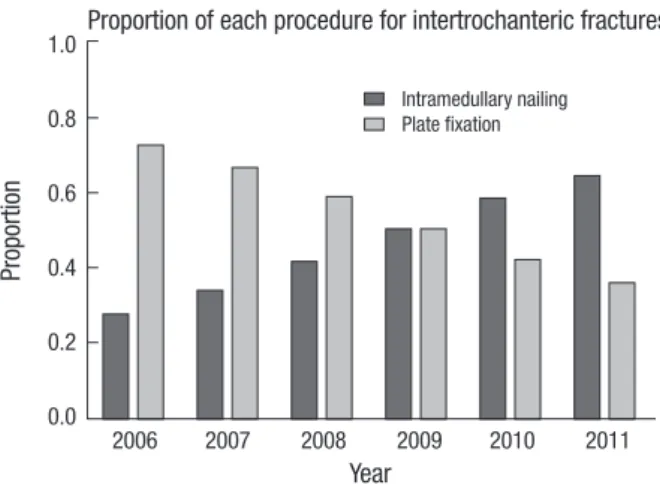
From 2006 to 2011, 35,569 intertrochanteric fractures were internally fixed using an intramedullary nail or plate. Of these, the proportion of the nailing increased from 27.9% in 2006 to 64.3% in 2011 (P < 0.001) (Fig. 1). Even after stratification by age
Lee Y-K, et al. • Trends of Surgical Treatment for Intertrochanteric Fractures in Korea
1408 http://jkms.org http://dx.doi.org/10.3346/jkms.2013.28.9.1407 and gender, the proportion of the nailing increased in all
groups, and that of plate fixation showed a corresponding de- crease in all groups.
The choice of surgical options for intertrochanteric fractures is controversial. We determined trends in the relative propor- tion of intramedullary nailing and plate fixation for these frac- tures in Korea, from 2006 to 2011. The present data reveal a shift in surgical treatment during the study period. The intramedul- lary nailing increased from 27.9% to 64.3% and the plate fixa- tion showed a corresponding decrease. This finding concurs with the results of a recent surgeon-derived survey conducted in the United States (4), which showed a nationwide transition from plate fixation to intramedullary nailing in surgical treat- ment for intertrochanteric fracture. According to their survey, the younger surgeons have used the more intramedullary nail in the United States (4).
There are several possible reasons for increasing utilization of intramedullary nailing in Korea. First, surgeons might prefer the theoretical advantages of the nailing, such as less invasive incision and better biomechanics for fixation of proximal fe- mur, especially in unstable intertrochanteric fracture (5-7). Sec- ond, promotion of industrial company might move from extra- medullary plating to intramedullary nailing during the study periods, because the cost of nail device is higher than that of plate system in Korea. Although we could not evaluate the utili- zation of each device at surgeon-level in this study, younger surgeons might prefer the newer device, intramedullary nail, like as the United States (4).
Our study had some limitations. First, other important factors for decision-making, such as radiographic findings (the defect of posteromedial cortex, reverse obliquity, extension to subtro-
chanteric area, and presence of osteoporosis) and demograph- ic characteristics (preinjury ambulatory state and instability risk), were not evaluated. Second, we could not evaluate the clinical outcomes such as complications after each fixation, be- cause only deidentified information was available in this study.
In spite of these limitations, this is the first epidemiological study on the national trends of internal fixation for intertrochan- teric fracture in East Asia, and our study demonstrated a shift in treatment of intertrochanteric fracture from plate fixation to in- tramedullary nailing from 2006 to 2011. Our study could provide contemporary nationwide data to estimate the surgical trend of intertrochanteric fractures.
REFERENCES
1. Zhang B, Chiu KY, Wang M. Hip arthroplasty for failed internal fixation of intertrochanteric fractures. J Arthroplasty 2004; 19: 329-33.
2. Hsu CJ, Chou WY, Chiou CP, Chang WN, Wong CY. Hemi-arthroplasty with supplemental fixation of greater trochanter to treat failed hip screws of femoral intertrochanteric fracture. Arch Orthop Trauma Surg 2008;
128: 841-5.
3. Haidukewych GJ, Berry DJ. Hip arthroplasty for salvage of failed treat- ment of intertrochanteric hip fractures. J Bone Joint Surg Am 2003; 85-A:
899-904.
4. Anglen JO, Weinstein JN; American Board of Orthopaedic Surgery Re- search Committee. Nail or plate fixation of intertrochanteric hip frac- tures: changing pattern of practice: a review of the American Board of Orthopaedic Surgery Database. J Bone Joint Surg Am 2008; 90: 700-7.
5. Parker MJ, Bowers TR, Pryor GA. Sliding hip screw versus the Targon PF nail in the treatment of trochanteric fractures of the hip: a randomised trial of 600 fractures. J Bone Joint Surg Br 2012; 94: 391-7.
6. Pajarinen J, Lindahl J, Michelsson O, Savolainen V, Hirvensalo E. Per- trochanteric femoral fractures treated with a dynamic hip screw or a pro- ximal femoral nail: a randomised study comparing post-operative reha- bilitation. J Bone Joint Surg Br 2005; 87: 76-81.
7. Barton TM, Gleeson R, Topliss C, Greenwood R, Harries WJ, Chesser TJ.
A comparison of the long gamma nail with the sliding hip screw for the treatment of AO/OTA 31-A2 fractures of the proximal part of the femur:
a prospective randomized trial. J Bone Joint Surg Am 2010; 92: 792-8.
8. Lippuner K, Johansson H, Kanis JA, Rizzoli R. Remaining lifetime and absolute 10-year probabilities of osteoporotic fracture in Swiss men and women. Osteoporos Int 2009; 20: 1131-40.
9. Park C, Ha YC, Jang S, Jang S, Yoon HK, Lee YK. The incidence and re- sidual lifetime risk of osteoporosis-related fractures in Korea. J Bone Mi- ner Metab 2011; 29: 744-51.
10. Yoon HK, Park C, Jang S, Jang S, Lee YK, Ha YC. Incidence and mortality following hip fracture in Korea. J Korean Med Sci 2011; 26: 1087-92.
Fig. 1. Proportion of each procedure for intertrochanteric fractures.
Proportion
Year
2006 2007 2008 2009 2010 2011 1.0
0.8 0.6 0.4 0.2 0.0
Proportion of each procedure for intertrochanteric fractures
Intramedullary nailing Plate fixation