Factors Related to Prehospital Time Delay in Acute ST-Segment Elevation Myocardial Infarction
Despite recent successful efforts to shorten the door-to-balloon time in patients with acute ST-segment elevation myocardial infarction (STEMI), prehospital delay remains unaffected.
Nonetheless, the factors associated with prehospital delay have not been clearly identified in Korea. We retrospectively evaluated 423 patients with STEMI. The mean symptom onset-to-door time was 255 ± 285 (median: 150) min. The patients were analyzed in two groups according to symptom onset-to-door time (short delay group: ≤ 180 min vs long delay group: > 180 min). Inhospital mortality was significantly higher in long delay group (6.9% vs 2.8%; P = 0.048). Among sociodemographic and clinical variables, diabetes, low educational level, triage via other hospital, use of private transport and night time onset were more prevalent in long delay group (21% vs 30%; P = 0.038, 47% vs 59%;
P = 0.013, 72% vs 82%; P = 0.027, 25% vs 41%; P < 0.001 and 33% vs 48%; P = 0.002, respectively). In multivariate analysis, low educational level (1.66 [1.08-2.56]; P = 0.021), symptom onset during night time (1.97 [1.27-3.04]; P = 0.002), triage via other hospital (1.83 [1.58-5.10]; P = 0.001) and private transport were significantly associated with prehospital delay (3.02 [1.81-5.06]; P < 0.001). In conclusion, prehospital delay is more frequent in patients with low educational level, symptom onset during night time, triage via other hospitals, and private transport, and is associated with higher inhospital mortality.
Key Words: Myocardial Infarction; Prehospital Delay; Mortality Yong Hwan Park1, Gu Hyun Kang1,
Bong Gun Song1, Woo Jung Chun1, Jun Ho Lee2, Seong Youn Hwang2, Ju Hyeon Oh1, Kyungil Park3, and Young Dae Kim3
1Division of Cardiology, Department of Internal Medicine, 2Department of Emergency Medicine, Samsung Changwon Hospital, Sungkyunkwan University School of Medicine, Changwon; 3Division of Cardiology, Department of Internal Medicine, Dong-A University College of Medicine, Busan, Korea
Received: 18 February 2012 Accepted: 17 May 2012 Address for Correspondence:
Young Dae Kim, MD
Division of Cardiology, Department of Internal Medicine, Dong-A University College of Medicine, 26 Daesingongwon-ro, Seo-gu, Busan 602-715, Korea
Tel: +82.51-240-2959, Fax: +82.51-255-8174 E-mail: [email protected]
http://dx.doi.org/10.3346/jkms.2012.27.8.864 • J Korean Med Sci 2012; 27: 864-869 Cardiovascular Disorders
INTRODUCTION
Despite considerable improvement of care and outcomes of acute ST-segment elevation myocardial infarction (STEMI) in recent years, STEMI remains one of the most fatal disease in Korea as in the western and developing countries (1, 2). Because of the front wave of necrosis expanding from endocardium sub- tended by infarct artery, the size of infarction and mortality in- creases in proportion to the elapsed time after coronary artery occlusion (3, 4). Timely reperfusion of infarct related artery is the cornerstone of treatment for interrupting the progression of necrosis and salvaging myocardium (5, 6). The outcomes of re- perfusion therapy are critically dependent on the ischemic time from the onset of symptoms to the treatment (7, 8).
Strategy to shorten the ischemic time involves integrated ef- forts to shorten the time delay in successive stages of patients’
decision, transfer, and inhospital management. Recent efforts to implement the expedient reperfusion as recommended in clinical guidelines (door-to-needle time ≤ 30 min, door-to-bal- loon time ≤ 90 min) resulted in significant curtailment of inhos- pital time delay to treatment and improved clinical outcomes (9-11). However, time delay prior to hospital arrival has been
largely unaffected, with little signs of change ever reported in recent years (12, 13).
Prehospital delay in patients with STEMI has been found to be an important factor of in-hospital and long-term mortality (14). Nonetheless, the magnitude of, and factors associated with prehospital time delay have not clearly identified in Korea. Ac- cordingly, the purpose of this study was to investigate and clari- fy the factors related to prehospital time delay in patients with STEMI presented to the emergency department.
MATERIALS AND METHODS Study design and subjects
Patients aged 18 yr or older who presented with acute STEMI to the emergency department of Samsung Changwon Hospital from January 2008 to December 2010 were registered for the analysis. During this time, a total of 430 consecutive patients were hospitalized. Seven patients were excluded in whom the accurate time of symptom onset could not be determined.
Data collection
Demographic, medical history and clinical characteristics were
registered from the hospital records by trained physicians and nurses. Educated nurses gave a person-to-person call to patients or their family members and interviewed to ask questions en- listed in questionnaire and variables difficult to get from hospi- tal records. Clinical as well as socioeconomic variables were in- vestigated with regard to age, sex, characteristics of symptoms, time of symptom onset, activity at the time of onset, location of residence, level of education, attendance of family member or bystanders, knowledge about myocardial infarction, the first reaction of patient to initial symptom, means of transportation, and triage via other hospitals. Patients were divided into two groups according to prehospital time delay; short delay group in whom time from symptom onset to hospital arrival is 180 min or less, and long delay group in who the time is more than 180 min.
Definitions
STEMI was defined according to the criteria of the universal def- inition of myocardial infarction (15). Crushing chest pain per- sisting longer than 20 min with or without diaphoresis was clas- sified as typical symptoms, while other symptoms like shortness of breath, epigastric pain, nausea, and loss of consciousness were classified as atypical symptoms.
Symptom onset-to-door time was the time from the onset of symptoms to the arrival at the emergency department, and con- stitute a prehospital delay.
Statistical analysis
Categorical variables were summarized by counts and relative frequencies; numeric variables, by their median and range. Dif- ferences in patients’ sociodemographic and clinical character- istics were compared between subgroups with chi-square test for categorical variables and Student t test for continuous vari-
ables. Overall survival was estimated using the Kaplan-Meier product limit method and differences in survival between groups were assessed by the log rank test. The logistic regression model was employed to identify the significant independent prognos- tic factors affecting response (symptom onset-to-door time).
The multivariate model was created using a backward elimina- tion method, and the probability was set at 0.05 for removal.
Crude and adjusted odds ratios (OR) and 95% confidence in- terval (CI) were calculated. P values lower than 0.05 were con- sidered statistically significant. This was a retrospective study therefore alpha was not adjusted for multiple testing. All statis- tical analyses were carried out using SPSS version 14.0 and Med- Calc version 11.6.1 statistical software (SPSS Inc., Chicago, IL, USA).
Ethics statement
The study protocol was reviewed and approved by the institution- al review board of Samsung Chanwon Hospital (IRB No. 2012- SCMC-001-00). Informed consent was waived by the board.
RESULTS
Baseline characteristics of study subjects
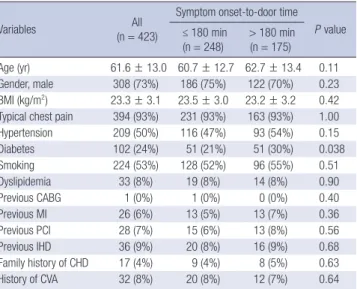
Baseline characteristics of 423 study patients are shown in Ta- ble 1. The mean age was 61.6 ± 13.0 yr, and 73% of the patients were male. Of all patients, 87% (n = 369) were eligible for throm- bolysis or primary percutaneuous coronary intervention (PCI).
Acute reperfusion therapy was performed in 95% of these pa- tients (thrombolysis, 12 patients [3%]; primary PCI, 340 patients [97%]) (Table 2). The patients in the short- and long delay groups did not differ with respect to the demographic characteristics, social and past medical history, except for diabetes where the prevalence was higher in long delay group than in short delay group (30% vs 21%, P = 0.038).
The mean symptom onset-to-door time of total 423 patients was 255 ± 285 (median: 150) min. Of the study groups, 337 pa- tients (79.7%) arrived at the hospital within 6 hr of symptom Table 1. Baseline clinical characteristics of study subjects
Variables All
(n = 423)
Symptom onset-to-door time P value
≤ 180 min
(n = 248) > 180 min (n = 175) Age (yr) 61.6 ± 13.0 60.7 ± 12.7 62.7 ± 13.4 0.11 Gender, male 308 (73%) 186 (75%) 122 (70%) 0.23 BMI (kg/m2) 23.3 ± 3.1 23.5 ± 3.0 23.2 ± 3.2 0.42 Typical chest pain 394 (93%) 231 (93%) 163 (93%) 1.00 Hypertension 209 (50%) 116 (47%) 93 (54%) 0.15
Diabetes 102 (24%) 51 (21%) 51 (30%) 0.038
Smoking 224 (53%) 128 (52%) 96 (55%) 0.51
Dyslipidemia 33 (8%) 19 (8%) 14 (8%) 0.90
Previous CABG 1 (0%) 1 (0%) 0 (0%) 0.40
Previous MI 26 (6%) 13 (5%) 13 (7%) 0.36
Previous PCI 28 (7%) 15 (6%) 13 (8%) 0.56
Previous IHD 36 (9%) 20 (8%) 16 (9%) 0.68
Family history of CHD 17 (4%) 9 (4%) 8 (5%) 0.63
History of CVA 32 (8%) 20 (8%) 12 (7%) 0.64
BMI, body mass index; CABG, coronary artery bypass surgery; MI, myocardial infarc- tion; PCI, percutaneous coronary intervention; IHD, ischemic heart disease; CHD, cor- onary heart disease; CVA, cerebrovascular accident.
Table 2. Treatment modality of study subjects
Modality All (n = 423)
Eligible for thrombolysis* or primary PCI† Thrombolysis
Primary PCI Refusal of PCI Failure of PCI
Medication and elective PCI
369 (87%) 12 340 1 2 14 Not eligible for thrombolysis or primary PCI
Spasm or insignificant coronary artery stenosis CABG
Refusal of PCI
Medication and elective PCI
54 (13%) 5 4 9 36
*Patients were presented within 3 hr after symptom onset; †Patients were presented within 12 hr after symptom onset and those with cardiogenic shock. PCI, percutane- ous coronary intervention; CABG, coronary artery bypass surgery.
onset and only 28 patients (6.6%) arrived within 30 min of symp- tom onset, a goal recommended in the recent guidelines (16) (Fig. 1).
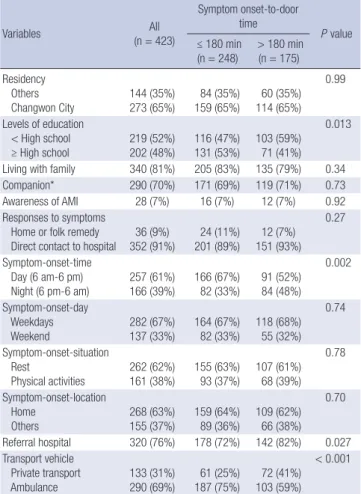
The sociodemographic characteristics are presented in Table 3. Seventy-six percent of overall patients enrolled in this study was referred from other hospital or clinics. Among sociodemo-
graphic variables, low educational level, triage via other hospi- tal, use of private transport, and symptom-onset during night time (6 pm-6 am) were more frequently observed in long delay group. Age, gender, characteristics of symptoms, previous isch- emic heart disease (IHD), residential area, knowledge about acute myocardial infarction (AMI), and patients’ responses to symptoms were not different between two groups.
Number of patients
Symptom onset-to-door time (min)
28 47
58
41 39
35 34
14 18
14
4 5 5 6 5
1 1
9
5 2 3 2 2 3
42
30 60 90 120 150 180 210 240 270 300 330 360 390 420 450 480 510 540 570 600 630 660 690 720 > 720 70
60 50 40 30 20 10 0
Fig. 1. Distribution of patients arriving with different symptom onset-to-door time.
Table 3. Baseline sociodemographic characteristics of study subjects
Variables All
(n = 423)
Symptom onset-to-door
time P value
≤ 180 min
(n = 248) > 180 min (n = 175) Residency
Others Changwon City
144 (35%) 273 (65%)
84 (35%) 159 (65%)
60 (35%) 114 (65%)
0.99
Levels of education < High school ≥ High school
219 (52%) 202 (48%)
116 (47%) 131 (53%)
103 (59%) 71 (41%)
0.013
Living with family 340 (81%) 205 (83%) 135 (79%) 0.34
Companion* 290 (70%) 171 (69%) 119 (71%) 0.73
Awareness of AMI 28 (7%) 16 (7%) 12 (7%) 0.92
Responses to symptoms Home or folk remedy
Direct contact to hospital 36 (9%)
352 (91%) 24 (11%)
201 (89%) 12 (7%) 151 (93%)
0.27
Symptom-onset-time Day (6 am-6 pm)
Night (6 pm-6 am) 257 (61%)
166 (39%) 166 (67%)
82 (33%) 91 (52%) 84 (48%)
0.002
Symptom-onset-day Weekdays Weekend
282 (67%) 137 (33%)
164 (67%) 82 (33%)
118 (68%) 55 (32%)
0.74
Symptom-onset-situation Rest
Physical activities
262 (62%) 161 (38%)
155 (63%) 93 (37%)
107 (61%) 68 (39%)
0.78
Symptom-onset-location Home
Others
268 (63%) 155 (37%)
159 (64%) 89 (36%)
109 (62%) 66 (38%)
0.70
Referral hospital 320 (76%) 178 (72%) 142 (82%) 0.027 Transport vehicle
Private transport
Ambulance 133 (31%)
290 (69%) 61 (25%)
187 (75%) 72 (41%) 103 (59%)
< 0.001
*Being with other members when symptoms began. AMI, acute myocardial infarction.
Table 4. Univariate logistic regression for symptom onset-to-door time
Variables Odds ratio
(95% Confidence interval)
P value
Sex (female) 1.30 (0.85-2.01) 0.23
Age (≥ 62 yr) 1.46 (0.99-2.15) 0.059
BMI (≥ 23.3 kg/m2) 0.65 (0.44-0.95) 0.028
Hypertension 1.33 (0.90-1.96) 0.15
Diabetes 1.61 (1.03-2.52) 0.039
Smoking 1.14 (0.77-1.68) 0.51
Dyslipidemia 1.05 (0.51-2.15) 0.90
Previous IHD 1.15 (0.58-2.30) 0.68
Family history of CHD 1.27 (0.48-3.37) 0.63
Typical chest pain 1.17 (0.54-2.54) 0.70
Residency (Others) 1.00 (0.66-1.50) 0.99
Level of education (< high school) 1.64 (1.11-2.43) 0.014
Living with family 0.79 (0.48-1.29) 0.34
Companion* 1.08 (0.70-1.66) 0.73
Awareness of AMI 0.96 (0.44-2.09) 0.92
Responses to symptoms (Home or folk remedy) 0.67 (0.32-1.37) 0.27 Symptom onset-time (6 pm-6 am) 1.87 (1.26-2.78) 0.002 Symptom onset-day (Weekend) 0.93 (0.62-1.41) 0.74 Symptom onset-situation (≥ Ordinary activity) 1.06 (0.71-1.58) 0.78 Symptom onset-location (Others) 1.08 (0.72-1.62) 0.70
Referral hospital 1.69 (1.06-2.71) 0.028
Transport vehicle (Private transport) 2.14 (1.41-3.25) < 0.001
*Being with other members when symptoms began. BMI, body mass index; CABG, coronary artery bypass surgery; AMI, acute myocardial infarction; PCI, percutaneous coronary intervention; IHD, ischemic heart disease; CHD, coronary heart disease; CVA, cerebrovascular accident.
Factors related to prolonged prehospital delay
In univariate analysis, body mass index (BMI), history of diabe- tes, levels of education, symptom-onset-time, triage via referral hospital and use of private transport were significantly associ- ated with prehospital delay (Table 4). By multiple logistic regres- sion analysis, low levels of education (< high school), symptom onset during night time (6 pm-6 am), triage via other hospital and use of private transport were statistically significant factors associated with prehospital delay (Table 5).
Clinical outcomes according to prehospital delay
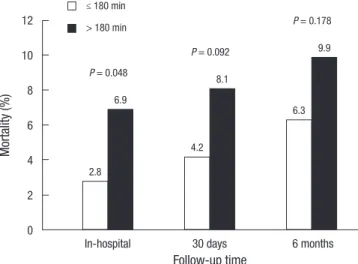
Nineteen patients (4.5%) had died during the admission (Table 6). Inhospital mortality was significantly higher in long delay group compared with short delay group (12 [6.9%] vs 7 [2.8%], P = 0.048). Mortality at 30 days and 6 month was also higher in the long delay group, but the difference was not statistically sig- nificant (10 [4.2%] vs 14 [8.1%], P = 0.092; 17 [6.3%] vs 17 [9.9%], P = 0.178, respectively) (Fig. 2). On Kaplan-Meier analysis the survival at 6 month was similar between two groups (Fig. 3).
DISCUSSION
In the reperfusion era, the outcomes of STEMI critically depend on the total ischemic time from the onset of symptom to treat- ment (7, 8). Prehospital delay is an important determinant of total ischemic time, yet unlike inhospital delay, it is difficult to employ systematic approach to reduce the delay substantially.
Therefore, prehospital delay remains largely unchanged over recent years in spite of the notable improvement in reducing time delay in the hospital after patient’s arrival (9-13).
The result of this study showed that in the typical Korean com- munity comprised of a large city and surrounding suburban area, the time from symptom onset to hospital arrival was still too long for optimal management of the patients with acute STEMI. Prehospital time delay in this study (mean 255 ± 285
min; median 150 min) already exceeded the goal of total isch- emic time 120 min (16). It has not been improved from earlier data of regional community in which median prehospital time delay was 172 min and also similar to previous nationwide reg- istry data (17, 18). Although 79.7% of study patients arrived at the hospital within 6 hr of symptom onset, only 6.6% of the pa- tients arrived within 30 min of symptom onset, which is the goal of the recent guideline for the optimal reperfusion (16).
It was noticeable that only 7% of study patients both in short and long delay group were aware of the possibility of acute MI.
This might have deterred the patient’s prompt action to call for help, and accounted for much of the delay. In addition, about 30% of the patients were using private transport to arrive at a hospital, and 76% of the patients were transferred via other hos- pital, contributing to delayed presentation. These data suggest that a nationwide and/or local-based coordinated effort is re- quired to enhance public awareness for risk of STEMI and to Table 5. Multivariate logistic regression for symptom onset-to-door time
Variables Odds ratio
(95% Confidence interval) P value Levels of education (< high school) 1.66 (1.08-2.56) 0.021 Symptom onset-time (6 pm-6 am) 1.97 (1.27-3.04) 0.002
Referral hospital 1.83 (1.58-5.10) 0.001
Transport vehicle (Private transport) 3.02 (1.81-5.06) < 0.001
Table 6. Mortality across subgroups based on symptom onset-to-door time All
(n = 423)
Symptom onset-to-door time
P value
≤ 180 min (n = 248)
> 180 min (n = 175)
Inhospital 19 (4.5%) 7 (2.8%) 12 (6.9%) 0.048
30 days 24 (5.8%) 10 (4.2%) 14 (8.1%) 0.092
6 months 32 (7.8%) 17 (6.3%) 17 (9.9%) 0.178
Mortality (%)
Follow-up time
In-hospital 30 days 6 months
12 10 8 6 4 2 0
2.8
4.2 6.9 6.3
8.1
≤ 180 min
> 180 min
9.9 P = 0.048
P = 0.092
P = 0.178
Fig. 2. In hospital, 30-day, 6-month mortality based on symptom onset-to-door time.
Fig. 3. Kaplan-Meier curve of study subgroups based on symptom onset-to-door time.
Survival probability (%)
100 90 80 70 60
50
Days
0 50 100 150 200
244 229 229 229 0
Number at risk
Group: ≤180 min (n = 248) Group: >180 min (n = 175)
173 158 158 158 0
≤ 180 min (n = 248)
> 180 min (n = 175)
log-rank test P value = 0.163 Symptom to door time
build an efficient emergency dispatch system.
To find the factors that correlate with delayed hospital arrival, patient-related factors and sociodemogrpahic factors were sought in the study population. Multivairate logistic regression revealed that patient’s level of education, symptom onset during night time, arrival via other hospital, and use of private transport were significant determinants for prehospital time delay. These find- ings differed from previous report that old age, female gender, diabetes, hypertension, previous history of coronary heart dis- ease or coronary intervention were associated with prolonged prehospital delay (19-23). Relatively small sized study popula- tion, and low incidence of previous coronary disease in the pres- ent study may have reduced the power to discriminate the risk among the patients. Remarkably, low level of education (not completing high school) was significant factor for prehospital delay (hazard ratio 1.66) in this study. Shorter time of education has been also shown to increase the delay in an Australian study (24). It is conceivable that low level of patient education elicited slower reaction of patients, or it just might mirror the low socio- economic status, which has been shown to be related to time delay (25). Night time onset and arrival via other hospitals were another factors, which was understandable and concurred with other study (17, 26). Most strongly associated with time delay was use of private transport as opposed to ambulance (hazard ratio 3.02), although the rate of private transport decreased con- siderably compared with previous regional community study in Korea (17). The cause of this relation is difficult to define, but private transportation may be accounted by other factors, such as low level of education or the lack of patient’s perception of urgency. Prehospital triage by the emergency medical service should be encouraged because it is associated with a shorter time to treatment and more favorable clinical outcomes (27).
In this study, inhospital mortality was significantly higher in long delay group compared with short delay group. During the period of 30 days and 6 months follow-up, the mortality benefit of short treatment delay was continuously observed, although the differences were not statistically significant. Of the study patients eligible for reperfusion therapy, 340 (92%) of 369 pa- tients were treated with primary PCI and the above result was consistent with previous report that treatment delay is critical determinants of outcomes after primary PCI (3). Several stud- ies, mostly observational ones including Korean registry, have suggested that the time dependency of reperfusion effect was less pronounced in the setting of primary PCI than in fibrinoly- sis (18, 28, 29). However, the concept of “time-insensitivity” of primary PCI has been recently questioned because of the con- founding factors associated with observational data (30). There- fore, although the role of primary PCI as a better reperfusion strategy is valid, the importance of reducing time delay should be applied to primary PCI, too.
Several limitations of this study warrant consideration. First-
ly, the number of the patients in this study was relatively small.
This might have deprived the power to detect the association between several variables and the time delay. Secondly, this study was retrospective, based on the information in the hospi- tal medical records and interviews with patients and their fami- ly members, which could have been affected by recall bias. Fi- nally, initial means of transportation and times between visiting first hospital and arriving in emergency department were not evaluated because of inaccurate information from referring hospitals. Despite the limitations, the present study could pro- vide the descriptive data showing the current status of triage for emergency management of STEMI patients.
In conclusion, the present study demonstrated significant prehospital delay in the treatment of STEMI patients in Korean community and the delay was correlated with inhospital mor- tality. In Korean STEMI patients, low educational level, symp- tom onset during night time, triage via other hospital and pri- vate transport are associated with the treatment delay. Public campaigns, education and counseling of patients and their families are needed to raise the public awareness of STEMI that should prompt to seek immediate medical attention for opti- mal patients’ outcomes.
REFERENCES
1. Lloyd-Jones D, Adams R, Carnethon M, De Simone G, Ferguson TB, Flegal K, Ford E, Furie K, Go A, Greenlund K, et al. Heart disease and stroke statistics--2009 update: a report from the American Heart Associa- tion Statistics Committee and Stroke Statistics Subcommittee. Circula- tion 2009; 119: e21-181.
2. Hong JS, Kang HC, Lee SH, Kim J. Long-term trend in the incidence of acute myocardial infarction in Korea: 1997-2007. Korean Circ J 2009; 39:
467-76.
3. De Luca G, Suryapranata H, Ottervanger JP, Antman EM. Time delay to treatment and mortality in primary angioplasty for acute myocardial infarction: every minute of delay counts. Circulation 2004; 109: 1223-5.
4. Kloner RA, Jennings RB. Consequences of brief ischemia: stunning, pre- conditioning, and their clinical implications: part 1. Circulation 2001;
104: 2981-9.
5. Van de Werf F, Bax J, Betriu A, Blomstrom-Lundqvist C, Crea F, Falk V, Filippatos G, Fox K, Huber K, Kastrati A, et al. Management of acute myocardial infarction in patients presenting with persistent ST-segment elevation: the Task Force on the Management of ST-Segment Elevation Acute Myocardial Infarction of the European Society of Cardiology. Eur Heart J 2008; 29: 2909-45.
6. Schomig A, Ndrepepa G, Mehilli J, Schwaiger M, Schuhlen H, Nekolla S, Pache J, Martinoff S, Bollwein H, Kastrati A. Therapy-dependent influ- ence of time-to-treatment interval on myocardial salvage in patients with acute myocardial infarction treated with coronary artery stenting or thrombolysis. Circulation 2003; 108: 1084-8.
7. Francone M, Bucciarelli-Ducci C, Carbone I, Canali E, Scardala R, Cal- abrese FA, Sardella G, Mancone M, Catalano C, Fedele F, et al. Impact of primary coronary angioplasty delay on myocardial salvage, infarct
size, and microvascular damage in patients with ST-segment elevation myocardial infarction: insight from cardiovascular magnetic resonance.
J Am Coll Cardiol 2009; 54: 2145-53.
8. Gersh BJ, Anderson JL. Thrombolysis and myocardial salvage. Results of clinical trials and the animal paradigm: paradoxic or predictable? Cir- culation 1993; 88: 296-306.
9. Nam YH, Cha KS, Kim JH, Park SY, Park TH, Kim MH, Kim YD. Reduc- tion of door-to-balloon time by new performance processes in patients with ST-segment elevation myocardial infarction undergoing primary percutaneous coronary intervention. Angiology 2011; 62: 257-64.
10. Blankenship JC, Scott TD, Skelding KA, Haldis TA, Tompkins-Weber K, Sledgen MY, Donegan MA, Buckley JW, Sartorius JA, Hodgson JM, et al.
Door-to-balloon times under 90 min can be routinely achieved for pa- tients transferred for ST-segment elevation myocardial infarction percu- taneous coronary intervention in a rural setting. J Am Coll Cardiol 2011;
57: 272-9.
11. Gross BW, Dauterman KW, Moran MG, Kotler TS, Schnugg SJ, Rostykus PS, Ross AM, Weaver WD. An approach to shorten time to infarct artery patency in patients with ST-segment elevation myocardial infarction.
Am J Cardiol 2007; 99: 1360-3.
12. McGinn AP, Rosamond WD, Goff DC Jr, Taylor HA, Miles JS, Chamb- less L. Trends in prehospital delay time and use of emergency medical services for acute myocardial infarction: experience in 4 US communi- ties from 1987-2000. Am Heart J 2005; 150: 392-400.
13. Goldberg RJ, Gurwitz JH, Gore JM. Duration of, and temporal trends (1994-1997) in, prehospital delay in patients with acute myocardial in- farction: the second National Registry of Myocardial Infarction. Arch In- tern Med 1999; 159: 2141-7.
14. Turi ZG, Stone PH, Muller JE, Parker C, Rude RE, Raabe DE, Jaffe AS, Hartwell TD, Robertson TL, Braunwald E. Implications for acute inter- vention related to time of hospital arrival in acute myocardial infarc- tion. Am J Cardiol 1986; 58: 203-9.
15. Thygesen K, Alpert JS, White HD. Universal definition of myocardial in- farction. Eur Heart J 2007; 28: 2525-38.
16. Antman EM, Anbe DT, Armstrong PW, Bates ER, Green LA, Hand M, Hochman JS, Krumholz HM, Kushner FG, Lamas GA, et al. ACC/AHA guidelines for the management of patients with ST-elevation myocardial infarction: a report of the American College of Cardiology/American Heart Association Task Force on Practice Guidelines (Committee to Re- vise the 1999 Guidelines for the Management of Patients with Acute Myocardial Infarction). Circulation 2004; 110: e82-292.
17. Kim JA, Jeong JO, Ahn KT, Park HS, Jang WI, Kim MS, Kim JH, Park JH, Lee JH, Choi SW, et al. Causative factors for time delays in patients with acute ST-segment elevation myocardial infarction undergoing primary percutaneous coronary intervention. Korean J Med 2010; 78: 586-594.
18. Song YB, Hahn JY, Gwon HC, Kim JH, Lee SH, Jeong MH. The impact of initial treatment delay using primary angioplasty on mortality among patients with acute myocardial infarction: from the Korea acute myo-
cardial infarction registry. J Korean Med Sci 2008; 23: 357-64.
19. Nguyen HL, Gore JM, Saczynski JS, Yarzebski J, Reed G, Spencer FA, Goldberg RJ. Age and sex differences and 20-year trends (1986 to 2005) in prehospital delay in patients hospitalized with acute myocardial in- farction. Circ Cardiovasc Qual Outcomes 2010; 3: 590-8.
20. Perkins-Porras L, Whitehead DL, Strike PC, Steptoe A. Pre-hospital de- lay in patients with acute coronary syndrome: factors associated with patient decision time and home-to-hospital delay. Eur J Cardiovasc Nurs 2009; 8: 26-33.
21. Saczynski JS, Yarzebski J, Lessard D, Spencer FA, Gurwitz JH, Gore JM, Goldberg RJ. Trends in prehospital delay in patients with acute myocar- dial infarction (from the Worcester Heart Attack Study). Am J Cardiol 2008; 102: 1589-94.
22. Berton G, Cordiano R, Palmieri R, Guarnieri G, Stefani M, Palatini P.
Clinical features associated with pre-hospital time delay in acute myo- cardial infarction. Ital Heart J 2001; 2: 766-71.
23. Sheifer SE, Rathore SS, Gersh BJ, Weinfurt KP, Oetgen WJ, Breall JA, Schulman KA. Time to presentation with acute myocardial infarction in the elderly: associations with race, sex, and socioeconomic characteris- tics. Circulation 2000; 102: 1651-6.
24. Dracup K, McKinley SM, Moser DK. Australian patients’ delay in re- sponse to heart attack symptoms. Med J Aust 1997; 166: 233-6.
25. Foraker RE, Rose KM, McGinn AP, Suchindran CM, Goff DC Jr, Whitsel EA, Wood JL, Rosamond WD. Neighborhood income, health insurance, and prehospital delay for myocardial infarction: the atherosclerosis risk in communities study. Arch Intern Med 2008; 168: 1874-9.
26. Ribeiro S, Gaspar A, Rocha S, Nabais S, Azevedo P, Salgado A, Pereira MA, Correia A. Predictors of pre-hospital delay in patients with ST-seg- ment elevation myocardial infarction. Rev Port Cardiol 2010; 29: 1521-32.
27. Postma S, Dambrink JH, de Boer MJ, Gosselink AT, Eggink GJ, van de Wetering H, Hollak F, Ottervanger JP, Hoorntje JC, Kolkman E, et al.
Prehospital triage in the ambulance reduces infarct size and improves clinical outcome. Am Heart J 2011; 161: 276-82.
28. Zijlstra F, Patel A, Jones M, Grines CL, Ellis S, Garcia E, Grinfeld L, Gib- bons RJ, Ribeiro EE, Ribichini F, et al. Clinical characteristics and out- come of patients with early (<2 h), intermediate (2-4 h) and late (>4 h) presentation treated by primary coronary angioplasty or thrombolytic therapy for acute myocardial infarction. Eur Heart J 2002; 23: 550-7.
29. Cannon CP, Gibson CM, Lambrew CT, Shoultz DA, Levy D, French WJ, Gore JM, Weaver WD, Rogers WJ, Tiefenbrunn AJ. Relationship of symp- tom-onset-to-balloon time and door-to-balloon time with mortality in patients undergoing angioplasty for acute myocardial infarction. JAMA 2000; 283: 2941-7.
30. Terkelsen CJ, Christiansen EH, Sorensen JT, Kristensen SD, Lassen JF, Thuesen L, Andersen HR, Vach W, Nielsen TT. Primary PCI as the pre- ferred reperfusion therapy in STEMI: it is a matter of time. Heart 2009;
95: 362-9.