INTRODUCTION
Gastric cancer is one of the most common adult malignant tumors. Gastric cancer is the fourth common type of cancer and the second most frequent cause of death from cancer, worldwide, with the highest incidence in China, Japan and Eastern European countries (1). Cisplatin is commonly used with 5-fluorouracil (5-FU) as chemotherapy doublets in the treatment of advanced gastric cancer (2). During the last few years additional drugs were introduced into chemotherapy regimens for gastric cancer such as oxaliplatin, taxanes and epirubicin. However, the response rates of these drugs or their combinations were still less than 50% (3-5). One of the re- maining challenges is the development of predictive marker profiles to identify patients who will derive both minimal toxicity and maximum benefit from certain chemotherapy.
There is a growing body of evidence suggesting that genetic polymorphisms in genes involved in metabolism, signalling, DNA-repair and cellular response pathways all contribute to inter-patient variability of drug response and toxicity (6, 7).
Therefore, pharmacogenetic analyses appear to be a promis- ing tool to develop individualized treatment plans. Individ-
ual chemotherapy based on pharmacogenetics and pharma- cogenomics has shown a potentially predictive role to achieve superior outcome in retrospective and perspective studies in lung cancer (8, 9). However, little is known in gastric cancer pharmacogenetics.
Oxaliplatin, carrying a 1,2-diamino-cyclohexane ring, leads to platinum-DNA adducts, which are more cytotoxic than adducts formed from other platinum agents and more effec- tive at blocking DNA replication (10). With the wider use of oxaliplatin in gastric cancer, predictive markers for clinical outcome to this platinum agent may help to identify pro- spectively those patients who are more likely to benefit from the treatment. Resistance to platinum agents has been attri- buted to enhanced tolerance to platinum DNA adducts, dec- reased drug accumulation, or enhanced DNA repair (11). Vari- able chemosensitivity to oxaliplatin may depend on detoxi- fication pathways, including the glutathione S-transferase (GST) family of isoenzymes (12, 13). Glutathione S-trans- ferase P1 (GSTP1) is a member of a superfamily of dimeric phase II metabolic enzymes that play an important role in the cell defense system. GSTP1 directly participates in the detoxification of platinum compounds and is an important
846
Qing-Fang Li, Ru-Yong Yao, Ke-wei Liu, Hong-Ying Lv, Tao Jiang, and Jun Liang
Treatment and Research Center of Oncology, The Affiliated Hospital of Medical College of Qingdao University, Qingdao, China
Address for Correspondence Jun Liang, M.D.
Treatment and Research Center of Oncology, The Affiliated Hospital of Medical College of Qingdao University, Jiangsu Road 16, Qingdao 266003, China Tel : +86-532-82911348, Fax : +86-532-82911999 E-mail : [email protected]
This work was supported in part by grants from Shandong Province Natural Science Foundation (Y2008C126).
Genetic Polymorphism of GSTP1: Prediction of Clinical Outcome to Oxaliplatin/5-FU-based Chemotherapy in Advanced Gastric Cancer
The aim of this study was to evaluate the predictive value of the polymorphism Glu- tathione S-transferase P1 (GSTP1) Ile105Val on oxaliplatin/5-FU-based chemother- apy in advanced gastric cancer. Patients with advanced gastric cancer accepted oxaliplatin/5-FU-based chemotherapy as first-line chemotherapy were investigated.
GSTP1 Ile105Val polymorphism was detected by TaqMan-MGB probe allelic discrimi- nation method. Response to treatment was assessed by disease controlled rate.
Time to progression, overall survival and toxicities were recorded. Final patient out- comes were as follows: the allele frequencies of GSTP1 were 105Ile/105Ile 52%, 105Ile/
105Val 41% and 105Val/105Val 7%. For patients with 105Ile/105Ile and those with at least one 105Val allele, disease control rate was 39% and 71% (P=0.026), respectively;
median time to progression was 4.0 and 7.0 months (P=0.002); median overall sur- vival time was 7.0 and 9.5 months (P=0.002). Neurological toxicity was more fre- quently occurred in patients with two 105Ile alleles (P=0.005). In conclusion, patients with at least one 105Val allele have better prognosis and response to oxaliplatin/5-FU- based regimen as first-line treatment for patients with advanced gastric cancer.
Key Words : Polymorphism; Glutathione S-Transferase pi; Oxaliplatin; Stomach Neoplasms
Received : 19 August 2009 Accepted : 23 November 2009
ⓒ 2010 The Korean Academy of Medical Sciences.
This is an Open Access article distributed under the terms of the Creative Commons Attribution Non-Commercial License (http://creativecommons.org/licenses/by-nc/3.0) which permits unrestricted non-commercial use, distribution, and reproduction in any medium, provided the original work is properly cited.
mediator of both intrinsic and acquired resistance to platinum (14). A single nucleotide substitution (A→ G) at position 313 (resulting in replacing isoleucine with valine at codon 105) has been found to modify the enzyme’s activity and affin- ity for electrophilic substrates (15). Previous studies showed the expression level and the polymorphic Ile105Val of GSTP1 had linked with the sensitivity of cancer cells to platinum (16). Clinical studies also have implicated GSTP1 as a pre- dictive marker for clinical outcome in patients with cancer treated with platinum-based chemotherapy (17, 18). How- ever, the predictive values in advanced gastric cancer with oxaliplatin-based chemotherapy are still not sufficient.
Given the further biochemical evidence that GSTP1 medi- ates inactivation of platinum drugs, we analyzed the common polymorphism in GSTP1-105 in patients with advanced gas- tric cancer to determine whether the presence of the poly- morphism is associated with clinical outcome to oxaliplatin/
5-FU-based first-line chemotherapy in Chinese population.
MATERIALS AND METHODS Study subjects
From July 2006 to December 2008, 163 patients with ad- vanced gastric cancer were treated at the Cancer Treatment Center in the Affiliated Hospital of Medical College, Qingdao University (China). The criteria for acceptance of the patients were as follows: 1) all patients had bi-dimensionally measur- able disease; 2) each participant had gastric adenocarcinoma with stage IV disease, definitely diagnosed by histology; 3) patients’ performance status was classified according to East- ern Cooperative Oncology Group (ECOG) criteria, and each patient’s ECOG status was not greater than 2; 4) patients had not been treated with chemotherapy previously; 5) each par- ticipant’s hemogram, hepatic function, renal function, and electrocardiogram were normal before chemotherapy. Accord- ing to the criteria mentioned-above, 92 patients were eligi- ble for the study. All the 92 patients signed an informed con- sent form before entering the study. Specimens (blood sam- ples) of the patients were obtained before treatment.
Chemotherapy
All participants received the following oxaliplatin/5-FU- based combination therapy regimen as first-line treatment.
All patients administered oxaliplatin plus 5-FU regimen once every two weeks: oxaliplatin (Jiangsu Heng-rui Express, China;
H20040817) 85 mg/m2as a 2-hr infusion on day 1, and then calcium folinate (Jiangsu Heng-rui Express) 200 mg/m2as a 2-hr infusion on days 1-2, combined with bolus 5-FU (Tian- jin Jin-yao Express, China; H12020959) 300 mg/m2and con- tinuous infusion of 5-FU 600 mg/m2on days 1-2. Treatment was continued until documented disease progression, unac-
ceptable toxic effects or patient’s refusal.
Clinical evaluation
All patients for analyses were required to have completed at least four cycles of chemotherapy. Computed tomography imaging was performed every 6 weeks. Objective response to the treatment corresponded to a decrease in tumor burden (the sum, over all measurable lesions, of the products of the largest diameter and its perpendicular diameter) of 50% or more for at least 6 weeks (partial response, or complete res- ponse). And disease control includes complete response (CR), partial response (PR) and stable disease (SD, ≤25% progres- sion, <50% shrinkage) for at least 6 weeks. Progressive dis- ease (PD) was defined as an enlargement in tumor burden of 25% or more (compared with the smallest measurement) or appearance of new lesions. We calculated the disease control rate (the percent of CR+PR+SD) to evaluate patients’ response to chemotherapy. Time to progression (TTP) was calculated from the time of initial treatment to disease progression. Over- all survival (OS) was calculated from the time of initial treat- ment to death or the last follow-up. Neuropathy was scored according to the oxaliplatin-specific scale reported by Caus- sanel et al. (19). On this oxaliplatin-specific scale, the grade of cumulative neuropathy depends on the duration and inten- sity of symptoms (grade 1, paresthesia, dysesthesia of short duration; grade 2, paresthesia, dysesthesia persisting between cycles; grade 3, paresthesia, dysesthesia causing functional impairment; grade 4, paralysis). Other reliable adverse events were evaluated using the National Cancer Institute-Common Toxicity Criteria (NCI-CTC) version 2.0 (grade 1, mild adverse event; grade 2, moderate adverse event; grade 3, severe and undesirable adverse event; grade 4, life-threatening or dis- abling adverse event).
DNA extraction and genotyping
Genomic DNA was isolated from 2 mL peripheral blood, using Blood Genomic DNA Isolation Kit (Watson Biotech- nologies, Inc., Taipei, Taiwan). The Ile105Val polymorphism was analyzed with TaqMan genotyping assays, using the Roter- gene real time 36-well polymerase chain reaction (PCR) sys- tem (Gene Company Limited, Hong Kong, China). Probes, primer and TaqMan universal PCR master mix were purchas- ed from Applied Biosystems Inc. (ABI). The TaqMan assay were performed in 25 mL reaction solution containing 1.25 mL TaqMan SNP Genotyping Assay Mix (consisting of 20×mix of unlabeled PCR primers and TaqMan MGB probe, FAM and VIC dye-labeled), 12.5 mL PCR mixture reagent and 20 ng genomic DNA. The polymerase chain reaction consisted of an initial step at 95℃for 10 min and 48 cycles of denatur- ing at 92℃for 15 sec and annealing 60℃for 1 min. SDS allelic discrimination software provided by Gene Company Limited was used for analysis of the PCR genotyping results.
30 randomly selected DNA samples were genotyped at least twice to confirm the results.
Statistical analysis
Initially, disease controlled rate, time to progression, over- all survival, and reliable toxicity were the end points consid- ered in this analysis. Patients’ characteristics were compared across genotypes using chi-square test. GSTP1 genotype dis- tribution gained in the study was tested by the Hardy-Wein- berg equilibrium law. The disease controlled rate were com- pared by the chi-square test and Fisher exact test between the patients with 105Ile/105Ile GSTP1 genotype and those with at least one 105Val allele. The Cox proportional hazards model was used to determine the association of TTP and OS with the following baseline prognostic factors: histology, site of tumor, number of metastatic sites, performance status, age at enrollment of study, and gender. The odds ratio (OR) and 95% confidence intervals (95% CI) were calculated at the same time. The log-rank test and Kaplan-Meier plots were used to evaluate the association of overall survival and time to progression with GSTP1 polymorphism. Treatment-relat- ed toxicity was compared by the Mann-Whitney test between the patients with GSTP1 wild genotype and patients with GSTP1 mutant genotype at codon 105.
All P values reported here were two-sided, and a probabil- ity of 0.05 or smaller was considered statistically significant.
Statistical analyses were performed using SPSS software, Ver- sion 16.0 (SPSS Inc., Chicago, IL, USA).
RESULTS GSTP1 polymorphism
Ninety-seven percent (89/92) of the patients’ genetic poly- morphism was determined successfully. GSTP1 genotype was analyzed for 89 patients, of which 46 (52%) were homozy- gous for the 105Ile/105Ile GSTP1 genotype, 37 (41%) were heterozygous for 105Ile/105Val, and 6 (7%) were homozygous for the 105Val/105Val. The allele frequency for the GSTP1 105Val allele in our study was 48% (43/89). The allelic distribution was in Hardy-Weinberg equilibrium (c2=0.156, P=0.692).
The 89 patients consisted of 25 females (28%) and 64 males
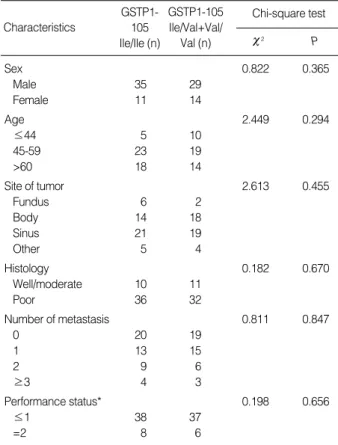
(72%), with a median age of 55 yr old (range 32 yr old to 77 yr old). No clear patterns for significant associations bet- ween the polymorphism and any of the other demographic (gender), clinical (performance status, site of the tumor, and number of metastases), or pathological characteristics (tumor differentiation) were observed (Table 1).
Response to chemotherapy
GSTP1-105 genotype analyses were successful for 89 pa- tients of which 85 were eligible for response analyses. Four patients withdrew from the study too early to evaluate their response. The four patients refused to continue chemothera-
*Performance status was classified according to Eastern Cooperative Oncology Group (ECOG) criteria.
GSTP1, Glutathione S-transferases P1.
GSTP1, Glutathione S-transferases P1; CR, complete response; PR, partial response; SD, stable disease; PD, progressive disease, OR, odds ratio; CI, confidence intervals.
Characteristics
c2 P
c2 P
Chi-square test GSTP1-
105 Ile/Ile (n)
GSTP1-105 Ile/Val+Val/
Val (n)
Sex 0.822 0.365
Male 35 29
Female 11 14
Age 2.449 0.294
≤44 5 10
45-59 23 19
>60 18 14
Site of tumor 2.613 0.455
Fundus 6 2
Body 14 18
Sinus 21 19
Other 5 4
Histology 0.182 0.670
Well/moderate 10 11
Poor 36 32
Number of metastasis 0.811 0.847
0 20 19
1 13 15
2 9 6
≥3 4 3
Performance status* 0.198 0.656
≤1 38 37
=2 8 6
Table 1. Demographic, clinical, and pathological characteristics compared between patients with different GSTP1 genotype
Response to treatment Genotype
CR+PR+SD PD OR (95% CI)
Chi-square test Logistic regression analysis P
GSTP1-105 Ile/Val+Val/Val 29 12 1.000
GSTP1-105 Ile/Ile 17 27 9.259 0.026 5.028 (1.750-14.446) 0.003
Table 2. Association between GSTP1 polymorphism and response to treatment
py. The median cycles of chemotherapy were 5 cycles for the remaining 85 patients. Among these 85 patients, 12 (14%) of the patients showed PR, 34 (40%) SD, 39 (46%) showed PD, and no patients showed CR. The association between the response to treatment and the GSTP1 polymorphisms was shown in Table 2.
Time to progression
The 85 patients mentioned-above were eligible for survival analysis since the four patients took off study too early to eval- uate their survival time. From July 2006 to April 2009, 83 patients (98%) were followed up, with a median follow-up period of 11.6 months (range 3.5 to 23 months). The survival time of the 2 patients who lost follow-up was treated as cen- sored data.
Among the 85 patients, eighty-seven percent (74/85) of the participants’ disease had progression during the follow-up period. Then the TTP of the 9 patients without disease pro- gression and the 2 patients with lost of follow up was censor- ed. Compared with patients with a homozygous 105Ile/105Ile
GSTP1 genotype, patients with one or two 105Val alleles had increased the median time to progression (MTTP). The MTTP for patients with a homozygous 105Ile/105Ile GSTP1 genotype was 4.0 months (95% CI 3.649-4.351), whereas that for pa-
Characteristics No.
OR (95% CI) TTP
COX regression analysis
P OR (95% CI)
OS
P Sex
Female 23 1.000 1.000
Male 62 0.953 (0.529-1.714) 0.871 1.120 (0.584-2.145) 0.733
Age (yr) 0.123 0.318
≤44 15 1.000 1.000
45-59 40 0.458 (0.215-0.972) 0.042 0.559 (0.257-1.215) 0.142
≥60 30 0.570 (0.251-1.294) 0.179 0.685 (0.290-1.621) 0.390
Site of tumor 0.457 0.362
Fundus 7 1.000 1.000
Body 31 1.374 (0.518-3.647) 0.523 1.225 (0.458-3.276) 0.686
Sinus 39 1.208 (0.476-3.070) 0.690 1.465 (0.551-3.896) 0.444
Other 8 2.271 (0.724-7.127) 0.160 2.645 (0.809-8.644) 0.108
Histology
Well/moderate 20 1.000 1.000
Poor 65 1.582 (0.892-2.804) 0.117 2.134 (1.153-3.949) 0.016
Number of metastasis 0.153 0.010
0 36 1.000 1.000
1 27 1.080 (0.616-1.894) 0.788 1.446 (0.799-2.684) 0.242
2 15 1.753 (0.864-3.559) 0.120 2.428 (1.120-5.262) 0.025
≥3 7 2.717 (0.976-7.613) 0.058 5.088 (1.804-14.348) 0.002
Performance status*
≤1 71 1.000 1.000
=2 14 2.229 (1.096-4.534) 0.027 1.611 (0.775-3.351) 0.202
GSTP1-105 genotype
Ile/Val or Val/Val 1.000 1.000
Ile/Ile 2.359 (1.362-4.087) 0.002 2.268 (1.281-4.017) 0.005
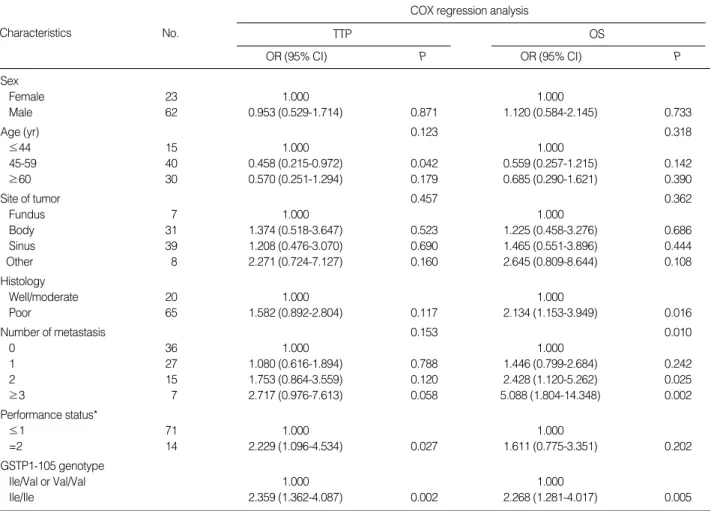
Table 3. Association between patients’ characteristics and TTP, OS after oxaliplatin/5-FU-based chemotherapy
*Performance status was classified according to Eastern Cooperative Oncology Group (ECOG) criteria.
TTP, time to progression; OS, overall survival; OR, odds ratio; CI, confidence intervals; GSTP1, Glutathione S-transferases P1.
Fig. 1. Time to progression curves of patients with advanced gas- tric cancer according to GSTP1 Ile105Val polymorphism.
Probability of time to progression
1.0
0.8
0.6
0.4
0.2
0.0
2.50 5.00 7.50 10.00 12.50
Time to progression (months)
GSTP1-105 lle/lle
P=0.002
GSTP1-105 lle/Val+Val/Val Group
1 2 1-censored 2-censored
1, lle/lle 2, lle/Val+Val/Val
tients with one or two 105Val GSTP1 genotype was 7.0 months (95% CI 5.360-8.640; c2=10.043, P=0.002) (Fig. 1).
The MTTP for all 85 patients was 5.3 months (95% CI 4.431-6.169). Homozygosity for 105Ile/105Ile GSTP1 genotype was associated with a significantly increased risk of progres- sion compared with at least one 105Val allele (OR 2.359; 95%
CI 1.362-4.087; P=0.002). Patients with a performance sta- tus ECOG=2 showed an increased risk of progressing (P=
0.027) when compared with patients who showed a superi- or performance status (ECOG 0-1). Age, sex, tumor histolog- ic grade, metastases, as well as site of tumor was not associ- ated with TTP in this series of patients (Table 3).
Overall survival time
Of the 85 patients, 14 patients were still alive. The survival time of the 14 patients and the two patients with lost of fol- low up was treated as censored data. The median overall sur- vival (MOS) for patients with a homozygous 105Ile/105Ile GS- TP1 genotype was 7.0 months (95% CI 5.137-8.863), where- as that for patients with one or two 105Val GSTP1 genotype was 9.5 months (95% CI 7.847-11.153; c2=9.223, P=0.002) (Fig. 2).
The MOS for all 85 patients was 8.0 months (95% CI
6.623-9.377). Patients with 105Ile/105Ile genotype had a high- er risk of death compared with patients with one or two 105Val alleles (OR 2.268; 95% CI 1.281-4.017; P=0.005). Age, sex, site of tumor, and performance status were not associat- ed with patient survival. However, patients with more metas- tases seemed to have a shorter survival time (P=0.010). Oth- erwise, 65 patients with a poorly differentiated tumor also tended to have a higher risk of death (P=0.016). The associ- ation of demographic, clinical, and pathological characteris- tics and clinical outcome was listed in Table 3.
Toxicity
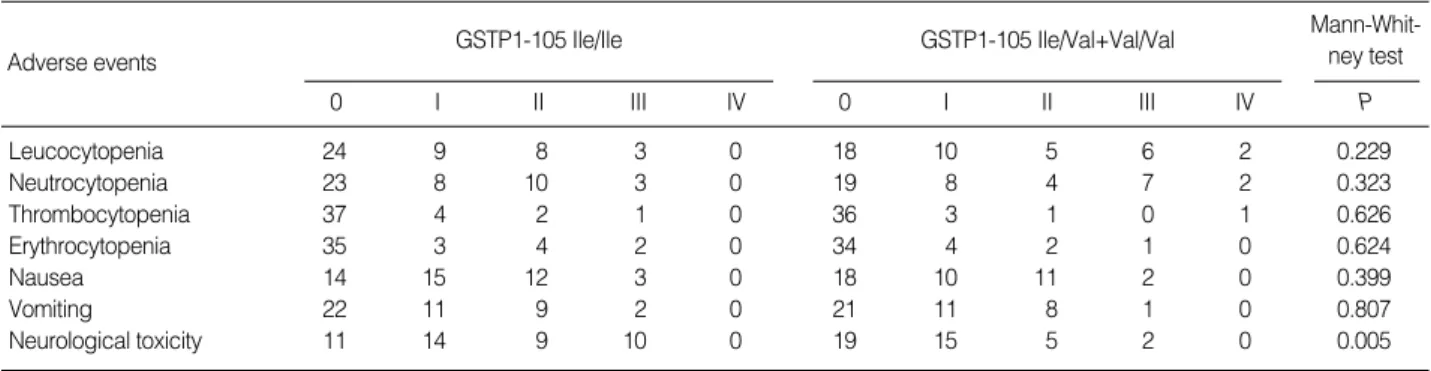
All 85 patients were evaluated toxicity from the time of initial chemotherapy to end of follow-up. No treatment-relat- ed deaths occurred. The most common adverse events of the treatment were hematological and neurological toxicity. Grade 3 or 4 cumulative peripheral neuropathy was significantly more common in patients with 105Ile/105Ile GSTP1 genotype (10 of 44 patients, 23%) compared with patients with 105Ile/
105Val or 105Val/105Val GSTP1 genotype (2 of 41 patients, 5%;
2=5.577, P=0.018). Meanwhile, the overall incidence of neu- rological toxicity in patients with homozygous 105Ile/105Ile GSTP1 genotype was significantly higher than that in patients with one or two 105Val GSTP1 genotype (P=0.005) (Table 4).
DISCUSSION
We attempted to identify predictive genetic polymorphisms for response and survival to oxaliplatin/5-FU chemotherapy in patients with advanced gastric cancer. Our analysis of the common polymorphism for the GSTP1 in patients with ad- vanced gastric cancer demonstrates that relevant alteration of a protein’s function can result in differences of defined clin- ical endpoints. In this study, patients with at least one 105Val allele had a better prognosis and response to the oxaliplatin/
5-FU-based regimen as first-line treatment for advanced gas- tric cancer.
The identification of molecular variables that predict either
Adverse events
0 I II III IV
GSTP1-105 Ile/Ile
0 I II III IV
GSTP1-105 Ile/Val+Val/Val Mann-Whit- ney test
P
Leucocytopenia 24 9 8 3 0 18 10 5 6 2 0.229
Neutrocytopenia 23 8 10 3 0 19 8 4 7 2 0.323
Thrombocytopenia 37 4 2 1 0 36 3 1 0 1 0.626
Erythrocytopenia 35 3 4 2 0 34 4 2 1 0 0.624
Nausea 14 15 12 3 0 18 10 11 2 0 0.399
Vomiting 22 11 9 2 0 21 11 8 1 0 0.807
Neurological toxicity 11 14 9 10 0 19 15 5 2 0 0.005
Table 4. Association between GSTP1 polymorphism and treatment-related toxicity
Fig. 2. Overall survival curves of patients with advanced gastric cancer according to GSTP1 Ile105Val polymorphism.
Probability of survival
1.0
0.8
0.6
0.4
0.2
0.0
0.0 5.0 10.0 15.0 20.0 25.0
Overall survival time (months)
Group 1 2 1-censored 2-censored
P=0.002 GSTP1-105 lle/lle
GSTP1-105 lle/Val+Val/Val GSTP1, Glutathione S-transferases P1.
1, lle/lle 2, lle/Val+Val/Val
resistance or sensitivity to chemotherapy is of major interest in selecting the most likely effective first-line treatment, avoid- ing adverse side effects of a toxic but inactive therapy. Glu- tathione S-transferases catalyze the first step in the formation of mercapturic acids, initiating a pathway that results most- ly in the elimination of toxic compounds. Previous studies revealed that substitution of isoleucine with valine at codon 105 alters the function of the GSTP1 protein (20).
It is known that the allele frequencies of metabolic genes are not equally distributed throughout the human population but follow diverse ethnic and/or geographic-specific patterns.
An American population-based study reported, for GSTP1, the prevalence rates of 105Ile/105Val heterozygosity and 105Val/
105Val homozygosity were found to be 30% to 51% and 7%
to 19%, respectively (15). For gastric cancer patients, a Chi- nese study showed the rates of GSTP1 105Ile/105Val genotype and 105Val/105Val genotype were 30.6% and 0% (21). In our study, 41% of the participants were heterozygous for 105Ile/
105Val, and 7% were homozygous for the 105Val/105Val. This frequency is similar to the frequencies above.
Stoehlmacher et al. (17) reported clinical response was not statistically associated with GSTP1 genotypes in patients with colorectal cancer. Ott et al. (18) reported GSTP1 genotypes were not correlated with response to neoadjuvant chemother- apy in gastric cancer. Cabelguenne et al. (22) could not observe a correlation between GSTP1 genotypes and response to cis- platin neoadjuvant chemotherapy in head and neck squamous cell cancer (HNSCC) patients. While another study showed patients possessing the GSTP1-105 Val/Val genotype showed a significant superior response in gastric cancer (23). Our results demonstrated patients with at least one 105Val allele had a better disease control rate compared with patients with homozygous 105Ile/105Ile genotype. There were some contro- versial reports about the impact of GSTP1 on clinical res- ponse, indicating that other potential factors may affect the response to chemotherapy, such as ethnic background, geo- graphic pattern or other potential genetic factors.
Our study suggested patients with GSTP1 105Val geno- type had a better clinical outcome to oxaliplatin/5-FU-based chemotherapy in advanced gastric cancer patients. GSTP1 Ile105Val polymorphism was studied widely in various tumors, such as prostate cancer, colorectal cancer, breast cancer, eso- phageal cancer and gastric cancer. Reports in colorectal can- cer patients demonstrated a significantly improved time to progression and overall survival for carriers of the GSTP1 105Val allele after 5-FU/oxaliplatin chemotherapy (17, 24). Goekkurt et al. reported that patients with GSTP1 105Val/105Val geno- type demonstrated significant superior median survival time after 5-FU/cisplatin chemotherapy for gastric cancer (23). In the present study, we demonstrated that patients with two
105Ile alleles had a significantly increased risk of progression and death. In summary, the results we report here are in strong agreement with the current understanding of GSTP1 involve- ment in platinum detoxification. Our findings support the
hypothesis that increased platinum sensitivity may in part be due to impaired GSTP1 enzyme function.
Recent clinical reports provided evidence for an association between GSTP1 genotype and cytotoxicity of chemothera- peutic agents (25). A study reported that oxaliplatin-related cumulative neuropathy scored grade 3 was significantly more frequent in patients homozygous for the GSTP1 105Ile allele than in patients homozygous or heterozygous for the GSTP1
105Val allele (OR 5.75; 95% CI 1.08-30.74; P=0.02) (26).
Another report showed Patients with GSTP1 105Ile/105Ile geno- type had a higher risk of developing a grade >or =2 docetax- el-induced peripheral neuropathy (25). Similarly, our study implied patients with two GSTP1 105Ile alleles had a higher risk of developing neurological toxicity, especially in grade 3 neuropathy. It was reported that individuals with two GSTP1
105Val alleles had a lower catalytic activity compared with indi- viduals with two GSTP1 105Ile alleles (15). In particular, there was in vitro evidence that GSTP1 105Val allele is much more active than the wild-type alleles against cisplatin and carbo- platin (27). Thus, the increasing rate of grade 3 neuropathy in patients with 105Ile/105Ile GSTP1 genotype could be exp- lained by the diminished capacity of detoxifying oxaliplatin.
And the involvement of GSTP1 in cellular apoptosis could be another hypothesis to explain the protective effect of the variant genotype.
In conclusion, we demonstrated that among patients with gastric cancer who received 5-FU/oxaliplatin chemotherapy as first-line treatment, those possessing the GSTP1 105Val variant allele show a statistically significant benefit for both time to progression and overall survival. Our results support the hypothesis that the effects of chemotherapeutic drugs may be altered when enzymes that could enhance the elimination of these drugs show a reduced activity. However, more per- spective multicentric randomized studies are required to con- firm our preliminary results for patients with advanced gas- tric cancer in Chinese population.
REFERENCES
1. Varadhachary G, Ajani JA. Gastric cancer. Clin Adv Hematol Oncol 2005; 3: 118-24.
2. Vanhoefer U, Rougier P, Wilke H, Ducreux MP, Lacave AJ, Van Cutsem E, Planker M, Santos JG, Piedbois P, Paillot B, Bodenstein H, Schmoll HJ, Bleiberg H, Nordlinger B, Couvreur ML, Baron B, Wils JA. Final results of a randomized phase III trial of sequential high-dose methotrexate, fluorouracil, and doxorubicin versus etopo- side, leucovorin, and fluorouracil versus infusional fluorouracil and cisplatin in advanced gastric cancer: a trial of the European Orga- nization for Research and Treatment of Cancer Gastrointestinal Tract Cancer Cooperative Group. J Clin Oncol 2000; 18: 2648-57.
3. Sadighi S, Mohagheghi MA, Montazeri A, Sadighi Z. Quality of life in patients with advanced gastric cancer: a randomized trial com- paring docetaxel, cisplatin, 5-FU (TCF) with epirubicin, cisplatin,
5-FU (ECF). BMC Cancer 2006; 6: 274.
4. Sumpter K, Harper-Wynne C, Cunningham D, Rao S, Tebbutt N, Norman AR, Ward C, Iveson T, Nicolson M, Hickish T, Hill M, Oates J. Report of two protocol planned interim analyses in a ran- domised multicentre phase III study comparing capecitabine with fluorouracil and oxaliplatin with cisplatin in patients with advanced oesophagogastric cancer receiving ECF. Br J Cancer 2005; 92:
1976-83.
5. Van Cutsem E, Moiseyenko VM, Tjulandin S, Majlis A, Constenla M, Boni C, Rodrigues A, Fodor M, Chao Y, Voznyi E, Risse ML, Ajani JA. Phase III study of docetaxel and cisplatin plus fluorouracil compared with cisplatin and fluorouracil as first-line therapy for advanced gastric cancer: a report of the V325 Study Group. J Clin Oncol 2006; 24: 4991-7.
6. Allen WL, Johnston PG. Role of genomic markers in colorectal can- cer treatment. J Clin Oncol 2005; 23: 4545-52.
7. Yamayoshi Y, Iida E, Tanigawara Y. Cancer pharmacogenomics:
international trends. Int J Clin Oncol 2005; 10: 5-13.
8. Rosell R, Cecere F, Santarpia M, Reguart N, Taron M. Predicting the outcome of chemotherapy for lung cancer. Curr Opin Pharma- col 2006; 6: 323-31.
9. Olaussen KA, Dunant A, Fouret P, Brambilla E, Andre F, Haddad V, Taranchon E, Filipits M, Pirker R, Popper HH, Stahel R, Sabatier L, Pignon JP, Tursz T, Le Chevalier T, Soria JC. DNA repair by ERCC1 in non-small-cell lung cancer and cisplatin-based adjuvant chemother- apy. N Engl J Med 2006; 355: 983-91.
10. Galanski M. Recent developments in the field of anticancer platinum complexes. Recent Pat Anticancer Drug Discov 2006; 1: 285-95.
11. Raymond E, Faivre S, Woynarowski JM, Chaney SG. Oxaliplatin:
mechanism of action and antineoplastic activity. Semin Oncol 1998;
25 (2 Suppl 5): 4-12.
12. Marsh S, McLeod HL. Cancer pharmacogenetics. Br J Cancer 2004;
90: 8-11.
13. Nagasubramanian R, Innocenti F, Ratain MJ. Pharmacogenetics in cancer treatment. Annu Rev Med 2003; 54: 437-52.
14. Goto S, Iida T, Cho S, Oka M, Kohno S, Kondo T. Overexpression of glutathione S-transferase pi enhances the adduct formation of cis- platin with glutathione in human cancer cells. Free Radic Res 1999;
31: 549-58.
15. Watson MA, Stewart RK, Smith GB, Massey TE, Bell DA. Human glutathione S-transferase P1 polymorphisms: relationship to lung tissue enzyme activity and population frequency distribution. Car- cinogenesis 1998; 19: 275-80.
16. Booton R, Ward T, Heighway J, Ashcroft L, Morris J, Thatcher N.
Glutathione-S-transferase P1 isoenzyme polymorphisms, platinum- based chemotherapy, and non-small cell lung cancer. J Thorac Oncol 2006; 1: 679-83.
17. Stoehlmacher J, Park DJ, Zhang W, Groshen S, Tsao-Wei DD, Yu MC, Lenz HJ. Association between glutathione S-transferase P1, T1, and M1 genetic polymorphism and survival of patients with metastat- ic colorectal cancer. J Natl Cancer Inst 2002; 94: 936-42.
18. Ott K, Lordick F, Becker K, Ulm K, Siewert J, Hofler H, Keller G.
Glutathione-S-transferase P1, T1 and M1 genetic polymorphisms in neoadjuvant-treated locally advanced gastric cancer: GSTM1-pre- sent genotype is associated with better prognosis in completely resect- ed patients. Int J Colorectal Dis 2008; 23: 773-82.
19. Caussanel JP, Levi F, Brienza S, Misset JL, Itzhaki M, Adam R, Milano G, Hecquet B, Mathe G. Phase I trial of 5-day continuous venous infusion of oxaliplatin at circadian rhythm-modulated rate compared with constant rate. J Natl Cancer Inst 1990; 82: 1046-50.
20. Srivastava SK, Singhal SS, Hu X, Awasthi YC, Zimniak P, Singh SV. Differential catalytic efficiency of allelic variants of human glu- tathione S-transferase Pi in catalyzing the glutathione conjugation of thiotepa. Arch Biochem Biophys 1999; 366: 89-94.
21. Liu B, Wei J, Zou Z, Qian X, Nakamura T, Zhang W, Ding Y, Feng J, Yu L. Polymorphism of XRCC1 predicts overall survival of gas- tric cancer patients receiving oxaliplatin-based chemotherapy in Chinese population. Eur J Hum Genet 2007; 15: 1049-53.
22. Cabelguenne A, Loriot MA, Stucker I, Blons H, Koum-Besson E, Brasnu D, Beaune P, Laccourreye O, Laurent-Puig P, De Waziers I.
Glutathione-associated enzymes in head and neck squamous cell car- cinoma and response to cisplatin-based neoadjuvant chemotherapy.
Int J Cancer 2001; 93: 725-30.
23. Goekkurt E, Hoehn S, Wolschke C, Wittmer C, Stueber C, Hossfeld DK, Stoehlmacher J. Polymorphisms of glutathione S-transferases (GST) and thymidylate synthase (TS)--novel predictors for response and survival in gastric cancer patients. Br J Cancer 2006; 94: 281-6.
24. Stoehlmacher J, Park DJ, Zhang W, Yang D, Groshen S, Zahedy S, Lenz HJ. A multivariate analysis of genomic polymorphisms: predic- tion of clinical outcome to 5-FU/oxaliplatin combination chemother- apy in refractory colorectal cancer. Br J Cancer 2004; 91: 344-54.
25. Mir O, Alexandre J, Tran A, Durand JP, Pons G, Treluyer JM, Gold- wasser F. Relationship between GSTP1 Ile(105)Val polymorphism and docetaxel-induced peripheral neuropathy: clinical evidence of a role of oxidative stress in taxane toxicity. Ann Oncol 2009; 20:
736-40.
26. Lecomte T, Landi B, Beaune P, Laurent-Puig P, Loriot MA. Glu- tathione S-transferase P1 polymorphism (Ile105Val) predicts cumula- tive neuropathy in patients receiving oxaliplatin-based chemothera- py. Clin Cancer Res 2006; 12: 3050-6.
27. Ishimoto TM, Ali-Osman F. Allelic variants of the human glutathione S-transferase P1 gene confer differential cytoprotection against anti- cancer agents in Escherichia coli. Pharmacogenetics 2002; 12: 543-53.