INTRODUCTION
Recently, the assessment of changes of white blood cell (WBC) subsets such as neutrophils, lymphocytes, monocytes, or ratio of neutrophil to lymphocyte counts (N/L) in periph- eral blood has been identified as an easy, simple, inexpensive, and reliable prognostic index to determine host immunity (1-17). As immune cells, WBC subsets undergo changes in their proportion in peripheral blood by inhibition of apop- tosis of neutrophils (1-4) and apoptosis of lymphocytes (7, 8) in certain psychological stress (9, 18), surgical trauma (10, 11), or advanced malignant tumors (1-4, 7, 8). It has been documented that the change of WBC subsets populations is a reliable prognostic index to predict survival rate and ther- apeutic benefit in cancer patients (1-8).
Major surgery produces tissue damage and acute inflam- mation, which are related with alterations in the immune status of patients (11, 19, 20). In already immune-changed cancer patients, surgical stress-induced suppression of cellu- lar immunity may potentially accelerate the tumor growth and dissemination of residual cancer cells (21). Therefore, it is especially important to keep immune status of cancer pa-
tients competent after surgery.
Differences between men and women in endocrine reac- tions to the nature of the stress have been reported (18, 22, 23). Acute psychological stress activated the endocrine res- ponse more profoundly in male subjects than in female sub- jects (18). In contrast, physical stress stimulated greater in- creases in cortisol response in female subjects than in male subjects (22, 23). Although there is a close relationship bet- ween endocrine responses and immune changes, the effects of gender on the perioperative and postoperative perturba- tion of cellular immunity by surgical stress in cancer patients have not been reported.
Stomach cancer is one of the most common cancer and a leading cause of death from cancer in both sexes in Korea.
Altered immune response to stomach cancer has been docu- mented (13, 14). Therefore, the aim of the current study was to investigate the effects of gender on the changes in blood WBC subsets populations and N/L during hospitalization after surgical treatment between male and female patients with stomach cancer by analyzing blood WBC subset values and N/L from the database, retrospectively.
Mi Sook Gwak, Soo Joo Choi, Jie Ae Kim, Justin Sang Ko, Tae Hyeong Kim, Sang Min Lee, Jung-A Park, Myung Hee Kim
Department of Anesthesiology and Pain Medicine, Samsung Medical Center, Sungkyunkwan University School of Medicine, Seoul, Korea
Address for correspondence Myung Hee Kim, M.D.
Department of Anesthesiology and Pain Medicine, Samsung Medical Center, Sungkyunkwan University School of Medicine, 50 Irwon-dong, Gangnam-gu, Seoul 135-710, Korea
Tel : +82.2-3410-2461, Fax : +82.2-3410-0361 E-mail : [email protected]
S104
Effects of Gender on White Blood Cell Populations and Neutrophil- Lymphocyte Ratio Following Gastrectomy in Patients with Stomach Cancer
Alterations of absolute number or percentage of circulating white blood cell (WBC) subsets are associated with psychological and physical stress. Gender effects on the changes of circulating WBC subsets following surgical treatment have not been determined. Therefore, the current study aimed to determine whether circulating neutrophils, lymphocytes and monocytes, and neutrophil-lymphocyte ratio (N/L) are different following major surgery according to the gender. We studied 409 male patients and 212 female patients who underwent total or subtotal gastrectomy due to stomach cancer, from 1 January to 31 December in 2005. The WBC count and percentage of its subsets were obtained from database and N/L was directly calcu- lated from the full blood count preoperatively, immediate postoperatively, and post- operative day 1, 3, 5 in a retrospective manner. Compared to preoperative values, neutrophilia, lymphopenia, monocytopenia, and increased N/L were associated with gastrectomy in all patients. In the comparison study between genders, there were significantly increased proportion of neutrophils, decreased lymphocytes and monocytes, and higher N/L in female patients than in male patients after gastrec- tomy. These findings indicate that female patients showed more immune-compro- mised response to gastrectomy than male patients.
Key Words : Gender; Gastrectomy; Stomach, Neoplasm; Leukocytes
Received : 1 February 2007 Accepted : 25 April 2007
MATERIALS AND METHODS Patients
After approval from the local ethics committee, we exam- ined 923 patients who were diagnosed as stomach cancer and received total or subtotal gastrectomy from January 1 to De- cember 31 in 2005 in this study. Counts of peripheral WBC and percentage of neutrophils, lymphocytes, and monocytes before and immediate after surgery, postoperative day (POD) 1, 3, and 5 were obtained from database retrospectively, and the ratio of neutrophils to lymphocytes was directly calcu- lated from the full blood count. Patients’ surgical, anesthet- ic records, and progression notes in ward during hospitaliza- tion were also reviewed. All patients without complications after gastrectomy were discharged on the POD 10 per a spe- cific protocol. Accordingly, patients hospitalized more than 10 days and those with risk factors that might have affected circulating WBC, were all excluded in the current study.
Patients with medical problems such as diabetes mellitus, hepatic, cardiac and renal problems, or postoperative com- plications such as pneumonia, surgical site leakage or uri- nary tract infection, patients who received blood transfusion during surgery or after surgery, patients who received com- bined surgery such as cholecystectomy or gynecological sur- gery, patients who had metastasis to other organs, or those who received palliative surgery due to unresectable stomach cancer, were all excluded. After exclusion, 409 male patients and 212 female patients were finally included for analysis.
Statistical analysis
One-way repeated measures analysis of variance and Holm- Sidak method as post hoc test was used to assess the statisti- cal differences in the variables of WBC subsets and N/L with- in the groups. For comparison of the WBC subsets and N/L between the groups at the same time points, t-test or Mann- Whitney ranksom test was used. Values were expressed as mean±SD. The 5% level was considered significant.
RESULTS Patients
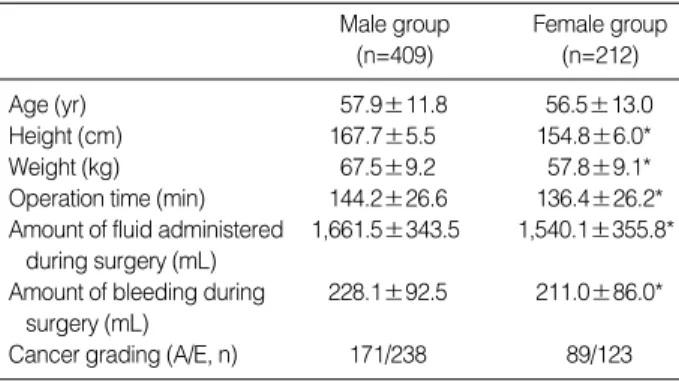
Four hundred and nine male patients and 212 female pa- tients who had underwent total or subtotal gastrectomy due to stomach cancer were identified from the database. The mean age of the patients was same between male patients and female patients (58 yr vs. 56 yr). However, predictably enough, weight and height were greater in male patients than in female patients (p<0.05). Subsequently, operation time, amount of bleeding, and the amount of fluid adminis- tered during surgery were slightly but significantly greater
in male patients than in female patients (p<0.05). The grad- ing of cancer stage was exactly same in both sexes. Advanced stomach cancer and early stomach cancer were 42% and 58%, respectively, in both sexes (Table 1).
Assessments of WBC subsets and N/L
The increase of total WBC number following surgical treat- ment was most significant at the immediate postoperative period, and the significant increase extended until POD 5.
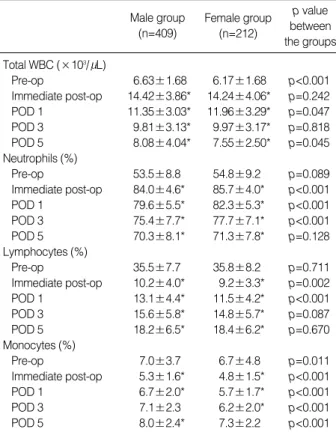
In the comparison between the groups, WBC count was not different between genders following surgery, but significantly higher in male patients than female patients preoperatively (p<0.05). We found that the percentage of neutrophils in peripheral blood increased most significantly at the imme- diate postoperative period compared with preoperative level in both groups, and the significant increase extended until POD 5 (p<0.05). In the comparison between genders, the percentage of neutrophils was significantly higher in female patients than in male patients from immediate postoperative period until POD 3 (p<0.001). The percentage of lympho- cytes in peripheral blood decreased most significantly at the immediate postoperative period compared with the preoper- ative level, and the significant decrease extended until POD 5 (p<0.05). In the comparison between the groups, the per- centage of lymphocytes was significantly lower in female patients than in male patients at the immediate postopera- tive period and POD 1 (p<0.001). The percentage of mono- cytes in peripheral blood decreased most significantly at the immediate postoperative period and significantly decreased until POD 1 in male patients and until POD 3 in female patients. However, the percentage of monocytes increased significantly in POD 5 compared to the baseline value in male patients. In the comparison between genders, the per- centage of monocytes was significantly lower in female pa- tients than in male patients from the preoperative period until POD 5 (p<0.001). There was no difference in N/L bet- ween male patients and female patients preoperatively (1.7
±0.4 vs. 1.7±0.8), but the N/L value was significantly
Values are mean±SD. *p<0.05 compared with male group.
A, advanced cancer; E, early cancer.
Male group (n=409)
Female group (n=212)
Age (yr) 57.9±11.8 56.5±13.0
Height (cm) 167.7±5.5 154.8±6.0*
Weight (kg) 67.5±9.2 57.8±9.1*
Operation time (min) 144.2±26.6 136.4±26.2*
Amount of fluid administered 1,661.5±343.5 1,540.1±355.8*
during surgery (mL)
Amount of bleeding during 228.1±92.5 211.0±86.0*
surgery (mL)
Cancer grading (A/E, n) 171/238 89/123
Table 1.Demographic and clinical data
higher in female patients than in male patients from the im- mediately postoperative period until POD 3. N/L between female patients and male patients at the immediate postop- erative period were 10.7±4.4 vs. 9.6±4.2, p<0.001, on POD 1 were 8.4±4.1 vs. 7.1±3.3, p<0.001, and on POD 3 were 6.3±3.2 vs. 5.7±3.1, p=0.022 (Fig. 1).
DISCUSSION
In response to total or subtotal gastrectomy in stomach cancer patients, increased neutrophils, decreased lympho- cytes and monocytes, and increase of N/L in circulating blood were demonstrated. The alterations of these values were most significant at the immediate postoperative period and tend- ed to be restored as time passes during the postoperative peri- od in both sexes. We found significant gender effects on the changes of the percentage of blood WBC subsets following surgery in the large sample size of this study. Female patients had more circulating neutrophils, less lymphocytes, conse- quently higher N/L, and less monocytes, which indicate a more immune-compromised state, than male patients for a few days postoperatively. In the preoperative values, except for the total number of WBC and percentage of monocytes,
there were no significant differences between sexes.
In the current study, database from 409 male patients and 212 female patients were available for analysis out of total 923 patients scheduled for total or subtotal gastrectomy from 1 January to 31 December in 2005. Exclusion criteria in the study were as follows: the patients with combined chemother- apy, combined medical disease that might have affected cir- culating WBC counts, or palliative surgery or combined surgery with other organs due to the correlation between surgical size and magnitude of immune suppression (19, 20), or postoperative complications such as pneumonia, urinary tract infection, and wound infection, or blood transfusion during surgery or postoperative period, or duration of hos- pital stay more than 10 days.
According to the stage of stomach cancer, the number of peripheral lymphocytes and lymphocyte subsets were sup- pressed in different degrees (13, 14). A quantitative change in circulating blood lymphocytes takes place in the advanced stage of stomach cancer (14). The immune status of the pa- tients with stomach cancer in the current study might have been altered according to the cancer stage. We found that the ratio of cancer grading between advanced stage and early stage was exactly same as 42% and 58%, respectively, in both sexes in the current study. Furthermore, the mean age of the two groups in the current study (58 yrs of male patients vs.
57 yrs of female patients) was similar. A relative decrease of circulating lymphocytes has been observed as ages normally (16). In the study with patients admitted to intensive care unit, the degree of lymphopenia was well correlated with age (5). In the present study, we could clarify that the differ- ences of WBC subsets percentage and N/L in the peripheral blood between the groups were not associated with cancer grading and age of patients. Although significantly shorter
Fig. 1.Peripheral neutrophil-lymphocyte ratio (N/L) from the pre- operative period until postoperative day 5 in 409 male patients and 212 female patients. Compared with the preoperative value, N/L increased significantly until postoperative day 5 in both gro- ups. In the comparison between the groups, N/L was significant- ly higher in female patients than in male patients from the imme- diate postoperative period until postoperative day 3.
Neutrophil-lymphocyte Ratio
16 14 12 10 8 6 4 2 0
Pre-op Immediate post-op POD 1 POD 3 POD 5 Time
Male Female
*
*
*
*
*
*,�
*,�
*,�
Values are mean±SD. *p<0.05 compared with the pre-op value within the groups.
WBC, white blood cell; POD, postoperative day.
Male group (n=409)
Female group (n=212)
p value between the groups Total WBC (×103/ L)
Pre-op 6.63±1.68 6.17±1.68 p<0.001 Immediate post-op 14.42±3.86* 14.24±4.06* p=0.242 POD 1 11.35±3.03* 11.96±3.29* p=0.047
POD 3 9.81±3.13* 9.97±3.17* p=0.818
POD 5 8.08±4.04* 7.55±2.50* p=0.045
Neutrophils (%)
Pre-op 53.5±8.8 54.8±9.2 p=0.089
Immediate post-op 84.0±4.6* 85.7±4.0* p<0.001 POD 1 79.6±5.5* 82.3±5.3* p<0.001 POD 3 75.4±7.7* 77.7±7.1* p<0.001
POD 5 70.3±8.1* 71.3±7.8* p=0.128
Lymphocytes (%)
Pre-op 35.5±7.7 35.8±8.2 p=0.711
Immediate post-op 10.2±4.0* 9.2±3.3* p=0.002 POD 1 13.1±4.4* 11.5±4.2* p<0.001
POD 3 15.6±5.8* 14.8±5.7* p=0.087
POD 5 18.2±6.5* 18.4±6.2* p=0.670
Monocytes (%)
Pre-op 7.0±3.7 6.7±4.8 p=0.011
Immediate post-op 5.3±1.6* 4.8±1.5* p<0.001
POD 1 6.7±2.0* 5.7±1.7* p<0.001
POD 3 7.1±2.3 6.2±2.0* p<0.001
POD 5 8.0±2.4* 7.3±2.2 p<0.001
Table 2.Gender effects on the changes of total WBC and its subsets during 5 days after gastrectomy
operation time and smaller amounts of fluid administration and bleeding were observed in female patients compared to male patients during surgery, these differences (8 min, 120 mL, and 17 mL, respectively) might have little influence on the immune response and do not seem to have any clinical effect. Therefore, the only noteworthy differences in WBC subsets values and N/L between the groups appeared to be gender-related factor.
Stomach cancer is the leading cause of cancer-related death in both male and female patients in Korea. Presurgical an- xiety in patients waiting for gastrectomy due to stomach can- cer clearly affect host immunity. Psychological distress in pa- tients bearing digestive tract cancer was well related with suppressed immune function including increased neutrophils and decreased lymphocytes and monocytes in both sexes (15).
Purely psychological stress such as in public speaking was also documented to cause the redistribution of circulating lymphocytes and their subsets (9). Because WBC subset val- ues prior to the preoperative data were not available in this study, we could not demonstrate the extent of presurgical stress induced changes of WBC subsets levels. However, pre- operative values of circulating blood WBC subsets, except the total number of WBC and percentage of monocytes, were not different between genders. The higher number of total WBC in male patients than in female patients may be relat- ed to potentially higher smoking population in male subjects than in female subjects in average age of 50s in Korea (17).
In the study to investigate the relationship between acute psychological stress and immune response in elderly (55-75 yr) healthy individuals, adrenocorticotropic hormone (ACTH) and cortisol secretion by the activation of hypothalamic-pitu- itary-adrenal (HPX) axis were significantly increased in male subjects compared to female subjects (18). In contrast, the cortisol response to physical challenges, such as high inten- sity treadmill test (22) and lumbar puncture stress (23), has been greater in female subjects than in male subjects. Stim- ulation of HPX axis due to mental stress or physical stress increases blood concentrations of ACTH and cortisol, which induce redistribution of circulating WBC by inhibition of neutrophil apoptosis and activation of lymphocyte apoptosis (11). Concentrations of circulating WBC change continu- ously, so that a large sample size as in our current study is required to detect the differences of cellular immune response to active or passive stress between genders (24). Despite the no discernable gender differences in the percentage of periph- eral neutrophils and lymphocytes, and N/L preoperatively, more increased percentage of neutrophils and decreased per- centage of lymphocytes, and higher N/L in female patients than in male patients were observed postoperatively in this study.
Assessment of the absolute number or percentage of cir- culating blood WBC subsets has been advocated as an easy, simple, inexpensive, and reliable prognostic factor in criti- cally ill patients with medical or surgical illnesses and malig-
nancy. Depending on the study types and conditions, neu- trophilia, lymphopenia, or N/L was identified as a predic- tive factor closely associated with mortality rate and thera- peutic benefits. Both the lymphopenia and neutrophilia rather than total WBC count have been suggested as more sensi- tive parameters in adults admitted due to suspected bacte- remia (5). An increased neutrophil count in peripheral blood has been suggested as a significant parameter to predict prog- nosis in patients with metastatic melanoma (4) and those with metastatic renal cell carcinoma (1-3). The degree of lymphopenia was correlated with host immunity and sur- vival rate in advanced pancreatic cancer patients (7). Recent- ly, N/L has been considered as a quick, simple and sensitive parameter to evaluate systemic inflammation and stress in critically ill patients following shock, multiple trauma, major surgery, or sepsis (6), and as the greatest predictive factor for increased cardiovascular risk (12). Preoperative N/L greater than 5 showed significantly higher cancer mortality in gen- eral compared to N/L lesser than 5 in patients with colorec- tal cancer (8). N/L in percutaneous fine- needle aspiration biopsy specimen was also found to be an independent prog- nostic factor for patients with advanced non-small cell lung carcinoma (25).
Although we observed suppressed cellular immunity only for 5 days after gastrectomy as a limitation of retrospective study, Ogawa et al. (11) showed significantly decreased lym- phocyte number and function for 2 weeks postoperatively in patients with gastrointestinal cancer. When already im- mune suppressed cancer patients undergo operation, the host immunity could be depressed more seriously because surgery- induced tissue damage and related acute inflammation cause decreases of immunocyte function. Because suppressed post- operative cellular immunity may accelerate remnant cancer cell growth or metastasis in cancer patients, particularly com- petent condition of host immunity should be considered (21).
In conclusion, in the current study female patients showed a more immune compromised pattern of immune cells in peripheral blood than male patients at least for a few days after gastrectomy due to gastric cancer. Further studies should determine whether and to what extent these postoperative changes of WBC subset populations and N/L affect long- term outcomes such as relapse of malignant tumor.
REFERENCES
1. Atzpodien J, Royston P, Wandert T, Reitz M; DGCIN--German Cooperative Renal Carcinoma Chemo-Immunotherapy Trials Group.
Metastatic renal carcinoma comprehensive prognostic system. Br J Cancer 2003; 88: 348-53.
2. Negrier S, Escudier B, Gomez F, Douillard JY, Ravaud A, Chevreau C, Buclon M, Perol D, Lasset C. Prognostic factors of survival and rapid progression in 782 patients with metastatic renal carcinomas treated by cytokines: a report from the Groupe Francais d’Immuno-
therapie. Ann Oncol 2002; 13: 1460-8.
3. Donskov F, Bennedsgaard KM, Hokland M, Marcussen N, Fisker R, Madsen HH, Fode K, von der Maase H. Leukocyte orchestration in blood and tumour tissue following interleukin-2 based immuno- therapy in metastatic renal cell carcinoma. Cancer Immunol Immu- nother 2004; 53: 729-39.
4. Schmidt H, Bastholt L, Geertsen P, Christensen IJ, Larsen S, Gehl J, von der Maase H. Elevated neutrophil and monocyte counts in peri- pheral blood are associated with poor survival in patients with meta- static melanoma: a prognostic model. Br J Cancer 2005; 93: 273-8.
5. Wyllie DH, Bowler IC, Peto TE. Relation between lymphopenia and bacteremia in UK adults with medical emergencies. J Clin Pathol 2004; 57: 950-5.
6. Zahorec R. Ratio of neutrophil to lymphocyte counts-rapid and sim- ple parameter of systemic inflammation and stress in critically ill.
Bratisl Lek Listy 2001; 102: 5-14.
7. Fogar P, Sperti C, Basso D, Sanzari MC, Greco E, Davoli C, Nava- glia F, Zambon CF, Pasquali C, Venza E, Pedrazzoli S, Plebani M.
Decreased total lymphocyte counts in pancreatic cancer: an index of adverse outcome. Pancreas 2006; 32: 22-8.
8. Walsh SR, Cook EJ, Goulder F, Justin TA, Keeling NJ. Neutrophil- lymphocyte ratio as a prognostic factor in colorectal cancer. J Surg Oncol 2005; 91: 181-4.
9. Lucas A, Holtmann G, Gerken G, Pietsch A, Braun-Lang U, Gilani K, Strassburger K, Gesing S, Janssen OE, Kavelaars A, Heijnen CJ, Schedlowski M, Elsenbruch S. Visceral pain and public speaking stress: Neuroendocrine and immune cell responses in healthy sub- jects. Brain Behav Immun 2006; 20: 49-56.
10. Iwase M, Kondo G, Watanabe H, Takaoka S, Uchida M, Ohashi M, Nagumo M. Regulation of fas-mediated apoptosis in neutrophils after surgery-induced acute inflammation. J Surg Res 2006; 134:
114-23.
11. Ogawa K, Hirai M, Katsube T, Murayama M, Hamaguchi K, Shi- makawa T, Naritake Y, Hosokawa T, Kajiwara T. Suppression of cellular immunity by surgical stress. Surgery 2000; 127: 329-36.
12. Horne BD, Anderson JL, John JM, Weaver A, Bair TL, Jensen KR, Renlund DG, Muhlestein JB; Intermountain Heart Collaborative Study Group. Which white blood cell subtypes predict increased cardiovascular risk? J Am Coll Cardiol 2005; 45: 1638-43.
13. Hong WS, Hong SI, Kim CM, Kang YK, Lee MS, Lee JO, Kang TW. Differential depression of lymphocyte subsets according to stage in stomach cancer. Jpn J Clin Oncol 1991; 21: 87-93.
14. Hong WS, Min YI, Son YS, Hong SI. Peripheral blood lymphocyte
subsets in patients with stomach cancer. J Korean Med Sci 1995;
10: 164-8.
15. Zhou FL, Zhang WG, Wei YC, Xu KL, Hui LY, Wang XS, Li MZ.
Impact of comorbid anxiety and depression on quality of life and cellular immunity changes in patients with digestive tract cancers.
World J Gastroenterol 2005; 11: 2313-8.
16. McNerlan SE, Alexander HD, Rea IM. Age-related reference inter- vals for lymphocyte subsets in whole blood of healthy individuals.
Scand J Clin Lab Invest 1999; 59: 89-92.
17. Jee SH, Park JY, Kim HS, Lee TY, Samet JM. White blood cell count and risk for all-cause, cardiovascular, and cancer mortality in a co- hort of Koreans. Am J Epidemiol 2005; 162: 1062-9.
18. Traustadottir T, Bosch PR, Matt KS. Gender differences in cardio- vascular and hypothalamic-pituitary-adrenal axis responses to psy- chological stress in healthy older adult men and women. Stress 2003;
6: 133-40.
19. Cruickshank AM, Fraser WD, Burns HJ, Van Damme J, Shenkin A.
Response of serum interleukin-6 in patients undergoing elective sur- gery of varying severity. Clin Sci (Lond) 1990; 79: 161-5.
20. Baxevanis CN, Papilas K, Dedoussis GV, Pavlis T, Papamichail M.
Abnormal cytokine serum levels correlate with impaired cellular immune responses after surgery. Clin Immunol Immunopathol 1994;
71: 82-8.
21. Eggermont AM, Steller EP, Sugarbaker PH. Laparotomy enhances intraperitoneal tumor growth and abrogates the antitumor effects of interleukin-2 and lymphokine-activated killer cells. Surgery 1987;
102: 71-8.
22. Deuster PA, Petrides JS, Singh A, Lucci EB, Chrousos GP, Gold PW. High intensity exercise promotes escape of adrenocorticotro- pin and cortisol from suppression by dexamethasone: sexually dimor- phic responses. J Clin Endocrinol Metab 1998; 83: 3332-8.
23. Petrie EC, Wilkinson CW, Murray S, Jensen C, Peskind ER, Raskind MA. Effects of Alzheimer’s disease and gender on the hypothalam- ic-pituitary-adrenal axis response to lumbar puncture stress. Psy- choneuroendocrinology 1999; 24: 385-95.
24. Willemsen G, Carroll D, Ring C, Drayson M. Cellular and mucosal immune reactions to mental and cold stress: associations with gen- der and cardiovascular reactivity. Psychophysiology 2002; 39: 222-8.
25. Nakahara Y, Mochiduki Y, Miyamoto Y, Nakahara Y, Katsura Y.
Prognostic significance of the lymphocyte-to-neutrophil ratio in per- cutaneous fine needle aspiration biopsy specimen of advanced non- small cell lung carcinoma. Cancer 2005; 104: 1271-80.