• 검색 결과가 없습니다.

Prognostic factors and efficacy of human intravenous immunoglobulin G in dogs with idiopathic immune-mediated hemolytic anemia: a retrospective study

N/A
N/A
Protected

Academic year: 2021

Share "Prognostic factors and efficacy of human intravenous immunoglobulin G in dogs with idiopathic immune-mediated hemolytic anemia: a retrospective study"

Copied!
7
0
0

로드 중.... (전체 텍스트 보기)

전체 글

(1)

Korean J Vet Res(2016) 56(3) : 139~145 http://dx.doi.org/10.14405/kjvr.2016.56.3.139

139

<Original Article>

Prognostic factors and efficacy of human intravenous immunoglobulin G in dogs with idiopathic immune-mediated hemolytic anemia:

a retrospective study

So-Young Park, Hakhyun Kim, Byeong-Taek Kang, Ji-Houn Kang*, Mhan-Pyo Yang*

College of Veterinary Medicine and Veterinary Medical Center, Chungbuk National University, Cheongju 28644, Korea (Received: March 18, 2016; Revised: May 28, 2016; Accepted: June 24, 2016)

Abstract: This study was conducted to determine the effect of treatment with intravenous human immunoglobulin G (hIVIgG) on outcome in dogs with idiopathic immune-mediated hemolytic anemia (IMHA), and to identify prognostic variables that determine outcome in affected dogs. Thirty-seven dogs that met the inclusion criteria were enrolled in a retrospective study. The dogs were categorized into two groups based on their having received hIVIgG. There was no significant difference in survival between the hIVIgG group and the non-hIVIgG group. Mortality during hospitalization and at 1 month, 1 year, or 2 years after discharge was not significantly different between the hIVIgG and the non-hIVIgG groups. Hemoglobinuria was significantly less prevalent in dogs that lived more than 1 year than in those who lived less than 1 year, and was less prevalent in dogs that lived more than 2 years than in those who lived less than 2 years. However, there was no difference in the presence of hemoglobinuria between dogs that lived less than 1 month and those that lived more than 1 month. Overall, there was no evidence of a beneficial effect of hIVIgG in dogs with idiopathic IMHA.

Keywords: autoimmune hemolytic anemia, canine, hemoglobinuria, mortality, seasonality

Introduction

Immune-mediated hemolytic anemia (IMHA) is a leading cause of severe anemia and mortality in dogs [3, 19, 26, 27].

It has been well known that IMHA occurs as a result of com- plement- or antibody-mediated destruction of red blood cells in dogs [3, 24, 26] and humans [4, 5, 25]. Immunoglobulin (Ig)-mediated hemolysis is caused mainly by intravascular complement activation and subsequent intravascular hemoly- sis. By contrast, extravascular hemolysis is mainly caused by macrophages in the liver, spleen, or both [3, 5]. Secondary IMHA may result from drug treatment, infectious agents, underlying neoplastic or chronic inflammatory disease, vacci- nation, and other immune-mediated diseases [9, 10, 12, 23, 35].

Idiopathic or primary IMHA is considered in cases where these inciting factors are not identified [22, 26]. Idiopathic IMHA is reported to be about 60 to 75% of all IMHA cases in dogs [24].

The mainstay of treatment for idiopathic IMHA is immun- osuppressive therapy. Commonly advocated immunosuppres- sive agents are prednisolone plus either cyclosporine or aza- thioprine. Other drugs, including human intravenous immu- noglobulin (hIVIgG) and mycophenolate mofetil have been

used in cases with IMHA considered more refractory [16, 31, 36, 39]. Several studies evaluated immunosuppressive regi- mens for IMHA, but there is a lack of evidence that treat- ment with additional agents improved outcome compared with treatment with corticosteroids alone [33, 34, 38, 39].

hIVIgG, highly purified IgG, is obtained from a large pool of donated healthy human plasma [25]. It has been used in humans since the 1940s as a mainstay treatment for disor- ders including primary immunodeficiency, serious infections, and autoimmune and inflammatory disorders [11], and the mechanism of its immunomodulatory activity are complex [25]. hIVIgG has also been used in dogs, but its use is lim- ited to patients with IMHA [26], immune-mediated thromb- ocytopenia [6], Evan’s syndrome [7], sudden acquired retinal degeneration syndrome [15], pemphigus foliaceus [28], and myasthenia gravis [1].

Several retrospective studies and one prospective study have evaluated the effectiveness of hIVIgG as an initial ther- apy in dogs with idiopathic IMHA, but no studies have shown any improvement with hIVIgG [16, 18, 38]. Furthermore, hIVIgG has been used infrequently for treatment of IMHA in dogs due to several adverse effects, including acute hypersen- sitivity, thromboembolism, renal failure, hypotension, aseptic

*Corresponding authors

Tel: +82-43-261-3691, Fax: +82-43-267-2595

E-mail: [email protected] (JH Kang), [email protected] (MP Yang)

(2)

meningitis, and fluid overload [13, 21, 33]. Nevertheless, treatment with hIVIgG in dogs with IMHA is considered to be useful for initial stabilization of patients because the immedi- ate response to hIVIgG is thought to be related to nonspecific Fc receptor blockade of phagocytes in the reticuloendothelial system [25]. Therefore, the aims of this retrospective study were to determine whether treatment with hIVIgG affected outcome in dogs with IMHA and to identify prognostic vari- ables for the disease.

Materials and Methods

Inclusion criteria

Clinical data were collected from dogs with idiopathic IMHA between January 2006 and July 2014. Cases were ini- tially included if they had hemolytic anemia (packed cell vol- ume [PCV] < 30%) on admission. Of these cases, as described elsewhere [22, 26, 27], inclusion criteria for IMHA included evidence of hemolysis (hyperbilirubinemia or hemoglobin- uria), positive in-saline agglutination test, and presence of significant numbers of spherocytes on a blood film (> 5 per high-powered field). Dogs were excluded if the medical record was incomplete; if there were other concurrent severe dis- eases; if there was concurrent immune-mediated thrombocy- topenia (platelet count < 50,000 × 10

9

/L); if there were underlying causes of IMHA, including neoplasia or infection with para- sites; if they had received any glucocorticoids medication for

> 48 h before admission; or if any other immunosuppressive agents had been administered.

Data collection

Data for selected animals were collected, including signal- ment, chief complaints, vaccination status, season of presen- tation, duration of hospitalization, and results of hematological and biochemical analyses on admission (PCV; neutrophil, platelet, and reticulocyte counts; concentrations of blood urea nitrogen [BUN], creatinine, and total bilirubin; urinalysis;

and in-saline agglutination), number of whole blood transfu- sions received, treatment regimens instituted during hospital- ization, and survival time after discharge, if possible. In addition, PCV on admission and PCV nadir, measured either during hospitalization or on follow-up, were obtained. Anal- ysis of blood samples was conducted by the same laboratory for all cases, and the PCV at presentation was measured manually. For the purpose of this analysis, animals were cat- egorized according to the treatment that they received: the hIVIgG group, which received hIVIgG (Liv-Gamma; SK Chem- ical Life Science, Korea) at a dose of 0.5 g/kg as a continuous IV infusion over 6 h, and the non-hIVIgG group, which did not receive hIVIgG, exclusively because the owners had declined.

Therapy

Whole blood or packed red blood cells were transfused on the basis of clinical examination findings and an assessment of the rate at which the PCV had decreased by the attending

clinician. Cross-matching was always carried out regardless of history of transfusion, and the number of blood transfu- sions was noted. If dogs had a PCV of less than 19% on fol- low-up, they received cross-matched fresh whole blood transfusion. Immunosuppressive treatment with prednisolone (Solon; Handong, Korea) was instituted in all 37 dogs, with 7 dogs (18.9%; 4 dogs in the hIVIgG group and 3 dogs in the non-hIVIgG group) receiving additional azathioprine (Immuth- era; Celltrion, Korea) at the discretion of the treating clini- cian. Initially, prednisolone was administered subcutaneously at a dose of 2 mg/kg twice a day. If dogs had or regained an appetite and ate voluntarily, prednisolone was given orally at a dose of 2 mg/kg twice a day and tapered based on PCV and the result of in-saline autoagglutination on regular follow-up.

If the dogs had a poor response to prednisolone, oral admin- istration of azathioprine was started at a dose of 2 mg/kg once a day and tapered like prednisolone. In addition, dalte- parin (Fragmin; Pfizer, Belgium) was administered subcuta- neously at dose of 100 to 150 IU/kg to prevent thromboembolism during hospitalization in all dogs.

Statistical analyses

All statistical analyses were performed using GraphPad Prism 6.0 (GraphPad Software, USA). A p < 0.05 was con- sidered significant. Population parameters were summarized using frequencies, medians with ranges (for categorical data), and means and SD (for continuous variables). Binary logistic regression was used to determine whether dogs with IMHA were more likely to be of a particular age, breed, sex, or body weight. Fisher’s exact test was performed to compare between groups for categorical variables, and the Wilcoxon rank-sum test was used for continuous variables.

Survival analysis was performed using the Kaplan-Meier method, censored for dogs that were alive at the end of the study or dead by a cause other than IMHA. Comparison of survival curves between the hIVIgG group and the non- hIVIgG group was done with a log-rank test (Mantel-Cox test). The percent mortality for the two groups during hospi- talization and at 1 month, 1 year, and 2 years after discharge was compared using a Chi-squared test.

To identify possible prognostic indicators, all variables recorded on admission were evaluated using a univariate Cox proportional hazards model. Individual variables with p val- ues < 0.15 were retained and entered together into a multi- variate analysis using a forward conditional method with the input criterion p < 0.05 in a likelihood ratio test.

Results

Initially, 121 dogs that had anemia and clinical evidence of

hemolysis were selected from the clinicopathological data-

base. Thirteen dogs were excluded, as they did not fulfill the

inclusion criteria, and 71 dogs were excluded because they

were positive for at least one of the exclusion criteria. As a

result, 37 dogs were ultimately included in the study. Of

(3)

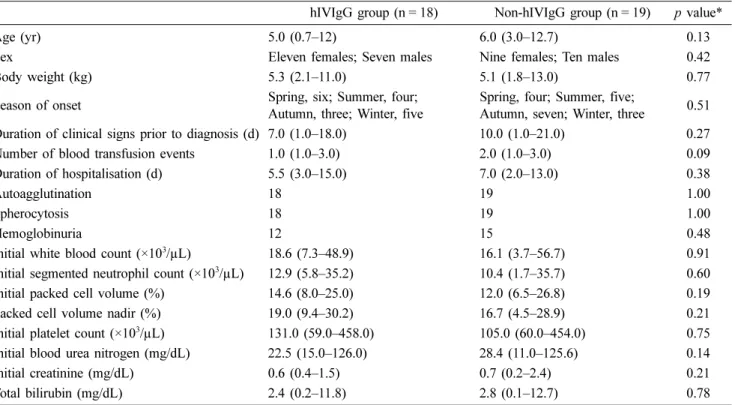
these, 18 dogs that received hIVIgG were assigned to the hIVIgG group, and 19 dogs that did not receive hIVIgG were assigned to the non-hIVIgG group (Table 1).

Animals in this study included Maltese (n = 12), Shih Tzu (n = 10), English Cocker Spaniel (n = 4), cross-breed (n = 4), toy Poodle (n = 3), Miniature Schnauzer (n = 2), Spitz (n = 1), and Yorkshire Terrier (n = 1). Twenty of the 37 dogs were female (13 intact and seven neutered), and 17 dogs were male (eight intact and nine castrated). The median age at the time of first diagnosis of idiopathic IMHA was 5 years (range, 7 months–12 years). The median duration of clinical signs preceding the diagnosis of idiopathic IMHA was 9 days (range, 1–21). In this study, dogs with IMHA had clinical signs including anorexia (n = 30), vomiting (n = 12), diar- rhea (n = 10), dark-colored urine (n = 5), and dyspnea (n = 4).

One dog had a history of syncope. On physical examination, all 37 dogs had pale mucous membranes, ten dogs showed icterus, seven dogs had an increased rectal body temperature, and three dogs had generalized lymphadenopathy. No signif- icant differences were found between the hIVIgG and non- hIVIgG groups in age, sex, body weight, seasonality, the dura- tion of clinical signs prior to diagnosis, the number of blood transfusion events, or the duration of hospitalization (Table 1).

On admission, the median PCV was 13% (range, 6.5–26.8;

n = 37). All dogs had regenerative anemia, agglutination, and spherocytosis. Ten dogs (27.0%) presented with evidence of hemoglobinuria. There were no statistical differences in the presence of hemoglobinuria, initial white blood cell (WBC)

or neutrophil counts, initial PCV, PCV nadir, initial platelet counts, or concentrations of BUN, creatinine, or bilirubin between the two groups (Table 1).

Of the 18 dogs in the hIVIgG group, all dogs were dis- charged from the hospital. Three dogs were re-hospitalized on the following day because of worsened clinical signs after discharge. Two dogs died on the day after discharge, and of the four dogs that relapsed, one was euthanized. The mean and median survival times for the hIVIgG group were 381 and 225 days, respectively. Of the 19 dogs in the non-hIVIgG group, 18 were discharged. One dog died during hospitaliza- tion, and five died after discharge. Of these five dogs, two dogs were euthanized due to suspected development of pul- monary thromboembolism, and three dogs died due to relapse of IMHA while re-hospitalized. The mean and median sur- vival times for the non-hIVIgG group were 453 and 373 days, respectively.

The Kaplan-Meier survival curve stratified by treatment group is shown in Figure 1. There was no significant difference (Chi-squared, 0.2083; p = 0.6481) in survival between the hIVIgG group and the non-hIVIgG group.

One dog died during hospitalization. The remaining 36 dogs (97.3%) were discharged after a median hospitalization period of 7 days (range, 2–12). Of these dogs, 29 (78.4%) were found to be alive for at least 1 month after discharge.

Seventeen dogs (45.9%) were still alive at 1 year after dis- charge, and nine of the animals (24.3%) were still alive at 2 years after discharge.

Table 1. Comparison of characteristics between 18 dogs that received human intravenous immunoglobulin G (hIVIgG) group and 19 dogs that did not (non-hIVIgG) group

hIVIgG group (n = 18) Non-hIVIgG group (n = 19) p value*

Age (yr) 5.0 (0.7–12) 6.0 (3.0–12.7) 0.13

Sex Eleven females; Seven males Nine females; Ten males 0.42

Body weight (kg) 5.3 (2.1–11.0) 5.1 (1.8–13.0) 0.77

Season of onset Spring, six; Summer, four;

Autumn, three; Winter, five

Spring, four; Summer, five;

Autumn, seven; Winter, three 0.51 Duration of clinical signs prior to diagnosis (d) 7.0 (1.0–18.0) 10.0 (1.0–21.0) 0.27

Number of blood transfusion events 1.0 (1.0–3.0) 2.0 (1.0–3.0) 0.09

Duration of hospitalisation (d) 5.5 (3.0–15.0) 7.0 (2.0–13.0) 0.38

Autoagglutination 18 19 1.00

Spherocytosis 18 19 1.00

Hemoglobinuria 12 15 0.48

Initial white blood count (×10

3

/µL) 18.6 (7.3–48.9) 16.1 (3.7–56.7) 0.91

Initial segmented neutrophil count (×10

3

/µL) 12.9 (5.8–35.2) 10.4 (1.7–35.7) 0.60

Initial packed cell volume (%) 14.6 (8.0–25.0) 12.0 (6.5–26.8) 0.19

Packed cell volume nadir (%) 19.0 (9.4–30.2) 16.7 (4.5–28.9) 0.21

Initial platelet count (×10

3

/µL) 131.0 (59.0–458.0) 105.0 (60.0–454.0) 0.75

Initial blood urea nitrogen (mg/dL) 22.5 (15.0–126.0) 28.4 (11.0–125.6) 0.14

Initial creatinine (mg/dL) 0.6 (0.4–1.5) 0.7 (0.2–2.4) 0.21

Total bilirubin (mg/dL) 2.4 (0.2–11.8) 2.8 (0.1–12.7) 0.78

All values are shown as the median (range) or the number of patients. *Wilcoxon’s signed rank test or Fisher’s exact test.

(4)

The mortality figures for the hIVIgG and non-hIVIgG groups during hospitalization and at 1 month, 1 year, and 2 years after discharge are shown in Figure 2. Mortality during the period of hospitalization and at 1 month, 1 year, or 2 years after discharge was not significantly different between the hIVIgG and the non-hIVIgG groups (Chi-squared, 2.961;

p = 0.0853).

Prognostic factors

Fifteen variables, including age; body weight; seasonality;

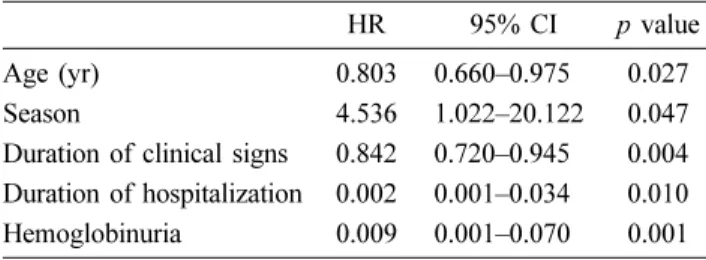
the duration of clinical signs; the number of blood transfu- sions; the duration of hospitalization; the presence of hemo- globinuria; initial WBC, neutrophil, and platelet counts; initial PCV and PCV nadir; and initial concentrations of BUN, cre- atinine, and total bilirubin were analyzed by univariate Cox proportional hazards analysis (Table 2). All the variables ana- lyzed were able to be collected from all cases, and five vari- ables (age, seasonality, the duration of clinical signs, the duration of hospitalization, and hemoglobinuria) were p ≤ 0.15. Of these variables, the duration of hospitalization was not entered into the multivariate model because it was not a prognostic criterion at the time of diagnosis. Multivariate Cox proportional hazards analysis with forward conditional

entry showed that season of onset (hazard ratio [HR], 3.973;

95% confidence interval [CI], 1.202–13.134] was a positive predictor of death (Table 3). Of the dogs that survived less than 1 month, five had IMHA in the spring, one in autumn, and two in the winter. Ten dogs who survived more than 1 month had IMHA in the spring, four in the summer, nine in autumn, and six in the winter. In 20 dogs who survived less than 1 year, IMHA occurred in spring (n = 5), summer (n = 6), autumn (n = 5), and winter (n = 4). In 17 dogs who survived more than 1 year, IMHA occurred in spring (n = 5), summer (n = 3), autumn (n = 5), and winter (n = 4). In addition, among 28 dogs that survived less than 2 years, seven dogs were diagnosed with IMHA in each of the four seasons, and among nine dogs that survived more than 2 years, three were diagnosed in the spring, two in the summer, three in autumn, and one in winter.

The presence of hemoglobinuria (HR, 0.063; 95% CI, 0.014–

0.288) was also found to be a positive predictor of death by multivariate Cox proportional hazards analysis (Table 3). All 11 dogs that survived less than 1 year (100%) had hemoglo- binuria, and of 26 dogs that survived more than 1 year, 16 (61.5%) had hemoglobinuria. There was a significant differ- ence in the proportion of hemoglobinuria between dogs that lived less than 1 year and those that lived more than 1 year (Chi-squared, 16.12; p < 0.0001), and between dogs that lived less than 2 years and those that lived more than 2 years (Chi-squared, 23.08; p < 0.0001), but not between dogs that lived less than 1 month or more than 1 month (Chi-squared, 3.780; p = 0.052).

Discussion

A previous study that evaluated the use of hIVIgG in 5 dogs demonstrated the effectiveness of hIVIgG in dogs with Fig. 1. Kaplan-Meier curve showing the difference in survival

between the hIVIgG group (A; n = 18) and the non-hIVIgG group (B; n = 19). Vertical lines indicate censored data.

Fig. 2. Bar graph showing mortality in the hIVIgG group (n = 18;

gray bars) and the non-hIVIgG group (n = 19; black bars) during hospitalization and at 1 month, 1 year, and 2 years after discharge.

Table 2. Univariate Cox proportional hazard analysis in 37 dogs with idiopathic immune-mediated hemolytic anemia (IMHA) with significance at p ≤ 0.15

HR 95% CI p value

Age (yr) 0.803 0.660–0.975 0.027

Season 4.536 1.022–20.122 0.047

Duration of clinical signs 0.842 0.720–0.945 0.004 Duration of hospitalization 0.002 0.001–0.034 0.010 Hemoglobinuria 0.009 0.001–0.070 0.001 HR, hazard ratio; CI, confidence interval.

Table 3. Multivariate Cox proportional hazards analysis in 37 dogs with IMHA using forward conditional entry with significance at p ≤ 0.05

Parameter HR 95% CI p value

Season 3.973 1.202–13.134 0.024

Hemoglobinuria 0.063 0.014–0.288 0.001

(5)

IMHA that fail to respond to conventional immunosuppres- sive therapy [30]. It was suggested that treatment with hIVIgG might be of value in IMHA dogs that do not respond well to corticosteroid therapy within 7 days [18]. However, there have been no studies to clearly demonstrate the effect of hIVIgG on survival rate in dogs with IMHA. A prospective clinical trial showed that hIVIgG did not appear to improve long-term survival, although it may be useful for short-term stabilization [31]. In another retrospective study of 88 dogs with primary IMHA, there was no difference in mortality associated with hIVIgG administration [16]. One study sug- gested a potential positive effect of treatment with hIVIgG in IMHA dogs; however, this data should be interpreted cau- tiously because clinical symptoms were more severe in the dogs that received hIVIgG [14]. One prospective, blinded, randomized, placebo-controlled investigation observed that the addition of hIVIgG to glucocorticoids did not affect response, survival, hospitalization, or transfusion requirement when compared with glucocorticoids alone [38]. In the present study, there was also no apparent difference in mortality between the hIVIgG group and the non-hIVIgG group. Furthermore, because there were no differences in the lowest PCV during the course of disease or in the number of transfusions required between the hIVIgG group and the non-hIVIgG group, a similar mortality between the two groups could not be inter- preted as a beneficial effect of hIVIgG in dogs with IMHA.

In humans, current U.S. Food and Drug Administration- approved uses for hIVIgG are in the context of Kawasaki disease, bone marrow transplantation, idiopathic thrombocy- topenic purpura, chronic B-cell lymphocytic leukemia, pedi- atric human immunodeficiency virus, and primary Ig deficiency [13]. However, treatment with hIVIgG is also employed in sep- sis, autoimmune hemolytic anemia, myasthenia gravis, necro- tizing fasciitis, toxic epidermal necrolysis, and Guilliain-Barre syndrome [13, 32]. hIVIgG alone or in combination with pred- nisone is frequently used in AIHA; however, its use remains controversial, primarily because only small case series have been reported [4]. In a recent guideline from human medi- cine, high-dose immunoglobulin was not recommended for use in AIHA, except under certain life-threatening circum- stances [2].

In the treatment of dogs with IMHA, prednisolone is the first choice of a variety of immunosuppressive agents. Although several reports showed an improved outcome with azathio- prine [8, 29] or cyclosporine in dogs with IMHA [40], these dogs had already received prednisone for several days or longer. One study revealed that treatment with a combina- tion of glucocorticoids, azathioprine, and ultra-low-dose aspi- rin improved short- and long-term survival in dogs with IMHA [37]. Treatment of IMHA with mycophenolate mofetil along with glucocorticoids showed no difference in survival to discharge, short-term survival rate, duration of hospitaliza- tion, or the number of transfusions compared with treatment with glucocorticoids plus azathioprine, cyclosporine, or hIVIgG [36]. A retrospective study, which described the difference in

mortality among treatments with prednisolone alone, pred- nisolone with cyclosporine, and prednisolone with azathio- prine, suggested that any difference in survival is due less to the choice of drug and more to the severity of disease with which the animal presented [34]. hIVIgG acts by several mechanisms, including neutralization by naturally occurring anti-idiotype antibodies present in hIVIgG, blockage of Fc receptors, and prevention of auto-antibody binding to Fc γ receptors on phagocytes [25, 33]. Therefore, unlike other immu- nosuppressive drugs, hIVIgG is thought to be valuable for initial stabilization in patients with IMHA, as blockade of Fc receptors by Ig immediately [30], which makes hIVIgG use- ful as an initial treatment in combination with glucocorti- coids. Therefore, it is often difficult to determine exactly what drug or combination caused an observed clinical response.

Furthermore, the effectiveness of hIVIgG may be different between dogs with predominant intravascular hemolysis and those with extravascular hemolysis. hIVIgG was considered more effective in patients with predominant extravascular hemol- ysis because hIVIgG regulated the immune response through attachment to affected red blood cells (RBCs) or blockade of Fc receptors on macrophages, inhibiting phagocytosis and subsequent tissue damage [33]. Moreover, the action of hIVIgG may differ depending on whether it was given before or after whole blood transfusion because sufficient attachment of hIVIgG may be diminished if the dogs received transfusion before hIVIgG treatment.

The mortality associated with idiopathic IMHA ranges from 29 to 72.7% [16, 20, 22]. The mortality rates at 1 month and 1 year in this study were similar to those in several recent retrospective analyses [22, 27, 29]. High serum biliru- bin and urea concentration, high serum alkaline phosphate activity, low platelet count, low PCV, autoagglutination, in- creased body temperature, prolonged prothrombin time, and lack of regenerative erythroid response were reported to increase the risk of death in IMHA based on HRs [27, 37, 38]. Hyperbilirubinemia and increased plasma urea concen- tration have been frequently studied as negative prognostic indicators; however, they were not found to be significantly associated with response in the univariate or multivariate analysis in our study. Notably, the multivariate model in the present study indicated the presence of hemoglobinuria as an individual negative prognostic indicator. Hemoglobinuria is a consequence of intravascular hemolysis, which results in the release of free hemoglobin into the bloodstream [3]. All the dogs that required more than one transfusion in the present study showed hemoglobinuria. The increased incidence of hemoglobinuria was likely to reflect the additional transfusion or the degree of intravascular hemolysis in dogs with IMHA.

Seasonal incidence was identified in this study as a nega-

tive prognostic factor. There is limited previous data on the

seasonality of IMHA [10, 17, 20]. A recent study failed to

demonstrate a seasonal incidence of IMHA [22]; however,

one retrospective study demonstrated that most diagnoses of

IMHA were made during the months of May and June (40%)

(6)

[20]. Tick-borne diseases such as ehrlichiosis or babesiosis were postulated to be possible causes of Coombs-positive IMHA based on seasonality [12, 35]. In our study, animals with a diagnosis of IMHA in the winter had a greater risk of death than those diagnosed in other seasons. This cannot be simply explained by tick-borne diseases and should be inter- preted cautiously with each patient’s drug and vaccination history. Moreover, because the seasonality might be only involved in the local climate in Korea, further evaluation should be warranted.

The major limitations of the current study are the small number of dogs included and inconsistencies between treat- ment regimens, as in other studies. Although the retrospec- tive nature of the study has significant weakness, this report contributes valuable information about IMHA in dogs in Korea, the long time period. In summary, the addition of hIVIgG to glucocorticoids as an initial treatment for dogs with IMHA did not improve response, prolong survival time, or shorten the duration of hospitalization. Additional clinical trials with larger sample sizes are necessary to elucidate the lack of benefit of hIVIgG in dogs with IMHA.

Acknowledgments

The authors thank all of the owners of the dogs included in the study. This research was supported by the Basic Science Research Program through the National Research Founda- tion of Korea (NRF), which was funded by the Ministry of Science, ICT, and Future Planning (2013R1A1A1011113).

References

1. Abelson AL, Shelton GD, Whelan MF, Cornejo L, Shaw S, O’Toole TE. Use of mycophenolate mofetil as a rescue agent in the treatment of severe generalized myasthenia gravis in three dogs. J Vet Emerg Crit Care (San Antonio) 2009, 19, 369-374.

2. Anderson D, Ali K, Blanchette V, Brouwers M, Couban S, Radmoor P, Huebsch L, Hume H, McLeod A, Meyer R, Moltzan C, Nahirniak S, Nantel S, Pineo G, Rock G.

Guidelines on the use of intravenous immune globulin for hematologic conditions. Transfus Med Rev 2007, 21 (Suppl 1), S9-56.

3. Balch A, Mackin A. Canine immune-mediated hemolytic anemia: pathophysiology, clinical signs, and diagnosis. Compend Contin Educ Vet 2007, 29, 217-225.

4. Barros MM, Blajchman MA, Bordin JO. Warm autoimmune hemolytic anemia: recent progress in understanding the immunobiology and the treatment. Transfus Med Rev 2010, 24, 195-210.

5. Bass GF, Tuscano ET, Tuscano JM. Diagnosis and classifi- cation of autoimmune hemolytic anemia. Autoimmune Rev 2014, 13, 560-564.

6. Bianco D, Armstrong PJ, Washabau RJ. Treatment of severe immune-mediated thrombocytopenia with human IV immunoglobulin in 5 dogs. J Vet Intern Med 2007, 21, 694- 699.

7. Bianco D, Hardy RM. Treatment of Evans’ syndrome with human intravenous immunoglobulin and leflunomide in a diabetic dog. J Am Anim Hosp Assoc 2009, 45, 147-150.

8. Burgess K, Moore A, Rand W, Cotter SM. Treatment of immune-mediated hemolytic anemia in dogs with cyclophos- phamide. J Vet Intern Med 2000, 14, 456-462.

9. Conrad P, Thomford J, Yamane I, Whiting J, Bosma L, Uno T, Holshuh HJ, Shelly S. Hemolytic anemia caused by Babesia gibsoni infection in dogs. J Am Vet Med Assoc 1991, 199, 601-605.

10. Duval D, Giger U. Vaccine-associated immune-mediated hemolytic anemia in the dog. J Vet Intern Med 1996, 10, 290-295.

11. Emmi L, Chiarini F. The role of intravenous immunoglobulin therapy in autoimmune and inflammatory disorders. Neurol Sci 2002, 23 (Suppl 1), S1-8.

12. Farwell GE, LeGrand EK, Cobb CC. Clinical observations on Babesia gibsoni and Babesia canis infections in dogs. J Am Vet Med Assoc 1982, 180, 507-511.

13. Foster R, Suri A, Filate W, Hallett D, Meyer J, Ruijs T, Callum JL, Sutton D, Mehta S. Use of intravenous immune globulin in the ICU: a retrospective review of prescribing practices and patient outcomes. Transfus Med 2010, 20, 403- 408.

14. Gerber B, Steger A, Hässig M, Glaus TM. Use of human intravenous immunoglobulin in dogs with primary immune mediated hemolytic anemia. Schweiz Arch Tierheilkd 2002, 144, 180-185.

15. Grozdanic SD, Harper MM, Kecova H. Antibody-mediated retinopathies in canine patients: mechanism, diagnosis, and treatment modalities. Vet Clin North Am Small Anim Pract 2008, 38, 361-387.

16. Grundy SA, Barton C. Influence of drug treatment on survival of dogs with immune-mediated hemolytic anemia:

88 cases (1989-1999). J Am Vet Med Assoc 2001, 218, 543- 546.

17. Jackson ML, Kruth SA. Immune-mediated hemolytic anemia and thrombocytopenia in the dog: a retrospective study of 55 cases diagnosed from 1979 through 1983 at the Western College of Veterinary Medicine. Can Vet J 1985, 26, 245-250.

18. Kellerman DL, Bruyette DS. Intravenous human immuno- globulin for the treatment of immune-mediated hemolytic anemia in 13 dogs. J Vet Intern Med 1997, 11, 327-332.

19. Kidd L, Mackman N. Prothrombotic mechanisms and anti- coagulant therapy in dogs with immune-mediated hemolytic anemia. J Vet Emerg Crit Care (San Antonio) 2013, 23, 3-13.

20. Klag AR, Giger U, Shofer FS. Idiopathic immune-mediated hemolytic anemia in dogs: 42 cases (1986-1990). J Am Vet Med Assoc 1993, 202, 783-788.

21. Marie I, Maurey G, Hervé F, Hellot MF, Levesque H.

Intravenous immunoglobulin-associated arterial and venous thrombosis; report of a series and review of the literature. Br J Dermatol 2006, 155, 714-721.

22. McAlees TJ. Immune-mediated haemolytic anaemia in 110 dogs in Victoria, Australia. Aus Vet J 2010, 88, 25-28.

23. Mellanby RJ, Holloway A, Chantrey J, Herrtage ME,

Dobson JM. Immune-mediated haemolytic anaemia associated

with a sarcoma in a flat-coated retriever. J Small Anim Pract

2004, 45, 21-24.

(7)

24. Mitchell K, Kruth S. Immune-mediated hemolytic anemia and other regenerative anemias. In: Ettinger SJ, Feldman EC (eds.). Textbook of Veterinary Internal Medicine. 7th ed. pp.

761-772, Elsevier Saunders, St. Louis, 2010.

25. Negi VS, Elluru S, Sibéril S, Graff-Dubois S, Mouthon L, Kazatchkine MD, Lacroix-Desmazes S, Bayry J, Kaveri SV. Intravenous immunoglobulin: an update on the clinical use and mechanisms of action. J Clin Immunol 2007, 27, 233- 245.

26. Piek CJ. Canine idiopathic immune-mediated haemolytic anaemia: a review with recommendations for future research.

Vet Q 2011, 31, 129-141.

27. Piek CJ, Junius G, Dekker A, Schrauwen E, Slappendel RJ, Teske E. Idiopathic immune-mediated hemolytic anemia:

treatment outcome and prognostic factors in 149 dogs. J Vet Intern Med 2008, 22, 366-373.

28. Rahilly LJ, Keating JH, O’Toole TE. The use of intravenous human immunoglobulin in treatment of severe pemphigus foliaceus in a dog. J Vet Intern Med 2006, 20, 1483-1486.

29. Reimer ME, Troy GC, Warnick LD. Immune-mediated hemolytic anemia: 70 cases (1988-1996). J Am Anim Hosp Assoc 1999, 35, 384-391.

30. Scott-Moncrieff JC, Reagan WJ, Glickman LT, DeNicola DB, Harrington D. Treatment of nonregenerative anemia with human gamma-globulin in dogs. J Am Vet Med Assoc 1995, 206, 1895-1900.

31. Scott-Moncrieff JC, Reagan WJ, Snyder PW, Glickman LT. Intravenous administration of human immune globulin in dogs with immune-mediated hemolytic anemia. J Am Vet Med Assoc 1997, 210, 1623-1627.

32. Soares MO, Welton NJ, Harrison DA, Peura P, Shankar- Hari M, Harvey SE, Madan J, Ades AE, Rowan KM, Palmer SJ. Intravenous immunoglobulin for severe sepsis and septic shock: clinical effectiveness, cost effectiveness and value of a further randomised controlled trial. Crit Care 2014,

18, 649.

33. Spurlock NK, Prittie JE. A review of current indications, adverse effects, and administration recommendations for intra- venous immunoglobulin. J Vet Emerg Crit Care (San Antonio) 2011, 21, 471-483.

34. Swann JW, Skelly BJ. Evaluation of immunosuppressive regimens for immune-mediated haemolytic anaemia: a retros- pective study of 42 dogs. J Small Anim Pract 2011, 52, 353- 358.

35. Troy GC, Vulgamott JC, Turnwald GH. Canine ehrlichiosis:

a retrospective study of 30 naturally occurring cases. J Am Anim Hosp Assoc 1980, 16, 181-187.

36. Wang A, Smith JR, Creevy KE. Treatment of canine idiopathic immune-mediated haemolytic anaemia with myco- phenolate mofetil and glucocorticoids: 30 cases (2007 to 2011). J Small Anim Pract 2013, 54, 399-404.

37. Weinkle TK, Center SA, Randolph JF, Warner KL, Barr SC, Erb HN. Evaluation of prognostic factors, survival rates, and treatment protocols for immune-mediated hemolytic anemia in dogs: 151 cases (1993-2002). J Am Vet Med Assoc 2005, 226, 1869-1880.

38. Whelan MF, O’Toole TE, Chan DL, Rozanski EA, DeLaforcade AM, Crawford SL, Cotter SM. Use of human immunoglobulin in addition to glucocorticoids for the initial treatment of dogs with immune-mediated hemolytic anemia. J Vet Emerg Crit Care (San Antonio) 2009, 19, 158-164.

39. Whitley NT, Day MJ. Immunomodulatory drugs and their application to the management of canine immune-mediated disease. J Small Anim Pract 2011, 52, 70-85.

40. Wohl JS, Moore AS. The use of single-agent cyclosporine A in dogs with severe immune mediated hemolytic anemia.

In: Research Abstract Program of the 14th Annual ACVIM

Forum: The American College of Veterinary Internal Medicine,

23-26 May 1996, San Antonio, Texas, USA.

수치

Table 1. Comparison of characteristics between 18 dogs that received human intravenous immunoglobulin G (hIVIgG) group and 19 dogs that did not (non-hIVIgG) group
Table 2. Univariate Cox proportional hazard analysis in 37 dogs with idiopathic immune-mediated hemolytic anemia (IMHA) with significance at p ≤ 0.15

참조

관련 문서

The aim of this study was not only to compare the differences of ego-resilience between students with high experience and students with low experience in

In this study, 12 weeks of aerobic exercise was conducted in middle-aged women aged 45 to 55 years with a body fat rate of 30% or more to determine the effects of blood

In the present study we investigated the proliferation effect of human oral cancer KB cell treated with pulsatilla koreana extract.. We analyzed the effects of this

This study was conducted to analyze the effects of obesity on the core stability and metabolic syndrome risk factors of middle - aged women.. The effect

 Although van der Waals equation is still less accurate at high

A subsidiary body for implementation shall report regularly to the Conference of the Parties on all outcome, which will be carried out in accordance with Article 7, paragraph 2,

Accordingly, this study aims to verify the effect of human brand attributes, which have the role of brands, on human brand authenticity, human brand attachment, and

The purpose of this study is to identify the leading factors affecting the human error using actor analysis on masters and officers’ responses in the ship navigation field.