청정소재제품기술
Benzylic Brominations with N-Bromosuccinimide in 1,2-Dichlorobenzene: Effective Preparation of (2-Bromomethyl-phenyl)-Methoxyiminoacetic Acid Methyl Ester
Sanghyuck Lee, and Choon Sup Ra*
School of Chemistry and Biochemistry, Yeungnam University 280 Daehak-Ro, Gyeongsan-si, Gyeongbuk 712-749, Korea
(Received for review October 25, 2016; Revision received November 23, 2016; Accepted November 23, 2016)
Abstract
The benzylic bromination of methoxyimino-o-tolyl-acetic acid methyl ester (1) into (2-bromomethyl-phenyl)-methoxyimino- acetic acid methyl ester (2) using N-bromosuccinimide in the presence of 2,2'-azobisisobutyronitrile in various reaction solvents were investigated. The efficiency of the reaction was found to be sensitive to the kind of reaction solvents. We found the benzylic bromination of 1 to 2 can be performed in 1,2-dichlorobenzene as reaction solvent superior to the classic Wohl-Ziegler procedure in both reaction time and isolated yield (8 h vs 12 h, 92 vs 79%). This system provides clean, rapid, and high-yielding reactions with replacement of conventional solvents, such as tetrachloromethane, by less-toxic 1,2-dichlorobenzene.
Keywords : Benzylic radical bromination, Wohl-Ziegler procedure, 1,2-dichlorobenzene, (2-bromomethyl-phenyl)-methoxyimino- acetic acid methyl ester
* To whom correspondence should be addressed.
E-mail: [email protected]; Tel: +82-53-810-2352; Fax: +82-53-810-4617 doi: 10.7464/ksct.2016.22.4.269 pISSN 1598-9712 eISSN 2288-0690
This is an Open-Access article distributed under the terms of the Creative Commons Attribution Non-Commercial License (http://creativecommons.org/licences/
by-nc/3.0) which permits unrestricted non-commercial use, distribution, and reproduction in any medium, provided the original work is properly cited.
Figure 1. Synthetic route for (2-bromomethyl-phenyl)-methoxyimino-acetic acid methyl ester (2) by the Wohl-Ziegler bromination of methoxyimino-o-tolyl-acetic acid methyl ester (1) in CCl4 solvent.
1. Introduction
Bromination of aromatic compounds at the benzylic positions is one of important organic transformations, as the brominated derivatives are used as versatile intermediates in organic synthesis [1]. The benzyl radical bromination reactions have been carried out using some corrosive bromine sources such as elemental bromine [2-4] or N-bromoimides [5]. Nowadays a method using a relatively safe and user-friendly brominating agent, N-bromo- succinimide (NBS) is established as the typical procedure, i.e., NBS in refluxing CCl4 in the presence of a radical initiator such as benzoyl peroxide or 2, 2′-azobis(isobutyronitrile) known as the Wohl-Ziegler bromination [6,7]. However, this protocol suffers from the use of the toxic and ozone-depleting solvent
CCl4 [8], due to its ozone-depleting capability, this solvent has been internationally banned (Montreal Protocol), and its use is therefore prohibited on an industrial scale [9]. Recently, various greener procedures, mainly substituting hazardous CCl4 by more benign solvents, such as methyl acetate [10,11], ethyl acetate and pivalate [12], trifluoromethylbenzene [13], acetonitrile [14], water [15-16], or ionic liquids [17] or even solvent-free conditions [17-20] have been developed.
In the course of our research toward a novel class of com- pounds having an aromatic compound with a methoxyimino- acetic acid methyl ester group, we need a brominated aromatic compound, (2-bromomethyl-phenyl)-methoxyimino-acetic acid methyl ester (2). Compound 2 can be prepared by a benzylic radical bromination of methoxyimino-o-tolyl-acetic acid methyl
269
Figure 2. The Wohl-Ziegler bromination of methoxyimino-o-tolyl-acetic acid methyl ester in dichlorobenzene solvent.
ester (1) using the Wohl-Ziegler procedure by the same method as when BASF chemist prepared Kresoxim-methyl (2) [21]
(Figure 1).
However, we needed to replace the hazardous reaction solvent CCl4 into more benign solvents for converting 1 into 2. Thus, we have tested the benzyl radical bromination of 1 using several reaction solvents to find out a substitute solvent for CCl4. In this report, we have found the benzylic bromination of 1 can be performed in 1, 2-dichlorobenzene superior to the classic Wohl-Ziegler procedure in both reaction time and isolated yield (Figure 2).
2. Experimental
Materials and Reagents. All chemicals, such as chlorobenzene, 1,4-dichlorobenzene, 1,2-dichlorobenzene, dimethylcarbonate were purchased from Sigma-Aldrich Chemicals and used without further purification. All of the solvents used for synthesis were of analytical grade. Methoxyimino-o-tolyl-acetic acid methyl ester (1) was prepared according to previously reported pro- cedure [22]. Thin layer chromatography (TLC) was carried out using Merck 60GF254 plates with a thickness of 0.25 mm (eluant, ethyl acetate : hexane (1 : 8, v/v).
Typical procedure for the benzylic bromination of methoxyimino-o-tolyl-acetic acid methyl ester (1)
To a solution of methoxyimino-o-tolyl-acetic acid methyl ester (1) (3.00 g, 14.49 mmol) in o-dichlorobenzene (50 mL), NBS (5.16 g, 28.98 mmol) and AIBN (95 mg, 0.58 mmol) was added sequentially and the mixture was heated with a magnetic stirring at 80 ℃ for 8 h. Toluene (100 mL) was added to the cooled (room temperature) reaction mixture. The progress of the reaction was monitored by TLC; Rf of the starting com- pound (1) = 0.3, Rf of the product (2) = 0.25. When the reaction mixture was heated for 8 h, the starting material disappeared on TLC and the reaction completed. The mixture was concen- trated under reduced pressure and the residue was subjected to silica gel column chromatography (eluant, ethyl acetate : hexane (1 : 10, v/v) to give the desired product as a pale-yellow oil (3.81 g, 92%).
3. Results and Discussion
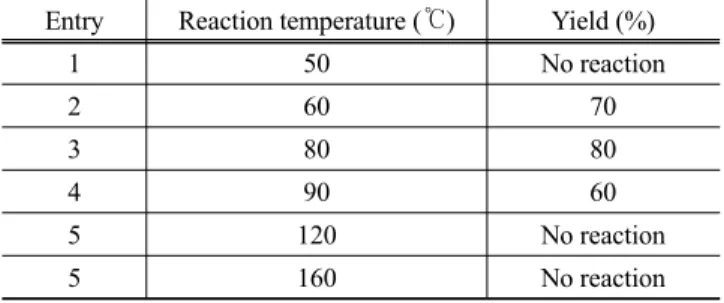
The benzylic bromination of methoxyimino-o-tolyl-acetic acid methyl ester (1) following the Wohl-Ziegler procedure using CCl4 gave the desired compound in 70% in our hand. The efficiency of the benzylic bromination of methoxyimino-o-tolyl- acetic acid methyl ester (1) using other solvents was first studied, where the reaction mixture of 1 (1 mmol) dissolved in 2 mL of solvents containing AIBN (0.04 eq.) and NBS (1.25 eq.) in a sealed vessel was heated at 60 ℃ for 8 h. As shown in Table 1, 1,2-dichlorobenzene turned to be a possible candidate for substituting CCl4. Next, we tested the effect of the reaction tem- perature on this reaction using o-dichlorobenzene. We found the reaction proceeds within the temperature range of 60 and 90 ℃ and the optimum temperature was 80 ℃ as shown in Table 2.
Table 1. Effect of solvent on the benzylic bromination of meth- oxyimino-o-tolyl-acetic acid methyl ester under non- optimized conditiona)
Entry Solvent Yield (%)
1 CCl4 70
2 benzene 40
3 hexane 40
4 Ethyl ether No reaction
5 dichloromethane 40
6 1,2-dichlorobenzene 70
a) The reaction of methoxyimino-o-tolyl-acetic acid methyl ester (1 mmol scale) using AIBN (0.04 eq.) and NBS (1.25 eq.) in a sealed vessel at 60 ℃ for 8 h
Table 2. Effect of reaction temperature on the benzylic bromination of methoxyimino-o-tolyl-acetic acid methyl estera) Entry Reaction temperature (℃) Yield (%)
1 50 No reaction
2 60 70
3 80 80
4 90 60
5 120 No reaction
5 160 No reaction
a)The reaction of methoxyimino-o-tolyl-acetic acid methyl ester (1 mmol scale) containing AIBN (0.04 eq.) and NBS (1.25 eq.) in 2 ml of 1,2-dichlorobenzene at 80 ℃ for 8 h.
Figure 3. 300 MHz 1H-NMR spectrum of methoxyimino-o-tolyl acetic acid methyl ester (1).
Figure 4. 300 MHz 1H-NMR spectrum of (2-bromomethyl-phenyl) methoxyimino-acetic acid methyl ester (2).
Table 3. Effect of NBS and AIBN catalyst on the benzylic bromina- tion of methoxyimino-o-tolyl-acetic acid methyl estera) Entry AIBN (eq.) NBS (eq.) Yield (%)
1 0.01 1.25 33
2 0.02 1.25 61
3 0.04 1.25 70
4 0.08 1.25 70
5 0.12 1.25 70
6 0.20 1.25 70
7 0.30 1.25 70
8 0.04 1.87 90
9 0.04 2.00 92
10 0.04 2.50 92
a)The reaction of methoxyimino-o-tolyl-acetic acid methyl ester (1 mmol scale) in 2 ml of 1,2-dichlorobenzene at 80 ℃ for 8 h.
The effect of the amount of added NBS and AIBN catalyst on the reaction was studied. The classical Wohl-Ziegler procedures conventionally have used the amount of AIBN in the range of 0.01-0.4 eq. of the starting material and the amount of NBS between 1.25-2.5 eq. of the starting material [6,7]. When we tested the bromination reaction of 1 using AIBN catalyst between 0.01 and 0.30 eq. in the presence of 1.25 eq. of NBS, the re- action yields increased as the amount of AIBN up to 0.04 eq.
and more than 0.04 eq. of the catalyst was found not necessary as shown in Table 3 (Entry 1-7). The formation of the brominated product increases with the amount of added NBS between 1.25 and 2.0 eq. of the reagent NBS, but more than 2.0 eq. of NBS seemed not necessary (Entry 3, 8-10 in Table 3).
The above results suggested the best reaction condition for the benzylic bromination of 1 can be established as follows; the
Table 4. The benzylic bromination of methoxyimino-o-tolyl-acetic acid methyl ester using other solvents using NBS (2.0 eq.) and AIBN (0.04 eq.) at 80 ℃ for 8 h
Entry Solvents Yield (%)
1 1,2-dichlorobenzene 92
2 benzene 40
3 chlorobenzene 87
4 1,4-dichlorobenzene 70
5 dimethylcarbonate 89
compound 1 is reacted with NBS (2.0 eq.) and AIBN (0.04 eq.) in o-dichlorobenzene at 80 ℃.
The chemical purity of the brominated product 2 which was finally purified by silica gel chromatography was easily analyzed by 300 MHz 1H-NMR with comparison to the reported example [23] as shown in Figure 4. The singlet peak at δ 4.32 (Br-CH2- of 2) which appeared after the reaction with disappearance of the singlet proton at δ 2.20 (CH3- of 1) (Figure 3) clearly shows this reaction afforded a clean and efficient mono-bromination at the benzylic position of the compound 1.
Moreover, the classic Wohl-Ziegler procedure requires the longer reaction time (12 h) and less yield (79%) [21] vs our procedure with 1,2-dichlorobenzene (8 h, 92%). Finally, we tested this reaction using other aromatic solvents using the same reaction condition and results were shown in Table 4. So far, we first found the benzylic bromination of 1 to 2 can be per- formed in 1,2-dichlorobenzene as reaction solvent superior to the classic Wohl-Ziegler procedure using other solvents. We need to apply this procedure in many benzylic bromination examples.
Further work is in progress for finding out the generality of this method.
4. Conclusion
The Wohl-Ziegler benzylic bromination of methoxyimino- o-tolyl-acetic acid methyl ester (1) using CCl4 solvent is known as the classical synthetic route to a key intermediate 2. We found the Wohl-Ziegler reaction in 1,2-dichlorobenzene as reaction solvent can be in a superior manner in both reaction time and isolated yield. When the compound 1 is reacted with NBS (2.0 eq.) and AIBN (0.04 eq.) in o-dichlorobenzene instead of using prohibited CCl4 at 80 ℃, the benzylic bromination proceeds with a higher yield (92% vs. 79%) and in a shorter reaction time (8 h vs. 12 h). Thus, this procedure provides clean, rapid, and high-yielding reactions with replacement of toxic solvents, such as tetrachloromethane, by less-toxic 1,2-dichlorobenzene.
References
1. Larock, R. C., Comprehensive Organic Transformations: A
Guide to Functional Group Preparations, 2nd ed.; Wiley-VCH:
New York, 313 (1999).
2. Coleman, G. H., and Honeywell, G. E., “p-Nitrobenzylbro- mide,” Org. Synth., Coll. Vol., 2, 443-445 (1943).
3. Snell, J. M., and Weissberger, A., “Terphthalaldehyde,” Org.
Synth., Coll. Vol., 3, 788-790 (1955).
4. Stephenson, F. M., “o-Xylene Dibromide,” Org. Synth., Coll.
Vol., 4, 984-986 (1963).
5. Campaign, E., and Tuller, B. F., “3-Thenyl Bromide,” Org.
Synth., Coll. Vol., 4, 921-923 (1963).
6. Wohl, A., “Bromierung Ungesättigter Verbindungen Mit N- Brom-acetamid, ein Beitrag zur Lehre vom Verlauf Chemi- scher Vorgänge,” Ber. Dtsch. Chem. Ges., 52, 51-63 (1919).
7. Ziegler, K., Schenck, G., Krockow, E. W., Siebert, A., Wenz, A., and Weber, H., “Die Synthese des Cantharidins,” Justus Liebigs. Ann. Chem., 551, 80-119 (1942).
8. WMO, Scientific Assessment of Ozone Depletion: 2006 Global Ozone Research and Monitoring Project; Report No. 50; World Meteorological Organization: Geneva, Switzerland (2007).
9. United Nations Environment Programme, Ozone Secretariat.
The Montreal Protocol on Substances that Deplete the Ozone Layer as either adjusted and/or amended in London (1990), Copenhagen (1992), Vienna (1995), Montreal (1997), and Beijing (1999); United Nations Environment Programme:
Nairobi, Kenya (2000).
10. Amijs, C. H. M., van Klink, G. P. M., and van Koten, G.,
“Carbon Tetrachloride Free Benzylic Brominations of Methyl Aryl Halides,” Green Chem., 5, 470-474 (2003).
11. Offermann, W., and Vögtle, F., “Secondary Interactions in Bromomethyl-substituted Benzenes: Crystal Structures of Three α,α-Bis-bromoxylenes, 1,2,3,5-Tetrakis(bromomethyl) benzene, and 1,2,4,5-Tetrakis(bromomethyl)benzene,” Syn- thesis, 272-273 (2007).
12. Mestres, R., and Palenzuela, J., “High Atomic Yield Bromine- less Benzylic Bromination,” Green Chem., 4, 314-316 (2002) 13. Suarez, D., Laval, G., Tu, S.-M., Jiang, D., Robinson, C. L.,
Scott, R., and Golding, B. T., “Benzylic Brominations with N-Bromosuccinimide in (Trifluoromethyl)benzene,” Syn- thesis, 1807-1810 (2009).
14. Salama, T. A., and Novák, Z., “N-Halosuccinimide/SiCl4 as General, Mild and Efficient Systems for the α-monohalo- genation of Carbonyl Compounds and for Benzylic Halogena- tion,” Tetrahedron Lett., 52, 4026-4029 (2011).
15. Podgorsek, A., Stavber, S., Zupan, M., and Iskra, J., “Visible Light Induced ‘On Water’ Benzylic Bromination with N-bro- mosuccinimide,” Tetrahedron Lett., 47, 1097-1099 (2006).
16. Kikuchi, D., Sakaguchi, S., and Ishii, Y., “An Alternative Method for the Selective Bromination of Alkylbenzenes Using NaBrO3/NaHSO3 Reagent,” J. Org. Chem., 63, 6023-6026 (1998).
17. Togo, H., and Hirai, T., “Environmentally-Friendly Wohl- Ziegler Bromination: Ionic-Liquid Reaction and Solvent-Free
Reaction,” Synlett, 702-704 (2003).
18. Rahman, A. N. M. M., Bishop, R., Tan, R., and Shan, N.,
“Solid-state Regio- and Stereo-selective Benzylic Bromination of Diquinoline Compounds using N-bromosuccinimide,” Green Chem., 7, 207-209 (2005).
19. Jereb, M., Zupan, M., and Stavber, S., “Visible-Light-Promoted Wohl-Ziegler Functionalization of Organic Molecules with N-Bromosuccinimide under Solvent-Free Reaction Conditions,”
Helv. Chim. Acta, 92, 555-566 (2009).
20. Jiang, X., Shen, M. Tang, Y., and Li, C., “Chemoselective Monobromination of Alkanes Promoted by Unactivated MnO2,”
Tetrahedron Lett., 46, 487-489 (2005).
21. Ammermann, E., Lorenz, G., Schelberger, K., Wenderoth, B.,
Sauter, H., Rentzea, C., “BAS 490 F - a broad- spectrum fun- gicide with a new mode of action,” in Proceedings of Brighton Crop Protection Conference - Pests and Diseases, British Crop Protection Council: Brighton, England, pp. 403-410 (1992) 22. Hwang, I.-C., Kim, J.-K., Kim, H.-H., and Kyung, S.-H.,
“Synthesis and SAR of Methoxyiminoacetate and Methoxyi- minoacetamide Derivatives as Strobilurin Analogues,” Bull.
Korean Chem. Soc., 30, 1475-1480 (2009).
23. Li, Y., Zhang, H.-Q., Liu, J., Yang, X.-P., and Liu, Z-.J.,
“Stereoselective Synthesis and Antifungal Activities of (E)-r- (Methoxyimino)benzeneacetate Derivatives Containing 1,3,5- Substituted Pyrazole Ring,” J. Agric. Food Chem., 54, 3636- 3640 (2006).