• 검색 결과가 없습니다.

Assessment of Skin Irritation Caused by S-(-)-10,11-Dihydroxyfarnesoic Acid Methyl Ester, a Metabolite of Beauveria bassiana CS1029

N/A
N/A
Protected

Academic year: 2021

Share "Assessment of Skin Irritation Caused by S-(-)-10,11-Dihydroxyfarnesoic Acid Methyl Ester, a Metabolite of Beauveria bassiana CS1029"

Copied!
4
0
0

로드 중.... (전체 텍스트 보기)

전체 글

(1)

Current Research on Agriculture and Life Science (2014) 32(3): 145−148 http://dx.doi.org/10.14518/crals.2014.32.3.024

Online ISSN 2288-0356 Print ISSN 2287-271X

Original Article

Assessment of Skin Irritation Caused by S-(-)-10,11-Dihydroxyfarnesoic Acid Methyl Ester, a Metabolite of Beauveria bassiana CS1029

Min-A Kim

1†

and Sang-Han Lee

1,2

*

1

Department of Food Science & Biotechnology

2

Food & Bio-Industry Research Institute, Kyungpook National University, Daegu 702-701, Korea

Received: August 20 2014 / Accepted: September 26 2014

Abstract To determine whether S-(-)-10,11-dihydroxyfarnesic acid methyl ester (DHFAME) produced by Beauveria bassiana CS1029 potentially causes acute skin irritation as a cosmetic ingredient, a skin toxicity test was conducted as recommended for compliance with Korea Food and Drug Administration regulations.

New Zealand White rabbits were treated with 100 mg/dose of DHFAME according to standard guidelines. No significant skin lesions or inflammation was observed in the DHFAME-treated group. Furthermore, DHFAME did not appear to cause skin irritation, as assessed by clinical observation of the rabbits. Thus, when taken together, the present results suggest that DHFAME is a promising potential cosmetic ingredient that does not irritate the skin.

Keywords: farnesoic acid, skin irritation, cosmetic, skin lesions

Introduction

Performing a skin irritation test is considered imperative for gaining approval and authorization to use a functional cosmetic ingredient (Antignac et al., 2011). Ever since Draize et al.

developed a method for testing the irritancy of substances applied

topically to the skin (Draize, 1959), many trials have been carried out to assess compounds for use in cosmetics. However, there is a recent trend of replacing animal models with in vitro techniques, such as the 3T3 NRU phototoxicity test and local lymph node assays (Nigam, 2009), to evaluate functional cosmetic ingredients.

These alternative methods are suitable for assessing chemicals, biochemicals, and various substances that may be added to cosmetics (Goebel et al., 2012).

Beauveria bassiana is a classical type of entomopathogenic fungi that is used for agricultural and medicinal purposes (Figueira et al., 2012; Pedrini et al., 2007). Compounds produced by etomopathogenic fungi, including Beauveria bassiana, Cordyceps sinensis, Cordyceps militaris, and Paecilomyces sp., are already used to treat atopic dermatitis, athlete's foot, and dandruff (Zhou et al., 2009), and it is widely known that products of entomopathogenic fungi have medicinal properties, such as immunomodulatory, anti- diabetic, anti-stress, and anti-tumor activities (Paterson, 2008), yet there are no current applications in the cosmetic industry.

Accordingly, the present study investigated whether S-(-)- 10,11-dihydroxyfarnesoic acid methyl ester (DHFAME), an anti- tyrosinase metabolite produced by Beauveria bassiana CS1029, causes skin irritation in vivo using an animal model. Although the metabolites of Beauveria sp., including Beauveria bassiana CS1029, do not appear to be toxic to the skin, the compound must still be evaluated by skin irritation tests to receive approval from the Korea Food and Drug Administration for use as a cosmetic ingredient. Therefore, the current study evaluated several parameters based on analyzing the degree of skin irritancy induced by DHFAME to determine whether this agent is safe for use in cosmetics.

Materials and Methods

Animals and care

Nine-week-old male rabbits (New Zealand White; NZW)

*Corresponding author: Sang-Han Lee, Ph.D.

Tel: 82-53-950-7754; Fax: 82-53-950-6772 E-mail: [email protected]

Present address: Graduate School of Bioresource and Bioenvironmental Sciences, Kyushu University, Fukuoka 812-8581, Japan

This is an Open Access article distributed under the terms of the Creative Commons Attribution Non-Commercial License (http://creativecommons.

org/licenses/by-nc/3.0/) which permits unrestricted non-commercial use, distribution, and reproduction in any medium, provided the original work is properly cited.

© 2014 Institute of Agricultural Science and Technology, Kyungpook

National University

(2)

146 Kim and Lee

Curr Res Agric Life Sci (2014) 32(3): 145 −148

weighing between 2.1~2.4 kg were obtained from Samtaco Korea (Osan, Korea) for the skin irritancy test. The animals were fed a commercial diet (Purina, St. Louis, MO, USA) and water ad libitum. The study protocols complied with the guidelines of the International Association for the Study of Pain, Committee for Research and Ethical Issues (Zimmermann, 1983) and internal guidelines of the Kyungpook National University Animal Ethical Committee (Daegu, Korea). All the rabbits were acclimated to the laboratory environment for at least 1 week prior to initiating the experiment.

Isolation and preparation of test material

The DHFAME was prepared by culturing Beauveria bassiana CS1029, obtained from the Rural Development Administration Resource Depository (RDARD), Suwon, Korea, in a broth. In brief, the germination was initiated by the inoculation of four clumps (8 mm × 8 mm) of Beauveria bassiana CS1029 that were grown in a Sabouraud dextrose broth. After 10 d of germination, the broth was transferred to a fermentation medium (3% sucrose, 2% corn steep liquor, 0.05% potassium dibasic phosphate, 0.1%

potassium monobasic phosphate, and 0.05% magnesium sulfate) in a 5L-jar fermentor (70% working volume, 180 rpm, 27

o

C, 3 d). The fermentation broth was then centrifuged at 3,000 rpm for 15 min (Hanil Industrial Co., Seoul, Korea), and supernatants subjected to HP20 silicagel column chromatography (55 mm × 800 mm, 0.4~0.63 mm) and high pressure liquid chromatography (Shimadzu LC-6AD, Shim-pack Vp-ODSb 150 mm × 4.6 mm column, 100%

acetonitrile, flow rate 1 ml/min). Several peaks were observed using a PDA detector (SPD-M10Avp, Shimadzu, Kyoto, Japan), and a compound finally identified at a retention time of 7.662 min based on measuring the tyrosinase inhibitory activity. The compound exhibiting anti-tyrosinase activity was identified as DHFAME using nuclear magnetic resonance (NMR) and mass spectroscopic analyses, as previously described (Baek et al., 2014).

Skin irritation test

To determine whether DHFAME was toxic to the skin on the middle back of the NZW rabbits, several parameters were assessed. Approximately 24 h prior to administrating the DHFAME, the rabbit fur was carefully removed using an electric shaver (CL-7000, SamAe Electric, Seoul, Korea). The shaved back area was divided into four areas (2.5 cm × 2.5 cm), where two served as the control areas and the other two were the test areas. One control area and one test area served as the “wound”

group, while the other control area and test area were the “non- wound” group. In each area of the wound group, a “#” symbol was scratched onto the skin using an 18 G needle (Duwon Meditec, Kimje, Korea) so that the epithelium was damaged without inducing bleeding. DHFAME was applied to each skin area on the back (0.5 mg/site) using three-fold gauze (2.5 cm × 2.5 cm, Daeil Medical, Seoul, Korea), and then gauze square covers

(10 cm × 10 cm) were taped to the back to prevent the DHFAME from leaking or evaporating. The DHFAME treatment was halted by carefully removing the gauze squares after 24 hr. Skin irritation was evaluated by scoring the skin erythema, eschar formation, and edema after DHFAME administration (24, 48, or 72 hr), as previously described (Draize, 1959).

Analysis of skin irritation

The degree of skin irritation was evaluated by measuring the erythema, edema, inflammation, and eschar, as previously described (Baek et al., 2014). This assessment was performed by trained examiners under the supervision of a veterinary pathologist from the Center of Lab Animal and Care, Kyungpook National University, Korea.

Results and Discussion

Identifying a compound(s) with anti-tyrosinase activity is important, as anti-tyrosinase activity is an indication that a substance may exhibit a whitening or anti-melanogenesis effect, which helps to keep skin healthy. While screening for potent agents from natural sources with anti-tyrosinase activities that could be used as cosmetic ingredients, the current authors found that Beauveria bassiana CS1029 secretes a potent whitening or anti-melanogenesis agent during liquid culturing. This agent was identified as DHFAME (Figure 1), and exhibits potent anti-tyrosinase activity in vitro and in vivo (Baek et al., 2014 and data not shown). A previous study also confirmed that this agent can ameliorate skin in- flammation and atopic dermatitis (Baek et al., 2014). Biomaterials from various sources can be obtained by processing raw materials using supercritical extraction, microbial fermentation, biotrans- formation, or chemical modification. The compounds produced from these techniques can then be converted into cosmetic, neutraceutical, or pharmaceutical products. Thus, when seeking anti-tyrosinase agents from various natural sources, it was found that the methyl ester produced by Beauveria bassiana CS1029, DHFAME, exhibits a potent anti-melanogenesis activity (Baek et al., 2014). Therefore, to investigate the toxicity of DHFAME, the

Figure 1. Structure of S-(-)-10,11-dihydroxyfarnesoic acid methyl ester

(DHFAME), metabolite produced by Beauveria bassiana CS1029.

(3)

Assessment of Skin Irritation by S-(-)-10,11-Dihydroxyfarnesoic Acid Methyl Ester 147

Curr Res Agric Life Sci (2014) 32(3): 145 −148 current study conducted an acute skin toxicity test.

The major classes of substances associated with acute toxicity include chemicals, drugs, biochemicals, and other harmful substances that can be metabolized in the human body. To date, there are many publications describing the acute and chronic toxicity of these different substances. To examine the anti-tyrosinase activities of compounds produced by enthomopathogenic fungi, the current authors previously performed a study to determine whether DHFAME has anti-melanogenesis properties (Baek et al., 2014). Such types of methyl ester can be synthesized from entomopathogenic fungi. DHFAME is secreted as a metabolite by Beauveria bassiana CS1029 during ecdysis (Rivera-Perez et al., 2012; Tomoda and Doi, 2008). Although little information about this compound is available, DHFAME appears to possess numerous advantages that make it suitable for cosmetic development by fermentation, biotransformation, or chemical modification.

Accordingly, the current study examined the skin irritancy potential of DHFAME by applying this reagent to the skin of rabbits (10, 30, or 100 mg/dose). After wounding the back skin using an 18 G needle, the wound healing observed in each area progressed in identical patterns (Figure 2). After 24, 48, and 72 h, natural wound healing was observed in the control group (Figure 2, first and second rows), as well as in the test groups (third to eighth rows).

While the Draize skin irritation test rigorously evaluates morphological characteristics, it does not fully reflect the degree of skin irritation, thereby producing inaccurate and unpredictable results. Notwithstanding, the skin irritation test is presently the most widely recognized and direct method for assessing skin toxicity in an animal model. Therefore, this study used the following test for an accurate toxicity evaluation with (Figure 2, each odd row) and without (Figure 2, each even row) skin

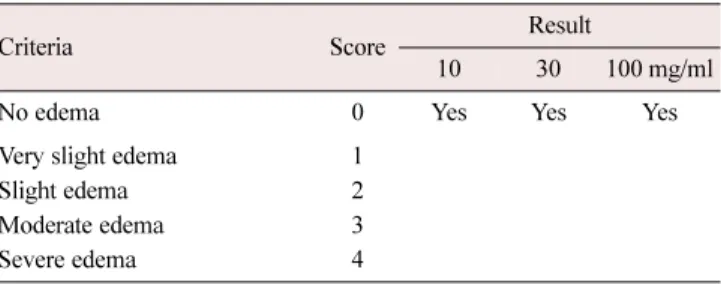
excoriation. In the human body, wound healing is known to be promoted by various mechanisms involving the immune system (Afshar and Gallo, 2013). Thus, to determine whether wound healing of the skin is affected by DHFAME, the skin of the rabbits was scratched and the healing process monitored, as previously described (Lee, 2013). Skin abrasions with (third to eighth rows) or without (first and second rows) DHFAME were compared over time. As a result, even the highest concentration of DHFAME (100 mg/dose) did not inhibit wound healing or irritate the skin, suggesting that this compound is not toxic. Similar results were also obtained for the skin that had not been wounded (Figure 2, first and second rows), indicating that the agent did not affect the skin with or without excoriation. As a result, the total scores used to evaluate the skin irritation were nearly 0. In addition, the DHFAME treatment did not result in piercing erythema (Table 1), edema (Table 2), or eschar (data not shown). Therefore, when taken together, the present findings demonstrated that DHFAME did not irritate the skin or affect wound healing.

Summary

The present study showed that DHFAME produced by Beauveria bassiana CS1029 does not cause acute skin irritation in rabbits.

Back skin treated with DHFAME did not develop lesions, edema, inflammation, or eschar. Furthermore, it is also worth mentioning that DHFAME did not appear to inhibit wound healing. Thus, DHFAME would seem to be a reagent that can be safely used for the development and production of cosmetics. However, even though the skin irritation test produced no toxic effects, alternative methods are still needed to further assess the in vitro and in vivo acute and/

Figure 2. Results of comparative skin irritation test measuring effects of DHFAME on back skin of rabbits with or without excoriation. Data are representative results of three independent observations. After scratching a “#” symbol on the skin, DHFAME was applied to each area of the back skin (10, 30, or 100 mg/site) using three-fold gauze (2.5 cm × 2.5 cm).

The areas were then covered with squares of gauze (10 cm × 10 cm) and secured with tape to prevent DHFAME leakage or evaporation. The DHFAME treatment was stopped by carefully removing the gauze squares after 24 hours. +, with excoriation; −, without excoriation.

Table 1. Comparison of degrees of erythema resulting from S-(-)-10,11- dihydroxy farnesoic acid methyl ester (DHFAME) treatment

Criteria Score Result

10 30 100 mg/ml

No erythema 0 Yes Yes Yes

Very slight erythema 1

Well-defined erythema 2 Moderate to severe erythema 3 Severe erythema to slight

eschar formation 4

Table 2. Confirmation that DHFAME treatment did not produce edema

Criteria Score Result

10 30 100 mg/ml

No edema 0 Yes Yes Yes

Very slight edema 1

Slight edema 2

Moderate edema 3

Severe edema 4

(4)

148 Kim and Lee

Curr Res Agric Life Sci (2014) 32(3): 145 −148

or chronic toxicity of DHFAME and other compounds that may be suitable for long-term and safe use with no adverse effects.

References

Antignac E, Nohynek GJ, Re T, Clouzeau J, Toutain H (2011) Safety of botanical ingredients in personal care products/cosmetics. Food Chem Toxicol 49: 324-341.

Draize JH (1959) Appraisal of the safety of chemicals in foods, drugs and cosmetics. United States: Association of Food and Drug Officials, Dermal Toxicity, pp. 46-59.

Nigam PK (2009) Adverse reactions to cosmetics and methods of testing.

Indian J Dermatol Venereol Leprol 75: 10-18.

Goebel C, Aeby P, Ade N, Alépée N, Aptula A, Araki D, Dufour E, Gilmour N, Hibatallah J, Keller D, Kern P, Kirst A, Marrec-Fairley M, Maxwell G, Rowland J, Safford B, Schellauf F, Schepky A, Seaman C, Teichert T, Tessier N, Teissier S, Weltzien HU, Winkler P, Scheel J (2012) Guiding principles for the implementation of non-animal safety assessment approaches for cosmetics: skin sensitisation. Regul Toxicol Pharmacol 63: 40-52.

Figueira L, Pinheiro D, Moreira R, Pinto E, Simões J, Camisa E, Torrão L, Palmares J, Falcão-Reis F (2012) Beauveria bassiana keratitis in

bullous keratopathy: antifungal sensitivity testing and management.

Eur J Ophthalmol 22: 814-818.

Pedrini N, Crespo R, Juárez MP (2007) Biochemistry of insect epicuticle degradation by entomopathogenic fungi. Comp Biochem Physiol C Toxicol Pharmacol 146: 124-137.

Zhou X, Gong Z, Su Y, Lin J, Tang K (2009) Cordyceps fungi: natural products, pharmacological functions and developmental products. J Pharm Pharmacol 61: 279-291.

Paterson RR (2008) Cordyceps: a traditional Chinese medicine and another fungal therapeutic biofactory? Phytochemistry 69: 1469-1495.

Zimmermann M (1983) Ethical guidelines for investigations of experimental pain in conscious animals. Pain 16: 109-110.

Baek SH, Ahn JW, Nam SH, Yoon CS, Shin JC, Lee SH (2014) S-(-)- 10,11-dihydroxyfarnesoic acid methyl ester inhibits melanin synthesis in murine melanocyte cells. Int J Mol Sci 15: 12750-12763.

Rivera-Perez C, Nouzova M, Noriega FG (2012) A quantitative assay for the juvenile hormones and their precursors using fluorescent tags.

PLoS One 7: e43784.

Tomoda H, Doi T (2008) Discovery and combinatorial synthesis of fungal metabolites beauveriolides, novel antiatherosclerotic agents. Acc Chem Res 41: 32-39.

Afshar M, Gallo RL (2013) Innate immune defense system of the skin. Vet Dermatol 24: 32-38.

Lee SH (2013) Evaluation of acute skin irritation and phototoxicity by aqueous

and ethanol fractions of Angelica keiskei. Exp Ther Med 5: 45-50.

수치

Figure 1. Structure of S-(-)-10,11-dihydroxyfarnesoic acid methyl ester (DHFAME), metabolite produced by  Beauveria bassiana CS1029.
Table 2. Confirmation that DHFAME treatment did not produce edema

참조

관련 문서