• 검색 결과가 없습니다.

Protective Effect of Vitis amurensis Stems and Leaves Extract on Hydrogen Peroxide-induced Oxidative Neuronal Cell Damage in Cultured Neurons

N/A
N/A
Protected

Academic year: 2021

Share "Protective Effect of Vitis amurensis Stems and Leaves Extract on Hydrogen Peroxide-induced Oxidative Neuronal Cell Damage in Cultured Neurons"

Copied!
7
0
0

로드 중.... (전체 텍스트 보기)

전체 글

(1)

과산화수소수로 유도된 배양 뇌신경세포손상에 대한 왕머루 잎과 줄기 추출물의 보호효과

김주연*·주현수*·반주연**·송경식***·배기환****·성연희*

*충북대학교 수의과대학, **경희대학교 의과대학, ***경북대학교 농업생명과학대학, ****충남대학교 약학대학

Protective Effect of Vitis amurensis Stems and Leaves Extract on Hydrogen Peroxide-induced Oxidative Neuronal Cell Damage in Cultured Neurons

Joo Youn Kim

*

, Hyun Soo Ju

*

, Ju Yeon Ban

**

, Kyung-Sik Song

***

, KiHwan Bae

****

, and Yeon Hee Seong

*

*

College of Veterinary Medicine, Chungbuk National University, Cheongju, Chungbuk 361-763, Korea.

**Department of Pharmacology, College of Medicine, Kyung Hee University, Seoul 130-701, Korea.

***College of Agriculture and Life-Sciences, Kyungpook National University, Daegu 702-701, Korea.

****College of Pharmacy, Chungnam National University, Daejon, 305-764 Korea.

ABSTRACT : Vitis amurensis (VA; Vitaceae) has long been used in oriental herbal medicine. It has been reported that roots and seeds of VA have anti-inflammatory and antioxidant effects. In the present study, the protective effect of ethanol extract from stems and leaves of VA on hydrogen peroxide (H

2

O

2

) (100 µ M)-induced neuronal cell damage was examined in primary cultured rat cortical neurons. VA (10-100 µ g/ml) concentration-dependently inhibited H

2

O

2

-induced apop- totic neuronal cell death measured by 3-[4,5-Dimethylthiazol-2-yl]-2,5-diphenyl-tetrazolium bromide (MTT) assay and Hoechst 33342 staining. VA inhibited H

2

O

2

-induced elevation of intracellular Ca

2+

concentration ([Ca

2+

]

i

) and generation of reactive oxygen species (ROS), which were measured by fluorescent dyes. Pretreatment of VA also prevented glutamate release into medium induced by 100 µ M H

2

O

2

, which was measured by HPLC. These results suggest that VA showed a neuroprotective effect on H

2

O

2

-induced neuronal cell death by interfering with H

2

O

2

-induced elevation of [Ca

2+

]

i

, glutamate release, and ROS generation. This has a significant meaning of finding a new pharmacological activity of stems and leaves of VA in the CNS.

Key Words : Vitis amurensis , Hydrogen Peroxide, Neurotoxicity, Neuroprotection, Anti-oxidant

INTRODUCTION

Oxidative stress occurs when the balance between free radical production and cellular defense mechanisms are disturbed and is implicated in the neuronal cell death that is associated with many neurodegenerative disorders such as Alzheimer’s disease, Parkinson disease and amyotrophic lateral sclerosis (Alexi et al ., 2000; Behl, 1999; Behl et al ., 1994; Chen et al ., 2008; Jellinger, 2000). It has been also indicated that oxidative stress is considered one of the primary risk factors that exacerbate the damage by cerebral ischemia (Chan, 2001). Several components of reactive oxygen species (ROS) generated after ischemia/reperfusion

injury, including superoxide anions (O

2−

), hydroxyl radical (OH

), hydrogen peroxide (H

2

O

2

), and peroxynitrite radical (ONOO

), are known to promote DNA damage, peroxida- tion of lipids, proteins and carbohydrates, blood brain-barrier break-down, and microglial infiltration in the ischemic territory (Camacho and Massieu, 2006; Crack et al ., 2005).

Therefore, in vitro H

2

O

2

toxicity has become a well- established model for studying the neuropathology of oxidative stress in CNS disorders. Many researches have demonstrated the involvement of glutamate in H

2

O

2

-induced neurotoxicity in cultured neurons (Gardner et al ., 1997).

H

2

O

2

and O

2−

inhibit uptake of glutamate and enhance the release of glutamate, resulting in NMDA receptor oversti-

Corresponding author: (Phone) +82-43-261-2968 (E-mail) [email protected]

Received January 20, 2009 / Revised February 5, 2009 / Accepted February 10, 2009

(2)

mulation (Mailly et al ., 1999; Volterra et al ., 1994). There are some reports on H

2

O

2

-induced intracellular Ca

2+

concen- tration ([Ca

2+

]

i

) increase (Das et al ., 2008; Numakawa et al ., 2007). NMDA receptor is a ligand-gated/voltage-sensitive cation channel, especially highly permeable to Ca

2+

. Calcium influx through NMDA receptor-coupled Ca

2+

channel appears to be a critical role in the H

2

O

2

-induced neurotoxicity (Mailly et al . 1999). Moreover, Ca

2+

signals activate enzymes, which lead to further ROS generation (Ekinci et al ., 2000; Butterfield et al ., 2001). Conversely, ROS generation can facilitate [Ca

2+

]

i

increases by damaging the [Ca

2+

]

i

regulatory mechanism and activating Ca

2+

release from intracellular Ca

2+

stores (Duffy and Macviar, 1996).

Vitis species, the family Vitaceae, is widely distributed over the world and has been used as foods and medicinal herbs (Nassiri-Asl and Hooeinzadeh, 2009). Grape seeds extract from Vitis vinifera has been reported to have excellent free radical scavenging and cardioprotective pro- perties such as inhibition of cardiac ischemia-reperfusion injury, myocardiac infarction, H

2

O

2

-induced oxidant injury in heart and reactive oxygen intermediates release (Bagchi et al ., 2000; Sato et al ., 1999; Shao et al ., 2003; Vitseva et al ., 2005). Furthermore, Vitis vinifera and its active components including polyphenols and flavanols exhibited neuroprotection against stroke and memory impairment in both in vitro cultured neurons and animal models (Anderson et al ., 2003; Angelo et al ., 2008; Chun et al ., 2008;

Vauzour et al ., 2007; Wang et al ., 2005; Wang et al ., 2006; Wang et al ., 2008). In terms of Vitis amurensis (VA), the roots extract and resveratrols isolated from it showed inhibition of cholinesterase, β -amyloid aggregation and β - amyloid-induced neuronal cell damage indicating its beneficial effect on Alzheimer disease (Jang et al ., 2007; Jang et al ., 2008) and showed anti-tumor and anti-inflammatory activities (Huang et al ., 2001; Lee et al ., 2006). The fruits extract of VA and polyphenols from it showed anti-allergic and anti- oxidant effects (Kim et al ., 2008; Wang et al ., 2000). Inter- estingly, however, there is no report to prove phar- macological activity of leaves and stems of VA. In the present study, the protective effect of ethanol extract from leaves and stems of VA against H

2

O

2

-induced neuronal cell damage was investigated in primary cultured rat cortical neurons to evaluate its therapeutic possibility in oxidative stress-induced brain damage.

MATERIALS AND METHODS

1. Plant material and extraction

The leaves and stems of VA were collected at Keryong Mountain in Daejeon, Korea, in July 2007. Botanical identification was performed by Professor KiHwan Bae and the voucher specimen (CNU-1552) was deposited at the herbarium of the College of Pharmacy, Chungnam National University, Korea. The dried leaves and stems (500 g) of VA were extracted with 50% ethanol in water at 90 ℃ in the water bath, three times. The combined ethanol extract was filtered and concentrated until the constant weight to yield an ethanol extract (98.5 g).

2. Experimental animals

Pregnant Sprague-Dawley (SD) rats were purchased from Daehan Biolink Co. Ltd. (Chungbuk, Korea) and housed singly in an environmentally controlled room at 22 ± 2 ℃ , with a relative humidity of 55 ± 5%, a 12-h light/dark cycle, and food and water ad libitum. The procedures involving experimental animals complied with the regulations for the care and use of laboratory animals of the animal ethics committee of Chungbuk National University.

3. Induction of neurotoxicity in primary cultures of rat cerebral cortical neurons

Primary cortical neuronal cultures were prepared using embryonic day 15 to 16 SD rat fetuses as described previously (Ban et al ., 2005; Lee et al ., 2007a). Isolated cells were plated onto poly-L-lysine coated 12 well-plates at a density of 4 × 10

5

cells/well in DMEM supplemented with 10% fetal bovine serum. Neurotoxicity experiments were performed on neurons after 5-7 days in culture. For every experiment, H

2

O

2

was diluted freshly in a HEPES buffer (pH 7.4) containing 8.6 mM HEPES, 154 mM NaCl, 5.6 mM KCl and 2.3 mM CaCl

2

. For the measurement of cell viability, neurons were treated with 100 µ M H

2

O

2

in HEPES buffer at 37 ℃ for 15 min, followed by incubation for 12 h in H

2

O

2

- and serum-free DMEM medium. Neurons were pretreated with VA (10, 50 and 100 ㎍ / ㎖ ) for 15 min prior to H

2

O

2

treatment, and then again during the H

2

O

2

exposure and post-exposure period. VA was dissolved in ethanol (100 ㎎ / ㎖ ) and then diluted further in experimental buffers. The final concentration of ethanol was

≤ 0.1%, which did not affect cell viability.

(3)

4. Measurements of H

2

O

2

-induced neuronal death and intracellular biochemical changes

A 3-[4,5-dimethylthiazol-2-yl]-2,5-diphenyl-tetrazolium bromide (MTT; Sigma Chemical Co.) assay and Hoechst 33342 (Molecular Probes Inc., Eugene, OR, USA) staining were performed to measure neuronal death at the end of the post-exposure period, as described previously (Ban et al ., 2005). The change of [Ca

2+

]

i

was measured with Fluo-4 AM (Molecular Probes), a Ca

2+

-sensitive fluorescent dye, using a laser scanning confocal microscope (LSM 510, Carl Zeiss Oberkochen, Germany) with a 488-nm excitation argon laser and 515- ㎚ longpass emission filters (Ban et al ., 2005;

Lee et al ., 2007). Glutamate secreted into the medium after treatment with 100 µ M H

2

O

2

in HEPES buffer at 37 ℃ for 15 min, followed by post-incubation for 3 h in H

2

O

2

- and serum-free DMEM medium was quantified by HPLC with an electrochemical detector (MF series, BAS, IN, USA) (Lee et al ., 2007). The microfluorescence assay of 2'7'- dichlorofluorescein, the fluorescent product of 2'7'-dichloro- dihydrofluorescein diacetate (H

2

DCF-DA; Molecular probes), and laser scanning confocal microscope (MRC1024ES, Bio- Rad, Maylands, UK) with 488 excitation and 510 emission filters were used to monitor the generation of ROS in neurons treated with 100 µ M H

2

O

2

for 20 min (Ban et al ., 2005).

5. Statistical analysis

Data are expressed as mean ± S.E.M. and statistical significance was assessed by one-way analysis of variance (ANOVA) and Tukey's test. P<0.05 was considered significant.

RESULTS

1. Protective effect of VA on H

2

O

2

-induced neuronal cell death

In a previous report, we demonstrated that H

2

O

2

over the concentration range of 50-200 µ M produced a concentration- dependent reduction of cell viability in cultured cortical neurons (Park et al ., 2006). For the present experiments, 100 µ M of H

2

O

2

was used. Following exposure to 100 µ M H

2

O

2

, the viability (MTT reduction rate) of cortical neurons decreased to 48.0 ± 5.0% relative to untreated controls. We observed that this decrease in MTT reduction could be ameliorated in a VA concentration-dependent manner, to 80.3

± 1.9 and 91.9 ± 2.5% with 50 and 100 ㎍ / ㎖ VA, respec-

tively (Fig. 1).

Chromatin condensation and nuclear fragmentation were observed in neurons treated with 100 µ M H

2

O

2

, whereas the control culture contained the round blue nuclei of viable neurons (Lee et al . 2007b). As shown in Fig. 2, apoptosis was observed in 35.8 ± 1.7% of cultured cortical neurons treated with 100 µ M H

2

O

2

, as compared with 13.2 ± 2.4%

of neurons in control cultures. On the other hand, the addition of VA (100 ㎍ / ㎖ ) significantly decreased H

2

O

2

- induced apoptotic neuronal death to 22.4 ± 2.1%.

Fig. 1.

Inhibitory effect of VA on H

2

O

2

-induced neuronal death in cultured cerebral cortical neurons. Neuronal cell death was measured using the MTT assay. The MTT absorbance from untreated cells was normalized to 100%. Values represent mean ± S.E.M. of data obtained from 4 independent experiments.

##P

<0.01 vs. control;

**P

<0.01 vs. 100

µ

M H

2

O

2

.

Fig. 2.

Inhibitory effect of VA on H

2

O

2

-induced apoptosis of cultured cerebral cortical neurons. Apoptotic cells measured by Hoechst 33342 staining were counted from 5 to 6 fields per well. Values represent mean ± S.E.M. of data obtained from 3 independent experiments.

##P

<

0.01 vs. control;

**P

< 0.01 vs. 100

µ

M H

2

O

2

.

(4)

2. Inhibitory effect of VA on H

2

O

2

-induced elevation of [Ca

2+

]

i

Many studies have shown that an increase in [Ca

2+

]

i

is associated with H

2

O

2

-induced cell death (Duffy and MacVicar, 1996). In cultured cortical neurons, treatment with 100 µ M H

2

O

2

produced a slow but gradual increase in [Ca

2+

]

i

, with the maximum fluorescence intensity (ca. 195, compared to a basal level of 110) observed about 10 min after H

2

O

2

application. In contrast, pretreatment with VA (100 / ) significantly inhibited this increase in [Ca

2+

]

i

throughout the measurement period (Fig. 3). VA did not affect basal [Ca

2+

]

i

.

3. Inhibitory effect of VA on H

2

O

2

-induced glutamate release

Glutamate release into the extracellular medium for 3 h was quantified 15 min after the incubation of cells with 100

µ M H

2

O

2

. H

2

O

2

elevated basal glutamate level to 3.86 ± 0.40 µ M from 0.44 ± 0.16 µ M in control cultures. VA (100

㎍ / ㎖ ) significantly blocked H

2

O

2

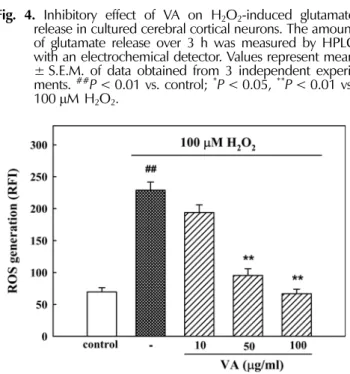
-induced elevation of glutamate release showing 1.14 ± 0.19 µ M (Fig. 4).

4. Inhibitory effect of VA on H

2

O

2

-induced elevation of ROS

In H

2

DCF-DA-loaded cortical neurons, H

2

O

2

increased the fluorescence intensity, indicating generation of ROS. A ca.

3-fold increase in fluorescence intensity was observed in

neurons treated for 20 min with 100 µ M H

2

O

2

, compared to control neurons (228.9 ± 12.8 and 69.6 ± 6.7, respectively).

However, the H

2

O

2

-induced increase in ROS generation was inhibited significantly by VA (50 and 100 ㎍ / ㎖ ) (Fig. 5).

DISCUSSION

H

2

O

2

causes neuronal cell death by inducing a delayed accumulation of extracellular glutamate and NMDA receptor

Fig. 3.

Inhibitory effect of VA on H

2

O

2

-induced [Ca

2+

]

i

increase in cultured cerebral cortical neurons. [Ca

2+

]

i

was monitored using Fluo-4 AM dye and a confocal laser scanning microscope. Results are expressed as the relative fluorescence intensity (RFI). Each trace shows a single cell that is representative of at least 3 independent experi- ments.

Fig. 4.

Inhibitory effect of VA on H

2

O

2

-induced glutamate release in cultured cerebral cortical neurons. The amount of glutamate release over 3 h was measured by HPLC with an electrochemical detector. Values represent mean

± S.E.M. of data obtained from 3 independent experi- ments.

##P

< 0.01 vs. control;

*P

< 0.05,

**P

< 0.01 vs.

100

µ

M H

2

O

2

.

Fig. 5

. Inhibitory effect of VA on H

2

O

2

-induced ROS generation

in cultured cerebral cortical neurons. ROS was monitored

using H

2

DCF-DA dye and a confocal laser scanning

microscope. Values represent mean ± S.E.M. of RFI

obtained from 4 independent experiments.

##P

< 0.01

vs. control;

**P

< 0.01 vs. 100

µ

M H

2

O

2

.

(5)

stimulation with both effects being mediated by OH

(Halliwell, 2006; Mailly et al ., 1999). Exposure to H

2

O

2

causes an increase in [Ca

2+

]

i

and produces ROS concomitant with NMDA receptor stimulation in cultured neuronal cells (Mailly et al ., 1999; Su et al ., 1999; Wang and Joseph, 2000). Thus the neurotoxic effect of H

2

O

2

is strongly reduced by antagonists of NMDA receptors and Ca

2+

channel antagonists (Mailly et al ., 1999). Confirming these reports, the present study demonstrated that H

2

O

2

stimulated glutamate release, elevation of [Ca

2+

]

i

, and ROS generation, resulting in neuronal cell death in cultured cortical neurons.

Many researchers have demonstrated that the neuronal loss following transient exposure of cultured neurons to H

2

O

2

results from an apoptotic process (Gardner et al ., 1997;

Numakawa et al ., 2007), whereas others have demonstrated the association of both necrosis and apoptosis with H

2

O

2

- induced neuronal death (Bao and Liu, 2004; Fatokun et al ., 2007). In the present study, cultured cortical neurons exposed to H

2

O

2

transiently followed by 12-h post-incubation with H

2

O

2

-free medium showed an increase in chromatin conden- sation, a typical characteristic of apoptotic cell death as described in a previous report (Lee et al ., 2007a), indicating that apoptotic process was mostly involved in the death.

Neuronal cells exposed to H

2

O

2

produce membrane depolarization resulting from the increased permeability to Na

+

. Na

+

increased by depolarization further increases the opening of Na

+

channels, and subsequently causes a great Ca

2+

influx via the voltage-dependent Ca

2+

channel (VDCC) (Halliwell, 2006). In the present study, H

2

O

2

elicited a gradual and significant [Ca

2+

]

i

increase after treatment, and this was blocked by VA. Furthermore, H

2

O

2

produced a significant increase in glutamate release, which was also blocked by VA. H

2

O

2

has been demonstrated to inhibit uptake of glutamate and to enhance the release of glutamate, resulting in NMDA receptor overstimulation and further increase of [Ca

2+

]

i

(Mailly et al ., 1999; Volterra et al ., 1994).

Therefore, it was suggested that VA could prevent Ca

2+

entry through VDCC and/or NMDA-receptor operated channels to inhibit neuronal death. However, the mechanism by which VA blocks H

2

O

2

- or NMDA-induced [Ca

2+

]

i

elevation is unclear.

Although elucidation of the events occurring downstream of neuronal Ca

2+

overloading requires further research, ROS generation undoubtedly takes place in glutamate neurotoxicity and is likely due to Ca

2+

influx in the cytosol. VA blocked

H

2

O

2

-induced ROS generation. In contrast with many reports that Ca

2+

signals activate enzymes associated with ROS generation, ROS can facilitate [Ca

2+

]

i

increases by damaging the [Ca

2+

]

i

regulatory mechanism and activating Ca

2+

release from intracellular Ca

2+

stores (Duffy and MacVicar, 1996).

Viniferin, which are known to have antioxidant activity (Privat et al ., 2002; Quiney et al ., 2004), have been isolated from the stems and leaves of VA (unpublished data). It could be suggested that ROS-scavenging activity of VA possibly attributable to viniferin and other polyphenols contained in the stems and leaves played a critical role in neuronal survival. Future study to elucidate the precise mechanism should be performed.

Polyphenolic compounds can scavenge free radicals, suppress ROS production in the rat brain (Bagchi et al ., 2000), and inhibits lipid peroxidation (Huang et al ., 2001).

It can also protect against oxidative DNA damage in stroke- prone hypertensive rats (Mizutani et al ., 2001). Polyphenols also inhibit glutamate-induced oxidative stress (Fu and Koo, 2006). In the present study, VA was able to reduce the H

2

O

2

-induced neuronal apoptotic death, by interfering with [Ca

2+

]

c

elevation, and then inhibiting glutamate release and ROS generation. It is hypothesized that the stems and leaves of VA contains polyphenols including viniferin, which have various antioxidant effects (Wang et al ., 2000), as evidenced in seeds and roots. Therefore, these effects of stems and leaves of VA might be, at least in part, attributable to viniferin isolated from these parts of VA and other polyphenols. Forthcoming studies will attempt to clarify the active principles of stems and leaves of VA. In conclusion, we demonstrated a novel pharmacological action of stems and leaves of VA and the mechanism in neurons.

The present study provides evidence that H

2

O

2

-induced injury to rat cortical neurons can be prevented by ethanol extract from stems and leaves of VA. The protection against H

2

O

2

-induced neurotoxicity by VA provides as a promising therapeutic approach to control the progression of neurodegenerative disease associated with oxidative stress in brain including stroke and Alzheimer's disease.

ACKNOWLEDGEMENTS

This work was supported by a grant (Code 20080401034050)

from the BioGreen 21 Program, Rural Development Admini-

stration, Republic of Korea.

(6)

LITERATURE CITED

Alexi T, Borlongan CV, Faull EL, Williams CE, Clark RG and Gluckman PD. (2000). Neuroprotective strategies for basal ganglia degeneration: Parkinson’s and Huntington’s diseases.

Progress in Neurobiology. 60:409-470.

Anderson T, Qin Y, Dey L and Yuan CS. (2003). Grape seed proanthocyanidin extract attenuates oxidant injury in cardiomyocytes. Pharmacological Research. 47:463-469.

Angelo C, Marco A, Victor DF, Manuel MPB and Jose PA.

(2008). Red wine, but port wine, protects rat hippocampal dentate gyrus against ethanol-induced neuronal damage- relevance of the sugar content. Alcohol & Alcoholism. 43:408- Bagchi D, Sen CK, Ray SD, Das DK, Bagchi M, Preuss HG 415.

and Vinson JA. (2003). Molecular mechanisms of cardio- protection by a novel grape seed proanthocyanidin extract.

Mutation Research. 523-524:87-97.

Ban JY, Cho SO, Jeon SY, Song KS, Bae K and Seong YH.

(2005). Protective effect of Sanguisorba officinalis L. root on amyloid

β

protein (25-35)-induced neuronal cell damage in cultured rat cortical neuron. Korean Journal of Medicinal Crop Science. 13:219-226.

Bao F and Liu D. (2004). Hydroxyl radicals generated in the rat spinal cord at the level produced by impact injury induce cell death by necrosis and apoptosis: protection by a metalloporphyrin.

Neuroscience. 126:285-295.

Behl C, Davis JB, Lesley R and Schubert D. (1994). Hydrogen peroxide mediates amyloid beta protein toxicity. Cell. 77:817- Behl C. 827. (1999). Alzheimer’s disease and oxidative stress:

implications for novel therapeutic approaches. Progress in Neurobiology. 57:301-323.

Butterfield DA, Drake J, Pocernich C and Castegna A. (2001).

Evidence of oxidative damage in Alzheimer's disease brain:

central role for amyloid beta-peptide. Trends in Molecular Medicine. 7:548-554.

Camacho A and Massieu L. (2006). Role of glutamate transporters in the clearance and release of glutamate during ischemia and its relation to neuronal death. Archives of Medical Research. 37:11-18.

Chan PH. (2001). Reactive oxygen radicals in signaling and damage in the ischemic brain. Journal of Cerebral Blood Flow and Metabolism. 21:2-14.

Chen L, Liu L, Luo Y and Huang S. (2008). MAPK and mTOR pathways are involved in cadmium-induced neuronal apoptosis.

Journal of Neurochemistry. 105:251-261.

Chun HS, Kim JM, Choi EH and Chang N. (2008).

Neuroprotective effects of several Korean medicinal plants traditionally used for stroke remedy. Journal of Medicinal Food.

11:246-251.

Crack PJ and Taylor JM. (2005). Reactive oxygen species and the modulation of stroke. Free Radical Biology and Medicine.

38:1433-1444.

Das A, Belagodu A, Reiter RJ, Ray SK and Banik NL. (2008).

Cytoprotective effects of melatonin on C6 astroglial cells exposed to glutamate excitotoxicity and oxidative stress. Journal

of Pineal Research. 45:117-124.

Duffy S and MacVicar BA. (1996). In vitro ischemia promotes calcium influx and intracellular calcium release in hippocampal astrocytes. Journal of Neuroscience. 16:71-81.

Ekinci FJ, Linsley MD and Shea TB. (2000).

β

-Amyloid-induced calcium influx induces apoptosis in culture by oxidative stress rather than tau phosphorylation. Molecular Brain Research.

76:389-395.

Fatokun AA, Stone TW and Smith RA. (2007). Cell death in rat cerebellar granule neurons induced by hydrogen peroxide in vitro: Mechanisms and protection by adenosine receptor ligands. Brain Research. 1132:193-202.

Fu Y and Koo MW. (2006). EGCG protects HT-22 cells against glutamate-induced oxidative stress. Neurotoxicity Research.

10:23-30.

Gardner AM, Xu FH, Fady C, Jacoby FJ, Duffey DC, Tu Y and Lichtenstein A. (1997). Apoptotic vs. nonapoptotic cytotoxicity induced by hydrogen peroxide. Free Radical Biology & Medicine. 22:73-83.

Halliwell B. (2006). Oxidative stress and neurodegeneration: where are we now? Journal of Neurochemistry. 97:1634-1658.

Huang SS, Tsai MC, Chih CL, Hung LM and Tsai SK. (2001).

Resveratrol reduction of infarct size in Long Evans rats subjected to focal cerebral ischemia. Life Sciences. 69:1057- 1065.

Jang MH, Piao XL, Kim HY, Co EJ, Baek SH, Kwon SW and Park JH. (2007). Resveratrol oligomers from Vitis amurensis attenuate beta-amyloid-induced oxidative stress in PC12 cells.

Biological & Pharmacological Bulletin. 30:1130-1134.

Jang MH, Piao XL, Kim JM, Kwon SW and Park JH. (2008).

Inhibition of cholinesterase and amyloid-beta aggregation by resveratrol oligomers from Vitis amurensis. Phytotherapy Research. 22:544-549.

Jellinger KA. (2000). Cell death mechanisms in Parkinson’s disease. Journal of Neural Transmission. 107:1-29.

Kim SD, Moon CK, Eun SY, Ryu PD and Jo SA. (2005).

Identification of ASK1, MKK4, JNK, c-Jun, and caspase-3 as a signaling cascade involved in cadmium-induced neuronal cell apoptosis. Biochemical and Biophysical Research Communi- cations. 328:326-334.

Lee EO, Lee HJ, Hwang HS, Ahn KS, Chae C, Kang KS, Lu J and Kim SH. (2006). Potent inhibition of Lewis lung cancer growth by heyneanol A from the roots of Vitis amurensis through apoptotic and anti-angiogenic activities. Carcinogenesis.

27:2059-2069.

Lee JH, Cho SO, Ban JY, Song KS and Seong YH. (2007a).

Neuroprotective effect of Korean Mistletoe extract against damage induced by hydrogen peroxide in cultured rat cortical neurons. Korean Journal of Medicinal Crop Science. 15:105- Lee SB, Kim JY, Cho SO, Ban JY, Ju HS, Bae K and Seong 111.

YH. (2007b). Extract of

Cedreala Sinensis

leaves protects neuronal cell damage induced by hydrogen peroxide in cultured rat neurons. Korean Journal of Medicinal Crop Science.

15:444-450.

Mailly F, Marin P, Israel M, Glowinski J and Premont J.

(1999). Increase in external glutamate and NMDA receptor

(7)

activation contribute to H

2

O

2

-induced neuronal apoptosis.

Journal of Neurochemistry. 73:1181-1188.

Mizutani K, Ikeda K, Kawai Y and Yamori Y. (2001).

Protective effect of resveratrol on oxidative damage in male and female stroke-prone spontaneously hypertensive rats.

Clinical and experimental pharmacology & physiology. 28:55- Nassiri-Asl M and Hooeinzadeh H. 59. (2009). Review of the pharmacological effects of Vitis vinifera (Grape) and its bioactive compounds. Phytotherapy research. (in press).

Numakawa Y, Matsumoto T, Yokomaku D, Taguchi T, Niki E, Hatanaka H, Kunugi H and Numakawa T. (2007). 17

β

- Estradiol protects cortical neurons against oxidative stress- induced cell death through reduction in the activity of mitogen- activated protein kinase and in the accumulation of intracellular calcium. Endocrinology. 148:627-637.

Park MS, Ban JY, Lee JH, Song KS and Seong YH. (2006).

Methanol extract of Paeonia Japonica root protects cultured rat cortical neurons against oxidative damage induced by hydrogen peroxide. Korean Journal of Medicinal Crop Science. 14:70-76.

Privat C, Telo JP, Bernardes-Genisson V, Vieira A, Souchar JP and Nepveu F. (2002). Antioxidant properties of tran-epsilon- viniferin as compared to stilbene derivatives in aqueous and nonaqueous media. Journal of Agricultural and Food Chemistry.

50:1213-1217.

Quiney C, Dauzonne D, Kern C, Fourneron JD, Izard JC, Mohammad RM, Kob JP and Billard C. (2004). Flavones and polyphenol inhibit the NO pathway during apoptosis of leukemia B-cells. Leukemia Research. 28:851-861.

Sato M, Maulik G. Ray PS, Bagchi D and Das DK. (1999).

Cardioprotective effects of grape seed proanthocyanidin against ischemic reperfusion injury. Journal of Molecular and Cellular Cardiology. 31:1289-1297.

Shao ZH, Vanden Hoek TL, Xie J, Wojcik K, Chan KC, Li CQ, Hamann K, Qin Y, Schumacker PT, Becker LB and Yuan CS. (2003). Grape seed proanthocyanidins induce pro-

oxidant toxicity in cardiomyocytes. Cardiovascular Toxicology.

3:331-339.

Su JYC, Kuffy S and Murphy TH. (1999). Reduction of H

2

O

2

- evoked intracellular calcium increases in the rat N18-RE-105 neuronal cell line by pretreatment with an electrophilic antioxidant inducer. Neuroscience Letter. 273:109-112.

Vauzour D, Vafeiadou K, Corona G, Pollard SE, Tzounis X and Spencer JP. (2007). Champagne wine polyphenols protect primary cortical neurons against peroxynitrite-induced injury.

Journal of Agricultural and Food Chemistry. 55:2854-2860.

Vitseva O, Varghese S, Chakrabarti S, Folts JD and Freedman JE. (2005). Grape seed and skin extracts inhibit platelet function and release of reactive oxygen intermediates. Journal of Cardiovascular Pharmacology 46:445-451.

Volterra A, Trotti D, Tromba C, Floridi S and Racagni G.

(1994) Glutamate uptake inhibition by oxygen free radicals in rat cortical astrocytes. Journal of Neuroscience. 14:2924-2932.

Wang H and Joseph JA. (2000). Mechanisms of hydrogen peroxide-induced calcium dysregulation in PC12 cells. Free Radical Biology and Medicine. 28:1222-1231.

Wang J, Ho L, Zhao W, Ono K, Rosensweig C, Chen L, Humala N, Teplow DB and Pasinetti GM. (2008). Grape- derived polyphenolics prevent A

β

oligomerization and attenuate cognitive deterioration in a mouse model of Alzheimer’s disease. Journal of Neuroscience. 28:6388-6392.

Wang J, Ho L, Zhao Z, Seror I, Humala N, Dickstein DL, Thiyagarajan M, Percival SS, Talcott ST and Pasinetti GM.

(2006). Moderate consumption of Cabernet Sauvignon attenuates A-beta neuropathology in a mouse model of Alzheimer’s disease. FASEB Journal. 20:2313-2320.

Wang Q, Simonyi A, Li W, Sisk BA, Miller RL, MacDonald

RS, Lubahn DE, Sun GY and Sun AY. (2005). Dietary grape

supplement ameliorates cerebral ischemia-induced neuronal

death in gerbils. Molecular nutrition & Food Research. 49:443-

451.

수치

Fig. 2.  Inhibitory effect of VA on H 2 O 2 -induced apoptosis of cultured cerebral cortical neurons
Fig. 5 . Inhibitory effect of VA on H 2 O 2 -induced ROS generation in cultured cerebral cortical neurons

참조

관련 문서

The present study used the guinea pig CPI model to investigate the effect of hypoxia on the development of mature neurons and to evaluate the relationship

In this study, hydrogen peroxide(H 2 O 2 ) was used for producing low molecular weight sodium alginates(LMWSAs) under e-beam irradiation or controlled

• The main power of the thermodynamic method stems from its provision of criteria for equilibrium in materials systems.. • S and V are an inconvenient choice of

Glutamate excitotoxicity induced by excessive activation of NMDA receptor causes various damage to cells, which leads to cell death.. In previous studies, increased ROS

In the present study we investigated the proliferation effect of human oral cancer KB cell treated with pulsatilla koreana extract.. We analyzed the effects of this

tricuspidata on the production of proinflammatory cytokines in TNFα+IFNγ-stimulated HaCaT cells ...15 Fig.5: The cell viability of sub-fractions from 70% EtOH

In this study, if the cell potential increases in voltaic cell environment and the effect of charge increases with applied external voltage, it promote s phase change

Effect of hydrogen peroxide on photooxidation rate of aquouse Phenol and Chlorophenols solution in continuous flow system... Total ion chromatogram by