Contrast Effect of Citric Acid and Ethylenediaminetetraacetic Acid on Cadmium Extractability in Arable Soil
Hyun Ho Lee, and Chang Oh Hong*
Department of Life science and Environmental Biochemistry, Pusan National University 1268-50 Miryang, 50463, Korea
(Received: August 20 2015, Revised: November 13 2015, Accepted: November 13 2015)
Chelating agents have been proposed to improve the efficiency of phytoextraction of heavy metal hyperaccumulator. However, little studies to elucidate mechanism of chelating agents to increase cadmium (Cd) extractability have been conducted. The objectives of this study were to evaluate effect of different chelating agents on Cd extractability and to determine mechanism of Cd mobilization affected by these agents.
An arable soil was spiked with inorganic Cd (CdCl
2) to give a total Cd concentration of 20 mg Cd kg
-1. Ethylenediaminetetraacetic acid (EDTA) and citric acid (CA) were selected and mixed with the arable soil at the rates of 0 and 5 mmol kg
-1. The mixture soils were incubated at 25°C for 4 weeks in dark condition.
Concentration of F1 Cd fractions (water soluble) significantly increased with addition of EDTA but did not changed with addition of CA. Especially; concentration of F5 Cd fractions (residual) significantly increased with addition of CA. Increase in water soluble with EDTA might be attributed to complexation of Cd and EDTA. Dissolved organic carbon concentration significantly increased with EDTA addition, but did not with CA implying that considerable amount of CA was decomposed to inorganic carbon by microorganism. Log activity of carbonate (CO
32-) which might be generated from CA increased with addition of CA. Increase in residual Cd fraction might be due to precipitation of Cd as CdCO
3. As a result, EDTA was effective in increasing Cd extractability, by contrast CA had significant effect in reducing Cd extractability.
Key words: Cadmium fraction, Carbonate, Chelating agent, Heavy metal, Phytoremediation
Distribution of Cd fractions in soil added with different chelating agents after 4 weeks of incubation.Chelating agent
Addition rate (mmol kg-1)
Cadmium fraction (mg kg-1)
F1x F2w F3v F4u F5t SUMs Total
cadmium
Recovery rate (%)
Control 0 0.18b 7.8b 10.2a 0.98a 1.1b 20.3 20.0a 101
EDTAz 5 13.1a 2.5c 3.4b 0.62a 1.3b 20.9 21.2a 99
CAy 5 0.73b 8.2a 9.3a 0.88a 3.4a 22.5 22.2a 102
zEDTA : Ethylenediaminetetraacetic acid.
yCA: Citric acid.
xF1: Water Soluble.
wF2: Exchangable + acidic.
vF3 : Reducible.
uF4 : Oxidizable.
tF5 : Residual.
sSUM : F1 + F2 + F3 + F4 + F5.
1)
*Corresponding author: Phone: +82553505548, Fax: +82553505549, E-mail: [email protected]
§Acknowledgement: This study was carried out with the support of “Research Program for Agricultural Science & Technology Development (Project No. PJ009198332015)”, National Academy of Agricultural Science, Rural Development Administration, Republic of Korea.
Table 1. Selected chemical properties of the studied soil.
pH (1:5, H2O)
OMz (g/kg)
T-Ny (g/kg)
Av. P2O5x (mg/kg)
Exchangeable cations (cmolc kg-1)
K Ca Mg
6.7 17.6 1.05 142 0.42 5.76 1.25
zOM : organic matter
yT-N : total nitrogen
xAv. P2O5 : available P2O5
Introduction
우리나라에 존재하는 카드뮴 (Cd) 오염 농경지는 주로 폐 금속광산이나 금속 제련소 인근에 위치하고 있으며 대상 농 경지 내 Cd의 총 함량은 대부분 10 mg kg-1 미만인 것으로 조사되었다 (ME, 2005). Cd으로 오염된 농경지를 복원하는 데 적용 가능한 방법은 토양세척, 굴착 및 폐기, 유리화, 동 전기법 등이 있으나, 이러한 방법들은 친환경적인 방법이지 못하며 복원 후 토양의 물리, 화학, 생물학적 특성에 영향 을 미쳐 작물생산성을 유지시킬 수 없는 단점이 있다. 따라 서 소량의 Cd으로 오염된 농경지에서는 대안으로써 식물을 이용한 정화공법 (phytoremediation)을 적용시킬 수 있다.
Phytoremediation은 1990 년대에 미국 등의 선진국에서 광 범위하게 적용하기 시작하였으며, 오염물질의 농도가 높지 않은 농경지를 복원하는데 적합하며 친환경적이고 오염물 질을 오염 농경지로부터 제거하는 등의 장점이 있다. 그러 나 이 기술은 정화시간이 상당히 오래 소요된다는 단점을 가지고 있다 (Jung et al., 2002). 따라서 현재 많은 연구자 들이 이러한 단점을 보완하여 현장 적용 가능한 공법으로 연구 개발하고 있다 (Angelova et al., 2004; Bjelkova et al., 2011; Fa¨ssler et al., 2010; Marchiol et al., 2007;
Neugschwandtner et al., 2008; Srivastava et al., 2014;
Vamerali et al., 2014).
Cd 오염 농경지에서 Phytoremediation 기술을 성공적으 로 적용시키기 위해서는 고농도의 Cd을 흡수하고 지상부로 이동시킬 수 있는 식물종 (Cd hyperaccumulator)의 선발이 중요하다 (Chen et al., 2003). 그리고 Phytoremediation 기 술의 단점을 보완하기 위해서는 Cd hyperaccumulator의 Cd 흡수능을 증대시켜야 하는데 토양에서 인위적으로 Cd의 용출성을 높여 hyperaccumulator의 Cd 흡수량을 증대시킬 수 있다. 이를 위해 Chelating agent (킬레이트 보조제)들을 이용한 연구가 많이 이루어져 왔다 (Lai and Chen., 2004, 2005; Niinae and Aoki., 2005; Romkens et al., 2002;
Turgut et al., 2004; Wu et al., 2004). 일부 연구에서는 ethylene diamine triacetic acid (EDTA), N-(2-hydroxyethyl)- ethylenediaminetriacetic acid (HEDTA), citric acid (CA)에 의해 토양 내 중금속의 용출성이 증대되었으며 식물체 내 중금속 흡수농도가 증대한다고 보고하였다 (Chen et al.,
2003; Chen and Cutright, 2001; Elless and Blaylock, 2000; Huang et al., 1997). Huang et al. (1997)은 킬레이 트 보조제들 중 EDTA가 식물체 내 납 (Pb)의 흡수를 증대시 키는데 가장 우수한 효과가 있다고 보고하였다. 다른 연구 에서는 CA가 다른 킬레이트 보조제들 보다 Cd의 식물흡수 를 더욱 증대시킨다고 보고하였다 (Elkhatib et al., 2001).
그러나 또 다른 연구에서는 EDTA가 CA 보다 Cd의 식물흡 수를 더욱 증대시킨다고 보고하였다 (Turgut et al., 2004).
이상에서 기술된 바와 같이 킬레이트 보조제의 종류에 따라 중금속의 용출성 및 식물유효도에 미치는 효과에 대한 의견이 분분하며 킬레이트 보조제의 종류에 따른 Cd의 용 출성에 미치는 영향에 대한 조사가 제대로 이루어지지 못한 실정이다. Phytoremediation 기술의 단점을 보완하고 현장 적용성을 높이기 위해서는 킬레이트 보조제가 Cd의 용출성 에 미치는 영향에 대한 명확한 구명이 이루어져야 할 것으 로 판단된다. 따라서 본 연구에서는 대표적인 킬레이트 보 조제인 EDTA와 CA를 선발하여 두 킬레이트 보조제가 Cd 용출성에 미치는 영향을 조사하였다.
Materials and Methods
공시토양 특성
연구를 수행하기 위해 경남 밀양시 부 북면 오례리에 소재하는 부산대학교 부속농장 밭토양 (35°30´07˝.6N 128°43´16˝.0E)을 공시토양으로 선정하였다.대상지역의 토양은 용지통에 속하는 토양이었으며 pH는 6.7이었고 유기물 함량은 17.6 g kg-1이였다. 자세한 공시토 양의 화학적 특성은 Table 1에 나타냈다.
실내시험
공시토양 20 kg을 채취하여 풍건세토 후 2 mm 체로 걸러냈다. 일정한 Cd 농도를 설정하기 위해 Cd의 농도가 20 mg kg-1이 되도록 토양 20 kg에 염화카드뮴 (CdCl2) 0.813 g을 처리하였다. 염화카드뮴을 처리 할 때 약 20 L 가량의 증류수에 녹여 20 kg 토양 전체에 골고루 부은 후 덩어리가 없어질 때까지 풀어주고 토양이 완전 건조하면 증류수를 가하였다. 이러한 과정을 3달 동안 3반복 실시 하 여 농경지 토양을 오염시켰다. 이 후 카드뮴이 처리된 토양 을 풍건세토하여 플라스틱 용기 200 ml에 토양 200 g을 넣 고 EDTA의 경우 0.30 g을 CA의 경우 0.21 g을 처리하고 잘혼합하여 각각 5 mmol kg-1 이 되도록 하였다. 킬레이트 보 조제와 혼합된 토양을 용적밀도가 1.25 g cm-3이 되도록 충 진하고 입자 밀도 2.65 g cm-3을 이용하여 토양 내 수분함 량이 공극 부피의 70%가 되도록 증류수 56.3 ml씩 첨가 하 였다. 일정한 수분량을 유지하기 위해 2일에 한번씩 무게를 측정하여 감소한 수분을 보충하였다. 다음과 같이 처리한 토양은 암조건의 인큐베이터에 25°C에서 4주간 놓아졌다.
처리구는 무처리와 함께 3반복으로 설치되었으며 각 처리 구는 인큐베이터 안에 완전임의배치법에 따라 위치했다.
토양의 화학적 특성분석
시험토양의 pH는 토양과 증 류수의 비를 1:5로 침출하여 pH meter (starter 3000, Ohaus, USA)로 측정 하였으며, 유기물 함량은 Wakley and Black 방법 (Sparks, 1996), 토양 내의 용존 유기탄소 함량은 토양 시료 3 g에 증류수 30 ml을 넣고 침출 후 0.45 ㎛ membrane filter로 여과 한 후 total organic carbon meter (TOC, analytic jena, Germany)를 이용하여 분석하였다. 총질소 함량은 Kjeldahl 증류 방법을 이용하여 분석하였다. 치환성 양이온 K+, Ca2+, Mg2+을 측정하기 위해 침출액 1 M NH4- acetate를 pH 7.0으로 보정한 다음 침출하여 atomic absorption spectrometer (AAS, perkin Elemer Model 3300, USA)로 측정하였다. Carbonate (CO32-)는 전위차계 적정법 (Lieu and kalbus, 1988)을 이용하여 측정하였다. 유효인산의 함 량은 아래와 같은 Lancaster method (RDA, 1988)로 토양 5 g에 유효인산 침출액 (0.33 M CH3CHOOH, 0.15 M Lactic acid, 0.03 M NH4F, 0.05 M (NH4)2SO4을 혼합 한 후 0.2 M NaOH를 사용하여 pH 4.25 로 보정) 20 ml로 침출하여 비 색법으로 분석하였다.카드뮴 분획 분석
시험 후 토양 내 Cd의 분획 특성은 연속 침출법을 이용하여 조사 하였다 (Ure et al., 1993). 증 류수를 이용하여 water soluble Cd fraction (F1; 물에 용해 되는 형태)을 침출 하였다. 이어서 침출 후 남은 토양에 0.11 M acetic acid를 가하여 exchangeable + acidic Cd fraction (F2; 치환성 및 carbonate 결합된 Cd)을 침출 하였다. 다음 으로 0.1 M NH2OH· HCl을 가하여 reducible Cd fraction (F3; Fe / Mn oxide 결합태 Cd)을 침출 하였다. 남은 토양 에 30% H2O2를 가하여 85°C에서 분해 후 1 M NH4OAc 용액 을 가하여 oxidizable Cd fraction (F4; 유기물 결합태 Cd) 을 침출하였다. 그 후 잔여토양을 에탄올로 닦아 내고 왕수 (HCl : HNO3, 3 : 1)로 residual Cd fraction (F5; 광물 내 고 정태 Cd)을 분해 하였다. Total Cd fraction (총 Cd함량)은 왕수 (HCl : HNO3, 3 : 1)로 분해 하였다. F1, F2, F3, F4 형 태의 Cd을 침출 후 원심분리기에서 15분간 3600 rpm에서 원 심분리 하여 상등액을 0.45 ㎛ cellulose acetate membrane filter로 여과 하였고 F5 분해액은 No.2 filter paper를 사용하여 여과 후 atomic absorption spectrometer (AAS, perkin Elemer Model 3300, USA)로 측정하였다.
모델링을 위한 토양용액 내 화학적 특성조사
4주간의 실내시험 후 토양 내 Cd 화학종 규명을 위한 모델링을 실시하기 위해 5 g을 증류수 30 ml로 침출 후 0.45 ㎛ membrane filter를 이용해 여과된 후 양이온 (Ca, Cd, Fe, K, Mg, Mn, Na, NH4, Ni, Pb, Zn)과 음이온 (Cl, CO3, NO3, PO4, SO4) 그리고 DOC의 함량을 분석하였다. 양이온 중 Ca, Cd, Fe, K, Ma, Mn, Na, Ni, Pb은 ICP-MS로 측정되었 으며 NH4의 함량은 비색법으로 측정하였다 (sparks, 1996).
음이온 Cl, CO3, NO3, PO4, SO4 함량은 이온크로마토그래피 (Ion Chromatograph Dionex Corporation Model ICS-2000 IC, USA)로 측정하였다. 음이온 중 PO4는 vanadate 비색법 을 이용하여 분석하였다. 실내시험 후 토양 용액 내 Cd의 화학종을 조사하기 위해 Visual MINTEQ (ver 2.23)모델링 프로그램을 사용하였다. 모델링을 실시하기 위해 이온세기 와 pH는 각 처리구에서 조사된 수치로 고정되었으며 양이 온 (Ca, Cd, Fe, K, Mg, Mn, Na, NH4, Ni, Pb, Zn)과 음이 온 (Cl, CO3, NO3, PO4, SO4)의 함량을 ppm (mg kg-1) 단위 로 대입하고 dissolved organic carbon (DOC)의 함량도 대 입되었다.
통계처리
시험 토양 내 용존 유기탄소함량과 CO32- 함 량 및 Cd 분획별 함량의 통계 분석을 위해 SAS 통계프로그 램 (버전 9.2)을 이용하여 실시하였다 (SAS institute, 2006).처리간의 차이를 비교하기 위하여 조사된 자료는 ANOVA 검증을 통하여 분석하였다. F-test 결과 값이 p<0.05의 범 위에서 유의한 경우에만 최소 유의차 검정 (LSD)을 실시하 였다.
Results and Discussion
카드뮴의 분획 특성
연속 침출법을 이용한 중금속의분획특성조사는 중금속으로 오염된 토양 내 중금속의 용출 특성을 평가하는데 이용하였으며 여러 연구에서 Cd의 분획 특성과 Cd의 식물이용성과의 관계를 보고하였다 (Hong et al., 2007, 2008, 2010; Shaheen and Rinkleb., 2015; Sposito et al., 1982). 킬레이트 보조제가 처리되지 않은 토양 내 Cd 은 주로 F2와 F3의 형태로 Cd 총 함량의 약 88%를 차지하 였으며 F1, F2, F3, F4, F5는 각각 0.9%, 38%, 50%, 4.8%, 5.4%에 해당하는 것으로 조사되었다 (Table 2). 다시 표현 하자면 킬레이트 보조제가 처리되지 않은 토양 내 Cd은 주 로 토양표면에 치환성의 형태나 산화물표면에 흡착된 형태 로 존재하는 것으로 판단된다. Hong et al.(2007)이 보고한 폐금속광산에 의해 자연적으로 오염된 농경지 내 Cd의 분
Table 2. Distribution of Cd fractions in soil added with different chelating agents after 4 weeks of incubation.
Chelating agent
Addition rate (mmol kg-1)
Cadmium fraction (mg kg-1)
F1x F2w F3v F4u F5t SUMs Total
cadmium
Recovery rate (%)
Control 0 0.18b 7.8b 10.2a 0.98a 1.1b 20.3 20.0a 101
EDTAz 5 13.1a 2.5c 3.4b 0.62a 1.3b 20.9 21.2a 99
CAy 5 0.73b 8.2a 9.3a 0.88a 3.4a 22.5 22.2a 102
zEDTA : Ethylenediaminetetraacetic acid.
yCA : Citric acid.
xF1 : Water Soluble.
wF2 : Exchangable + acidic.
vF3 : Reducible.
uF4 : Oxidizable.
tF5 : Residual.
sSUM : F1 + F2 + F3 + F4 + F5.
Table 3. Chemical properties of soil solution added with different chelating agents after 4 weeks of incubation.
Chelating agent Addition rate (mmol)
pH (1:5 with H2O)
Log activity (mol L-1)
Cd2+ x Cd-DOCv CO32-
Control 0 6.83 -5.820 -6.158 -10.665
EDTAz 5 6.71 -3.859 -4.183 -10.806
CAy 5 6.99 -5.364 -5.709 -9.888
zEDTA : Ethylenediaminetetraacetic acid.
yCA : Citric acid.
xCd2+ : Free Cd ion.
vCd-DOC : complex of Cd and dissolved organic carbon.
획 특성의 경우 F1, F2, F3, F4, F5는 각각 0.2%, 12%, 30%, 49%, 9.5%에 해당하는 것으로 조사되었다. 해당 토양 의 경우 Cd 주로 산화물표면에 흡착된 형태와 유기물에 결 합된 형태로 존재하는 것으로 판단된다. 본 연구에서 사용 된 토양은 CdCl2를 이용하여 인위적으로 오염되었으나 Cd 의 분획 특성은 자연적으로 오염된 토양과 현저한 차이가 나타나지 않는 것으로 판단된다. 단지 두 토양간에 유기물 에 결합된 Cd 함량의 차이가 있는데 이는 두 토양 내 유기 물 함량의 차이에 기인된 것으로 판단된다. 자연적으로 오 염된 토양 내 유기물의 함량은 49.7 g kg-1이었으며 본 연구 의 공시토양 내 유기물의 함량은 17.6 g kg-1이었다. 따라서 두 토양 간의 카드뮴 분획특성의 차이는 자연적인 오염과 인위적인 오염에 의한 차이로 기인된 것이 아닌 것으로 판 단된다.
Table 2에 제시된 바와 같이 EDTA를 5 mmol kg-1로 처 리한 토양에서 F1의 함량이 무처리에 비해 유의적으로 증가 한 반면 F2의 함량이 유의적으로 감소하였다. 이러한 결과 는 EDTA의 처리에 의해 토양 내 치환성 형태의 Cd이 더욱 용출성이 높은 수용성의 형태로 전환된 것으로 판단된다.
일부 연구에서 EDTA는 금속양이온과 높은 친화력을 가지 고 있어 Cd, 니켈 (Ni), 아연 (Zn)의 용출성을 증대시킨다고
보고하였다 (Li and Shuman, 1996; Romkens et al., 2002).
또한 Turgut et al. (2004)은 EDTA의 처리에 의해 해바라기 내 Cd와 Ni의 함량이 증대되었다고 보고하였다. CA를 처리 한 토양에서 수용성 형태의 Cd인 F1의 함량은 무처리에 비 해 다소 증가되었으나 유의한 증가는 없었다 (Table 2). 반 면에 치환성 형태의 Cd인 F2의 함량은 무처리에 비해 유의 하게 증가했다. CA가 처리된 토양용액의 pH는 무처리에 비 해 다소 증가된 결과를 보였다 (Table 3). 토양 내 Cd의 용 출성은 pH의 변화와 관련성이 높다 (Lindsay, 1979). 토양 의 pH가 증가는 토양표면의 음하전의 증가를 유도하며 양 이온성의 Cd는 토양표면에 더욱 쉽게 흡착된다 (Bolan et al., 2003a, b; Hong et al., 2007). CA의 처리에 의해 토양 의 pH는 무처리의 6.83에서 6.99로 증가하였는데 이러한 pH에 의해 유도된 토양 음하전의 증대는 토양표면에 흡착 된 형태의 Cd인 F2의 함량을 증대시킨 것으로 판단된다. 또 한 CA는 Cd와 복합체 (CA-Cd)를 형성하여 토양 교질에 흡 착되어 치환성 형태의 Cd함량을 증가시킨다 (Li et al., 2001). EDTA와 CA를 동일한 양으로 처리하였으나 EDTA가 용출성이 높은 수용성 형태의 Cd 함량을 증대시키는 효과 가 CA에 비해 우수한 것으로 판단된다. 다른 연구결과에서 도 EDTA가 CA에 비해 Cd의 용출성을 더욱 증가시킨다고
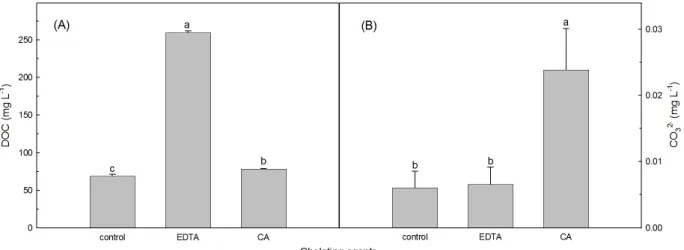
Fig. 1. Concentration of dissolved organic carbon (DOC) (A) and carbonate (CO32-) (B) in soil solution added with different chelating agents after 4 weeks of incubation (Different letters on the bar denote significant difference at p > 0.05 level of probability).
보고하였다 (Niinae and Aoki., 2005).
CA가 처리된 토양 내 Cd의 분획 특성에서 가장 주목할 만한 것은 F5의 함량이 무처리와 EDTA처리에 비해 유의하 게 증가한 것이다 (Table 2). F5는 광물의 격자에 결합되어 있거나 결정형으로 존재하는 Cd의 형태를 의미하며 토양 환경에서 쉽게 용출되지 않아 식물체로 흡수되기 힘든 형태 의 Cd이다. Hong et al. (2010)은 토양 내 F5의 함량과 알타 리무 내 Cd의 함량은 유의한 부의 상관관계가 있으며 F5의 함량이 증가함에 따라 알타리무 내 Cd의 함량은 감소한다 고 보고하였다. 이상의 결과를 바탕으로 볼 때 CA는 EDTA 에 비해 Cd의 용출성을 증대시키는 효과가 낮은 것으로 조 사되었으며 오히려 Cd의 용출성과 식물에 대한 유효도를 감소시킬 수 있을 것으로 판단된다.
카드뮴의 화학종 분석
토양 용액 내 존재하는 Cd의 화학종을 조사하기 위해 Visual MINTEQ 프로그램을 이용 하여 모델링을 실시한 결과, EDTA가 처리된 토양의 용액 내 Cd2+ 이온과 Cd와 DOC의 복합체 (Cd-DOC)의 활동도는 무처리와 CA가 처리된 토양 용액에 비해 현저히 증가하였 다 (Table 3). EDTA의 처리에 따른 토양 내 F1 함량의 증대 는 토양 용액 내 Cd2+ 이온과 Cd-DOC 활동도의 증대에 기 인된 것으로 판단된다 (Table 3, Fig. 1). 수용성 형태의 Cd 중 Cd-DOC은 식물체 뿌리에서 흡수될 때 세포벽의 지질이 중막의 소수성기를 쉽게 통과할 수 있어 Cd2+ 이온보다 쉽 게 흡수된다 (Phinney and Bruland., 1994).인큐베이션 4주 후 EDTA와 CA를 처리한 토양 내 DOC의 함량과 무처리 토양 내 함량을 비교한 결과, EDTA를 처리 하였을 때 DOC의 함량이 무처리와 CA에 비해 유의하게 높 은 것으로 나타났다 (Fig. 1(A)). 토양 내 DOC 함량이 증가 함에 따라 Cd의 용출성 및 식물체 내 Cd의 흡수량은 증가한
다 (Antoniadis and Alloway, 2002). 동일한 5 mmol kg-1의 EDTA와 CA를 토양에 처리하였음에도 불구하고 인큐베이션 4주 후 CA가 처리된 토양에서 EDTA가 처리된 토양에서 보 다 DOC 함량이 현저히 낮은 것은 4주 동안 유기탄소화합물 인 CA가 미생물에 의해 분해되어 무기태 탄소의 형태로 전 환된 것으로 판단된다. 이러한 판단은 Fig. 1(B)에 제시한 CO32-의 함량변화에 의해 증명된다. 인큐베이션 4주 후 EDTA가 처리된 토양 용액 내 CO32-의 함량은 무처리에 비 해 유의한 차이가 없었으나 CA가 처리된 토양 용액 내 CO32-의 함은 유의적으로 증가하였다. CA는 박테리아가 존 재하는 조건에서 40시간 후에 80% 이상이 CO2 형태의 무기 탄소화합물과 formic acid, acetic acid, succinic acid와 같 은 저분자의 유기탄소화합물로 빠르게 분해된다 (Bruce, 1934). 일부 연구에서 CA는 토양 내에서 미생물에 의해 빠 르게 분해되어 금속이온의 용출성을 증대시키지 못한다고 보고하였다 (Elkhatib et al., 2001; Romkens et al., 2002).
CA가 처리된 토양 용액 내 Cd-CO32-의 활동도는 EDTA 에 비해 현저히 증가하였는데 (Table 3) 이러한 결과는 Fig.
1(B)의 토양 내 CO32-의 농도와 일치하는 결과였다. 토양의 pH가 7.0 이상인 알칼리조건에서 Cd은 불용성의 CdCO3 형 태로 침전되고 Cd의 용출성은 감소하게 된다 (McBride, 1994). 본 연구에서 CA가 처리된 토양 용액의 pH는 6.99까 지 증대되어 CO32-가 상대적으로 증가한 조건에서 Cd은 아 래와 같은 난용성의 안정한 광물로 결정화될 수 있을 것으 로 판단된다 (Table 3).
CdCO3 (Octavite):
CdCO3 ↔ Cd2+ + CO32-
Log Ksp = -11.3 (Santillan-Medrano and Jurinak, 1975).
CA가 처리된 토양에서 F5 함량의 증대는 CA가 미생물에
의해 분해되고 CO32- 형태의 무기탄소화합물로 전환되어 Cd와 결합하여 octavite를 형성함에 의한 것으로 판단된다 (Table 2). 그러나 이러한 결과를 직접적으로 증명할 수 있 는 연구결과는 본 연구에 포함되어 있지 않다. CA에 처리에 의한 Cd의 용출성 저감원인을 구명하기 위해서는 octavite 의 형성 여부를 확인할 수 있는 X-ray 회절분석이나 전자 현미경을 이용한 형태학적 조사를 추가적으로 수행해야 할 것으로 판단된다.
Conclusion
CA와 EDTA가 Cd의 용출성에 미치는 영향을 조사한 실 내시험에서 두 킬레이트 보조제는 상반되는 결과를 명확히 나타냈다. EDTA는 수용성 형태의 Cd인 Cd-DOC와 Cd2+ 이 온의 함량을 증대시켜 Cd의 용출성을 증가시키는 결과를 나타냈다. 반면에 CA는 다소의 pH 증가에 의해 치환성 형 태의 Cd 함량을 증가시켰으나 DOC와 Cd의 복합체 형성에 의한 수용성 Cd 함량의 증가는 없는 것으로 나타났다. 인큐 베이션 4 주 후 대부분의 CA는 미생물에 의해 분해되어 무 기태 탄소화합물인 CO32-로 전환된 것으로 판단된다. 이러 한 CO32-의 증대는 CdCO3와 같은 안정한 형태의 Cd인 F5의 함량 증대를 유도한 것으로 판단된다. 결론적으로 EDTA는 Cd의 용출성을 증대시켜 phytoremediation 기술의 단점을 보완하는 킬레이트 보조제로 활용될 수 있을 것으로 판단되 나 CA는 오히려 Cd의 용출성을 감소시켜 Cd을 부동화하는 토양개량제로 활용할 수 있을 것으로 판단된다.
References
Angelova, V., R. Ivanova, V. Delibaltova, and K. Ivanov.
2004. Bio-accumulation and distribution of heavy metals in fiber crops (flax, cotton and hemp). Ind. Crop Prod.
19:197-205.
Antoniadis, V. and B.J. Alloway. 2002. The role of dissolved organic carbon in the mobility of Cd, Ni and Zn in sewage sludge-amended soils. Environ. Pollut. 117:515-521.
Bjelkova, M., V. Gencurova, and M. Griga. 2011. Accumula- tion of cadmium by flax and linseed cultivars in field- simulated conditions: A potential for phytoremediation of Cd-contaminated soils. Ind. Crop Prod. 33:761-774.
Bolan, N.S., D.C. Adriano, P.A. Mani, and A. Duraisamy.
2003a. Immobilization and phytoavailability of cadmium in variable charge soils.Ⅱ. Effect of lime addition. Plant Soil 251:187-198.
Bolan, N.S., D.C. Adriano, P. Duraisamy, A. Mani, and K.
Arulmozhiselvan. 2003b. Immobilization and phytoavailability of cadmium in variable charge soils.Ⅰ. Effect of phosphate addition. Plant Soil 250:83-94.
Bruce, W. F. 1934. The Decomposition of citric acid by bacillus aertrycke. J. Biol. Chem. 107:119-129.
Chen, H. and T. Cutright. 2001. EDTA and HEDTA effects on Cd, Cr, and Ni uptake by Helianthus annuus. Chemo- sphere 45:21-28.
Chen, Y.X., Q. Lin, Y.M. Luo, Y.F. He, S.J. Zhen, Y.L. Yu, G.M. Tian, and M.H. Wong. 2003. The role of citric acid on the phytoremediation of heavy metal contaminated soil.
Chemosphere 50:807-811.
Elkhatib, E.A., A.G. Thabet, and A.M. Mahdy. 2001.
Phytoremediation of cadmium contaminated soils: role of organic complexing agents in cadmium extraction. Land Contam. Reclam. 9:359-366.
Elless, M.P., M.J. Blaylock, J.W. Huang, and C.D. Gussman.
2000. Plants as a natural source of concentrated mineral nutritional supplements. Food Chem. 71:181-188.
Fassler, E., B.H. Robinson, W. Stauffer, S.K. Gupta, A.
Papritz, and R. Schulin. 2010. Phytomanagement of metal- contaminated agricultural land using sunflower, maize and tobacco. Agr. Ecosyst. Environ. 136:49-58.
Hong, C.O., D.K. Lee, and P.J. Kim. 2008. Feasibility of phosphate fertilizer to immobilize cadmium in a field.
Chemosphere 70:2009-2015.
Hong, C.O., J. Gutierrez, S.W. Yun, Y.B. Lee, C. Yu, and P.J. Kim. 2007. Heavy metal contamination of arable soil and corn plant in the vicinity of a zinc smelting factory and stabilization by liming. Arch. Environ. Contam. Toxicol.
56:190-200.
Hong, C.O., S.Y. Kim, J. Gutierrez, V.N. Owens, and P.J.
Kim. 2010. Comparison of oyster shell and calcium hydroxide as liming materials for immobilizing cadmium in upland soil. Biol. Fertil. Soils 46:491-498.
Huang, J.W., J. Chen, W.R. Berti, and S.D. Cunningham.
1997. Phytoremediation of Lead-contaminated soils: Role of synthetic chelates in lead phytoextraction. Environ. Sci.
Technol. 31:800-805.
Jung, G.B., W.I. Kim, J.S. Lee, and K.M. Kim. 2002.
Phytoremediation of soils contaminated with heavy metal by long-term cultivation. Kor. J. Environ. Agric. 21:31-37.
Lai, H.Y. and Z.S. Chen. 2004. Effects of EDTA on Solubility of cadmium, zinc and lead and their uptake by rainbow pink and vetiver grass. Chemosphere 55:421-430.
Lai, H.Y. and Z.S. Chen. 2005. The EDTA effect on phyto- extraction of single and combined metals-contaminated soils using rainbow pink (Dianthus chinensis). Chemosphere 60:1062-1071.
Li, Z. and L.M. Shuman. 1996. Redistribution of forms of zinc, cadmium and nickel in soils treated with EDTA. Sci.
Total Environ. 191:95-107.
Li, Z.B., J.A. Ryan, J.L. Chen, and S.R. Al-abed. 2001.
Adsorption of cadmium on biosolids-amended soils. J.
Environ. Qual. 30:903-911.
Lieu, V.T. and G.E. Kalbus. 1988. Potentiometric titration of acidic and basic compounds in household cleaners,. J.
Chem. Ed. 65:184.
Lindsay. W.L. 1979. Chemical equilibria in soils. p. 316-327.
Cadmium. The Blackburn Press. Caldwell, NJ, USA.
Marchiol, L., G. Fellet, D. Perosa, and G. Zerbi. 2007. Removal of trace metals by Sorghum bicolor and Helianthus annuus in a site polluted by industrial wastes: A field experience.
Plant Physiol. Bioch. 45:379-387.
McBride, M.B. 1994. Environmental chemistry of soils. p.
330. Trace and Toxic Elements in soils. Oxford University Press, Inc., Madison, NY, USA.
ME (Ministry of Environment) South Korea. 2005. Report of investigation for heavy metal contamination of abandoned mine areas distributed in nation.
Neugschwandtner, R.W., P. Tlustos, M. Komarek, and J.
Szakova. 2008. Phytoextraction of Pb and Cd from a contaminated agricultural soil using different EDTA application regimes: Laboratory versus field scale measures of efficiency. Geoderma. 144:446-454.
Niinae, M. and K. Aoki. 2005. Enhanced electrokinetic remediation of cadmium contaminated soils by chelating agents. Eur. J. Miner. Process. Environ. Prot. 5:153-162.
Phinney, J.T. and K.W. Bruland. 1994. Uptake of Lipophilic Organic Cu, Cd, and Pb Complexes in the Coastal Diatom Thalassiosira weissflogii. Environ. Sci. Technol. 11:307-318 RDA (Rural Development Administration, Korea). 1988.
Methods of soil chemical analysis. National Institute of Agricultural Science and Technology, RDA, Suwon, Korea.
Romkens, P., L. Bouwman, J. Japenga, and C. Draaisma.
2002. Potentials and drawbacks of chelate-enhanced phy- toremediation of soils. Environ. Pollut. 116:109-121.
Santillan-Medrano, J., and J. J. Jurinak. 1975. The chemistry of lead and cadmium in soil: solid phase formation. Soil Sci. Soc. Am. Proc. 39:851-856.
SAS Institute Inc. (2006) User’s guide: statistics SAS Version
9.2. SAS Institute, Cary, NC.
Shaheen, S.M. and J. Rinklebe. 2015. Impact of emerging and low cost alternative amendments on the (im)mobilization and phytoavailability of Cd and Pb in a contaminated floodplain soil. Ecol. Eng. 74:319-326.
Sparks, D.L. 1996. Methods of Soil Analysis Part 3-Chemical Methods. p. 995-996. In: D.W. Nelson and L.E. Sommers (ed.). Total carbon, orgnic carbon, and organic matter.
SSSA Inc. Madison, WI, USA.
Sposito. G., L.J. Lund, and A.C. Chang. 1982. Trace metal chemistry in arid-zone field soils amended with sewage sludge: I. Fractionation of Ni, Cu, Zn, Cd and Pb in solid phases. Soil Sci. Soc. Am. J. 46:260-264.
Srivastava, S., S. Sounderajan, A. Udas, and P. Suprasanna.
2014. Effect of combinations of aquatic plants (Hydrilla, Ceratophyllum, Eichhornia, Lemna and Wolffia) on arsenic removal in field conditions. Ecol. Eng. 73:297-301.
Turgut, C., M.K. Pepe, and T.J. Cutright. 2004. The effect of EDTA and Citric acid on phytoremediation of Cd, Cr, and Ni from soil using Helianthus annuus. Environ. Pollut.
131:147-154.
Vamerali, T., M. Bandiera, P. Lucchini, N.M. Dickinson, and G. Mosca. 2014. Long-term phytomanagement of metal- contaminated land with fieldcrops: Integrated remediation and biofortification. Eur. J. Agron. 53:56-66.
Ure, A.M., P. Quevauviller, H. Muntau, and B. Griepink.
1993. Speciation of heavy metals in soils and sediments.
An account of the improvement and harmonization of extraction techniques undertaken under the auspices of the BCR of the commission of the European Communities. J.
Environ. Anal. Chem. 51:135-151.
Wu, L.H., Y.M. Luo, X.R. Xing, and P. Christie. 2004.
EDTA-enhanced phytoremediation of heavy metal contami- nated soil with Indian mustard and associated potential leaching risk. Agr. Ecosyst. Environ. 102:307-318.