First author:Kwon Hyuk Joon, Department of Horticultural Science, Chungbuk National University, Tel:+82-43-261-2526, E-mail:[email protected]
Corresponding author:Lee, Cheol Hee, Department of Horticultural Science, Chungbuk National University, Tel:+82-43-261-2526, E-mail:[email protected]
Received:22 November, 2012. Revised:11 October, 2013. Accepted:26 December, 2013.
- 1 -
봉의 꼬리를 이용한 수림지 토양의 비소정화에 미치는 유황분말과 구연산의 영향
권혁준․조주성․이철희 충북대학교 원예과학과
Effect of Sulfur Powder and Citric Acid on Arsenic Phytoremediation Using Pteris multifida in Forest Soil
Hyuk Joon Kwon․Ju Sung Cho and Cheol Hee Lee
Dept. of Horticultural Science, Chungbuk Nat’l Univ., Cheongju 361-763, Korea.
ABSTRACT
This study was carried out not only to identify the optimum concentrations of sulfur powder and
citric acid treated for improving arsenic absorption of Pteris multifuda known as hyperaccumulator of
arsenic, but also to develop arsenic purification model in the forest soil. After applying sulfur powder
(0, 30, 45, 60g・m
-2) and citric acid (0, 200, 400, 800g・m
-2) in the forest soil contaminated with heavy
metals, P. multifuda was planted and cultivated for 16 weeks. And then the growth and arsenic contents
of plants were analyzed. In the result of research, the growth of P. mulifuda, except plant width,
cultivated in soils treated with sulfur powder and citric acid was relatively lower than control. The
accumulated amount of arsenic in aerial parts of P. multifuda (1822.2 mg・kg
-1) cultivated in soils treated
with 200g・m
-2citric acid was improved 62.5% against the control. And the accumulated amount of
arsenic per 1 m
2(20.1mg・m
-2) was the greatest in 200g・m
-2citric acid treatment. Translocation rate
(TR) was higher in all acid treatment compare to control, and was the best in 200g・m
-2citric acid
treatment (0.95) especially. It showed that the arsenic absorbed in underground parts was transferred
fast to aerial parts. Therefore, 200g・m
-2citric acid treatment in the soil is recommended for arsenic
purification using P. multifuda.
Key Words:Arsenic, Field application, Hyperaccumulator, Heavy metal, Smelter.
I. 서 론
산업발달 및 도시화 등으로 인한 심각한 환경 문제는 인류에게 피해를 주고 있으며, 국내에도 수질, 토양, 대기오염으로 인한 피해가 증가하고 있다. 특히 휴․폐광산으로 인한 토양 및 하천 내 중금속 오염이 심각한 문제로 대두되고 있으 나, 이러한 오염지역에 토양오염 유발방제 및 복 원시설이 전무한 실정으로 주변 생태계가 위협 받고 있다(Lee, 2008).
중금속 오염원으로부터 확산된 오염물질은 자연분해가 어렵고, 오염된 토양에서 자라는 작 물의 생육을 저해하며, 먹이사슬을 통해 동물이 나 인간에게 축적되어 각종 질병을 야기하는 등 심각한 위협원이 되고 있다(Jung, 2007). 본 연구 지인 J제련소 주변은 50여 년간 비철금속을 제 련하며, 발생한 분진의 비산으로 인해 납, 아연, 구리, 카드뮴 등 중금속을 비롯하여 비소의 오염 이 자연상태(0.56mg・kg
-1)에 비해 7~17배 심각 한 곳이다(Kim, 1993; Kim and Beak, 1994; Kim
et al., 1994, 1996; Yun and Yu, 2007). 비소는피부암과 폐암을 유발하는 1급 발암물질로 평가 되며(Boffetta, 1993), 제련소나 양조장 등 작업장 에서 비소의 노출에 의하여 폐, 간, 신장, 위장 등 의 암 발생 및 사망과 상관관계가 있어 제련소 주 변의 토양정화가 매우 시급한 실정이다(Tokudome and Kuratsune, 1976; Enterline and Marsh, 1982;
Jarup and Pershagen, 1991).
중금속으로 오염된 토양의 정화기법 중 친환경 적인 생물학적 정화를 극대화한 기술로 식물을 이 용한 식물상정화기법(Phytoremediation)은 저탄소 녹색성장과 함께 주목받고 있다(Kim, 2009). 국내 에서도 식물정화법에 대한 관심이 높아지고 있으 며, 현장에서 조사된 야생식물의 중금속 함량과 내성 등에 대한 연구가 수행되고 있다(Jung et al.,
1993; Kang et al., 1998; Kim et al., 1999; Song
et al., 1999; Hwang et al., 2000; Kim et al., 2002;Og et al., 2003; Min, 2004).
식물의 비소축적은 토양의 비소함량(National Research Council, 1977), pH 및 토성 등의 물 리․화학적 특성(Von Endt et al., 1968)과 토양 이온의 영향을 많이 받는 것으로 알려져 있다 (Fitz and Wenzel, 2002). 따라서, 식물정화를 위해서는 현장 실증화 연구를 통해 적용 가능 성 연구가 필요하다. 봉의꼬리(Pteris multifida) 는 2009년 본 연구지와 동일한 제련소 주변에 서 재배하여 중금속 축적능을 분석한 결과, 1,121.68mg・kg
-1의 비소를 축적하여 현장적용이 가능한 식물로 분석되었으며(JU, 2011), 비소의 축적능이 매우 우수한 고축적 식물로 보고되었 다(Du et al., 2005; Oh, 2006; Wang et al., 2006, 2007; Wei et al., 2007; JU, 2011). 그러나 식물 상정화기법은 물리적, 화학적 방법에 비해 정화 에 소요되는 기간이 길어 식물상정화법의 효율 을 높이기 위한 토양개량제 연구가 필요한 실정 이다.
산성 토양개량제 처리를 통해 토양의 pH를 낮추면, 중금속의 양이온치환능력을 높여 토양 입자와의 흡착력 및 안정화를 낮추어 식물의 축 적능을 향상시키는 것으로 보고되었다. (Um and Kim, 2003). 대표적인 산성 토양개량제인 유황 분말(S)을 중금속 오염 토양에 30~60g・m
2처리 한 다음 쑥(Artemisia princeps)을 재배하면 카드 뮴, 아연, 납 등의 중금속 축적능이 무처리구에 비해 각 1.8, 1.7, 1.8배 향상되는 것으로 보고되 었다(Kim, 2002).
구연산[C
3H
4OH(COOH)
3] 등의 유기산 처리
는 중금속으로 오염된 토양의 pH를 변화시켜,
중금속과 결합하여 고정화된 중금속의 이동성
을 증가시켜 식물의 중금속 축적능을 향상시키
Table 1. Growth state of Pteris multifida used for this study.
Plant height (cm)
Plant width (cm)
No. of leaves/plant (ea)
Root length (cm)
Leaf length (cm)
Leaf width (cm)
5.3±1.17z 5.3±2.30 2.8±1.03 5.8±2.16 6.2±1.96 2.3±1.43
zValues are mean±SE (n=10).
Table 2. Fresh and dry weight of Pteris multifida used for this study.
Fresh weight (g) Dry weight (g)
Aerial part Underground part Aerial part Underground part
0.2±0.09z 0.2±0.15 0.1±0.03 0.1±0.05
zValues are mean±SE (n=10).
Table 3. Arsenic accumulation of Pteris multifida used for this study.
Arsenic accumulation (mg・kg-1)
Aerial part Underground part
1.6±0.72z 21.3±1.34
zValues are mean±SE (n=3).
는 것으로 알려져 있다(Huang et al., 1997; Kirk
et al., 1999; Elless and Blaylock, 2000; Chen et al.,2003, Wang et al., 2011).
따라서, 본 연구는 봉의꼬리의 비소 축적능을 향상시킬 것으로 기대되는 유황분말과 구연산 등의 대표적인 산성 토양개량제를 처리하여 봉 의꼬리의 생육 반응 및 비소 축적능을 분석하기 위해 실시하였다. 이를 통해 비소 오염이 심각한 곳으로 알려진 J제련소 주변의 식물상 정화를 위한 봉의꼬리의 토양개량제 종류 및 농도를 구 명하고자 하였다.
II. 재료 및 방법
조직배양을 통해 비소 축적능이 우수한 것으 로 알려진 봉의꼬리를 번식하여 충북 청주시 충 북대학교 내의 무가온 비닐하우스에서 1년 동안 육묘한 다음 동일한 생육단계에 있는 것을 시험 재료로 사용하였다(Tables 1 and 2). 식재 전 봉
의꼬리의 비소 함량은 Table 3과 같다.
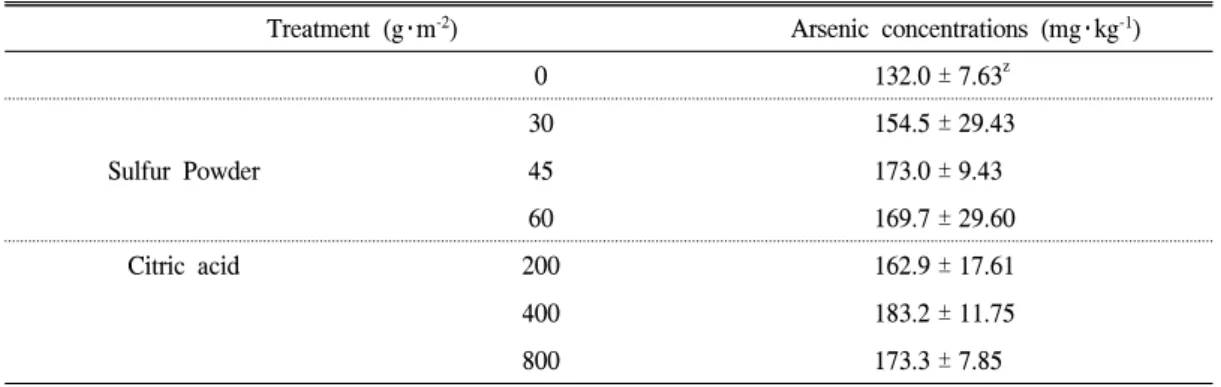
연구는 비소의 오염이 심각한 곳으로 알려진 J제련소에서 북으로 약 800m 떨어진 수림지에 서 연구를 수행하였다(Figure 1). 수림지 토양의 각 처리구의 비소함량은 132.0∼183.2mg・kg
-1수준으로 토양환경보전법 2지역 임야의 토양오 염대책수준 150mg・kg
-1를 초과한 토양정화가 시급한 곳이었다(Table 4).
연구는 2010년 6월 5일부터 2010년 10월 3일 까지 16주간 수행하였으며, 시험규모는 1개의 처리구가 가로 1.4m × 세로 1.4m(1.96m
2)로 무 처리를 포함한 7처리를 완전임의배치법 3반복 (총 시험구 21개구)으로 수행하였다. 원활한 물 빠짐을 위하여 배수로를 만들고, 잡초발생을 방 지하기 위하여 실험구 주위에 부직포를 깔아 멀 칭하였다.
대표적인 산성 토양개량제인 유황분말과 구
연산을 선정하여 식재 1일 전에 실험구 1m
2당
유황분말 30, 45, 60g과 구연산 200, 400, 800g을
▼
Figure 1. Place of this study.
Table 4. Arsenic concentrations of each soils used for this study.
Treatment (g・m-2) Arsenic concentrations (mg・kg-1)
0 132.0 ± 7.63z
Sulfur Powder
30 154.5 ± 29.43
45 173.0 ± 9.43
60 169.7 ± 29.60
Citric acid 200 162.9 ± 17.61
400 183.2 ± 11.75
800 173.3 ± 7.85
zValues are mean±SE (n=3).
각 처리하여 경운하였다. 재식주수는 1.96m
2당 49주씩 20×20cm의 간격으로 2010년 6월 5일에 식재하여 16주간 재배하였다.
봉의꼬리는 2010년 10월 3일에 주변 환경의 영향을 배재하기 위하여 가장 자리에 식재한 식 물을 제외하고, 가운데 식재된 식물을 반복당 10 개체씩 총 30개체를 수확하여 생육정도와 분석 시료로 사용하였다.
봉의꼬리의 생육정도를 분석하기 위하여 식 재하기 전의 식물과 황가루와 구연산 처리를 달 리한 중금속 오염토에서 16주 동안 재배한 식물 의 초장, 초폭, 엽장, 엽폭, 엽수, 근장, 지상부와 지하부의 생체중 및 건체중을 측정하여 생육상 태를 비교하였다. 모든 생육분석은 각 처리당 10 주씩 3반복으로 조사하였다.
비소함량 분석을 위하여 봉의꼬리를 지상부와
지하부로 나누어 60°C의 건조기(Hanbaek Scientific Co., Korea)에서 72시간 건조시킨 다음 분쇄하 여 습식분해법으로 전처리하였다. 토양은 음건 하여 나무망치로 분쇄하여 0.15mm(100mesh)로 체걸음한 다음 시료를 각 200g씩 취하여 사분법 에 의해 균일하게 혼합하여 환경부의 토양오염 공정시험법에 준하여 전처리하였다.
전처리가 완료된 식물과 토양은 유도결합플 라즈마분광도계(Perkin Elmer Optima 5300DV ICP-AES, Perkin Elmer)를 이용하여 유도결합플 라스마-원자발광분광법으로 충북대학교 환경자 원분석센터에서 3회 3반복으로 비소(As)의 함량 을 분석하였다.
면적당 비소 축적량은 각 처리별 건물중 1kg
당 비소 축적능과 면적당 재식주수(49주/1.96m
2)
의 총 건물중을 계산하여 분석하였다. 또한 식물
Table 5. Effect of soil conditioner on growth of Pteris multifida cultivated in forest soil contaminated with heavy metals for 16 weeks.
Treatment (g・m-2)
Plant height (cm)
Plant width (cm)
No. of leaves/plant
(ea)
Root length (cm)
Leaf length (cm)
Leaf width (cm)
0 11.1az 13.2b 8.2a 12.7a 12.4a 7.3a
Sulfur powder
30 8.7b 15.4a 6.1bc 10.8b 12.4a 7.2a
45 8.7b 14.3ab 6.2bc 10.2b 10.8b 6.4a
60 6.4c 13.3b 5.3cd 9.7b 9.6c 5.1b
Citric acid
200 6.7c 11.0c 6.7b 9.9b 9.3c 4.9b
400 4.8d 7.9d 5.3cd 8.2c 7.4d 4.6b
800 4.8d 6.0e 4.5d 6.6d 5.3e 3.3c
zMean separation within columns by Duncan's multiple range test, p < 0.05.
이 축적한 중금속이 지하부에서 지상부로 이동 되는 이동계수(translocation rate, TR)를 아래의 식을 이용하여 구하였다.
이동계수(Translocation rate, TR)
= 지상부의 중금속 축적량
지상부와 지하부의 중금속 축적량 통계처리는 SAS version 9.1(SAS Institute Inc., Cary, NC, USA)를 이용하였으며, 각 처리구의 평균과 표준오차를 구하고, 던컨의 다중검정방 법(Duncan's multiple range test)을 이용하여 처 리구간의 유의성을 검정하였다(p < 0.05).
III. 결과 및 고찰
1. 유황분말과 구연산의 처리에 따른 봉의꼬리의 생육 반응
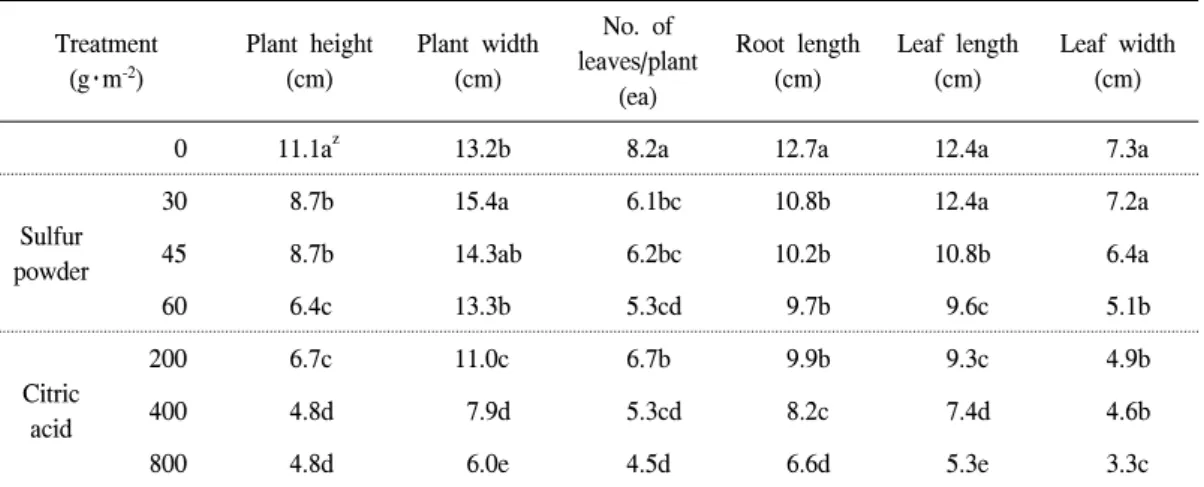
봉의꼬리의 생육은 초폭을 제외하고는 무처 리구에서 토양개량제인 유황분말과 구연산 처 리구에 비해 전반적으로 우수하였다(Table 5).
이는 식재 초기의 이식 장애와 함께 유황분말과 구연산 처리로 인한 토양의 pH 및 화학적 특성 의 변화가 봉의꼬리의 스트레스를 증가시켜(Um
and Kim, 2003), 유황분말과 구연산 처리구에 서 대부분의 봉의꼬리 지상부가 하엽된 후 신 초가 발생했기 때문으로 생각된다. 봉의꼬리의 초장은 무처리구에서 11.1cm로 가장 컸으며, 다 음으로 유황분말 30과 45g・m
-2처리구(8.7cm)의 순이었다. 초폭은 유황분말을 30g・m
-2로 첨가하 여 재배한 처리구(15.4cm)에서 가장 넓게 생장 하였다. 봉의꼬리의 엽수는 무처리구에서 8.2개 로 가장 많았고, 구연산 200g・m
-2와 유황분말 30, 45g・m
-2의 농도로 첨가했을 때 무처리구 다음으 로 많은 잎이 발생하였다. 봉의꼬리의 근장은 무 처리구에서 12.7cm로 가장 길었으며, 엽장과 엽 폭도 무처리구에서 가장 우수하였다.
중금속으로 오염된 수림지에서 유황분말과
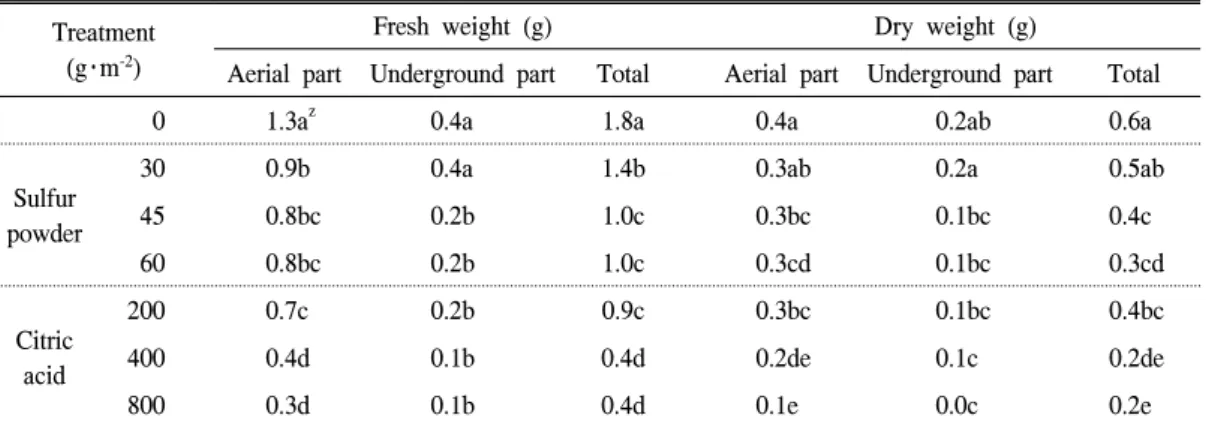
구연산 처리에 따른 생체중과 건물중은 Table 6
과 같다. 유황분말과 구연산을 첨가하지 않은 대
조구에서 두 종류의 토양개량제 처리구에 비해
봉의꼬리의 생체중과 건물중이 많았다. 유황분
말과 구연산 처리구의 지상부 생체중은 유황분
말 30과 45g・m
-2처리구에서 각 0.9, 0.8g으로 가
장 높았으며, 지하부는 유황분말 30g・m
-2처리
구에서 0.4g으로 가장 우수하였다. 유황분말 처
리구의 생체중이 구연산 처리구에 비해 모든 농
Table 6. Effect of soil conditioners on fresh and dry weight of Pteris multifida cultivated in forest soil contaminated with heavy metals for 16 weeks.
Treatment (g・m-2)
Fresh weight (g) Dry weight (g)
Aerial part Underground part Total Aerial part Underground part Total
0 1.3az 0.4a 1.8a 0.4a 0.2ab 0.6a
Sulfur powder
30 0.9b 0.4a 1.4b 0.3ab 0.2a 0.5ab
45 0.8bc 0.2b 1.0c 0.3bc 0.1bc 0.4c
60 0.8bc 0.2b 1.0c 0.3cd 0.1bc 0.3cd
Citric acid
200 0.7c 0.2b 0.9c 0.3bc 0.1bc 0.4bc
400 0.4d 0.1b 0.4d 0.2de 0.1c 0.2de
800 0.3d 0.1b 0.4d 0.1e 0.0c 0.2e
zMean separation within columns by Duncan's multiple range test, p < 0.05.
도에서 무거웠으며, 특히 구연산의 첨가량이 많 아질수록 생체중의 감소량이 유황분말 처리구 에 비해 많은 경향을 보였다.
지하부의 생체중은 유황분말 30g・m
-2처리구 를 제외한 모든 처리구에서 대조구에 비해 감소 하였다. 특히 구연산의 농도가 높아질수록 봉의 꼬리의 지하부 생체중과 근장이 감소하는 경향 을 보였다. 이는 토양개량제 처리가 식물의 생육 과 밀접한 관계가 있어(Park et al., 2003), 유황 분말과 구연산의 농도가 높아질수록 봉의꼬리 의 생육에 악영향을 미친 것으로 생각된다.
토양개량제 처리구의 지상부 건물중은 농도 에 따라 0.1∼0.3g 이었으며, 무처리구는 0.4g으 로 유황분말과 구연산 처리구에 비해 많았다. 유 황분말과 구연산을 첨가한 처리구의 건물중은 유황분말 처리구가 구연산 200g・m
-2처리구를 제외한 모든 구연산 처리구에 비해 많았다.
쑥의 경우에는 유황분말 30∼60g을 처리하였 을 때 무처리구에 비해 전반적으로 생육이 향상 되었으며, 유황분말의 처리농도가 증가함에 따 라 생체중과 근장의 증가하였다(Kim, 2002). 그 러나 본 연구에서 사용한 봉의꼬리는 유황분말 처리량이 증가함에 따라 생육이 대체로 불량해 지는 경향을 보여, 식물에 따라 토양개량제에 대
한 생육 반응이 다른 것으로 생각된다.
2. 유황분말과 구연산의 처리에 따른 봉의꼬리의 비소 축적
1) 비소 축적능
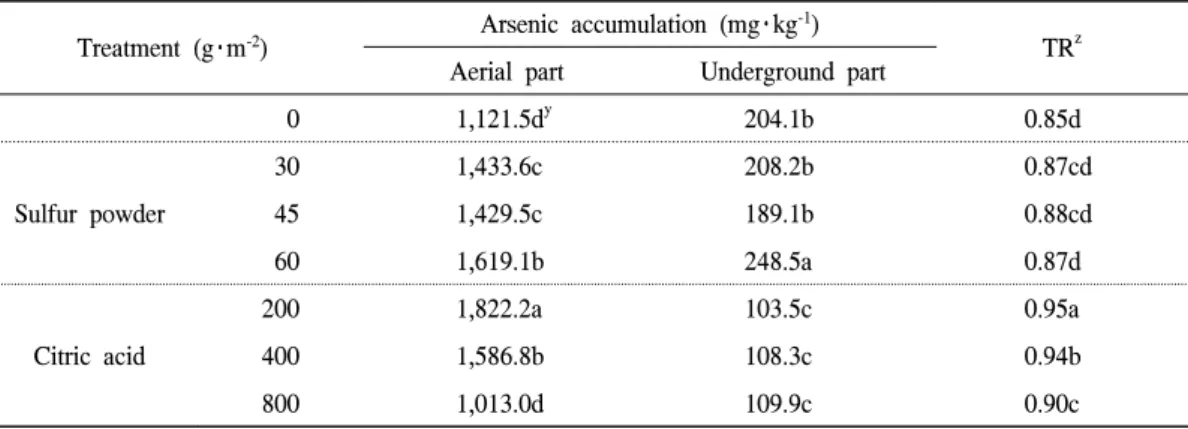
비소의 식물정화에서 효과적인 고축적 식물 은 지상부의 건물중 당 0.1% 이상의 비소를 축 적하는 식물로 정의하는데(Baker and Books., 1989), 현장에 적용한 본 연구의 봉의꼬리는 모 든 처리구에서 0.1% 이상의 비소 축적량을 나타 냈다(Table 7).
유황분말과 구연산 처리에 따른 봉의꼬리 지 상부의 비소 축적능은 고농도의 구연산 처리구 (800g・m
-2)를 제외한 모든 처리구에서 유황분말 과 구연산을 첨가하지 않은 대조구에 비해 27.5
∼62.5% 증가하였다. 특히 구연산 200g・m
-2처리 구에서 1,822.2mg・kg
-1로 비소 축적능이 가장 높았 다. 다음으로 유황분말 60g・m
-2(1619.1mg・kg
-1), 구 연산 400g・m
-2(1,586.8mg・kg
-1) 순이었다. 따라 서 봉의꼬리의 비소 축적능을 향상시키기 위해 서는 토양에 구연산을 200g・m
-2로 처리하는 것 이 가장 좋을 것으로 판단된다.
본 연구의 유황분말과 구연산에 따른 봉의꼬
리의 비소 축적능은 2009년에 본 연구지와 동일
Table 7. Effect of soil conditioners on arsenic accumulation of Pteris multifida cultivated in forest soil contaminated with heavy metals for 16 weeks.
Treatment (g・m-2) Arsenic accumulation (mg・kg-1)
TRz Aerial part Underground part
0 1,121.5dy 204.1b 0.85d
Sulfur powder
30 1,433.6c 208.2b 0.87cd
45 1,429.5c 189.1b 0.88cd
60 1,619.1b 248.5a 0.87d
Citric acid
200 1,822.2a 103.5c 0.95a
400 1,586.8b 108.3c 0.94b
800 1,013.0d 109.9c 0.90c
zTR: Translocation rate (ratio of arsenic in aerial parts to underground parts).
yMean separation within columns by Duncan's multiple range test, p < 0.05.
한 수림지에서 실험한 봉의꼬리의 비소 축적능 (1,193.6mg・kg
-1)에 비해서도 월등히 높았다(Ju, 2011). 따라서, 구연산과 유황분말 처리에 의해 뿌리에서 흡수된 비소가 세포 소기관으로 분리 되어 저장하거나 조직에 축적되는 능력이 향상 되어, 봉의꼬리의 비소 축적능이 증가한 것으로 생각된다(Grill et al., 1985). 또한 유황분말과 구 연산 처리로 인해 고정화된 비소가 식물이 이용 할 수 있는 형태로 전환되어, 봉의꼬리의 비소 축적능이 향상된 것으로 판단된다(Kirk et al., 1999; Um and Kim, 2003).
또한 중금속 오염 토양에 유황분말 30g・m
2를 처리한 다음 쑥(Artemisia princeps)을 재배하 면 지상부에 축적된 카드뮴(146.31µg・g
-1), 아연 (6,541.29µg・g
-1), 납(6,541.29µg・g
-1) 등의 중금 속 축적능이 무처리구[76.76(Cd), 3,567.87(Zn), 3,567.87(Pb)µg・g
-1]에 비해 83.3∼90.6% 향상되 며, 60g・m
2처리구에서도 무처리에 비해 중금속 축적능이 우수한 것으로 보고된 바 있다(Kim, 2002).
본 연구의 봉의꼬리에서도 유황분말을 처리 하였을 때 비소 축적능이 27.5∼44.4% 향상되었 다. 이는 유황분말 처리시 유효태 중금속의 함량
증가로 인해 쑥의 중금속 축적능이 향상된 것과 같은 결과로 분석된다(Kim, 2002). 구연산 처리 에 의해서도 유효태의 중금속 함량이 증가된 것 으로 생각된다.
이동계수(TR)는 0.5 이상일 때 중금속의 식물 정화에 적합한 식물로 알려져 있다(Jeong, 2011). 봉의꼬리는 모든 처리구에서 이동계수가 0.85 이상으로 식물정화에 매우 효과적인 것으 로 분석되었다(Table 7). 무처리구의 이동계수는 0.85 이었으나, 유황분말과 구연산 처리를 통해 0.87∼0.95로 향상되어 축적한 비소를 지상부로 더욱 빠르게 이동시키는 것을 확인하였다. 따라 서 봉의꼬리는 축적한 비소의 85∼95%를 지상 부에 축적하므로, 지상부의 수확에 의해 지속적 으로 비소의 제거가 가능하여, 경제적으로 식물 정화가 가능할 것으로 생각된다.
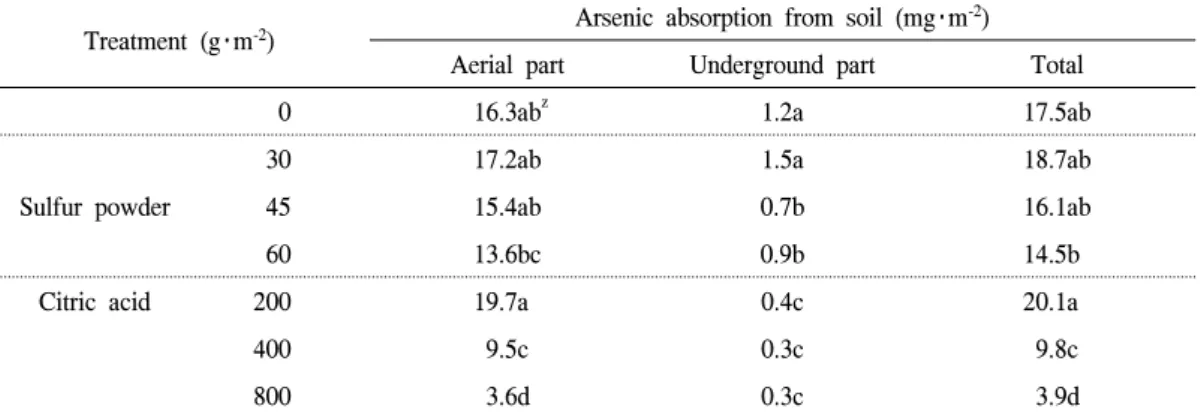
2) 단위면적(1m2)당 비소 축적량
중금속으로 오염된 J제련소 주변 수림지 오염
토양에서 식재간격을 20×20cm로 하여 16주 동
안 재배한 후, 수확한 봉의꼬리의 건물중과 비소
축적능을 분석하여 단위면적(1m
2) 당 봉의꼬리
의 비소 축적량을 분석하였다(Table 8).
Table 8. Effect of soil conditioners on arsenic absorption of Pteris multifida from forest soil contaminated with heavy metals for 16 weeks.
Treatment (g・m-2) Arsenic absorption from soil (mg・m-2)
Aerial part Underground part Total
0 16.3abz 1.2a 17.5ab
Sulfur powder
30 17.2ab 1.5a 18.7ab
45 15.4ab 0.7b 16.1ab
60 13.6bc 0.9b 14.5b
Citric acid 200 19.7a 0.4c 20.1a
400 9.5c 0.3c 9.8c
800 3.6d 0.3c 3.9d
zMean separation within columns by Duncan's multiple range test, p < 0.05.
봉의꼬리 지상부의 비소 축적능이 가장 우수했 던 구연산 200g・m
-2처리구에서 단위면적(1m
2) 당 축적한 비소 함량도 가장 많았다. 구연산 200g・m
-2처리구의 봉의꼬리는 총 20.1mg・m
-2의 비소를 축적하여 무처리구(17.5mg・m
-2)에 비해 약 14.9% 많은 비소 축적량을 보였다. 그러나 비 교적 고농도의 토양개량제를 처리한 유황분말 60mg・m
-2처리구와 구연산 400, 800mg・m
-2처 리구는 무처리에 비해 비소 축적량이 적었다. 이 는 고농도의 유황분말과 구연산 처리가 봉의꼬 리의 단위면적(1m
2) 당 건물중 생산량이 감소시 켰기 때문으로 분석된다. 특히, 유황분말 60g・
m
-2처리구는 비소 축적능이 무처리구에 비해 우수하였으나, 생육이 저조하여 실제 단위면적 당 비소 축적량은 무처리구에 비해 감소하였다.
봉의꼬리는 재식간격을 20×20cm로 식재하 여, 연중 1회 수확하는 것이 봉의꼬리의 건물중 생산량 및 비소 축적량을 향상시키는 것으로 알 려져 있다(Kwon et al., 2011). 봉의꼬리는 35∼
75%의 차광이 필요한 중생식물로(Suh et al., 2006), 비소 축적능을 향상시키기 위해서는 차 광처리가 필요한 것으로 알려져 있다(Kwon et
al.,, 2013). 또한 본 연구를 통해 유황분말과 구연산 적정 농도처리는 봉의꼬리의 비소 축적능
을 향상시켜, 구연산 200g・m
-2를 처리하였을 때 봉의꼬리의 비소 축적능이 약 62.5%로 가장 많 이 향상되었으며, 비소 축적량 또한 14.9% 증가 하였다.
이상의 연구결과를 종합해 보면, 비소로 오염된 수림지의 식물정화를 위해서는 구연산 200g・m
-2를 처리한 다음 간격을 20×20cm로 조절하여 식 재한 후 재배하여 연중 1회 지상부을 제거하는 것이 가장 경제적이고 효과적인 방법으로 판단 된다. 또한 수림지처럼 봉의꼬리의 생육에 필요 한 자연차광을 할 수 없는 논토양이나 밭토양의 토양정화시에는 비교적 비소 축적능이 우수한 것 으로 알려진 회양목(Buxus microphylla) 등의 목 본식물이나(Jung et al., 2002), 생육이 우수하여 차광을 제공할 수 있는 초본식물과 복합식재 (Jeong, 2011)하면 봉의꼬리를 이용한 효율적인 식물정화가 가능할 것으로 판단된다.
식물 정화법에서 토양의 정화효과는 식물의
생육과 밀접한 관계를 가지고 있어(Park et al.,
2003), 봉의꼬리의 생육을 증대시킬 수 있는 토
양개량제의 연구가 필요하다. 쑥의 경우에는 유
황분말과 퇴비의 혼용(Kim, 2002), 인산과 유기
물질이 풍부한 토양개량제의 처리(Choi et al.,
2002; Choi and Chiang, 2003)를 통해 생육 및
중금속 축적량이 크게 향상되었다. 또한 해바라 기는 돌로마이트 처리시 중금속 오염토양에서 생육 및 중금속 축적량이 우수한 것으로 알려져 있다(Choi et al., 2002). 따라서 봉의꼬리의 생 육 및 비소 축적능 향상을 위한 다양한 토양개 량제에 대한 적극적인 연구가 필요할 것으로 생 각된다.
IV. 결 론
J제련소 주변 수림지 토양은 비소함량 132.0
∼183.2mg・kg
-1수준으로 토양환경보전법 2지 역 임야의 비소 오염기준을 초과한 정화가 매우 시급한 곳이었다. 수림지의 지리적 특성상 물 리․화학적인 토양정화가 불가능하므로 식물을 이용한 토양정화가 절실히 필요하다. 이에 본 연 구는 비소 정화능이 우수한 것으로 알려진 봉의 꼬리의 비소 축적능을 증가시킬 수 있는 유황분 말과 구연산의 적정 처리농도를 구명하여 봉의 꼬리를 이용한 비소 정화모델을 개발하기 위하 여 수행하였다.
중금속으로 오염된 수림지에 유황분말과 구 연산을 처리하여 봉의꼬리를 재배한 결과, 무처 리에 비해 초폭을 제외한 생육은 다소 저조하였 으나, 두 종류의 산성 토양개량제 처리에서도 대 체로 생육이 양호하였다. 또한 유황분말과 구연 산 처리를 통해 봉의꼬리 지상부의 비소 축적량 은 구연산 200g・m
-2과 유황분말 60g・m
-2를 처리 하였을 때 각 1,822.2, 1,619.1mg・kg
-1로 무처리 구(1,121.5mg・kg
-1)에 비해 약 62.5, 44.4% 향상 되었다. 이동계수(TR) 또한, 무처리구는 0.85 이 었으나, 구연산 200g・m
-2처리구는 0.95로 축적 한 비소를 지상부로 더 빠르게 이동시키며, 비소 의 약 95%를 지상부로 축적하여 지상부의 제거 만으로도 효과적인 식물정화가 가능할 것으로 판단된다. 단위면적(1 m
2) 당 식재한 봉의꼬리의 비소 축적량도 구연산 200g・m
-2처리구에서 20.1mg・m
-2로 무처리구(17.5mg・m
-2)에 비해 약
14.9%가 증가하였다.
본 연구를 통해 구연산이 봉의꼬리의 비소 축 적능을 향상시킬 수 있는 토양개량제로 구명되 었으나, 토양의 정화효과와 밀접한 관계를 가지 고 있는 봉의꼬리의 생육을 향상시킬 수 있는 연 구가 더 필요할 것으로 생각된다. 따라서 봉의꼬 리의 생육을 향상시킬 수 있는 시비와 퇴비의 종 류 및 농도, 토양의 산도 조절 등의 다양한 토양 개량제 연구가 필요할 것으로 판단된다.
인 용 문 헌