*Corresponding author: Chang Oh Hong Phone: +82-55-350-5548; Fax: +82-55-350-5549;
E-mail: [email protected]
Korean J Environ Agric. 2016;35(4):235-240. Korean Online ISSN: 2233-4173
Published online 2016 November 15. https://doi.org/10.5338/KJEA.2016.35.4.35 Print ISSN: 1225-3537
중금속 오염 논토양에서 카드뮴의 용출성과 벼의 흡수에 대한 인산시용의 효과
이현호1, 김근기1, 이용복2, 곽연식2, 김석철3, 이상범3, 심창기3, 홍창오1*
1부산대학교 생명자원과학대학 생명환경화학과, 2경상대학교 농업생명과학대학 응용생명과학부,
3농촌진흥청 국립농업과학원 농업환경부 유기농업과
Effect of Phosphate Application on Cadmium Extractability and its Uptake by Rice Cultivated in Contaminated Paddy Soil
Hyun Ho Lee
1, Keun Ki Kim
1, Yong Bok Lee
2, Youn Sig Kwak
2, Suk Chul Kim
3, Sang-beom Lee
3, Chang Ki Shim
3and Chang Oh Hong
1*(
1Department of Life Science and Environmental Biochemistry, College of Life Science and Environmental Biochemistry, Pusan National University, Miryang 54063, Korea,
2Division of Applied Life Science, College of Agriculture and Life Science, Gyeongsang National University, Jinju 52828, Korea,
3Organic Agriculture Division, Department of Agricultural Environment, National Institute of Agricultural Science, Rural Development Administration, Wanju 55365, Korea)
Received: 18 October 2016 / Revised: 3 November 2016 / Accepted: 10 November 2016 Copyright ⓒ 2016 The Korean Society of Environmental Agriculture
This is an Open-Access article distributed under the terms of the Creative Commons Attribution Non-Commercial License (http://creativecommons.org/licenses/by-nc/3.0) which permits unrestricted non-commercial use, distribution, and reproduction in any medium, provided the original work is properly cited.
ORCID Chang Oh Hong
http://orcid.org/0000-0001-6456-804X
235
Abstract
BACKGROUND: To determine effect of phosphate (P) application on Cadmium (Cd) extractability and its uptake by rice plant in Cd contaminated paddy soil, dipotassium (K
2HPO
4) which was the most effective of P materials to decrease Cd extractability in previous study was selected as P fertilizer.
METHODS AND RESULTS: Dipotassium phosphate was applied at the rates of 0, 78, 234, and 390 kg P
2O
5/ha, and then rice was cultivated in submerged paddy soil from Jun.
to Oct. in 2015. Cadmium concentrations in grain, straw, and root of rice plant decreased significantly with increasing application rate of K
2HPO
4. The trend of 1 M NH
4OAc extractable Cd concentration in soil was similar to that of Cd uptake by rice plant. One M NH
4OAc extractable Cd concentration was negatively related to soil pH and negative charge. Alleviation of Cd phytoavailability of rice
in paddy soil might be attributed to increase in pH and negative charge of soil. Using a quadratic response model, amount of grain yield were related to K
2HPO
4application rates as Grain yield = 5.38 + 2.39 ×10
-3K
2HPO
4– 6.65 × 10
-6K
2HPO
42(model R
2= 0.968). Using this equations, the greatest grain yield (5.6 Mg/ha) was at the rate of 180 kg P
2O
5/ha. At this application rate of P, the Cd concentration in grain was 0.53 mg/kg, implying ca. 23% lower than the control.
CONCLUSION: From the view point of heavy metal safety and crop productivity, it might be good P management to apply P fertilizer with 4 times higher rate than recommendation (45 kg/ha).
Key words: Cadmium, Immobilization, Phosphate, Phytoavailability
서 론
카드뮴 (Cd) 으로 오염된 광산 토양 및 농경지 토양에서 Cd을 부동화시켜 토양을 복원하는 여러 연구들이 이루어졌
Research Article Open Access
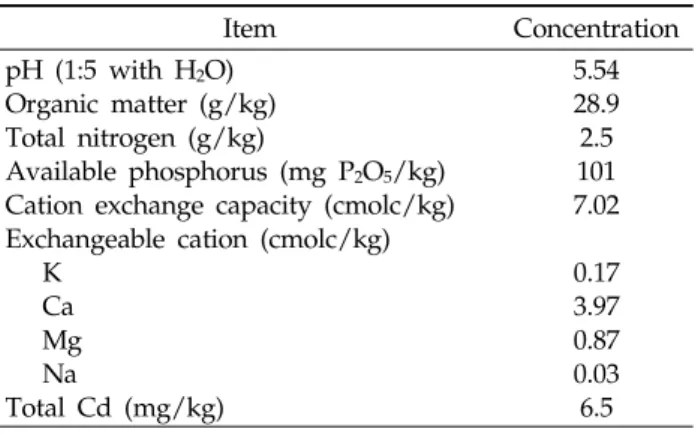
Table 1. Physico-chemical characteristics of soil in the main Korean potato fields
Item Concentration
pH (1:5 with H2O) Organic matter (g/kg) Total nitrogen (g/kg)
Available phosphorus (mg P2O5/kg) Cation exchange capacity (cmolc/kg) Exchangeable cation (cmolc/kg) K
Ca Mg Na
Total Cd (mg/kg)
5.54 28.9 2.5 101 7.02 0.17 3.97 0.87 0.03 6.5
으며, 해당 연구는 생물학적, 물리적, 화학적으로 다각도에
서 연구가 진행되고 있다(Anderson and siman, 1991;
Kreutzer, 1995; Gray et al ., 1999; Angelova et al ., 2004; Marchiol et al ., 2007; Neugschwandtner et al ., 2008; Fässler, et al ., 2010; Srivastava et al ., 2014;
Vamerali et al ., 2014). 현재까지 Cd 부동화에 관한 연구는 상당한 발전을 해왔으나, 각 기술의 현장 적용성은 늘 주요한 문제점이다. Cd과 같은 중금속의 유입 가능한 농경지는 주로 산간지 또는 패공업단지 주위에 위치하고 있어 토지가격이 낮고 개발가능성과 생산성이 매우 낮아 복원을 위해 경제적 타당이 있는 복원방법이 필요하다. 이 부분에 대한 연구들에 서 인산비료는 작물의 생육 및 생식에 필요한 영양성분을 함 유하고 있어 매년 농경지에 시용되고 있으며 가격이 저렴한 농업자재이므로 인산을 이용한 화학적 안정화방법은 현장 적 용성, 경제성, 지속성을 고려한 현실적인 복원방법으로 판단 된다. 따라서 인산을 투입하여 Cd을 부동화시키는 연구들이 많이 보고되었다(Santillian-Medrano and Jurinak, 1975;
Street et al ., 1977; Pierzynski and Schwab, 1993;
Naidu et al ., 1994; Mandjiny et al ., 1998; Boisson et al ., 1999; McGowen et al ., 2001; Seamon et al ., 2001;
Bolan et al ., 2003; Hong et al ., 2008, 2010, 2014).
대표적으로 본 연구팀에서 실시한 연구결과에 따르면 (Hong et al ., 2010; Kim et al ., 2015), Cd 농도 5.56 mg/kg에서 알타리무를 재배할 때, 인산의 시용농도를 증가 시킴에 따라 1 M NH
4OAc로 침출한 Cd의 농도가 감소하 는 연구결과가 보고되었고 인산의 농도를 1,600 mg P/kg까 지 처리하였을 때 침전반응은 이론적으로 발생하지 않았다.
하지만 16,000 mg P/kg을 처리한 토양에서는 Cd-mineral 이 형성 할 수 있다고 보고되었다. 이러한 다양한 실험 결과 를 요약하면 인산에 의한 Cd의 부동화 메커니즘은 두 가지로 설명된다. 첫번째는 인산의 투입에 따른 음하전도의 증가로 Cd의 흡착이 증대되어 부동화 되는 것이고(Naidu et al ., 1994; Seamon et al ., 2001;, Bolan et al ., 2003; Hong et al ., 2008, 2010) 둘째는 인산의 투입으로 Cd
3(PO
4)
2와 CdCO
3같은 Cd 광물로 침전되어 부동화되는 것이다(Xu et al ., 2016; Kim et al ., 2015; McGowan et al ., 2001).
농경지 주변에 위치하고 있는 폐금속광산 또는 제련소와 같은 공업단지로부터 유입되는 Cd의 오염도가 증가함에 따 라 1996년 농경지의 중금속 함량에 대한 토양오염 우려 및 대책기준을 환경부의 토양환경보전법에 의해 설정 되었고 식 의약처은 쌀의 Cd 허용기준을 0.2 mg/kg 으로 고시하였다.
그럼에도 불구하고 Cd으로 오염된 논토양의 복원에 대한 연 구는 (Kim et al ., 2004, Kim et al ., 2008.) 실제로 미비하 며, 특히 논토양에서 인산제재를 이용한 Cd 복원에 관한 연 구는 거의 수행되지 않았다. 따라서 본 연구는 논토양 현장 조건에서 인산 투입에 따른 벼 알곡 내 Cd 농도와 식물이 이 용 가능한 Cd 농도의 변화를 조사하여 중금속으로부터 안전 하고 생산성을 극대화 할 수 있는 최적의 인산 투입량을 조사 하고자 실시하였다.
재료 및 방법
공시토양
공시토양은 경남 합천군 술곡리의 봉산광산(128°01'N 34°37'E) 인근 논토양을 선정하였다. 대상지역의 토양은 칠곡 통에 속하는 토양이고, 토성은 점토 6.1%, 미사 35%, 모래 58.9%를 포함하는 사질양토(sandy loam)이었다. 공시토양 의 이화학적 특성은 Table 1에 나타냈다. 공시토양 내 조사 된 중금속 중 Cd의 함량은 5.56 mg/kg으로 토양오염우려 기준(4.0 mg/kg)을 초과하였다.
현장시험
현장조건에서 인산의 처리에 따른 카드뮴의 용출성 및 벼 의 흡수특성을 조사하기 위해 2015년 6월 중순에 동진벼를 이앙 후 동년 10월 중순에 수확하여 알곡 내 Cd 농도를 조사 하였다. K
2HPO
4를 0, 78, 234, and 390 kg P
2O
5/ha로 벼 이앙과 동시에 시용하였으며 개별 처리구의 면적은 4 m × 5 m이고 3반복으로 난괴법에 의해 배치하였다. 모든 처리구에 질소(N 110 kg/ha)와 가리 (K
2O 30 kg/ha) 및 축분퇴비 (12 Mg/ha)를 동일한 양으로 처리하였으며 퇴비는 벼 이앙 2주전에 처리하였다.
토양과 식물체 샘플 준비 및 벼 수량조사
토양 및 식물체 샘플 채취는 10월 중순 수확 직후 실시하 였다. 토양은 개별 처리구마다 일정한 위치 4 곳의 토양을 채 취하여 섞은 후 분석하기 위해 풍건세토 하였다. 벼 알곡의 채취는 일정한 크기의 틀(1 m×1 m)에 맞춰 처리구의 중심부 를 예취하였다. 수확한 주들의 알곡들을 드라이 오븐 70℃에 서 72시간 건조하고 알곡의 건물 함량을 구하여 ha당 건물수 량으로 환산 하였다.
토양과 식물체 이화학적 특성 및 카드뮴 함량 조사 공시토양의 이화학적 분석방법은 다음과 같은 방법을 따 랐다; pH(1:5 토양:물), 유기물 함량(Wakley and Black method; Allison 1965), 총질소 함량(Kjeldahl method;
Bremner, 1965), 치환성 양이온 K
+, Ca
2+, Mg
2+, Na
+(1 M
1 M NH4OAc extractable Cd (mg/kg)
0.50 0.55 0.60 0.65 0.70 0.75
Soil pH (H2O, 1:5)
6.15 6.20 6.25 6.30 6.35 6.40
K2HPO4 application (kg P2O5/ha)
0 100 200 300 400
Negative charge (cmolc/kg)
6.9 7.0 7.1 7.2 7.3 7.4
a
ab
b
b
b
a a
a
b
a
a a
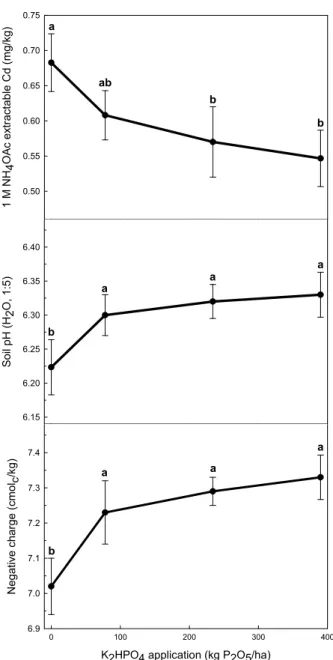
Fig. 1. Changes of 1M NH4OAc extractable Cd concentration (A), pH (H2O,1:5), and negative charge (C) of Cd contaminated paddy soil amended with different rates of K2HPO4 at harvest time (
different letters on the bar denote significant difference at p>0.05 level
).NH
4OAc pH 7.0, ICP-OES, inductively coupling plasma optical emission spectroscopy, Perkin elmer model DV 4300, Shelton, CT, USA). 유효인산의 함량은 Lancaster method를 이용하여 분석하였다. 유효태 카드뮴 의 함량은 토양:용액 비 1:5의 비로 1 M NH
4OAc로 1시간 진탕한 후 여과하여 ICP-OES로 Cd의 함량을 분석하였다.
토양의 음하전도를 측정하기 위하여 토양 5 g을 centrifuge tube에 담고 1 M NaCl 30 ml을 가하여 1 시간 동안 교반한 후 원심분리하여 상등액을 따라내고 남아 있는 토양에 ethylalcohol 20 ml을 가하여 남아있는 침출액을 3회 반복하
여 씻어냈다. ethyl alcohol을 분리시킨 후 상등액은 따라내 고 남은 토양에 1 M NH
4OAc 30 ml을 가하여 1 시간 동안 침출하였다. 침출 후 여과시켜 여과액 내의 나트륨(Na)의 함 량을 ICP-AES (Inductively Coupled Plasma Absorption Emission Spectrophotometer, GBC model X-100, Australia)로 분석하여 음하전도를 구하였다. Total Cd (카 드뮴 총 함량)은 왕수(HNO
3:HCl, 1:3)분해법에 의해 측정되 었다. 수확 후 벼 작물의 알곡을 드라이 오븐 70℃에서 72 h 동안 건조 후 분쇄하였다. 분쇄된 시료 1 g을 채취하여 ternary solution (H
2SO
4:HClO:H
2O, 5:9:1)으로 분해시킨 후 ICP-AES로 Cd의 함량을 측정하였다. 또한 중금속 농도 측정 의 신뢰도를 높이기 위해 CRM (Certificated Reference Material)인 Montena Ⅱ 토양을 분석해서 회수율 100±5
%를 확인한 후 측정하였다.
통계분석
시험 토양 내 1 M NH
4OAc 침출된 Cd 함량과 음하전 도, pH의 통계 분석 및 수확한 벼 알곡 내 Cd 함량과 벼 수 확량 데이터의 통계분석을 위해 SAS 통계프로그램 (버전 9.2)을 이용하였다. 처리간의 차이를 비교하기 위하여 조사된 자료는 ANOVA 검증을 통하여 분석하였다. F-test 결과 값 이 p<0.05의 범위에서 유의한 경우에만 최소 유의차 검정 (LSD)을 실시하였다.
결과 및 고찰
카드뮴의 용출성
논토양 현장시험에서 인산을 시용하여 벼를 재배한 후 토 양시료를 채취하여 토양 내 유효태 Cd 함량과 토양 pH, 음 하전도를 측정하였다 (Fig. 1). 인산의 시용에 따른 부동화된 Cd의 함량을 조사하기 위해 1 M NH
4OAc를 이용하여 유 효태 Cd의 함량을 침출하였다. 인산의 시용량을 증가시킴에 따라 1 M NH
4OAc를 이용하여 침출한 유효태 Cd의 함량 은 유의하게 감소하는 것으로 나타났다 (Fig. 1 (A)). 인산을 최고처리 수준인 390 kg P
2O
5/ha를 투입하였을 때 유효태 Cd의 농도는 무처리에 비해 약 28% 가량 감소하였다. 인산 의 시용에 따른 토양 pH와 음하전도의 변화를 측정한 결과, 토양의 pH와 음하전도 모두 인산을 78 kg P
2O
5/ha처리하 였을 때 유의하게 증가하다가 점차 증가 폭이 완만하게 나타 났다. (Fig. 1 (B), (C)). 인산을 최고농도인 390 kg P
2O
5/ha 를 투입하였을 때 음하전도는 무처리에 비해 0.3 cmol
c/kg 만큼 증가 하였다.
카드뮴 오염토양에 인산을 처리함에 따라 Cd 부동화 기
작은 침전반응과 흡착반응이 주된 기작인데, 인산의 시용에
의해 Cd의 흡착이 증가하는 것은 시용된 인산이 토양 교질에
특이적으로 흡착하여 증가한 음하전 자리에 Cd
2+이온이 흡
착하여 이루어지는 것으로 판단된다(Hong et al ., 2008). 또
한 pH가 5.54인 공시토양조건에서 무기태 인산은 주로
Y = 0.687 - 1.237x10⁻³X + 1.9496x10-6X2, R2=0.995***
Cd concentration in grain (mg/kg on dry base)
0.5 0.6 0.7 0.8
K2HPO4 application (kg P2O5/ha)
0 100 200 300 400
Grain yield (Mg/ha)
4.5 5.0 5.5 6.0 6.5
Y = 5.384 + 2.393x10⁻³ X -6.648x10-6X2, R2=0.983***
a
a a
a a
b
c
c
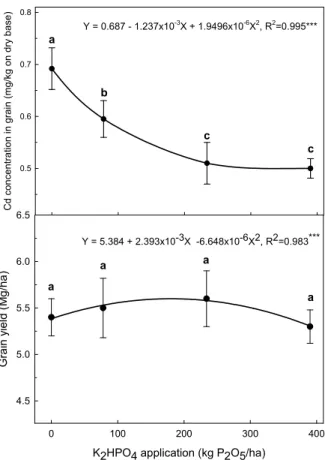
Fig. 2. Changes of Cd concentration in grain of rice plant (A), grain yield (B) of Cd contaminated paddy soil amended with different rates of K2HPO4 (
different letters on the bar denote significant difference at p>0.05 level
).H
2PO
4-형태로 존재하므로 공시토양에 K
2HPO
4를 시용하면 토양용액에서 아래와 같은 해리반응을 통해 토양의 pH를 증 가시킨다(Lee and Doolittle, 2002).
K
2HPO
4+ H
+↔ 2K
++ H
2PO
4-따라서 1 M NH
4OAc로 침출한 Cd의 농도가 감소하는 것은 인산의 특이적 흡착에 의한 음하전도의 증대 뿐만 아니 라 pH의 증가에 따른 잠시전하의 증가로 판단된다(McBride 1979; Alidoust et al ., 2015; Bolan et al ., 2003; Hong et al ., 2007, 2008; Ok et al ., 2010; Lee and Hong et al ., 2016)
본 연구에서 인산의 최대 시용량은 390 kg P
2O
5/ha로써 토양 내 시용된 인산의 농도와 공시토양의 인산 농도를 합한 전체의 인산 농도는 약 310 mg P
2O
5/kg을 넘지 않는 것으 로 계산된다. 따라서 토양 pH가 6.3이고 인의 농도가 310 mg P
2O
5/kg 이하인 토양의 Cd 부동화 기작은 Cd
3(PO
4)
2형태의 침전 보다는 흡착에 기인한 것으로 판단된다. 이러한 판단은 다음의 두 가지 이유에 의해 설명된다. 첫 번째 이유 로 최소 토양의 pH가 8.0 이상의 조건에서 CdCO
3와 Cd
3(PO
4)
2형태로 침전이 가능하고(Naidu et al ., 1994), 두
번째 이유로는 Kim 등(2015)에 따르면 토양 내 Cd 농도가 5 mg/kg일 때, 인산의 처리를 16,000 mg P/kg까지 처리 한 다 하더라도 CdCO
3와 Cd
3(PO
4)
2에 의한 침전반응이 일어 나지 않았다고 보고하였다. 따라서 1 M NH
4OAc로 침출 가 능한 Cd 함량의 감소는 Cd의 침전반응 보다는 Cd의 흡착에 의해 기인되었을 가능성이 크다(Alidoust et al ., 2015;
Bolan et al ., 2003; Hong et al ., 2010, 2008; Ok et al ., 2010).
벼의 카드뮴 흡수특성 및 수량
카드뮴으로 인한 작물의 가시적인 독성발현은 보고된바에 의하면 28 mg/kg 이상의 Cd 농도에 의해서 유발된다 (John et al ., 1972, Khan and Frankland, 1983, McLaughlin and Singh, 1999). 본 연구팀에서 이전에 실시한 연구들에서 약 5.56 mg/kg의 Cd을 함유한 토양에서 알타리무를 재배한 연구에서 알타리무의 가시적인 독성발현은 나타나지 않았다 (Hong et al ., 2007, 2008). 본 연구에서 또한 벼의 재배기간 동안 가시적인 독성현상을 발견할 수 없었다. 인산의 시용량 에 따른 벼 알곡의 Cd 농도를 확인 해 본 결과, 무처리에서 는 0.69 mg/kg, 78 kg P
2O
5/ha에서는 0.59 mg/kg, 234 와 390 kg P
2O
5/ha 처리구에서는 각각 0.51 mg/kg과 0.50 mg/kg으로 나타났다. 인산의 시용량을 증가시킴에 따라 234 kg P
2O
5/ha 까지는 벼의 알곡 내 Cd의 흡수 농도는 유 의적으로 감소하였다.(Fig. 2 (A)). 인산의 시용량에 따라 식 물체 내 Cd 농도가 감소하는 결과는 밭 토양 조건에서 실험 한 일부 연구결과와 같은 경향을 보이며 시험 작물인 알타리 무, 옥수수, 다홍채 내 Cd 농도가 인산의 시용에 따라 감소된 다고 보고되었다(Hong et al ., 2010; Chen et al ., 2007). 인 산의 처리량에 따른 통계적으로 유의한 차이는 없었지만 벼 알곡의 수량은 234 kg P
2O
5/ha까지는 증가하는 경향을 나 타냈다(Fig. 2 (B)). 벼 알곡 수량의 회귀곡선식에 따르면 벼 알곡의 최대수량은 5.6 Mg/ha으로 인산을 180 kg P
2O
5/ ha 만큼 시용했을 때이었다. 또한 인산을 180 kg P
2O
5/ha 으로 시용했을 때 벼 알곡 내 Cd의 함량은 무처리에 비해 약 29% 저감되는 효과를 나타냈다.
따라서 본 현장실험의 결과를 바탕으로, Cd으로 오염된 논 토양에서 벼 재배 시 인산비료를 추천시비량인 45 kg P
2O
5/ha 보다 4 배 높은 180 kg P
2O
5/ha를 시용하면 작물 의 생산성을 유지하면서 벼 알곡의 Cd 흡수량을 저감할 수 있을 것으로 판단된다.
결 론
인산의 시용량에 따라 식물이 이용가능한 Cd의 농도와
벼 알곡 내 Cd의 농도가 감소하는 결과를 나타냈다. 또한 인
산의 시용량이 증가함에 따라 토양 pH와 음하전도는 증가하
는 것으로 나타났고 그로 인해 용출성 Cd이 감소하는 것으로
판단된다. 또한 토양 pH가 모든 처리구에서 6.7이하의 조건
에서 인산에 의한 Cd의 부동화는 Cd 화합물의 침전반응보
다는 주로 흡착반응에 의해 이루어진다고 판단된다. 인산의 시용을 권장량(약 40 kg/ha) 보다 약 4.5배를 시용할 경우 식물이 이용 가능한 Cd 농도를 줄이면서 벼 생산성을 극대화 할 수 있다고 판단된다.
Acknowledgement
This study was carried out with the support of
“Research Program for Agricultural Science &
Technology Development (Project No. PJ01082704)”, National Academy of Agricultural Science, Rural Development Administration, Republic of Korea.
References