Evaluation of Erosivity Index (EI) in Calculation of R Factor for the RUSLE
Hye-Jin Kim, Jin-A Song, Youjin Lim, and Doug-Young Chung*
Dept. of Bio-Environmental Chemistry, College of Agriculture and Life Sciences, Chungnam National University. Daejeon 305-764, Korea
The Revised Universal Soil Loss Equation (RUSLE) is a revision of the Universal Soil Loss Equation (USLE).
However, changes for each factor of the USLE have been made in RUSLE which can be used to compute soil loss on areas only where significant overland flow occurs. RUSLE which requires standardized methods to satisfy new data requirements estimates soil movement at a particular site by utilizing the same factorial approach employed by the USLE. The rainfall erosivity in the RUSLE expressed through the R-factor to quantify the effect of raindrop impact and to reflect the amount and rate of runoff likely is associated with the rain. Calculating the R-factor value in the RUSLE equation to predict the related soil loss may be possible to analyse the variability of rainfall erosivity with long time-series of concerned rainfall data. However, daily time step models cannot return proper estimates when run on other specific rainfall patters such as storm and daily cumulative precipitation. Therefore, it is desirable that cross-checking is carried out amongst different time-aggregations typical rainfall event may cause error in estimating the potential soil loss in definite conditions.
Key words: Soil loss, RUSLE, R factor, Erosivity index, Rainfall intensity
Received : January 20. 2012 Accepted : February 9. 2012
*Corresponding author : Phone: +82428216739 E-mail: [email protected]
Introduction
Soil loss by water is regarded as one of the crucial environmental problems. Eroded soils which can include various materials such as nutrients, pesticides, and other harmful chemicals can be transported into rivers, streams, and ground water resources (Gallaher and Hawf, 1997). The most general impairment of surface water is eutrophication caused by excessive inputs of phosphorus and nitrogen, which affects on the aquatic ecosystems (Carpenter et al., 1998). Research on soil erosion and its effect from the viewpoint on agricultural productivity started in the United States in 1930s.
Since then research scientists began to develop a quantitative procedure for estimating soil loss using soil loss equation including several primary factors such as slope and practice in the United States, because it was recognized that a soil loss equation could have a great value for farm planning (http://www.iwr.msu.
edu/rusle).
The USLE has been widely used to predict rainfall
erosion losses resulting from various crop and mana- gement practices (Wischmeier and Smith, 1965, 1978).
RUSLE has the same formula as USLE, but has several improvements in determining factors adopting a time-varying approach for soil erodibility factor and a new equation to reflect slope length and steepness (Renard and Ferreira, 1993; Renard et al., 1997;
Wischmeier and Smith, 1965, 1978).
Importance of Rainfall erosivity used as an input
parameter not only for modeling soil erosion but also
for sediment yield and water quality modeling has
been grown. Thus, the accurate estimation of rainfall
erosivity may contribute to better modeling results
(Renard et al., 1997). The rainfall and runoff factor
(R) of USLE, which was developed initially as a tool
to estimate soil loss on specific slopes in specific
fields to estimate the possible cropping intensity for
alternative conservation measures for given cropping
and management practices while meeting the needs
and wishes of the farmer in farm planning, was derived
from research data from many sources (Wischmeier
1959, Wischmeier and Smith 1958). The results represent
that soil losses from cultivated fields are directly
proportional to a rainstorm parameter when factors
other than rainfall are held constant. That is, R can be interpreted as the total storm energy (E) times the maximum 30-min intensity (I
30).
Unceasing rainfall data is required to calculate R factor although the spatial and temporal coverage of pluviograph data are generally limited (Yu and Rosewell, 1998). For this reason, many methods for predicting R factor have been developed by applying daily, monthly, annual rainfall data (Amoldus, 1980; Ferro et al., 1991; Renard and Freidmund, 1994; Zhang et al., 2008). The objective of this study is to review existing methodologies for predicting rainfall erosivity, and to compare estimates obtained using these metho- dologies with R factor values calculated by the RUSLE procedure.
Nonpoint source pollution and soil erosion Nonpoint source (NPS) pollution, unlike pollution from industrial and sewage treatment plants, comes from many diffuse sources. NPS pollution is caused by rainfall or snowmelt moving over and through the ground. The runoff picks up and carries away natural and human-made pollutants as it moves and finally arrives to deposit them into lakes and rivers (http://www.epa.gov/owow_keep/NPS/
index.html).
In areas with intensive rainfall, agricultural land tends to be non-point source pollutants which enter the water when soil particles are conveyed into the water system, such as lake, river. Nonpoint source pollution usually occurs when rainfall and runoff move over the ground, conveying pollutants with soil particles.
Therefore, nonpoint source pollution from agriculture tends to be determined by the amount of rainfall and its intensity.
Soil erosion The loss of soil from land surfaces by erosion is widespread and adversely affects the productivity of all natural ecosystems as well as agricultural, forest, and rangeland ecosystems (Lal and Stewart, 1990; Pimentel, 1993; Pimentel et al., 1995;
Pimentel and Kounang, 1998). Soil erosion results when soil is exposed to the erosive powers of rainfall energy and flowing water (Barfield,et al. 1983). Rain along with the shearing force of flowing water acts to detach soil particles, while runoff transports the soil particles downslope.
The processes of soil erosion by rain reaching the
ground are closely related to the pathways taken by rain in its movement through the vegetation cover and over the ground surface. The rain reaching the ground may be stored in small depressions or hollows on the surface or it may infiltrate the soil, to lateral movement downslope within the soil as subsurface or interflow or, by percolating deeper, to groundwater. When the soil is unable to take in more water rain reaching the ground, the excess contributes to runoff on the surface, resulting in erosion by overland flow or by rills and gullies.
RUSLE The soil loss as an average erosion rate computed by RUSLE is the amount of sediment lost from a landscape profile which is defined by a slope length, which is the length from the origin of overland flow to the point where the flow reaches a major flow concentration or a major area of deposition. Erosion estimated by soil movement at a particular site can vary widely even on a uniform slope due to slope position and configuration of the slope profile (Jung et al., 2004; Kim et al., 2010).
Estimation of soil loss by the model must be undertaken before implementing the best management practice because it was difficult to measure soil loss directly.
Therefore the USLE has been the most widely accepted and utilized soil loss equation for ove 40 years (Wischmeier and Smith, 1965 and 1978; Laflan and Moldenhauer, 2003).
Wishmeier (1976) also explained that the USLE was designed to guide the selection of conservation practices for specific sites, However, the equation is not recommended for geographic regions where its factors cannot be accurately evaluated, for computing soil erosion from specific rainfall events. RUSLE that utilizes the same basic equation as of USLE has been known to be scientifically superior to the USLE. The RUSLE relates the rate of erosion per unit area (A) to the erosive power of the rain (R), the soil erodibility (K), the land slope and length (LS), the degree of soil cover (C), and conservation practices (P) (Renard et al., 1997).
A = R × K × LS × C × P (1)
USLE erosivity calculations in the western U.S. were
based on the use of a very few weather stations to
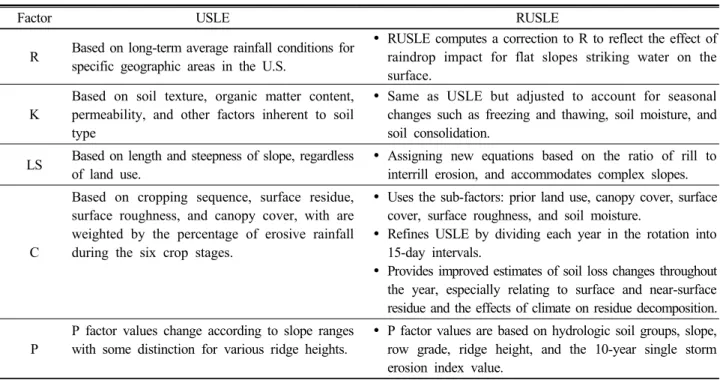
Table 1. The differences between RUSLE and USLE.
Factor USLE RUSLE
R Based on long-term average rainfall conditions for specific geographic areas in the U.S.
y RUSLE computes a correction to R to reflect the effect of raindrop impact for flat slopes striking water on the surface.
K
Based on soil texture, organic matter content, permeability, and other factors inherent to soil type
y Same as USLE but adjusted to account for seasonal changes such as freezing and thawing, soil moisture, and soil consolidation.
LS Based on length and steepness of slope, regardless of land use.
y Assigning new equations based on the ratio of rill to interrill erosion, and accommodates complex slopes.
C
Based on cropping sequence, surface residue, surface roughness, and canopy cover, with are weighted by the percentage of erosive rainfall during the six crop stages.
y Uses the sub-factors: prior land use, canopy cover, surface cover, surface roughness, and soil moisture.
y Refines USLE by dividing each year in the rotation into 15-day intervals.
y Provides improved estimates of soil loss changes throughout the year, especially relating to surface and near-surface residue and the effects of climate on residue decomposition.
P
P factor values change according to slope ranges with some distinction for various ridge heights.
y P factor values are based on hydrologic soil groups, slope, row grade, ridge height, and the 10-year single storm erosion index value.
develop a relationship between the R factor and the 2-yr frequency 6-hr duration rainfall event. In contrast, erosivity values in RUSLE are based on analysis of data from over 1,000 weather stations (Wischmeier and Smith, 1978). There are many changes for estimating erosion by water in RUSLE. The differences between RUSLE and USLE are represented in Table 1.
Rainfall-runoff factor (R-factor) To estimate the soil loss or soil erodibility at particular site, the numerical value of a rainfall and runoff factor (R-factor) derived from research data from many sources on precipitation by keeping the factors other than rainfall constant, is needed (Wischmeier and Smith, 1958). Originally, the USLE was used with an annual R value to predict annual erosion yields. R, the rainfall-runoff erosivity factor as an indication of the two most important characteristics of a storm determining its erosivity over and extended period, is the average annual summation EI values in a normal year’s rain although it has a number of limitations and requires adaptation for different climatic regions (http://www.iwr.msu.edu/rusle/
contact.htm). The soil loss from a cultivated field is directly proportionate to the following characteristics of a storm: the product of total kinetic energy of rainfall (E) and its peak 30-minute intensity (I
30).
The R-factor is measured as the product (EI
30) of total storm energy (E) and the maximum 30-min
intensity (I
30) for all storms over a long time (Brown and Foster, 1987; Renard and Freidmund, 1994; Wischmeier and Smith, 1978; Istok et al., 1986; Williams and Sheridan, 1991). However, storms less than 0.5 inches are not included in the erosivity computations because these storms generally add little to the total R value (Janeček et al., 2006). The R factor is defined as (Renard et al., 1997):
R n
j n
k m
EI
k
j
where E is the total storm kinetic energy (MJ ha
-1), I
30is the maximum 30 min rainfall intensity (mm hr
-1), j is an index of the number of years used to produce the average, k is an index of the number of storms in each year, n is the number of years used to obtain the average R, and m is the number of storms in each year (Renard et al., 1997). An event’s rainfall erosivity EI
30is calculated as follows:
where e
rand v
rare, the unit rainfall energy and the
rainfall volume during a time period r, and I
30is the
maximum rainfall intensity in a 30 min period during
the event.
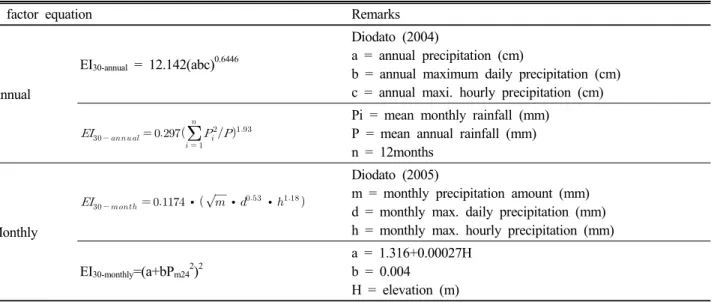
Table 2. Typical empirical rainfall factor equations developed in different areas of the world for calculating E.
R factor equation Remarks
R = E × I30/100 E =
E
i= (206 + 87 log Isi) × Hsi
E : total kinetic energy of rainfall (J/m²)
E
i: kinetic energy of the i-th segment of rainfall (n : number of rainfall segments)
I
30: peak 30-min. intensity of rainfall (cm h
-1) Isi : intensity of the i-th segment of rainfall (cm h
-1) Hsi : rainfall amount in the i-th segment (cm)
R n
j
n
k
m EIk
j