Possibility of Natural Hybridization between Red Seabream (Pagrus major) and Blackhead Seabream (Acanthopagrus schlegeli)
Jung-Ha Kang
1, Sang-Geun Yang
2, Eun-Mi Kim
1, Eun-Soo Noh
1, Dong-Gyun Kim
1, Bong-Seok Kim
2and Tae-Jin Choi
3*
1Biotechnology research division, NFRDI, Busan 619-705, Korea
2Future aquaculture research center, NFRDI, Jeju 699-804, Korea
3Department of Microbiology, Pukyong National University, Busan 608-737, Korea Received October 20, 2014 /Revised January 7, 2015 /Accepted January 9, 2015
During the storage of these two species in a large conservation tank, fertilized eggs were collected and the offspring were raised. During culturing of the offspring, individuals with mixed character- istics of these two species were observed, and 96 individuals were randomly tested using micro- satellite markers applicable to both species. Among the 96 individuals, 15 individuals with mixed morphological characteristics were confirmed to be hybrids showing both of genotypes red seabream and blackhead seabream. Additionally, based on sequence analysis of mitochondrial cytochrome oxi- dase subunit 1 (mtDNA CO1), 81 showed 99% nucleotide sequence identity to that of black sea bream, and the remaining 15 individuals showed over 99% sequence identity to that of red seabream. So, hy- brids were produced by female red seabream and male blackhead seabream. These results suggest that hybrids may form in nature between these two species if their habitats overlap due to the influ- ence of humans or global climate change.
Key words :
Habitats overlap, hybrid, microsatellite, seabream
*Corresponding author
*Tel : +82-51-720-2462, Fax : +82-51-720-2456
*E-mail : [email protected]
This is an Open-Access article distributed under the terms of the Creative Commons Attribution Non-Commercial License (http://creativecommons.org/licenses/by-nc/3.0) which permits unrestricted non-commercial use, distribution, and reproduction in any medium, provided the original work is properly cited.
Journal of Life Science 2015 Vol. 25. No. 1. 16~20 DOI : http://dx.doi.org/10.5352/JLS.2015.25.1.16
Introduction
In undisturbed ecosystems, reproductive isolation is pri- marily maintained by spatial and temporal barriers [10].
However, such barriers to interbreeding may be lost because of habitat disturbance and introduction of non-native spe- cies, which can be exacerbated by habitat modification, translocation of fish species, and global climate change [1].
In addition to hybridization in natural ecosystems (usually between native and nonnative taxa), artificially induced hy- bridization has been used to improve aquaculture pro- ductivity through heterosis in fish [2, 6, 12, 15]. Hybridiza- tion is more common in fish than in any other vertebrate because of their external fertilization and similar mating be- haviors [9]. Long-term hybridization, especially in cases leading to genomic introgression, may result in speciation, and thereby contribute to diversity within taxa [4]. However,
hybridization can also be destructive, because it can lead to
sterile or nonviable progenies, loss of unique genetic diver-
sity, breakdown of adaptive multi-gene complexes, and the
collapse of such substructures [4]. Since the late 1960s, there
have been increasing reports of hybridization between di-
verse animals, including fish species [5]. Although the ma-
jority of hybridization is due to the introduction of non-na-
tive species, hybridization between sympatric species has al-
so been reported [3, 13, 16]. In contrast to hybridization be-
tween sympatric freshwater fish species, less is known re-
garding the hybridization between sympatric marine fish
species [14]. In this study, we analyzed offspring in a stock-
ing tank containing a mixture of male and female red seab-
ream (Pagrus major) and blackhead seabream (Acanthopagrus
schlegeli). These two species inhabit Korean and Japanese wa-ters to the South China Sea, and are very important aquatic
species for recreational fishing (A. schlegeli) and commercial
aquaculture (P. major). Hybrids for higher productivity have
been developed and cultured using artificial fertilization of
eggs from P. major and sperm from A. schlegeli [7]. However,
hybridization between these two species has not been per-
formed using artificial fertilization, and to the best of our
knowledge, this is the first evidence of natural hybridization
between these two species.
A B
C
Fig. 1. Morphological characteristics of parental seabream species and their hybrid offspring. The hybrid offspring (A) have the forehead, the lateral line, and dorsal pins with 12 spines that resemble the maternal red seabream (B), but have faint vertical lines and ‘V’ form tail fin shape similar to the paternal blackhead seabream (C).
Materials and Methods
Sample collection and DNA extraction
The red (n=23) and black (n=12) seabream broodstock were collected from the wild, and maintained for stock pres- ervation in a tank of 100 metric tons with approximately 100 other fish of about 10 species at the Jeju Hatchery Center, National Fisheries Research & Development Institute in Korea. The floating eggs fertilized by natural mating were collected using a net of nylon mesh during April, which is the middle of the seabream spawning season. The hatched larvae were cultured using running water culturing methods before analysis. A total of 96 progeny (6 months of age and average weight of 8.5 g) and all individuals of the two paren- tal species were analyzed for genetic inheritance. Small pieces of fin tissue were cut from individuals and preserved in 100% ethanol. Total DNA was isolated from each sample using a MagExtractor MFX-6100 automated DNA extraction system (Toyobo, Japan). The extracted genomic DNA was quantified using a NanoDrop ND-1000 spectrophotometer (Thermo Fisher Scientific, Waltham, MA, USA) and stored at -20°C until microsatellite genotyping analysis.
PCR amplification and genotyping
The 20 microsatellite markers developed for blackhead seabream by Kim et al. [8] were first tested for cross species transferability to red seabream, and 9 of them showing trans- ferability were used for analysis. For multiplex PCR, the 5′
-end of each forward primer was labeled with one of three fluorescent dyes; namely, 6-FAM and HEX (Applied Biosys- tems, Foster City, CA, USA). PCR for amplification of micro- satellite loci was performed in a 10 μl reaction volume con- taining 1× ExTaq buffer, 10-50 ng template DNA, 0.2 mM dNTPs, 0.5 μM of each primer, and 0.25 U TaqDNA polymer- ase (Takara, Shiga, Japan) using an RTC 200 thermocycler
(MJ Research, Waltham, MA, USA) . The PCR conditions were as follows: initial denaturation at 95℃ for 11 min, fol- lowed by 35 cycles of denaturation at 94℃ for 1 min, anneal- ing at optimal temperature for each primer set for 1 min, extension at 72℃ for 1 min, and a final extension at 72℃
for 5 min. A 1 μl aliquot of PCR product was mixed with a genotyping reaction mixture containing formamide and a size standard using GeneScan400HD ROX (Applied Biosys- tems), and was electrophoresed with an ABI3130 DNA se- quencer (Applied Biosystems). The fragment lengths of the PCR products were determined using GeneMapper software ver. 4.0 (Applied Biosystems).
Results and Discussion
Offspring production
Based on sequence analysis of mitochondrial cytochrome oxidase subunit 1 (mtDNA CO1), 81 out of 96 randomly se- lected individuals showed 99% nucleotide sequence identity to that of black sea bream (HQ846832.1), and the remaining 15 individuals showed over 99% sequence identity to that of red seabream (JF952802.1). In addition, these 15 in- dividuals showed specific morphological characteristics of both species; they had more round heads with bulging on the forehead, which is a characteristic of the red seabream.
The dorsal fin of the red seabream is composed of 12 spines, with the posterior formed of 10 soft rays in contrast to the blackhead seabream that has 11 spines and soft rays. The suspected hybrid had dorsal pins with 12 spines and 10 soft rays. However, these individuals showed faint residual ver- tical lines that can be seen on blackhead seabream (Fig. 1).
Hybrids have been produced using artificial insemination
between female red seabream and male blackhead seabream
[7]. Therefore, these 15 individuals were assumed to be natu-
ral hybrids between red seabream dam and blackhead seab-
Fig. 2. Genotyping of parental seabream species and their hybrid offspring using microsatellite marker AS392. The paternal red seabream and the maternal blackhead seabream shows a peak of 90 bp and 130 bp, respectively and their hybrid shows the peaks of both parents.
ream sire, and further genotyping was performed.
Molecular identification of hybrids
Among the nine markers that showed amplification both in blackhead seabream and red seabream [8], microsatellite marker AS392 (GenBank accession number GU121420) showed clear differences in the size of amplified products used for hybrid identification. This marker has a sequence composition of (AC)
13AT(AC)
4, and produced polymorphic PCR products ranging from 109-135 base pairs (bp) in black- head seabream. The cross species transferability of this marker to red seabream was confirmed later, and produced polymorphic PCR products of 90 bp in red seabream (unpublished data). The typical amplification patterns of the parent and offspring are shown in Fig. 2. The parental red seabream and blackhead seabream showed a peak of 90 and
130 bp, respectively. The 81 individuals identified as black- head seabream showed a peak of 130 bp corresponding to their parent. However, the suspected hybrid showed peaks at both positions. Therefore, the morphological and molec- ular characterization confirmed that these 15 individuals are hybrids between female red seabream and male blackhead seabream.
Hybrids between red and blackhead seabream have been
generated to incorporate the high growth rates of red seab-
ream and resistance to environmental stress of blackhead
seabream, and the resulting hybrid showed mixed character-
istics [7]. However, these hybridizations have been con-
ducted using artificial insemination of eggs from red seab-
ream and sperm of blackhead seabream; this is the first re-
port on the identification of these two species using a meth-
od other than artificial insemination. Although hybrids have
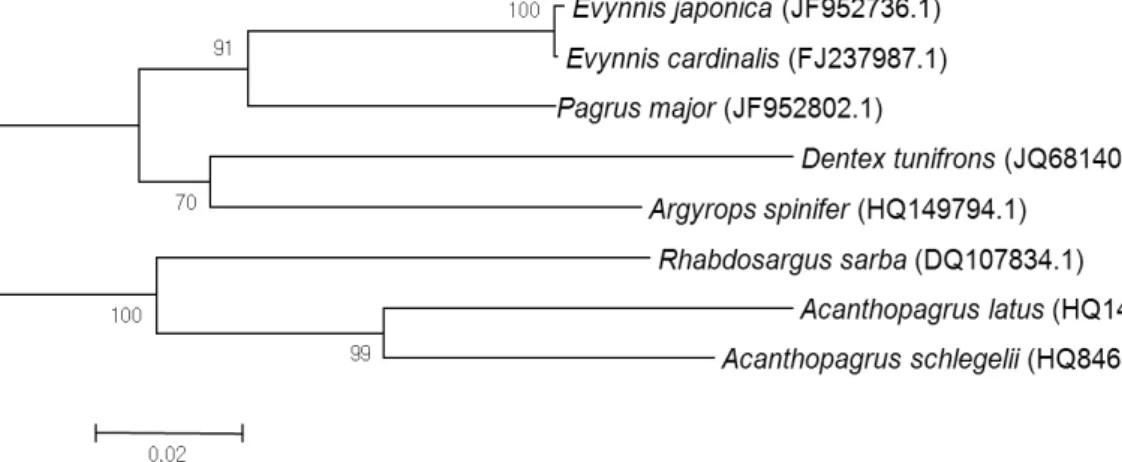
Fig. 3. Neighbor-joining tree of the Sparidae inhabiting the Korean Peninsula based on the CO1 gene sequence. The numbers near the nodes represent bootstrap support.
not been identified under completely natural conditions, there was sufficient space and interaction with other fish species in this report.
Despite our observations, the possibility of hybridization is very low for several reasons. First, the habitats of these two species are different. Red seabream inhabit rocky deep sea areas ranging from 10-200 m, while blackhead seabream lives in sandy areas rich in seaweeds near the shore of 5-50 m. Red seabream tends to be a shoal fish, although the size of the shoals decreases with age. In contrast, mature black- head seabream lives in solitary. Therefore, the chance for these two fish to inhabit a common area is low. However, local changes in the habitats by destruction or global climate change can result in the co-inhabitation of these two species in a common area. Firstly, write result and then discussion.
The other reason for the low chance of hybridization is their genetic distance. As shown in Fig. 3, these two species are genetically separated. Seabream with a red color includ- ing P. major, Dentex tumifrons, and Evynnis japonica have 12 spines in their dorsal fin. In contrast, black-colored seab- ream such as A. schelegeli and Rhabdosargus sarba have 11 spines. One interesting feature in our analysis is that we did not observe any red seabream offspring. There can be several reasons for this observation. In the analysis, the ratio of hybrid was very low (16%) and the majority of offspring were blackhead seabream. This indicated that only a few female red seabream were involved in spawning. The spawning of red seabream is affected by water temperature and salinity, and the optimal conditions were a water tem- perature of 15°C to 22°C and salinities from 18% to 36%
[11]. The optimal temperature for blackhead seabream spawning is 20°C, but details of other conditions are not
available.This sentence needed more detail expression..
However, it is suspected that the water conditions were con- ducive to the spawning of blackhead seabream, and most of the eggs originated from blackhead seabream. The other reason for the absence of red seabream could be the mating style and characteristics of the fish species. Red seabream is monogamous, and blackhead seabream is more aggressive and compete for the female of interest. If only a few red seabreams were involved in the spawning, less aggressive red seabream males could be excluded from the fertilization.
This could be examined using parental analysis of all off- spring; however, this is complicated because of the complex mating partnerships that occur.
Acknowledgment
This work was supported by grants from the National Fisheries Research and Development Institute (NFRDI) in Korea.
References
1. Allendorf, F. W., Leary, R. E., Spruell, P. and Wenburg, J.
K. 2001. The problems with hybrids: setting conservation guidelines. Trends Ecol. Evol. 16, 613-622.
2. Bartley, D. M., Ran, K. and Immink, A. J. 2001. The use of interspecific hybrids in aquaculture and fisheries. Rev.
Fish Biol. Fish. 10, 325-337.
3. Campton, D. E. and Utter, F. M. 1985. Natural hybridization between steelhead trout (Salmo gairdneri) and coastal cut- throat trout (Salmo clarki clarki) in two Puget Sound streams.
Can. J. Fish. Aquat. Sci. 42, 110-119.
4. Epifanio, J. and Nielsen, J. 2001. The role of hybridization in the distribution, conservation and management of aquatic
초록:참돔( Pagrus major )과 감성돔( Acanthopagrus schlegeli ) 종간 자연 잡종 가능성
강정하
1․양상근
2․김은미
1․노은수
1․김동균
1․김봉석
2․최태진
3*
(
1국립수산과학원 생명공학과,
2국립수산과학원 미래양식연구센터,
3부경대학교 미생물학과)
참돔과 감성돔은 우리나라 주변에 서식하는 고유 어종으로, 참돔의 암컷과 감성돔의 수컷을 이용한 인공수정에 의하여 잡종은 생산되었으나, 자연 상태에서는 이들 간의 잡종이 보고된 바 없다. 이들 두 어종의 암수 및 타 어종 을 섞어서 대형 수조에서 사육하는 과정에서 생산된 수정란을 회수하여 부화시켜 육성하는 과정에서 이들 두 종 간의 잡종의 형태를 보이는 개체들이 관찰되었다. 임의로 96개체를 선택하여 두 종에 모두 적용할 수 있는 micro- satellite marker를 이용하여 유전학적 분석을 실시한 결과 96개체 중 두 종의 혼합된 형태적 특징을 보이는 15개 체는 참돔 암컷과 감성돔 수컷 간의 잡종으로 판명되었으며, 나머지 81개체는 감성돔 치어로 확인되었다. 사육 수조의 크기가 매우 컸으며 다른 어류들도 함께 들어 있었다는 점과, 이와 같이 유전적으로 구분되는 두 종 간의 잡종이 자연상태와 유사한 환경에서 생산되었다는 점을 고려할 때 본 연구의 결과는 자연 상태에서도 인위적인 영향이나 기후 변화에 의하여 이들의 서식지가 중복될 경우 두 종간의 잡종이 생산될 가능성이 있다는 것을 시사 한다.
species. Rev. Fish Biol. Fish. 10, 245-251.
5. Hatfield, T. and Schluter, D. 1999. Ecological speciation in sticklebacks: Environment dependent hybrid fitness. Evol- ution 53, 866-873.
6. Ihssen, P. E., Casselman, J. M., Martin, G. W. and Philips, R. B. 1988. Biochemical genetics differentiation of lake trout (Salvelinus namaycush) stocks of the Great Lakes region. Can.
J. Fish Aquat. Sci. 45, 1018-1029.
7. Kim, B. S., Kang, J. H., Kim, J. H., Kim, K. K., Kim, J. U., Lee, J. Y. and Park, I. S. 2006. Production of hybrids between female red seabream and male black seabream in Korea.
Kor. J. Genet. 27, 133-140.
8. Kim, W. J., Kim, K. K., Kim, Y. K., Shin, E. H. and Kim, S. G. 2010. Isolation and characterization of 20 polymorphic microsatellite loci in the black seabream, Acanthopagrus schlegeli. Mol. Ecol. Resour. 10, 404-408.
9. Leary, R. F., Allendorf, F. W. and Sage, G. K. 1995. Hybrid- ization and introgression between introduced and native fish. Am. Fish. Soc. Symp. 15, 91-101.
10. Mayr, E. 1970. Populations, species, and evolution: an abridgment of animal species and evolution, pp. 55-68, Beknap Press: Cambridge, MA, USA.
11. Mihelakakis, A. and Yoshimatsu, T. 1998. Effects of salinity
and temperature on incubation period, hatching rate and morphogenesis of red sea bream. Aquacult. Int. 6, 171-177.
12. Moav, R. 1979. Genetic improvement in aquaculture in- dustry, pp. 610-622. In: Pillay, T. V. R. and Dill, W. A. (eds), Advances in aquaculture. Fishing News Books Ltd.: London, UK.
13. Ostberg, C. O., Slatton, L. and Rodriquez, R. J. 2004. Spatial partitioning and asymmetric hybridization among sym- patric coastal steelhead (Oncorhynchus mykiss irideus), coastal cutthroat trout (O. clarki clarki) and interspecific crosses. Mol.
Ecol. 13, 2773-2788.
14. Roques, S. J., Sevigny, J. M. and Bernatchez, L. 2001.
Evidence for broadscale introgressive hybridization between two redfish (genus Sebastes) in the North-west Atlantic: a rare marine example. Mol. Ecol. 10, 149-165.
15. Wohifarth, G. W. 1993. Heterosis for growth rate in common carp. Aquaculture 113, 31-46.
16. Young, W. P., Ostberg, C. O., Keim, P. and Thorgaard, G.
H. 2001. Genetic characterization of hybridization and in- trogression between anadromous rainbow trout (Oncorhyn- chus mykiss irideus) and coastal cutthroat trout (O. clarki clar- ki). Mol. Ecol. 10, 921-930.