Introduction
Artificial hybridization as a genetic breeding technique has been used as a tool to improve aquaculture productivity through heterosis in fish (Chevassus, 1983; Park et al., 1997a, b, 2003;
Kim et al., 2005). In an attempt to obtain better phenotypes, several fish hybrids have been pro- duced in Korea, including hybrids of olive floun- der (Paralichthys olivaceus) and spotted flounder (Verasper variegates; Kim et al., 1996); rainbow trout (Oncorhynchus mykiss) and coho salmon (O.
kisutch; Park et al., 1996); rainbow trout and cherry salmon (O. masou; Park et al., 1997a); and mud loach (Misgurnus mizolepis) and cyprinid
loach (M. anguillicaudatus; Park et al., 1997b;
Park and Kim, 2000).
Red seabream (Pagrus major Temminck and Schlegel, 1843) and black seabream (Acantho- pagrus schlegelii Bleeker, 1854), which belong to the Sparidae in the Perciformes, are distributed from Korea and Japan to the East China coast.
In Korea, these fish are very popular and valu- able sport fish, and are also available as aqua- culture fish (Choi et al., 2002). Thus, both species are economically important. To gain hybrid vigor between red and black seabream for increased productivity, hybrids between female red and male black seabream have been produced (Murata et al., 1995, 1997; Kim et al., 2005; Park et al., 2006). Subsequent cytogenetic analyses of hy- brids of female red and male black seabream
Scale Characteristics of Hybrids between Female Red Seabream, Pagrus major and Male Black Seabream, Acanthopagrus schlegelii
Bong-Seok Kim, Sang Jun Lee, Hyung-Soo Kim, Jong-Hyun Kim
1, Hea Ja Baek
2, Eun-Mi Kim
3, Young Ja Kim
4and In-Seok Park
3,*
Biotechnology Research Center, National Fisheries Research and Development Institute, Busan 619-902, Korea
1Department of Aquaculture, National Fisheries Research and Development Institute, Busan 619-902, Korea
2Department of Marine Biology, Pukyong National University, Busan 608-737, Korea
3Division of Marine Environment and Bioscience, College of Ocean Science and Technology, Korea Maritime University, Busan 606-791, Korea
4Korea Busan Sea Grant College Center, Korea Maritime University, Busan 606-791, Korea
We described the scale characteristics of induced hybrids between female red seabream (Pagrus major Temminck et Schlegel) and male black seabream (Acanthopagrus schlegelii Bleeker), and of their parental species. The external scalar morphology of induced hybrids showed intermediate characters compared to those of the parental species. The mean number of primary apical grooves and lateral line scales was 10.5±±2.6 and 49.5±±0.5, respectively, in induced hybrids, which also showed intermediate meristic characters compared to those of the parental species (P⁄⁄0.01). The meristic characters used in this study may be useful parameters for the identification of genotypes of these seabream species.
Key words : black seabream, induced hybrid, red seabream, scale characteristics
*Corresponding author: [email protected]
─
─ 107 ──
have been performed (Park et al., 2004).
Several studies of the characters of hybrid fish have been conducted to compare their biological characteristics with those of the parental species, e.g., shape and number of scales and fins, num- ber of vertebrae and bones, position of the eyes, shape of the mouth, and the ratio of the weight of each organ to the body weight (Bhowmick et al., 1981; Dunham et al., 1982; Krasznai and Máráin, 1982). However, few studies have re- ported on scale morphology. The scales in the same species are almost uniform in their shape and structure, and can therefore, be used as a key characteristic for species classification. An- nuli on the surfaces of scales are also used to estimate fish age and identify populations (Gri- tsai, 2002). This study was performed to assess the suitability of scales for species identification and population differentiation in hybrids bet- ween red and black seabream.
Materials and Methods
Hybrids between female red and male black seabream were produced following the method of Kim et al. (2005). In May 2001, seabream hybri- dization was carried out at the National Fisheries Research and Development Institute (NFRDI), Korea, to obtain hybrids using ten mature fe- male (34.88±2.98 cm total length [TL], 630.35±
138.70 g body weight [BW]) and eight mature male (33.96±2.61 cm TL, 624.45±125.97 g BW) red seabream, and ten mature female (28.53±
1.51 cm TL, 424.86±57.72 g BW) and five ma- ture male (26.30±1.10 cm TL, 349.18±39.64 g BW) black seabream. We established three gro- ups, i.e., pure red, pure black, and hybrid sea- bream. Hatched larvae of the three groups were maintained at 5.0 mL L
-1dissolved oxygen (DO), 7.6~8.2 pH, 32.21~33.32‰ salinity, and 20� C water temperature.
To compare scales of the hybrids and parental species, 18 red, 23 hybrid, and 20 black seabream were sampled from each culture tank, fixed in 10% formalin, and then washed in tap water to remove the formalin from the body surface.
Scales were removed from the head, body, and tail of fish from the three groups. The scales were immersed in 0.5% KOH (Sigma, USA) to remove attached epithelial tissue and pigment to produce a clean profile of the scales; these scales were then washed with secondary distilled water
and stained for 1 h in 0.05% alizarin red S (Sig- ma, USA). To clean the surface of the scales, scales obtained from the three groups were left in glycerol (Sigma, USA), which was replaced once, for 3 days.
The scales were observed and measured under an optical microscope (Axiostar plus, Zeiss, Ger- many) and the external characteristics were pho- tographed under a stereomicroscope (Stemi DV4, Germany) using a 40×digital camera. Primary apical grooves were counted in 45 samples taken from each body part (head, body, and tail) of each fish. The numbers of lateral line scales from the anterior margin of the pectoral fin to the anterior margin of the caudal fin were also counted. Sig- nificant differences in the mean number of pri- mary apical grooves and the mean number of la- teral scales among the three groups were analyz- ed using one-way analysis of variance (ANOVA;
P⁄0.01).
Results and Discussion
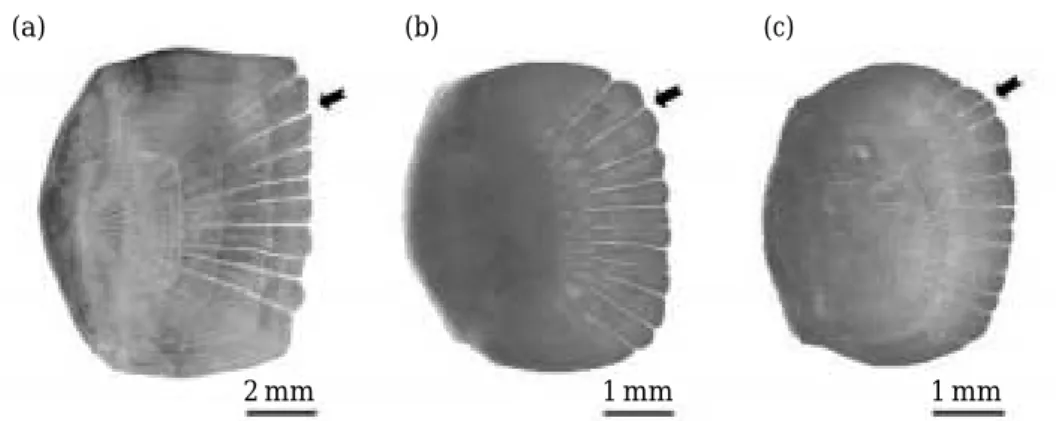
All scales of the head, body, and tail of red, black, and hybrid seabream contained pigment on the outer margin of the scale surface. All three groups had ctenoid scales with ctenii, as is common in most teleosts. The shapes of the scales were similar among the three groups, although the scales differed in size (Fig. 1). As shown in Fig. 1, the external shape of each scale was slightly round to square in red seabream and round in black seabream. The external shape of the scale in hybrids was intermediate, i.e., roundsquare, compared to those of the two parental species. Suzuki (1963) reported that in hybrids produced by crosses and back crosses of female minnows Gnathopongon elongatus elon- gatus and male G. japonicus, the external shape of the scales was more similar to that of the male parental species.
The annuli and annual rings on the scale sur- face were observed more clearly in red seabream than in black seabream and hybrids, whereas the focus was observed in all three groups. An- nuli on the scales of black seabream were found on the surface, but the foci were rarely observed.
The characteristics of the annuli and foci in the hybrids were similar to those of black seabream.
The number of primary apical grooves on the scales of red, black, and hybrid seabream was 7.6
±1.4, 11.1±3.0, and 10.5±2.6, respectively
(Table 1). The hybrids showed intermediate characteristics compared to the parental species (P⁄0.01). Our results corresponded to a report by Suzuki (1963), who showed that the number of primary apical grooves in hybrids produced via crosses and back crosses between minnows (G. elongatus elongatus and G. japonicus) was intermediate compared to that of the parental species. The number of scales along the lateral line in the hybrids was intermediate between both parental species (P⁄0.01). In our study, the number of scales arranged along the lateral line in red seabream, hybrids, and black seabream were 54.0±2.0, 49.5±0.5, and 46.5±0.5, res- pectively. This pattern, in which the number of lateral line scales in hybrids was intermediate between the parental species, has also been re- ported in grass carp (Ctenopharyngodon idella), carp (Cyprinus caprio), and their hybrids, in which the number of lateral scales was 40.5, 11.4, and 33.8, respectively (Stanley and Jones, 1976). The hybrid was closer to grass carp than carp in the number of lateral line scales (Stanley and Jones, 1976). In another study, the number of lateral line scales in striped bass (Morone
saxatilis) and white bass (M. chrysops) and their hybrids were reported to be 59.1, 52.8 and 56.5, respectively (Harrel and Dean, 1988).
The morphological and meristic characteristics of hybrids of red and black seabream were inter- mediate to those of the parental species, or were more similar to one parental species (Park et al., 2004, 2006). Hybrids between minnow and cru- cian carp, grass and big-head carp, and mud and cyprinid loach show intermediate characteristics between the two parental species for some mor- phometric traits, whereas other morphometric traits resemble only one of the parental species (P⁄0.01; Krasznai and Márián, 1982; Kasama and Kobayasi, 1991; Park, 1992).
It has generally been reported that the charac- teristics of hybrids are intermediate between those of the parental species or are sometimes more similar to those of one parental species (Susuki and Fukuda, 1973; Chevassus, 1983;
Park et al., 2004, 2006). In our study, some of the morphological, meristic, and morphometric cha- racteristics of the scales in hybrids of red and black seabream differed from those of the par- ental species. Therefore, on the basis of our re- sults, the number of primary apical grooves and the scale number of the lateral line, as well as the shape of the scales, may be used in the iden- tification of red and black seabream, and may be used to differentiate among individuals under anesthesia, without having to sacrifice the fish.
Acknowledgments
This work was funded by a grant from the National Fisheries Research and Development Institute (NFRDI), Korea, and was accomplished
Table 1. Comparision of the number of primary apical groove and number of the scale in lateral line in red seabream, black seabream, and the hybrid Genotype (n) No. of primary No. of lateral
apical groove line scale Red seabream (18) 7.6±1.4a 54.0±2.0a
Hybrid (23) 10.5±2.6ab 49.5±0.5ab
Black seabream (20) 11.1±3.0b 46.5±0.5b Values indicate Mean±SD. n==number of individual tested.
Values in different letters in each column indicate significant differences (P⁄0.01).
Fig. 1. Morphology of the scales in the red seabream (a), the hybrid (b) and black seabream (c). Arrows indicate primary apical grooves in the scale.
(a) (b) (c)
2 mm 1 mm 1 mm
in cooperation with the Marine Science Technology Institute of the Korea Maritime University sup- ported by the Korea Research Foundation (con- tribution number KRF-2004-005-F00003). The authors thank two anonymous referees for help- ful suggestions that improved the quality of this paper.
References
Bhowmick, R.M., R.K. Jana, S.D. Gupta, G.V. Kowtal and M. Rout. 1981. Studies on some aspects of biology and morphometry of the intergeneric hybrid, Catla catla× Labeo rohita produced by hypophysation. Aquaculture, 51 : 25~32.
Chevassus, B. 1983. Hybridization in fish. Aquaculture, 33 : 245~262.
Choi, Y., J.H. Kim and J.Y. Park. 2002. Marine fishes of Korea. Kyo-Hak Publishing Co., Ltd., Seoul, pp. 645.
Dunham, R.A., R.O. Smitherman, M.J. Brooks, M.
Benchakan and J.A. Chappell. 1982. Paternal predomi- nance in reciprocal channel-blue hybrid catfish. Aqua- culture, 29 : 389~396.
Gritsai, E.V. 2002. Variability of the characteristics of the first scale annulus and length of year-old fish in the Bering Sea walleye pollock Theragra chalcogramma.
Russ. Mar. Biol., 28 : 379~386.
Harrell, R.M. and J.M. Dean. 1988. Identification of juvenile hybrids of Morone based on meristics and morphometrics. Trans. Amer. Fish Soc., 117 : 529~535.
Kasama, M. and H. Kobayasi. 1991. Hybridization experi- ment between Gnathopogon elongatus elongatus♀and Carassius carassius�. Jap. J. Ichthyol., 38 : 295~300.
Kim, B.-S., J.-H. Kang, J.-H. Kim, K.-K. Kim, J.-U. Lee, J.Y. Lee and I.-S. Park. 2005. Production of the hybrids between female red seabream and male black seabream in Korea. Korean J. Genetics, 27 : 133~140.
Kim, K.-K., I.C. Bang, Y. Kim, Y.K. Nam and D.S. Kim.
1996. Early survival and chromosomes of intergenetic hybrids between Japanese flounder Paralichthys oli- vaceus and spotted halibut Verasper variegatus. Fish.
Sci., 62 : 490~491.
Krasznai, Z. and T. Márián. 1982. Crossbreeding of grass carp, Ctenopharyngodon idella and bighead carp, Aristichthys nobilis embryogenesis of interspecific hy- brid and results of its morphological analysis. Aquacul.
Hung. (Szarvas), 3 : 5~15.
Murata, O., K. Kato, Y. Ishitani, T. Nasu, S. Miyashita, S.
Yamamoto and H. Kumai. 1997. Gonadal maturation of Pagrus major×Acanthopagrus schlegelii and Pagrus major×Sparus sarba seabream hybrids. Suisanzos- hoku, 45 : 75~80.
Murata, O., S. Miyashita, T. Nasu and H. Kumai. 1995.
Growth, external morphology, and resistance to envi-
ronmental stress of hybrid red seabream, Pagrus major
×black sea bream, Acanthopagrus schlegeli. Suisanzo- shoku, 43 : 145~151.
Park, I.-S. 1992. Induced hybrid and allotrploid between Misgurnus anguillicaudatus and M. mizolepis (Teleos- tomi: Cobitidae) (in Korean with English summary).
PhD Thesis, National Fisheries University of Pusan, Busan, Korea, pp. 84.
Park, I.-S., B.-S. Kim, S.J. Lee, J.W. Hur, J.S. Yoo, Y.-C.
Song and Y.J. Kim. 2006. Comparative morphometric traits of hybrid between red sea bream (Pagrus major) and black sea bream (Acanthopagrus schlegelii). J. Fish.
Sci. Technol. 9 : 44~47.
Park, I.-S. and D.S. Kim. 2000. Comparison of some tissues in diploid and triploid hybrid between mud loach, Misgurnus mizolepis and cyprinid loach, M. anguil- licaudatus (in Korean with English summary). Dev.
Reprod., 4 : 19~28.
Park, I.-S., B.-S. Kim, J.H. Im, H.M. Park, Y.K. Nam, C.H.
Jeong and D.S. Kim. 1997b. Improved early survival in backcrosses of male mud loach (Misgurnus mizolepis)
×cyprinid loach (M. anguillicaudatus) hybrids to fe- male cyprinid loach (in Korean with English summary).
J. Aquaculture, 10 : 363~371.
Park, I.-S., B.-S. Kim, J.W. Hur, I.G. Syasina, D.S. Kim, J.H. Im and I.-S. Park. 2004. Cytogenetic analysis of an artificial red (♀) black seabream (�) hybrid. Korean J.
Genetics, 26 : 283~288.
Park, I.-S., G.-C. Choi and D.S. Kim. 1997a. Production of hybrid and allotriploid between rainbow trout, Oncor- hynchus mykissand cherry salmon, O. masou. II. Cha- racteristics of sex ratio and morphometric traits (in Korean with English summary). J. Aquaculture, 10 : 49
~54.
Park, I.-S., P.K. Kim, J.M. Kim, G.C. Choi and D.S. Kim.
1996. Production of hybrid and allotriploid between rainbow trout (Oncorhynchus mykiss) and coho salmon (O. kisutch) (in Korean with English summary). J.
Aquaculture, 9 : 133~140.
Park, I.-S., Y.K. Nam, S.E. Douglas, S.C. Johnson and D.S.
Kim. 2003. Genetic characterization, morphometrics and gonad development of induced interspecific hybrids between yellowtail flounder, Pleuronectes ferrugineus (Storer) and winter flounder, Pleuronectes americanus (Walbaum). Aquacult. Res., 34 : 389~396.
Stanley, J.G. and J.B. Jones. 1976. Morphology of androge- netic and gynogenetic grass carp, Ctenopharyngodon idella (Valenciennes). J. Fish. Biol., 9 : 523~528.
Susuki, R. and Y. Fukuda. 1973. Appearance and numer- ical characters of F1 hybrids among salmonid fishes.
Bull. Freshwater Fish Res. Lab., 23 : 5~32.
Suzuki, R. 1963. Hybridization experiments in cyprinid fishes. VI. reciprocal crosses between Gnathopogon elongatus elongatus and Gnathopogon japonicus. Jap.
J. Ichthyol., 10 : 39~42.
Received : April 24, 2006 Accepted : June 5, 2006
참돔
, Pagrus major (
♀)
과 감성돔, Acanthopagrus schlegelii (
�)
간 유도 잡종의 비늘 특성김봉석∙이상준∙김현수∙김종현1 백혜자2∙김은미3∙김영자4∙박인석3,*
국립수산과학원 생명공학연구단, 1국립수산과학원 양식개발과,
2부경대학교 자원생물학과, 3한국해양대학교 해양환경∙생명과학부,
4씨그랜트 대학사업단
참돔, Pagrus major Temminck et Schlegel (♀)과 감성돔, Acanthopagrus schlegelii Bleeker (�) 그리고 이들간 유도 잡종 개체의 비늘 특성을 조사하였다. 본 연구 결과, 유도 잡종 개체의 비늘 외형은 양친의 중간적인 특성을 나타내었다. 참돔과 감성돔의 primary apical grooves와 측선 비 늘 수의 평균은 각각 10.5±2.6과 49.5±0.5를 나타내었으며, 유도 잡종의 평균 primary apical grooves 수와 평균 측선 비늘 수 역시 양친의 중간적 계수형질의 경향을 보였다(P⁄0.01). 본 연 구에서의 계수형질은 본 연구 대상 어류인 돔류에서의 동정에 유용한 parameter로 사용될 수 있을 것이다.