INTRODUCTION
The Citrus, which is a family of Ructaaceac and Aurantioideae, but closely related to Fortunella, and Pocirus, is called “Citrus unshiu M” or “Citrus mandarin” and only the genus citrus are raised as a fruit tree. (Chung SK et al 2000). The Citrus is used as a ingredient of functional foods that has not only anti-allergic, anti-inflammatory, but also an- ti-virus and antitumor effect as well. In addition, it cleans blood vessels by reducing LDL cholesterol in the blood. It is also used as medicinal herbs because Hesperidin(ie. a flavanone glycoside found in citrus fruits) aids capillary contraction which leads to hy- pertension prevention(Shin JP et al 1999).
There are research says “Pork Sausage with Add- ed Citrus peel and Dried Lentinus edodes Powders”
(Kang YJ et al 2005), “Growth Performance, Hemato-
logical Parameter and Fatty Acid Composition of Growing Olive Flounder to Dietary Inclusion of Citrus Meal”(Seo JY et al 2010), “Effects of Feeding Diets Containiing Tangerine Pulp, Sea Tangle or Prickly Pear Cactus on Lipid Level, Intestinal Cholesterol Ab- sorption, Platelet Aggregation and Liver Tissue in Hypercholestrolemic Rats” (Kang MS 2011), “Muffin added with Tangerine Peel Powder”(OH SW 2014),
“Injeulmi Containing Different Ratios of Citrus Man- darin Powder (Kim CW 2009), “Pound Cake with Citrus Mandarin Powder” (Park YS et al 2008), “Post- Daged Doenjang (Fermented Soybean Pastes) added with Citrus Fruits, Green Tea and Cactus Powder”
(Kim JH et al 2010), “Yanggaeng added with Freeze dried Citrus Mandarin Powder” (Cha MA 2013), “Pan Bread Added with Citrus Mandarin Peel Powder”
(Lee EJ et al 2012) Sponge cake is a cake based on flour, sugar, and eggs. Combining flour that contains
Culinary Science and Hospitality Research (October 2015)Vol. 21, No. 5, pp. 88-97
Quality Characteristics of Sponge Cake added with Citrus peel Powder
Gil-Man Shin
¶¶Department of Tourism Management, Gwangju University
ABSTRACT: This study was conducted to evaluate the effect of Citrus peel powder on the quality charac-
teristics of sponge cake. Citrus peel powder sponge cake was prepared with different ration of Citrus peel powder(0, 10, 20, 30, 40%). The specific gravity, baking loss rate and cake weight increases as the ratio of Citrus peel powder. The sponge cake's a, b level increased with the increasing level of Citrus peel powder 40% appeared to be the highest. In terms of textural characteristics, the samples containing 10, 20, and 40% Citrus peel powder had significantly higher hardness than the control samples. The sub- stance's level of springiness, and cohesiveness decreased as the Citrus peel powder additive increased.
In sensory evaluation, overall acceptability and taste of the cake was better than others when 10% Citrus peel powder was added. The results indicated that substituting 10% Citrus peel powder to sponge cake is optimal for quality and provides a product with reasonable high overall acceptability.
Keywords: Citrus peel powder, sponge cakes, characteristics, sensory evaluation
¶ Corresponding Author: Gil-Man Shin, Department of Tourism Management, Gwangju University, Gwangju, 503-703, Korea, Tel:
+82-62-670-2965, Fax: +82-62-670-2864, E-mail: [email protected]
captured air and foam made of sugar and eggs is a simple process of making sponge cake. There are largely two ways to make sponge cake : hot sponge mix, cold sponge mix. Hot sponge mix is a way to make dough with foam made of a whole egg. Re- cently, adding new ingredients in sponge cake has become cake has become a trend due to an interest and demand on functional foods. Concerning that there are studies like “Rice Sponge Cakes Containing Various Levels of Jerusalem Artichoke Powder"(Suh KH 2014), “Spinach Powder" (Lee UN et al 2014),
“Sponge Cake Added with Laminaria japonia Pow- der" (Lee UN et al 2013), “Sponge Cake Containing Beaknyuncho(Opuntia ficus-indica var. saboten) Pow- der”(Lee SB 2013), “Sponge Cakes Supplemented with Cinnamon”(Lee SB 2013), "Sponge Cake with Pakchoi(Brassica compestris L. ssp. chinensis Jusl.) Pow- der"(Chung YS 2009), “Sponge Cakes with Addition of Gastrodiae rhizoma Powder” (Kang CS 2007),
“Sponge Cake Containing Varying Amounts of Per- simmon Leaf Powder”(Chio GY et al 2007), we con- clude tangerine peel powder can be also used on sponge cake products. Therefore, in this study we will make a sponge cake with tangerine peel pow- der by adding different ratio of the powder; 10, 20, 30, 40%. Then we will measure its general compo- nent, specific gravity, pH, weight, volume, loss ratio when baking, chromaticity, texture, and sensory test to decide the optimum compounding ratio of the tangerine peel powder added sponge cake.
MATERIALS
The materials used in the study were as follows : Citrus peel powder(Chinese medicine Store, Seoul, Korea), weak flour(KFMC Co., Dangjin, Korea) milled from American soft flour, eggs and sugar(Samyang, Co., Incheon, Korea), refined salt, water.
Material Mixing Ratio of Sponge Cake
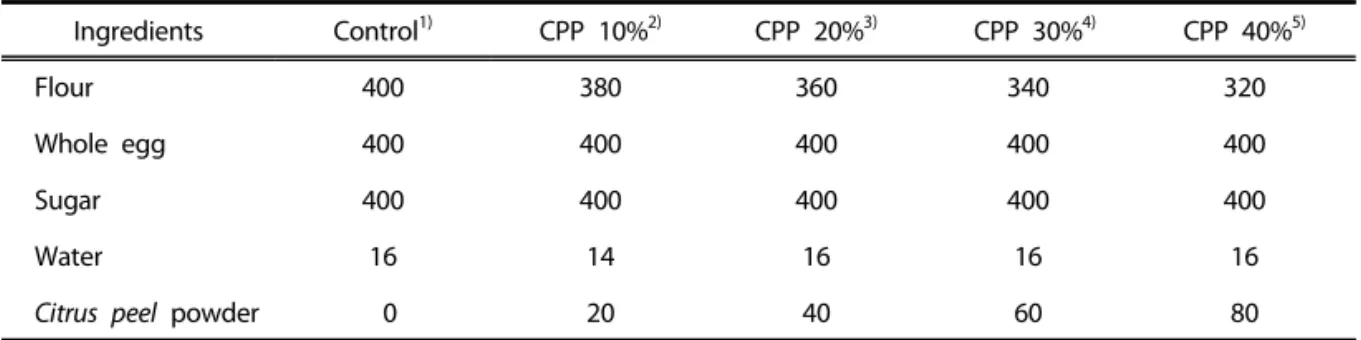
The material ratio of the sponge cake used in this experiment is as follows in Table 1. Citrus peel pow- der were added at the level of flour 0%(Control), 10%(CPP10), 20%(CPP20), 30%(CPP30), 40%(CPP40).
The material ratio of Citrus peel powder and wheat flour was set through several preliminary experi- ments. The sponge cake prepared without Citrus peel powder was designated as control group. The sponge cake with added Citrus peel powder by rate of 10, 20 30, 40% was designated as test group. The other material ratio of sponge cake except for wheat flour and Citrus peel powder were the same as in the control group.
Preparation of a Sponge Cake with the Addi- tion of Citrus peel Powder
Method of producing a sponge cake with the ad- dition of Citrus peel powder was prepared by the hot sponge method which is the most common method on the shop floor. First, the eggs, sugar and salt was put into a stainless bowl, cooked in a double boiler
Ingredients Control1) CPP 10%2) CPP 20%3) CPP 30%4) CPP 40%5)
Flour 400 380 360 340 320
Whole egg 400 400 400 400 400
Sugar 400 400 400 400 400
Water 16 14 16 16 16
Citrus peel powder 0 20 40 60 80
1) Control: Flour powder 100%.
2) CPP 10%: Citrus peel powder 10% added.
3) CPP 20%: Citrus peel powder 20% added.
4) CPP 30%: Citrus peel powder 30% added.
5) CPP 40%: Citrus peel powder 40% added.
Table 1. Standard formula for sponge cakes with Citrus peel powder(g)
Weighing. ingredients
↓
Sugar, whole egg
↓
Mixing(1 sec at speed 4 and 5 min at speed 10)
↓
Adding flour, Citrus peel powder
↓ Adding water
↓
Prepare cake paper on the pan
↓ Panning(180 g)
↓
Oven baking for 180℃, 25 min
Figure 1. Diagram for making sponge cake contain- ing Citrus peel powder.
at 45℃ and then, mixed with a Kenwoob mixer(Co., London., United Kingdom) for 30seconds at dial 1, for 5 minutes at dial 4, for 5 minutes at dial 10 in sequence. The batter crust around mixing bowl was scraped out with a rubber spatula. Then, the batter mixture were further mixed for 30 seconds at dial 1. After that, water was added to the batter mixture, mixed well to the floor. Next, 180 g of the cake bat- ter was placed into No. 1 fan. The cakes were then transferred to a lightly greased baking tray and ba- ked in an electric oven (Dae Yung Bakery, Machinery Co., Seoul) at upper temperature of 180℃ and lower temperature of 180℃ for 25 min. The baked cakes were removed from the baking pan, allowed to cool at room temperature for 1 hr before anaysis.
The Specific Gravity and pH of the Sponge Ca- ke Batter with Added Citrus peel Powder
The specific gravity of the sponge cake batter with added Citrus peel powder was calculated using the equation below according to the AACC method 10-15(11)
–
–
×
10 grams of cake batter and 45 mL of distilled water were mixed completely and the pH was mea- sured 3 times using a pH meter (ORION Co., Ltd., California, USA) as described in the (Choi et al 2000).
Measurement of Height, Weight, Dough Yield and Baking Loss
The height of sponge cake was measured from 5 different points after cutting into pieces using template according to AACC 10-15(1986). The wei- ght of sponge cake was measured with scale. The dough yield and baking loss were calculated with following equation.
×
–
×
Measurement of Volume and Specific Volume The volume of sponge cake prepared with differ- ent ration of Citrus peel powder was measured by the method of seed substitution. The Specific vol- ume was calculated with following equation.
×
Physicochemical Measurements of Sponge Cakes
The chromaticity of sponge cake ((20×20×20 mm)
was measured using a color m meter (CE-7000,
Macbeth Spectrophotometer, New York, USA) cali-
brated with a white tile(Calibration palate CR-A43,
L=95.91, a=0.00, b=2.27), and expressed as Hunter’s
L(lightness) a(redness) and b(yellowness) color va-
lues. The textural properties of cake (40×40×30 mm)
were measured using a Rheometer(Sun Scientific
Co., Ltd., Tokyo, Japan). Operating conditions were
as follows: load cell: 2 kg, adaptor type: circle(diame-
ter 20 mm), table speed: 60 mm/min.
Sensory Evaluation
A panel of 20 assessors were selected from the students in the Department of Culinary Science at Gwangju University(Jeonnam, Korea). All assessors had been trained to get a taste of samples and ac- quainted with the method and properties of evalua- tion. The assesors evaluated the appearance, color (internal and external), flavor, taste, texture, and overall acceptability(the level of preference from the customer’'s viewpoint) on a 5 point Likert scales. All samples were presented to the size of 3×3×1 cm la- beled with three-digit numbers in the white plate using a table of sampling digits. Evaluation items were color, appearance, flavor, taste, texture and overall acceptability.
Statistical Analysis
One-way analysis of variance (ANOVA) and Dun- can’'smultiple range test were performed for sig- nificant differences. The p-values less than 0.05 were considered statistically significant. One-way ANOVA, Pearson’'s correlation, and simple linear regression analyses were conducted using SPSS(SPSS 12.0 for windows, SPSS Inc., Chicago, IL, USA).
RESULT
Specific Gravity and pH
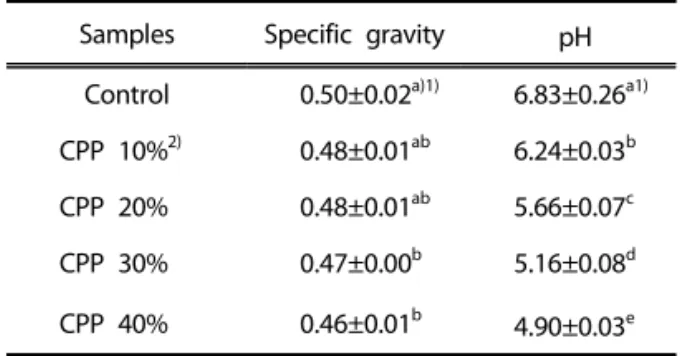
Table 2 shows the Specific gravity and pH of the sponge cake batter with added Citrus peel powder.
High specific gravity makes a compact and small vol- ume pole. In contrast, low specific gravity makes ri- gid internal injuries due to the lack of entrained air.
Specific gravity is influnced by the type of wheat flour, temperature, time and mixing conditions, mix- ing speed, existence and type of chemical leavening agent. The Specific gravity value of control group was 0.50 and gradually decreased as the added Citrus peel powder increased, ranging from 0.46 to 0.48 in 10~40% sample groups. Similar result was reported for the sponge cake with added black gar- lic(Uoo YY et al 2006), rice cupcake prepared with pine leaf powder(Kim WJ et al 2012). In terms of pH value, control group was measured to most lowest value of 6.83 and gradually increased as the added pine leaf powder increased, ranging from 4.90 to
Samples Specific gravity pH Control 0.50±0.02a)1) 6.83±0.26a1) CPP 10%2) 0.48±0.01ab 6.24±0.03b CPP 20% 0.48±0.01ab 5.66±0.07c CPP 30% 0.47±0.00b 5.16±0.08d CPP 40% 0.46±0.01b 4.90±0.03e
Table 2. Specific gravity and pH added Citrus peel powder
1) Values are mean±standard deviation(n+3).
2) Means with the same superscripts in the row are sig- nificantly different (p<0.05).
3) CPP : Citrus peel powder.
6.24 in 10~40% sample groups. Other food con- clude ingredient such as oil-and-honey-pastry(Park BH et al 2012) caused similar increase in the pH val- ue of sponge cake.
Cake Weight, Dough Yield and Baking Loss Add- ed Citrus peel Powder
The weight of sponge cake batter with different ration of Citrus peel powder(0, 10, 20, 30, 40%) be- fore/after baking, dough yield and baking loss is as follows in Table 3. There was no significant differ- ence in the weight of sponge cake batter among all samples. However, after baking, the control was measured to lowest value of 305.3 and those of 10~
Samples Cake weight(g)
Dough yield rate(%)
Baking loss rate(%) Control 305.33±1.13a)1) 132.45±0.03a 7.68±0.011)a CPP 10%2) 305.00±1.00a 133.33±0.33a 7.58±0.01b CPP 20% 306.00±0.00a 132.70±0.58ab 7.27±0.01c CPP 30% 306.67±2.08a 132.89±0.90b 7.07±0.01d CPP 40% 307.33±2.31a 132.45±0.33a 6.86±0.01e
Table 3. Cake weight, dough yield and baking loss added Citrus peel powder
1) Values are mean±standard deviation(n+3).
2) Means with the same superscripts in the row are sig- nificantly different (p<0.05).
3) CPP : Citrus peel powder.
40% samples ranged from 305.0 to 307.3. As the amount incorporated into the formulaation in- creased, the weight of sponge cake significantly de- creased(p<0.001). Similar decrease was observed for the sponge cake prepared with roasted black bean powder(Jung, 2012). The dough yield of sponge cake in control group was 131.0% and gradually in- creased as the amount incorporated into the for- mulation increased, ranging 130.1% to 131.1% in 10
~40% sample groups.
This result is considered to be due to the differ- ence between the weight of the samples. It was also reported baking loss is resulted from the dough puf- fed by the heat and water evaporation in the pores of the dough during baking process. In terms of baking loss, the control was 7.68% and tended to decrease as the pine leaf powder content increased, ranging from 6.86% to 7.58% in 10~40% sample groups. Similar result was found for sponge cake made with made with Ecklonia cava powder(Lee &
Heo, 2010), pine leaf powder sponge cake(Lee & Lee, 2013).
Cake Height, Volume and Specific Volume Add- ed Citrus peel Powder
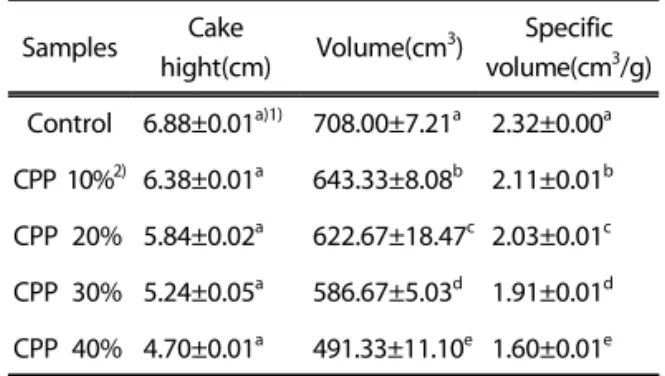
Table 4 shows cake was measured from 5 differ- ent point after cutting into pieces using template.
according to AACC(2000)10-15. The height value of sponge cake was highest for control group with 6.88 cm and tended to decreased as Citrus peel powder content increased, ranging from 4.70 cm to 6.38 cm in 10~40% sample groups. Similar result was found for sponge cake made with pakchoi powder(Chung
& Kim, 2009). Volume and specific volume added Citrus peel powder were measured with the method of seed substitution. The volume was highest for the control cake with 708.00 cm
3and those of samples ranged from 491.33 to 643.33 cm
3. As Citrus peel powder content increased, the volume tended to decreased significantly(Kim et al 2012). In terms of specific volume, the value of control cake was ob- served to 2.32 cm
3/g and those of 10~40% sample groups ranged from 1.60 cm
3/g to 2.11 cm
3/ g. This indicates that the control cake had the highest spe- cific volume, which decreased in proportion to the level of Citrus peel powder(p<0.001).
It showed same result as the volume, which is
Table 4. Cake hight, volume and specific volume added Citrus peel powder
1) Values are mean±standard deviation(n+3).
2) Means with the same superscripts in the row are sig- nificantly different (p<0.05).
3) CPP : Citrus peel powder.
considered to be due to reduced flour content de- pending on increased amount of added Citrus peel powder. A similar finding was reported for the spon- ge cake made with lotus leaf and lotus root pow- der(Kim et al 2011).
Color Evaluation
The L(lightness) value of the sponge cake incor- porated with different levels of Citrus peel powder was shown in Table 5. The L value of the control cake was observed to 46.43 and those of sample groups ranged from 29.31 to 39.17. This indicates that the control cake had the highest brightness, which decrease in proportion to the level of the
Table 5. Hunter’s color value of sponge cake added Citrus peel powder
1) Values are mean±standard deviation(n+3).
2) Means with the same superscripts in the row are sig- nificantly different (p<0.05).
3) CPP : Citrus peel powder.
Samples Cake
hight(cm) Volume(cm3) Specific volume(cm3/g) Control 6.88±0.01a)1) 708.00±7.21a 2.32±0.00a CPP 10%2) 6.38±0.01a 643.33±8.08b 2.11±0.01b CPP 20% 5.84±0.02a 622.67±18.47c 2.03±0.01c CPP 30% 5.24±0.05a 586.67±5.03d 1.91±0.01d CPP 40% 4.70±0.01a 491.33±11.10e 1.60±0.01e
Samples L a b
Control 46.43±0.01a)1) 10.62±0.06a 31.03±0.60b CPP 10%2) 39.17±0.23a 13.98±0.33b 27.51±0.66b CPP 20% 37.94±0.06b 13.59±0.33a 27.81±0.30a CPP 30% 31.85±0.00a 12.25±0.01a 21.64±0.01a CPP 40% 29.31±0.66c 8.45±0.00a 18.08±1.02c
Citrus peel powder(p<0.001). Similar decreases in L are caused by the incorporation of other food ingre- dient powders such as laver(Keeon et al 2005) and paprica(Jeong et al 2007).
Hunter a value (redness) of the control cake was 10.62 and gradually increased as the added pine leaf powder increased, resulting in the highest value of 18.45 for the cake containing 40% Citrus peel pow- der. Hunter b value(yellowness) of the control cake was the highest with 31.68 and decreased with the increasing level of the Citrus peel powder, showing the value of 27.52~18.08 in 10~40% samples(p<
0.001).
In a parallel study with red Ginseng powder, as the amount incorporated into the formulation in- creased, b value decreased significantly. These result, the significant difference of L, a, b value between control group and Citrus peel powder added groups are considered to be attributable to the own color the Citrus peel powder have itself. Formulation of the Citrus peel powder with other food such as noo- dle(Jeon et al 2005) and matrimony vine(Kim & Shin, 2005) caused similar result. As the amount incor- porated into the formulation increased, L decreased while b increased significantly. Therefore, it could be stated that The L(lightness) value of the sponge cake was affected by the incoporation of Citrus peel pow- der.
Texture Analysis
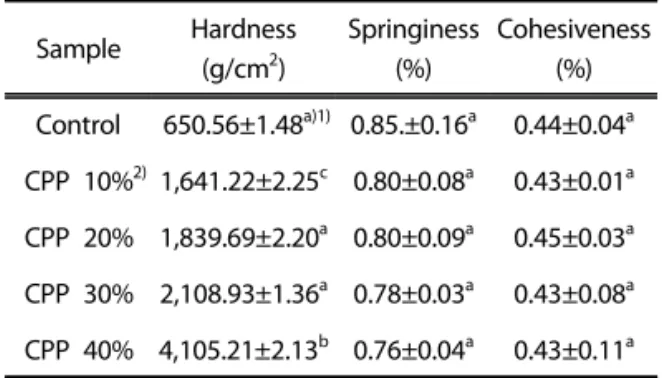
Previously reported, subsidiary ingredients affect the texture properties of sponge cake, and thus the textural characteristics of sponge cake with different ration of Citrus peel powder(0, 10, 20, 30, 40%). were determined as follows in Table 6. The hardness of the 10~40% samples group ranged 1,641.22 to 4,106.21 was significantly higher than the control measured to 650.56 (g/cm
2). In fact, the hardness value was significantly increased as the amount of Citrus peel powder incorporated in the formulation increased. The hardness of the sponge cake was af- fected by moisture content of the cake, degree of pore development and volume. It was considered to be due to added Citrus peel powder which interfered with bubble foaming, so that the batter was ob- structed to make the film of the bubble, resulting
Table 6. Texture properties of sponge cake added Citrus peel powder
Sample Hardness (g/cm2)
Springiness (%)
Cohesiveness (%) Control 650.56±1.48a)1) 0.85.±0.16a 0.44±0.04a CPP 10%2) 1,641.22±2.25c 0.80±0.08a 0.43±0.01a CPP 20% 1,839.69±2.20a 0.80±0.09a 0.45±0.03a CPP 30% 2,108.93±1.36a 0.78±0.03a 0.43±0.08a CPP 40% 4,105.21±2.13b 0.76±0.04a 0.43±0.11a
1) Values are mean± standard deviation(n+3).
2) Means with the same superscripts in the row are sig- nificantly different (p<0.05).
3) CPP : Citrus peel powder.
in the compact structure inside the cake.
Similar result was found for the sausage with add- ed Citrus peel powder(Kwon et al 2012) and sponge cake with added Cudrania tricuspidata leaf pow- der(Lee et al 2013). The springiness value was high- est for control group with 0.85 and significantly de- creased, from 0.76 to 0.80 as added the Citrus peel powder increased in the formulation. The cohesive- ness value of control group was highest with 0.44 and gradually decreased with increasing the level of Citrus peel powder, showing the value of 0.43~0.45 in 10~40% sample groups(p<0.001). The sponge cake with added pumpkin puree(Park et al 2008) and sponge cake with added artichoke powder(Suh
& Kim, 2014) also caused similar decrease in the co- hesiveness of sponge cakes.
Sensory Analysis
A 9-point hedonic scale was used to determine
which sponge cake incorporated with different le-
vels of Citrus peel powder were preferred by the ma-
jority of consumers. Table 7 shows the mean scores
of consumer sensory results on the several attributes
including appearance, taste, flavor, texture and over-
all acceptability. In terms of appearance, the control
received the most favorable mean scores of 4.07 and
10~40% sample ranged from 3.79 to 4.68 In fact,
the appearance acceptance decreased as the per-
cent of pine leaf powder incorporation increased in
the formulation.
The consumer preferences on flavor were sig- nificantly affected by the amount of Citrus peel pow- der incorporated in the sample. In the acceptability of flavor, the control received 3.8 and 10~40% sam- ple ranged 3.8 to 4.2 This result is consistent with the study of the rice cake with added pine leaf(Lee
& Han, 2002) and cookie with added pine leaf pow- der(Jung et al 2009). In terms of taste, the control received the most favorable mean scores of 4.1 and 10~40% sample received relatively low scores ran- ged 3.8 to 4.5. There were significant differences found among the samples(p<0.001). In terms of tex- ture, the control received 4.18 and 10~40% sample ranged from 3.8 to 4.5. In fact, as the amount in- corporated into the formulation increased, the tex- ture acceptance tend to decreased. Overall accept- ability was the highest in control group with 4.3 and tended to decreased, from 3.6 to 4.5, with the in- creasing level of Citrus peel powder. Similar result was found for the study on uniformity and moisture of pore(Shin 2007), the importance of the cake with suitable volume, uniform organization, soft feel(Mi- zukoshi 1983) and cookie made with matrimony vine(Park et al 2005). Therefore, The results indicated that substituting 10% Citrus peel powder to sponge cake is optimal for quality and provides a product with reasonable high overall acceptability.
RESULT AND DISCUSSION
The Specific gravity value of control group was 0.50 and gradually decreased as the added Citrus peel powder increased, ranging from 0.46 to 0.48 in
10~40% sample groups. In terms of pH value, con- trol group was measured to most lowest value of 6.83 and gradually increased as the added pine leaf powder increased, ranging from 4.90 to 6.24 in 10~
40% sample groups. After baking, the control was measured to lowest value of 305.3 and those of 10~
40% samples ranged from 305.0 to 307.3. The dough yield of sponge cake in control group was 131.0%
and gradually increased as the amount incorporated into the formulation increased, ranging 130.1% to 131.1% in 10~40% sample groups. In terms of bak- ing loss, the control was 7.68% and tended to de- crease as the Citrus peel powder content increased, ranging from 6.86% to 7.58% in 10~40% sample groups. The height value of sponge cake was high- est for control group with 6.88 cm and tended to decreased as Citrus peel powder content increased, ranging from 4.70 cm to 6.38 cm in 10~40% sample groups. In terms of baking loss, the control was 7.68% and tended to decrease as the Citrus peel powder content increased, ranging from 6.86% to 7.58% in 10~40% sample groups. The height value of sponge cake was highest for control group with 6.88 cm and tended to decreased as Citrus peel pow- der content increased, ranging from 4.70 cm to 6.38 cm in 10~40% sample groups.
REFERENCES
AACC (1986). Official Method of the American Acsso- ciation of Cereal Chemist. 8
thed. American Asso- ciation of Cereal Chemists St. paul mn U.S.A., 10-15.
Samples Appearance Flavor Taste Texture Overall
acceptability Control 4.07±1.30bc)1) 3.80±0.95b 4.18±1.18a 3.26±1.13a 4.38±1.26a CPP 10%2) 4.68±1.13ab 4.23±1.23ab 4.50±1.00a 4.13±1.065a 4.50±0.95a CPP 20% 4.86±1.27a 4.77±0.85a 4.36±1.03a 4.24±0.92a 4.28±0.93b CPP 30% 3.78±1.27c 4.29±0.10ab 4.42±1.04a 4.27±0.96a 4.09±1.03ab CPP 40% 3.78±0.93c 3.87±0.82b 3.82±1.14a 4.05±1.08a 3.61±1.09b
1) Values are mean±standard deviation(n+3).
2) Means with the same superscripts in the row are significantly different (p<0.05).
3) CPP : Citrus peel powder.
Table 7. Sensory properties of sponge cake added Citrus peel powder
AACC (2000). Approved Method of thE American Association of Cereal Chemists.10
thed. American Association of Cereal Chemists st. paul mn U.S.A, 10-18.
Chung Y, Kim D (2009). Quality characteristics spon- ge cake with pakchio powder. J Korean Soc Food Nutr 38(7):914-919.
Cha M, Chung H (2013). Quality characteristics of yanggaeng supplemented with freeze-dried cit- rus mandarin powder. Korea Soc Food Culture 28(5):488-494.
Chio G, Kim H, Bae J (2007). Quality characteristics sponge cake ocurrred with percentages of per- simmon leaves powder added. Korean J Culinary Research 13(4):269-278.
Cho A, Kim N (2013). Quality characteristics of spon- ge cake containing beaknyuncho (Opuntia fi- cus-indica var. saboten) powder. J East Asian Soc Dietary Life 23(1):107-118.
Guon S, Shin M, Iee K (2012). Quality characteristics of sausage with added pine needle powder. J East Asian Soc Dietary Life 22(3):357-364.
Jeong C, Kim J, Cho J, Ahn C, Shin K (2007). Quality characteristics sponge cake with upon addition of parprika powder. Korean J Food Preserv 14(1):
281-287.
Jung H (2012). Quality characteristics of sausage with added baked black soybean powder. J East Asian Soc Dietary Life 22(3):401-407.
Jung H, Kim S, Lee M (2009). Storage quality charac- teristics of cookies prepared with pine needle powder. Korean J Food Preserv 7(1):1139-1146.
Jeong H, Kim S, Lee M (2009). Physicochemical and consummer preference characteristics of tofu in- corporated with pine needle powder. Korean J Food Preserv 16(4):506-511.
Kang Y, Yang M, Ko W, Park S, Lee B (2005). Sensory characteristics of pork sausages with added Ci- trus peel and dried Lentinus edodes powders.
Korean Soc Food J Sci Nutr 37(5):783-788.
Kang M, Kang J (2011). Hypocholesterolemic effect of tangerin pulp, sa tangle or prickly pear cactus on lipid level, intestinal cholesterol abosorption, platelet aggregation and liver tissue in hyper- cholesterolemic rats. J Nutr and Health, 34(2):
44-54.
Kim J, Kim M, Kim I (2011). Quality characteristics of
sulgidduk supplemeted with Citrus peel powder.
J Korean Soc Food Sci Nutr 40(7):993-998.
Kim, C, Song, E (2009). Quality characteristics of in- jeulmi containing different ratios of citrus man- darin powder. J Korean So Food Sci Nutr 22(2):
293-301.
Kim J, Oh H, Oh Y, Lim S (2010 ) The quality proper- ties composition post-daged doenjang (fermen- ted soybean pastes) added with citrus fruits, green tea and cactus powder. East Asian Soc Dietary Life 21(2):279-29.
Kim I, Ko Y, Choi I, Kim Y, Ryu C, Shim K (2012).
Antioxidative activities of pine needles and qual- ity characteristics of Korean wheat noodle with pine needle powder. J Agriculture & Life Sci 46 (5):125-133.
Kim W, Kim J, Huh Y, Shin M (2012). Antioxidant ac- tivities and quality characteristic of rice cupcakes prepared with pine needle powder and extract.
Korean J Food Cookery 28(5):613622.
Kim W, Chio H (2001). Dry Spice. Hyoilbooks, Seoul Korea, 161-167.
Kim Y, Shin D (2005). Volatile components and anti- bacterial effect of pine needle extracts. Korean J Food Microbiol 22(1):37-45.
Kim Y (2011). Effects of dietary supplementation of pine needle powder on carcass characteristics and blood cholesterol contents of broiler chi- cken. Korean J Poultry Sci 38(1):51-57.
Kim W, Kim J, Cheong H, Huh Y, Shin M (2014).
Antioxidative activity and quality characteristics of rice madeleine added with pine needle pow- der and extract. J Korean Soc Food Sci Nutr 43 (3):65-76.
Kim W, Kim J, Cheong H, Huh Y, Shin M (2012).
Antioixdative acttivity and quality characteristics of rice cupcakes prepared with pine needle powder and extract. J Korean So Food Soc Nutr 28(5):31-39.
Kim M, Jeon T, Chi H, Kim J (2011). Physiological ac- tivities of extracts from Fomitella fraxinea on brown rice added rice bran, pine neeld and tu- meric powder. Korean J Soc Food Cookery Sci 39(2):696-702.
Kweon B, Jeon S, Kim D (2005). Quality character-
istics sponge cake with addition of leave pow-
der. J Korean Soc Food Sci Nutr 32(2):1278-1284.
Lee E, Ju H, Lee K (2012). Quality characteristics of pan bread added with citrus mandarin peel powder. Korean J Culinary Research 18(1):27-39.
Lee U, Kim Y (2013). Quality chaaracteristics sponge cake occured with percentages of parsley pow- der added. Korean Soc Food & Cookery Sci 13 (2):169-169.
Lee J, Lee S (2013). Quality and antioxidant proper- ties of sponge cakes incorporated with pine leaf powder. Korean Soc Food Sci Nutr 45(1):53-55.
Lee S, Lee J (2013). Quality of sponge cakes supple- mented with cinamon. J Korean Soc Food Sci Nutr 42(4):650-654.
Lee J, Seong Y, Teong B, Yoon S, Lee I, Jeong Y (2009). Characteristics of sponge cake added with black garlic powders. Korean Soc Food J Sci Nutr 38(9):1222-1228.
Lee H, Han J (2002). Sensory and textural character- istics of solsulgi using varied levels of pine leave powdders and different type of sweetness. Kore- an J Food Cookery Sci 18(1):164-172.
Moon S, Kang S, Jin Y, Park J, Lee Y, Lee Y, Park D, Kim S (2004). Fermentation of Citrus unshiu Marc and functional characteristics of the fer- mented products. Korea J Food Sci Techol 36 (1):306-312.
Mizukoshi M (1983). Model studies of cake baking.
Ⅲ. Effect of silicone on form stability of cake batter. American Cereal Chem 60(1):396-400.
Oh S, Chung K (2014). Physicochemical and sensory properties of muffins with added powdered tan-
geriine peel. Food Engineering Progress 18(3):177- 185.
Park Y, Shin S, Shin G (2008). Quality characteristics of pound cake cake with ctrus mandarin powder during storage. J East Asian Soc Dietary Life 18 (6):1022-1031.
Park B, Yang H, Cho H (2012). Quality characteristics and antioxidative effect of yukwa prepared with Lycii fructus power. J Korean Soc Food Sci Nutr 41(6):745-751.
Park Y, Kim M, Bea S (2002). Enhancement of anti- carcinogenic effect by combination of Lycii fruc- tus with vitamin c. J Korean Soc Food Sci Nutr 31(1):143-148.
Seo J, Kim K, Son M, Lee M (2010). Growth perfo- mance, phemtaological parameter and fatty acid composition of growing olive flounder (Paralich- thys olivaceus) to dietary inclusion of kelp meal, krill meal, garlic powder or citrus meal. Korea J Fish Aquat Sci 43(5):557-561.
Shin G, Shin S, No H (2005). Baeksan publish. Seoul, 35-37.
Shin J, Ryu S, Lee S, Jeong H, Park E (2008). Optim- ization of formulation condition for muffins with added brocoli powder. Korea J Food Culture 23 (6):21-28.
Received: 25 August, 2015 Revised: 30 September, 2015
Accepted: 20 October, 2015
감귤분말을 첨가한 스펀지 케이크의 품질특성
신길만

광주대학교 관광경영학과
국문초록