Vol. 16, No. 4, p. 447 − 454, December 2012 DOI 10.1007/s12303-012-0039-y
ⓒ The Association of Korean Geoscience Societies and Springer 2012
Typhoon-generated microseisms observed from the short-period KSRS array
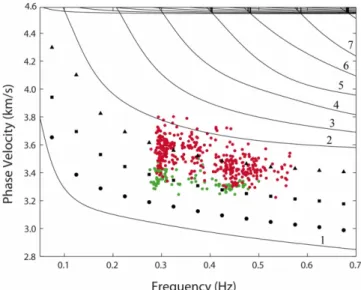
ABSTRACT: The seismic-noise data recorded on 19 vertical-com- ponent short-period seismometers of the KSRS seismic array are analyzed (1) to determine whether typhoons in the Pacific Ocean can be tracked accurately, and (2) to explore the seismic phases comprising the noise field recorded at the array. For our tests, two super typhoons, Sinlaku and Rammasun of 2008, were selected on the basis of their strength and wide azimuthal coverage from the seismic array. To track the source of DF microseisms, f-k analysis was applied to the KSRS data to estimate the back azimuth of the 0.2–0.7 Hz noise field (DF microseisms). These computed back azi- muths show good agreement with the known values to the centers of the NW Pacific typhoons. This clearly indicates that these typhoons were the main source of microseisms during their passing. The seismic phases in our DF microseism band are investigated with the phase velocities from our f-k analysis. The estimated horizontal phase velocities range from 3.2 to 3.8 km/s, with an average of about 3.5 km/s. This indicates that the major phases of the observed DF microseisms are surface waves consisting of mostly P-SV Mode 1 and Mode 2—in amplitude ratio A
1/A
2≈ 1/3—and possibly some Mode 3.
Key words: KSRS, directivity, typhoon, f-k analysis 1. INTRODUCTION
Seismometers record continuous and systematic vibra- tions due to ocean activities. These continuous vibrations are called microseisms and have two prominent peaks in the frequency ranges 0.05–0.1 Hz (primary or single-frequency microseisms, SF) and 0.1–0.5 Hz (secondary or double-fre- quency microseisms, DF).
It has long been recognized that intense cyclonic storms at sea produce strong winds that transfer atmospheric energy into oceanic gravity waves, and part of that energy couples with the solid earth to generate diffuse seismic waves, or microseisms, propagating in the acoustic system formed by the ocean and solid structure below. Investigation of microseisms
is now recognized as an important means of monitoring cli- mate-change effects, of locating storms (Bromirski, 2001), and of imaging the earth structure (Shapiro et al., 2005;
Kang and Shin, 2006).
The relation between oceanic storms (or moving pressure lows) and microseisms was studied by Gutenberg (1931), and the cyclones near North America were first successfully tracked with observed microseism data (Gilmore, 1946) using the tripartite method (Ramirez, 1940). However, research on the source of microseisms was only moderately success- ful until array seismology (summarized by Rost and Thomas, 2002) became practical in the 1960s. Since then, array- based studies of noise have been more successfully focused on both the sources of microseisms and the composition of seismic phases within these arrivals.
Sources of primary microseisms near the coastlines of the North Atlantic and Pacific Oceans were detected using a wide-angle triangulation approach (Cessaro and Chan, 1989).
Location of source areas of secondary microseisms, that are observed at continental stations, has caused debates con- cerning whether these microseisms are generated mainly along the coast (Bromirski, 2001; Bromirski and Duenne- bier, 2002; Bromirski et al., 2005), or whether they are also generated in deep-sea regions (Cessaro, 1994; Stehly et al., 2006; Kedar et al., 2008).
Recent array techniques using the body waves from a continuous-noise source, also allow location of the sources (Gerstoft et al., 2006; Zhang et al., 2010) and show that there exist seasonal variations of the source area (Gerstoft and Tanimoto, 2007; Koper et al., 2009). However, studies that track moving pressure lows, based on array techniques, are not common.
Backus et al. (1964) analyzed the noise data and found higher-mode Rayleigh waves with phase velocities of 3.5–
4.5 km/s within the period range 0.2–1.0 s. They also reported the presence of teleseismic P waves in the seismic noise Woo-Dong Lee
Bong-Gon Jo*
Fred Schwab Sat-Byul Jung
Department of Earth and Environmental Science, School of Science and Technology, Chonbuk National University, Jeonju 561-756, Republic of Korea
Department of Earth and Environmental Science, School of Science and Technology, Chonbuk National University, Jeonju 561-756, Republic of Korea
Institute of Earth and Environmental System, Chonbuk National University, Jeon ju 561-756, Republic of Korea Department of Earth and Space Sciences, University of California Los Angeles, Los Angeles, California 90095-1567, USA
Department of Earth and Environmental Science, School of Science and Technology, Chonbuk National University, Jeonju 561-756, Republic of Korea
*Corresponding author: [email protected]
(Backus, 1966). Lacos et al. (1969) demonstrated that the microseism wavefield consists of fundamental-mode Ray- leigh and Love waves at periods longer than 7 s. Recent studies have shown that at shorter periods, there is a com- plicated mixture of fundamental-mode surface waves, higher-mode surface waves, and body waves (Bonnefoy- Claudet et al., 2006; Koper et al., 2010; Gerstoft et al., 2008; Koper and de Foy, 2008; Landes et al., 2010; Zhang et al., 2010).
Strong DF microseism peaks during Korean summer sea- son were correlated with the presence of Pacific typhoons (Sheen et al., 2009). In this study, we carry out a survey of the noise field using the KSRS seismic array. The seismic array technique is a powerful tool for the study of noise sources; it provides accurate information on both the direc- tion of propagation and wave velocity of the incoming seis- mic noise as it crosses the array. Our research target is two- fold: (1) to determine whether typhoons in the Pacific Ocean (east and south of Japan) can be tracked accurately using the short-period KSRS array, and thereby verifying that typhoons are sources of recorded microseisms, and (2) to examine the seismic composition of the noise field recorded
at the KSRS array. Our report is the initial analysis of using the KSRS array to track typhoons.
2. DATA AND METHOD
In the year 2008 there were 32 tropical cyclones (or mov- ing pressure lows) in the NW Pacific, 11 of which reached
“Typhoon” level. We have studied the second (“Ramma- sun”) and eighth (“Sinlaku”) of these typhoons (Fig. 1).
This pair was selected on the basis of (1) their strength, both being Category 4-equivalent, “Super Typhoons”, and of (2) their wide azimuthal coverage at, and ease of distinguishing them with, the KSRS array. (We use the 2009 tropical-cyclone classification of the Hong Kong Observatory, which is given in Table 1) This array consists of 19 vertical-component, short-period instruments located at Wonju, South Korea.
The seismometers are within a circle of diameter—maxi- mum array aperture—10.1 km, and the minimum inter-sta- tion separation is about 2 km (Fig. 1). The 19 short-period instruments with resonance frequency at 1 Hz are identical, and measure velocity; and to the accuracy required in the current study, the phase response of all the instruments is
Fig. 1. Index map. This shows the Korean seismic array KSRS, and the typhoon-center tracks of Sinlaku and Rammasun of 2008. The circles repre- sent effective diameters of strong wind of each typhoon. (The effective diam- eter of strong wind is the area inside the typhoon, having a speed greater than 54 km/h.) The typhoon locations with circle and square symbols corre- spond to the same symbols in Figure 3.
The inset shows the array configura-
tion of the 19 vertical, short-period
instruments of the KSRS array.
assumed to be the same.
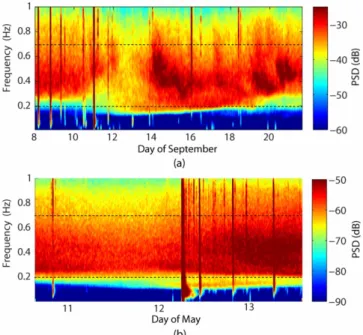
To prepare for analysis, these velocity records are filtered using a three-pole Butterworth band-pass filter with corners at 0.2 and 0.7 Hz, and each window is individually detrended and tapered with a Hanning window. Even though the fre- quency range used in this study is lower than the resonance frequency of the KSRS instruments, the DF microseism energy in the frequency range of 0.2–0.7 Hz appears dom- inant in the recorded seismogram during the days of min- imum seismic intensity shown in Figure 3. To the array’s spatial distribution of recorded and processed seismograms, frequency-wavenumber ( f-k) analysis is applied to compute f-k spectra for two different sizes of time windows, 6.5 s and 720 s.
The complete details of this procedure will be found in Rost and Thomas (2002) and references therein. This pro- vides us with the direction and horizontal velocity of mono- chromatic waves passing across array KSRS, i.e., the vector (horizontal) wavenumber at the array for the frequency band and time window of the processed set of recordings.
For this purpose, a modified version of the Generic Array Processing (GAP) Software Package (Koper, 2005) is used to analyze the KSRS array data. The frequency band ana- lyzed for the array was carefully chosen to avoid spatial aliasing. For the KSRS short-period network, the inter-sta-
tion distance ( ∆x ≈ 2 km) is quite constant. Thus the Nyquist wavenumber (1/2 ∆x) is 0.25 km
−1. With the slowness grid ranging between –45 to +45 s/ ° in S
xand S
ydomain, and a center frequency of 0.5 Hz at which to calculate f-k spectra, a maximum wavenumber within the search bounds is about 0.2 km
−1. The maximum wavenumber for the center fre- quency is lower than the Nyquist wavenumber of the array so that the spatial aliasing for 0.5 Hz is not a problem for Table 1. Classification of tropical cyclones
Tropical Cyclone classification
Maximum 10-minute mean wind near the center Tropical Depression up to 62 km/h
Tropical Storm 63 to 87 km/h
Severe Tropical Storm 88 to 117 km/h
Typhoon 118 to 149 km/h
Severe Typhoon
a150 to 184 km/h Super Typhoon
a185 km/h or above
a