대기 중 CO 2 농도의 상승에 대한 배추의 광합성과 생장 반응
오순자1⋅손인창1⋅위승환1⋅송은영1⋅고석찬2*1)
1농촌진흥청 국립원예특작과학원 온난화대응농업연구소, 2제주대학교 생물학과 (2016년 10월 6일 접수; 2016년 12월 10일 수정; 2016년 12월 25일 수락)
Photosynthetic and Growth Responses of Chinese Cabbage to Rising Atmospheric CO 2
Soonja Oh
1, In-Chang Son
1, Seung Hwan Wi
1, Eun Young Song
1and Seok Chan Koh
2*1
Agricultural Research Institute for Climate Change, National Institute of Horticultural and Herbal Science, RDA, Jeju 63240, Korea
2
Department of Biology, Jeju National University, Jeju 63243, Korea
(Received October 6, 2016; Revised December 10, 2016; Accepted December 25, 2016)
ABSTRACT
The effects of elevated atmospheric CO
2on photosynthesis and growth of Chinese cabbage (Brassica campestris subsp. napus var. pekinensis) were investigated to predict productivity in highland cropping in an environment where CO
2levels are increasing. Vegetative growth, based on fresh weight of the aerial part, and leaf characteristics (number, area, length, and width) of Chinese cabbage grown for 5 weeks, increased significantly under elevated CO
2(800 μmol⋅mol
-1) compared to ambient CO
2(400
μmol⋅mol
-1). The photosynthetic rate (A), stomatal conductance (g
s), and water use efficiency (WUE) increased, although the transpiration rate (E) decreased, under elevated atmospheric CO
2. The photosynthetic light-response parameters, the maximum photosynthetic rate (A
max) and apparent quantum yield (φ), were higher at elevated CO
2than at ambient CO
2, while the light compensation point (Q
comp) was lower at elevated CO
2. In particular, the maximum photosynthetic rate (A
max) was higher at elevated CO
2by 2.2-fold than at ambient CO
2. However, the photosynthetic CO
2-response parameters such as light respiration rate (R
p), maximum Rubisco carboxylation efficiency (V
cmax), and CO
2compensation point (CCP) were less responsive to elevated CO
2relative to the light-response parameters. The photochemical efficiency parameters (F
v/F
m, F
v/F
o) of PSII were not significantly affected by elevated CO
2, suggesting that elevated atmospheric CO
2will not reduce the photosynthetic efficiency of Chinese cabbage in highland cropping. The optimal temperature for photosynthesis shifted significantly by about 2
oC under elevated CO
2. Above the optimal temperature, the photosynthetic rate (A) decreased and the dark respiration rate (R
d) increased as the temperature increased. These findings indicate that future increases in CO
2will favor the growth of Chinese cabbage on highland cropping, and its productivity will increase due to the increase in photosynthetic affinity for light rather than CO
2.
Key words: Elevated CO
2, Optimal temperature, Photosynthetic rate (A), Vegetative growth
* Corresponding Author : Seok Chan Koh ([email protected])
DOI: 10.5532/KJAFM.2016.18.4.357
ⓒ Author(s) 2016. CC Attribution 3.0 License.
I. 서 론
대기 중의 이산화탄소(CO2) 농도는 산업혁명 이후 화 석연료 사용의 증가, 삼림의 훼손 및 전용에 따른 손실 등 다양한 산업 활동의 영향으로 지속적으로 증가하고 있 으며, 지구온난화와 이상기후 현상의 원인이 되고 있다.
1850년까지만 하더라도 대기 중 CO2의 농도는 약 280 ppm이었으나 현재는 394.5 ppm에 이르며(2010년 기 상청 안면도 국가기후변화 감시센터 자료), 인구증가와 경제활동의 가속화로 인해 앞으로도 CO2 방출량은 지 속적으로 증가하고, 이로 인해 21세기말 지구의 평균 표 면온도도 약 1.5∼2.0℃ 높아질 것으로 예측하고 있다 (IPCC, 2014). 우리나라의 연평균 온도도 최근 30년 (1981-2010) 동안 0.7℃ 상승하였고, 앞으로도 지속적 으로 상승할 것으로 예측된다(KMA, 2011).
대기 중 CO2 농도 증가가 지구온난화를 야기하지만 C3 식물 대부분에서는 광합성을 촉진하기 때문에 작물 의 온실재배시 CO2 농도를 높여 생산성을 향상시킬 수 있다(Poorter, 1993). 농작물의 CO2 시비는 순광합성을 향상시킬 수 있으며, 대략 33%의 수율 증가로 이어지기 도 한다(Kimball, 1985). 제주도의 일부 온실 농가에서 는 작물의 생산성을 높이기 위하여 지하 40-80m 지점의 화산암층(암반층)에 분포하고 있는 화산쇄설층의 지하 공기 내 CO2를 이용하기도 한다(Kang et al., 2009). 대 기 중 CO2 농도 증가에 대한 농업분야의 연구는 대부분 작물의 CO2 고정의 결과라고 할 수 있는 바이오매스 생 산에 초점을 맞추고 있다. 더군다나, 시설 작물재배에 있 어서 작물의 생산성을 극대화할 뿐만 아니라 조기 수확 을 목적으로 시설 내부에 CO2 농도를 인위적으로 높여 서 재배하기도 한다. 하바네로 고추(Capsicum chinense Jacq.)의 경우 CO2 농도 증가에 의해 수확량이 증가할 뿐만이 아니라 과실 크기와 적색 고추 열매의 캡사이신 함량도 크게 증가하는 것으로 나타나 CO2 농도가 이차 대사산물의 합성에도 관여하는 것으로 보고되었다 (Garruña-Hernández et al., 2013).
배추(Brassica campestris subsp. napus var. pekinensis) 는 십자화과(Cruciferae)에 속하는 식물이며, 김치의 주 재료로써 우리나라에서 생산 및 소비가 높은 채소작물 중에 하나이며, 여러 작형을 통해 연중 재배되고 있다. 그 중 고랭지 여름배추의 재배면적은 전체 배추 재배면적 의 약 10%이며, 강원도 등 해발 600m 이상의 고랭지 지 역에서 재배하고 있다(Park and Park, 2013). 고랭지는 해발고도가 높아질수록 기온이 점차 낮아지는 기후 특
성 때문에 여름철에 고온다습으로 인해 평난지에서 재 배하기 어려운 호냉성 작물인 배추를 재배하기에 적합 하다. 고농도 CO2 조건에서 배추의 광합성 특성과 생육 에 대하여는 봄배추나 가을배추 재배시 연구가 진행된 바 있으나(Choi et al., 2011; Lee et al., 2006), 여름철 고 랭지 환경 하의 고농도 CO2 조건의 영향에 대하여는 연 구된 바가 없다.
따라서, 본 연구는 대기 중 CO2 농도가 증가하였을 때 배추의 생리적 특성과 광합성에 미치는 영향을 조사하 여 미래의 CO2 농도 증가 시 고랭지 배추의 생산성을 예 측해보고자 수행하였다.
II. 재료 및 방법
2.1. 식물재료 및 재배조건
본 실험에 사용한 식물재료는 고랭지 여름 배추의 주 품종인 춘광(Brassica campestris subsp. napus var.
pekinensis cv. Chungwang)이며, 배양용 상토가 들어 있
는 105구 육묘용 플러그 트레이에 종자를 1립 씩 파종하 여 자연광 하에서 20±1℃ (day)/15±1℃ (night)의 조건 으로 재배하였다. 파종 30일 후에 본엽이 3-4매 나온 균 일하게 자란 개체들을 선발하여 사각포트(용적 15L)에 정식하고, 20±1℃, 60-70% 상대습도, 800 μmol⋅m-2⋅s-1 (14h light/10h dark), 400 μmol CO2⋅mol-1로 유지되도 록 설정된 환경제어챔버(GR96, EGC, Chagrin Falls, USA)에서 5일간 순화시켰다. 이후 건전한 상태의 개체 들을 각각 10개체씩 무작위적으로 선발하여 고랭지 환 경조건과 유사한 배양조건에서 챔버 내 CO2 농도를 각각 400 μmol⋅mol-1 (ambient)과 800 μmol⋅mol-1 (elevated)로 다르게 설정한 환경제어 챔버에서 배 양하면서 식물의 생육 및 광합성 특성 등을 조사하기 위 한 재료로 사용하였다. 정식된 배추는 농촌진흥청 표준 영농재배법에 준하여 관리하였으며, 토양수분은 조사 기간 동안 2일 간격으로 충분히 관수하였다. 챔버 내 CO2 농도를 달리하여 처리한 후 5주째에 각 처리구에서 자라는 배추의 8∼10번째 잎 중에서 엽색이 비슷하고 균일한 상태의 잎을 실험재료로 사용하였다.챔버 내부의 주야간 대기온도는 대표적인 고랭지 배추 재배지역인 강원도 태백의 25년간(1983-2007) 기상자 료 중에 생육기에 해당하는 6∼7월의 기온자료를 토대로 1시간 간격으로 구현되도록 하였으며, 일출 시각부터 주 간 온도로, 일몰 시각부터 야간 온도로 전환되도록 설정하 였다. 챔버 내 CO2 농도는 각각 400 μmol⋅mol-1과 800
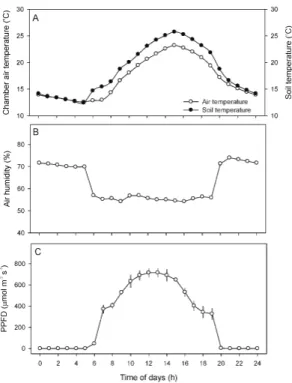
μmol⋅mol-1로 유지되도록 조절하였다. 토양온도는 토 심 10 cm에서 간이측정기(CS655, Campbell Scientific Inc., Logan, USA)를 사용하여 측정하였다. 재배기간 동 안의 대기온도, 토양온도, 상대습도와 일사량은 데이터 로거(CR1000, Campbell Scientific Inc., Logan, USA) 를 이용하여 수집하였으며, 1시간 간격으로 나타내었다 (Fig. 1).
Fig. 1. Diurnal climatic (culture environmental
conditions - chamber air and soil temperature, air humidity, photosynthetic photon flux density) variables during leaves development of Chinese cabbage plants under different culture CO2 conditions. Each value represents the mean ± SE measured from culture periods.2.2. 생육특성 조사
배추의 생육특성은 챔버내 CO2 농도를 400 μmol⋅
mol-1과 800 μmol⋅mol-1로 설정된 조건에서 5주간 배 양한 후 각각 5개체를 선정하여 생체량, 개체당 엽수와 엽면적, 엽장, 엽폭, SPAD값을 측정하였다. 생체량은 뿌리를 제외한 지상부 무게를 측정하였으며, 엽수는 잎 의 길이가 1㎝ 이상인 것을 모두 조사하였고, 엽면적은 이들 잎을 엽면적계(LI-3100, Li-Cor, USA)로 측정하 였다. 그리고, 엽장, 엽폭과 SPAD값은 각 개체의 8∼10
번째 잎을 대상으로 조사하였으며, SPAD값은 엽록소 계(SPAD-502, Minolta Co. Ltd., Osaka, Japan)를 사용 하여 측정하였다.
2.3. 광계II 활성 분석
광계II 활성은 엽록소형광분석기(Plant Efficiency Analyzer, Hansatech Instrument Ltd., King`s Lynn, UK)를 이용하여 분석하였다. 챔버 내 CO2 농도를 달리 하여 처리한 후 5주째에 각각의 조건에서 자란 식물체를 대상으로 20분간 광을 차단하여 암적응시킨 배추의 잎 에 1500 μmol⋅m-2⋅s-1의 광량을 5초간 조사하여 Fo, Fm, Fv/Fm, Fv/Fo 등의 형광변수를 측정하였다.
2.4. CO
2 고정률과 호흡률의 측정CO2 고정률(A)은 휴대용 광합성 측정기 LCpro+ Portable Photosynthesis System (ADC Bio Scientific Ltd., Hoddesdon, UK)을 사용하여 조사하였으며, 측정 시에 leaf 챔버는 25±1℃, 1300 μmol⋅m-2⋅s-1의 포화 광을 비추어 5분간 안정화시킨 후 측정하였다. 호흡률 (Rd)은 CO2 고정률과 같은 방법으로 측정하였으며, 다 만 포화광을 비추는 대신에 암조건을 유지하였다. CO2
고정률 측정 시 기공전도도(gs)와 증산률(E)도 측정하였 으며, 증산률에 대한 CO2 고정률로부터 수분이용효율 (WUE)을 산출하였다. 그리고, 엽온에 대한 광합성 반응 은 광합성측정기의 작동 매뉴얼에 따라 5℃ 단위로 증가 시켜 20-40℃범위에서 상기한 광합성 측정과 동일한 방 법으로 조사하였다.
2.5. 광반응 및 CO
2반응 곡선의 분석광반응 곡선(A/PPFD curve)과 CO2반응 곡선(A/Ci curve)을 작성하기 위한 각각 광합성률은 LED 광원과 CO2 분사시스템이 부착된 휴대용 광합성 측정기 LCpro+ Portable Photosynthesis System (ADC Bio Scientific Ltd., Hoddesdon, UK)과 Li-6400 Portable Photosynthesis System (Li-Cor Biosciences, Lincoln, NE, USA)을 사용하여 25±1℃조건에서 측정하였으며, SigmaPlot 10.0 (Systat Software Inc., Erkrath, Germany) 을 이용하여 non-rectangular hyperbolar equation을 유 도하고 광반응 곡선과 CO2반응
곡선을 작성하였다. 광
반응 곡선을 토대로 최대광합성률(Amax), 암호흡률(Rd), 광보상점(Qcomp), 광포화점(Qsat), 순양자수율(φ), 반포 화상수(K) 등을 산출하였다(Marshall and Biscoe, 1980;Oh et al., 2015). 또한 CO2반응 곡선을 토대로 최대전자 전달률(Jmax), 광호흡률(Rp), CO2 보상점(CCP), CO2 포 화점(CSP), 탄소고정효율(ACE), 최대카르복실화속도 (Vcmax) 등을 산출하였다(Farquhar et al., 1980).
2.6. 통계분석
산출된 변수들에 대한 모든 통계분석은 SPSS 통계 패 키지 18.0(SPSS, Chicago, IL, USA)를 이용하여 수행 하였으며, 통계적 검증은 t-test를 수행하여 p값이 0.05 이하인 경우만을 통계학적으로 유의성이 있는 것으로 판단하였다.
III. 결과 및 고찰
3.1. 배추의 생육조건과 생육특성
재배기간 동안 챔버 내 평균 대기온도는 17.1℃(주간 19.4℃, 야간 13.8℃)이며, 토양온도는 18.5℃(주간 21.7℃, 야간 14.1℃)로 대기온도보다 대략 1.4℃ 높았 다(Fig. 1A). 그리고 상대습도는 평균 62.2%(주간 56.6%, 야간 70.0%)이며, 낮시간의 광량은 700 μmol⋅
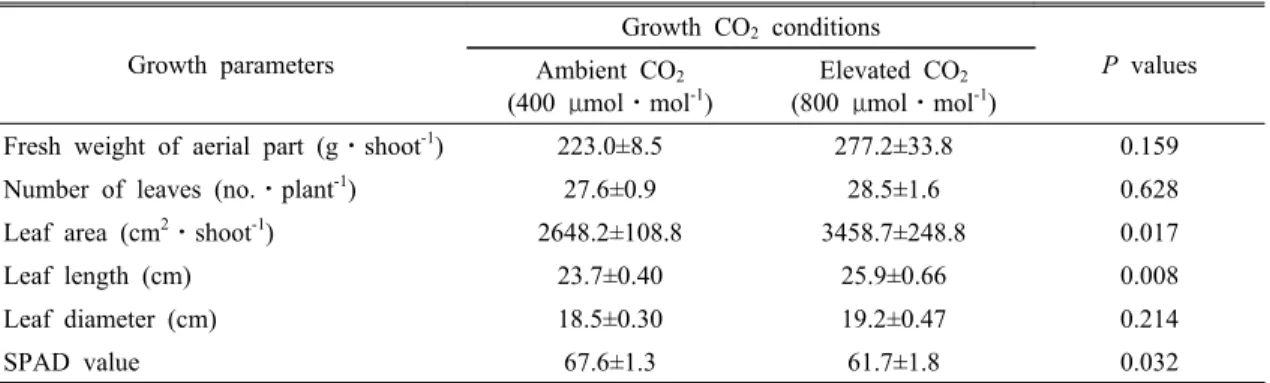
m-2⋅s-1를 상회하였다(Fig. 1B와 1C). 고농도의 CO2 (800 μmol⋅mol-1)에서 5주간 재배된 배추의 지상부 생체량, 엽수, 엽면적, 엽장, 엽폭은 모두 대기 CO2 농도 조건(400 μmol⋅mol-1)에서 재배되었을 때 보다 높게 나타났으 며, SPAD 값은 오히려 낮았다(Table 1). 특히, 엽면적, 엽장과 SPAD값은 챔버내 CO2 농도에 따라 유의한 차 이를 보였다. 이러한 결과는 양배추(Brassica oleracea subsp. capitata cv. Lennox), 고추(Capsicum annuum),
무(Raphanus sativus) 등의 다른 재배 작물에서도 보고 된 바 있다(Vuorinen et al., 2004; Piñero et al., 2014; Lee
et al., 2009). 양배추의 경우 대기 중 CO
2 농도가 증가하 였을 때 건체량이 증가하였으며(Vuorinen et al., 2004), 고추나 무에서도 엽수가 증가하거나 엽장과 엽면적이 증가하는 등 고농도의 CO2가 작물의 생장을 촉진시키 는 것으로 알려지고 있다(Piñero et al., 2014; Lee et al., 2009). 이처럼, CO2 농도 증가는 식물체에 직접적이면 서 중요하게 작용하는데, 가장 일반적인 반응은 식물의 생육 속도를 대략 37% 증가시키는 시비효과이다 (Poorter, 1993). 고농도의 CO2에서 바이오매스의 증가 는 잎의 확장과 엽두께가 두껍게 발달하는 등의 형태적 특징에서 비롯되며, 야생종보다 재배 작물에서 더 명확 하게 나타난다(Pritchard et al., 1999; Poorter, 1993).3.2. 광계II 활성과 광합성 특성의 변화
초기형광수율(Fo)과 최대형광수율(Fm)은 고농도의 CO2 (800 μmol⋅mol-1)에서 재배하였을 때 증가하였으 며, 광계II의 최대 광화학적 효율(Fv/Fm)과 잠재적 광합 성능(Fv/Fo)은 챔버내 CO2 농도에 따라 유의한 차이를 보이지 않았다. 그리고 CO2 고정률(A), 기공전도도(gs) 와 수분이용효율(WUE)도 고농도의 CO2 (800 μmol⋅
mol-1)에서 높았으며, 증산률(E)은 다소 낮았다(Table 2). 엽록소형광 변수, 특히 Fv/Fm과 Fv/Fo 값의 변화가 없 는 것으로 보아 고농도 CO2에 의해 식물체가 스트레스 를 받고 있지 않은 것으로 보이며, 오히려 기공저항(Ls) 이 낮고, Ci/Ca가 높아 CO2 고정이 더 활발하게 이루어 지고 있음을 알 수 있다. 그리고, CO2 농도가 높아짐으로
Growth parameters
Growth CO2 conditions
P values
Ambient CO2(400 μmol⋅mol-1)
Elevated CO2
(800 μmol⋅mol-1)
Fresh weight of aerial part (g⋅shoot-1) 223.0±8.5 277.2±33.8 0.159 Number of leaves (no.⋅plant-1) 27.6±0.9 28.5±1.6 0.628 Leaf area (cm2⋅shoot-1) 2648.2±108.8 3458.7±248.8 0.017
Leaf length (cm) 23.7±0.40 25.9±0.66 0.008
Leaf diameter (cm) 18.5±0.30 19.2±0.47 0.214
SPAD value 67.6±1.3 61.7±1.8 0.032
Data show mean values ± standard error of six independent plants. Statistical differences between CO2 treatments were tested with a one-way analysis of variance.
Table 1. Growth characteristics of Chinese cabbage plants grown under different culture CO
2 conditions (ambient, 400 μmol⋅mol-1; elevated, 800 μmol⋅mol-1) at 5 weeks after treatment. Each value represents the mean ± SE measured from 5 independent plants써 광합성률은 증가하고 증산률은 감소시켜 수분이용효 율은 증가하는 것으로 보인다. 고농도 CO2 하에서 수분 이용효율과 CO2 고정률의 증가는 Table 1에서처럼 배 추의 생장을 촉진시켜 결과적으로 바이오매스 증가를 야기하는 것으로 보인다. 특히, 광합성은 세포 간극과 대 기 중 이산화탄소 농도의 차이에 큰 영향을 받으며 대기 중 이산화탄소 농도의 증가는 이 차이를 증가시켜 식물 은 같은 양의 수분을 증산하면서도 광합성을 증가시키 는데(Norby et al., 1995), 본 연구에서도 고농도의 CO2
(800 μmol⋅mol-1)에 의한 시비효과가 나타났다. 식물 의 광합성 속도가 상승하게 되면 건체량이 증가하게 된 다(Pooter, 1993). Brassica속의 양배추(B. oleracea subsp. capitata cv. Lennox)도 고농도의 CO2에서 재배 되었을 때 건체량이 증가하는 것으로 보고되었다 (Vuorinen et al., 2004). 본 연구에서도 Table 1에서 보 는 바와 같이 지상부 생체량, 엽수, 엽면적, 엽장, 엽폭 등 배추의 생육이 고농도의 CO2에서 재배되었을 때 증가 하여 우호적으로 작용하고 있음을 확인할 수 있었으며, 특히 엽면적이 30% 이상 증가하였다.
3.3. 광반응 곡선과 CO
2 반응 곡선의 분석배추 잎의 광반응 곡선(A/PPFD curve)과 CO2반응 곡선(A/Ci curve)을 작성하고(Fig. 2), 이로부터 여러가
지 광합성 특성을 조사하였다(Table 3). 광반응 곡선 (Fig. 2A)으로부터 얻은 광합성 특성 중 최대광합성률 (Amax)은 대조구인 대기 중 CO2 농도(400 μmol⋅mol-1) 에서 재배된 배추에서보다 고농도의 CO2 조건(800 μ mol⋅mol-1)에서 재배된 배추에서 2.2배 더 높았다. 광 보상점(Qcomp)은 대조구에서보다 고농도의 CO2 조건에 서 재배되었을 때 다소 낮았으며, 순양자수율(φ)은 오히 려 높았다(Table 3). 이러한 결과는 식물에서의 광합성 률은 0-1000 μmol⋅mol-1 범위에서 CO2 농도가 높아질 수록 증가한다는 보고와 일치하며(Mortensen, 1987), 대기 중 CO2 상승이 배추의 생산성을 향상시킬 수 있음 을 나타내 준다. 실제 토마토(Lycopersicon esculentum), 오이(Cucumis sativus), 고추(Capsicum annuum) 등의 재배시 광합성률을 증가시키기 위하여 주간에 CO2 농 도를 1000 μmol⋅mol-1 로 높여 주기도 한다(Nederhoff and Vegter, 1994). 그러나, 반포화상수(K)가 고농도의 CO2 조건에서 재배되었을 때 대조구에서 보다 더 높아 서 광합성 능력을 극대화하기 위해서는 더 많은 빛이 필 요함을 나타내 주고 있다. 따라서 미래의 대기 중 CO2 증 가는 고랭지 재배시 배추의 생육에 있어서 엽면적, 순양 자수율(φ)을 증가시켜 빛의 흡수량과 광합성에 대한 이 용효율을 높이는 형태의 적응 반응을 나타낼 것으로 보 인다. CO2반응
곡선(Fig. 2B)으로부터 얻은 광합성 특
ParametersGrowth CO2 conditions
P values
Ambient CO2(400 μmol⋅mol-1)
Elevated CO2
(800 μmol⋅mol-1)
Fo (ratio) 412±8.1 439±5.0 0.014
Fm (ratio) 2307±33.9 2420±25.0 0.016
Fv/Fm (ratio) 0.82±0.003 0.82±0.002 0.495
Fv/Fo (ratio) 4.42±0.09 4.30±0.06 0.287
A (μmol CO
2⋅m-2⋅s-1) 18.6±0.18 41.9±0.38 0.000g
s (mol H2O⋅m-2⋅s-1) 0.31±0.001 0.48±0.001 0.000E (mmol H
2O⋅m-2⋅s-1) 4.85±0.03 4.77±0.07 0.295WUE (mmol CO
2⋅mol-1 H2O) 3.83±0.03 8.78±0.08 0.000ITE (μmol CO
2⋅mol-1 H2O) 60.6±1.26 87.0±1.04 0.000L
s 0.42±0.006 0.35±0.004 0.000C
i/Ca 0.58±0.006 0.65±0.004 0.000Data show mean values ± standard error of six independent plants. Statistical differences between CO2 treatments were tested with a one-way analysis of variance.
Table 2. Characteristics of the chlorophyll fluorescence and photosynthetic parameters of Chinese cabbage plants
grown under different culture CO2 conditions (ambient, 400 μmol⋅mol-1; elevated, 800 μmol⋅mol-1) at 5 weeks after treatment. Each value represents the mean ± SE measured from 10 independent plantsPhotosynthetic photon flux density, mol photons m
-2s
-10 300 600 900 1200 1500 1800
Net ph otos yn thetic rate, mol CO
2m
-2s
-10 10 20 30 40 50
Ambient CO2 Elevated CO2
Internal CO
2concentration, mol mol
-10 200 400 600 800 1000 1200
Net photos yn thetic r ate, mol C O
2m
-2s
-10 10 20 30 40 50
Ambient CO2 Elevated CO2
A B
Fig. 2. Photosynthetic light-response curves and atmospheric CO
2 concentration (Ci) obtained from leaves of Chinese cabbage plants grown under different culture CO2 conditions (ambient, 400 μmol⋅mol-1; elevated, 800 μ mol⋅mol-1). The curves were fitted with the non-rectangular hyperbola. Each value represents the mean ± SE measured from 4 independent plants.Photosynthetic parameters
Growth CO2 conditions
P values
Ambient CO2(400 μmol⋅mol-1)
Elevated CO2
(800 μmol⋅mol-1)
A
max (μmol CO2⋅m-2⋅s-1) 22.1±0.49 49.4±0.41 0.000R
d (μmol CO2⋅m-2⋅s-1) -2.64±0.01 -2.95±0.14 0.065Q
comp (μmol⋅m-2⋅s-1) 55.2±2.11 45.2±2.08 0.009Q
sat (μmol⋅m-2⋅s-1) 960.4±86.3 1122.9±26.2 0.109K (μmol⋅m
-2⋅s-1) 335.0±9.6 472.0±4.6 0.000ϕ (μmol CO2⋅μmol-1 photons) 0.050±0.002 0.069±0.001 0.000
θ 0.861±0.031 0.869±0.005 0.798
J
max (μmol⋅m-2⋅s-1) 49.9±0.052 46.9±0.87 0.008R
p (μmol⋅m-2⋅s-1) -4.78±0.27 -4.38±0.08 0.195CCP (μmol⋅mol
-1) 61.5±2.02 62.2±0.46 0.721CSP (μmol⋅mol
-1) 673.0±20.9 750.2±8.9 0.009ACE (μmol⋅m
-2⋅s-1) 0.083±0.001 0.071±0.001 0.000V
cmax (μmol⋅m-2⋅s-1) 26.1±2.19 25.4±1.79 0.803A
max, net photosynthetic rate under light saturated conditions; Rd, dark respiration rate at zero irradiance; Qcomp, light compensation point; Qsat, light saturation point; K, half saturation constant; ϕ apparent quantum yield; θ, convexity of the non-rectangular hyperbola curve.J
max, maximum electron transport driving regeneration of RuBP; Rp, mitochondrial respiration rate in the light; Vcmax, maximum Rubisco carboxylation efficiency; CCP, CO2 compensation point; CSP, CO2 saturation point; ACE, apparent carboxylation efficiency.Each value represents the mean ± SE of four independent plants. Statistical differences between CO2 treatments were tested with a one-way analysis of variance.
Table 3. Characteristics of the photosynthetic light-response curves and CO
2-response curves obtained from leaves of Chinese cabbage plants grown under different culture CO2 conditions (ambient, 400 μmol⋅mol-1; elevated, 800 μmol⋅mol-1).성들은 CO2 농도에 따라서 차이가 없거나 있더라도 미 미하였다(Table 3). 즉, 광호흡률(Rp), 최대카르복실화 속도(Vcmax), CO2 보상점(CCP) 등은 CO2 농도 처리간 에 통계학적으로 유의한 차이가 없었으며, 최대전자전 달률(Jmax)과 탄소고정효율(ACE)은 고농도 CO2에서 재배하였을 때 대기 CO2 농도 조건에서 재배되었을 때 보다 다소 낮았다. 그리고, CO2 포화점(CSP)은 오히려 고농도 CO2에서 다소 높았다. 그러나 이러한 결과는 앞 에서 대기 중 CO2 농도와 고농도 CO2에서 자란 배추 간 에 광반응 양상이 크게 다른 것과 비교하였을 때 CO2 반 응은 차이가 크지 않음을 보여주고 있다.
3.4. 엽온별 광합성의 변화
엽온을 달리하였을 때 CO2 고정률은 모든 온도에서 고농도 CO2 (800 μmol⋅mol-1)에서 재배된 배추 잎이 대기 CO2 농도(400 μmol⋅mol-1)에서 재배된 배추보다 1.5배 가량 더 높았으며, 광합성을 위한 최적 온도는 대 기 CO2 농도와 고농도 CO2에서 각각 27℃, 29℃로 나 타났다(Fig. 3A). 그리고, 각각의 온도 조건에서 배추의 CO2 고정률은 대기 CO2 농도에서 자란 잎에서 20.2 μ mol⋅m-2⋅s-1이며, 고농도 CO2 농도에서 자란 잎에서 는 37.6 μmol⋅m-2⋅s-1를 상회하였다. 봄철 노지에서 재배되는 배추의 경우 광합성은 15-30℃ 범위에서는 엽 온이 증가함에 따라 광합성 속도가 증가하나 30℃ 이상
의 온도에서는 감소하고, 광합성을 위한 최적의 온도가 26.1℃임이 보고된 바 있는데(Oh et al., 2015), 본 연 구에서도 대기 CO2 조건에서 이와 유사한 최적온도 를 나타내고 있음을 확인할 수 있었다. 갈풀(Phalaris
arundinacea), 강낭콩(Phaseolus vulgaris), 유칼립투스
(Eucalyptus globulus)에서도 CO2 농도가 증가하였을 때 광합성을 위한 최적의 온도가 다소 높아졌을 뿐만 아 니라 지상부와 지하부의 생산량 또한 증가하는 것으로 보고되었다(Körner and Bazzaz, 1996; Crous et al., 2013; Ge et al., 2012; Prasad et al., 2002). 본 연구에서 도 광합성을 위한 최적의 온도도 Fig. 3A에서처럼 고농 도 CO2에서 다소 상승하였으며 Table 1과 Table 2에서 살펴본 바와 같이 고농도 CO2에서 자란 배추가 대기 CO2 농도에서 재배된 것보다 생체량, 엽면적과 엽장이 증가하였다. 반면에, 암호흡률(Rd)은 배추가 자라는 CO2 농도 조건에 관계없이 온도 증가에 비례하여 증가 하였으며, 30℃ 이상의 높은 온도에서는 고농도 CO2 조 건에서 좀 더 높았다(Fig. 3B). 이는 Fig. 3A에서 CO2 고 정률이 최적온도 이상에서 감소하는 것은 일정 부분 암 호흡률의 증가와 관련이 있음을 나타내 준다.이상의 결과로부터 미래의 대기 중 CO2 증가는 고랭 지 재배시 배추의 생육에 있어서 수광량을 증가시켜 광 합성에 우호적으로 작용하고 생산성을 향상시킬 것으로 보인다. 더군다나 광계II의 최대 광화학적 효율(Fv/Fm)
Fig. 3. Temperature response curves of foliar net photosynthetic rate and dark respiration in leaves of Chinese cabbage
plants grown under different culture CO2 conditions (ambient, 400 μmol⋅mol-1; elevated, 800 μmol⋅mol-1). Each value represents the mean ± SE measured from 5 independent plants.과 잠재적 광합성능(Fv/Fo)이 CO2 농도에 따라 유의한 차이를 보이지 않아 고농도 CO2 조건이 고랭지 배추의 생육에 스트레스로 작용하고 있지 않을 것으로 보인다. 그리고, 고농도 CO2에서 재배되는 고랭지 배추는 엽면 적과 생체량이 증가하는 등 빠른 생장을 보여, 수광량이 증대되고 빛의 흡수이용효율과 수분이용효율을 높일 것 으로 나타났다. 다만, 최적온도 이상에서는 암호흡률의 증가로 인하여 CO2 고정률의 감소가 있을 것으로 보인 다. 그러나 식물의 생장과 광합성은 대기 중 CO2 증가뿐 만이 아니라 광, 온도, 수분, 영양물질과 같은 많은 환경 요인에 의해 영향을 받기 때문에, CO2 증가에 대한 고랭 지 배추의 반응은 환경 변화에 따라 복잡하고 다양해질 수 있다. 따라서 미래의 CO2 증가에 의한 고랭지 배추의 광합성과 생장 반응을 이해하기 위해서는 차후에 CO2
농도뿐만 아니라 다양한 환경 요인들 간의 복합적인 상 호 작용에 관한 연구가 필요할 것으로 보인다. 그리고 본 연구에서 축적된 자료는 배추의 광합성, 기공전도도, 증 산량 등을 예측할 수 있는 모형 개발 및 평가에 유용할 것 으로 사료된다.
적 요
본 연구는 대기 중 CO2 농도의 증가가 배추(B. campestris subsp. napus var. pekinensis)의 광합성과 생리적 특성 에 미치는 영향을 조사하여 미래의 대기중 CO2 농도 증 가로 인한 고랭지 배추의 생산성을 예측해 보고자 수행 하였다. 대기 CO2 농도를 달리하여 배추를 5주 동안 재 배하였을 때, 지상부 생체량, 엽수, 엽면적, 엽장, 엽폭은 모두 대기 CO2 농도 조건(400 μmol⋅mol-1)에서 재배 된 배추에서보다 고농도의 CO2 조건(800 μmol⋅mol-1) 에서 재배된 배추에서 더 높게 나타났다. 그리고 증산률 (E)이 다소 낮았지만, CO2 고정률(A), 기공전도도(gs)와 수분이용효율(WUE)도 고농도의 CO2에서 높았다. 최 대광합성률(Amax)은 대조구인 대기 중 CO2 농도에서보 다 고농도의 CO2 조건에서 2.2배 더 높았다. 광보상점 (Qcomp)은 대조구에서보다 고농도의 CO2 조건에서 다소 낮았다. 순양자수율(φ)은 고농도의 CO2 조건에서 재배 된 배추에서 높았다. 그러나, CO2반응 곡선으로부터 얻 은 광호흡률(Rp), 최대카르복실화속도(Vcmax), CO2 보 상점(CCP), 최대전자전달률(Jmax), 탄소고정효율(ACE) 등은 CO2 농도에 따라서 차이가 없거나 있더라도 미미 하였다. 그리고, 광계II의 최대 광화학적 효율(Fv/Fm)과 잠재적 광합성능(Fv/Fo)이 CO2 농도에 따라 유의한 차
이를 보이지 않아 고농도 CO2 조건이 고랭지 재배시 배 추의 생육에 스트레스로 작용하지 않는 것으로 보인다.
배추의 광합성을 위한 최적 온도는 고농도 CO2에서 2℃
정도 더 높았으며, 최적온도 이상의 조건에서는 대기 CO2와 고농도 CO2에서 모두 CO2 고정률은 감소하고 암호흡은 증가하는 양상을 보였다. 이상의 결과로부터 미래의 대기 중 CO2 증가는 고랭지 재배시 배추의 생육 에 있어서 스트레스 요인으로 작용하지는 않으며 수광 량의 증가가 생산성을 향상시킬 것으로 보인다.
감사의 글
본 연구는 농촌진흥청 연구사업 “기온변화에 따른 배 추, 고추, 마늘의 생리⋅생육반응 모니터링(세부과제번 호: PJ009292022914)”의 지원에 의해 이루어진 것임.
REFERENCES
Choi, E. Y., T. C. Seo, S. G. Lee, I. H. Cho, and J.
Stangoulis, 2011: Growth and physiological responses of Chinese cabbage and radish to long-term exposure to elevated carbon dioxide and temperature. Horticulture,
Environment, and Biotechnology 52(4), 376-386.
Crous, K. Y., A. G. Quentin, Y. S. Lin, B. E. Medlyn, D.
G. Williams, C. V. Barton, and D. S. Ellsworth, 2013:
Photosynthesis of temperate Eucalyptus globulus trees outside their native range has limited adjustment to elevated CO2 and climate warming. Global Change
Biology 19(12), 3790-3807.
Farquhar, G. D., S. von Caemmerer, and J. A. Berry, 1980: A biochemical model of photosynthetic CO2
assimilation in leaves of C3 species. Planta 149(1), 78-90.
Garruña-Hernández R., M. Monforte-González, A.
Canto-Aguilar, F. Vázquez-Flota, and R. Orellana, 2013: Enrichment of carbon dioxide in the atmosphere increases the capsaicinoids content in Habanero peppers (Capsicum chinense Jacq.). Journal of the Science of
Food and Agriculture 93(6), 1385-1388.
Ge, Z. M., X. Zhou, S. Kellomäki, C. Zhang, H. Peltola, P. J. Martilainen, and K. Y. Wang, 2012: Acclimation of photosynthesis in a boreal grass (Phalaris arundinacea L.) under different temperature, CO2, and soil water regimes. Photosynthetica 50(1), 141-151.
Intergovernmental Panel on Climate Change (IPCC), 2014: Climate Change 2014, Mitigation of climate change-contribution of working group III to the fifth
assessment report of the intergovernmental panel on climate change. Cambridge University Press, Cambridge, New York, USA.
Kang, B. R., G. P. Kim, and S. J. Kim, 2009: Characteristics of regional underground air distribution for various geothermal utilization. R p. JERI 2, 223-237.
Kimball, B. A., 1985: Adaptation of vegetation and management practices to a higher carbon dioxide world. US Department of Energy, Washington, USA, 185-204 pp.
Korea Meteorological Administration (KMA), 2011:
Automatic weather system (AWS). http://www.kma.go.kr Körner, C., and F. A. Bazzaz, 1996: Carbon dioxide,
populations, and communities. San Diego, CA: Academic Press.
Lee, S. G., J. H. Moon, Y. A. Jang, S. Y. Kim, and K. D.
Ko, 2009: Change of photosynthesis and cellular tissue under high CO2 concentration and high temperature in radish. Korean Journal of Horticultural Science &
Technology 27(2), 194-198.
Lee, J. W., S. Y. Kim, Y. A. Jang, J. H. Moon, and W. M.
Lee, 2006: Growth Response and CO2 Biomass of Chinese Cabbage and Radish under High Temperature and CO2 Concentration. Journal of Bio-Environment
Control 15, 364-368.
Marshall, B., and P. V. Biscoe, 1980: A model for C3
leaves describing the dependence of net photosynthesis on irradiance. Journal of Experimental Botany 31(1), 29–39.
Nederhoff, E. M., and J. G. Vegter, 1994: Photosynthesis of stands of tomato, cucumber, and sweet pepper measured in greenhouses under various CO2-concentration.
Annals of Botany 73(4), 353-361.
Norby, R. J., S. D. Wullschleger, C. A. Gunderson, and C. T. Nietch, 1995: Increased growth efficiency of
Quercus alba trees in a CO
2-enriched atmosphere.New Phytologist 131(1), 91-97.
Oh, S., K. H. Moon, E. Y. Song, I. C. Son, and S. C.
Koh, 2015: Photosynthesis of Chinese cabbage and radish in response to rising leaf temperature during spring. Horticulture, Environment, and Biotechnology
56(2), 159-166.
Park, J. Y., and Y. G. Park, 2013: The development of Chinese cabbage and radish forecast models. Report M125 on Korea Rural Economic Institute, KREI, Seoul, Korea.
Piñero, M. C., F. Houdusse, J. M. Garcia-Mina, M.
Garnica, and F. M. del Amor, 2014: Regulation of hormonal responses of sweet pepper as affected by salinity and elevated CO2 concentration. Physiologia
Plantarum 151(4), 375-389.
Poorter, H., 1993: Interspecific variation in the growth response of plants to an elevated ambient CO2
concentration. Vegetatio 104(1), 77-97.
Prasad, P. V., K. J. Boote, L. H. Allen, and J. M. Thomas, 2002: Effects of elevated temperature and carbon dioxide on seed-set and yield of kidney bean (Phaseolus
vulgaris L.). Global Change Biology, 8(8), 710-721.
Pritchard, S. G., H. H. Rogers, S. A. Prior, and C. M.
Peterson, 1999: Elevated CO2 and plant structure: a review. Glob Change Biology 5(7), 807-837.
Vuorinen, T., G. V. P. Reddy, A. M. Nerg, and J. K.
Holopainen, 2004: Monoterpene and herbivore-induced emissions from cabbage plants grown at elevated atmospheric CO2 concentration. Atmospheric Environment