Signal Processing for Perpendicular Recording Systems
Jun Lee * , Choong-Chae Woo **
Abstract
Longitudinal recording has been the cornerstone of all two generations of magnetic recording systems, FDD and HDD. In recent, perpendicular recording has received much attention as promising technology for future high-density recording system Research into signal processing techniques is paramount for the issued storage system and is indispensable like longitudinal recording systems. This paper focuses on the performance evaluation of the various detectors under perpendicular recording system. Parameters for improving the their performance are examined for some detectors. Detectors considered in this work are the partial response maximum likelihood (PRML), noise-predictive maximum likelihood (NPML), fixed delay tree search with decision feedback (FDTS/DF), dual decision feedback equalizer (DDFE) and multilevel decision feedback equalizer (MDFE). Their performances are analyzed in terms of mean squared error (MSE) and noise power spectra, and similarity between recording channel and partial response (PR) channel.
Key words: Detectors with partial response signaling, Nonlinear distortion, Perpendicular recording systems.
* M & S Lab., AMT Gr., LG electronics
** Corresponding Author
Department of electronics and computer engineering, Hanseo University
Manuscript received Mar. 2, 2011 ; revised Mar.
26, 2011
I. Introduction
Signal detection techniques have played a significant role for increasing the remarkable linear density for longitudinal magnetic recording systems.
Various detection methods have been developed and their performances have been examined under assumption of linear or nonlinear channel model [1].
In recent, perpendicular recording systems [2] have received much attention as promising technology for future high-density recording system because of the superparamagnetic effect of high-density longitudinal recording. In order to achieve high-density perpendicular recording systems, signal processing techniques are also indispensable like longitudinal recording systems. However, the performances of conventional detection methods are not fully evaluated
for perpendicular recording systems.
In this paper, the performances of various detection methods are examined for perpendicular recording systems with transition jitter and DC-offset. Their performances are explained in terms of the learning curve and the degree of noise enhancement at discrimination point, and spectral characteristic between recording channel and PR polynomial.
For channel modeling, this paper employs a hyperbolic tangent function to represent the isolated readback signal [2]. Transition jitter and DC-offset are considered in reproducing waveform for modeling nonlinear distortions. The detectors used under the channel model are 2/3 (1,7) run-length limited (RLL) coded PRML, NPML, FDTS/DF, DDFE and MDFE [1][3][4][5]. The performances of PRML and NPML systems are examined on third order PR target polynomials with positive integer coefficients. The 8 states and 8 add compare select (ACS) operations for PRML and NPML systems are reduced to 6 and 4 by minimum run-length constraint (d=1) of 2/3 (1,7) RLL code, respectively.
FDTS/DF is detection method using recursive tree
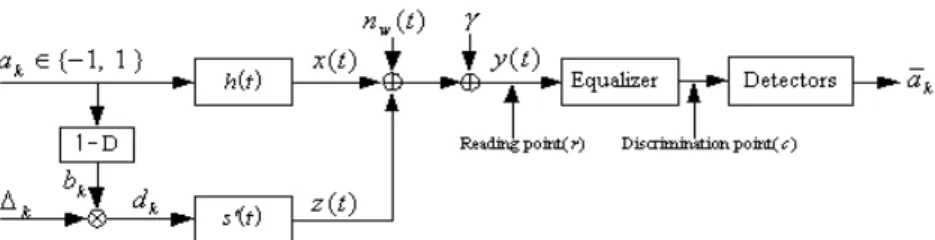
Fig. 1. Nonlinear channel model for perpendicular recording
search algorithm instead of the level slicer in DFE as detector. A path following branches in the tree
of FDTS/DF represents a permitted input sequence.
Under the RLL coded channel, the number of valid paths is reduced and the performance improvement is induced. The performance of FDTS/DF is examined at =0, 3 and 5. DDFE is the dual version of DFE. The performance improvement of DDFE results from the reduction of the error propagation by erasure declaration in decoding process. The reduction of the error propagation can be achieved by using the energy of postcursors in each DFE.
The performance of DDFE depends on the range of erasure zone and detection delay. This paper surveys the performance of DDFE when the erasure zone is between -0.25 and 0.25, and the detection delay is 12. MDFE is the simplified version of FDTS/DF with . Its detector performs binary decision on multilevel signal. The main difference between MDFE and FDTS/DF is the desired target polynomial. The desired target polynomial of FDTS/DF is a constant while that of MDFE is not.
Because of this, a Viterbi detector matched to the desired target polynomial can be concatenated with MDFE for performance improvement. This paper investigates the performance of MDFE when its desired target polynomial is 1+2D+D
2[4].
This paper is originized as follows. Section II introduces the nonlinear channel model for perpendicular recording, and Section III overviews the some conventional detection schemes. In Section IV, the simulation results are discussed. Finally, Section V remarks conclusion.
II. Channel Model
Fig. 1 shows channel model for evaluating the performance of detectors.
and
represent the precoded channel sequence, transition sequence, transition shift and AWGN, respectively.
represents the dipulse response, and transition jitter is generated by the convolution of random noise sequence
and derivative waveform of isolated transition waveform , and degree of
DC-offset is adjusted by percent ratio of amplitude of at infinite time. Then, readback waveform of channel model used at reading point is given by
∞
∞
∞
∞
′
(2.1) where,
, and
and
denote the transition width and channel bit interval. Here, the normalized recording density for recording system is defined as
, and the relationship between and normalized user density
satisfies
because
under the rate
RLL coded channel, where
is the user bit
interval. At reading point, we assume that the
noises considered are AWGN, transition jitter and
DC-offset. Transition shift for modeling transition
jitter is assumed random variable with Gaussian
distribution that is independent of
and
. Then,
can be defined as follows:
log
(2.2)
where
′
, and
,
and
denote noise powers of AWGN, transition shift and DC-offset, respectively, and | · | is the norm of vector.
III. Detection Schemes
A. PRML and NPML Systems
PRML system combines PR signaling with maximum likelihood sequence detection (MLSD). In PRML systems, the measured signal from the channel is firstly equalized to PR target, and is then followed by the Viterbi detector. PR target polynomials are chosen to permit controlled intersymbol interference (ISI) that can be handled by the Viterbi detector. The performance of PRML system depends on how overall system response
is close to the PR target polynomial
in frequency domain, where and
denote the D-transform of the recording channel and the feedforward filter response, respectively.
NPML system is devised for magnetic recording channel that provide a substantial performance improvement over PRML detector in terms of bit error rate (BER) and linear density. NPML system arises by imbedding the noise prediction/whitening process into the branch metric computation of the Viterbi detector. Reliable operation of the prediction/whitening process is achieved by using the decisions (or branch values) from the path memory of the Viterbi detector. The number of noise prediction filter (NPF) tap is fixed to 7, and the order and coefficient of PR targets are confined to 3 and positive integer, respectively. The main reason for positive coefficients of the PR targets is because the spectral characteristic of perpendicular recording channel is DC-full.
B. FDTS/DF Detector
Equalization in FDTS/DF is similar to the equalization in DFE, with the exception that forward filter in FDTS/DF can be chosen to optimize SNR
length instead of removing all causal ISI included in feedforward filter output by feedback filter (FB) of DFE. Then, the tree search detector calculates the path metric at ending point of each tree path after computing the branch metrics between the current detector input with residual ISI and the
possible noiseless sequences. Finally, FDTS/DF decides the most likely -delay input symbol to 1 if tree path with minimum path metric exists on top half of tree. Otherwise, it is determined to -1. Then, the decision symbol is saved in location of FB shift register for continuing the next process. In this paper, the number of valid tree path is reduce from 16 and 64 to 10 and 26 when and , respectively, because of employing 2/3 (1, 7) RLL code.
C. DDFE Detector
DDFE uses two DFEs that are completely identical except for the threshold level of their bit detectors.
The top DFE normally uses a threshold , while the bottom DFE uses a threshold -. If noise is small, then decisions of both DFEs are correct and identical. However, if detector input value falls within erasure zone [-, ], then decisions between the top and bottom DFE are not identical and the erasure detector flags the erasure. In that time, the threshold of two DFEs is switched to zero. The error energy of each DFE is computed across erasure period (or detection delay). Finally, at the end of erasure period, the DFE of the smallest error energy delivers the final decision, and the register contents of the selected DFE are transferred to the other one so as to realign two DFEs. In this point, the search for erasure starts again.
IV. Simulation Results
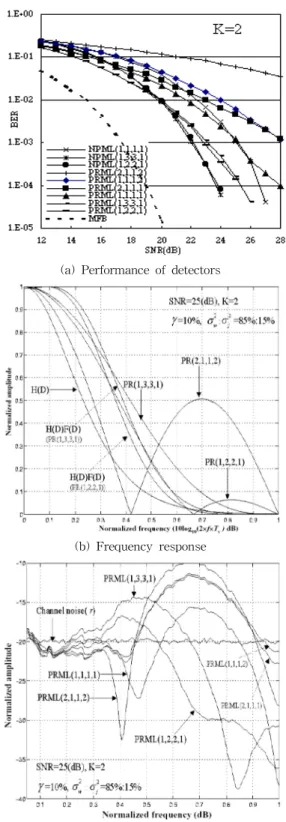
In simulation, noise power of DC-offset is fixed to 10% (% of , ), and noise power ratio of AWGN and transition jitter except for DC-offset noise from total noise is
: