635
Copyright © 2016 The Korean Society of Fisheries and Aquatic Science pISSN:0374-8111, eISSN:2287-8815
서 론
방어
(Seriola quinqueradiata)
는우리나라를비롯한일본,
하 와이등태평양에 주로분포하며,
농어목전갱이과에 속하는 어류로이중Seriola
속에속하는어류는우리나라에4
종,
전세 계에54
종이서식하는것으로알려져있다(Kim et al., 2005;
Froese and Pauli, 2016).
방어는치어시기를부유조(drifting
seaweed)
밑에서은신하며보내다이후성장과함께떠나는것
으로알려져있다
(NFRDI, 2004).
방어의생태에관한 선행연구를살펴보면 국외연구로일 본
Wakasa
만에 출현하는 방어의식성에 관한연구(Fumio, 1958),
일본주변해역의어황및자원변동,
회유경로연구(Mi- tani, 1959; Murayama, 1992),
동중국해부유조에출현하는방어치어의연령조성
(Sakakura and Tsukamoto, 1997),
일본연안부유조에출현하는방어자어와치어의식성연구
(Anraku
and Azeta, 1965)
등이있다.
일본부유조에출현한방어자어는 요각류미성숙체(copepodite)
와요각류를,
치어는요각류와갑 각류를섭식한다고하였다.
국내에서수행된방어생태에관한연구는분포와어장형성 에관한연구
(Kim et al., 2002; Chang et al., 2010)
등이있으 며,
치어와유어에관한생태적연구는통영해역뜬말에출현 한유어에관한연구(Cho et al., 2002)
가있을뿐매우부족한 실정에있다.
경제적가치가높고수요가지속적으로증가하는어류의초 기생태에관한연구는효율적인자원관리와보전에있어매우 중요하고
,
이러한연구는지속적으로이루어져야한다.
본연구한국 남해안에 출현하는 방어(Seriola quinqueradiata) 치어 및 유어의 식성
정재묵·황강석*·송세현
1·김희용
2·박정호·이정훈
국립수산과학원 연근해자원과, 1국립수산과학원 남해수산연구소 자원환경과, 2국립수산과학원 연구기획과
Feeding Habits of Juvenile and Young Yellow Tail
Seriola quinqueradiata in Coastal Waters of the South Sea, Korea
Jae-Mook Jeong, Kang-Seok Hwang*, Se-hyun Song
1
, Hee-yong Kim2
, Jeong-Ho Park and Jung-Hoon LeeCoastal Water Fisheries Resources Research Division, National Institute of Fisheries Science, Busan 46083, Korea
1
Fisheries Resources and Environment Division, National Institute of Fisheries Science, Yeosu 59780, Korea
2
Research and Development Planning Division, National Fisheries Research and Development Institute, Busan 46083, Korea The feeding habits of juvenile and young Seriola quinqueradiata , which were collected by a hand net and set net in coastal waters of the South Sea during the period from June to August 2014 and 2015, were analyzed. The size range of juveniles was 4.9-10.9 cm FL, and that of young S . quinqueradiata was 11.0-20.4 cm FL. Important prey items in the diets of juveniles were euphausiacea and copepoda, dominated by the Euphausia sp., Paracalanus sp. and Calanus sinicus while the diets of the young consisted mainly of pisces, dominated by Engraulis japonicus , Trachurus japoni- cus . Stomach content compositions differed significantly among body size levels in both the juveniles and young (ANOSIM, P <0.05). With increasing size, the mN/ST constantly decreased while the mW/ST constantly increased (one-way ANOVA). Graphical analysis of the diet composition showed that juvenile S . quinqueradiata are general- ized feeders, young is a specialized feeders characterized by strong individual feeding specialization.
Key wards: South Sea, Feeding habits, Juvenile, Young, Seriola quinqueradiata
This is an Open Access article distributed under the terms of the Creative Commons Attribution Non-Commercial Licens (http://creativecommons.org/licenses/by-nc/3.0/) which permits unrestricted non-commercial use, distribution, and reproduction in any medium, provided the original work is properly cited.
http://dx.doi.org/10.5657/KFAS.2016.0635 Korean J Fish Aquat Sci 49(5) 635-641, October 2016
Received 18 August 2016; Revised 21 October 2016; Accepted 26 October 2016
*Corresponding author: Tel: +82. 51. 720. 2290 Fax: +82. 51. 720. 2337
E-mail address: [email protected]
정재묵
ㆍ
황강석ㆍ
송세현ㆍ
김희용ㆍ
박정호ㆍ
이정훈636
의결과는방어치어와유어가우리나라해역에서어떠한먹이 생물을얼만큼섭식하는지에대한정량적인분석으로이들의 생태적지위뿐아니라
,
인공종묘생산과같은양식산업의중요 한기초자료를제공할수있을것이다.
본연구는여름철우리나라남해에출현하는방어치어와유 어의위내용물분석을통하여
1)
치어와유어의위내용물조성 을파악하고, 2)
치어와유어의크기군별먹이생물조성을통해 먹이전환이이루어지는크기를파악하고, 3)
섭식경향을분석하 였다.
재료 및 방법
연구지역 및 시료채집
본 연구에 사용된 치어 표본은
2013
년6-8
월(
수온, 6
월: 18.6℃; 7
월: 21.5℃; 8
월: 27.5℃)
에통영욕지도주변연안에서소형어선을이용해부유조에접근하여뜰채
(
망구: 70 cm;
망목
: 3 mm)
로채포하였으며,
유어표본은2015
년7-8
월(
수 온, 7
월: 21.7℃; 8
월: 26.7℃)
에 여수돌산도 연안(35°17‘N, 129°18‘E)
에서정치망(
망목크기: 10 mm,
수심: 25 m)
에어획 된개체를채집하였다.
채집된시료는위내용물의소화를방지하기위해현장에서
10%
포르말린에고정하여실험실로운반하였다
.
이후실험실에서각개체의가랑이체장(fork length, FL)
과체중을각각0.1 cm
와0.01 g
단위까지측정하였다.
측정 된개체는위를적출한뒤위내용물분석전까지5%
포르말린 에보관하였다.
위 내용물 분석
위내용물분석전
Okiyama (1988), Leis and Carson-Ewart (2004)
를참고해외부형태를 관찰한후 치어(juvenile stage)
와유어단계(young stage)
로구분하였다.
유사종인부시리(Se- riola lalandi)
와의오동정을방지하기위해지느러미기조수(
방 어,
등지느러미: Ⅴ-Ⅵ, 29-36,
뒷지느러미: Ⅱ-Ⅰ, 17-22;
부시 리,
등지느러미: Ⅵ-Ⅶ, 30-36,
뒷지느러미: Ⅱ-Ⅰ, 19-22)
를계 수하였다.
각개체의위를해부현미경아래에서침핀과핀셋을 이용해절개한뒤,
먹이생물을종류별로구분하였다.
발견된먹 이생물을가능한종(species)
수준까지분류하였으며,
소화가진 행되어분류가어려울경우과(family)
또는목(order)
수준으로 나타내었다.
위내용물이없었던개체는분석에서제외시켰다.
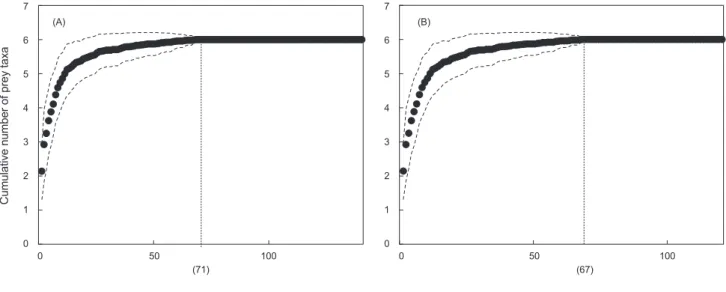
위내용물조사를위한충분한표본크기를결정하기위하여 누적먹이곡선
(cumulative prey curve)
을사용하였다(Ferry and Cailliet, 1996).
분석된위내용물은요각류(copepoda),
갯가재 류(stomatopoda),
단각류(amphipoda),
어류(Pisces),
새우류(Ma crura),
게류(Brachyura),
난바다곤쟁이류(Euphausiacea)
로구분하여위의순서를100
번무작위화한뒤,
평균과표준편 차를그래프상에나타내었다.
이때곡선의점근선은위내용물 분석을위한최소표본크기를나타낸다.
위내용물분석결과는다음과같은식으로각먹이생물에대하여출현빈도
(%F),
개체 수비(%N),
습중량비(%W)
로나타냈다(Hyslop, 1980).
%F = A
i/ N × 100
%N = N
i/ N
total× 100
%W = W
i/ W
total× 100
여기서
, A
i는위내용물중해당먹이생물이발견된방어의개 체수이고, N
은먹이를섭식한방어의총개체수, N
i와W
i는해 당먹이생물의개체수와습중량, N
total과W
total은전체먹이개체 수와습중량이다.
먹이생물의 상대중요성지수
(index of relative importance, IRI)
는Pinkas et al. (1971)
의식을이용하여구하였다.
IRI = (%N +%W)×%F
이후백분율로환산하여상대중요성지수비
(%IRI)
로나타내 었다.
%IRI = IRI
i/ ∑
nIRI ×100
i=1
치어와유어의가랑이체장별위내용물변화를분석하기위 해각각
3 cm
간격으로구분하여(juvenile stage (n=119): <5.0;
5-7.9; 8-10.9 cm, young stage (n=108): 11-13.9; 14-16.9; 17- 19.9; 20 cm <),
각체장군에서먹이분류군조성을분석하였다. 자료분석
가랑이체장에따른치어와유어의먹이생물조성의차이를
알아보기위해
ANOSIM
분석을통하여유의성을검증하였다.
먹이섭식특성을파악하기위해크기군별개체당먹이의평균 개체수
(mean number of preys per stomach, mN/ST)
와개체 당먹이의평균중량(mean weight of preys per stomach, mW/
ST)
을구하였으며, one-way ANOVA
를이용하여유의성을검 정하였다.
치어와 유어의 가랑이 체장별먹이생물의 중복도(Schoener, 1970)
는dietary overap index
를이용하여다음과 같이구하였다.
C
xy= 1 - 0.5( ∑|P
xi- P
yi|)
여기서
, P
xi와P
yi는x, y
그룹에서먹이생물i
의습중량비(%W)
이다.
중복도지수값의범위는0
에서1
까지이고, 1
에가까울수 록먹이생물의중복도가높아지는것으로볼수있다.
중복도값이
0.6
이상이면유의하게중복되는 것으로간주하였다(Wal-
lace, 1981).
상기분석을위해SPSS v18
과PRIMER v5
프로 그램을사용하였다(Clarke and Gorley, 2001).
방어치어와유어의먹이중요도
(dominant or rare),
섭식전략(specialist or generalist),
섭식폭(niche width)
은 도해적방법(graphical method)
을사용하여나타내었다(Amundsen et al.,
1996).
이방법은출현빈도(%F)
에대하여prey- specific abun-
dance
를도식화함으로써나타내며, prey-specific abundance
는 다음과같이구하였다P
i= (∑S
i/ S
i)×100
여기서
, P
i는먹이생물i
의prey -specific abundance, S
i는위 내용물중먹이생물i
의개체수, S
ti는먹이생물i
를섭식한개체 의위내용물중전체먹이생물개체수이다.
결 과
위내용물 조성
위내용물이발견된개체
(
치어: 119
개체;
유어: 108
개체)
를대 상으로조사한누적먹이곡선은치어71
개체,
유어67
개체에서 점근선에근접하였다(Fig. 1).
이번연구는각각71
개체와67
개체이상의표본을분석하였으므로방어치어와유어의위내 용물을설명하기에충분했다.
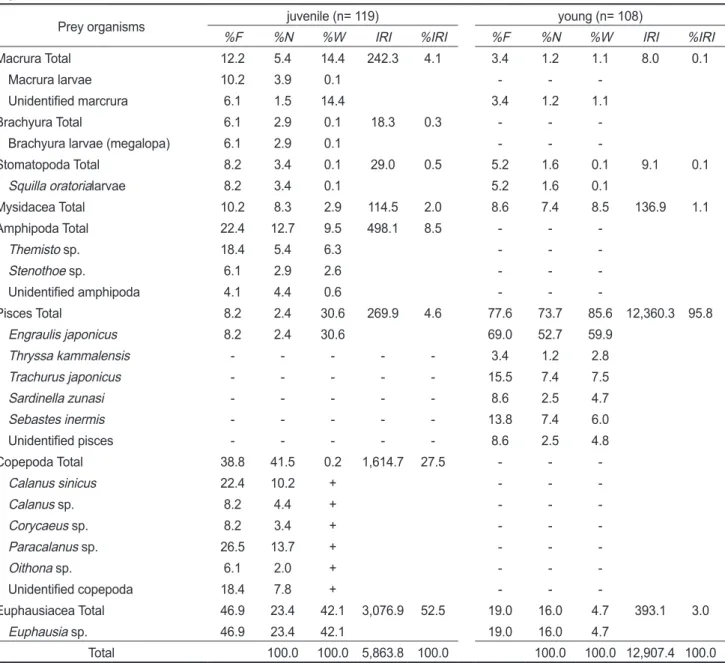
방어치어의가장중요한먹이생 물은IRI 52.5%
를차지한난바다곤쟁이류(Euphausiacea, 46.9
%F, 23.4 %N, 42.1 %W)
였으며,
그다음으로는IRI 27.5%
를 차지한요각류(Copepoda, 28.8 %F, 41.5 %N, 0.2 %W)
였다(Table 1).
단각류(Amphipoda)
와 어류(Pisces),
새우류(Ma- crura)
는각각8.5, 4.6, 4.1 %IRI
를나타냈다.
단각류는 섭식 된대부분의종이Themisto sp.
와같은부유성단각류였다.
이 들외에곤쟁이류(Mysidacea),
갯가재류(Stomatopoda),
게류(Brachyura)
등도섭식되었지만, %IRI
는2.0%
이하로낮은비 율을보였다(Table 1).
방어유어의가장중요한먹이생물은
IRI 95.8%
를차지한어 류(77.6 %F, 73.7 %N, 85.6 %W)
였는데,
어류중에서는멸치(Engraulis japonicus)
가가장많이섭식되었으며,
전갱이(Tra-
churus japonicus),
볼락(Sebastes inermis)
순이었다.
그다음으 로는각각%IRI 3.0%
와1.1%
를차지한난바다곤쟁이류와곤 쟁이류였다(Table 1).
이들외에갯가재류와새우류도섭식되 었지만, %IRI
는0.1%
이하로매우낮은비율을보였다.
치어기 에출현했던요각류와단각류는발견되지않았다.
치어와유어 의위내용물조성은통계적으로유의한차이를보였다(ANO- SIM, P<0.05).
성장에 따른 먹이생물 조성, 평균 먹이생물 개체수와 중량, 먹이 중복도
치어의가랑이체장
(FL)
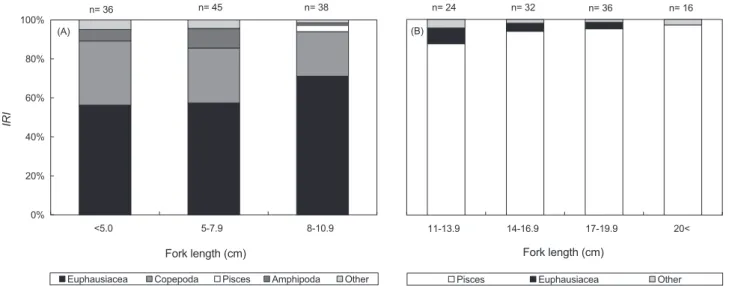
에따른먹이생물조성을살펴본결과,
<5.0 cm
크기군에서는난바다곤쟁이류의%IRI
가56.3%
로가 장높은비율을차지하였고
,
다음으로는요각류가32.8%
로나 타났다(Fig. 2A). 5-7.9 cm
크기군은<5.0 cm
크기군과%IRI
가매우유사한양상을보였다
. 8-10.9 cm
크기군에서는요각류와단각류비율이감소하고
,
난바다곤쟁이류는소폭증가하였 으며,
어류가적은비율이었지만,
출현하기시작하였다.
치어의 가랑이체장별먹이생물조성은유의한차이를보이지않았다(ANOSIM, P>0.05).
크기군별방어치어의개체당평균먹이 생물의개체수(one-way ANOVA, F= 5.946, P<0.05)
와중량(one-way ANOVA, F= 7.708, P<0.05)
은모두통계적으로유의한차이가있었다
(Fig. 3).
치어의먹이생물중복도지수는모든크기군사이에서
0.77
이상으로높게나타나,
유의하게중복되었다
(Table 2A).
유어는
11-13.9 cm
크기군부터어류의비율이87.6%
로큰폭 으로상승하기시작하여14-16.9, 17-19.9, 20 cm <
크기군까지 모든크기군에서어류가%IRI 93.9%
이상으로매우높은비율을보였다
(Fig. 2B).
유어의가랑이체장별먹이생물조성은유0 1 2 3 4 5 6 7
0 50 100
(71)
Cumulative number of prey taxa
Number of stomach samples (A)
0 1 2 3 4 5 6 7
0 50 100
(67)
Number of stomach samples (B)
11-13.9 14-16.9 17-19.9 20<
Fork length (cm)
Pisces Euphausiacea Other
n= 24 n= 32 n= 36 n= 16
0%
20%
40%
60%
80%
100%
<5.0 5-7.9 8-10.9
IRI
Fork length (cm)
Euphausiacea Copepoda Pisces Amphipoda Other
n= 36 n= 45 n= 38
(A) (B)
0 5 10
0 4 8 12
<5.0 5-7.9 8-10.9 11-13.9 14-16.9 17-19.9 20<
mN/ST mW/ST
Fork length (cm)
mN/ST
mW/ST(
g)
0 50 100
0 0.5 1 0 0.5 1
Dominant Speicalization High BPC
High WPC Generalization
Rare
(i) (ii) (ii)
Frequence of occurrence Frequence of occurrence
Prey-specific abundance (%)
MaSt BrPi
Eu
My Am
Co
(A) juvenile (C)
0 0.5 1
Ma
Pi
St Eu My (B) young
Frequence of occurrence
Fig. 1. Cumulative prey curves of prey taxa per stomach of Seriola quinqueradiata (A: juvenile stage; B: young stage).
정재묵
ㆍ
황강석ㆍ
송세현ㆍ
김희용ㆍ
박정호ㆍ
이정훈638
의한차이를보이지않았다
(ANOSIM, P>0.05).
크기군별방어 유어의개체당평균먹이생물의개체수(one-way ANOVA, F=
9.547, P>0.05)
는통계적으로유의한차이를보이지않았으며,
평균먹이생물의중량(one-way ANOVA, F= 6.915, P<0.05)
은 통계적으로유의한차이가있었다(Fig. 3).
유어의중복도지수 또한모든크기군사이에서0.9
이상으로높게나타나,
유의하게 중복되었다(Table 2B).
섭식경향
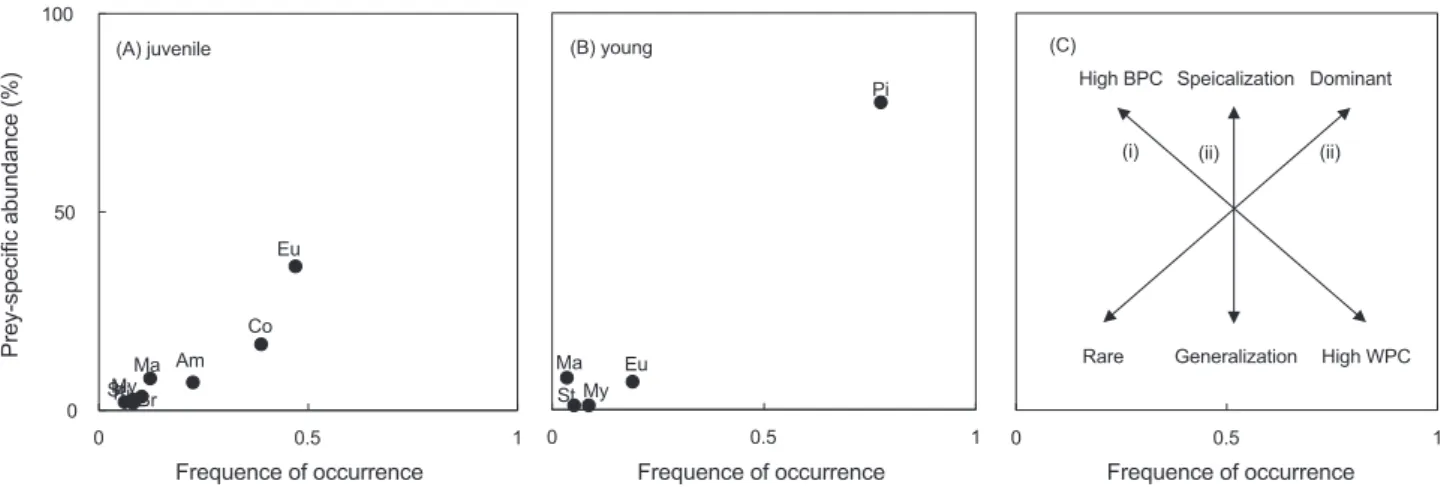
방어치어와유어의섭식전략을파악하기위해먹이생물을도
해적방법으로나타낸결과는
Fig. 4
와같다.
방어치어는위내 용물중난바다곤쟁이류와요각류는그래프의중앙아래쪽에 위치해있으며,
단각류와 어류,
새우류는그래프의왼쪽아래 에위치해있는소수먹이생물로나타나,
섭식이일반화된gen- eralist feeder
의양상을나타내었다(Fig. 4A).
방어유어는어류 의비율이매우높고그래프의우측상단에위치해,
섭식이특 화된specialist feeder
의양상을나타낸것을확인할수있었다.
그외먹이생물인난바다곤쟁이류,
곤쟁이류,
새우류,
갯가재류 는그래프의왼쪽아래에위치해있는소수의먹이생물로나타 났다(Fig. 4B).
Table 1. Composition of the gut contents of juvenile and young Seriola quinqueradiata by frequency of occurrence, number and relative importance (RI)
Prey organisms juvenile (n= 119) young (n= 108)
%F %N %W IRI %IRI %F %N %W IRI %IRI
Macrura Total 12.2 5.4 14.4 242.3 4.1 3.4 1.2 1.1 8.0 0.1
Macrura larvae 10.2 3.9 0.1 - - -
Unidentified marcrura 6.1 1.5 14.4 3.4 1.2 1.1
Brachyura Total 6.1 2.9 0.1 18.3 0.3 - - -
Brachyura larvae (megalopa) 6.1 2.9 0.1 - - -
Stomatopoda Total 8.2 3.4 0.1 29.0 0.5 5.2 1.6 0.1 9.1 0.1
Squilla oratorialarvae 8.2 3.4 0.1 5.2 1.6 0.1
Mysidacea Total 10.2 8.3 2.9 114.5 2.0 8.6 7.4 8.5 136.9 1.1
Amphipoda Total 22.4 12.7 9.5 498.1 8.5 - - -
Themisto sp. 18.4 5.4 6.3 - - -
Stenothoe sp. 6.1 2.9 2.6 - - -
Unidentified amphipoda 4.1 4.4 0.6 - - -
Pisces Total 8.2 2.4 30.6 269.9 4.6 77.6 73.7 85.6 12,360.3 95.8
Engraulis japonicus 8.2 2.4 30.6 69.0 52.7 59.9
Thryssa kammalensis - - - - - 3.4 1.2 2.8
Trachurus japonicus - - - - - 15.5 7.4 7.5
Sardinella zunasi - - - - - 8.6 2.5 4.7
Sebastes inermis - - - - - 13.8 7.4 6.0
Unidentified pisces - - - - - 8.6 2.5 4.8
Copepoda Total 38.8 41.5 0.2 1,614.7 27.5 - - -
Calanus sinicus 22.4 10.2 + - - -
Calanus sp. 8.2 4.4 + - - -
Corycaeus sp. 8.2 3.4 + - - -
Paracalanus sp. 26.5 13.7 + - - -
Oithona sp. 6.1 2.0 + - - -
Unidentified copepoda 18.4 7.8 + - - -
Euphausiacea Total 46.9 23.4 42.1 3,076.9 52.5 19.0 16.0 4.7 393.1 3.0
Euphausia sp. 46.9 23.4 42.1 19.0 16.0 4.7
Total 100.0 100.0 5,863.8 100.0 100.0 100.0 12,907.4 100.0
+: less than 0.1%; -: no occurrence
방어 치어와 유어의 식성
639
고 찰
본연구에서방어치어의가장중요한먹이생물은난바다곤 쟁이류
(Euphausia sp.)
였다.
난바다곤쟁이류는 해양생태계에 서식물플랑크톤과같은일차생산자와상위포식자를연결하는 중요한역할을하며(Mauchline, 1980),
서해와남해의플랑크 톤군집에서도우점하여출현하는것으로알려져있다(Kim et al., 2010).
하지만일본Sendai
만에출현하는방어치어의가 장중요한먹이생물은요각류로본연구와는다소차이를보였 는데(Safran, 1990),
이는선행연구가수행된환경이만(bay)
이 었으며,
분석에이용된개체들의크기군별개체수에서차이가 있어우점먹이생물이다른것으로판단되었다.
두번째로우점한먹이생물은요각류였다
.
요각류는치어기단계에있는많 은해산어류의중요한먹이생물로알려져있는데(Jeong et al., 2015; Kim et al., 2015; Kim et al., 2016),
이는부유조에은신 해생활하는방어치어에게섭식이용이하고,
주변에풍부하게 출현했기때문인것으로판단되었다.
방어유어는어류가IRI
95.8%
로극우점하였는데,
이는유어기부터난바다곤쟁이류,
요각류와같은소형갑각류에서어류를주먹이원으로전환한 것으로판단되었다
.
어류중에는멸치가가장우점하였는데,
남 해에출현하는어식성어류중멸치를많이섭식한어류는삼치(Scomberomorus niphonius),
고등어(Scomber japonicus),
달 고기(Zeus faber)
등,
다수보고되어있었다(Huh et al., 2006;
Yoon et al., 2008; An et al., 2012).
방어유어를비롯해남해에 출현하는다수의어식성어류에서멸치의섭식비율이높은것 Table 2. Proportional food overlap coefficients (Schoener’s index) of the diet among juvenile (A) and young (B) Seriola quinquera- diata size classes(A)
Size class (cm) <5.0 5-7.9
5-7.9 0.82
8-10.9 0.77 0.84
(B)
Size class (cm) 11-13.9 14-16.9 17-19.9
14-16.9 0.94
17-19.9 0.92 0.99
20< 0.90 0.96 0.97
0 1 2 3 4 5 6 7
0 50 100
(71)
Cumulative number of prey taxa
Number of stomach samples (A)
0 1 2 3 4 5 6 7
0 50 100
(67)
Number of stomach samples (B)
11-13.9 14-16.9 17-19.9 20<
Fork length (cm)
Pisces Euphausiacea Other
n= 24 n= 32 n= 36 n= 16
0%
20%
40%
60%
80%
100%
<5.0 5-7.9 8-10.9
IRI
Fork length (cm)
Euphausiacea Copepoda Pisces Amphipoda Other
n= 36 n= 45 n= 38
(A) (B)
0 5 10
0 4 8 12
<5.0 5-7.9 8-10.9 11-13.9 14-16.9 17-19.9 20<
mN/ST mW/ST
Fork length (cm)
mN/ST
mW/ST(
g)
0 50 100
0 0.5 1 0 0.5 1
Dominant Speicalization High BPC
High WPC Generalization
Rare
(i) (ii) (ii)
Frequence of occurrence Frequence of occurrence
Prey-specific abundance (%)
MaSt BrPi
Eu
My Am
Co
(A) juvenile (C)
0 0.5 1
Ma
Pi
St Eu My (B) young
Frequence of occurrence
Fig. 2. Ontogenetic changes in the composition of gut contents by RI of juvenile (A) and young (B) Seriola quinqueradiata.
0 1 2 3 4 5
0 50 100
(71)
Cumulative number of prey taxa
Number of stomach samples
0 1 2 3 4 5
0 50 100
(67)
Number of stomach samples
11-13.9 14-16.9 17-19.9 20<
Fork length (cm)
Pisces Euphausiacea Other
n= 24 n= 32 n= 36 n= 16
0%
20%
40%
60%
80%
100%
<5.0 5-7.9 8-10.9
IRI
Fork length (cm)
Euphausiacea Copepoda Pisces Amphipoda Other
n= 36 n= 45 n= 38
(A) (B)
0 5 10
0 4 8 12
<5.0 5-7.9 8-10.9 11-13.9 14-16.9 17-19.9 20<
mN/ST mW/ST
Fork length (cm)
mN/ST
mW/ST(
g)
0 50 100
0 0.5 1 0 0.5 1
Dominant Speicalization High BPC
High WPC Generalization
Rare
(i) (ii) (ii)
Frequence of occurrence Frequence of occurrence
Prey-specific abundance (%)
MaSt BrPi
Eu
My Am
Co
(A) juvenile (C)
0 0.5 1
Ma
Pi
St Eu My (B) young
Frequence of occurrence
Fig. 3. Variation of mean number of preys per stomach (mN/ST,individuals/stomach) and mean weight of prey per stomach (mW/
ST, g/stomach) of juvenile and young Seriola quinqueradiata among size classes.
정재묵
ㆍ
황강석ㆍ
송세현ㆍ
김희용ㆍ
박정호ㆍ
이정훈640
은멸치가남해주변해역에서풍부하게출현해섭식이용이하 고
,
영양적측면에서효율이높기때문인것으로판단되었다.
방어치어는가장작은크기군에서는요각류의비율이높다 가가랑이체장이증가함에따라요각류는감소하고난바다곤쟁 이류가증가하였으며
,
어류가출현하기시작하였다.
이는성장 에따른일반적인먹이생물의변화로,
주로섭식되는먹이의에 너지효율과관련이있는것으로추측된다(Gerking, 1994).
방 어유어에서는모든크기군에서어류가대부분으로차지하였 다.
이는방어의생활사에서요각류,
난바다곤쟁이류와같은소 형갑각류에서멸치,
전갱이와같은어류로먹이전환을하는것 으로판단되었으며,
그크기는가랑이체장약13 cm
인것으로 추정되었다.
방어치어와유어의평균먹이생물의개체수(mN/
ST)
는가장작은크기군에서가장큰크기군으로갈수록지속 적으로감소했다.
이는요각류,
난바다곤쟁이류와같은소형갑 각류에서어류로먹이전환을했기때문이고,
평균먹이생물의중량
(mW/ST)
은반대로지속적으로증가하는양상을보였는데
,
이는앞서언급한성장에따라일어나는일반적인현상에대 한근거로볼수있을것이다.
출현빈도에대한특정먹이생물우점도그래프상에나타내는 방법은
Amundsen et al. (1996)
에의해제안되었으며,
많은연 구에서어류의섭식형태및섭식전략을분석하는데유용하게 사용되었다.
먹이생물종(
또는분류군)
이그래프에서상부에위 치할수록우점먹이생물이며,
좁은섭식폭을가진섭식특화종 임을나타낸다.
어류의섭식전략에서섭식특화종은좁은섭식 폭을가지는반면,
섭식일반종은넓은섭식폭을가진다(Pianka,
1988).
본연구결과,
방어치어는난바다곤쟁이류와요각류를가장우점적으로섭식하고
,
방어유어는대부분의개체가어류 를집중적으로섭식하는것으로판단되었다.
치어시기에gen-
eralist feeder
의특징을나타낸것은부유조주변에서은신하며 먹이를섭식해야하고(Cho et al., 2002),
포식자로부터의포식 압이작용한결과인것으로추측되었다(wootton, 1990).
유어 시기에는specialist feeder
경향을보였는데,
이는방어유어가 부유조에서벗어나선호하는먹이를섭식할수있는향상된유 영능력과에너지요구량증가가밀접한관련이있는것으로판 단되었다.
사 사
본연구는
2016
년도국립수산과학원수산과학연구사업근해어업자원조사
(R2016026)
의 지원으로 수행되었으며,
연구비 지원에감사드립니다.
References
Amundsen PA, Gabler HM and Staldvik FJ. 1996. A new ap- proach to graphical analysis of feeding strategy from stom- ach contents data modification of Costello (1990) method. J Fish Biol 48, 607-614.
An YS, Park JM, Ye SJ, Jeong JM and Baeck GW. 2012. Feed- ing habits of john dory, Zeus faber in the coastal waters of Geomun-do, Korea. Korean J Ichthyol 24, 20-26.
Anraku M and Azeta M. 1965. The feeding habits of larvae and juveniles of the yellowtail, Seriola quinqueradiata Tem- minck et Schlegel, associated with floating seaweeds. Bull Seikai Reg Fish Res Lab 33, 13-45.
Chang DS, Yoo JT, Kim BY, Lee SJ, Kwon DH, Koo JH, Ahn JM and Oh IY. 2010. Acharacteristics on the forming of fishing ground and population ecological study of Yellow
0 1 2 3 4 5 6 7
0 50 100
(71)
Cumulative number of prey taxa
Number of stomach samples (A)
0 1 2 3 4 5 6 7
0 50 100
(67)
Number of stomach samples (B)
11-13.9 14-16.9 17-19.9 20<
Fork length (cm)
Pisces Euphausiacea Other
n= 24 n= 32 n= 36 n= 16
0%
20%
40%
60%
80%
100%
<5.0 5-7.9 8-10.9
IRI
Fork length (cm)
Euphausiacea Copepoda Pisces Amphipoda Other
n= 36 n= 45 n= 38
(A) (B)
0 5 10
0 4 8 12
<5.0 5-7.9 8-10.9 11-13.9 14-16.9 17-19.9 20<
mN/ST mW/ST
Fork length (cm)
mN/ST
mW/ST(
g)
0 50 100
0 0.5 1 0 0.5 1
Dominant Speicalization High BPC
High WPC Generalization
Rare
(i) (ii) (ii)
Frequence of occurrence Frequence of occurrence
Prey-specific abundance (%)
MaSt BrPi
Eu
My Am
Co
(A) juvenile (C)
0 0.5 1
Ma
Pi
St Eu My (B) young
Frequence of occurrence
Fig. 4. Graphical representation of feeding pattern of juvenile (A) and young (B) Seriola quinqueradiata in the coastal waters of South Sea, Korea. (Eu, Euphausiacea; Co, Copepoda; Am, Amphipoda; Ma, Macrura; My, Mysidacea; St, Stomatopoda; Br, Brachyura; Pi, Pisces).
(C) Explanatory diagram for interpretation of nichewidth contribution [axis i, withinphenotypic component (WPC) or betweenphenotypic component (BPC)] of the study population, feeding strategy (axis ii), and prey importance (axis iii).
tail, Seriola quinqueradiata, in the coastal waters off Gim- nyeong of Jeju Island, Korea. Korean J Fish Technol 46, 406-415. http://dx.doi.org/10.3796/KSFT.2010.46.4.406.
Cho SH, Myoung JG, Kim JM, Lee JH and Park YJ. 2002.
Study on the young yellowtail, Seriola quinqueradiata (Ca- rangidae, Perciformes) from drifting seaweeds in the coast of Tongyeong, Korea. J Korean Fish Soc 35, 583-588.
Clarke KR and Gorley RN. 2001. Getting started with PRIMER v5: User Manual/Tutorial. Primer-E, Plymouth.
Froese R and Pauly D. 2016. Fishbase. World wide wed elec- tronic publication. Retrieved from http://www.fishbase.org, version (01/2016).
Gerking SD. 1994. Feeding ecology of fish. Academic Press, Sandiego, U.S.A., 416.
Huh SH, Park JM and Baeck GW. 2006. Feeding habits of span- ish mackerel Scomberomorus japonicus in the Southern Sea, Korea. J Korean Fish Soc 39, 35-41.
Ferry LA and Cailliet GM. 1996. Sample size and data analy- sis: are we characterizing and comparing diet properly. In:
MacKinlay, D. and K. Sheare (eds.), Feeding Ecology and Nutrition in Fish, Symp. Proc., American Fisheries Society, San Francisco, CA, U.S.A., 71-80.
Fumio M. 1958. Feeding habits of the Yellow-tail, Seriola quin-
queradiata T. & S., caught in Wakasa bay, the Japan Sea,
based on its stomach contents-I food elements and their sea- sonal variation. Japanese Soc Sci Fish 24, 176-181. http://doi.org/10.2331/suisan.24.176.
Jeong JM, Kim HJ, Ye SJ, Yoem SD, Park JH and Baeck GW.
2015. Diet composition of juvenile sea perch, Lateolabrax
japonicus in the tidal creek at Sangnae-ri, Suncheon, Ko-
rea. Korean J Fish Technol 51, 221-226. http://dx.doi.org/10.3796/KSFT.2015.51.2.221.
Kim HJ, Jeong JM, Ye SJ, Baeck GW and Huh SH. 2016. Feed- ing habits of juvenile of Gymnogobius heptacanthus in the coastal waters of Geoje, Korea. Korean J Ichthyol 28, 41-46.
Kim HY, Lim YN, Jeong JM, Kim HJ and Baeck GW. 2015. Diet composition of juvenile Trachurus japonicus in the coastal waters of Geumodo Yeosu, Korea. Korean J Fish Technol 51, 637-643. http://dx.doi.org/10.3796/KSFT.2015.51.4.637.
Kim HS, Ju SJ and Ko AR. 2010. Comparisons of feeding ecol- ogy of Euphausia pacifica from Korean waters using lipid composition. Ocean and Polar Res 32, 165-175.
Kim IS, Choi Y, Lee CR, Lee YJ, Kim BJ and Kim JH. 2005. Il- lustrated Book of Korean Fishes. Kyo-hak Publ. Co, Seoul, Korea, 615.
Kim JT, Rho HK, Kim SH, Ko JC, Ahn YH, Choi CM. 2002.
Characteristics of catch fluctuation and distribution of Yel- low tail, Seriola quinqueradiata, Temminck et Schlegel, in Korean waters. Korean J Fish Technol 38, 11-19.
Leis JM and Carson-Ewart BM. 2004. The Larvae of Indo-Pa- cific Coastal Fishes: An Identification Guide to Marine Fish Larvae, 2nd. Brill, Boston, 850.
Mauchline J. 1980. The biology of the euphausiids. Adv Mar Biol 18, 373-623.
Mitani F. 1959. On shoals of the Yellow tail, Seriola quinquera-
diata migrating to the Tsushima Island. Bull Japanese Soc
Sci Fish 24, 888-892.Murayama T. 1992. Migration of young Yellow tail in the Japan Sea estimated from tagging experiments. Japanese Soc Sci Fish 58, 417-426.
NFRDI (National Fisheries Research and Development Insti- tute). 2004. Commercial Fishes of the Coastal & Offshore Waters in Korea. Natl Fish Res Dev Ins, Busan, Korea, 333.
Okiyama M. 1988. An Atlas of the Early Stage Fishes in Japan.
Tokai University Press, Tokyo, Japan, 1154 pp.
Pianka ER. 1988. Evolutionary Ecology 4th ed. Harper Collins New York, U.S.A., 468.
Pinkas L, Oliphant MS and Iverson ILK. 1971. Food habits of albacore, bluefin tuna and bonito in California waters. Fish Bull 152, 1-105.
Safran P. 1990. Drifting seaweed and associated ichthyofauna:
floating nursery in Tohoku waters. La mer 28, 225-239.
Sakakura Y and Tsukamoto K. 1997. Age composition in the schools of juvenile yellowtail Seriola quinqueradiata as- sociated with drifting seaweeds in the East China Sea. Fish Sci 63, 37-41.
Schoener TW. 1970. Non-synchronous spatial overlap of lizards in patchy habitats. Ecol 51, 408-418.
Wallace RK. 1981. An assesment of diet-overlap indexes. Trans Am Fish Soc 110, 72-76.
Wootton RJ. 1990. Ecology of teleost fishes. Champman Holl, Newyork, U.S.A., 404.
Yoon SJ, Kim DH, Baeck GW and Kim JW. 2008. Feeding hab- its of chub mackerel Scomber japonicus in the South Sea of Korea. J Korean Fish Soc 41, 26-31.