개념이해와 학습활동을 고려한 네트워크 및 디지털 창작도구 교육과정 모델 개발
*
성영훈*⋅정영식**⋅박남제***
진주교육대학교 컴퓨터교육과*⋅전주교육대학교 컴퓨터교육과**⋅제주대학교***
요 약
본 연구는 학교현장의 SW교육과정 적용을 위해 SW교육 중 네트워크 및 디지털 창작도구 교육과정에 대한 연구이다. 이를 위해 국내외 SW교육과정 분석을 통한 주요한 키워드를 추출하여 개념이해와 학습활동 요소를 각 영역별 특성에 맞게 재구조화한 교육과정 모델을 개발하였다. 네트워크 영역은 개념이해 중심, 디지털 창작도 구 영역은 활동중심의 형태로 영역별 교육과정을 모델링하였으며, 이를 기반으로 영역별 내용요소를 구성하여 전문가 검증을 통한 타당도를 제시하였다. 또한 다른 영역의 내용요소들을 결합하여 학교에서 재구성하기 쉽게 제시되었고 연구의 결과는 국내 SW교육과정 표준모델 적용을 위한 기초연구 자료로써 활용되기를 기대한다.
키워드 : SW교육과정, 네트워크 교육과정, 디지털 창작도구, 디지털 리터러시, SW교육모델
Development of Network and Digital creation tools Curriculum Model to consider understanding concepts and learning activity
Younghoon Sung*, Youngsik Jeong**, Namje Park***
Chinju National University of education*⋅Jeonju National University of education**⋅ Jeju National University***
ABSTRACT
This paper is a research on the curriculums of network and digital creation tools among SW education in order to apply them to SW curriculum in education fields. For doing so, a curriculum model was developed by extract- ing main key words through the analyses of domestic and foreign SW curriculum, and reorganization of concept understanding and learning activity elements was made so as to be fit to characteristics of each curriculum. And curriculums were remodeled by curriculum such like concept understanding was focussed in network, activities in digital creation tools and its validity was suggested through expert verification by composing contents elements based on the results. Also, this model was proposed so that each school could recompose it easily by combining contents elements of other curriculums. Therefore, the suggested model could be utilized as a basic research data in applying domestic SW curriculum standard model.
Keywords : SW curriculum, Network curriculum, Digital creation tools, Digital Literacy, SW education model
이 논문은 한국정보교육학회 2016년 10월 학술논문집(제7권 제3호)의 내용을 보완·확장하였음 교신저자 : 박남제(제주대학교 초등컴퓨터교육전공)
논문투고 : 2016-11-08 논문심사 : 2016-11-08 심사완료 : 2016-12-07
December 2016, pp. 563-574
1. 서론
소프트웨어(SW)가 중요시되는 시대로 접어들면서 컴 퓨터교육 분야에서는 기존의 지식정보화사회에서 필요 로 했던 ICT 활용 중심의 교육에서 학습자의 창의성, 비판적 사고력, 의사소통능력과 같은 고등사고능력과 문 제해결력을 향상시킬 수 있는 SW교육 중심으로 변화하 고 있다[5]. SW교육에서 컴퓨터과학 개념과 원리 이해 를 위해 컴퓨팅 사고(Computational thinking) 기반의 일상생활 문제해결과정을 다루고 있으며 프로그래밍 교 육 등 다양한 방법이 활용되고 있다[2][3][21]. 다양한 SW교육에서 문제해결능력 향상을 위해 정보의 가공을 위한 검색과 수집, 자신의 창작적 결과물을 유통하기 위 한 네트워크와 관련된 이해와 지식도 필요하며 정보수 집, 가공 및 창의적 표현을 위한 학생들의 디지털 리터 러시 능력이 중요시되고 있다[9].
SW교육과 관련하여 선진국의 경우를 살펴보면 미국 CSTA(2016)의 개정되고 있는 표준안에서는 컴퓨터과학 뿐만 아니라 모든 분야에서 컴퓨팅 사고 기반의 문제해 결방법이 적용될 수 있도록 단계(Levels), 개념들 (Concepts)과 학습활동들(Practices)로 나누어진 체계적 인 컴퓨터과학교육 프레임워크를 만들고 있다[5]. 또한 영국의 컴퓨팅 교과에 대한 교사 가이드라인에서는 크 게 컴퓨터과학, 정보기술영역, 디지털 리터러시 영역으 로 구분되는 대표적인 개념들을 규정하여 이에 따른 학 습내용요소를 제시하고 있다[1].
국내에서도 SW교육에 대한 내용을 강화한 2015 개정 교육과정을 마련하여 학생들의 컴퓨팅사고 기반의 문제 해결력 향상을 위한 내용을 구성하였으나 상대적으로 정보관리, 표현과 관련된 컴퓨터 활용부분에 대한 내용 은 상당부분 축소되었다[17]. 그리고 내용체계 기술에서 개념에 대한 이해와 역량 및 활동에 대한 기술이 복잡하 고 분류되지 않아 제시되고 있는 영역을 기반으로 학교 의 교육과정을 구성하여 운영하기에는 부족한 점이 많 다. 또한 한국정보교육학회(KAIE)에서 국내 2015 개정 교육과정에서 제시하고 있는 제한적인 17시간의 형식적 틀을 벗어나고 SW교육목적 달성을 위해 2015년 SW 교 육과정 표준모델을 개발하였다. 개발한 SW교육 내용체 계를 살펴보면 크게 소프트웨어, 컴퓨터 시스템, 융합활 동 3개 영역으로 구분하고 학년별 구분없이 학습할 수
있도록 7단계로 구분하여 제시하였다[23]. 특히 네트워 크 및 창작도구 영역에 대해서 살펴보면 학습단계와 내 용구성요소의 연관성 및 위계성이 부족하여 학교현장에 바로 적용하기에는 보완해야 할 부분이 있다[22].
본 연구에서는 KAIE(2015)에서 개발한 SW교육과정 표준모델의 영역 중 네트워크 및 창작도구 영역에 대해 서 국내외 SW교육과정 관련 내용체계 분석과 이를 통 해 얻은 시사점으로 학교현장에 보다 쉽게 적용할 수 있는 교육과정 모델을 제안하였다. 또한 KAIE 창작도 구 영역의 명칭과 관련하여 다양한 형태의 정보를 디지 털화하여 처리, 창작을 위해 활용하는 것으로 디지털 창 작도구라 정의하여 기술하였다[22].
2. 관련연구
2.1 국내외 SW교육과정 영역 구조
2.1.1 국내 SW교육과정
2015년 KAIE의 SW교육 표준모델에서 제시하고 있 는 교육과정의 영역구조는 학년별 구분없이 학습할 수 있도록 소프트웨어(정보, 문제해결, 알고리즘, 프로그래 밍), 컴퓨터시스템(정보기기, 운영체제, 네트워크), 융합 활동(정보윤리, 창작도구, 로봇) 3영역과 10개 하위영역 으로 구성하였으며 본 연구와 관련된 영역은 다음과 같 다[22].
첫째, 컴퓨터시스템 영역에 포함되어 있는 네트워크 영역은 가정 , 학교구성원들의 정보유통에 대한 이해와 인터넷 기반 정보생성, 전송, 검색에 대한 지식이해와 네트워크 환경설정 방법을 학습하는 것을 목표로 하고 있다[23].
둘째, 융합활동 영역에 포함되어 있는 창작도구 및 로봇영역 중 창작도구 영역은 그래픽, 문서와 프리젠테 이션 등의 소프트웨어 활용을 통한 다양한 창작활동을 수행하는 것을 목표로 한다. 또한 로봇영역의 경우 로봇 기초소양 능력을 기반으로 창의적 문제해결력 향상과 다양한 교과와의 융합으로 개념과 원리 이해를 목표로 하고 있다[23].
이와 관련하여 <Table 1>와 같이 교육부의 2015 개 정교육과정과 연관지어 살펴보면 SW교육은 초등학교 실과교과에 포함하여 크게 기술시스템과 기술활용 영역 으로 구분되어있다[17].
Scope Key Contents KAIE
Scopes
Techno l o g y system
Comm unicati on
Eleme ntary (5,6)
Understanding of Software
Network, Procedural problem-solving
Program element and structure
Mid.
(1-3)
Communication technology system
Communication technology problem-solving
Media and mobile communication
Techno l o g y utilizati on
Innova tion
Eleme ntary (5,6)
Invention and problem-solving
Creation tools Protection of personal
information and intellectual property
Mid.
(1-3)
Technical problem-solving Realizing invention ideas Use and standard of technology
<Table 1> Korea 2015 revised curriculum[17]
또한 2015 소프트웨어교육 운영지침에서는 소프트웨 어, 알고리즘과 프로그래밍, 컴퓨팅과 문제해결 3영역으 로 나누어져 있고 네트워크와 창작도구 영역과 관련된 세부적인 내용은 다음과 같다[18].
Scope Elemen
tary Middle High KAIE
Scopes
Life and software
I and software
Utilizing of software and its importance
Computing and information life
C r e a t i o n tools Configuration of
information devices and information exchange
Operation of information devices and information processing
Network
Algoris m and program ing
Experie n c i n g Problem -solving procedur es
Information type and
structuralization
Information expression and manipulate
C r e a t i o n tools Network
<Table 2> 2015 Software Education Guideline[18]
창작도구와 네트워크 영역은 생활과 소프트웨어 및
알고리즘과 프로그래밍 영역에서 다루고 있다. 제시되 고 있는 국내 교육과정은 제한된 17시간 내에 SW교육 과정의 내용요소를 다루기에는 어려운 점이 있으며 학 교현장의 교육과정 구성을 위한 KAIE SW교육 표준모 델의 영역별 내용요소에 대한 표현이 학습자의 개념이 해와 학습활동 등을 고려할 때 연관성, 위계성면에서 부 족하고 복잡하여 보완이 필요하다[9].
2.1.2 국외 SW교육과정
KAIE의 SW교육 표준모델의 내용체계를 수정 및 보 완하기 위해 국외의 컴퓨터과학 관련 교육과정을 살펴 보면 다음과 같다.
미국 CSTA에서 2011년도 개발한 컴퓨터과학 교육과정 표준의 영역은 크게 3단계로 구성된 컴퓨터과학과 나, 컴퓨 터과학과 커뮤니티, 현대세계에서의 컴퓨터과학과 컴퓨터 과학의 개념과 실제를 주제로하여 컴퓨터과학에 대한 기초 개념 학습에서부터 타분야와 연계되는 프로젝트기반의 교 육과정까지 제시하였다[4]. 또한 ACM(Association for Computing machinery), Code.org, CSTA(Computer Science Teachers Association), CIC(Cyber Innovation Center) 및 NMSI(National math and Science Initiative)로 구성된 협회(이하 K12cs.org)에서는 컴퓨터과학교육에 대 한 개념적 가이드라인을 제시하였으며 이를 CSTA(2011) 의 내용과 비교하여 보면 <Table 3>와 같다[13].
Div. Contents
CSTA (2011)
Level1: K-6 Level2: K6-9 Level3
∙3A: K9-10
∙3B: K10-11
∙3C: K11-12
∙STANDARDS
CT: Computational Thinking CL: Collaboration
CPP: Computing Practice and Programming
CD: Computer and Communication Devices CI: Community, Global, and Ethical Impacts
K12cs.or g (2016)
Level
1A(~K2): K2 / 1B(~K5): K2-5 2(~K8): K6-8
3(~K12): 3A: K9-12 / 3B: K11-12 /
CONCEPTS C: Computing Systems N: Networks and the Internet
<Table 3> CSTA(2011) vs K12CS.ORG(2016)[4][13]
첫째, 컴퓨터과학교육을 위한 내용체계 변화를 살펴 보면 CSTA(2011)에서 제시한 표준안에 포함된 5가지 영역(CT, CL, CPP, CD, CI)에서 크게 5가지 개념 (Concepts)과 7가지 활동(Practices)으로 재구조화하였 다. 또한 성취수준면에서 기존 3단계 형태에서 K-2, 5, 8, 12학년까지 각 단계까지의 이루어야할 성취수준을 명 시하여 학습연계성과 수준을 보완하였다.
둘째, CSTA(2016)와 K12cs.org(2016)에서 제시하고 있는 프레임워크는 컴퓨터과학에 대한 커다란 아이디어 를 나타내는 것으로 이를 교육하기 위해 크게 개념 (Concepts)과 활동(Practices)으로 구성되어 있다. 개념 은 컴퓨터과학에서 주요한 영역들로 학생들이 알아야할 지식을 의미하며 활동은 개념과 관련되어 학생들이 학 습활동 해야 하는 기술들을 의미한다.
셋째, 제시한 프레임워크는 컴퓨터과학에 대한 표준 안이 아니며 프레임워크를 구성하고 있는 개념들과 활 동들의 결합으로 지역, 학교현장에서 다양한 컴퓨터과학 교육과정 표준(Standards)을 개발할 수 있도록 제시되 어 있다.
또한 실제 학교현장에 적용한 사례로 메사츄세스 교 육청의 DLCS교육과정에서는 컴퓨팅과 사회, 디지털 도 구와 협력, 컴퓨팅 시스템, 컴퓨팅 사고 영역으로 구분 하여 학년별 단계를 K12cs.org의 내용체계와 같이 유치 원에서 K2, K3-5, K6-8, K9-12의 4단계로 나누어 성취 목표와 활동목록의 결합모델로 제시하고 있다[22]. 특히 DLCS에서는 디지털 리터러시와 관련된 영역을 디지털 도구라고 정의하고 있고 이는 KAIE의 창작도구 영역명 과 관련하여 컴퓨팅 기반의 디지털화된 데이터를 생산, 가공, 창작 표현하는 면에서 고려할 점이 있다.
영국의 경우 2014년 9월부터 컴퓨터과학교육을 위해
국가수준의 교육과정을 기존의 ICT 교육에서
‘Computing’ 교과로 변경하여 컴퓨터과학(Computer Science) 영역, 정보기술(Information Technology) 영역, 디지털 리터러시(Digital Literacy) 영역의 내용체계로 초등학교부터 고등학교까지 가르치고 있다[1][8][14]. 영 역별 세부내용은 첫째, 컴퓨터과학 영역은 컴퓨터와 컴 퓨터시스템의 동작을 이해하고 컴퓨팅사고력을 기르며 프로그래밍 하는 내용을 담고 있으며 둘째, 정보기술 영 역은 디지털 콘텐츠를 생성하고, 관리(manipulate), 저장 하고 검색하는 능력을 기르며 목적에 맞는 소프트웨어 를 활용하는 내용을 포함하고 셋째, 디지털 리터러시는 기술의 안전과 책임 있는 활용, 소통과 협력을 위한 다 양한 기술들을 이해하고 디지털 콘텐츠를 평가할 수 있 는 내용으로 구성되었다.
에스토니아의 경우 전체 학년을 대상으로 2015년부터 2020년까지 프로그래밍 교육을 위해 ‘ProgeTiger’ 프로젝 트를 운영하고 있다. 제시된 프레임워크는 기술능력과 디 지털 능력향상, 엔지니어링 과학 분야의 흥미와 기능, 참 여를 통한 알고리즘사고, 문제해결, 프로그래밍 능력향상 및 교수학습자간 네트워크 강화를 목적으로 하고 있다.
세부적 영역은 그래픽과 멀티미디어 분야인 디자인과 테 크놀로지(Design and Technology)영역과 프로그래밍, 로 봇, 전자기술관련 엔지니어링 과학(Engineering Science) 영역이 결합되어 교수학습활동이 이뤄지고 컴퓨터과학과 디지털 의사소통 기반의 정보통신기술(Information and Communications Technology, ICT) 영역을 타교과와 과 외활동에서 교수 학습할 수 있도록 하였다[7][20].
또한 학교급별로 살펴보면 초등학교에서는 기초적인 그래픽 프로그래밍 언어을 다루어 프로그래밍접근성을 높이고 중,고등학교에서는 웹사이트 제작과 웹 프로그래 밍을 통해 정보기술의 최신 흐름을 읽고 활용할 수 있 도록 구성하고 있다[20].
2.2 관련 영역별 내용요소
2.2.1 네트워크 영역
<Table 4>과 같이 KAIE 네트워크 영역과 관련된 국외 SW교육과정의 주요 내용요소를 살펴보면 다음과 같다.
Div. Contents
D: Data and Analysis
A: Algorithms and Programming I: Impacts of Computing
PRACTICES
1-Fostering and Inclusive Computing Culture 2-Collaborating
3-Recognizing and Defining Computational Problems 4-Developing and Using Abstractions
5-Creating Computational Artifacts 6-Testing and Refining
7-Communicating about Computing
Div. Main keywords
UK [6]
∙Understanding and recognizing information basics
∙Computer network, Internet, communication, Collaborative learning, Search skills
∙Configurating computer and device, Understanding HW and SW communication
∙Computer science, digital media, information technology competency, creative knowledge development
USA
(K12cs.org)[13]
∙Connecting type(person, others, place), Internet connection
∙Wire&wireless information distribution, Network structure
∙Data transmission protocol, security, speed, reliability
∙Understanding network type, environment, structure (Microsoft Digital Literacy Curriculum)[16]
∙Internet mail account
∙Searching Web data, Evaluating Web data
∙Utilizing social networking (DLCS curriculum(MA)[15]
∙Understanding connection (person, computer equipment)
∙Network components (HW, SW)
∙Network connection (Computing device, person, service)
∙Network usefulness, security, Internet global communication
China [10]
∙Network communication basics, Internet and information service
∙Collecting Internet information, Browsing, Download
∙Using email, Other utilizing of Internet
∙Producing webpage
<Table 4> Contents of Network related
영국의 경우 키스테이지 1-2에서는 정보에 대한 기초 이해를 바탕으로 인터넷, 검색기술 및 커뮤니케이션 및 협력학습에 대한 내용을 다루고 있으며 키스테이지 3-4 에서는 시스템 통신과 정보통신과 관련된 다양한 분야 에서 네트워크를 학습할 수 있도록 안내하고 있다. 미국 의 경우는 네트워크에 대한 이해를 위해 연결에 대한 개념을 먼저 학습할 수 있도록 안내하고 이를 기반으로 점차 정보유통, 네트워크 환경 및 데이터 전송으로 확장 시켜 나가고 있으며 중국 교육과정, 마이크로소프트사의 디지털 리터러시 심화교육과정에서는 디지털시대의 학 생들에게 필요한 인터넷, 웹페이지제작과 웹기반의 소셜 네트워크에 대한 내용을 다루고 있는 것을 알 수 있다 [6][12][22].
2.2.2 디지털 창작도구 영역
KAIE 창작도구영역과 관련한 국외 교육과정을 살펴 보면 <Table 5>과 같이 영국과 미국의 경우 개념 중심 의 학년별 내용요소를 포함하고 있는 반면 중국의 경우
에는 프로그래밍 기능 활용 중심의 내용요소로 구성되 어 있다[10][13][15].
Div. Main keywords
UK [6]
∙Digital contents management(Creation, organization, search, storage etc.)
∙Searching skills, program utilization(Data collection, analyses, evaluation, expression, Internet)
∙Data analysis and modification, Project execution, Utilizing various applications
∙Digital media and information technology competency, Developing of creative competency and knowledge
USA
(K12cs.org)[13]
∙Collection(Data collection→Expression→Data conversion→
Automatic collection and protecting personal information, tool utilization)
∙Storage (Storage→Copy→Data organization, Tool utilization)
∙Visualization and Transformation (Expressing various datum→Transformation→Configuration→Combination→
Classification→Integrity→Relationship expression→Big data, Utilizing communication and various applications)
∙Inference and models (Recognizing chart and graph․→
Understanding real collecting data expression→ Inference and prediction by event simulation→ Using computer model system → Testing effectiveness→ Understanding abstract) (DLCS curriculum(MA)[15]
∙Using simple digital tool, Exchanging information
∙Producing multimedia datum(Word Processor), Enhancing keyboard input ability
∙Producing on-line data and questionnaire survey data, Using various digital tools and kinds
∙Selecting optimistic digital tool or resources and its utilization, Evaluating digital sources, Researching skills
China [10]
∙Drawing, Documentation, Making multimedia files
∙Document literacy(Simple editing, Modifying etc), Data processing(Spread sheet), Producing and exhibition of multimedia project
∙Document literacy(Text, Object, Specific effects etc), Database basics, Data treatment and types, Understanding multimedia-producing tools, project sharing
<Table 5> Contents of Digital creation tools related
영국의 경우 실제 생활 속의 문제 해결을 위해 다양 한 정보기술에 대한 응용능력 향상을 목표로 하고 있고 컴퓨터를 비롯한 다양한 장치들의 사용, 데이터 관리와 처리 능력을 향상시키는 것을 내용으로 하고 있다. 미국 K12cs.org의 경우 데이터와 분석 개념으로 수집, 저장, 시각화 및 변형, 추론 및 형상화 요소를 포함하고 있고 이에 대한 기준을 적용한 메사추세스 DLCS 교육과정에 서는 학생들의 협력과 의사소통 및 자료 조사능력을 중 요시 하고 있다. 중국의 경우에는 프로그램에 대한 활용
중심의 교육과정으로 국가교육과정의 지역과 학교수준 에서 응용하고 적용할 수 있도록 운영되고 있으며 KAIE의 창작도구의 내용영역과 유사하다.
2.3 시사점
KAIE의 네트워크, 창작도구, 로봇 영역에 대한 내용 체계 개발을 위해 국내외 SW교육과정의 내용체계 분석 을 통해 얻은 시사점은 다음과 같다.
첫째, 학습자를 위한 지식이해와 학습활동 면에서 국 내 개정교육과정은 하드웨어와 소프트웨어를 통합한 컴 퓨팅 시스템과 기술활용, 소프트웨어 운영지침은 소프트 웨어 중심의 생활, 프로그래밍과 문제해결과 융합활동으 로 구분할 수 있다[17][18]. 영국의 경우 디지털세상에서 필요한 컴퓨터과학, 정보기술 및 디지털 리터러시 영역 으로 구분하였으나 지식이해와 학습활동이 각각의 영역 별로 결합되어 있는 형태를 보이고 있다[1]. 미국의 K12cs.org.에서 제시하고 있는 컴퓨터과학교육 프레임 워크는 각각 결합하여 구성 가능한 지식이해 부분의 개 념들(Concepts)과 학습활동으로 구분되는 활동들 (Practices)로 제시해 줌으로써 지역, 학교 등에서 교육 현황에 맞게 재구성하고 개발할 수 있도록 하는 점에서 유의미한 시사점을 준다. 또한 학습자의 협력과 의사소 통을 강조하기 위한 다양한 전략과 학습방법이 각각의 영역 내에서 기술되어 있다[13].
둘째, 네트워크 영역과 관련하여 국내외 교육과정을 분석해 보면 일반적으로 인간, 기술 및 장치(시스템)간 의 연결에 대한 이해를 바탕으로 정보의 유통과정과 적 용에 이르기까지의 내용을 담고 있다. 특히 정보의 공유 와 원활한 의사소통의 기능이해를 통해 인터넷, 웹, 소 셜네트워크 분야에 대한 커뮤니케이션 기능과 서비스에 대한 내용을 다루고 있음을 알 수 있다. 이를 통해 네트 워크를 통한 디지털시대의 삶에 대한 이로움과 실생활 에서 모든 사람들에게 중요한 역할에 대한 교육의 필요 성에 대해 강조하고 있다[16][19].
셋째, 디지털 리터리시 영역과 관련하여 선진국의 교 육과정의 경우 디지털시대를 살아가는 학생들에게 타교 과와 연계하여 이해하고 학습할 수 있는 기초적인 도구 가 되는 디지털리터러시를 하나의 영역으로 확보하거나 영역의 하위 내용요소에 포함하고 있다는 것은 국내 소
프트웨어교육 강조와 더불어 ICT 교육활동 시간이 축 소된 우리 교육현실에 시사하는 바가 크다[8].
3. 영역별 교육과정 모델 개발
연구의 진행은 (Fig. 1)과 같이 크게 관련 연구분석, 영역별 모델링을 위한 핵심 키워드 추출과 영역별 내용 요소 개발 및 전문가 평가를 통해 영역별 내용체계 모 델을 개발하였으며 세부적인 절차는 다음과 같다.
(Fig. 1) A process of study
첫째, 영역별 내용체계 모델을 개발하기 위해 국내외 교육과정 분석을 통한 영역별로 관련된 중심 내용요소 들을 수집하였다. 둘째, 각 영역별 내용체계 모델링은 국내외 교육과정별로 내용요소의 공통적인 것과 일반적 인 것을 핵심 키워드로 추출하여 네트워크 영역은 개념 이해 중심으로 분류하였고 디지털 창작도구는 학습활동 중심요소로 나누어 개발하였다[11]. 셋째, SW교육 표준 모델 개선에 대한 연구 자료로 제시 할 수 있도록 영역 별로 개발한 내용체계에 대한 전문가 타당성검증과 예 비교사의 인식조사를 실시하였다.
3.1 네트워크 영역
KAIE 네트워크 영역목표의 지향점은 네트워크를 통
한 정보유통과 인터넷 기반 정보검색 및 적합한 네트워 크 환경 설정을 목표로 하고 있으므로 내용구성요소에 인간, 기술, 장치(시스템)의 연결과 이로 인한 정보유통 에 따른 이점을 포함하여 필요성 및 연계성을 강화할 필요가 있다[19].
(Fig. 2) Key concepts of Network
이를 위해 (Fig 2)와 같이 Ⅱ장의 국내외 교육과정의 주요 키워드에서 추출한 사람, 기술 및 연결과 상호작용 의 4가지 주요 개념을 기반으로 하여 <Table 6>과 같 이 네트워크 영역을 모델링하였다.
Div. Connection Interaction
Human
[Human-Connect, HC]
∙Delivering information
∙Understanding network
∙Understanding social media
[Human-Interact, HI]
∙Information exchange(Network relations, expression)
∙Searching
methods(Ranking etc.)
∙Information search guideline (Reliability, Accuracy, Newest)
∙Social network
interaction(Contents offer and participation : Wiki)
Technol ogy
[Technology-Connect,TC]
∙Internet(Understanding internet connection)
∙Mail and
communication(E-mail, File transmission)
∙Web components(Web browser, Webpage)
∙Social network tool (Instant messaging)
[Technology-Interact, TI]
∙Internet(Internet information management)
∙Mail and communication(File exchange)
∙Searching web site(Web search, Searching methods of selected datum)
∙Social network (Personalized Facebook, Blog)
<Table 6> Modeling of Network
<Table 7>은 모델링에 포함된 개념요소를 학교현장
에서 다른 영역들과 결합하여 교육과정을 개발할 수 있 도록 단계성과 위계성을 고려한 내용요소를 제시하였다.
각 소영역별 단계는 KAIE의 무지개 단계를 따르며 학 습자, 학년별, 학교급별 수준에 맞게 결합하여 사용할 수 있도록 제시하였다.
Step
(KAIE) Subject Contents Div.
1.1 Information delivery (Red)
Network understandi
ng
∙Discovery of surrounding network , understanding of Connection kinds
HC
Information delivery methods
∙Information delivery through relations(Friends, Family members)
∙Information delivery by utilizing simple media
HC
1.2 Information exchange (Orange)
Knowing Network relations
∙Knowing various network
types and usage HI
Network Expression
∙Expressing information giving and receiving in daily life HI
2.1 Male and Communication (Yellow)
E-mail ∙Creating mail account
∙Utilizing mail SW TC
File transmissio
n and Exchange
∙Information exchanges by
utilizing file SW TI
2.2 Internet (Green)
Internet connection
∙Internet understanding
∙Setting Internet connection TC Internet
information management
∙Identifying Internet information
∙Internet information processing and management
TI
3.1 Web search (Blue)
Web browser
∙Web understanding
∙Installing Web browser TC Searching
methods ∙Search engine HI
3.2 Web information search and expression (Navy)
Information search
∙Searching methods on the web, Understanding search results and principle
∙Identifying Web-based information, Evaluating
HI
Webpage
∙Integrating various information types and expression
TC
4.1 Social network (Violet)
Social network understandi
ng and interaction
∙Social network
∙Intellectual interaction of social network (Information distribution, Wiki)
H C , HI
Social network
tools
∙Finding new information delivery methods and expression(Instant messaging, Personalized SNS)
T C , TI
<Table 7> Contents of Network
3.2 디지털 창작도구 영역
디지털 시대에서 컴퓨터를 활용한 다양한 데이터의 디지털 정보화, 정보수집, 가공과 자신의 생각을 창의적 으로 표현하는 활동은 문제해결 능력 향상을 위한 중요 한 교육활동이다[9].
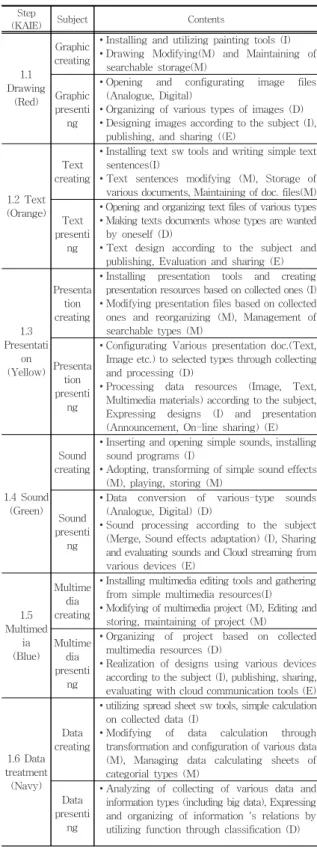
본 연구에서는 <Table 8>와 같이 디지털 창작도구의 영역의 내용체계를 디지털 도구의 활용을 통한 이해와 학습활동을 통해 알게 되는 인식에 근거하여 디지털 창 작도구를 활용하는 것에 대한 명확한 내용을 표현하기 위해 제작하기(Creating)와 표현하기(Presenting) 2가지 활동중심 단계로 구분하였다. 첫째, 제작하기 단계는 디 지털 창작도구를 활용한 디지털 창작도구 설치 (Installing)와 기본활용, 데이터 또는 정보의 변경 (Modifying) 및 관리(Maintaining)의 단계로 구성된다.
둘째, 표현하기 단계는 수집된 데이터와 정보를 기반으 로 조직화, 분석, 사용자화하는 개발하기(Developing), 데이터 또는 정보의 디자인, 출력 및 표현하는 구현하기 (Implementing), 구현한 것을 친구들과 공유하고 협력하 는 평가하기(Evaluating) 단계로 구성하였다.
Stage Key Elements(learning activity) Creating
(I-M-M)
∙Installing: Gather, Select, Insert
∙Modifying: Edit, Change, Adapt
∙Maintaining: Store, Retrieval, Manage Presentin
g (D-I-E)
∙Developing: Organize(Integration), Analyze, Customize
∙Implementing: Design, Publish, Realization
∙Evaluating: Collaborate, Share, Communicate
<Table 8> Modeling of Digital creation tools
<Table 9>과 같이 디지털 창작도구의 내용체계를 모 델링한 것을 기반으로 국내외 교육과정에서 기술된 공 통적이고 일반적인 성질의 내용요소를 추출하여 구성하 였다. 디지털 창작도구가 가지고 있는 다른 교과와의 연 계와 활용도구로서의 특성을 유지하기 위해 기존 KAIE 의 창작도구 영역에서 7가지 색상 형식의 모듈개념을 반영하였다. 또한 국외교육과정에서 다루고 있는 소셜 네트워크, 클라우드 서비스와 같은 디지털 시대에서 요 구되는 리터러시 요소를 반영하여 보다 실용적인 영역 이 될 수 있도록 구성하였다.
Step
(KAIE) Subject Contents
1.1 Drawing
(Red)
Graphic creating
∙Installing and utilizing painting tools (I)
∙Drawing Modifying(M) and Maintaining of searchable storage(M)
Graphic presenti
ng
∙Opening and configurating image files (Analogue, Digital)
∙Organizing of various types of images (D)
∙Designing images according to the subject (I), publishing, and sharing ((E)
1.2 Text (Orange)
Text creating
∙Installing text sw tools and writing simple text sentences(I)
∙Text sentences modifying (M), Storage of various documents, Maintaining of doc. files(M)
Text presenti
ng
∙Opening and organizing text files of various types
∙Making texts documents whose types are wanted by oneself (D)
∙Text design according to the subject and publishing, Evaluation and sharing (E)
1.3 Presentati
on (Yellow)
Presenta tion creating
∙Installing presentation tools and creating presentation resources based on collected ones (I)
∙Modifying presentation files based on collected ones and reorganizing (M), Management of searchable types (M)
Presenta tion presenti
ng
∙Configurating Various presentation doc.(Text, Image etc.) to selected types through collecting and processing (D)
∙Processing data resources (Image, Text, Multimedia materials) according to the subject, Expressing designs (I) and presentation (Announcement, On-line sharing) (E)
1.4 Sound (Green)
Sound creating
∙Inserting and opening simple sounds, installing sound programs (I)
∙Adopting, transforming of simple sound effects (M), playing, storing (M)
Sound presenti
ng
∙Data conversion of various-type sounds (Analogue, Digital) (D)
∙Sound processing according to the subject (Merge, Sound effects adaptation) (I), Sharing and evaluating sounds and Cloud streaming from various devices (E)
1.5 Multimed
ia (Blue)
Multime dia creating
∙Installing multimedia editing tools and gathering from simple multimedia resources(I)
∙Modifying of multimedia project (M), Editing and storing, maintaining of project (M) Multime
dia presenti
ng
∙Organizing of project based on collected multimedia resources (D)
∙Realization of designs using various devices according to the subject (I), publishing, sharing, evaluating with cloud communication tools (E)
1.6 Data treatment (Navy)
Data creating
∙utilizing spread sheet sw tools, simple calculation on collected data (I)
∙Modifying of data calculation through transformation and configuration of various data (M), Managing data calculating sheets of categorial types (M)
Data presenti
ng
∙Analyzing of collecting of various data and information types (including big data), Expressing and organizing of information ‘s relations by utilizing function through classification (D)
<Table 9> Contents of Digital creation tools
4. 전문가 검증 및 예비교사 인식 분석
영역별로 개발한 내용체계에 대한 전문가 타당성검증 과 예비교사의 인식을 알아보기 위해서 컴퓨터교육과 교수, 컴퓨터교육과 대학원, J교육대학교 예비교사에게 온라인 설문조사를 요청하였으며 구성원 분류 미응답자 2명을 제외한 컴퓨터교육과 교수 2명, 컴퓨터석사과정 을 졸업한 현장종사자 6명으로 구성된 전문가 A그룹 8 명과 컴퓨터교육과 4학년 예비교사 15명의 B그룹 총 23 명의 설문조사를 분석하였다.
설문조사는 아래 <Table 10>와 같이 영역별 교육과 정 모델 개발 내용에 대한 5단계 리커트 척도 형식의 설문문항으로 구성하였다.
Div. Questionnaire items Each scope
Verifying modeling Verifying contents elements
Verifying stepwise and hierarchy of contents elements
<Table 10> Questionnaire survey items
설문조사 결과를 살펴보면 <Table 11>과 같이 전문 가 A그룹의 타당도 검증결과 영역별 평균은 네트워크 영역 4.125점, 디지털 창작도구 영역 4.125, 전체 평균 4.125점으로 높게 나타나 타당성을 확보하였다. 예비교 사 B그룹의 영역별 인식조사결과 평균은 네트워크 영역 3.800점, 디지털 창작도구 영역 3.844점, 전체 평균 3.822 점으로 A그룹에 비해 다소 낮게 나타났으며 이는 영역 별 내용체계에 대한 지식이해 및 현장교육에 대한 경험
과 이해도 수준이 상대적으로 적은 원인에 의한 것으로 보인다.
Div. Verifying Contents
Group(Mean) Expert
(A)
Preservice–
teachers (B)
Network
Modeling 4.375 3.867
Contents elements 3.875 3.667
Stepwise and hierarchy of
contents elements 4.125 3.867
Mean 4.125 3.800
Digital creation
tools
Modeling 4.125 3.800
Contents elements 4.250 3.800
Stepwise and hierarchy of
contents elements 4.000 3.933
Mean 4.125 3.844
Overall 4.125 3.822
<Table 11> Results of Survey
5. 결론 및 제언
본 연구는 SW교육과정과 관련하여 네트워크 및 창 작도구 영역에 대한 교육과정을 학교현장에서 보다 쉽 게 적용할 수 있도록 개념이해와 학습활동을 고려한 영 역별 교육과정 모델을 개발하였으며 연구결과는 다음과 같다.
첫째, 국내의 SW교육과정과 선진국의 컴퓨터과학 관 련 교육과정 내용체계, 내용요소를 중심으로 영역별 주 요한 키워드를 추출하고 추출된 키워드에서 공통적인 성질의 개념이해요소와 학습활동 요소를 각각 영역의 특성에 맞게 재구조화하여 네트워크 영역은 개념이해 중심, 디지털 창작도구 영역은 학습활동 중심으로 모델 링하였다.
둘째, 영역별 주요요소를 살펴보면 네트워크 영역은 사람, 기술, 연결 및 상호작용 개념을 중심으로 하였으 며 디지털 창작도구 영역은 제작하기와 표현하기 활동 중심으로 내용요소를 구성하였다.
셋째, 기존 KAIE의 SW교육 표준모델의 무학년 개념 의 단계별 내용체계를 수용하되 본 연구와 관련된 영역 별 내용요소들을 각각 다른 영역의 내용요소들과 결합 하여 재구성할 수 있도록 제시하였다. 또한 본 연구에서
Step
(KAIE) Subject Contents
∙Implementing information according to the subject, publising, expressing, and evaluating info graphics design by utilizing tables and charts (E)
1.7 Web contents (Violet)
Web- page creating
∙Creating web-pages on the web manage sites or webpage tools (I)
∙Modifying of webpage having text shapes (M), Changing, applying, managing to other different types of data and utilizing (M)
Web- page presenti
ng
∙Developing of portfolio web-pages by composing multimedia resources (D)
∙Designing and online posting web contents and web-pages in which own subject (I), On-line evaluating, interacting activity on the friends’
webpage (E)
개발한 교육과정 모델의 타당성 검증을 위해 전문가 집 단 및 예비교사의 설문조사 결과 각각 4.125, 3.822 로 높게 나타났다.
추후 연구로는 KAIE의 SW교육 표준모델 전체 영역 에 대한 교육과정의 개선 모델링과 각 영역별 내용체계, 내용요소 및 성취기준과 평가체계 개선과 이에 대한 델 파이조사 실시 및 수정보완을 통해 우리나라 SW교육과 정 표준모델 적용을 위한 기여와 제시된 모델의 일반화 를 위한 학교현장 적용연구가 필요하다.
참고문헌
[1] CAS (2013), Computing in the national curriculum:
A guide for primary teachers. Computing at school.
[2] Chul Kim (2014). A Study on Contents of Robot Education Curriculum. Journal of The Korean
Association of Information Education, 18(3),
443-452. The Korean Association of Information Education.[3] Chul Kim (2015). A Development of Robot and Convergence Activity Curriculum Model for Elementary School Students. Journal of The Korean
Association of Information Education, 19(4),
481-499. The Korean Association of Information Education.[4] CSTA (2011). The 2011 CSTA K-12 Computer Science Standards. Retrieved from http://www.csteachers.
org/page/CSTA_Standards.
[5] K-12 CS Standards Revision Task Force members (2016). The
Interim CSTA K–12 Computer Science Standards. Retrieved http://www.csteachers.org/re- source/resmgr/Docs/Standards/2016StandardsRe vision/INTERIM_StandardsFINAL_07222.pdf.
[6] Department for Education in UK (2013). National curriculum in England: computing programmes of study. Retrieved from https://www.gov.uk/govern ment/publications/national-curriculum-in-englan d-computing-programmes-of-study/national-cur riculum-in-england-computing-programmes-of-
study.
[7] HITSA (2016). ProgeTiger Programme 2015–2017.
Retrieved from http://www.hitsa.ee/it-educa- tion/educational-programmes/progetiger.
[8] Hongrae Kim (2016). The Research about Policy Background of Computer Science Education in UK School: Lesson from the UK. Journal of The Korean
Association of Information Education, 20(2),
207-218. The Korean Association of Information Education.[9] Hyunbae Kim (2015). A Development of Curriculum Model on Information Ethics and Creation Tools for Elementary School Students. Journal of The
Korean Association of Information Education, 19(4),
545-556. The Korean Association of Information Education.[10] JaMee Kim, WonGyu Lee (2015). China’s in- formatics curriculum to consider equality and excellence. Journal of The Korean Association of
Computer Education, 18(2), 11-20. The Korean
Association Of Computer Education.[11] JaMee Kim, WonGyu Lee (2016). Implications for Informatics Curriculum Standard of KOREA through the Comparison of CSTA 2003 and 2011.
Journal of The Korean Association of Computer Education, 19(1), 41-51. The Korean Association
Of Computer Education[12] Joanna Goode, Gail Chapman (2016). Exploring Computer Science. Retrieved from http://www.
exploringcs.org/curriculum.
[13] K12cs.org (2016). K–12 Computer Science Framework. Retrieved form http://K12cs.org.
[14] Kapsu Kim (2016). An Implications of Computer Education in Korea from the U.S., U.K. and Germany Computer Curriculums. Journal of The
Korean Association of Information Education, 20(4), 421-432. The Korean Association of
Information Education.[15] Massachusetts Department of Elementary and Secondary Education (2016). Massachusetts
Digital Literacy and Computer Science (DLCS) Curriculum Framework. Retrieved from http://www.doe.mass.edu.
[16] Microsoft (2016). Digital Literacy Advanced Curriculum. Retrieved from https://www.microsoft.
com/en-us/DigitalLiteracy/advancedcurriculum.
aspx.
[17] Ministry of Education (2015). 2015 Revised Curriculum. Korea Ministry of Education.
[18] Ministry of Education (2015). Software Education Guidelines. Korea Ministry of Education.
[19] NetSciEd (2016). Network Literacy: Essential Concepts and Core Ideas. Retrieved from https://sites.google.com/a/binghamton.edu/nets- cied/teaching-learning/network-concepts.
[20] Seungki Shin, Youngkwon Bae (2015). Study on the Implications about Curriculum Design through the Analysis of Software Education Policy in Estonia. Journal of The Korean Association of
Information Education, 19(3), 361-372. The Korean
Association of Information Education.[21] Young-Hoon Sung (2016). Development and Application of CT-SPI Model for Improving Computational Thinking for Elementary School Students. Journal of The Korea Society of
Computer and Information, 21(1), 169-180. The
Korea Society of Computer and Information.[22] Younghoon Sung, Youngsik Jeong, Namje Park (2016). Implication of Network, Digital creation tools, and Robot curriculum by KAIE through the Analysis of domestic and Foreign SW curriculum.
The Korean Association of Information Education Research Journal, 7(3), 17-24. The Korean
Association of Information Education.[23] Youngsik Jeong, Kapsu Kim, Inkee Jeong, Hyunbae Kim, Chul Kim, Jeongsu Yu, Chongwoo Kim, Myunghui Hong (2015). A Development of the Software Education Curriculum Model for Elementary Students, Journal of The Korean
Association of Information Education, 19(4),
467-480. The Korean Association of Information Education.
저자소개
성 영 훈
2000. 진주교육대학교(학사) 2002. 진주교육대학교 교육대학원 컴퓨터교육 전공(석사)
2010. 경상대학교 대학원 컴퓨터과 학(공학박사)
2011∼2015. 한국교육학술정보원 연구원
2015∼현재 진주교육대학교 컴퓨 터교육과 조교수
관심분야 : SW교육, 컴퓨팅융합교 육, 국가행정정보시스템 e-mail : [email protected]
정 영 식
1996 춘천교육대학교 수학교육학 과(교육학학사)
2001 한국교원대학교 컴퓨터교육 과(교육학석사)
2004 한국교원대학교 컴퓨터교육 과(교육학박사)
2004~2011 한국교육개발원 연구 위원
2004~현재 전주교육대학교 컴퓨 터교육과 교수
관심분야: 컴퓨터교육, 프로그래 밍, 이러닝
E-Mail: [email protected]
박 남 제
2008 성균관대학교 컴퓨터공학과 (공학박사)
2003~2008 한국전자통신연구원 정보보호연구단 선임연구원 2009 University of California at
LA(UCLA) Post-doc.
2010 Arizona State University (ASU) Research Scientist 2010~현재 제주대학교 교육대학
초등컴퓨터교육전공 교수 관심분야 : 컴퓨터교육, STEAM,
정보보호, 암호이론 등 E-Mail: [email protected]